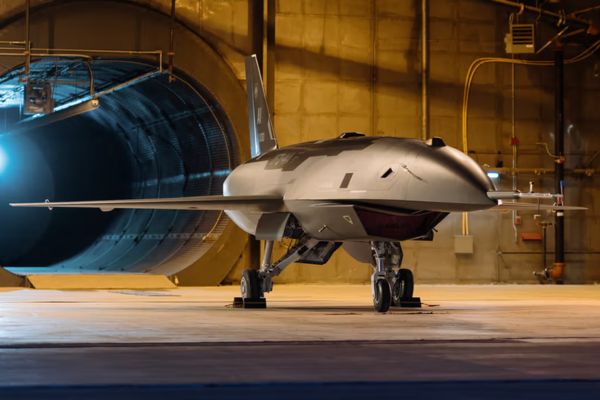
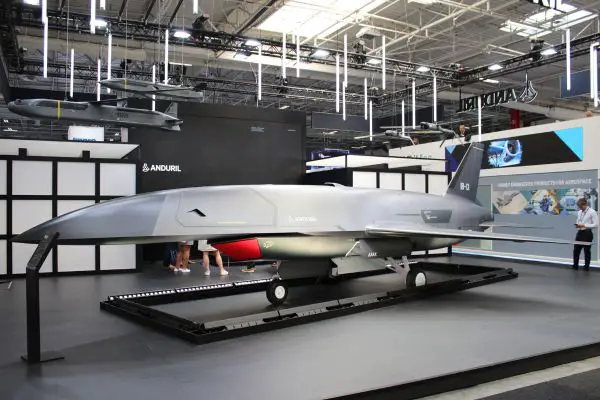
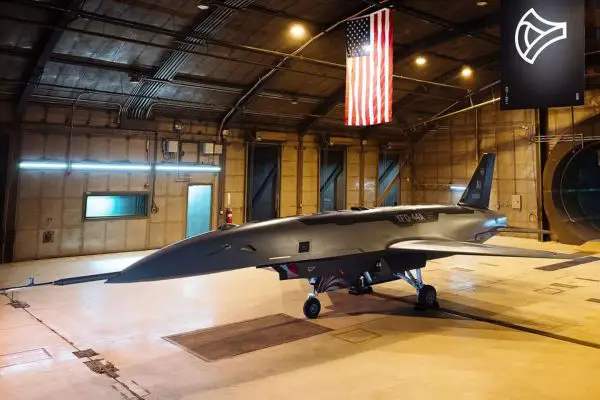
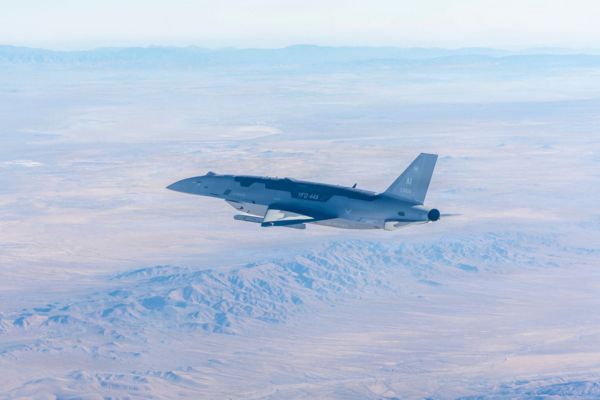
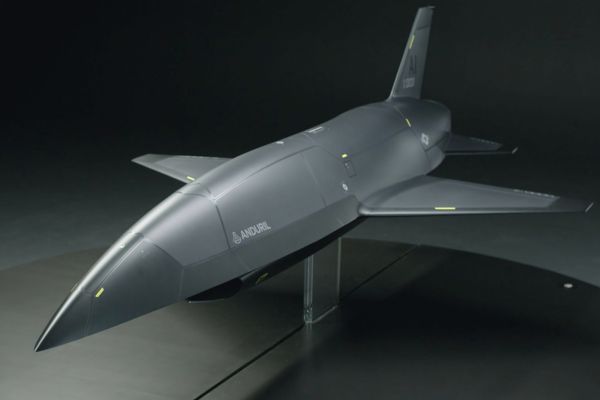
The YFQ-44A Fury is a next-generation Collaborative Combat Aircraft (CCA) and Uncrewed Combat Aerial Vehicle (UCAV) developed by Anduril Industries for the United States Air Force (USAF). Derived from the Fury platform originally developed by Blue Force Technologies, this autonomous combat aircraft is designed to operate alongside crewed fighter aircraft during high-risk missions. Combining a modular architecture, fighter-like performance, and the Lattice autonomy software, the YFQ-44A Fury is intended to conduct air superiority, intelligence, electronic warfare, and collaborative combat missions as part of the Collaborative Combat Aircraft (CCA) program.






Technical Data
-
Design and Architecture
The YFQ-44A Fury is a Collaborative Combat Aircraft (CCA) classified as a U.S. Autonomous Air Vehicle Group 5. It is a jet-powered autonomous combat aircraft designed to operate from conventional runways and accompany crewed fighters during collaborative air combat missions. Its design is based on an open, modular architecture that allows the mission configuration to be rapidly adapted to operational requirements. Different payloads can be exchanged without modifying the aircraft's overall structure, facilitating its adaptation to air superiority, intelligence, surveillance, and reconnaissance (ISR), electronic warfare, and communications relay missions. The internal architecture is organized around modular subsystems that make extensive use of Commercial Off-The-Shelf (COTS) components. This approach is intended to accelerate development, simplify maintenance, reduce production costs, and facilitate the rapid integration of new equipment developed by both Anduril and third-party manufacturers. The absence of a cockpit optimizes the internal volume available for mission computers, avionics, communications equipment, payloads, and a substantial internal fuel capacity, thereby increasing the platform's endurance without compromising its performance.
The YFQ-44A Fury is developed using a fully digital approach based on digital engineering, advanced simulation, rapid prototyping, and continuous validation of mission software. This methodology shortens development cycles while facilitating the evolution of the platform's capabilities throughout the CCA program.
-
Armament and Payloads
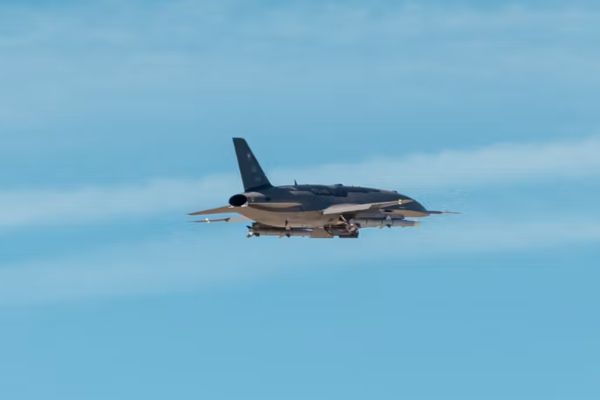
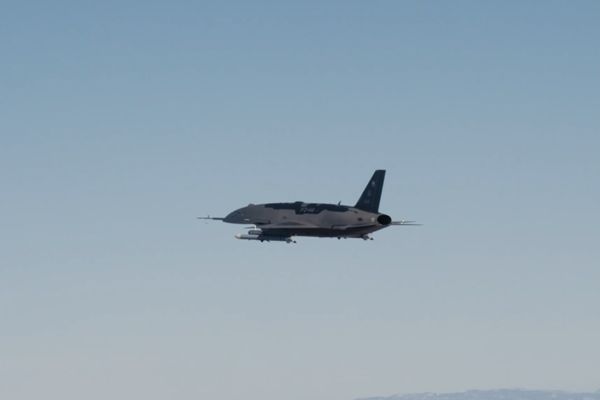
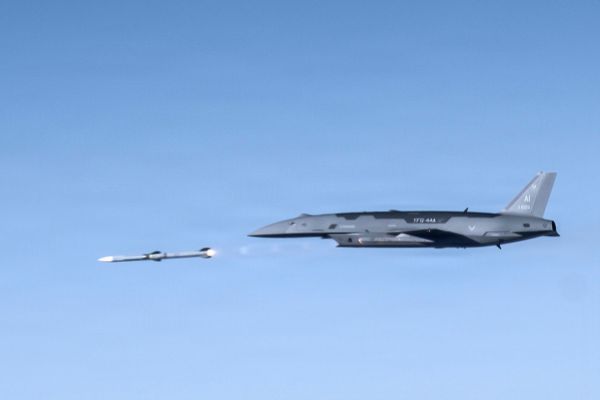
The letter "F" in the YFQ-44A Fury designation identifies its role as an air combat platform. Developed under the Collaborative Combat Aircraft program, the aircraft is intended to complement crewed fighters by increasing the number of available weapons within an air formation. The first weapon officially integrated on the YFQ-44A Fury is the AIM-120 AMRAAM (Advanced Medium-Range Air-to-Air Missile), an active radar-guided air-to-air missile designed for Beyond Visual Range (BVR) engagements. Its integration enables the YFQ-44A Fury to conduct medium- and long-range interceptions while increasing the offensive capacity of U.S. Air Force air formations. The weapons qualification campaign was conducted in several stages. Initial testing consisted of flights carrying CATM-120C (Captive Air Training Missile) rounds, which are fully inert versions replicating the mass, center of gravity, and aerodynamic characteristics of an operational AIM-120. These trials validated the platform's flight behavior, aerodynamic performance, and loading procedures. The program continued with tests using inert AIM-120 AMRAAM missiles to qualify the interfaces between the aircraft and the weapon system, verify logistics procedures, maintenance operations, operations from forward bases, and employment procedures within the Agile Combat Employment (ACE) concept.
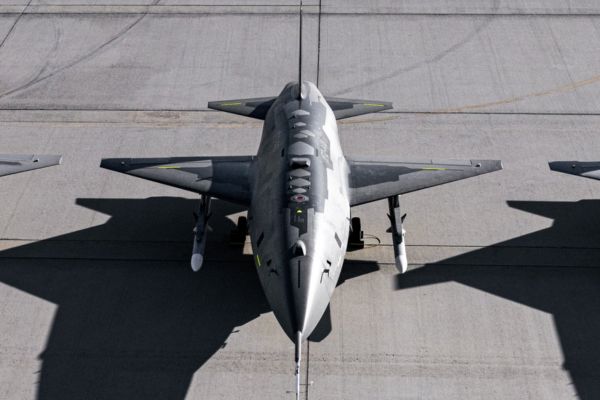
On July 15, 2026, the YFQ-44A Fury became the first U.S. Collaborative Combat Aircraft to conduct a live AIM-120 AMRAAM launch. Conducted from Edwards Air Force Base, the trial demonstrated the complete engagement sequence. After receiving a digital target track through Lattice, an operator authorized the launch before the missile was fired at a simulated digital target within restricted airspace over the Mojave Desert. All publicly observed configurations of the YFQ-44A Fury feature two external underwing pylons, each capable of carrying either an AIM-120 AMRAAM or a CATM-120C. To date, no additional weapon stations have been publicly observed on the prototypes. Thanks to its modular architecture, the YFQ-44A Fury can also accommodate payloads for intelligence, surveillance, and reconnaissance (ISR), electronic warfare, communications relay, and other equipment developed by third-party manufacturers. This modularity enables the United States Air Force to integrate new capabilities rapidly without requiring major modifications to the platform.
-
Propulsion and Flight Performance
The YFQ-44A Fury is powered by a single jet engine, enabling it to achieve performance comparable to that of a light combat aircraft while retaining the advantages of an autonomous platform. Its airframe has been developed to provide high maneuverability and a flight envelope compatible with collaborative combat missions alongside U.S. Air Force crewed fighters. The YFQ-44A Fury can reach a maximum speed of Mach 0.95, allowing it to operate in the transonic regime and accompany formations of modern fighter aircraft during many phases of a mission. Its structure is designed to withstand load factors of up to 9 g, providing maneuvering capability consistent with that expected of an aircraft intended for air combat. A substantial internal fuel capacity contributes to increased endurance while reducing reliance on external fuel tanks. Development of the YFQ-44A Fury also relies on a Virtual Simulation System (VSS), which is used to recreate complex tactical scenarios, evaluate flight performance, test mission software, and validate new autonomous behaviors before they are implemented during live flight testing.
-
Avionics, Autonomy, and Onboard Systems
The core of the YFQ-44A Fury's mission system is Lattice for Mission Autonomy, the software environment developed by Anduril for planning, executing, and coordinating autonomous missions. Lattice supports the entire operational cycle by integrating Mission Design, Tactics Development, Mission Planning, Mission Operations, Debrief, and the continuous improvement of autonomous behaviors through the Learn function.
This software architecture enables the YFQ-44A Fury to autonomously manage navigation, route planning, coordination between multiple aircraft, tactical information sharing, and execution of missions assigned by the operator. The YFQ-44A Fury supports Manned-Unmanned Teaming (MUM-T) operations as well as collaborative missions involving multiple autonomous aircraft. Multiple platforms can share tactical information, distribute mission tasks, automatically maintain formation, and coordinate their actions within a common combat network.
In 2026, Anduril demonstrated the integration of the YFQ-44A Fury with Hivemind Enterprise, the autonomy software developed by Shield AI. This demonstration illustrates the open architecture adopted for the CCA program and confirms the platform's ability to employ different autonomy software solutions according to operational requirements. The YFQ-44A Fury has also been integrated into the United States Air Force Experimental Operations Unit, which is responsible for evaluating future employment concepts for Collaborative Combat Aircraft. Testing conducted within this framework focuses on the development of tactics, techniques, and procedures, cooperation with crewed fighters, and accelerating the platform's operational introduction. The open architecture of the YFQ-44A Fury also supports the integration of ISR sensors, electronic warfare systems, communications relay equipment, and other systems developed by different manufacturers, allowing the platform to evolve throughout the CCA program.


Photo Gallery