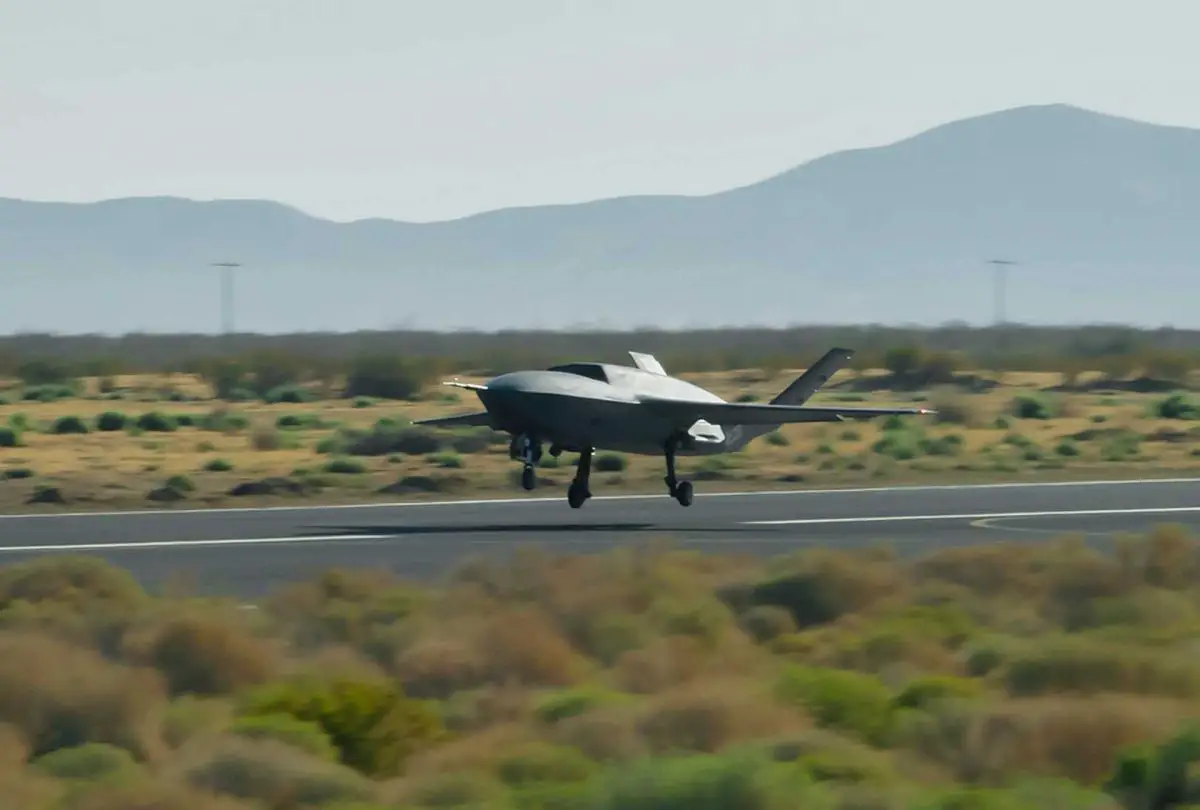
The General Atomics YFQ-42A is a next-generation autonomous Collaborative Combat Aircraft (CCA) developed by General Atomics Aeronautical Systems, Inc. (GA-ASI) for the United States Air Force (USAF). Designed as a low-observable, jet-powered unmanned combat aircraft, the YFQ-42A is intended to operate in close coordination with crewed fighters, expanding combat capability through autonomous mission execution, distributed sensing, and networked weapons employment. As one of the first unmanned aircraft to receive an official USAF fighter ("F") designation, the YFQ-42A represents a significant milestone in the evolution of autonomous air combat and forms a key element of the Air Force's future force structure.
Country users: United States







Technical Data
-
Design
The YFQ-42A features a low-observable airframe developed to reduce radar signature while providing sufficient internal volume for fuel, mission systems, and payloads. Publicly released imagery indicates a blended fuselage with smoothly aligned surfaces, swept wings, canted vertical tail surfaces, and a dorsal engine installation intended to contribute to reduced observability. Composite materials are expected to constitute a significant portion of the primary structure, improving both structural efficiency and signature management.
The aircraft has been designed around a modular architecture that allows mission systems, sensors, software, and payloads to be updated throughout its service life without major structural redesign. Although complete structural details have not been publicly released, the aircraft is expected to incorporate internal mission payload capacity and provisions for future capability growth consistent with the objectives of the Collaborative Combat Aircraft program.
-
Engine
The YFQ-42A is powered by a single turbofan engine, although the engine model and manufacturer have not been publicly disclosed by either General Atomics or the U.S. Air Force. The propulsion system has been optimized to provide the endurance, operational radius, and reliability required for long-range autonomous missions while enabling sustained operations alongside crewed tactical aircraft in contested environments. Its aerodynamic configuration emphasizes efficient high-subsonic and transonic flight, balancing speed, endurance, and low-observable performance.
Based on current industry assessments and publicly available program information, the aircraft is expected to achieve Mach 1-class performance, providing sufficient speed to accompany fifth- and sixth-generation fighter aircraft during collaborative combat operations. The estimated service ceiling is between 45,000 and 50,000 feet (13,700–15,200 m), allowing the aircraft to operate within the same altitude envelope as modern tactical fighters. Endurance is estimated at 6 to 8 hours, supporting extended patrols, escort missions, intelligence, surveillance and reconnaissance (ISR), electronic warfare, and stand-in sensing tasks. The aircraft's estimated operational range is approximately 1,500 km (930 miles), enabling deployment across large operational areas while maintaining connectivity with crewed aircraft and other networked assets.
While these figures are consistent with current assessments of the Collaborative Combat Aircraft program, official performance specifications for the YFQ-42A have not yet been released by the U.S. Air Force or General Atomics, and they should therefore be regarded as estimated capabilities rather than confirmed values.
-
Armament
The YFQ-42A is being developed as a combat-capable Collaborative Combat Aircraft (CCA) capable of employing internally carried precision-guided weapons while maintaining a low-observable configuration. Although the U.S. Air Force has not publicly disclosed the specific weapons that will be integrated on the General Atomics YFQ-42A, the aircraft is intended to provide autonomous air-to-air and air-to-surface strike capability in support of crewed fighter aircraft.
A significant milestone for the broader CCA program was achieved when the U.S. Air Force successfully conducted the first live launch of an AIM-120 Advanced Medium-Range Air-to-Air Missile (AMRAAM) from the Anduril Industries YFQ-44A Collaborative Combat Aircraft demonstrator over the Mojave Desert. The successful test validated a critical weapon-employment sequence for autonomous collaborative aircraft, demonstrating the ability of a CCA platform to detect, track, receive engagement authorization, and launch an air-to-air missile while operating as part of a networked combat force. Although this milestone was accomplished using the YFQ-44A rather than the YFQ-42A, it significantly reduces technical risk across the entire Collaborative Combat Aircraft program and supports the future integration of similar air-to-air weapon capabilities on the General Atomics platform.
While official weapon integration details for the YFQ-42A remain classified or have not yet been announced, the aircraft is expected to support a range of internally carried air-to-air missiles and precision-guided air-to-surface munitions consistent with its intended roles in air superiority, escort, precision strike, suppression of enemy air defenses, and autonomous collaborative operations. Additional weapon types are expected to be integrated as the Collaborative Combat Aircraft program progresses through flight testing and operational evaluation.
-
Avionics and Onboard Equipment
The YFQ-42A incorporates a modern digital mission architecture designed around autonomous operation, secure networking, and human-machine teaming. Publicly available information indicates that the aircraft supports advanced autonomous mission software capable of executing assigned tasks while remaining under human command authority. The platform is also expected to employ an open mission systems architecture, enabling rapid integration of future sensors, payloads, and mission software.
The aircraft is being developed to operate as part of a networked combat force, sharing information with crewed aircraft and other assets through secure communications and distributed mission management. Although the complete avionics suite has not been publicly disclosed, the aircraft is expected to incorporate advanced mission computers, autonomous flight-control systems, secure datalinks, integrated navigation systems, and scalable interfaces that allow future mission equipment to be incorporated as operational requirements evolve.


Photo Gallery