Unmanned aerial vehicles.

AR5 TEKEVER Unmanned Aircraft System..

TEKEVER AR5 fixed-wing unmanned aircraft system, Portugal

The TEKEVER AR5 is a Portuguese medium-altitude, medium-endurance fixed-wing unmanned aircraft system for maritime patrol, land surveillance, border monitoring, and search and rescue.

Country users: United Kingdom — Border Force support operations; British Army acquisition under Project CORVUS. Ukraine — operational use. Portugal — Portuguese Air Force contracted customer. EMSA — multinational service customer; deployment countries are not necessarily aircraft owners.

Key Tactical Insight:

• TEKEVER AR5 Main Roles and Missions: TEKEVER AR5 is a Portuguese medium-altitude, medium-endurance fixed-wing unmanned aircraft system designed for maritime patrol, border surveillance, search and rescue, and military intelligence, surveillance, and reconnaissance, depending on mission configuration.

• TEKEVER AR5 Firepower: The platform is configured strictly as an unarmed reconnaissance and surveillance aircraft with no integrated missile, bomb, or gun fit. An optional laser-designator payload can mark targets for external strike assets, while life-raft delivery supports maritime rescue missions.

• TEKEVER AR5 Sensors and Survivability: A 50 kg payload capacity accommodates modular electro-optical/infrared cameras, maritime radar, synthetic aperture radar, AIS receivers, and SIGINT/ELINT suites. Twin engines and the ability to launch and recover from short 200–300 m unprepared strips enhance operational survivability and basing flexibility.

• TEKEVER AR5 Digital Architecture: Automatic take-off and landing, the ATLAS mission management system, and multi-link communications combining 230 km radio line-of-sight, SATCOM, and 4G connectivity support extended beyond-line-of-sight operations. Predefined lost-link return logic maintains mission continuity during communications interruptions.

• TEKEVER AR5 Key Technical Specifications: Uncrewed twin-engine fixed-wing configuration | Maximum take-off weight: 180 kg | Payload capacity: 50 kg | Cruise speed: 100 km/h | Service ceiling: 3,600 m | Endurance: 12–20 hours (configuration-dependent) | Wingspan: 7.3 m | Length: 4.0 m.


Description

The TEKEVER AR5 is a Portuguese fixed-wing unmanned aircraft system developed for sustained observation over land and sea. The aircraft belongs to the medium-altitude, medium-endurance category in TEKEVER’s product description. Its role is to carry surveillance equipment and deliver information to ground teams rather than transport a pilot. Maritime patrol, border surveillance, search and rescue, and land observation form the core mission set.

The system includes more than the air vehicle. Portugal’s Air Force procurement includes a ground control station, the ATLAS mission system, and operator training. This illustrates the operational requirement behind the aircraft: a usable surveillance capability depends on trained crews, communications, mission planning, and the means to interpret and distribute collected information. The Portuguese programme covers maritime security, Exclusive Economic Zone monitoring, and public-interest missions including environmental protection and firefighting support.

The AR5 also has a military surveillance role. TEKEVER announced a British Army contract under Project CORVUS in September 2026, with a potential value of £400 million. The manufacturer described the programme as a long-range intelligence, surveillance and reconnaissance capability, drawing on experience in Ukraine. The announcement envisaged service entry later in 2026; that schedule should not be treated as independent confirmation that every contracted system has been delivered or declared operational.

For maritime authorities, AR5 services can be supplied through a contractor rather than national ownership of an aircraft fleet. TEKEVER’s EMSA announcement describes deployments in Portugal, Spain, France, Italy, and the Baltic States. Such deployments support fisheries enforcement, environmental monitoring, maritime awareness, and rescue. They demonstrate the geographical reach of the service, but do not establish each host country as a military operator.

Configuration is central to interpreting AR5 performance. TEKEVER advertises up to 20 hours on its product page, while its EMSA contract announcement specifies up to 12 hours for that delivered configuration. The Maritime Defence brochure lists 16–20 hours depending on payload. These figures describe different mission fits, not a single endurance guaranteed with every sensor combination. Likewise, satellite connectivity extends communications coverage; it does not make the aircraft’s fuel-limited flight range unlimited.

The resulting operational proposition is persistent sensing with a reusable aircraft. Editorial assessment: its usefulness depends on the selected payload, the quality of the communications service, the availability of a suitable operating strip, and the organisation receiving the intelligence. A specification table should therefore be read alongside the mission configuration and operating arrangements, rather than as a complete measure of effectiveness.

AR5 configurations and documented developments

AR5 Evolution Mk 2 is documented in a UK AAIB investigation. TEKEVER also markets patrol and Deep Find mission configurations. These labels and mission packages should not be treated as interchangeable evidence for identical engines, sensors, endurance, or certification status.

Back to top

Key Technical Specifications

Design

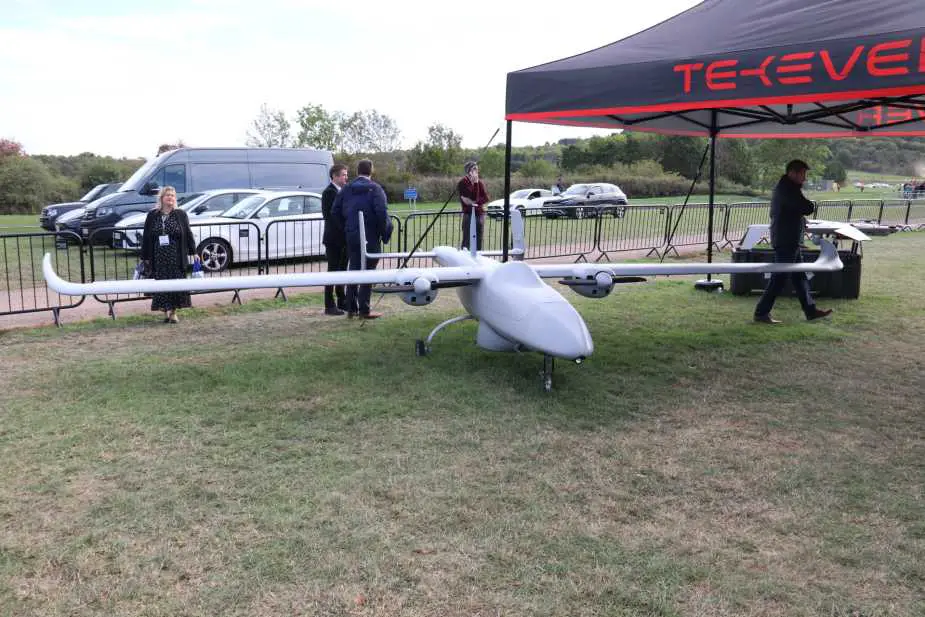
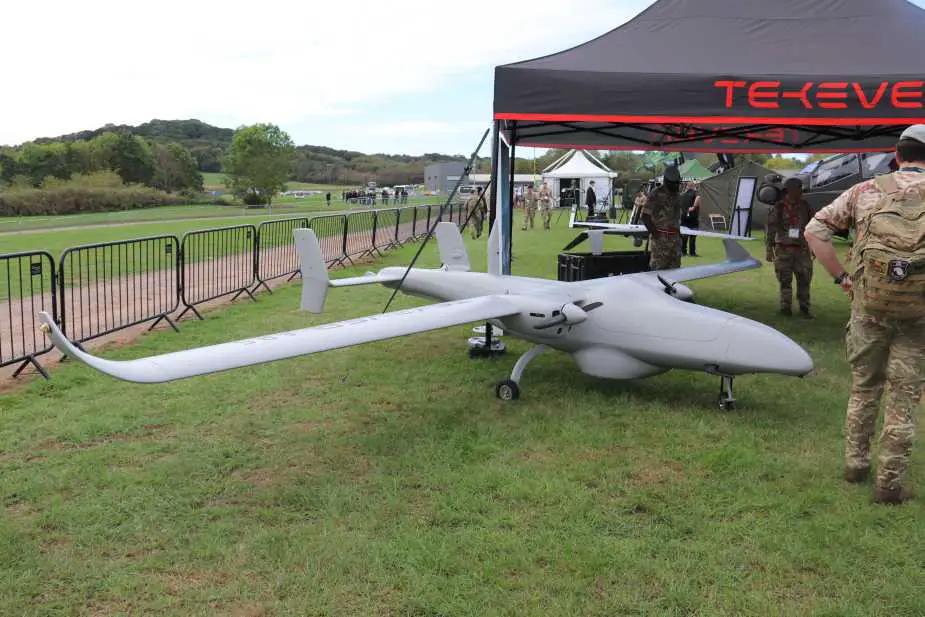
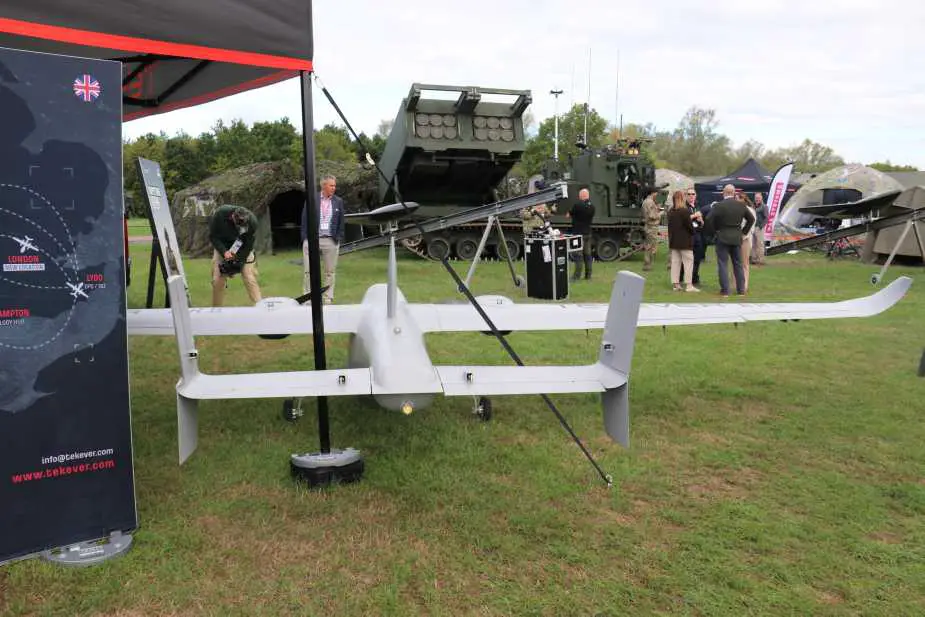
The supplied photographs show a central fuselage, long wing, two engine installations, twin tail booms, and fixed wheeled landing gear. The layout provides recognisable identification features from front, rear, and side views. An AAIB report on the AR5 Evolution Mk 2 gives a wingspan of 7.29 m and a length of 4.03 m; TEKEVER’s current brochure rounds the overall dimensions to 7.3 × 4.0 m. The report describes a maximum take-off mass of 180 kg. These measurements refer to documented configurations; the illustration is not an engineering drawing.

Armament

The reviewed product material presents the AR5 primarily as a surveillance and reconnaissance platform. It does not identify an integrated missile, bomb, or gun fit for the aircraft described here. The defence brochure offers a laser-designator payload option; designation supports another weapon’s engagement process and does not establish that the AR5 itself carries that weapon. Life-raft delivery is a rescue function, not an armament specification. No combat payload should be inferred solely from the platform’s military customers.

Engine and Flight Performance

The AAIB identifies two 170 cc, two-stroke boxer engines on the investigated Evolution Mk 2, with endurance up to 12 hours. This is configuration-specific evidence rather than confirmation of the engine model installed on every current AR5. TEKEVER’s Maritime Defence brochure gives a 100 km/h cruise speed, 3,600 m service ceiling, 50 kg payload capacity, and 16–20 hours endurance according to payload. Launch and recovery use a runway or unprepared strip of approximately 200–300 m. Maximum speed, climb rate, and a universal mission radius are not established by these figures.

Avionics and Onboard Equipment

Mission options include electro-optical/infrared sensors, maritime radar, synthetic aperture radar, AIS and distress-beacon reception, and signals-intelligence payloads. The Deep Find configuration lists additional sensing and navigation options; availability does not mean every aircraft carries all of them. Automatic take-off and landing and satellite communications are advertised. In the Evolution Mk 2 investigated by the AAIB, the ground station supported satellite links, radio line-of-sight communications, and 4G connectivity. That report also documents a predefined lost-link return route. Such functions are configuration-specific and should not be interpreted as immunity to communications failure or electronic interference.

Back to top

Specifications

Type

Medium-altitude, medium-endurance fixed-wing UAS

Country users

United Kingdom — Border Force support operations; British Army acquisition under Project CORVUS. Ukraine — operational use. Portugal — Portuguese Air Force contracted customer. EMSA — multinational service customer; deployment countries are not necessarily aircraft owners.

Designer Country

Portugal — TEKEVER

Avionics

Configuration-dependent EO/IR, maritime radar, SAR, AIS and SIGINT/ELINT options; SATCOM and automatic take-off and landing.

Armament

No onboard weapon fit identified in reviewed sources. Laser designation is a payload option, not confirmation of carried weapons.

Engine

Twin engines; Evolution Mk 2: two 170 cc two-stroke boxer engines (AAIB). Current engine fit not confirmed for every configuration.

Maximum take-off weight: 180 kg; payload capacity: 50 kg.

Speed

100 km/h

Range

RLOS communications: 230 km. SATCOM-enabled beyond radio line of sight. Flight range is mission-dependent; communications coverage is not flight range.

Missions

Maritime patrol, land surveillance, border monitoring, search and rescue, and military intelligence, surveillance and reconnaissance.

Dimensions

7.3 m × 4.0 m

Back to top

Sources: TEKEVER AR5 product page; Maritime Defence brochure; Portuguese Air Force contract; CORVUS contract; EMSA agreement; AAIB Evolution Mk 2 report; UK Ministry of Defence AR5 procurement. Checked 18 November 2026. Manufacturer claims and configuration-dependent values are identified above.

Details View

TEKEVER AR5 front, rear, left and right line drawings with main technical features; illustrative, not to scale
TEKEVER AR5 front view 001
TEKEVER AR5 rear view 001
TEKEVER AR5 right left view 001
TEKEVER AR5 right side view 001
Back to top

Photo Gallery

Back to top

Copyright © 2026 Army Recognition