



Army - Conflicts in the world
-
Ukrainian FPV drones hit two Russian Mi-28 attack helicopters in midair strikes over Belgorod
{loadposition bannertop}{loadposition sidebarpub}
On October 17, 2026, Ukraine's 115th Separate Mechanized Brigade announced that its Prybultsi air defense unit engaged a second Russian Mi-28 attack helicopter using a modified FPV interceptor drone over Russia's Belgorod region. This midair engagement follows a similar strike against an Mi-28NM on October 14, demonstrating an evolving tactical deployment of low-cost unmanned aerial systems against Russian attack helicopters operating within border airspace. The operations reflect Ukrainian efforts to counter Russian stand-off aviation strikes by adapting long-range VB140 Blyskavka interceptors to penetrate regions affected by active electronic warfare systems.
The two attacks show how Ukraine is increasingly using its relatively inexpensive FPV drones to threaten Russian attack helicopters that were previously able to freely fire guided missiles against Ukrainian forces from inside Russian territory. (Picture source: ZSU_115OMBr)
On October 16, 2026, Ukraine's 115th Separate Mechanized Brigade announced that its soldiers had attacked a second Russian Mi-28 attack helicopter with an interceptor drone in midair over Russia's Belgorod region, following a similar attack against an Mi-28NM on October 14. Both operations were carried out by the brigade's Prybultsi air defense unit, using modified FPV interceptor drones, originally intended to destroy Russian reconnaissance drones, to pursue these Russian helicopters. The first attack occurred near Yasnozorenskoye, 9 km from the front line, while the second was located 4 km farther north, approximately 16 km from Ukrainian positions. The brigade claimed that the helicopters had been shot down, although the recordings end before the impacts and do not establish their loss or the fate of their crews.
The October 14 engagement involved an interceptor approaching the Mi-28NM from above and behind, toward the helicopter's upper-right rear quarter, without establishing whether the aircraft crashed or returned to service. Earlier Russian imagery showed damage near an Mi-28's emergency escape ladder beneath the pilot's cockpit, inconsistent with the interceptor's apparent approach toward the upper fuselage. The October 17 engagement likewise lacks confirmation of permanent aircraft loss. These incidents followed a Mi-28N interception attempt by Ukraine's 427th Rarog Unmanned Systems Brigade in Belgorod on July 15, 2026, and a FPV strike against an Mi-28's tail rotor in Kursk on August 7, 2024.
Related topic:Ukraine's fiber-optic drone shoots down Russian Ka-52 attack helicopter in flight for the first time
Developed in the Soviet Union during the late 1970s as a dedicated two-seat attack helicopter, the Mi-28 first flew on November 10, 1982, while the Mi-28N Night Hunter entered Russian service in October 2009. Its most modernized variant, the Mi-28NM, first flew on October 12, 2016, introducing the H025/N025 mast-mounted radar, digital weapons controls, improved targeting equipment, and two VK-2500P turboshaft engines with electronic management. Russia contracted 98 Mi-28NMs on June 27, 2019, for deliveries scheduled between 2020 and 2027, without confirmation that this schedule has been fulfilled. The related Mi-28NE export configuration has a maximum takeoff weight of 12,100 kg, a maximum speed of 300 to 315 km/h, a cruising speed of 275 to 285 km/h, and a normal range of 420 to 425 km. Its service ceiling reaches 5,600 to 5,650 m, while additional fuel extends ferry range to 1,000-1,015 km.
Considered as one of the most heavily armed and heavily armored attack helicopters in the world, the Mi-28NM Havoc carries a chin-mounted NPPU-28 turret with a 30 × 165 mm 2A42 cannon carrying approximately 250 rounds, with an effective range of 2.5 km, alongside four underwing hardpoints accommodating anti-tank guided missiles, unguided rockets, and other external stores, with configurations carrying up to 16 Ataka missiles or smaller quantities of modernized Khrizantema-M/VM anti-tank missiles which could reach up to 10 km. For longer-distance attacks, the helicopter employs the LMUR missile, also designated Izdeliye 305 or Kh-39, which carries a 25 kg warhead and uses inertial navigation, a two-way data link, and terminal electro-optical guidance, allowing a commonly cited operational range of 14.5 km.
Unlike the Vikhr's continuous laser-beam guidance, the LMUR allows the helicopter to maneuver after launch while the operator retains the ability to receive seeker imagery and provide corrections. The helicopter also carries S-8 80 mm rockets in 20-round B8V-20 pods and S-13 122 mm rockets in five-round B-13 pods, while the Mi-28NE export configuration accommodates up to 2,100 kg of external weapons. However, even a missile launched from 14.5 km does not establish that the helicopter, valued at $18 to 20 million, is 14.5 km away from Ukrainian interceptor operators, particularly when those teams are positioned along the border or have been warned in advance of Russian helicopter movements by neighboring units, which was the case during the October operations.
This is operationally important, as the helicopter was originally protected against missiles, cannon fire, and battlefield damage rather than small FPV drones deliberately pursuing it in flight. Therefore, on June 18, 2026, a Russian Mi-28NM appeared with additional antenna housings on both sides of the nose, above the stub-wing defensive equipment fairings, and along the tail boom while conducting an LMUR missile strike. The arrangement could improve the MI-28NM's electronic warfare capabilities across several directions, including against drone-control transmissions, video downlinks, and satellite-navigation signals. The helicopter's existing missile-approach warning, infrared countermeasures, chaff and flare dispensers, protected fuel tanks, and cockpit armor were also conceived to address threats different from a small FPV interceptor.
Russian helicopter crews consequently face a related problem when conducting counter-UAV missions, particularly against larger Ukrainian strike drones that target Russian military facilities or infrastructure. On September 9, 2026, Russian Mi-28N/NM and Ka-52 helicopters were employed against Ukrainian FP-1 and MICH-2000 drones, including the Mi-28's 30 mm 2A42 cannon. The Mi-28 combines an OPS-28M electro-optical targeting system with the N025 radar, which reportedly detects certain small aerial targets at distances up to 5 km. At a hypothetical relative closing speed of 150 km/h, the 2.5 km between the detection and engagement ranges would be covered in 60 seconds, but the actual engagement interval could be shorter because the radar does not guarantee immediate acquisition of a small drone against terrain clutter.
The Mi-28 can also employ short-range air-to-air missiles such as the 9M342 Igla-S, although infrared seeker acquisition against small electric-powered FPV drones also presents a problem. On February 5, 2026, Rostec subsequently introduced a programmable 30 × 165 mm airburst cartridge for the 2A42 cannon to improve its engagement capabilities through timed fragmentation, but operational integration remains unconfirmed. The Ukrainian interceptions also follow four years of changes in Russian helicopter employment, beginning with low-altitude penetration and direct battlefield support in February 2022. Approximately 34 helicopters participated in the Hostomel assault, and six were reportedly lost, equivalent to 17.6% of the force; by November 2022, at least 23 Ka-52s, six Mi-28s, and eight Mi-24/Mi-35s had already been visually confirmed lost.
During Ukraine's June 2023 counteroffensive, Russian Ka-52 crews increasingly operated behind Zaporizhzhia's minefields, engaging armored vehicles with Vikhr missiles from 8 to 10 km, but its laser-beam guidance required the helicopter to maintain suitable target-tracking geometry during flight. The subsequent employment of LMUR missiles on Mi-28NMs reduced this constraint by allowing crews to maneuver after launch, while retaining operator-assisted guidance through the missile's data link. Ukrainian attacks against Russian aviation also expanded beyond conventional air defense weapons.
This includes an August 2024 FPV engagement against an Mi-28 in Kursk, a December 2024 missile engagement launched from a Magura V5 unmanned surface vessel, and reported drone strikes against Mi-8 and Ka-52 helicopters in November 2025 and March 2026. By October 2026, the Prybultsi unit was using modified VB140 Blyskavka interceptors manufactured by Vinnytski Bdzhоly, which possess a maximum range of 50 km and an operating altitude of 4,500 m. A member of the unit identified by the callsign Hektor explained that the engagements depended on warning from neighboring Ukrainian formations, preparation by interceptor crews, and modifications to the VB140 to operate in areas affected by Russian electronic warfare. During its summer campaign, the same unit also claimed the destruction of one Orion, approximately 20 Orlan, and ten Merlin drones, indicating that Ukrainian units now use this experience to contest some Russian helicopter operating areas beyond the front line.
Explore More Defense News
• Land Defense News
• Naval Defense News
• Defense Aerospace News
Written by Jérôme Brahy
Jérôme Brahy is a defense analyst and documentalist at Army Recognition. He specializes in naval modernization, aviation, drones, armored vehicles, and artillery, with a focus on strategic developments in the United States, China, Ukraine, Russia, South Korea, Türkiye, and Belgium. His analyses go beyond the facts, providing context, identifying key actors, and explaining why defense news matters on a global scale.
-
Ukraine says US Starlink restrictions are disrupting its drones as Russia launches new attacks
{loadposition bannertop}{loadposition sidebarpub}
On October 14, 2026, SpaceX enforced a 100 mph (161 km/h) velocity cap on Starshield and Starlink military satellite terminals used by Ukraine, severing live communication links for long-range unmanned aerial systems and aerial interceptors. The restriction degrades real-time command, control, and targeting relays for fixed-wing drones operating behind front lines and limits pursuit capabilities against Russian Shahed loitering munitions. Ground-speed enforcement prevents satellite antenna handovers at higher velocities, disrupting flight guidance without physically altering the drone's mechanical engine performance.
Starlink and Starshield terminals allow Ukrainian drones to transmit live video, receive targeting updates, and remain under operator control hundreds of kilometres beyond conventional radio range, enabling long-range strikes, reconnaissance, and interceptions against Russian forces. (Picture source: Ukrainian MoD)
On October 14, 2026, Ukrainian presidential adviser Serhii “Flash” Beskrestnov announced that SpaceX imposed a 100 mph (161 km/h) speed limit on Starlink military satellite terminals used by Ukrainian forces, disrupting middle-strike drones, aerial interceptors, reconnaissance flights, and communications relays amid renewed Russian missile and Shahed attacks. Presidential adviser Serhii Beskrestnov confirmed that the Starshield restriction arrived without warning, while Ukraine's 7th Air Assault Corps had to cancel several drone missions in the Huliaipole sector of Zaporizhzhia Oblast after losing connectivity. Serhii Sternenko suspected that Washington had requested the change amid U.S. President Donald Trump's pressure on Kyiv to stop attacking Russian oil refineries and threats to reduce intelligence sharing, although no American order was confirmed.
Elon Musk responded that Starshield was controlled by the U.S. government, with usage restrictions determined by the U.S. military and ultimately the president. Ukraine's Defense Ministry confirmed that connectivity had stabilized at speeds up to 160 km/h by October 14 evening, but negotiations with SpaceX and American authorities to remove the restriction continued. The 161 km/h ceiling applies to the ground speed of the terminal carrying the satellite antenna, not the drone's mechanical performance or internet bandwidth. At 160 km/h, a drone travels 44.4 m/s, compared with 55.6 m/s at 200 km/h and 69.4 m/s at 250 km/h. However, a drone maintaining an airspeed of 150 km/h with a 20 km/h tailwind would reach 170 km/h, exceeding the terminal limit. In Ukraine, commercial Starlink terminals already faced movement restrictions of 75–90 km/, partly to prevent Russian use aboard attack drones.
Related topic:Ukraine's new AI-powered drone campaign across Crimea could collapse Russia's Southern Front
On October 14, however, Ukrainian units experienced connectivity losses between 72 and 161 km/h, indicating that the initial service degradation extended below the nominal ceiling in several cases. The Starlink restriction therefore does not stop a Ukrainian drone from flying faster, but can sever the communications connection carrying vital flight commands, live video, and targeting information. Ukraine's current middle-strike drone campaign covers Russian ammunition depots, fuel convoys, vehicle concentrations, and logistics routes located 50 to 200 km behind the front line, particularly in occupied Donetsk and Zaporizhzhia regions. Ukrainian units increasingly fitted these drones with Starlink terminals during 2026, enabling attacks beyond the effective coverage of conventional ground-based radio-control links.
At 250 km/h, a Ukrainian drone reaches Russian targets 50, 100, and 200 km away in 12, 24, and 48 minutes, respectively; at 160 km/h, those times increase to 18 minutes 45 seconds, 37 minutes 30 seconds, and 75 minutes. For a 150 km outbound mission, the restriction consequently requires 56 minutes 15 seconds instead of 36 minutes, increasing outbound flight time by 56.25%, excluding loitering and terminal manoeuvres. Longer transit times can reduce the usefulness of targeting information against moving convoys, increase exposure to Russian electronic warfare and air defense, and alter the fuel reserves available for manoeuvring near the target. The restriction is particularly consequential for fixed-wing drones whose minimum sustainable airspeed, combined with wind conditions, prevents them from remaining below the terminal's permitted ground speed, unless they find alternative communications.
Starlink connects Ukrainian drones through low-Earth-orbit satellites using Ku- and Ka-band frequencies, electronically steered antennas, and satellite handovers, reducing dependence on terrestrial radio stations. Under a simplified geometric line-of-sight calculation, a drone flying at 100 metres altitude with a ground antenna 2 metres high has a radio horizon of 55.4 km, increasing to 92.7 km at 500 metres altitude. Terrain, electronic warfare, and antenna performance can further constrain practical communications distances, explaining the use of satellite terminals for missions extending 100 to 200 km behind Russian positions. Some drones carry Starshield directly, while others relay commands and video between additional drones and ground operators.
If a satellite-equipped relay loses connectivity above 161 km/h, several dependent drones can lose their communications path simultaneously. Replacing that connection requires additional airborne relays, elevated antennas, or ground stations, and the resulting network must maintain coverage along the entire drone's route rather than only at its launch point. The restriction also affects Ukraine's interception of Russian jet-powered Shahed drones, capable of speeds approaching 322 km/h, equivalent to 89.4 m/s. At that speed, a Ukrainian interceptor maintaining the Starlink limit of 160 km/h travels 44.4 m/s, leaving a 45 m/s disadvantage during pursuit from behind. Consequently, a Russian drone initially 5 km ahead would increase that separation by 2.7 km every minute if both maintained those speeds, meaning the interceptor cannot neutralize the threat.
In a head-on engagement, the combined closing speed reaches 482 km/h, equivalent to 133.9 m/s, reducing the time available for terminal guidance and target identification. Ukrainian interceptors can physically exceed the Starshield ceiling, but risk losing operator commands and video reception unless alternative radio control or autonomous terminal guidance is available. The number of missed interceptions attributable to the October 14 disruption remains unquantified, but it occurred during successive Russian attacks against Kyiv, Kropyvnytskyi, Dnipro, and energy infrastructure. Ukraine began using Starlink after Russia's February 24, 2022 invasion and the simultaneous cyberattack against Viasat satellite communications. Mykhailo Fedorov requested SpaceX assistance on February 26, and the first terminals arrived on February 28.
By March, Ukrainian command centers and special operations units were using the service, followed by defenders of Mariupol and Azovstal during the Russian siege in April and May 2022. Artillery formations subsequently integrated this satellite connectivity into target exchange and fire correction, while applications expanded during 2023 and 2024 to reconnaissance drones, infantry communications, mobile command posts, and unmanned naval vessels operating in the Black Sea. Notably, SpaceX had already restricted certain Ukrainian offensive drone applications in February 2023, distinguishing military communications from direct weapons employment. The October 2026 measure therefore affected an established military communication network, with the greatest immediate consequences for unmanned aircraft requiring continuous satellite links while travelling above the authorized speed, either to strike or defend.
SpaceX's relationship with the U.S. government includes a $150 million Space Development Agency contract in October 2020 for four missile-tracking satellites launched in April 2023. Elon Musk then introduced Starshield, the military variant of Starlink, in December 2022, and secured a U.S. Space Force communications contract in September 2023, expanding military access to commercial satellites. In February 2026, Ukraine and SpaceX cooperated to restrict unauthorized Russian Starlink terminals, reducing Moscow's ability to operate satellite-connected drones. Ukrainian forces subsequently expanded their Starlink use during middle-strike missions against Russian logistics within occupied territory.
On July 28, Zelensky sought American approval to employ these drones inside Russia, including potential attacks against mobile Iskander ballistic missile launchers used against Ukrainian civilians, but authorization remained unresolved by August 31. Musk opposed extending offensive Starlink operations into Russia, while maintaining on October 14 that Starshield usage restrictions were determined by American military authorities, including the U.S. President Donald Trump, but did not identify the official responsible for introducing the ceiling or establish whether it originated from a military requirement, a contractual limitation, or a political decision. However, and significantly, the Starlink restriction followed several days of deteriorating relations between Washington and Kyiv over Ukrainian attacks against Russian oil refineries, as President Trump threatened to withhold intelligence sharing and military assistance unless Ukraine stopped.
Kyiv initially agreed to pause refinery strikes for three days even as Russian forces continued attacking Ukrainian electricity infrastructure, as Trump sought to promote an energy ceasefire that Moscow refused to accept. On October 12, five Russian S-400 ballistic missiles struck Kyiv shortly after 10 p.m., with air raid warnings arriving after explosions; Zelensky said Ukraine received no advance warning from partners. Another attack on October 13 killed three women and injured 24 people, including a seven-year-old girl, while Ukrainian Air Force spokesperson Yurii Ihnat confirmed that partner warnings were missing for the first of four missile waves.
Nevertheless, several Ukrainian and American officials publicly maintained that intelligence sharing had not formally stopped. Russian attacks continued on October 14-15, with more than 850 Shahed drones launched against Kyiv, Kropyvnytskyi, Dnipro, Odesa, Kharkiv, and other regions, resulting in at least six deaths. The sequence exposed three distinct U.S. leverages on Ukrainian operations: intelligence sharing to warn of Russian strikes in advance, Starshield authorization for satellite communications, and continued military assistance for sustaining air defense and other combat capabilities, although no confirmed order established that these restrictions formed part of a coordinated pressure campaign.
Explore More Defense News
• Land Defense News
• Naval Defense News
• Defense Aerospace News
Written by Jérôme Brahy
Jérôme Brahy is a defense analyst and documentalist at Army Recognition. He specializes in naval modernization, aviation, drones, armored vehicles, and artillery, with a focus on strategic developments in the United States, China, Ukraine, Russia, South Korea, Türkiye, and Belgium. His analyses go beyond the facts, providing context, identifying key actors, and explaining why defense news matters on a global scale.
-
Ukraine brings U.S. Abrams tanks back to combat against Russia with new drone tactics
{loadposition bannertop}{loadposition sidebarpub}
On October 11, 2026, Ukraine's 475th Separate Assault Regiment CODE 9.2 returned M1A1 Abrams main battle tanks and M2 Bradley infantry fighting vehicles to direct-fire frontline operations in Kharkiv Oblast. The deployment near Vilkhuvatka follows structural modifications including heavy anti-drone cage armor, protective hull enclosures, and integrated airborne FPV interceptor escorts designed to counter Russian drone strikes. This tactical integration restores heavy armor direct-fire capabilities against fortified positions while mitigating high-density loitering munition threats along the front line.
Ukraine is bringing Abrams tanks back into combat by combining reinforced anti-drone armor with Mavic reconnaissance drones that detect Russian threats, FPV interceptors that destroy incoming attack drones, and Vampire bomber drones in support. (Picture source: CODE 9.2)
On October 11, 2026, Ukraine's 475th Separate Assault Regiment, known as CODE 9.2, returned the M1A1 Abrams tank to frontline combat operations alongside the M2 Bradley infantry fighting vehicle, but heavily protected by reconnaissance drones, FPV interceptors, and anti-drone armor. The operation followed a September 30 assault near Vilkhuvatka in Kharkiv Oblast, where the same regiment used heavily protected tanks to attack Russian infantry occupying buildings. Both engagements demonstrated how Ukraine is adapting its armored vehicles with metal cages, additional protective barriers, reconnaissance drones, and FPV interceptors to counter Russian drone attacks. The renewed use of Abrams tanks is particularly significant because Ukraine had restricted their frontline deployment since April 2024 after losing several of the 31 tanks supplied by the United States, largely due to Russian reconnaissance and strike drones.
Since then, Australia has delivered another 49 M1A1 Abrams, and, during the latest attack, a Ukrainian FPV interceptor destroyed an incoming Russian drone before it reached the tank, while both armored vehicles completed their firing missions and withdrew. The first operation, conducted on September 30, 2026, near Vilkhuvatka, a settlement in Kupiansk district situated 9 km from the Russian border, involved two heavily protected tanks from the 475th Separate Assault Regiment advancing against Russian infantry occupying buildings. The vehicles, equipped with large protective enclosures that covered much of their hulls and turrets, crossed light mines without being immobilized and opened direct fire on Russian positions, while several FPV drones, a Vampire heavy bomber, and a Mavic reconnaissance quadcopter compensated for the crews' restricted visibility through the protective structures.
Related topic:Ukraine adapts Stugna-P anti-tank missile for short-range air defense against Russian drones
In a second operation publicized on October 11, CODE 9.2 deployed an Abrams tank again alongside an American-supplied M2 Bradley infantry fighting vehicle, both fitted with additional metal barriers against drone attacks. The vehicles approached Russian positions under aerial surveillance and fired directly at their targets, while a Ukrainian FPV interceptor destroyed an incoming Russian drone before it could reach the tank. Together, the two operations show how CODE 9.2 combined tanks, infantry fighting vehicles, reconnaissance drones, and aerial interceptors again to conduct short armored attacks despite the threat from Russian FPV drones. CODE 9.2, the regiment conducting these attacks, developed from a reconnaissance platoon established in 2022 within Ukraine's 92nd Mechanized Brigade, became an attack-drone company in 2024, expanded into the 475th Separate Assault Battalion in January 2025, and into an independent regiment in August 2025.
Its commander, Oleksandr "Flint" Nastenko, has organized the formation around three assault companies supported by tanks, artillery, short-range air defense, engineers, electronic warfare personnel, reconnaissance UAVs, attack drones, and unmanned ground vehicles. The regiment's planned observation and strike capabilities extend to 120 km, while its FPV drones provide short-range attack and interception capabilities during ground operations. Nastenko has also proposed assigning robotic systems up to 70% of certain battlefield tasks, particularly those that would otherwise expose infantry to mines, artillery, or Russian drones. When Russian jamming disrupts a drone's radio link, the unit's programmers, electronics engineers, mechanics, and communications specialists can examine its frequencies, antennas, navigation software, and flight parameters, then introduce modifications directly into subsequent missions.
The same command can therefore reduce the delay between identifying a problem and testing a solution. The return of heavily protected Abrams tanks to direct-fire operations must be considered against the deterioration of their survivability during the first months of their Ukrainian deployment. Ukraine originally received 31 M1A1 Abrams from the U.S. in autumn 2023, equivalent to a Ukrainian tank battalion, but five had already been lost by April 2024, prompting Ukrainian commanders to restrict their employment in areas saturated with Russian surveillance and FPV drones. Australia then announced another 49 M1A1 AIM SA tanks on October 17, 2024, valued at A$245 million, delivering 37 in July 2025 and the remaining 12 in December. The M1A1's principal advantage remains the ability to deliver repeated direct fire engagements against buildings, fortified positions, and armored vehicles while protecting its crew.
However, the original Cold War-era armor arrangement cannot provide equivalent protection against attacks directed at the turret roof, engine compartment, or rear hull. The April 2024 restrictions therefore reflected a change in the conditions under which Abrams could operate, not the permanent withdrawal of every Ukrainian Abrams from combat. The modifications brought by Ukrainian crews illustrate how drones are changing the century-long Iron Triangle, a design balance between firepower, mobility, and survivability. Survivability is now being prioritized over some combat capabilities. In September, the two tanks carried hangar-style enclosures that restricted turret traverse, requiring crews to align their hulls with targets, while a Mavic reconnaissance drone compensated for reduced visibility. In October, the tank and Bradley carried elaborate anti-drone structures intended to disrupt Russian FPV attacks before their warheads reached the vehicle armor.
Originally, the Bradley's 25 mm M242 Bushmaster cannon provides sustained fire against infantry and light vehicles, while its TOW missiles can engage armored targets; the Abrams' 120 mm cannon delivers heavier direct fire. However, these protective additions increase vehicle dimensions, obstruct crew observation and maintenance access, complicate movement through narrow routes, and interfere with weapon movement. CODE 9.2's solution therefore combines passive barriers with airborne interception, illustrated by the destruction of a Russian FPV drone during the October operation. Nevertheless, both vehicles depend increasingly on reconnaissance and protection drones before they can exploit their capabilities. CODE 9.2's September engagement provides a concrete example: the Mavic monitored the route and target area because the tanks' protective enclosures reduced crew visibility, while other drones accompanied the vehicles to respond to Russian threats.
This creates a division of responsibilities in which unmanned aircraft perform much of the observation and immediate aerial protection previously dependent on vehicle crews, accompanying infantry, or dedicated reconnaissance formations. The regiment's armored vehicles consequently function as mobile direct-fire assets within a broader network rather than as independent assault elements. This arrangement also creates vulnerabilities because losing reconnaissance coverage, communications, or FPV interceptors can leave the vehicles exposed despite their additional armor. The number of drones required per armored mission, their loss rate, and the time needed to replace exhausted interceptors will therefore influence how frequently such operations can be repeated. CODE 9.2's earlier operations demonstrate the personnel and equipment required to sustain this approach.
In May 2024, a detachment operating 6.4 km from Russia deployed two Vampire multicopters, a Starlink terminal, a long-range antenna, and dozens of batteries within 30 minutes. Russian Orlan reconnaissance drones repeatedly interrupted preparations, while GPS interference temporarily disrupted a Vampire carrying two mines into Russia. The crew restored control and released both mines onto a road, later claiming that they damaged one armored and one unarmored vehicle. The detachment also claimed a maximum of 24 Vampire sorties during one night. The same requirements may apply to armored escorts, which need surveillance and interception coverage during their approach, firing mission, and withdrawal. Consequently, Ukraine's ambition to manufacture more than seven million drones in 2026 corresponds to 19,178 units per day, while projected expenditure of 9,000 daily would consume 3.285 million annually.
Manufacturers reportedly revise drone hardware and software three or four times yearly, with frontline workshops introducing more frequent changes as Russian forces adapt their jamming equipment and interception methods. The resulting competition affects both armies because a drone effective in one sector can become unreliable elsewhere when operating frequencies, electronic warfare coverage, or enemy defensive measures differ. The broader implication is that surviving a short armored assault and sustaining a mechanized offensive in Ukraine now require different levels of support. CODE 9.2 demonstrated that two tanks, or an Abrams and a Bradley, could reach Russian positions and withdraw under drone escort, but neither engagement establishes the feasibility of advancing a complete tank battalion through successive defensive lines.
A larger attack would require simultaneous protection of assault vehicles, engineers, ammunition carriers, recovery equipment, and evacuation routes, multiplying demand for reconnaissance and interceptor drones. Concentrating armor increases available firepower but exposes more vehicles again to Russian surveillance and artillery; dispersing it reduces exposure while limiting the firepower needed for a breakthrough. The industrial consequences are equally important because tanks require substantial repair capacity and long replacement cycles, while FPV interceptors and reconnaissance drones may be consumed or technologically superseded within weeks or months. The decisive measure of success is not whether a protected tank survives one mission, but whether a mechanized formation can now repeatedly advance under the threat of FPV drones, occupy positions, maintain supply routes, and resist counterattacks without exhausting its equipment or losing operational momentum.
Explore More Defense News
• Land Defense News
• Naval Defense News
• Defense Aerospace News
Written by Jérôme Brahy
Jérôme Brahy is a defense analyst and documentalist at Army Recognition. He specializes in naval modernization, aviation, drones, armored vehicles, and artillery, with a focus on strategic developments in the United States, China, Ukraine, Russia, South Korea, Türkiye, and Belgium. His analyses go beyond the facts, providing context, identifying key actors, and explaining why defense news matters on a global scale.
-
Ukraine uses new FP-7 ballistic missile against Russia for first time before mass production
{loadposition bannertop}{loadposition sidebarpub}
Ukrainian President Volodymyr Zelenskyy announced the first combat deployment of the domestically developed Fire Point FP-7 tactical ballistic missile against Russian targets. The operational milestone transitions the 250 km-range weapon from flight testing into active service, expanding Ukraine's capacity for deep precision strikes against fixed military infrastructure.
The FP-7 tactical ballistic missile features a maximum range of 250 km, a 200 kg warhead payload, and a circular error probable (CEP) of 14 m. Developed by Fire Point within an accelerated seven-month timeframe from initial flight tests, the system is designed to target operational-depth assets including ammunition depots and command nodes.
Related topic:Ukraine's new FP-9 ballistic missile to target Moscow's energy infrastructure by summer 2026
Ukraine used its new FP-7 ballistic missile against Russian forces for the first time on October 1, 2026, just 216 days after flight testing began, and with its range and payload already increased to 250 km and 200 kg. (Picture source: Army Recognition and Telegram/Volodymyr Zelenskyy)
On October 1, 2026, Ukraine conducted the first combat use of Fire Point's FP-7 tactical ballistic missile, 392 days after its September 4, 2025 unveiling at MSPO in Poland. President Volodymyr Zelenskyy released launch footage and said production was next, but Ukraine disclosed neither the target, launch location, number of missiles, nor strike result, so the event confirms operational employment rather than wartime accuracy or effectiveness. The FP-7 moved from flight testing on February 27-28, 2026 to combat in seven months, with about 15 test launches reported by August and preparations for combat trials underway by September. Compared with the closest U.S. equivalents, seven months from first flight testing to combat use is exceptionally compressed, as the PrSM required 48 months from first flight to initial delivery. The current FP-7 is also more capable on paper than the FP-7 initially disclosed in 2025, with a maximum range of 250 km and a payload of 200 kg, compared with the earlier 200 km and 150 kg configuration, increasing range by 50 km (25%) and payload by 50 kg (33.3%).
The maximum velocity remains at 1,500 m/s (5,400 km/h), with a flight altitude of 60 km and a Circular Error Probable (CEP) of 14 m. The CEP means that, if 100 missiles were fired under the conditions represented by that figure, statistically 50 would be expected to impact within 14 m of the aim point and 50 outside that 14 m radius. The FP-7 is intended for operational-depth targets rather than the deeper target set assigned to Fire Point's other missiles. The FP-9 short-range ballistic missile reaches 850 to 855 km with an 800 kg payload, giving it 3.4 times the FP-7 range and four times its payload, while the FP-5 Flamingo cruise missile's range extends to about 3,000 km with up to 1,200 kg. The FP-7 can therefore focus on fixed targets such as ammunition depots, headquarters, railway nodes, airfields and air defense sites within its launch geometry, while its maximum speed reduces flight time compared with other Ukrainian cruise missiles and one-way attack drones.
The FP-7's rapid development is easier to explain when its relationship with the Soviet 48N6 missile is considered. The FP-7 is about 7.25 m long, close to the 48N6 at about 7.5 m and 0.51 m diameter; the baseline 48N6 weighs about 1,900 kg, carries a 145 kg warhead and reaches about 150 km, while the later 48N6M and 48N6DM extend to roughly 200 and 250 km with 150 and 180 kg warheads, respectively. The FP-7 retains the missile's useful aerodynamic geometry but substitutes a composite structure, Ukrainian electronics, Ukrainian solid propellant, and changes the mission from interception to surface strike. Fire Point had already reproduced the fourth missile compartment and actuators associated with an S-300/S-400 architecture before moving into propulsion, while Ukrainian industry had already tested a domestic replacement for the 5V55 missile's 48D6 solid-fuel motor by 2020.
The launcher similarly removes part of the S-300 family's infrastructure burden. Instead of a vertical canister arrangement on a specialized multi-axle transporter-erector-launcher (TEL), the FP-7 uses an inclined guide rail on a trailer and a hot launch, with the motor igniting directly from the launcher. This reduces Ukraine's dependence on specialized heavy chassis, erection mechanisms, and canisters when expanding the number of firing units. The unanswered figures are operationally important: Ukraine has disclosed no FP-7 launcher inventory, reload time, missiles allocated per launcher, displacement time after firing or maximum salvo size. A stock of hundreds of missiles therefore would not automatically translate into equivalent firing capacity unless launcher, reload and crew numbers expand alongside missile production.
Production is now the central measurable variable. Fire Point previously discussed an eventual ballistic missile output measured in hundreds per month, but the October 1 announcement does not show that such a rate has been reached, and Zelenskyy's move from first combat use to production indicates that scaling remains underway. At 10 FP-7s per month, the potential annual output reaches 120 missiles and 24 metric tons of payload; 25 per month produces 300 and 60 tons; 50 produces 600 and 120 tons; 100 produces 1,200 and 240 tons. Four launches per day would consume 120 missiles every 30 days and 1,460 annually, meaning even 100 missiles per month would leave a 260-round annual deficit before testing, rejects, and reserves. Fire Point adds another useful industrial metric: each FP-7 requires about 1 metric ton of solid propellant, compared with more than 4.5 tons for the FP-9. Consequently, producing 100 FP-7s monthly would require roughly 100 tons of missile propellant per month and 1,200 tons annually before accounting for manufacturing losses.
That requirement helps explain Fire Point's investment in a new solid-propellant plant in Denmark, where construction is already underway on a production site exceeding 120,000 m². Fire Point says the facility is intended to support 800 to more than 4,000 missiles annually depending on demand, initially covering FP-7, FP-7.x and Flamingo boosters, with operations scheduled by the end of 2027. For the FP-7 alone, 800 missiles would equal 66.7 per month and 160 metric tons of payload annually, while 4,000 would equal 333 per month and 800 tons. The missile itself is only one part of that capacity problem: motors, composite structures, actuators, guidance electronics, warheads, fuzes, launch equipment, and acceptance testing must all reach comparable throughput, or the slowest process will determine completed-missile output.
Ukraine nevertheless entered FP-7 production with more than two decades of experience on Soviet-origin missiles. Ukroboronservice has conducted S-300 repair and service-life-extension work since 2004; Ukraine pursued a 5V55R modernization in 2018 intended to increase its roughly 75 km range toward 150 km; and by 2020 Ukrainian industry was repairing 5V55 missiles and testing domestically produced replacement motors. The FP-7 production also provides an industrial baseline for the FP-7.x interceptor associated with the Freyja program, although surface strike and ballistic interception remain fundamentally different missions. The FP-7.x, at about 7.25 m long, is intended to target ballistic threats at altitudes up to about 20 km, with a wider architecture intended to be connected to European radars and fire control equipment from Saab, Thales, Hensoldt, Weibel, Leonardo and Kongsberg. The relevant connection is manufacturing: both depend on repeatable production of 7 m-class missile structures, solid-propellant motors, actuators and flight-control electronics, making the FP-7's monthly output and reliability concrete indicators of the industrial capacity available to the latter interceptor.
Explore More Defense News
• Land Defense News
• Naval Defense News
• Defense Aerospace News
Written by Jérôme Brahy
Jérôme Brahy is a defense analyst and documentalist at Army Recognition. He specializes in naval modernization, aviation, drones, armored vehicles, and artillery, with a focus on strategic developments in the United States, China, Ukraine, Russia, South Korea, Türkiye, and Belgium. His analyses go beyond the facts, providing context, identifying key actors, and explaining why defense news matters on a global scale.
-
Ukraine deploys amphibious UGV on first 40 km frontline supply mission across rivers and marshland
{loadposition bannertop}{loadposition sidebarpub}
On September 29, 2026, the Alter Ego unit of Ukraine's 93rd Separate Mechanized Brigade completed the nation's first frontline logistics mission using an amphibious unmanned ground vehicle, traveling over 40 kilometers across land and water to deliver ammunition and provisions. This deployment overcomes critical mobility bottlenecks by allowing the robotic system to seamlessly transition from wheeled ground transit to swimming mode without requiring intermediate cargo transfers at water obstacles. The deployment bypasses fixed-route vulnerabilities such as bridges and fords that are heavily targeted by adversarial reconnaissance and FPV drones.
The amphibious system traveled more than 40 km across complex terrain under the coordination of the Ministry of Defense and the BRAVE1 defense innovation cluster, which established a dedicated amphibious UGV development track in June 2026. This capability expands unmanned frontline supply lines past rivers, canals, and wetlands that typically halt conventional ground robots.
Related topic:Ukraine captures Russian position using only drones in first-ever combat operation without soldiers
The Alter Ego unit of the 93rd Mechanized Brigade Kholodnyi Yar deployed an amphibious UGV on Ukraine’s first frontline logistics mission of this kind, covering more than 40 km and solving a key limitation of rivers, flooded areas, and other water obstacles. (Picture source: Ukrainian MoD)
On September 29, 2026, the Alter Ego unit of the 93rd Separate Mechanized Brigade Kholodnyi Yar completed Ukraine's first logistics mission with an amphibious unmanned ground vehicle (UGV), sending the unmanned vehicle more than 40 km across land and water to deliver ammunition and provisions to frontline positions. The UGV, possibly identified as Triton, traveled as a wheeled UGV on dry terrain and switched to swimming mode within seconds when it reached water obstacles, allowing the cargo to remain aboard throughout the whole route instead of being transferred at a river, canal, or flooded section. The 40 km figure is the distance actually traveled during this mission, as Ukraine did not disclosed the Triton's maximum range, payload, weight, dimensions, endurance, speed, and control range. This amphibious UGV nevertheless underwent several months of modifications with Ukrainian troops to adapt it to frontline terrain and operational tasks, while the BRAVE1 defense cluster funded development and established a dedicated Amphibious UGV program in June 2026.
The Triton UGV addresses a specific weakness in conventional UGV logistics: even a narrow canal can terminate a route if the robot cannot swim, forcing it toward a bridge, culvert, or ford, which could be much longer than the width of the obstacle itself. As these crossings concentrate repeated movements at fixed coordinates, they can reveal logistics patterns to adversarial reconnaissance UAVs, mined or targeted by FPV drones and artillery. The Triton instead approaches on land, enters the water within seconds, and continues with its cargo still aboard, eliminating a risky intermediate transfer or detour. Ukraine had already codified another amphibious UGV in April 2025, the UNEX, for water, floodplains, swamps, mud, sand and ice, indicating that the requirement covers both water crossing and terrain where conventional wheeled supply vehicles and many ordinary UGVs lose mobility.
The mission occurred after Ukrainian UGV employment had reached six figures. Ukraine recorded more than 7,000 UGV missions in January 2026, more than 9,000 in March and about 24,500 during Q1, or 272 per day; the cumulative figure reached 66,300 by July. By the end of August, Ukrainian forces had exceeded 100,000 logistics and evacuation missions alone, meaning at least 33,700 additional missions had been accumulated beyond the July total, although the categories are not fully identical. Typical logistics payloads were between 200 and 300 kg, while procurement was expanding at the same time: Ukraine had contracted more than 22,000 domestically produced UGVs by July 20, nearly twice the number contracted during all of 2025, and added 67 newly codified models during 2026.
Payload, speed, and sortie rate explain why these vehicles are being inserted into the forward logistics chain rather than treated simply as substitutes for infantry, cargo UAVs, and trucks. Ukrainian logistics robots routinely move 200 to 300 kg, sufficient for ammunition, water, batteries, food, engineering material, or fortification needs, while individual larger systems have moved loads reaching 1 tonne. At typical speeds of 12 to 15 km/h, an uninterrupted 40 km movement requires 2 hours 40 minutes to 3 hours 20 minutes, before stops, difficult terrain, water crossings, and concealment are included. Ukrainian practice has included positioning logistics UGVs 2 to 5 km behind forward positions while operators remain farther rearward, planning routes with daytime ISR and conducting movements at night, trading road speed for reduced personnel exposure and greater route choice through areas exposed to mines, artillery, FPV drones, and persistent aerial observation.
This matters within a Ukrainian battlespace where the heavily contested zone can extend roughly 15 km from the front and the middle battle area another 30 km, exposing logistics movements well beyond immediate infantry positions. A conventional truck remains more efficient for moving tonnes of cargo from rear depots, but its size and dependence on roads, intersections and bridges make it unsuitable for every section of that network; a logistics UGV can receive a fraction of that cargo at a distribution point and move it through secondary tracks, tree lines and terrain inaccessible to a normal vehicle. Amphibious UGVs adds canals, rivers, marshes and flooded ground to that route network, so a 20 km route containing an exposed bridge may be now operationally less usable than a longer route with an unprepared water crossing. The Triton’s 40+ km mission is therefore significant because amphibious movement was sustained as part of an actual long-distance supply run rather than demonstrated over a short water obstacle.
Ukraine is applying the same logic to engineering and casualty movement, which changes how the return leg of a logistics mission can be used. Ukraine’s Vepr can carry up to 350 kg, evacuate one or two casualties, conduct mine-clearance work and recover damaged UGVs, while other Ukrainian systems can move as many as three equipped casualties over distances exceeding 40 km. During Operation Vivaldi, Third Army Corps robots cleared 30 km of routes around Shandryholove in two nights without sapper losses, compared with an estimated two sapper companies working for one week conventionally. The corps also attributed about 60% of anti-personnel mine neutralization in its area to robotic systems, showing how engineering UGVs can prepare routes subsequently used for logistics, evacuation and assault support.
Ukraine is also removing portions of the ground route by carrying UGVs beneath heavy UAVs. During Operation Vivaldi, heavy bomber drones deployed NC13 strike robots more than 10 km behind Russian positions, after which the UGVs continued under their own power, while robotic attacks were conducted against positions and logistics targets as far as 15 km from the front. Alter Ego separately developed the Desantnyk UGV and its precision aerial-release mechanism in about 10 days from initial concept to combat application. The two methods solve different mobility problems for the unit: aerial deployment carries a robot over an inaccessible or heavily observed area, while the Triton crosses water under its own power without transferring its cargo, although both remain dependent on communications, navigation, battery endurance and mechanical reliability.
The larger change is therefore in the geometry and volume of Ukraine's frontline logistics. Trucks retain tonne-scale capacity between rear depots and forward distribution points; 200-300 kg UGVs divide those loads for the exposed final kilometers; amphibious UGVs maintain those routes across waterways and wetlands; cargo UAVs handle lighter urgent loads; and heavy UAVs can now insert specialized ground robots beyond obstacles altogether. The June rate of more than 16,600 logistics and evacuation UGV missions corresponds to more than 553 missions per day if spread evenly across a 30-day month, compared with more than 7,000 missions in January, showing that Ukraine was already deploying several hundred unmanned vehicles every day before Triton’s September operation, allowing supplies to be dispersed across a larger number of smaller and less road-dependent axes rather than relying on a limited set of approaches that could be covered and attacked by Russian forces.
Explore More Defense News
• Land Defense News
• Naval Defense News
• Defense Aerospace News
Written by Jérôme Brahy
Jérôme Brahy is a defense analyst and documentalist at Army Recognition. He specializes in naval modernization, aviation, drones, armored vehicles, and artillery, with a focus on strategic developments in the United States, China, Ukraine, Russia, South Korea, Türkiye, and Belgium. His analyses go beyond the facts, providing context, identifying key actors, and explaining why defense news matters on a global scale.
-
U.S. Epic Fury Shows Patriot and THAAD Air Defense Effectiveness Against Iranian Drones and Missiles
{loadposition bannertop}{loadposition sidebarpub}
Operation Epic Fury against Iran saw U.S. and regional air defenses intercept more than 6,000 Iranian one-way attack drones and over 1,500 ballistic missiles targeting U.S. and partner forces, according to the first Lead Inspector General report on the campaign. The scale of the attack demonstrated the combat value of Patriot and THAAD air defense missile systems while exposing how quickly sustained mass salvos can strain even advanced missile defense networks.
Patriot and THAAD provided critical protection against repeated Iranian ballistic missile and drone attacks, but the campaign also highlighted the operational importance of interceptor depth. Any renewed high-intensity confrontation would place renewed pressure on U.S. stockpiles, making magazine capacity and resupply as important as the performance of the air defense systems themselves.
Related Topic: Iran Conflict Accelerates Gulf States Shift Toward a More Integrated U.S. Air Defense Network
A U.S. THAAD interceptor missile is launched during a firing test. Operation Epic Fury against Iran highlighted the combat role of THAAD and Patriot systems after the U.S.-led regional defense network reportedly intercepted more than 1,500 Iranian ballistic missiles and 6,000 one-way attack drones. (Picture source: French MoD)
Published in September 2026, the report covers Operation Epic Fury through June 30 and details how U.S. Central Command reinforced integrated air and missile defenses across the Middle East. Operation Epic Fury began on February 28 as a U.S.-Israeli campaign targeting Iranian nuclear, ballistic missile, naval, and security infrastructure, with USCENTCOM reporting approximately 13,500 targets struck, 36,000 combat sorties, and more than 1,800 fire missions during the main combat phase through April 7.
At the height of the operation, U.S. forces included more than a dozen air defense batteries, including THAAD air defense units, while additional air defense and counter-unmanned aircraft teams were distributed across regional bases. Patriot batteries provided terminal defense against ballistic missiles and other aerial threats, THAAD extended ballistic missile interception to higher-altitude engagements, and Israel's Arrow, David's Sling and Iron Dome systems added complementary defensive layers. U.S. personnel embedded in partner air operations centers supported shared warning, engagement coordination and deconfliction across the regional network.
The most important lesson from the campaign may be less about whether Patriot or THAAD can defeat Iranian ballistic missiles than about how long those defenses can continue firing. The Lead Inspector General report states that Operation Epic Fury generated strategic munitions inventory shortfalls and exposed industrial bottlenecks, with the Department of War estimating that $22.3 billion worth of munitions had been expended by late June. Solid rocket motors, high-grade explosives, propellants, and skilled manufacturing labor were identified among the persistent constraints limiting how quickly U.S. weapons inventories can be replenished.
That shortage becomes particularly important during missile defense saturation attacks. Modern ballistic missile defense depends on maintaining enough ready interceptors to defeat repeated salvos rather than a single attack, and commanders may need to allocate more than one defensive missile against high-priority incoming threats depending on engagement conditions. The Lead Inspector General report does not disclose how many Patriot, THAAD, Arrow, David's Sling or Iron Dome interceptors were actually fired, meaning the more than 7,500 reported interceptions cannot be translated directly into an equivalent number of interceptor missiles consumed.
The operational challenge is amplified by the growing use of mixed ballistic missile and drone attacks in current conflicts. Ballistic missiles can strike air bases, headquarters, logistics centers, and other fixed targets at high speed with limited warning, while one-way attack drones provide a less costly way to generate additional incoming tracks, forcing defenders to divide radar attention and consume defensive resources. When these weapons arrive in coordinated waves, the problem becomes one of magazine depth, sensor capacity, and engagement management as much as individual interceptor performance.
Iran is well positioned to create that kind of pressure because it developed its missile force around dispersion, mobility, and survivability. The Lead Inspector General report notes that Iran spent decades expanding its domestic defense industry while protecting military capabilities through underground facilities, dispersed ammunition storage, concealment, deception, and mobile missile launchers. These measures allow portions of the force to survive offensive strikes and preserve the ability to resume attacks after known bases, launch areas, or production facilities have been hit.
Iran's underground missile cities are an important part of this survivability strategy. Iranian authorities have repeatedly displayed extensive tunnel networks containing ballistic missiles, transporter-erector-launchers and associated equipment, while several hardened complexes are understood to support missile storage, assembly, testing or production. Major missile-industrial areas such as Khojir and Shahroud form part of a wider, geographically dispersed structure intended to make the Iranian missile force harder to eliminate through conventional air strikes.
These facilities matter because destroying visible factories does not necessarily destroy missiles, components, or production equipment protected underground. Tunnel networks can preserve assembled weapons, launch vehicles, guidance components, and manufacturing equipment, while mobile missile units can disperse away from permanent bases before an attack. Thousands of strikes can therefore substantially degrade Iran's missile force without guaranteeing its complete suppression, particularly when intelligence cannot continuously locate every launcher, storage site, and underground production area.
Available open-source information indicates that Iranian missile forces were heavily degraded, but not destroyed, and that some assembly and production activity has continued or resumed at underground facilities. Precise postwar missile inventories remain uncertain, and Iranian claims should be treated cautiously, but surviving launchers, stored missiles, and hardened production infrastructure mean Tehran can regenerate at least part of its missile force.
Despite more than 7,500 reported interceptions, Iranian attacks still inflicted substantial damage. USCENTCOM reported that hundreds of buildings and structures at U.S. bases in Kuwait, Bahrain, Qatar, the United Arab Emirates, Saudi Arabia, Iraq, Oman and Jordan were damaged or destroyed during the conflict. This demonstrates the limits of even a dense layered air and missile defense network when attacks are geographically dispersed and sustained over time.
The Lead Inspector General report does not provide a system-by-system accounting of Patriot, THAAD, Arrow, David's Sling, or Iron Dome interceptor expenditures, meaning the more than 7,500 interceptions cannot be translated directly into an equivalent number of missile shots. Some unmanned aerial threats can be defeated by combat aircraft, electronic warfare, guns, or dedicated counter-UAS systems, while ballistic missile engagements can require multiple interceptors depending on doctrine, trajectory, and the importance of the defended target.
The broader industrial challenge is nevertheless clear. The Pentagon's June supplemental request included approximately $21 billion for munitions, while subsequent procurement actions have focused on accelerating PAC-3 MSE and THAAD output. Yet production lead times remain measured in years rather than months, meaning another large Iran missile attack in the near term would test existing inventories before the planned expansion of U.S. interceptor manufacturing reaches full output.
Regional procurement is moving in the same direction. The Lead Inspector General report lists major U.S. arms-sale notifications involving PAC-3 Missile Segment Enhancement interceptors for Saudi Arabia, Patriot replenishment for Qatar, air and missile defense radars and Integrated Battle Command System equipment for Kuwait, and a Long Range Discrimination Radar with THAAD integration for the United Arab Emirates. These acquisitions show that regional partners are increasingly focused not only on buying launchers and radars but also on building sufficient interceptor depth for repeated attacks.
Operation Epic Fury therefore provides one of the clearest recent examples of both THAAD combat performance and the growing risk of U.S. interceptor shortage. Patriot, THAAD and Israeli missile defenses helped defeat thousands of Iranian ballistic missiles and drones, but the campaign simultaneously consumed a large share of available stocks and exposed production bottlenecks that cannot be solved quickly.
The central issue for any renewed confrontation is therefore not whether Patriot and THAAD can intercept Iranian missiles. They have demonstrated that capability. The question is how long they can continue doing so under repeated mass salvos. Iran's surviving mobile launchers, underground missile cities and hardened production network preserve its ability to regenerate offensive pressure, while U.S. and allied defenses remain constrained by interceptor inventories and industrial replacement rates.
In a prolonged missile war, the decisive factor may increasingly be which side can replenish faster: Iran rebuilding ballistic missile stocks and restoring underground production, or the United States and its partners rebuilding the Patriot and THAAD interceptors required to stop them. That makes missile-defense endurance, industrial production, and stockpile depth just as important as the interceptor's technical performance.
Explore More Defense News
• Land Defense News
• Naval Defense News
• Defense Aerospace News
Written by Alain Servaes – Chief Editor, Army Recognition Group
Alain Servaes is a former infantry non-commissioned officer and the founder of Army Recognition. With over 20 years in defense journalism, he provides expert analysis on military equipment, NATO operations, and the global defense industry.
-
Ukraine adapts Stugna-P anti-tank missile for short-range air defense against Russian drones
{loadposition bannertop}{loadposition sidebarpub}
Ukraine's 1021st Anti-Aircraft Artillery Regiment converted Stugna-P anti-tank guided missiles into short-range air defense systems to intercept Russian Geran-2 and Gerbera-class attack drones. The deployment addresses critical shortages of conventional surface-to-air interceptors by repurposing existing laser-guided anti-tank architecture for lower-cost aerial engagement. Operating units utilize remote-control terminals and thermal optics to execute tracking and terminal destruction of slow-moving unmanned aerial vehicles.
The adapted Stugna-P surface-to-air (SAM) missile incorporates high-explosive fragmentation warheads with laser proximity sensors to engage aerial targets without requiring direct impact. This modification leverages established manufacturing lines by Luch Design Bureau to supplement short-range air defense layers against massed drone strikes, just days after the company unveiled the RK-2PZ surface-to-air missile at MSPO 2026.
Related topic:Ukraine's new AI-powered drone campaign across Crimea could collapse Russia's Southern Front
The main advantage of converting an ATGM such as Stugna-P into a short-range air defense system is that it reuses an already-produced missile architecture and industrial supply chain, while creating a faster-to-field and potentially cheaper interceptor for slow Russian UAVs without consuming more sophisticated Western SAMs. (Picture source: 1021 ЗАП)
On September 13, 2026, Ukraine's 1021st Anti-Aircraft Artillery Regiment showed a Stugna-P anti-tank missile configured for air defense against Russia's Geran-2 and Gerbera-class attack drones, only five days after Luch Design Bureau, the company behind the ATGM, unveiled the RK-2PZ 130 mm surface-to-air missile at MSPO 2026. The RK-2PZ weighs 28.9 kg, 47 kg in its transport-launch container, and carries a 6.1 kg HE-fragmentation warhead, equal to 21.1% of the missile's mass. It notably retains the Stugna/RK-2 missile's laser guidance but integrates an automatic aerial target tracking, a proximity sensing, and a contact initiation. As target acquisition remains external to the missile through television or thermal-imaging optics, this avoids fitting a costly active radar or infrared seeker in each round. The result is not simply an ATGM fired upward, but that Ukraine is effectively improving the air defense potential of the existing Stugna/RK-2 to a battlefield increasingly shaped by repeated Russian drone attacks, which require the country to intercept large numbers of relatively slow one-way attack and decoy UAVs without consuming scarce Western surface-to-air missiles on every target.
The 1021st Regiment provides a particularly relevant environment for determining if the Stugna fits to counter drones because it already operates several weapons covering different portions of the problem. Formed as an anti-aircraft artillery battalion in 2022, reorganized as a regiment in early 2024, and transferred from the Ground Forces to the Ukrainian Air Force in late April 2026, the formation includes three self-propelled anti-aircraft artillery battalions and a dedicated UAV-interceptor battalion, supported by engineer, repair, and logistics companies. Its inventory includes Gepard 1A2 self-propelled anti-aircraft guns, ZU-23-2 23 mm guns, and Sting and P1-Sun interceptor UAVs. One Ukrainian Gepard crew had recorded 32 kills by March 2025, comprising 28 attack UAVs and four cruise missiles. The Stugna therefore can occupy the space between gun and UAV interception on one side and conventional SAM expenditure on the other, particularly where a target is within several kilometers, can be held continuously by electro-optical tracking, and does not justify the expenditure of a surface-to-air missile.
This adaptation is possible because the Stugna-P ATGM was modular from the start. Developed by Luch between 2005 and 2010, accepted into Ukrainian service in April 2011 and placed into mass production in March 2015, a standard Stugna-P firing position combines a 32 kg launcher, a 15 kg PN-I guidance unit, a 10 kg remote control panel and a containerized missile. Moreover, the operator can work up to 50 m from the launcher, allowing the sight and launcher to remain forward while personnel occupy cover. Its standard 130 mm RK-2 ammunition covers 100 to 5,000 m by day, while the 152 mm round reaches 5,500 m; nighttime range is 100 to 3,000 m. Furthermore, this ammunition family already separates propulsion and guidance from terminal effect and could use the RK-2S tandem-HEAT and the RK-2OF HE-fragmentation warheads. The newer RK-2PZ consequently changes the target set while retaining much of the existing anti-tank missile architecture.
The Stugna-P's current kinematics help to explain its potential air defense effectiveness better than the generic label "ATGM converted into SAM." The parent RK-2 family flies at 200 to 220 m/s (720-792 km/h) towards its target; to date, the RK-2PZ velocity remains undisclosed. Still, at those reference speeds, hitting a Russian drone located 3 km away requires 13.6 to 15 seconds; 4 km requires 18.2 to 20 seconds, and 5 km requires 22.7 to 25 seconds. A Gerbera flying at 160 km/h gives the missile a 4.5-4.95:1 speed advantage; a Geran-2 at 250 km/h reduces this to 2.88-3.17:1. During a theoretical 4 km flight, a 250 km/h Geran-2 moves 1.26 km, so automatic tracking and lead calculation are essential. In a simplified head-on engagement, a 220 m/s missile and a 250 km/h Geran-2 close at 289.4 m/s, or 1,042 km/h. Rear-aspect geometry is worse: starting 3 km behind the same UAV would require 4.38 km of missile travel to catch it, while a 4 km initial separation requires 5.84 km, potentially exceeding the ATGM's current engagement envelope.
However, the Stugna-P had already demonstrated that its guidance architecture could engage airborne targets before the RK-2PZ's appearance. The original weapon was primarily intended for tanks, armored vehicles, and fortified positions, but hovering helicopters were already part of its target set; on April 5, 2022, Ukraine's 95th Air Assault Brigade destroyed a Russian Ka-52 with the ATGM. Another engagement against a hovering Ka-52 followed on May 1. Ukrainian crews have also conducted ground engagements at ranges of up to 5 km, with another claimed shot at 5.3 km, demonstrating the ability to maintain guidance over long flight times. A Geran-2 or Gerbera creates a harder tracking problem because it continuously changes position in azimuth and elevation. Subsequently, the RK-2PZ combines an already demonstrated airborne target capability with automatic tracking and a warhead specifically configured for interception rather than relying on the original ATGM's direct-hit geometry.
The warhead is therefore the principal physical change. Standard RK-2S uses a tandem HEAT designed for at least 800 mm penetration behind ERA, while the RK-2OF uses HE-fragmentation and produces roughly 600 fragments; the RK-2PZ instead combines HE-fragmentation with laser proximity sensors positioned around its forward section and a contact sensor for direct impact. This removes the requirement for the 130 mm missile body itself to collide with a small UAV. That matters against a Gerbera weighing 18 kg with a 2.5 m wingspan, because a near pass can place fragments through its propulsion, structure, control components, or electronics even without direct impact. Guidance remains the main performance constraint. The Stugna-P's current PN-I can detect a tank-sized object at up to 6.5 km in daylight and recognize it at 2.5 km, but those figures cannot be transferred directly to a much smaller Gerbera or Geran-2.
The RK-2PZ uses television or thermal imagery for acquisition, automatic optical tracking after target selection, and laser guidance until interception. A 4-5 km engagement could therefore occupy a guidance channel for 18 to 25 seconds using parent-missile velocity as a reference. This becomes critical during saturation attacks if a launcher can guide only one missile at a time. The industrial advantage is more measurable than claims that the missile is simply cheaper than a SAM. Ukraine delivered roughly 2,500 Stugna missiles to its armed forces in 2018, and by August 2023, the monthly Stugna-P production had reached four times its January 2023 level. Conventional Stugna missiles have been said to have a price in the $20,000-$50,000 range, although no RK-2PZ unit price has been released. Luch can still reuse its experience while concentrating new work on the 6.1 kg fragmentation warhead, proximity sensors, and aerial-target fire control. The trade is equally specific: Ukraine gains a new domestically producible interceptor suited to slow UAVs without putting a costly seeker in every missile.
Explore More Defense News
• Land Defense News
• Naval Defense News
• Defense Aerospace News
Written by Jérôme Brahy
Jérôme Brahy is a defense analyst and documentalist at Army Recognition. He specializes in naval modernization, aviation, drones, armored vehicles, and artillery, with a focus on strategic developments in the United States, China, Ukraine, Russia, South Korea, Türkiye, and Belgium. His analyses go beyond the facts, providing context, identifying key actors, and explaining why defense news matters on a global scale.
-
Germany delivers first RCH 155 howitzers to Ukraine to strike Russian forces after long delays
{loadposition bannertop}{loadposition sidebarpub}
German Aid to Ukraine confirmed on September 5, 2026, the arrival of the first RCH 155 self-propelled howitzers in Ukraine, concluding a procurement process initiated in September 2022. The delivery introduces a two-person operated, fully automated 155 mm/L52 artillery system capable of executing precision strikes while moving at speeds up to 30 km/h on suitable terrain. This deployment provides the Armed Forces of Ukraine with enhanced survivability against counter-battery fire and drone targeting through automated fire-control integration and rapid displacement capabilities.
The RCH 155 integrates a 12.5-tonne unmanned Artillery Gun Module onto a GTK Boxer 8×8 chassis, maintaining a sub-39-tonne combat weight and carrying 30 projectiles with 144 modular propellant charges. Funded by Germany under an €890 million contract for 54 total units across three production batches, the system achieves firing ranges from 30 km with conventional ammunition up to 70 km using Vulcano precision-guided munitions.
Related topic:Rheinmetall wins major contract to build British Army RCH 155 howitzer guns in Telford
German Aid to Ukraine (GAU) confirmed on September 5, 2026, that the first of 54 promised RCH 155 self-propelled howitzers have finally been delivered to the Ukrainian Armed Forces following four years of delays. (Picture source: X/Nicholas Drummond)
As confirmed by German Aid to Ukraine on September 5, 2026, the first RCH 155 self-propelled howitzers were finally delivered to Ukraine, 1,449 days after Germany approved the initial 18-gun procurement on September 17, 2022. Ukraine currently has a total of 54 RCH 155s contracted in three batches of 18 units, with a German expenditure reaching €890 million against €216 million for the original batch. The first RCH 155 was formally handed over to Ukraine in Kassel on January 13, 2025, but remained in Germany, leaving 600 days between that ceremony and confirmation in Ukraine. Delivery had successively slipped from Q1 2024 to end-2024, April 2025, and then 2026 as Ukrainian-requested changes and integration with Ukraine's battle management system continued. More than 600 Ukrainians had completed RCH 155-related training modules by March 2026, but the number of guns delivered, their unit assignment, and ammunition allocation remain undisclosed.
The RCH 155 combines the GTK Boxer 8×8 drive module with a 12.5-tonne unmanned Artillery Gun Module (AGM) carrying a NATO-standard 155 mm/L52 cannon derived from the weapon architecture used by the PzH 2000. Combat weight is below 39 tonnes, compared with 57.6 tonnes for the PzH 2000, a reduction of 32.3%. The turret has no crew stations: two personnel remain in the armored Boxer compartment, with one acting as driver and system operator and the second as commander and fire-mission operator. The magazine carries 30 fuzed projectiles and 144 modular propellant charges, equivalent to 4.8 charge modules per projectile if the complete load were distributed evenly, although actual charge use varies with range and trajectory. Projectile loading, charge loading, gun laying, and fuze programming are automated, while inductive fuze setting occurs during the loading cycle rather than requiring manual preparation outside the weapon.
The turret traverses through 360°, elevates from -2.5° to +65°, and fires without hydraulic stabilizing spades, removing a separate emplacement and recovery sequence before and after firing. Range depends directly on ammunition: conventional DM111/DM121 rounds reach 30 km, base-bleed 40 km, V-LAPs 54 km, and Vulcanos 70 km, with longer-range ammunition remaining part of the growth path. A 54 km V-LAP shot therefore extends reach by 24 km, or 80%, over a 30 km conventional projectile; Vulcano adds 40 km, or 133%. The corresponding theoretical circular coverage increases from 2,827 km² at 30 km to 5,027 km² at 40 km, 9,161 km² at 54 km, and 15,394 km² at 70 km. MRSI permits up to five rounds fired on different trajectories to arrive within two seconds, with repeated Ukrainian first-round hits at 40 km reported. KNDS's dedicated ammunition supply system carries more than 60 projectiles and 288 modular charges, enough for two complete AGM reloads.
The fire-control chain combines inertial navigation, satellite-position updates, automated ballistic calculation, electrical gun laying and muzzle-velocity measurement. After receiving target coordinates, the computer calculates azimuth, elevation, charge, fuze setting and firing interval using the NATO Armaments Ballistic Kernel. The muzzle-velocity radar measures each departing projectile, allowing the ballistic solution to account for propellant temperature, ammunition-lot variation and barrel wear. This removes the requirement to survey each firing position before engagement and supports rapid displacement. It also places more functions inside the automated chain: navigation, computing, electrical drives, projectile loading, charge loading and fuze programming must remain functional for a two-person crew to exploit the system's firing rate.
The 815 hp MTU engine gives the sub-39-tonne vehicle 21 hp/t, a road speed above 100 km/h and road range above 700 km. It can negotiate a 60% gradient, 30% side slope, 2 m trench and 1.2 m ford. The RCH 155 can also fire while moving on suitable terrain at speeds up to 30 km/h, a major difference from guns that must stop and deploy stabilizers before firing. At 30 km/h it moves 8.33 m/s, 250 m in 30 seconds and 500 m per minute, so successive rounds can originate from different coordinates rather than a fixed firing point. The operational question in Ukraine is whether moving fire retains useful dispersion at 20, 30 and 40 km, because no CEP or hit-probability figures for this mode have been released.
The 54-gun order requires only 108 personnel inside the howitzers, compared with 270 for a five-person crew of the same fleet size. An 18-gun formation requires 36 onboard operators and a six-gun battery 12, but these figures exclude ammunition, maintenance, recovery, command, communications and reconnaissance personnel. The more than 600 Ukrainians trained by March 2026 equal 5.56 times the 108 positions required to crew all 54 guns once, reflecting training beyond a single set of vehicle crews. Automation therefore reduces manpower at the gun without eliminating manpower behind it, particularly when 18 guns can consume 162 projectiles in one nine-round mission and 486 in three. The Ukrainian test will show whether the two-person concept reduces total artillery-unit manpower or shifts personnel toward ammunition handling and maintenance.
The procurement also provides a measurable cost and reliability test. Dividing the original €216 million package by 18 gives €12 million per system, while €890 million divided by 54 gives €16.48 million, although both are program averages rather than bare vehicle prices. Ukraine can now generate the figures needed for a meaningful comparison with PzH 2000, CAESAR and Archer: operational availability percentage, rounds between autoloader failures, maintenance hours per 100 rounds, complete 30-round reload time, rounds fired per gun per day, barrel wear by charge, time from target receipt to first round, time from final round to displacement, moving-fire CEP and losses per 1,000 missions. Without those figures, the confirmed facts are narrower: the RCH 155 gives Ukraine a two-person, sub-39-tonne 155 mm/L52 gun carrying 30 rounds, firing more than eight rounds per minute, reaching 54 km with V-LAP and 70 km with Vulcano, traveling more than 700 km by road and capable of firing while moving at up to 30 km/h under suitable conditions.
Explore More Defense News
• Land Defense News
• Naval Defense News
• Defense Aerospace News
Written by Jérôme Brahy
Jérôme Brahy is a defense analyst and documentalist at Army Recognition. He specializes in naval modernization, aviation, drones, armored vehicles, and artillery, with a focus on strategic developments in the United States, China, Ukraine, Russia, South Korea, Türkiye, and Belgium. His analyses go beyond the facts, providing context, identifying key actors, and explaining why defense news matters on a global scale.
-
Ukraine confirms first combat use of Iskander-1000 ballistic missile by Russia in Kyiv attack
{loadposition bannertop}{loadposition sidebarpub}
Ukraine's Main Directorate of Intelligence confirmed that Russian forces executed the first operational combat launch of the upgraded 9M723-2 ballistic missile, known under the development code Iskander-1000, during a strike on Kyiv. Part of the updated Bora-M complex, the weapon integrates an enlarged solid-propellant motor to expand maximum strike range from 390 km to 550 km while retaining the core 9M723-1 airframe, guidance, and warhead architecture. This extended stand-off distance reduces flight time to target to several minutes and expands launcher positioning flexibility to force air defense systems to cover nearly double the target envelope.
The 9M723-2 ballistic missile introduces a 41 percent range increase over its predecessor to reach 550 kilometers via an upgraded propulsion section and enlarged launcher configuration. Despite foreign dependency across 64.3 percent of its primary electronic components, the initial 2025 procurement was priced at RUB 221 million per unit as Russia scales broader Iskander series output toward 60 to 70 missiles monthly.
Related topic:Russia receives first KN-30 ballistic missiles as North Korea expands direct support against Ukraine
The upgraded 9M723-2 ballistic missile, commonly referred to as Iskander-1000, offers a range increase of 41% compared to the Iskander-M, enabling Russia's mobile launchers to move 160 km farther away from Ukrainian drones. (Picture source: X/MilitaryRussia.Ru)
On August 27, 2026, Ukraine’s Defense Intelligence confirmed that Russia had used the 9M723-2 ballistic missile, also known as Iskander-1000, against Kyiv during a combined strike in summer 2026, establishing the first confirmed combat employment of the new member of the Iskander family. The 9M723-2 is said to be related to the Bora-M missile system and reaches 550 km, compared with 390 km for the Iskander-M's 9M723-1 missile, an increase of 160 km or 41%. The missile achieves that increase primarily through a larger and more powerful solid-propellant motor, which also required enlargement of the associated launcher, while the remainder of the missile remains substantially common with the 9M723-1. Russia has therefore increased range without replacing the complete guidance, warhead, control, production and support architecture of the Iskander-M.
An initial order covered only 18 9M723-2 missiles for production in 2025, valued at RUB 221 million per missile, or RUB 3.978 billion for the batch, equivalent to roughly $45 million at the stated $2.5 million unit value. That initial quantity was small compared with Russian 9M723 procurement as a whole, but the missile entered combat at a time when estimated Iskander-M ballistic missile output had risen to 60-70 missiles per month, giving Russia an existing production base from which the longer-range configuration could be expanded. The current 9M723-1 missile measures 7.2 m in length, has a 920 mm body diameter, and a launch mass of 3.8 tonnes, while carrying a 450 kg warhead that can be configured as cluster, high-explosive fragmentation, high-explosive, or penetrating.
The 9M723-2 is therefore more accurately characterized as a range-extension package built around an established missile than as an entirely new ballistic weapon. The first visible indication of the extended-range configuration appeared in May 2024 in material marking the 78th anniversary of the Kapustin Yar test range, while the production of the first identified 18 Iskander-1000 missiles was planned for 2025 and combat use followed in summer 2026. That sequence places no more than about 27 months between the May 2024 appearance and the confirmed operational use of this secretive missile, and only about one year between planned initial production and battlefield employment. The 550 km operational range is 1.41 times that of the 9M723-1's 390 km and gives an Iskander launcher positioned at the same location an additional 160 km of depth against Ukrainian targets behind the front.
The Iskander-1000 program nevertheless extends beyond the currently demonstrated 550 km configuration. Its projected objective reaches as far as 1,000 km, which would be 2.56 times the 390 km range of the 9M723-1 and 1.82 times the range of the operational 9M723-2. Estimates for such a 1,000 km configuration envisage increasing the solid-propellant charge by 10-15%, changing the motor and control system, and potentially reducing warhead mass toward 300 to 350 kg to improve the fuel-to-payload ratio. The propulsion and flight profile explain why a 160 km increase has effects beyond a simple change in map radius. The standard 9M723 is a single-stage solid-fuel quasi-ballistic missile about 7.3 m long and 0.92 m in diameter, with a maximum speed near 2.1 km/s, equivalent to 7,560 km/h.
Unlike a conventional ballistic missile following a fixed high apogee trajectory, the Iskander uses a depressed quasi-ballistic flight path and remains maneuverable, forcing an air defense radar and interceptor to update the predicted collision point as the missile alters its trajectory. The missile combines aerodynamic control with gas-dynamic control and can generate maneuver loads in the 25-30 g range in configurations associated with the extended-range program. At 30 g, instantaneous acceleration reaches roughly 294 m/s², a level sufficient to shift the future intercept point rapidly during the few seconds available to an air defense fire control system, although an actual trajectory takes longer because the missile does not maintain maximum velocity continuously. Even so, flight time to Kyiv from relevant launch areas is reduced to only several minutes.
Increasing stand-off by 160 km means a Russian launcher can remain farther from Ukrainian reconnaissance UAVs, long-range drones, and missiles while maintaining time-to-target characteristics measured in minutes rather than tens of minutes. This is the operational trade: the defender must search a larger rear area for the launcher while receiving little additional warning once the missile is fired. The missile’s guidance and countermeasure package creates a second problem for Patriot interception. The 9M723 can combine autonomous inertial guidance with satellite correction and terminal correction, including optical methods depending on the version. The flight-information processing unit connected to the laser gyroscope contains 43 identified electronic components, but only five are manufactured in Russia.
The other 38 represent 88.4% of the unit’s identified component count and include microprocessors, FPGAs, memory devices, digital-to-analog converters and analog-to-digital converters from foreign manufacturers. This dependence is concentrated in the electronics that calculate navigation, process sensor data and generate flight-control commands, rather than in secondary mechanical assemblies. The Iskander can also use a modernized 9B899 penetration module during the terminal phase, releasing decoys, dipole reflectors and other radar countermeasures that produce additional returns and force the defensive radar to distinguish the missile body from false targets within a very short engagement window. The resulting engagement problem consists of several factors acting simultaneously: a missile moving at speeds measured in kilometers per second, a non-fixed trajectory, terminal maneuvering, radar countermeasures, and only minutes between detection and impact.
The Patriot and SAMP/T are among the few Western systems designed to counter such threats, but every additional ballistic target consumes radar attention, interceptor inventory, and engagement channels, particularly when ballistic missiles arrive within a larger strike that also includes cruise missiles and kamikaze drones. The 9M723-2/Iskander-1000 also retains the warhead flexibility of the existing Iskander family rather than exchanging payload versatility for range. The baseline 9M723-1 carries a 450 kg warhead, while a broader standard 9M723 figure reaches roughly 480 kg. The available configurations include high-explosive fragmentation, high-explosive, penetrating, and cluster payloads. A penetrating warhead can concentrate its effect against reinforced structures, hardened command facilities or protected storage sites, while a unitary high-explosive or fragmentation warhead is better suited to buildings, communications infrastructure, logistics installations and other point targets.
Cluster configurations are intended for targets distributed over a larger footprint, such as parked aircraft, air defense equipment, vehicle concentrations or ammunition areas. The extended-range development creates a direct propulsion-payload trade-off. Retaining a warhead near 450 to 480 kg at 550 km is operationally different from reaching 1,000 km while reducing warhead mass toward 300 to 350 kg. A reduction from 450 kg to 350 kg would remove 100 kg, or 22.2%, of payload mass; a reduction to 300 kg would remove 150 kg, or one third. Road mobility multiplies the effect of the additional missile range. The Iskander family is built around transporter-erector-launchers (TELs) rather than fixed firing positions, allowing a unit to move, stop, prepare two missiles, fire them, and leave the launch area. This architecture has its roots in a development program that began in the late Soviet period and continued through the 1990s, with the Iskander-M configuration entering Russian service in the mid-2000s.
The standard launcher uses the MZKT-7930 8×8 chassis and carries two missiles, giving each TEL two ready rounds before reloading. A launcher measuring roughly 13.07 m long and 3.07 m wide and weighing 40 to 43.2 tonnes can reach 70 km/h on roads, 40 km/h on unpaved roads, and 20 km/h cross-country, with road endurance close to 1,000 km. From movement, launch preparation requires about 16 minutes; from the highest readiness state, the process can be reduced to roughly four minutes, and the two missiles can be fired at separate targets with about one minute between launches. The difference between 390 km and 550 km becomes particularly clear in area terms: π × 390² gives 477,836 km², while π × 550² gives 950,332 km². The theoretical area within maximum missile range therefore increases by 472,496 km², or 98.9%, even though linear range rises by only 41%.
Real coverage is further constrained by national borders, terrain, road access and target geography, but Ukraine must nevertheless search a substantially deeper belt for launchers that can relocate by road over distances approaching twice the missile’s own 550 km strike range. Russian procurement volumes will determine whether the new Iskander-1000 missile remains a limited weapon or becomes a regular element of its long-range strike packages. The Machine-Building Design Bureau received an order listed as 1,202 missiles of various 9M723 modifications for 2024-2025, with 589 scheduled in 2024 and 643 in 2025. Those annual quantities actually total 1,232 missiles, leaving a 30-round discrepancy with the stated 1,202 total.
The subtype quantities reproduce the same 1,232 figure: 771 9M723-1F2 fragmentation-high-explosive missiles, 217 9M723-1F3 missiles, 185 9M723-1K5 cluster-warhead missiles and 59 9M723-1F1 missiles. The 18-round 9M723-2 order therefore equaled 1.46% of the 1,232 missiles represented by those subtype quantities. At RUB 221 million per 9M723-2, 18 rounds cost RUB 3.978 billion; 50 rounds at the same unit value would cost RUB 11.05 billion, 100 would cost RUB 22.1 billion, and 500 would cost RUB 110.5 billion. Estimated production by spring 2026 had reached 60 to 70 Iskander-M ballistic missiles per month, plus about 10 Iskander-K cruise missiles. At 65 missiles per month, Russia would manufacture the numerical equivalent of the initial 18-round batch every 8.3 days.
The principal uncertainty is therefore no longer whether the 9M723-2 can be manufactured and used operationally, but how much of a high-volume production system Russia chooses to allocate to the longer-range configuration. The industrial structure of that production line is unusually important because the 9M723-2 preserves extensive commonality with the missile already being manufactured at scale. At least 35 enterprises are associated with the Iskander production, while 140 identified components provide a measurable picture of the supply chain. Only about one quarter, equivalent to roughly 35 components, are manufactured in Russia.
Sixty-three components originate from U.S. manufacturers, accounting for 45.0% of all 140 identified components; eight are Swiss, and eight Belarusian, each 5.7%; four are German and four Taiwanese, each 2.9%; and three are Chinese, or 2.1%. Those explicitly identified foreign categories total 90 components, or 64.3% of the entire set, while the guidance processing unit alone contains 38 foreign components out of 43. The industrial advantage of the 9M723-2 is therefore commonality: Russia does not need a separate supply chain for a completely different missile if the guidance electronics, warhead family, control equipment, and much of the airframe remain shared with the 9M723-1.
Only the propulsion section and launcher geometry required the principal changes identified for the 550 km variant. Russia has simultaneously increased its ballistic missile inventory through the North Korean supply of KN-23, KN-24, and KN-30 missiles. This creates a layered Russian ballistic inventory in which more accurate Iskander-K, Iskander-M, and Iskander-1000 missiles can be reserved for compact or hardened aimpoints while North Korean weapons can be allocated to larger targets where a 50-100 m miss distance is less consequential.
Written by Jérôme Brahy
Jérôme Brahy is a defense analyst and documentalist at Army Recognition. He specializes in naval modernization, aviation, drones, armored vehicles, and artillery, with a focus on strategic developments in the United States, China, Ukraine, Russia, Türkiye, and Belgium. His analyses go beyond the facts, providing context, identifying key actors, and explaining why defense news matters on a global scale.
Explore More Defense News
• Land Defense News
• Naval Defense News
• Defense Aerospace News
-
North Korea deploys ballistic missile unit to help Russia exploit Patriot interceptor shortages in Ukraine
{loadposition bannertop}{loadposition sidebarpub}
On August 5, 2026, Ukraine's Defense Intelligence reported that North Korea began deploying a specialized ballistic missile unit of roughly 90 personnel to Voronezh Oblast in western Russia. The unit is projected to operate six transporter-erector-launchers and maintain an inventory of up to 120 KN-23 and KN-24 short-range ballistic missiles under the operational integration of Russia’s 112th Guards Missile Brigade. Stationing the detachment inside Voronezh establishes direct access to Western Russian rail and road networks less than 250 kilometers from the Ukrainian border while placing launch facilities beyond the reach of standard Ukrainian tube artillery and tactical drones.
Pyongyang transferred an initial shipment of 40 solid-propellant missiles to Russian storage infrastructure alongside technical crews, reopening an established supply corridor that had previously delivered approximately 150 missiles between late 2023 and August 2025. The integration of additional North Korean maneuvering ballistic vectors directly leverages persistent shortages in Ukraine's Patriot interceptor inventory while expanding Russia's total operational salvo size without requiring the creation of new Iskander-M brigades.
Related topic:New video confirms North Korea provided M1991 240mm rocket launchers to Russia to fight against Ukraine
The addition of 120 KN-23 and KN-24 ballistic missiles would allow Russia to increase the size, frequency, and complexity of attacks against Ukraine, while preserving the Iskander-Ms and further straining Ukraine's limited Patriot interceptor inventory. (Picture source: North Korean MoD)
On August 5, 2026, Reuters announced that Ukraine’s Main Directorate of Intelligence assessed that North Korea was preparing to deploy a ballistic missile unit to Russia’s Voronezh Oblast with roughly 90 personnel, six transporter-erector-launchers (TELs) and up to 120 KN-23 and KN-24 ballistic missiles for future strikes against Ukraine. Pyongyang has already transferred an initial batch of 40 missiles and associated personnel, while the final force structure, missile allocation and operating arrangements are expected to be settled through senior-level Russian-North Korean consultations. The unit is intended to operate with Russia’s 112th Guards Missile Brigade, meaning North Korean crews would likely depend on Russian storage infrastructure and command authorization even if they retained responsibility for launcher operation, missile preparation and maintenance.
Voronezh places the unit less than 250 km from the Ukrainian border, inside Russia’s western rail and road network, but outside the range of most Ukrainian artillery, drones and cruise missiles. The deployment coincides with Russia’s renewed use of North Korean ballistic missiles in late July 2026 after an interruption dating to August 2025, while Ukraine is experiencing a shortage of Patriot interceptors and an increase in Russian attacks combining ballistic missiles with drones and cruise missiles. The operational significance is not limited to 120 additional weapons; it is the creation of a foreign missile formation inside Russia’s strike structure, adding launchers, trained crews and a separate ammunition source without requiring Moscow to form and equip another Iskander brigade.
Russian procurement of North Korean ballistic missiles began in late 2023 after sustained use of Iskander-M missiles, cruise missiles and guided weapons had placed pressure on prewar stocks and current production. North Korea supplied approximately 150 KN-23 and KN-24 missiles between late 2023 and August 2025, while a separate Ukrainian total placed deliveries at 148 missiles by early 2025, indicating that most of the first supply cycle had already occurred before Russian use stopped in August 2025. The additional 40 missiles delivered during summer 2026 therefore represent the reopening of an established supply channel. If the planned 120-missile inventory includes those 40 weapons, Russia would still expect 80 additional missiles; if the 120 are separate, the current deployment cycle could reach 160 missiles.
The available information does not resolve that distinction, but both interpretations point to a stock far larger than a one-time demonstration batch. North Korea has also supplied millions of artillery rounds and deployed approximately 14,000 troops in connection with fighting in Kursk Oblast, of whom roughly 9,500 remained there by August 2026 without being directly engaged at that time. Russia was simultaneously preparing facilities in Voronezh for as many as 30,000 additional North Korean personnel, making the region a combined reception, training, staging, and logistics area for North Korean units supported by the 2024 Russia-North Korea mutual defense agreement. The KN-23, also known as Hwasong-11A, is the larger and longer-ranged weapon expected in the unit.
North Korea first displayed it in February 2018 and conducted its first flight test on May 4, 2019, followed by further launches on May 9, July 25, and August 6, 2019. The missile measures 8.77 m in length and 1.1 m in diameter, while estimated launch mass ranges from 3,415 kg to 8,729 kg because different calculations use different assumptions for propellant load, motor structure, and warhead weight. It uses a single-stage solid-propellant motor, which removes the fueling delay associated with older liquid-fuel Hwasong-5 and Hwasong-6 missiles and permits a launcher to move with the missile at a higher readiness state. Demonstrated and assessed range extends from 190 km on a depressed trajectory to 800 or 900 km with a reduced payload or range-optimized flight profile.
With a 500 kg warhead, a 450 km range is a more realistic planning figure, while the available payload volume is assessed at 500 to 1,500 kg. Some KN-23s employed against Ukraine were assessed to carry warheads close to 1,000 kg, double the commonly cited load, which increases blast and fragmentation effects against power facilities, industrial buildings, railway yards, ammunition depots and large headquarters complexes. The KN-23 is operationally difficult because it does not follow a simple, fixed ballistic arc. Its trajectory generally remains below 50 km altitude, where aerodynamic control surfaces can continue altering the missile’s path in relatively dense air. The missile can fly a depressed profile, execute a terminal pull-up maneuver, change pitch before impact, descend steeply, or extend range through aerodynamic lift.
These maneuvers force an air defense system such as the Patriot to update its intercept solution continuously rather than calculate a single predictable collision point. Guidance combines inertial navigation with possible satellite-assisted corrections, producing an estimated circular error probable (CEP) of 35 to 200 m, although Ukrainian assessments credited missiles used during 2025 with 50 to 100 m accuracy. The six launchers intended for Russia have not been identified by type, but if each carries two missiles, the unit could place 12 weapons in firing condition before reloading. A stock of 120 missiles would then provide ten complete two-missile loads per launcher, excluding training rounds, maintenance reserves and weapons rejected during pre-launch checks. The KN-24, or Hwasong-11B, fills a shorter-range tactical role and is not simply a smaller version of the KN-23.
First tested on August 10, 2019, this ballistic missile measures approximately 7.2 m long and 1.0 m in diameter, carries a 400 to 500 kg warhead, and has demonstrated a maximum range of 410 km. During the first test, two missiles reached an apogee of 48 km, flew 400 km, and attained 2.1 km/s, equivalent to Mach 6.2 under the stated atmospheric conditions. The missile uses a single-stage solid-fuel motor and is carried in rectangular canisters on tracked or four-axle wheeled launchers, normally with two missiles per vehicle. It also follows a low, maneuvering trajectory below 50 km and can conduct terminal pull-up maneuvers, reducing the time available for radar detection, track confirmation, and interceptor launch. Guidance is based on inertial navigation with possible satellite correction, with an estimated accuracy of 35 to 200 m CEP.
Its 410 km reach is sufficient for strikes against Ukrainian brigade and corps headquarters, air defense positions, rail junctions, ammunition depots, troop assembly areas, maintenance centers, and logistics hubs from firing areas inside western Russia or occupied Ukrainian territory. The KN-24 provides less range and a lighter warhead than the KN-23, but it allows Russia to assign a lower-cost imported missile to operational targets and reserve Iskander-M missiles for missions requiring greater accuracy, deeper reach or tighter integration with Russian targeting systems. Russia began using North Korean ballistic missiles in late December 2023, and the January 2, 2024 strike on Kharkiv provided one of the first confirmed cases. By December 2024, Ukrainian officials assessed that Russia had fired roughly 60 KN-23 missiles.
Early batches showed major reliability problems: in May 2024, Ukrainian authorities said close to half of the examined North Korean missiles had deviated from their programmed trajectories or exploded in flight. That failure rate points to inconsistent propellant manufacture, motor casting, control system performance, assembly tolerances, storage conditions or quality control, rather than a single design defect. Later missiles appear to have performed more consistently, and Ukrainian estimates for 2025 placed KN-23 accuracy at 50 to 100 m CEP, narrower than the earlier 35 to 200 m range. Russian use stopped after August 2025, then resumed on July 30, 2026, when a missile from the new 40-round batch struck Radushne in Dnipropetrovsk Oblast, destroyed a residential home, and killed several members of one family.
The pause of almost one year likely reflects exhaustion of the first inventory, delayed deliveries, production scheduling, or a decision to retain remaining missiles until a new supply cycle began. Nevertheless, the July 2026 strike confirms that recently manufactured missiles had moved from North Korean factories through Russian transport and storage networks into operational firing units. The immediate military problem for Ukraine is the interaction between missile quantity and interceptor scarcity. Russia increasingly combines Shahed attack drones, cruise missiles, Iskander-M missiles, and North Korean ballistic missiles in the same attack, using each category to impose a different demand on Ukrainian air defense. Drones can force radar activation, reveal defended sectors, and consume gun ammunition or short-range missiles. Cruise missiles approach at low altitude and require coverage along likely routes.
Ballistic missiles arrive at several kilometers per second during the terminal phase and can only be engaged by a much smaller number of systems. On August 5, 2026, Ukraine intercepted 98 of 115 drones but none of the 24 ballistic missiles included in the attack. The strike killed at least 17 people, injured dozens, and hit seven locations in Kyiv, including industrial buildings and warehouses. The Patriot remains Ukraine’s principal system against Iskander-M, KN-23 and KN-24 missiles, but the supplied interceptor stock is almost completely depleted. Russia does not need to destroy every Patriot launcher to gain an advantage; forcing Ukraine to expend interceptors faster than they are delivered can produce the same operational effect. North Korean production capacity determines whether the deployment remains a finite 120-missile package or becomes a recurring supply stream.
The February 11 Plant in Hamhung was expanded in 2024, while inspections in December 2025 and June 2026 showed roughly 90 Hwasong-11A airframes during the first visit and close to 80 missile bodies during the second. Those quantities indicate serial production in batches of dozens, not small-scale assembly for testing. Recovered missile wreckage contained more than 290 foreign-made electronic components, with about 75% linked to U.S. manufacturers, 16% to European companies and the remainder to Asian suppliers. North Korea therefore remains dependent on imported commercial electronics entering through distributors, intermediaries and third countries, but sanctions have not prevented access in sufficient quantities to maintain missile production.
Ukrainian assessments also found older manufacturing methods and less energy-efficient propulsion than in comparable Russian missiles, requiring larger airframes and motors to obtain similar range. These deficiencies reduce efficiency and can affect reliability, but they do not remove the missile’s operational value. A KN-23 that is less accurate than an Iskander-M still carries up to a 1,000 kg-class conventional warhead, follows a maneuvering trajectory, and may require one or two scarce Patriot interceptors. Russia gains value from the exchange even when the imported missile is technically inferior because the Ukrainian defensive resource used against it is more constrained than the missile supply itself.
The longer-term consequence is a combined Russian-North Korean ballistic missile force with two production bases, two missile families, additional launch crews and shared operational infrastructure. Russia can continue manufacturing Iskander-M missiles while using KN-23s and KN-24s to increase salvo size, preserve domestic stocks and allocate different missiles according to target type. More accurate Iskanders can be reserved for hardened command posts, air defense nodes or targets requiring tighter precision, while North Korean missiles can be used against power plants, substations, railway yards, warehouses, airfields, industrial zones and troop concentrations with larger physical footprints.
Integration with the 112th Guards Missile Brigade would also give North Korean personnel direct experience with Russian target selection, electronic warfare, camouflage, dispersal, reload procedures, battle-damage assessment and operations against Patriot-equipped defenses. Six launchers and 120 missiles would not independently determine the course of the war, but they could add two to twelve ballistic missiles to future strike packages over repeated cycles. That is sufficient to increase Patriot expenditure, raise the probability of leakage through defended sectors, and support winter attacks on Ukrainian electricity, transmission, fuel storage, and heating infrastructure. The main change is therefore not the arrival of another batch of missiles, but the establishment of a repeatable system linking North Korean factories, imported electronics, Russian transport networks, North Korean crews and Russian strike planning.
Written by Jérôme Brahy
Jérôme Brahy is a defense analyst and documentalist at Army Recognition. He specializes in naval modernization, aviation, drones, armored vehicles, and artillery, with a focus on strategic developments in the United States, China, Ukraine, Russia, Türkiye, and Belgium. His analyses go beyond the facts, providing context, identifying key actors, and explaining why defense news matters on a global scale.
Explore More Defense News
• Land Defense News
• Naval Defense News
• Defense Aerospace News
-
Satellite image confirms destruction of Russian Tu-95MS strategic bomber by Ukraine at Engels Air Base
{loadposition bannertop}{loadposition sidebarpub}
On July 16, 2026, long-range unmanned aerial vehicles operated by the Security Service of Ukraine struck Engels-2 Air Base in Saratov Oblast, permanently destroying a Russian Aerospace Forces Tu-95MS strategic bomber. Satellite imagery confirmed the complete severance of the bomber's rear fuselage and empennage, rendering the out-of-production airframe structurally irrecoverable. The targeted strike directly reduces Russia's operational inventory of mission-ready heavy cruise missile carriers, degrading the immediate salvo capacity and rotation flexibility of its Long-Range Aviation fleet.
The strike utilized long-range drones traveling nearly 800 kilometers to hit Engels-2 Air Base, where high-resolution satellite imagery recorded a Tu-95MS bomber with its tail section completely detached from the primary structure. Because original manufacturing of Tu-95 airframes concluded in 1992, this loss permanently removes one operational Kh-101 and Kh-555 missile carrier from an active fleet estimated at 27 to 34 usable aircraft.
Related topic:Ukraine's new AI-powered drone campaign across Crimea could collapse Russia's Southern Front
Satellite imagery shows a Tu-95MS with the entire tail section detached and lying behind the main airframe, making restoration to flying condition technically unrealistic. (Picture source: Wikimedia/Sergey Kustov and X/AviVector)
On July 17, 2026, Ukrainian President Volodymyr Zelenskyy announced that the Security Service of Ukraine had destroyed a Russian Tu-95MS Bear-H strategic bomber at Engels-2 Air Base in Saratov Oblast during the night of July 15-16. The strike required Ukrainian long-range unmanned aircraft to penetrate nearly 800 km into Russian territory and reach a base located 14 km east of Saratov that supports the 184th Guards Heavy Bomber Aviation Regiment and the 121st Guards Heavy Bomber Aviation Regiment. Satellite imagery shared on July 19 by AviVector showed the bomber with its rear fuselage severed and the entire empennage separated from the main airframe.
The aircraft had remained at Engels for an extended period with another Tu-95MS and was used for maintenance rotations, training flights, and operational preparation. The loss could appear as permanent because Russia no longer manufactures Tu-95 airframes, while the number of bombers available for combat is already much lower than the nominal inventory retained by the Russian Aerospace Forces. The strike therefore removed one operational cruise missile carrier, one maintenance rotation asset and one reserve aircraft from a fleet whose readiness depends on aging structures, limited spare parts and the availability of overhaul capacity. The damage visible on July 19 goes far beyond the loss of exterior control surfaces.
The Tu-95MS rear fuselage carries the vertical stabilizer, rudder, horizontal stabilizers, elevators, tail warning equipment, hydraulic lines, electrical wiring and load-bearing structural members that transfer aerodynamic forces into the main fuselage. Complete separation of this section means the aircraft lost the structures required for pitch control, directional stability, and safe load distribution during flight. Repair would require replacing a large portion of the rear pressure structure, aligning new frames and longerons with the existing fuselage, reconnecting hydraulic and electrical systems, restoring flight control runs, and then conducting extensive ground and flight testing. The aircraft is 46.2 m long, has a 50.1 m wingspan, an empty weight close to 90 tonnes, and a maximum takeoff weight exceeding 180 tonnes, so this would not be comparable to replacing a damaged panel or engine nacelle.
Russia could use another non-flying Tu-95MS as a donor, but combining two aging airframes would consume extensive engineering resources and would still produce an aircraft requiring certification after major structural reconstruction. Salvaging the four NK-12 engines, AV-60 propeller assemblies, landing gear units, cockpit instruments, avionics modules, generators, pumps and undamaged wing components is therefore more practical than attempting to restore the bomber. The Tu-95MS remains a central element of Russia’s long-range conventional strike force because it can release cruise missiles from well outside Ukrainian airspace. Its four Kuznetsov NK-12 turboprop engines each produce more than 11,000 kW and drive large contra-rotating propellers, giving the aircraft the endurance required for missions lasting more than ten hours without relying on penetration of defended airspace.
The Tu-95MS6 carries six Kh-55, Kh-55SM or Kh-555 missiles on an internal rotary launcher. The Tu-95MS16 adds four external pylons and can carry up to sixteen Kh-55 missiles or fourteen Kh-55SM missiles, while aircraft modified for the Kh-101 and nuclear-capable Kh-102 use four double pylons for a maximum external load of eight missiles. The Kh-101 is physically larger than the Kh-55 series and is normally carried outside the fuselage, which increases drag but allows the bomber to launch conventional precision weapons from launch areas over the Caspian Sea, western Russia, or other protected zones. The destroyed aircraft had been repeatedly used in missile strikes against Ukraine, so its loss removes a bomber capable of adding six to sixteen weapons to a strike package and eliminates an airframe that could have supported repeated launches over several years.
The operational fleet is substantially smaller than the total number of Tu-95MS airframes attributed to Russia. Before the losses sustained during Ukraine’s Operation Spiderweb on June 1, 2025, the overall inventory was estimated at 55 to 58 aircraft, but that figure included bombers in storage, prolonged overhaul, modernization, testing or non-flying condition. Subsequent attrition reduced the usable force to an estimated 27 to 34 aircraft. A 65 to 75% availability rate would produce only 18 to 25 mission-ready bombers at a given time, which is consistent with the maintenance burden associated with aircraft manufactured mainly during the 1980s and intensively employed since February 2022. A fleet of 25 available bombers loses 4% of its immediate capacity when one aircraft is destroyed, while a fleet of 20 loses 5%.
The operational effect is greater than the percentage alone because the missing aircraft can no longer replace another bomber undergoing engine overhaul, structural inspection or unscheduled repair. If four aircraft from a 24-bomber ready force are unavailable because of maintenance and one additional airframe is destroyed, the force immediately usable for a major operation falls from 20 to 19, while the maintenance reserve becomes smaller and less flexible. The impact on missile salvo size can be measured directly. A formation of eight Tu-95MS aircraft carrying eight Kh-101 missiles each can theoretically launch 64 missiles. Removing one bomber reduces the same package to 56 missiles, a 12.5% decline, unless Russia substitutes another aircraft from reserve or assigns a Tu-160. In a six-bomber formation, the loss of one aircraft reduces the number of participating bombers by 16.7%, while in a four-bomber formation the reduction reaches 25%.
The effect is not limited to the number of missiles released because Russian planners also use bomber numbers to create separate launch groups, stagger launch times and generate missiles from different axes. Large attacks against Ukraine combine Kh-101 cruise missiles with Kalibr sea-launched missiles, Iskander-M ballistic missiles, Kinzhal air-launched ballistic missiles and long-range unmanned aircraft in order to complicate detection and interception. One fewer Tu-95MS reduces the number of launch points available, narrows the margin for a pre-flight technical failure and leaves fewer aircraft available for a second strike wave later the same day. Russia can compensate by increasing reliance on other weapons, but that shifts demand to Tu-160 crews, naval launch cells, Iskander brigades and unmanned aircraft production.
Engels-2 remained fully usable after the attack, which shows that Ukraine achieved a point effect against one aircraft rather than suppressing the base as a whole. Satellite imagery from July 19 at 08:29 UTC showed one Tu-95MS, two Tu-160M bombers, four Tu-22M3 bombers and five Su-34 strike aircraft at the airfield. Four Tu-22M3s redeployed from Olenya Air Base and landed at Engels at 06:55 UTC, departed at 11:15 UTC, launched four Kh-22 missiles toward southern Ukraine and returned at 14:50 UTC. One Tu-160M arrived from Borisoglebskoye at 05:15 UTC, while another Tu-160M was transferred from Engels toward Ukrainka Air Base in Amur Oblast. These movements indicate that Engels continued to function as a staging, weapons-loading, refueling and maintenance location immediately after the Tu-95MS loss. They also show that Russian Long-Range Aviation is rotating aircraft among Engels, Olenya, Ukrainka, Dyagilevo and other bases to reduce exposure.
Dispersal improves survivability only if receiving airfields possess compatible fuel systems, missile handling equipment, spare parts, trained technicians, secure communications and adequate protection against follow-on strikes. The July 2026 attack followed a sustained campaign against Engels and its supporting infrastructure. Ukrainian unmanned aircraft first reached Engels and Dyagilevo on December 5, 2022, demonstrating that Russia’s strategic aviation bases could be attacked hundreds of kilometers from the border. A second strike on December 26, 2022, killed three members of the technical staff after wreckage fell inside the base. Later attacks targeted the Kristall fuel depot, ammunition-related areas and the perimeter of the airfield, including operations in January, February, March and June 2025.
The March 19-20, 2025 attack produced major secondary explosions, damaged nearby buildings and forced civilian evacuations, indicating that fuel or stored munitions had been affected. By June 2026, Russia had started constructing hardened shelters at Engels, but a Tu-95MS requires a shelter with sufficient internal length, wingspan clearance, door height and blast protection for a bomber measuring more than 46 m by 50 m. Building enough shelters for the entire strategic bomber force would require substantial construction time, reinforced concrete, specialized doors and protected taxi access, while aircraft left outside remain detectable through satellite imagery and vulnerable during refueling, maintenance and weapons loading.
The destruction of one Tu-95MS does not prevent Russia from continuing long-range missile attacks, but it adds to a cumulative attrition problem that Russia cannot solve through new production. Tu-95 manufacturing ended in 1992, and the current modernization program converts surviving Tu-95MS16 aircraft to the Tu-95MSM standard instead of creating additional bombers. The upgrade includes the Novella NV1.021 radar, S021 navigation system, Meteor-NM2 defensive suite, NK-12MPM engines and AV-60T propellers, but every upgraded aircraft still depends on an airframe built more than three decades ago. If the mission-ready fleet declines from 24 aircraft to 20, immediate availability falls by 16.7%.
A further reduction from 20 to 16 removes another 20% of the remaining force and would force greater reliance on a smaller number of aircraft for each strike cycle. Higher annual flying hours accelerate engine overhaul schedules, propeller inspections, fatigue monitoring and replacement of hydraulic, electrical and navigation components. The principal constraint on future Tu-95MS operations will therefore be the number of airframes that can be kept structurally sound and mission-ready at the same time, not the larger nominal inventory that includes aircraft in storage, overhaul or non-operational condition.
Written by Jérôme Brahy
Jérôme Brahy is a defense analyst and documentalist at Army Recognition. He specializes in naval modernization, aviation, drones, armored vehicles, and artillery, with a focus on strategic developments in the United States, China, Ukraine, Russia, Türkiye, and Belgium. His analyses go beyond the facts, providing context, identifying key actors, and explaining why defense news matters on a global scale.
Explore More Defense News
• Land Defense News
• Naval Defense News
• Defense Aerospace News
-
Ukraine negotiates SCALP cruise missile production license with France for deep strike strategy
{loadposition bannertop}{loadposition sidebarpub}
Ukrainian Defense Minister Mykhailo Fedorov confirmed that Ukraine and France have advanced into detailed negotiations to secure a domestic manufacturing license for French SCALP-EG long-range cruise missiles. The strategic initiative follows a direct bilateral framework established between President Volodymyr Zelenskyy and President Emmanuel Macron during a recent diplomatic visit to France. Securing local production rights would transition the Ukrainian military from reliance on irregular Western supply batches toward a sustainable, domestic deep-strike capability capable of independently replenishing specialized ordnance inventories.
The ongoing bilateral negotiations between Kyiv and Paris focus on navigating industrial bureaucracy, intellectual property rights, and complex subsystem integration required to establish localized SCALP-EG infrastructure under potential MBDA supervision. Concurrently, Ukraine is maintaining high-level dialogue with the United States regarding manufacturing licenses for advanced air defense assets following a broad G7 defense localization agreement.
Related topic:Ukraine requests US authorization to produce Patriot PAC-3 MSE missiles to solve air defense crisis
The SCALP-EG was developed after the 1991 Gulf War, when coalition air forces demonstrated both the effectiveness of precision stand-off weapons and the risks faced by strike aircraft penetrating dense integrated air defense networks. (Picture source: UK MoD)
On June 29, 2026, Ukrainian Defense Minister Mykhailo Fedorov confirmed that Ukraine and France started negotiations on licensing domestic production of SCALP-EG long-range cruise missiles, following President Volodymyr Zelenskyy's June visit to France, where he raised the SCALP license directly with President Emmanuel Macron. MBDA is likely involved because Fedorov said the discussions had progressed, but he also indicated that the process remained complex because SCALP production involves sensitive subsystems, protected industrial know-how, and issues that cannot be transferred through a normal procurement contract.
Simultaneously, Ukrainian talks with the United States continue for selected missile and air defense licenses, including Patriot PAC-3 MSE missiles, after G7 leaders agreed to consider allowing Ukraine to manufacture Western military equipment needed for its defense. If the SCALP license is concluded, it would mark a shift from periodic missile deliveries toward a controlled production model in which Ukraine could replenish part of its deep-strike inventory while France and MBDA retain authority over the missile's design, software, quality standards and export-controlled components. The SCALP-EG is the French designation of the Franco-British Storm Shadow missile, developed after the 1991 Gulf War exposed the need for weapons able to destroy hardened command bunkers, airfields and infrastructure without requiring aircraft to penetrate dense air defense zones.
The requirement took shape through the British CASOM program and a parallel French need for a long-range conventional stand-off weapon, with Matra and British Aerospace selected in the mid-1990s before their missile activities became Matra BAe Dynamics and later MBDA. France ordered 500 SCALP-EG missiles in January 1998, while the United Kingdom procured Storm Shadow for the Royal Air Force. The weapon entered operational service in 2003-2004, first with fighters such as the Tornado GR4, Mirage 2000D and Rafale, and was later integrated on Typhoon and other carriers. The missile was designed for operational-level interdiction, which means its intended targets are fixed, high-value and often protected: headquarters, hardened aircraft shelters, underground command facilities, port infrastructure, ammunition depots, bridges, air bases and strategic military buildings.
Before its transfer to Ukraine, the missile had already been used in Iraq in 2003, Libya in 2011, Syria in 2015-2018 and Iraq again against ISIS bunker complexes. The SCALP-EG weighs 1,300 kg, is 5.1 m long, has a 480 mm body diameter, a 3 m wingspan and uses a Microturbo TRI 60-30 turbojet producing 5.4 kN of thrust. It flies at subsonic speed, generally near Mach 0.8, along a low-altitude route selected before launch to reduce radar exposure and exploit terrain masking. The missile carries a 450 kg BROACH tandem penetrating warhead, built around a precursor charge that opens a path through soil, concrete or hardened cover before the main charge detonates inside the structure after a programmable delay. Guidance uses inertial navigation, GPS, TERPROM terrain-reference navigation and an imaging infrared terminal seeker.
Mission planners must load the missile with terrain data, waypoints, altitude profile, threat avoidance routing, target imagery, impact angle and fuze timing before takeoff as, once released, the missile cannot be redirected. Near the target, it climbs to improve the seeker field of view, exposes its infrared sensor, compares the target scene with stored imagery, selects the programmed aim point, and dives onto the target. The United Kingdom announced the supply of Storm Shadow missiles on May 11, 2023, after months of Ukrainian requests for weapons exceeding the 80 km class range of GMLRS rockets. France followed on July 11, 2023, when Macron confirmed at the NATO summit in Vilnius that Paris would supply SCALP-EG missiles. At that time, Ukraine chose the Su-24M as the carrier because it was the only available combat aircraft with enough structural capacity and payload margin to carry a 1,300 kg cruise missile under each wing.
The Su-24M had been designed for low-level strike missions and was therefore closer in operational role to the Tornado GR4 than the MiG-29 or Su-27. Integration used adapter hardware derived from former British Tornado launch equipment, fitted to the Su-24M's inboard wing stations. The more difficult work involved aircraft wiring, release authorization, cockpit procedures, mission-data loading, ground planning tools and the interface between a Soviet-era bomber and a NATO cruise missile. This adaptation gave Ukraine its first air-launched deep-strike weapon of NATO origin and allowed the Air Force to hold at risk targets in occupied Crimea, southern Ukraine and later selected military sites inside Russia without flying the Su-24M deep into contested airspace.
The weakness of the system is the launch fleet: Ukraine has only a small number of surviving Su-24Ms, limited trained crews and maintenance teams, and aircraft that Russia has repeatedly tried to locate and destroy through missile strikes on airfields. The first phase of Ukrainian employment in 2023 focused on operational isolation of Russian forces in the south. The Chongar road bridge was struck on June 22, 2023, and the Chongar railway bridge was struck on July 29, 2023, affecting routes that connected occupied Crimea to Russian forces in Kherson and Zaporizhzhia. Damage to spans, approaches and rail alignment forced repairs, slowed movement, concentrated traffic on fewer corridors and made Russian logistics more dependent on Armyansk and other routes.
During the same period, Ukrainian pilots used Storm Shadow and SCALP against command posts, ammunition depots and rear-area headquarters supporting the defense of occupied southern Ukraine. The second phase, beginning in September 2023, concentrated on the Black Sea Fleet's infrastructure in Sevastopol. On September 13, 2023, cruise missiles hit the Sevastopol dry docks, seriously damaging the Kilo-class submarine Rostov-on-Don and the Ropucha-class landing ship Minsk. On September 22, 2023, the Black Sea Fleet headquarters was hit, disrupting a major command node in Crimea. On December 26, 2023, the landing ship Novocherkassk was hit at Feodosia. These attacks contributed to Russia's decision to move a larger share of its naval activity from Sevastopol to Novorossiysk and other locations farther from Ukrainian strikes, reducing the freedom of the Black Sea Fleet in western waters and increasing the burden on Russian port, repair, and air defense infrastructure.
Ukrainian employment has since expanded into a layered strike method in which SCALP and Storm Shadow are used against targets that cheaper systems cannot reliably destroy. Typical targets include brigade or fleet headquarters, air defense command posts, aircraft shelters, ammunition depots, railway logistics nodes, communications facilities, naval repair infrastructure, underground command rooms and hardened buildings. The missile is rarely used for routine interdiction because stocks are limited and each launch consumes an expensive weapon requiring detailed pre-mission planning. The normal planning cycle involves target confirmation, fresh imagery, assessment of Russian radar coverage, route calculation, electronic warfare conditions, weather, likely interceptor positions, and the terminal image used by the seeker.
Ukrainian strike windows often include one-way attack drones to trigger Russian radars, decoys to create additional tracks, reconnaissance UAVs for target confirmation, electronic warfare to degrade sensors, and sometimes AGM-88 HARM anti-radiation missiles carried by MiG-29 or Su-27 fighters to threaten radar operators. Russian systems such as S-300, S-400, Buk, Tor and Pantsir can engage cruise missiles under favorable conditions, but their effectiveness drops when operators face drones, decoys, anti-radiation threats and low-flying missiles approaching from different directions in the same time window. After repeated strikes on Crimea and rear-area facilities, Russia dispersed aircraft across more airfields, reinforced shelters and revetments, increased camouflage, placed decoy aircraft and equipment at selected locations, strengthened point defenses around Sevastopol, Saky, Belbek, Feodosia and other military sites, and shifted some naval assets away.
Command posts and ammunition depots have had to move farther from the front or operate in a more dispersed layout, which increases transport distances, complicates communications, and reduces the convenience of centralized storage. Bridges and rail nodes require additional repair resources and air defense coverage, while ports need layered protection against both cruise missiles and naval drones. In that sense, the SCALP has become the high-end component of Ukraine's long-range strike complex, used where a 450 kg penetrating warhead and autonomous terminal guidance justify expenditure, while domestically produced drones and other missiles handle softer, more numerous or more distant targets. The licensing negotiations with France therefore matter because they concern the sustainment of a capability that Ukraine has already integrated into its operational method.
A license could take several forms, and each would have different industrial and security implications. The lowest-risk option would be maintenance, inspection, and refurbishment of missiles in Ukraine under MBDA supervision. A second model would involve final assembly from French-supplied kits, allowing Ukraine to build industrial familiarity while sensitive components remain controlled by MBDA and partner governments. A third model would localize selected structural parts, wiring, mechanical assemblies or test procedures while guidance, seeker, warhead and software elements remain imported. The most ambitious model would involve deeper licensed production, but that would require transfer of manufacturing data, certification authority, specialized tooling, secure software handling, trained personnel, supply chain protection and strict quality assurance.
A small defect in navigation calibration, seeker alignment, wing deployment, turbojet integration, warhead safety, fuze timing, or mission data loading can cause a failed launch or an inaccurate impact. For France, the decision also intersects with its own stockpile and industrial constraints. French SCALP inventories were reduced by deliveries to Ukraine, while the French Air and Space Force still needs a viable long-range conventional strike inventory until successor programs mature. MBDA must balance Ukrainian needs with French and British replenishment, ongoing support for existing users, production restart costs, and future work on the next generation of deep-strike missiles.
For Ukraine, the value of a license would be strongest if it reduces dependence on irregular foreign batches and creates a domestic replenishment path for a weapon potentially adaptable to future fighter jets. It would also support Ukraine's broader industrial policy: scaling domestic missiles and long-range drones while selectively absorbing Western technologies for guidance, mission planning, quality control, and systems integration. A realistic outcome is more likely to begin with controlled workshare, maintenance, final assembly, or component-level manufacturing before expanding if quality, security, and export-control conditions are satisfied. Over the long term, such a model would make Ukraine's deep-strike force less dependent on emergency transfers, while allowing the SCALP to remain the specialized weapon for hardened command posts, aircraft shelters, bridge nodes, naval infrastructure, and protected depots.
Written by Jérôme Brahy
Jérôme Brahy is a defense analyst and documentalist at Army Recognition. He specializes in naval modernization, aviation, drones, armored vehicles, and artillery, with a focus on strategic developments in the United States, China, Ukraine, Russia, Türkiye, and Belgium. His analyses go beyond the facts, providing context, identifying key actors, and explaining why defense news matters on a global scale.
Explore More Defense News
• Land Defense News
• Naval Defense News
• Defense Aerospace News
-
Ukraine's new FP-9 ballistic missile to target Moscow's energy infrastructure by summer 2026
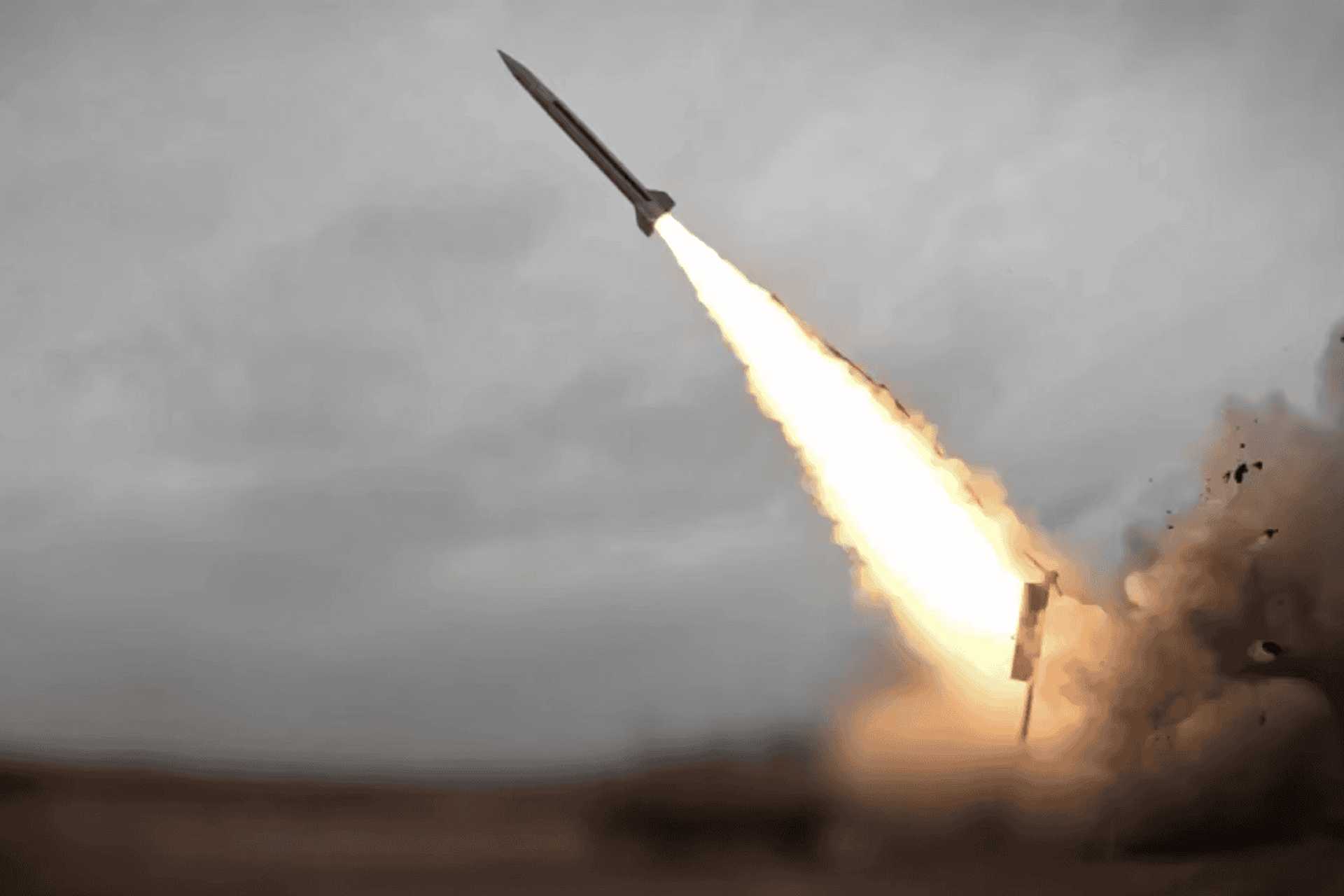 {loadposition bannertop}{loadposition sidebarpub}
Ukrainian defense manufacturer Fire Point is prepared to initiate flight trials of its new FP-9 short-range ballistic missile toward Moscow by summer or early autumn 2026, according to statements by company chief designer Denys Shtilerman on June 3, 2026. The deployment timeline relies on an engine validation test scheduled for June 2026, which represents the final major hurdle for an airframe that already features completed guidance, control, and structural systems. By validating this domestic ballistic capability, Kyiv aims to establish a reciprocal strategic deterrent against Russian infrastructure attacks while bypassing foreign policy restrictions linked to US-supplied weaponry.
The FP-9 is a short-range ballistic missile measuring 9.5 meters in length and 1.1 meters in diameter, engineered to deliver an 800-kilogram warhead across an operational range of 800 to 855 kilometers at speeds exceeding 1,200 meters per second. Fire Point plans to bypass standard procurement delays by manufacturing an initial batch of 10 to 20 test missiles simultaneously alongside engine validation trials to accelerate deep-strike readiness.
Related topic:Ukraine's new AI-powered drone campaign across Crimea could collapse Russia's Southern Front
The FP-9 is a larger, longer-range variant of the FP-7 missile pictured here, which increases the operational range from 300 km to 855 km and the warhead weight from 150 kg to 800 kg. (Picture source: Fire Point)
On June 3, 2026, Fire Point chief designer and co-owner Denys Shtilerman said Ukraine could use the FP-9 ballistic missile to strike Moscow in summer 2026 or early autumn 2026 if the engine test planned for June 2026 and follow-on flight trials validate the missile. He said FP-9 has “everything except the engine,” and tied the schedule directly to operational intent by saying that after a successful test flight, the next flight should be “to Moscow.” Shtilerman also named energy infrastructure in Moscow as a possible target category, mirroring Russia’s attacks on Kyiv’s energy system, and said the FP-9 range would make St. Petersburg, Vladimir Putin’s birth city, reachable.
The FP-9 carries an 800 kg warhead, is about 9.5 m long, has a maximum diameter of 1.1 m, and is expected to pass through roughly ten test missiles before production can expand after Ukrainian codification. The immediate significance is not an already operational ballistic missile force, but a defined path from engine testing to flight trials, codification, production expansion, and possible use against targets directly inside Russia’s capital. The FP-9 development fits into Russia’s repeated use of ballistic missiles, hypersonic missiles, cruise missiles, and drones in combined attacks against Ukraine, forcing Kyiv to defend against threats with different speeds, trajectories, altitudes, and warning times.
During May and June 2026, Iskander, Kinzhal, Zircon, and Oreshnik appeared in Russian strike claims, while Kyiv and other Ukrainian cities continued to face large missile-drone attacks. Ballistic missiles shorten the time between detection and impact, reduce engagement opportunities, and require high-end interceptors, which gives them political and military weight beyond their explosive payload. Russia’s use of these systems has likely increased Ukrainian desire for a reciprocal capability against Moscow, not only with drones or cruise missiles, but with a faster weapon that also creates a shorter air defense response.
Currently, the FP-9 remains non-operational until its engine, flight behavior, guidance, launch process, and production model are validated, with the program sequence still defined as engine test, flight test, codification, production expansion, and operational employment. The FP-9’s size and performance place it near the upper end of the short-range ballistic missile category. Its range, between 800 and 855 km, is nearly twice the range of Russia’s Iskander-M, while its 800 kg warhead gives it an unusually heavy payload for this missile category, to strike fixed infrastructure such as fuel storage, power generation facilities, rail junctions, ammunition depots, military-industrial plants, air bases, command facilities, and air defense nodes.
The missile’s 9.5 m length and 1.1 m maximum diameter also make it larger than Russia’s 9M723 Iskander missile, which is about 7.2 m long and 0.95 m in diameter. That comparison indicates a missile designed to trade compactness for range and payload rather than simply mirror an Iskander-class missile. Its reach would extend Ukrainian ballistic strike options beyond front-line depots and command posts into Russia’s deeper military, industrial, energy, and transport network, with Moscow central because of its political, command, infrastructure, and air defense significance, and St. Petersburg included under the same operational logic. The ATACMS also explains why Ukraine's political authority over the FP-9 matters as much as its specifications.
Ukraine received its first ATACMS from the U.S. in 2023, gaining a precision strike option against operational-depth targets such as airfields, depots, logistics nodes, command sites, and other military support infrastructure, but initial use was limited to Ukrainian territory, including Russian-occupied areas. In November 2024, the Biden administration allowed Ukraine to use U.S.-made weapons for deeper strikes inside Russia, but in August 2025, the Trump administration reportedly blocked Ukraine from using U.S.-made ATACMS against targets inside Russia. The practical lesson is that range does not automatically translate into usable political authority, since foreign approval can shape target selection, timing, and geography.
The FP-9 would reduce that dependency if it becomes operational, because target selection and launch timing would fall under Ukrainian authority rather than Washington’s approval cycle. It would certainly not replace the ATACMS for operational-depth missions, but it would occupy a different threat scale against rear infrastructure that supports Russian operations at scale. Fire Point’s portfolio now points to a layered strike structure across drones, cruise missiles, and ballistic missiles. The FP-7, with a range of about 300 km, fits tactical and operational-depth missions broadly aligned with ATACMS use, while the FP-9 extends that logic to strategic-depth ballistic strikes against more distant targets between 800 and 855 km, including Moscow and St. Petersburg.
The more widely used FP-5 Flamingo is a cruise missile with a 3,000 km range and a 1,150 kg warhead. Although the FP-5 has greater reach and payload than the FP-9, it faces a different air defense problem because cruise missiles usually spend more time in defended airspace and allow more time for detection, tracking, and interception. Ukraine has also increased attacks on Russian energy and military infrastructure with domestically produced drones and missiles, while earlier Ukrainian ballistic projects, such as the Hrim-2/Sapsan, show that the ballistic strike concept predates the current Fire Point track. The operational logic is practical: drones create volume and cost pressure, cruise missiles deliver long-range payloads, and ballistic missiles compress warning time and complicate interception.
The main operational rationale for the FP-9 is the penetration problem around Moscow. Denys Shtilerman has referred to multiple defensive rings around the city, creating a serious challenge for slow or medium-speed weapons crossing long distances through defended airspace. Long-range drones can be produced in numbers and impose a continuing defense burden, but they are vulnerable to radar detection, electronic warfare, fighters, guns, and surface-to-air missiles. Cruise missiles such as the FP-5 can fly low and maneuver, but their flight time still allows Russian defenders to build tracks, warn target areas, allocate interceptors, and attempt engagements.
A ballistic missile, descending at high speed, would give less time for detection, classification, interceptor launch, and final engagement. Fire Point's FP-9 has a speed above 1,200 m/s, which would not make the missile impossible to intercept but would change the cost, density, and timing requirements of defense. Russia currently imposes this problem on Ukraine, while Kyiv depends on scarce high-end interceptors and systems such as Patriot, which Ukrainian leaders continue to request after large Russian attacks. If the FP-9 becomes available even in modest numbers, Russia would have to face the same problem: shifting even more high-end air defense assets toward key cities, air bases, logistics hubs, energy sites, defense-industrial facilities, ammunition depots, command sites, rail junctions, and air defense nodes.
Fire Point’s industrial base gives the FP-9 a credible production pathway, but ballistic missile output remains more demanding than drone manufacturing. The company operates more than 60 dispersed production sites inside Ukraine, has a workforce between 2,000 and more than 4,000 personnel, and held more than $1 billion in Ukrainian state contracts in 2025. Fire Point leadership said the FP-1 long-range drone production exceeded 100 units per day. The company’s first working product required about $2 million in initial investment, and Shtilerman separately said he had personally invested about $2.5 million.
Its procurement model relies on parallel sourcing, with multiple engines, antennas, parts, suppliers, and subcontractors tested at the same time to reduce schedule risk. That method can shorten component problem-solving, but ballistic missiles impose stricter demands in propulsion consistency, structural loads, thermal stress, guidance survivability, launch preparation, and post-launch reliability. The FP-9’s main bottlenecks remain engine reliability, solid propellant supply, airframe manufacturing, guidance package availability, and state-funded procurement. A missile that can fly once still has to be produced repeatedly, stored safely, transported, launched from survivable positions, and guided accurately enough to justify each launch.
Key indicators of the FP-9's effectiveness will include successful flight tests, demonstrated flights, predictable ballistic trajectory, terminal behavior, and range performance close to the claimed 800-855 km band. Accuracy will matter because an 800 kg warhead has different military value if it can hit a defined military-industrial plant, energy facility, depot, air base, command site, rail node, or air defense position rather than only a broad area. Launch survivability will also be critical, including Ukraine’s ability to prepare, move, conceal, and fire FP-9s before Russian intelligence, surveillance, missiles, drones, or aircraft can attack the launch chain.
Codification would move the missile into a formal procurement and fielding process, while the monthly production rate would determine whether the FP-9 becomes a recurring operational pressure mechanism rather than a small number of demonstrative launches like Russia's Oreshnik. If codified, funded, produced beyond symbolic numbers, and launched from survivable positions, the FP-9 would force Russia to account for Ukrainian ballistic strike risk out to nearly 850 km, making Moscow, St. Petersburg, major air bases, logistics hubs, energy sites, military-industrial facilities, ammunition depots, command centers, rail junctions, and air defense nodes compete for ballistic missile defense coverage, mirroring what Kyiv has to face every day.
Written by Jérôme Brahy
Jérôme Brahy is a defense analyst and documentalist at Army Recognition. He specializes in naval modernization, aviation, drones, armored vehicles, and artillery, with a focus on strategic developments in the United States, China, Ukraine, Russia, Türkiye, and Belgium. His analyses go beyond the facts, providing context, identifying key actors, and explaining why defense news matters on a global scale.
Explore More Defense News
• Land Defense News
• Naval Defense News
• Defense Aerospace News
-
Leaked video confirms Ukrainian drones destroyed Russian corvette Boikiy in St Petersburg attack
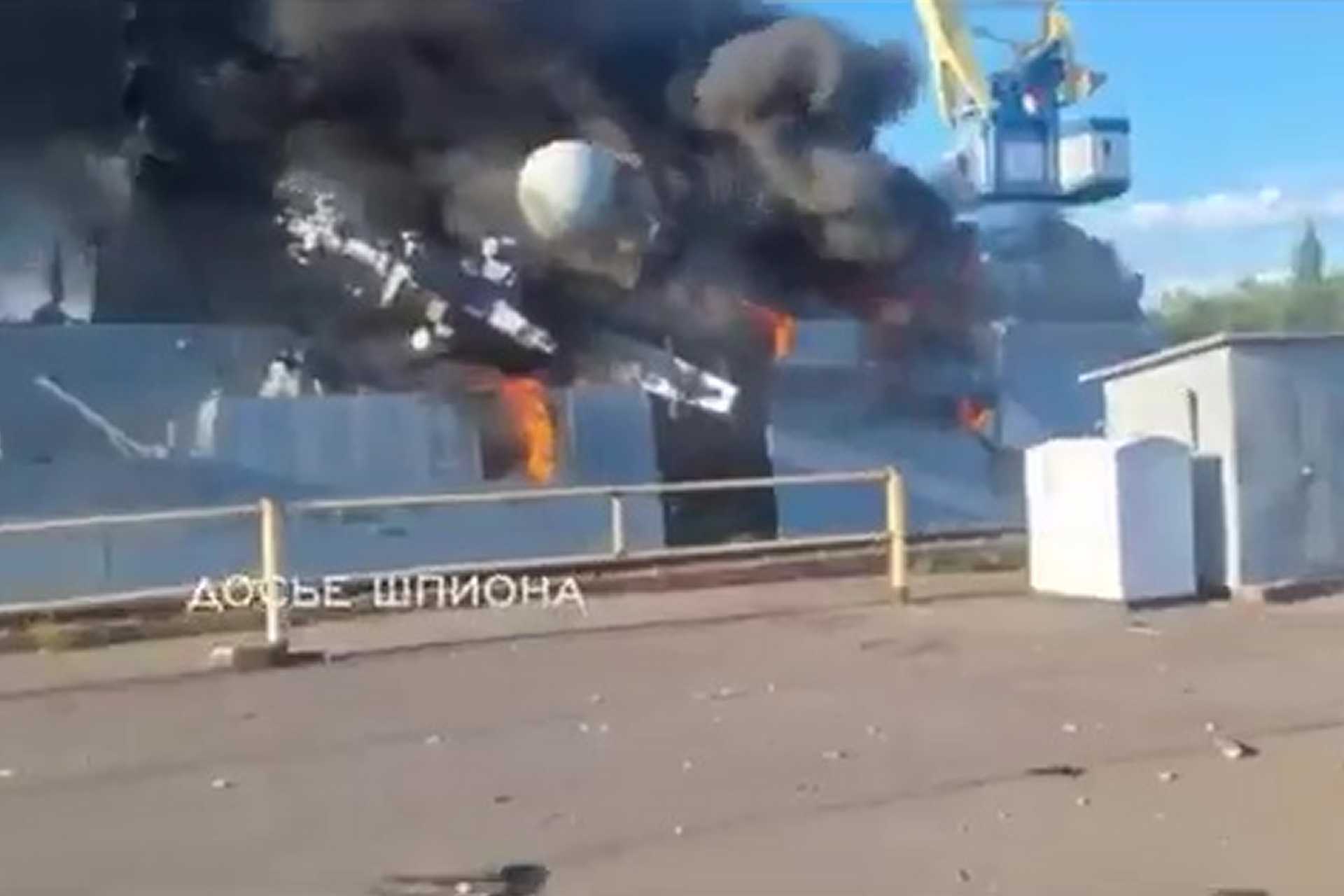 {loadposition bannertop}{loadposition sidebarpub}
A Ukrainian drone strike has effectively removed the Russian Baltic Fleet corvette Boikiy from operational service after the warship suffered catastrophic damage while in dry dock at Kronstadt, according to leaked footage shared on June 4, 2026, by the Russian Telegram channel Dosye Shpiona. The attack is strategically significant because it struck an actively deployed combatant at one of Russia’s most important naval support hubs, exposing the vulnerability of high-value warships during maintenance periods when mobility and self-protection are severely reduced.
The most critical damage appears to be the destruction of the Boikiy’s integrated mast, which concentrated the ship’s air-surveillance radar, targeting systems, communications, electronic warfare equipment, navigation sensors, and command-and-control functions. Even without sinking the vessel, the loss of these systems can neutralize much of its combat capability, highlighting how modern naval warfare increasingly focuses on disabling sensors and battle-management networks rather than destroying ships outright.
Related topic:Ukraine's new AI-powered drone campaign across Crimea could collapse Russia's Southern Front
The footage shows the Project 20380 Steregushchiy-class corvette Boikiy engulfed by fire inside the Veleshchynskyi Dry Dock at the Kronstadt Naval Plant, resulting in the total collapse of its integrated sensor mast. (Picture source: Telegram/Dosye Shpiona)
On June 4, 2026, a leaked video shared by the Russian Telegram channel Dosye Shpiona provided the first visual confirmation that the Baltic Fleet corvette Boikiy suffered catastrophic damage during a Ukrainian drone attack against Kronstadt on June 3, which possibly involved the use of the FP-2. The footage shows the Project 20380 Steregushchiy-class corvette engulfed by fire inside the Veleshchynskyi Dry Dock at the Kronstadt Naval Plant, with the vessel's integrated mast structure completely collapsed and much of the superstructure destroyed. On a Russian Project 20380 corvette, the mast is the central node that combines air surveillance, targeting, communications, navigation, electronic warfare, and command-and-control functions.
The Boikiy entered service on May 14, 2013, as the third Steregushchiy-class corvette and remained operational until the days immediately preceding the attack. During 2025 and 2026, the ship repeatedly operated beyond the Baltic Sea, escorting submarines, logistics vessels, and sanctioned commercial shipping through some of Europe's most heavily monitored maritime corridors. The strike, therefore, removed from service a warship that remained actively deployed in operational and strategic missions by Russia. The Ukrainian attack occurred during the morning of June 3 while Boikiy was undergoing maintenance work inside the Veleshchynskyi Dry Dock at Kronstadt.
Located on Kotlin Island, approximately 30 km west of central St. Petersburg, Kronstadt functions as one of the Russian Navy's most important support hubs in the Baltic region. The installation combines ship repair infrastructure, maintenance facilities, fleet support functions, and command elements supporting Baltic Fleet operations. Because the corvette was in dry dock, it lacked every defensive advantage normally available to a warship at sea. It could not maneuver, change position, increase speed, disperse to another anchorage, or leave the area. At least two drones reportedly struck the vessel, and the resulting fire appears to have propagated upward through the superstructure rather than downward through engineering spaces or the underwater hull, while one sailor was reported killed.
The fact that the vessel was hit inside a fixed maintenance facility is operationally significant because dry docks concentrate high-value naval assets in predictable locations where mobility, one of the most effective forms of naval protection, is completely absent. The most consequential damage appears to involve the destruction of the integrated sensor mast. This structure housed the Furke-2 (5P-27) three-dimensional air-search radar, the primary sensor responsible for air surveillance. The Furke-2 provides the simultaneous detection and tracking of 100 to 200 aircraft, helicopters, unmanned aerial vehicles, and incoming missiles at ranges commonly reported between 100 and 150 km.
The same mast contains the Monument-A surface-targeting radar, which performs an equally critical role, generating targeting information for the ship's eight Kh-35 Uran anti-ship missiles. Also installed within the mast are the HF, VHF, UHF, and satellite communications antennas linking the ship to Baltic Fleet headquarters, naval aviation assets, coastal command centers, and other warships. Components of the TK-25E-5 electronic warfare suite are also mounted within the same structure. The TK-25E-5 performs radar warning, emitter identification, electronic support measures, and electronic countermeasures, processing hundreds of electromagnetic emissions and helping protect the ship against radar-guided threats.
Navigation radars, Identification Friend or Foe (IFF) systems, GPS and GLONASS antennas, and aviation-support systems used during Ka-27 helicopter operations are also integrated in this mast. Consequently, the destruction of the mast simultaneously affects surveillance, targeting, communications, navigation, electronic warfare, and aviation support. The Boikiy displaces between 2,100 and 2,250 tonnes at full load, measures 104.5 meters in length, and operates with a crew of roughly 100 personnel. The vessel carries eight Kh-35 Uran anti-ship missiles, a 12-cell Redut vertical-launch air defense system, two quadruple Paket-NK launchers carrying up to eight anti-submarine or anti-torpedo weapons, an A-190 100 mm naval gun, two AK-630 close-in weapon systems, and a Ka-27 helicopter housed in an enclosed hangar.
On paper, this combination gives the ship anti-surface, anti-air, and anti-submarine capabilities. In practice, however, almost every major weapon aboard the vessel depends on the mast architecture that appears to have been destroyed. The Redut air defense system requires surveillance and tracking data. The Kh-35 missiles require surface-targeting information. The helicopter depends on communications, navigation, and control systems. The combat management network depends on sensor inputs arriving from the mast. As a result, the sensors and command systems often account for a larger share of operational capability than the launchers and guns themselves. The Boikiy occupied an important place within the Russian Navy's Baltic Fleet.
Assigned to the 128th Surface Ship Brigade and built at Severnaya Verf in St. Petersburg, the vessel is one of four Project 20380 corvettes serving with the fleet. These ships replaced Soviet-era Grisha-class anti-submarine vessels and constitute the Baltic Fleet's principal inventory of modern light multi-role surface combatants. The removal of a single vessel, therefore, affects approximately 25 percent of the fleet's Project 20380 inventory. Unlike larger navies that can absorb the temporary loss of an individual ship through numerical depth, the Baltic Fleet has limited redundancy within this category of warship, as the Project 20380 vessels perform patrol duties, escort missions, anti-submarine operations, local air defense tasks, and maritime security operations.
A prolonged absence of the Boikiy (an euphemism) therefore reduces the Baltic Fleet's capability across multiple mission areas simultaneously. In January 2025, the Boikiy accompanied the Improved Kilo-class submarine Novorossiysk through the North Sea, where the formation was tracked by Dutch naval forces near the Dutch Exclusive Economic Zone. During March 2025, the corvette also escorted the cargo vessel Baltic Leader from the eastern Mediterranean toward Russia after operations affecting maritime logistics routes connecting Russia and Syria. The ship subsequently conducted multiple English Channel transits monitored by Royal Navy units. In June 2025, the Boikiy also escorted the sanctioned tankers Selva and Sierra through the Channel.
These missions demonstrate the importance of the vessel for Russia. Rather than being used solely as a fleet combatant assigned to traditional naval exercises or Baltic patrol duties, the corvette increasingly served as a key escort asset protecting strategically important maritime movements. The vessel therefore contributed directly to safeguarding logistics traffic, commercial shipping, and politically sensitive sea lines of communication extending far beyond the Baltic Sea. Repairing the vessel would require far more than replacing damaged external structures.
Reconstruction of the mast alone would involve replacing the Furke-2 radar, Monument-A radar, communications arrays, electronic warfare equipment, antenna systems, processing hardware, cooling equipment, and large sections of cabling running throughout the ship. Fire damage aboard modern warships frequently extends beyond visible burn areas because high temperatures travel through cable trunks and enclosed compartments containing electronics. Sensitive sensors, processors, transmitters, and combat management equipment can therefore become unusable even when external structures remain intact.
The challenge is compounded by the fact that systems installed aboard Project 20380 corvettes are specialized naval equipment produced through Russian defense-industrial supply chains rather than commercially available components. Firefighting operations may have introduced additional damage through the large volumes of water used to suppress the blaze. Saltwater and contaminated runoff can penetrate cable trunks, electronic compartments, radar equipment spaces, and power distribution systems, causing corrosion, short circuits, and failures that may not become apparent until detailed inspection and testing are completed.
If the strike penetrated deck structures beneath the mast, repairs would also expand from systems replacement into structural reconstruction, potentially extending the shipyard period considerably, if the ship has not been scrapped in the meantime. Beyond the immediate damage to Boikiy, the strike highlights a broader vulnerability affecting Kronstadt, which contains key infrastructure, maintenance facilities, repair capacity, and command functions essential to sustaining Baltic Fleet operations. The attack targeted a stationary warship whose location was fixed and predictable because it was undergoing maintenance.
Dry docks inherently concentrate valuable naval assets while simultaneously restricting their ability to react. The incident also illustrates a broader trend in contemporary naval warfare. Modern warships derive much of their military value from sensors, communications networks, targeting systems, and battle management architecture. Destroying these functions can neutralize a combatant without sinking it. In the case of Boikiy, the area that appears to have suffered the greatest damage contains precisely those systems. The strike, therefore, achieved effects extending beyond physical destruction of the superstructure. It removed a functioning multi-role combatant from the Baltic Fleet while simultaneously affecting maintenance infrastructure at one of the most important naval facilities in northwestern Russia.
Written by Jérôme Brahy
Jérôme Brahy is a defense analyst and documentalist at Army Recognition. He specializes in naval modernization, aviation, drones, armored vehicles, and artillery, with a focus on strategic developments in the United States, China, Ukraine, Russia, Türkiye, and Belgium. His analyses go beyond the facts, providing context, identifying key actors, and explaining why defense news matters on a global scale.
Explore More Defense News
• Land Defense News
• Naval Defense News
• Defense Aerospace News
-
Ukraine's new AI-powered drone campaign across Crimea could collapse Russia's Southern Front
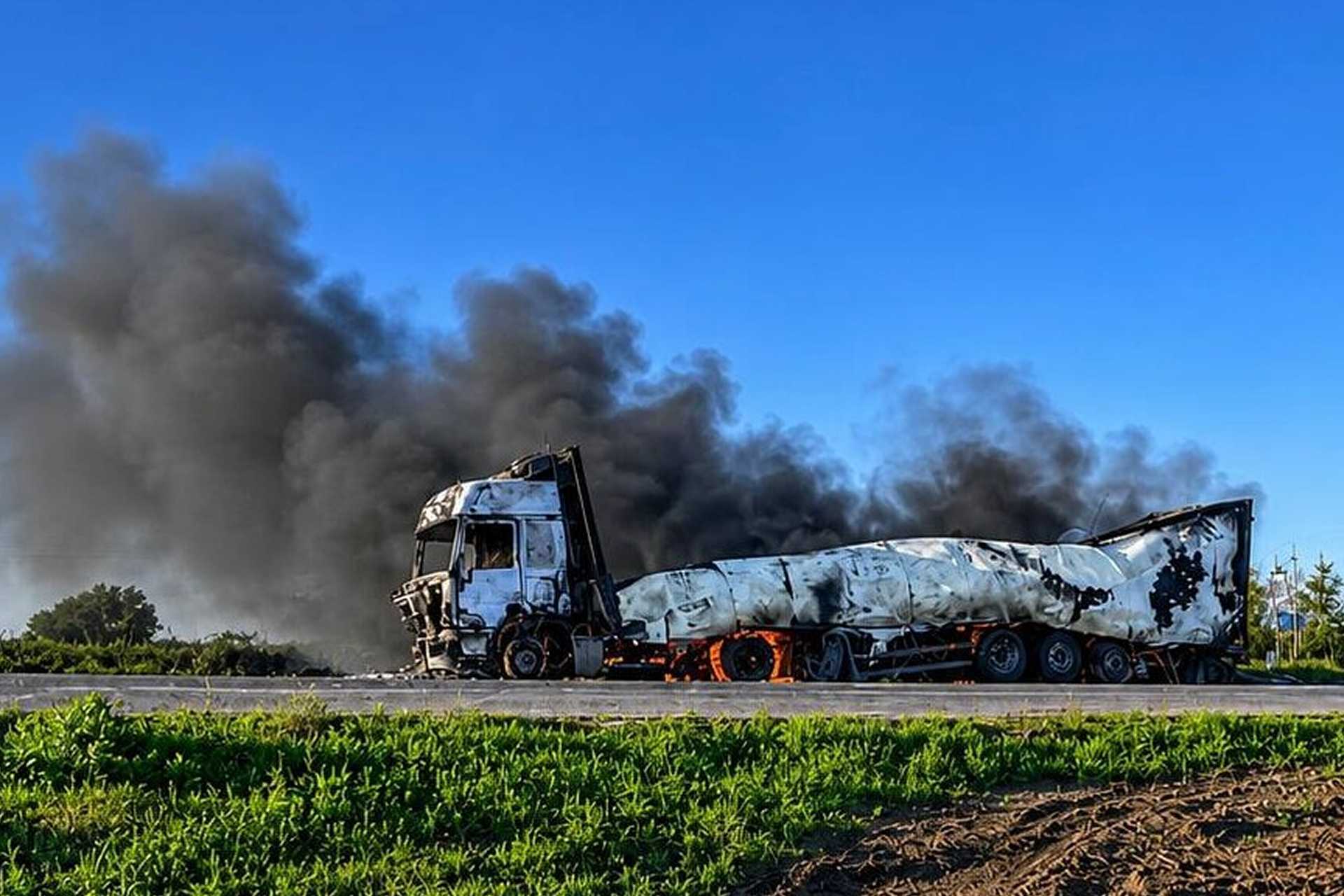 {loadposition bannertop}{loadposition sidebarpub}
Ukraine is expanding an AI-enabled drone campaign against the logistics network that sustains Russian forces across occupied southern Ukraine and Crimea, targeting fuel tankers, ammunition trucks, transport vehicles, and key supply routes rather than frontline combat units. The shift, highlighted in reporting by the BBC on May 31, 2026, aims to erode Russia’s ability to sustain offensive operations by reducing the flow of fuel, ammunition, spare parts, and personnel into the southern theater.
The campaign combines Palantir’s PRISMA battlefield-management system with long-range FPV and one-way attack drones to identify air-defense gaps, route strike packages at operational depth, and hit critical transport nodes from Mariupol to Dzhankoy. By focusing on transportation capacity as much as stockpiles, Ukraine is attempting to turn Russia’s concentrated logistics network into a vulnerability that could constrain combat power across Crimea, Kherson, Zaporizhzhia, and the wider Southern Front.
Related topic:Ukraine captures Russian position using only drones in first-ever combat operation without soldiers
If the quantity of fuel, ammunition, and equipment reaching combat units falls below daily consumption requirements, Russia's offensive operations become increasingly difficult to organize and sustain around Crimea. (Picture source: Telegram)
As reported by the BBC on May 31, 2026, Ukraine increasingly employs AI-powered drones to strike the logistics network sustaining Russian forces in occupied southern Ukraine, shifting a growing share of drone operations away from Russian combat units themselves and toward fuel tankers, ammunition trucks, transport vehicles, and supply convoys moving along key rear-area routes. Since April 2026, Ukrainian drone operations have concentrated on the Rostov-on-Don-Mariupol-Berdyansk-Melitopol-Dzhankoy corridor, a 500-kilometer logistics system that currently functions as Russia's principal overland connection between mainland Russia, occupied southern Ukraine, and Crimea.
The importance of this corridor increased substantially following the progressive degradation of the Kerch Strait crossing, which forced a larger proportion of military traffic onto road and rail routes that extend through occupied territories. Therefore, on May 27, Digital Transformation Minister Mykhailo Fedorov announced a dedicated $113 million "logistics lockdown" initiative designed to increase Ukraine's ability to conduct strikes at operational depth. The objective is to reduce the volume of fuel, ammunition, spare parts, and personnel that can move through the southern theater every day: if Russian units consume more supplies than the logistics network can deliver, combat effectiveness declines regardless of available manpower.
The campaign is enabled by a command architecture increasingly built around Palantir's PRISMA software environment. Ukrainian military intelligence units use the American PRISMA system to merge real-time battlefield telemetry, active radar positions, historical drone flight paths, and targeting intelligence into a single operational picture. The system continuously identifies gaps between Russian radar sectors, maps air defense coverage, and generates optimized flight corridors for Ukraine's drone operations. This process shortens the sensor-to-shooter cycle by transforming reconnaissance data directly into strike opportunities. Instead of individual operators manually selecting routes, strike packages can be generated based on known radar locations, electronic warfare coverage, and historical mission data.
Mid-course navigation is maintained through Starlink connectivity and mesh-relay networks, while terminal guidance increasingly relies on onboard processing and machine-vision target recognition. The practical consequence is that dozens of Ukrainian drones can be routed simultaneously through identified air defense gaps toward multiple targets located across hundreds of kilometers. In operational terms, PRISMA functions as a tool for identifying vulnerabilities in Russian ground lines of communication and optimizing strike assets against the highest-value bottlenecks within the logistics network. The significance of Ukraine's intermediate-range strike campaign also lies in the distances currently reached.
Before 2026, Ukraine's FPV and loitering munitions generally reached 10 to 20 kilometers behind the line of contact. Fiber-optic FPV systems later expanded that depth to approximately 25 to 50 kilometers while reducing vulnerability to electronic warfare. The introduction of Hornet one-way attack drones created a new engagement envelope extending from 75 kilometers to more than 150 kilometers, fundamentally changing the geography of the battlefield. Mariupol, located roughly 80 to 100 kilometers from active combat sectors, moved inside the practical strike range of Ukrainian tactical units. Dzhankoy, situated approximately 120 to 150 kilometers behind the southern front and serving as Crimea's primary rail-sorting center, also entered the engagement zone.
A verified strike against a moving Russian UAZ truck at a depth of 102 kilometers demonstrated that Ukraine's low-cost FPV drones can now bridge the entire operational gap between the frontline and rear logistics nodes without requiring carrier or relay drones. Russian vehicles moving from Rostov-on-Don toward Crimea no longer face risk only during final delivery to frontline units, as they remain vulnerable during much of their transit across the southern theater, exposing Russia's key logistics assets to a near-certain destruction throughout their journey. Russia's logistics network, now under constant attack, relies on a limited number of critical nodes.

The fuel crisis hit both civilian and military consumers in Crimea, as they draw from the same regional fuel distribution system, with oil arriving in Crimea must either cross the Kerch route, arrive by maritime transport, or move south through the R-280 corridor. (Picture source: Telegram)
Rostov-on-Don functions as the primary rail-to-truck transfer center for the southern theater. Ammunition, fuel, armored vehicles, and military equipment arriving from Russian industrial regions are consolidated there before moving south and west. Mariupol, for its part, serves as the largest distribution hub in occupied southern Ukraine, redistributing cargo arriving from Russia toward Berdyansk, Melitopol, and frontline formations. Berdyansk acts as a coastal transfer point and geographic bottleneck through which large volumes of traffic must pass. Melitopol connects occupied Donetsk, occupied Zaporizhzhia, and Crimea, making it one of the most important logistics junctions in southern Ukraine.
Dzhankoy serves as the principal sorting node inside Crimea, distributing incoming military cargo toward Sevastopol, Kherson, and other operational sectors. Because these locations form a sequential network, disruption at a single point affects multiple downstream sectors simultaneously. A reduction in throughput at Mariupol or Berdyansk can directly influence the flow of ammunition and fuel reaching Zaporizhzhia, Kherson, and Crimea. The network's efficiency is derived from concentration, and this same concentration creates vulnerability because relatively few nodes process a large share of total traffic. Ukraine's targeting logic focuses on transportation capacity rather than stored inventories, as Russia's brigades require several hundred tonnes of supplies every day to sustain combat operations.
Ammunition, diesel fuel, food, lubricants, replacement components, and engineering materials must arrive continuously to maintain operational tempo. A standard ammunition truck can transport approximately five to ten tonnes of cargo. A fuel tanker can carry between 20,000 and 40,000 liters of fuel. Destroying one vehicle, therefore, removes both the cargo being transported and the future carrying capacity represented by the vehicle itself. This distinction is important. If 100 fuel tankers are destroyed, the immediate fuel loss is significant, but the longer-term effect is the elimination of the transport fleet required to move future fuel shipments.
On May 29, 2026, a reported record of 483 transport vehicles was neutralized in a single day, and such losses create cumulative effects. Even if Russia possesses adequate ammunition and fuel stockpiles in rear areas, those supplies remain operationally irrelevant if insufficient transportation assets exist to move them to frontline formations. Intermediate-range strikes also support Ukraine's strategic drone campaign. Nearly 50 percent of mid-range sorties have reportedly been directed against Russia's radar stations, surface-to-air missile launchers, and early-warning systems, such as the P-18 and PRV-16 radars. The objective is not simply to destroy individual radar systems but to create gaps within the radar network protecting occupied territories.
Every radar removed from the network expands the size of undefended air corridors available to follow-on logistic strikes. This effort supports HUR's Vector long-range drone force, which employs systems such as the Sichen drone with a range of 870 miles alongside larger jet-powered one-way attack drones. By May 2026, Ukraine's strategic drone inventory reportedly achieved a maximum operational reach of 3,500 kilometers. That distance places key military-industrial infrastructure in the Urals and western Siberia within range. On May 29, air raid sirens sounded across the Urals region, demonstrating that facilities previously considered geographically insulated now face potential exposure. The relationship between intermediate and strategic operations is therefore direct.

Another adaptation has been the appearance of camouflage resembling First World War-era dazzle paint on Russian fuel tankers, cargo trucks, and other logistics vehicles, but the effectiveness of these measures remains uncertain. (Picture source: Telegram)
Intermediate-range drones suppress radar coverage and degrade air defense networks. Strategic drones exploit the resulting corridors to penetrate deeper into Russian airspace. Developments in Crimea provide one of the clearest indicators of the campaign's effects. On June 1, Sergei Aksyonov, a Russian politician serving as the head of the occupied Crimea, introduced rationing measures for Ai-95 gasoline, replacing unrestricted retail sales with a coupon-based distribution system. Long vehicle queues subsequently appeared at filling stations across Sevastopol. Crimea contains more than two million civilian residents while simultaneously supporting major military installations, naval infrastructure, and logistics facilities.
Both civilian and military consumers draw from the same regional fuel-distribution system. Fuel arriving in Crimea must either cross the Kerch route, arrive by maritime transport, or move south through the R-280 corridor. Restrictions implemented after weeks of Ukrainian attacks against fuel tankers and logistics vehicles north of the peninsula suggest that transportation had become the critical constraint. This distinction matters. Logistics systems often fail not because supplies cease to exist but because transportation networks can no longer distribute those supplies efficiently, which reminds me of the situation in Japan, or even Germany, at the end of the Second World War.
Russian countermeasures have also imposed high costs on the logistics network itself. According to data collected across the southern theater, convoy sizes have been reduced dramatically, with some formations limiting movements to pairs of vehicles rather than large transport columns. This reduces the risk of catastrophic losses from drone attacks but also reduces transport efficiency. A shipment previously moved by a large convoy must now be distributed across many smaller movements. Another adaptation has been the appearance of camouflage resembling First World War-era dazzle paint, on fuel tankers, cargo trucks, and other logistics vehicles.
Many Ukrainian strike drones rely on onboard optical recognition algorithms trained to identify vehicle outlines and proportions, and those irregular black-and-white patterns are intended to reduce the probability of successful autonomous lock-on, but the effectiveness of these measures remains uncertain. Additional escort vehicles, electronic warfare systems, and security personnel are also required. Russian logistics units have increasingly shifted traffic away from the M-14 and M-18 highways and onto agricultural tracks and unimproved roads. Heavy vehicles operating off-road consume more fuel, travel more slowly, and experience higher mechanical wear rates.
Spare parts consumption also increased while maintenance intervals shortened. Consequently, even vehicles that successfully complete deliveries impose higher sustainment costs on Russia's weakening logistics system. The Ukrainian campaign, therefore, generates losses through multiple mechanisms simultaneously: direct destruction, increased operating costs, longer transit times, higher vehicle wear, and greater demand for security assets. The growing use of dazzle paint also reflects concern within Russian logistics units about the increasing role of Ukraine's AI-assisted targeting to reduce traditional operational constraints.
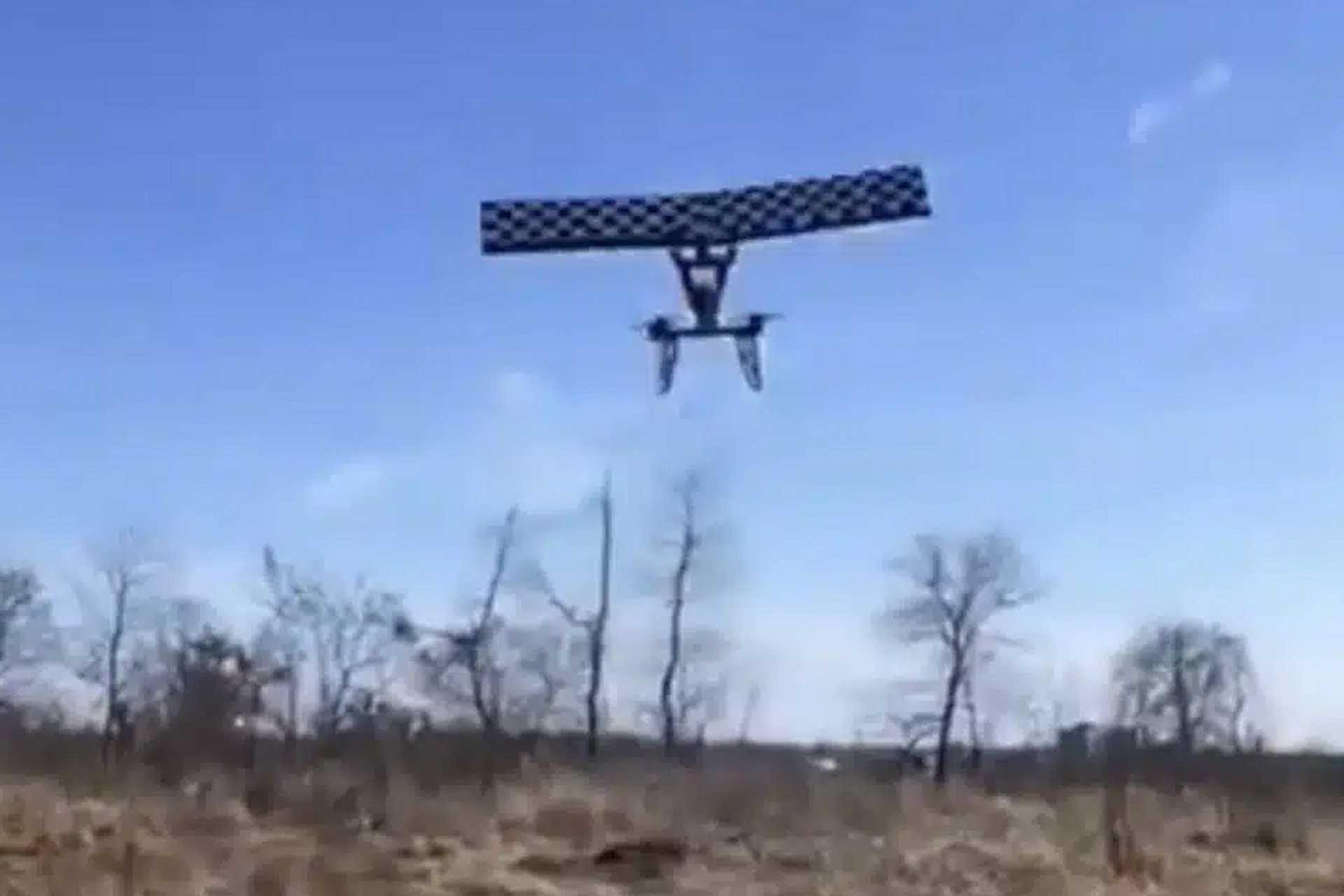
A verified strike against a moving Russian UAZ truck at a depth of 102 kilometers demonstrated that Ukraine's low-cost FPV drones can now bridge the entire operational gap between the frontline and rear logistics nodes. (Picture source: Telegram)
Hornet drones employ onboard machine-vision systems trained using thousands of hours of imagery of Russian military equipment. Once launched toward a target area through Starlink connectivity or pre-programmed navigation, the drone can identify, classify, and engage moving vehicles without continuous operator control. This directly addresses a longstanding limitation in drone warfare: the requirement for human operators to track targets throughout the engagement sequence. It also reduces vulnerability to electronic warfare, as traditional jamming techniques seek to sever the connection between drone and operator.
Autonomous terminal guidance removes much of that dependency, and, as a result, Ukraine's strike units can process significantly larger numbers of Russian targets per day. This operational model is further supported by rapidly expanding production capacity. Ukrainian FPV production increased from approximately 3,000 to 5,000 units in 2022 to roughly two million units in 2024 and four million units in 2025. By mid-2026, annualized output had reached between seven and eight million drones. According to Deputy Defense Minister Mstyslav Banik on June 2, Ukraine possesses sufficient industrial infrastructure to scale production to 20 million drones annually if additional financing becomes available.
Standard Sternenko FPV drones cost roughly $500, while winged long-range FPV variants cost roughly $640, and Wild Hornets Sting interceptor drones cost approximately $2,500. By comparison, Patriot PAC-3 interceptors cost roughly $3 million each, while the value of many targeted radar systems, fuel installations, and armored vehicles reaches several million dollars per target. This cost relationship allows large numbers of strike sorties to be generated at a fraction of the replacement cost imposed on the defender. The broader significance of the Ukrainian drone campaign becomes visible when measured against Russian battlefield performance.
During the first five months of 2026, Russian forces reportedly captured 15.6 times less territory than during the equivalent period in 2025. Advances along key sectors slowed to between 15 and 70 meters per day. The logistics-lockdown concept seeks to reinforce that trend by reducing the volume of ammunition, diesel fuel, and replacement equipment available to frontline formations. Individual vehicle losses, fuel rationing measures, and radar suppression operations are therefore components of a larger operational design. The campaign's ultimate objective is not the destruction of trucks but the reduction of daily delivered tonnage.
If the quantity of fuel, ammunition, and equipment reaching combat units falls below daily consumption requirements, Russia's offensive operations become increasingly difficult to organize and sustain. The central question is therefore not how many vehicles are destroyed but how many tonnes of materiel successfully reach Russian formations each day. That metric will soon determine whether Russia's southern logistics network continues functioning as an effective sustainment system or gradually becomes a bottleneck constraining operations across the entire Ukrainian theater.
Written by Jérôme Brahy
Jérôme Brahy is a defense analyst and documentalist at Army Recognition. He specializes in naval modernization, aviation, drones, armored vehicles, and artillery, with a focus on strategic developments in the United States, China, Ukraine, Russia, Türkiye, and Belgium. His analyses go beyond the facts, providing context, identifying key actors, and explaining why defense news matters on a global scale.
Explore More Defense News
• Land Defense News
• Naval Defense News
• Defense Aerospace News
-
Ukraine requests US authorization to produce Patriot PAC-3 MSE missiles to solve air defense crisis
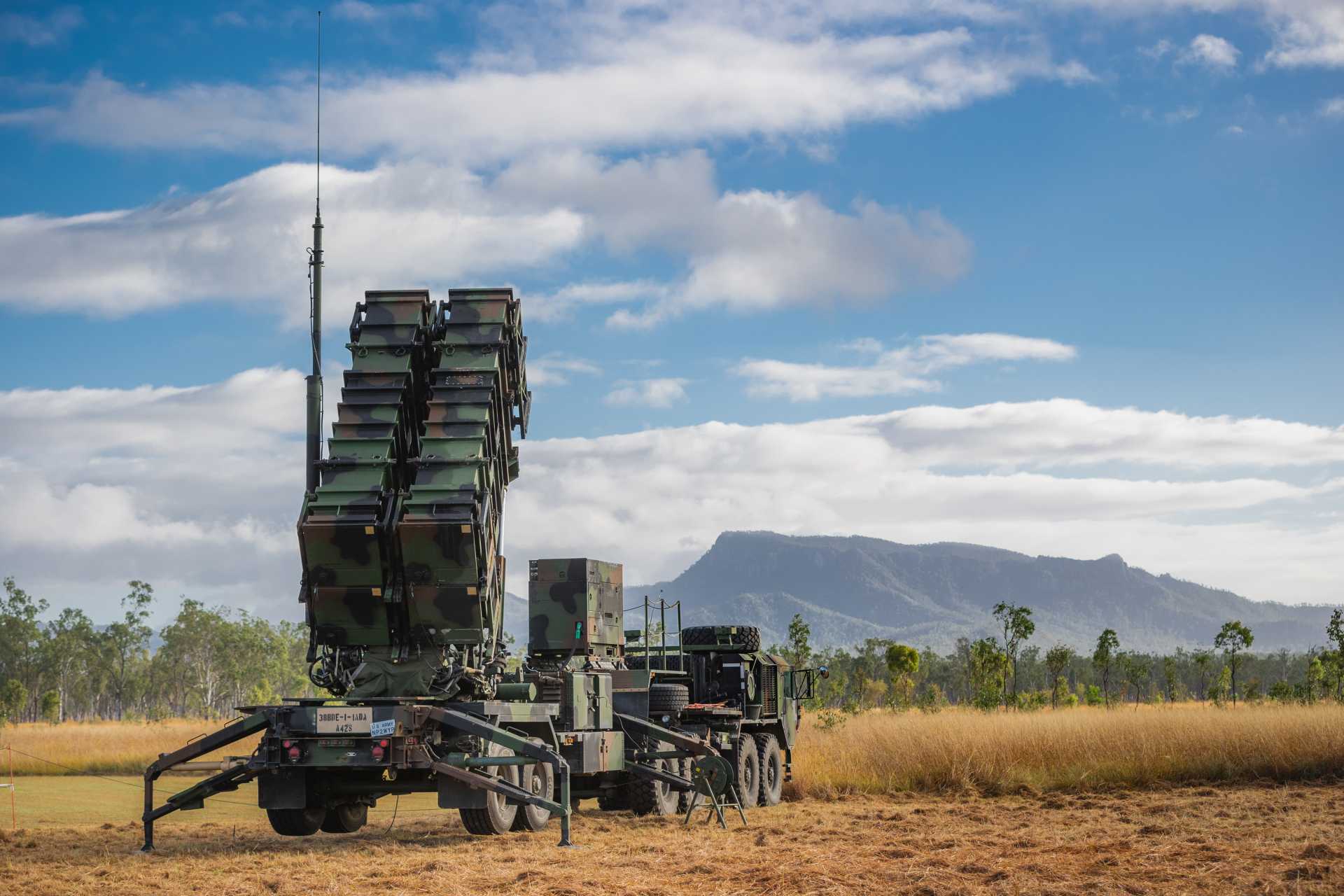 {loadposition bannertop}{loadposition sidebarpub}
Ukraine has formally asked the United States to authorize licensed production of Patriot PAC-3 MSE interceptors, a move confirmed by President Volodymyr Zelensky to CBS News on May 29, 2026, as Russian ballistic missile attacks continue to strain Ukraine’s air defense network. The request targets the growing gap between interceptor consumption and production, highlighting that missile manufacturing capacity, not the number of Patriot launchers, has become the critical factor in sustaining Ukraine’s ability to defeat high-speed ballistic threats.
The PAC-3 MSE remains one of the few Western interceptors optimized to destroy ballistic missiles such as the Russian Iskander-M and Kinzhal, making it central to the defense of key Ukrainian cities and infrastructure. If approved, Ukrainian participation in Patriot production would expand long-term interceptor output for Ukraine, the United States, and allied operators, underscoring how industrial capacity has become as strategically important as battlefield air defense systems themselves.
Related topic:Can Ukraine create an alternative to the U.S. Patriot air defense missile system with Germany?
Currently, every PAC-3 missile produced must simultaneously support U.S. replenishment requirements, Ukrainian operational demands, and standing obligations to Patriot operators across Europe, Asia, and the Middle East. (Picture source: Australian MoD)
On May 29, 2026, Ukrainian President Volodymyr Zelensky confirmed to CBS News that Ukraine had formally requested U.S. authorization to manufacture Patriot PAC-3 MSE interceptors under license, following letters sent to the White House and Congress amid continuing Russian ballistic missile attacks. The request was not primarily linked to the number of Patriot batteries available in service, but to the growing mismatch between interceptor consumption and interceptor production. Zelensky cited current production at roughly 60-65 PAC-3 interceptors per month, a figure that has become increasingly insufficient because Ukraine's estimated routine expenditure already stands at 60-70 interceptors per month.
During periods of intensive missile attacks, expenditure can increase to an estimated 150 to 180 Patriot interceptors per month, exceeding current production by a factor of nearly three. The proposal emerged as the United States, Ukraine, European allies, and Middle Eastern operators compete for access to the same production lines. In practical terms, the debate concerns industrial capacity rather than launcher availability, with missile production becoming the principal bottleneck in ballistic missile defense. The importance of the Patriot for Ukraine stems from the nature of the threat it is designed to counter.
Unlike NASAMS or IRIS-T SLM, which are optimized primarily for aircraft, cruise missiles and other aerodynamic targets, PAC-3 MSE was specifically developed for ballistic missile interception. The missile employs a hit-to-kill mechanism, meaning that destruction occurs through direct collision rather than by detonating a fragmentation warhead near the target. This distinction becomes critical against missiles such as the Russian Iskander-M, which can approach Mach 6-7 during the terminal phase and maneuver during portions of its flight profile.
Russia is estimated to manufacture 40 to 50 Iskander-M ballistic missiles and roughly 10 Kh-47M2 Kinzhal air-launched ballistic missiles per month. Combined, that production level of 50-60 ballistic missiles closely mirrors Ukraine's minimum monthly Patriot expenditure, illustrating how Russian missile production alone can absorb nearly an entire month's current PAC-3 output. Since 2023, Patriot batteries have repeatedly been deployed around Kyiv specifically to counter Iskander attacks because few Western systems fielded in Europe are optimized for routine interception of such threats.
Ukraine's request also coincides with a significant depletion and replenishment challenge facing the United States. Prior to the war, U.S. PAC-3 inventories were estimated at approximately 2,330 missiles. During the 2026 conflict involving Iran, U.S. forces reportedly fired between 1,060 and 1,430 Patriot interceptors, equivalent to roughly 45-60 percent of those estimated inventories. Even at the lower estimate, more than four years of production at the 2024 manufacturing rate would be required to replace the missiles expended. At the higher estimate, replacement requirements would approach the equivalent of nearly seven years of 2024 production.
This calculation illustrates why interceptor production has become a strategic issue extending beyond Ukraine. Every PAC-3 missile produced must simultaneously support U.S. replenishment requirements, Ukrainian operational demands and standing obligations to Patriot operators across Europe, Asia and the Middle East. Production expansion is constrained by manufacturing realities rather than funding alone. Lockheed Martin produced roughly 500 PAC-3 MSE interceptors in 2024 and approximately 620 in 2025, representing annual growth of about 24 percent but still averaging only slightly more than 52 missiles per month.
The company intends to increase production toward 2,000 missiles annually by 2030, which would correspond to roughly 167 missiles per month, yet even that future objective would barely cover Ukraine's peak monthly requirements during periods of intense missile activity. Patriot interceptors are assembled from a large network of specialized suppliers rather than a single production line. RTX manufactures major radar and launcher components, while other suppliers provide rocket motors, seekers, guidance electronics, flight-control systems and software packages. Each interceptor contains hundreds of precision components that must function under extreme acceleration, high temperatures and very short engagement timelines.
Unlike artillery shells, which can tolerate limited defect rates, a single malfunction in a ballistic missile interceptor can result in the complete loss of an engagement opportunity. The limitations of European alternatives, even the IRIS-T SLM/X, help explain why Kyiv is focused specifically on Patriot production. Europe's principal anti-ballistic missile system, the SAMP/T, employs the Aster 30 interceptor developed by MBDA and Eurosam. While capable against a range of air and missile threats, Aster production capacity remains substantially below worldwide Patriot demand. The Patriot is currently operated by roughly 19 countries, generating decades of accumulated logistics infrastructure, maintenance facilities, training pipelines and missile stockpiles.
The SAMP/T remains concentrated primarily within France and Italy, with additional but limited deployments elsewhere. This disparity is reflected in procurement decisions across Europe, where NATO's European Sky Shield Initiative relies heavily on Patriot and Israeli Arrow acquisitions rather than solely on European missile defense systems. No European program currently possesses the industrial depth required to replace Patriot inventories at an equivalent scale during the remainder of the decade. Even under an accelerated approval process, a Ukrainian production license would not immediately generate operational missiles.
Patriot missile manufacturing requires secure facilities, specialized tooling, certified suppliers and access to controlled technical data. Production personnel must complete qualification procedures measured in years because ballistic missile interceptors require far stricter tolerances than most conventional munitions. New suppliers entering the Patriot ecosystem must pass validation and reliability testing before components can be integrated into operational missiles. For this reason, initial Ukrainian participation would likely focus on selected components, subassemblies or support equipment rather than complete interceptor production.
Building a fully certified production line capable of manufacturing PAC-3 MSE interceptors from start to finish would require a multi-year industrial effort. The immediate value of licensing would therefore be the expansion of future production capacity rather than the rapid delivery of additional missiles to the battlefield. The proposal is consistent with broader trends in Ukraine's defense-industrial policy since 2022. Kyiv has increasingly sought licensed manufacturing arrangements instead of relying exclusively on imported military equipment.
Domestic drone production, the best example, has expanded from small wartime workshops into one of the largest UAV manufacturing sectors in Europe, while local production initiatives have also been pursued for artillery ammunition, armored vehicles and missile-related technologies. On the battlefield, Ukraine increasingly reserves Patriot batteries for engagements against Iskander-M and Kinzhal missiles because those targets present challenges beyond the capabilities of most other available systems. Cruise missile interceptions are increasingly assigned to IRIS-T SLM and NASAMS batteries, while Shahed drones are engaged by Gepard vehicles, mobile anti-aircraft teams, electronic warfare systems and interceptor drones.
Ukrainian Patriot crews have also increasingly adopted single-interceptor engagements instead of the two-to-four missile doctrine traditionally employed by many Western operators, accepting lower engagement probabilities in exchange for preserving scarce missile inventories. At the strategic level, Zelensky's proposal highlights the absence of a European equivalent to Patriot rather than a temporary wartime shortage. Switzerland has already been informed that Patriot deliveries may be delayed because production capacity is being allocated to higher-priority requirements, demonstrating that industrial constraints are affecting countries beyond Ukraine.
Developing an entirely new European interceptor family would require billions of euros in investment and likely more than a decade of development involving radar design, battle-management software, interceptor engineering, flight testing and operational certification. During that period, NATO's ballistic missile defense architecture would remain dependent on Patriot, THAAD and Aegis. From Kyiv's perspective, expanding PAC-3 production capacity through additional licensed manufacturing lines offers a solution measured in years rather than decades. The central issue is therefore whether Washington is prepared to transfer sufficient industrial access and technical knowledge to allow new Patriot production capacity to emerge outside the existing U.S.-based manufacturing network.
Written by Jérôme Brahy
Jérôme Brahy is a defense analyst and documentalist at Army Recognition. He specializes in naval modernization, aviation, drones, armored vehicles, and artillery, with a focus on strategic developments in the United States, China, Ukraine, Russia, Türkiye, and Belgium. His analyses go beyond the facts, providing context, identifying key actors, and explaining why defense news matters on a global scale.
Explore More Defense News
• Land Defense News
• Naval Defense News
• Defense Aerospace News