



Global Land & Army World Defense News
-
U.S. Army Integrates Epirus Leonidas Microwave Weapon Into Layered Counter-Drone Network
{loadposition bannertop}{loadposition sidebarpub}
The U.S. Army has integrated Epirus’ Leonidas high-power microwave counter-drone weapon with external sensors and a broader command-and-control network during Operation JAILBREAK FALCON FURY, moving the system beyond standalone drone-defeat demonstrations toward employment inside a layered air-defense architecture. The integration connects threat detection, command decisions, and microwave effects across systems from different suppliers, giving Army operators another non-kinetic option against individual drones and massed unmanned attacks.
Epirus disclosed the milestone on October 3, 2026, saying Leonidas demonstrated its ability to integrate sensors and high-power microwave effects within a wider command-and-control ecosystem. The development matters because counter-drone effectiveness increasingly depends not only on destroying an unmanned aircraft, but on rapidly passing target data from the sensor that detects it to the most appropriate weapon available.
Related Topic: U.S. unveils self-driving Leonidas AGV microwave weapon to take down drone swarms in seconds
Epirus Leonidas is a high-power microwave counter-drone weapon designed to disrupt or disable the electronics of unmanned aerial vehicles using directed electromagnetic energy, providing a non-kinetic option against individual drones and swarms. (Picture source: Epirus)
The Epirus Leonidas microwave counter-drone weapon uses high-power microwave energy to disrupt or disable the electronics unmanned aircraft need to operate. Unlike missiles or gun-based defenses, the weapon produces electromagnetic effects without expending a kinetic interceptor, giving air-defense units a potentially high-capacity response against electronically vulnerable drone threats.
The system has already demonstrated relevance against targets that are difficult to defeat through conventional jamming. In December 2025 testing subsequently publicized by Epirus, a Leonidas VehicleKit configuration disabled a fiber-optic-controlled FPV drone, whose physical command link makes standard radio-frequency jamming ineffective.
Leonidas has also been demonstrated against larger numbers of targets. During an August 2025 event at Camp Atterbury, Indiana, a Leonidas system disabled a swarm of 49 quadcopters within seconds, highlighting the attraction of high-power microwave technology for saturation defense where firing individual kinetic interceptors at every incoming aircraft can quickly consume ammunition.
Operation JAILBREAK FALCON FURY addresses a different challenge. Rather than focusing primarily on whether Leonidas can disable a drone, the event examines whether sensors, command systems, and weapons built by different suppliers can exchange the information needed to find, identify, prioritize, and engage airborne threats as part of a common defensive architecture.
That requirement is central to the U.S. Army’s broader Operation Jailbreak and “Right to Integrate” effort. During the initial Operation Jailbreak sprint at Fort Carson, Colorado, in May 2026, the Army brought together roughly 600 participants and more than 50 companies to expose software interfaces and connect capabilities that had previously operated in isolation, with more than 70 military capabilities opened for new integrations.
For Leonidas, this integration significantly changes how the weapon could be employed operationally. A high-power microwave system may offer greater engagement capacity than defenses that depend on finite missile inventories, but that advantage shrinks if it cannot receive timely tracks from external sensors or be incorporated into the command architecture controlling a layered defense.
Network integration lets one sensor detect a threat while command software and operators decide how to engage it. A radar or electro-optical sensor could identify an approaching unmanned aircraft, pass the track through the command network, and enable operators to assign Leonidas or another available weapon according to range, target type, threat density, and tactical conditions.
This approach is particularly relevant against mixed drone attacks. A layered defense could use electronic warfare against radio-controlled FPV drones, high-power microwave effects against groups of electronically vulnerable unmanned aircraft, and kinetic interceptors against targets requiring physical destruction or operating outside the effective conditions of non-kinetic weapons.
The U.S. Army has already demonstrated the broader technical direction behind this concept through the Right to Integrate initiative. The effort seeks to merge disparate radars, sensors, and effectors into a common operating picture through open software architectures, reducing the time required to build new sensor-to-effector combinations as threats and available weapons evolve.
Leonidas has also been adapted for mobile counter-drone missions. In March 2026, Epirus, General Dynamics Land Systems and Kodiak AI unveiled an autonomous Leonidas-equipped ground vehicle intended for missions including airfield, installation, infrastructure and forward-area defense.
Mobility and network connectivity address complementary operational requirements. A mobile microwave weapon can reposition with defended forces or respond to changing attack directions, while integration with external sensors can expand its situational awareness and connect it to a broader defensive network.
The Falcon Fury integration does not establish that Leonidas has entered widespread operational U.S. Army service, nor does Epirus’ October 3, 2026, announcement provide detailed engagement ranges, sensor types, or the precise command-and-control systems involved in the demonstration. The milestone instead shows that the high-power microwave weapon has been exercised as part of the Army’s effort to connect sensors, command software and multiple effectors rather than only as an independent counter-drone system.
That distinction is important as the U.S. military confronts increasingly numerous and inexpensive unmanned threats. The challenge is shifting from proving that individual technologies can destroy drones to building an air-defense architecture that can detect multiple threats, prioritize them, and assign the most suitable weapon without rapidly exhausting costly interceptor inventories.
By bringing Leonidas into that architecture, the U.S. Army is testing where high-power microwave weapons could fit within a layered defense. The system is not being positioned as a replacement for missiles, guns or electronic warfare, but as an additional non-kinetic effector available to the same command network directing the broader air-defense fight.
Explore More Defense News
• Land Defense News
• Naval Defense News
• Defense Aerospace News
Written by Alain Servaes – Chief Editor, Army Recognition Group
Alain Servaes is a former infantry non-commissioned officer and the founder of Army Recognition. With over 20 years in defense journalism, he provides expert analysis on military equipment, NATO operations, and the global defense industry.
-
U.S. Army SGT Stout and Germany’s Boxer Skyranger 30 Show Two Paths to Mobile Counter-Drone Defense
{loadposition bannertop}{loadposition sidebarpub}
Germany’s Boxer-mounted Skyranger 30, manufactured by Rheinmetall, and the U.S. Army’s SGT Stout M-SHORAD, developed by Leonardo DRS and General Dynamics Land Systems, illustrate two approaches to rebuilding mobile short-range air defense against drones and other low-altitude threats. Both combine 30 mm guns, onboard sensors, and surface-to-air missiles on armored 8x8 vehicles, but Skyranger emphasizes programmable airburst ammunition, while SGT Stout uses a broader mix of Stinger, Hellfire, and networked U.S. Army sensors. As drone threats multiply, both systems show why Western armies are increasingly turning to cannon-based counter-UAS fire to preserve more expensive guided missiles for harder targets.
The comparison has become increasingly relevant as unmanned aircraft and loitering munitions force ground units to defend themselves against large numbers of low-cost aerial targets at short range. The SGT Stout is already fielded with U.S. Army air-defense units, while Germany’s first Boxer Skyranger 30 remains a verification vehicle ahead of production deliveries planned mainly for 2027 and early 2028.
Related Topic: Ukraine Reportedly Fields First Skyranger 35 Air Defense Systems Mounted on Leopard 1 ChassisGermany’s Boxer Skyranger 30 and the U.S. Army’s SGT Stout M-SHORAD illustrate two approaches to mobile short-range air defense, combining 30 mm cannon fire, onboard sensors, and short-range missiles to protect maneuver forces against drones and other low-altitude threats. (Picture source: Army Recognition editing)
At the center of Rheinmetall’s Skyranger 30 is the 30x173 mm KCE revolver cannon, which the manufacturer gives an effective range of up to 3,000 meters. The weapon fires programmable AHEAD airburst ammunition designed to create a controlled projectile pattern around the predicted interception point, increasing the probability of destroying very small unmanned aerial vehicles without requiring a direct cannon hit. This gives crews an alternative to firing a surface-to-air missile at every drone entering the engagement zone and helps preserve guided interceptors for longer-range or more demanding targets.
The Skyranger 30 turret integrates its cannon with a search radar and electro-optical sensors providing 360-degree surveillance and target tracking. Rheinmetall says the air-defense system can conduct engagements autonomously or exchange information with a wider air-defense network, allowing a Boxer crew to detect, classify, and engage threats using sensors carried directly on the vehicle. Germany originally planned the configuration with Stinger missiles, while Rheinmetall has continued developing the turret for additional missile options, including DefendAir.
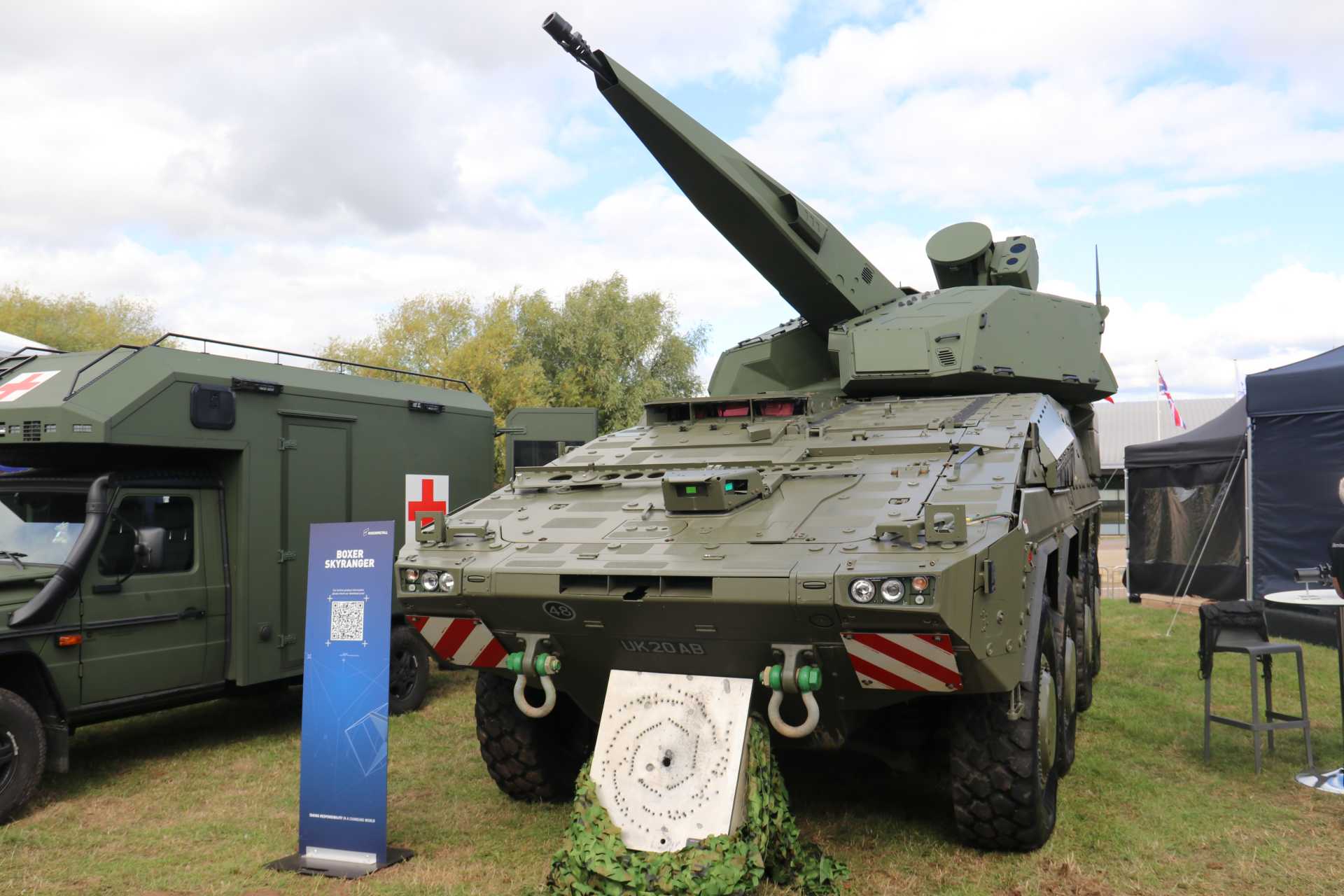
Boxer Skyranger 30: Germany’s Boxer Skyranger 30 is a mobile short-range air-defense vehicle combining a 30 mm KCE revolver cannon, programmable AHEAD airburst ammunition, integrated radar and electro-optical sensors, and short-range missiles to protect maneuver forces against drones, helicopters, and other low-altitude threats. (Picture source: Army Recognition Group)
Germany ordered one verification vehicle and 18 production Boxer Skyranger 30 systems under a €595 million contract awarded in February 2024, with an option for another 30. Rheinmetall delivered the verification vehicle at the end of January 2025 for Bundeswehr qualification work, while serial deliveries are scheduled primarily for 2027 and early 2028.
The Boxer gives the system the mobility and protection needed to accompany mechanized forces rather than defend only fixed positions. Rheinmetall previously demonstrated a functional Skyranger 30 firing both from stationary positions and while moving during trials in Switzerland, an important characteristic for an air-defense vehicle expected to remain close to maneuver units and reposition rapidly under threat.
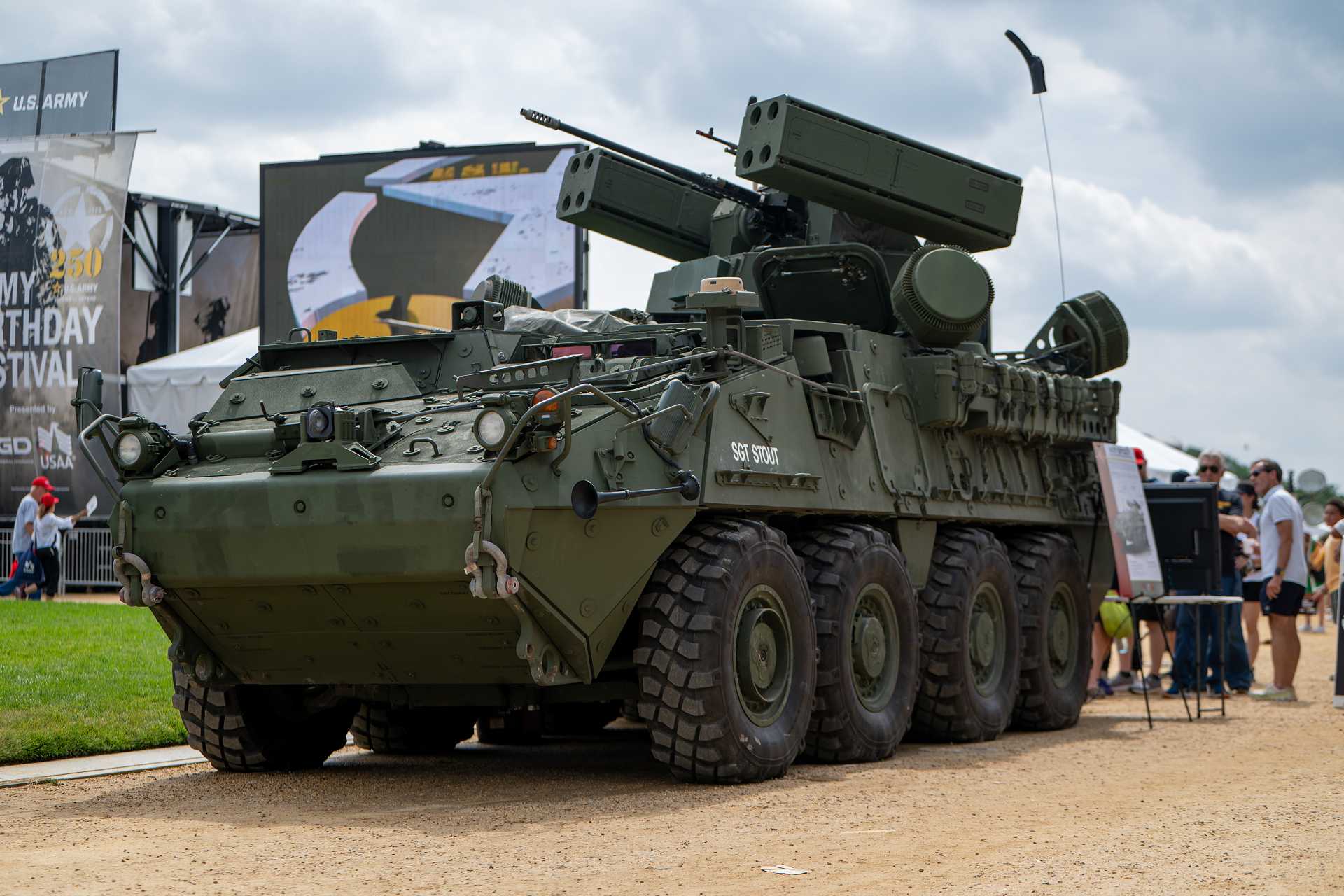
SGT Stout M-SHORAD: The U.S. Army’s SGT Stout M-SHORAD is a Stryker A1-based mobile air-defense vehicle armed with an XM914 30 mm cannon, Stinger missiles and Longbow Hellfire missiles, supported by onboard radars and electro-optical sensors to defend brigade combat teams against unmanned aircraft and other low-flying threats. (Picture source U.S. Department of War/Defense)
The U.S. Army’s SGT Stout addresses the same operational requirement through the Stryker A1 armored vehicle. Formerly designated M-SHORAD, it is intended to protect brigade combat teams against unmanned aircraft, helicopters, and fixed-wing aircraft while retaining the mobility required to operate alongside ground formations.
Its Increment 1 weapons configuration combines an XM914 30 mm cannon, an M240 7.62 mm machine gun, four Stinger missiles and two Longbow Hellfire missiles. The Army also integrated electro-optical and infrared sights, identification friend-or-foe equipment, Multi-Mission Hemispheric Radars, and Forward Area Air Defense Command and Control connectivity into the Stryker-based air-defense system.
The four hemispheric radars provide continuous coverage around the vehicle, while the electro-optical system supports identification and engagement. SGT Stout can also receive information from other Army sensors, allowing it to operate as part of a larger short-range air-defense network rather than relying exclusively on what its own crew can detect. The XM914 provides an additional option for engaging smaller Group 1 and Group 2 unmanned aircraft at close range while preserving Stinger missiles for aerial targets requiring greater reach or a guided interceptor.
The U.S. system has moved beyond development into operational units. Fielding began with the 5th Battalion, 4th Air Defense Artillery Regiment in Germany in 2021, followed by the 4th Battalion, 60th Air Defense Artillery Regiment beginning in 2023. Its operational maturation has continued through exercises, including live Stinger firings from SGT Stout during multinational training in Europe and subsequent U.S.-based events.
The most important technical difference between the two approaches is the relative weight placed on cannon-based counter-drone fire. Skyranger 30 was designed from the outset around programmable 30 mm airburst ammunition as a core short-range air-defense effector, particularly against small drones, with missiles adding another engagement layer.
SGT Stout instead emerged as a multi-effector U.S. Army solution combining Stinger, Hellfire, and conventional 30 mm fire within one Stryker-based weapon system. Its architecture places significant emphasis on integrating with existing U.S. Army sensors, command-and-control systems, and brigade formations, although the distinction between the two approaches is narrowing.
The U.S. Army is working to integrate 30 mm Multi-Mode Proximity Airburst ammunition and associated software modifications into SGT Stout as part of later M-SHORAD development. That would strengthen its ability to defeat small aerial targets with the cannon and move the U.S. system closer to the engagement logic already used by Skyranger 30 with AHEAD ammunition. The Army is also pursuing a future Stinger replacement, indicating that SGT Stout will continue evolving as both drone threats and interceptor requirements change.
Neither vehicle removes the need for medium- or long-range air defense. Their purpose is to cover the close-range layer around maneuver formations, where drones, helicopters, and other low-altitude threats can appear quickly and where heavier air-defense systems may not be positioned to respond to every contact. This creates an ammunition problem as much as a detection problem, because a force facing repeated reconnaissance drones, one-way attack unmanned aircraft and loitering munitions cannot depend exclusively on relatively expensive missiles.
The 30 mm cannon therefore becomes increasingly important because it gives crews an additional kinetic option with a deeper onboard ammunition reserve. Programmable or proximity-fuzed ammunition can further improve effectiveness against small aerial targets that are difficult to hit with conventional impact-fuzed rounds, while missiles remain available for threats that require greater range, maneuverability or engagement certainty.
Mobility is equally critical. Air-defense vehicles protecting armored formations must repeatedly reposition, survive artillery and drone observation, and stay close enough to tanks, infantry fighting vehicles and command elements to protect them throughout movement. Boxer and Stryker provide that armored mobility while carrying their own radars, optical sensors, and weapons, reducing dependence on fixed firing positions and allowing short-range air defense to follow the maneuver formation.
Germany and the United States are therefore reaching similar operational conclusions through different system designs. Boxer Skyranger 30 combines programmable airburst cannon fire with modular missiles in a vehicle optimized around short-range air defense, while SGT Stout integrates several U.S. weapons and sensors onto an established Stryker chassis already operating with Army units.
The evolution of both systems also shows how rapidly counter-drone requirements are reshaping ground-based air defense. Germany is moving toward serial Skyranger 30 deliveries as Rheinmetall expands the system across European users, while the U.S. Army is modifying the already-fielded SGT Stout with new ammunition and future interceptors.
For maneuver forces, the operational objective is increasingly clear: mobile air-defense vehicles must detect and engage large numbers of low-altitude threats without consuming a guided missile against every drone. Boxer Skyranger 30 and SGT Stout represent two different solutions to that requirement, but both point toward a layered combination of armored mobility, autonomous sensors, cannon-based counter-drone fire, and short-range missiles as a central element of battlefield protection.
Explore More Defense News
• Land Defense News
• Naval Defense News
• Defense Aerospace News
Written by Alain Servaes – Chief Editor, Army Recognition Group
Alain Servaes is a former infantry non-commissioned officer and the founder of Army Recognition. With over 20 years in defense journalism, he provides expert analysis on military equipment, NATO operations, and the global defense industry.
-
North Korea Tests Ballistic Missile With 700 Km Flight That May Mask Longer Range Strike Capability
{loadposition bannertop}{loadposition sidebarpub}
North Korea launched a ballistic missile from the Wonsan area on October 3 that travelled about 700 kilometers before falling into the East Sea. While the observed distance is compatible with deployed Hwasong-11 tactical missiles, Seoul is examining whether Pyongyang instead tested a longer-range system below its maximum reach.
North Korea fired a ballistic missile from Wonsan that covered approximately 700 kilometers before falling into the East Sea, leaving the weapon’s classification unresolved. The flight could correspond to a Hwasong-11tactical missile already in North Korean service, but South Korean authorities are also assessing whether the launch involved a longer-range missile deliberately restricted to a shorter trajectory, which would distinguish the test from Pyongyang’s regular short-range firings from its eastern coast.
Related News: North Korea Tests Ballistic Missile That Flies 700 Km Days Before US-South Korea Military ExerciseA North Korean KN-23 Hwasong-11Ga short-range ballistic missile during a launch. The missile fired on October 3 has not yet been identified and may belong to a different class. (Picture source: KCNA)
The known flight profile does not yet allow the system to be identified. Japan assessed that the missile reached a maximum altitude of about 90 kilometers over a distance of roughly 680 kilometers. These parameters could correspond to a short-range ballistic missile from the Hwasong-11 family, some variants of which are assessed at around 700 to 800 kilometers, but they are also compatible with a higher-category missile operated below its maximum reach.
According to South Korea’s Yonhap News Agency on October 3, 2026, the Joint Chiefs of Staff detected the missile at around 6:30 a.m. from Wonsan and recorded a flight of more than 700 kilometers. South Korean and U.S. authorities are still analyzing its characteristics. A government source cited by Yonhap said that an intermediate-range ballistic missile, or IRBM, fired over a reduced distance is among the scenarios under review and that the projectile appeared similar to the one launched from Wonsan on August 12.
The Hwasong-11 nevertheless remains an immediate point of comparison. This family of solid-fuel ballistic missiles, also known in Western reporting as the KN-23, includes several road-mobile variants designed to strike targets across the Korean Peninsula. During the August 12 launch, also conducted from Wonsan, the projectile travelled more than 700 kilometers, and early assessments considered a KN-23, credited with a maximum range of roughly 700 to 800 kilometers, as one possible match for the observed profile. The missile was never formally identified.
The September 20 test further complicates the assessment. Pyongyang launched from Wonsan a new system identified from North Korean imagery as the Hwasongpho-11Ma-1, likely a development of the Hwasong-11 family fitted with a hypersonic glide vehicle. Data visible on screens released by Pyongyang indicated a distance of 908.2 kilometers and an altitude of 35.8 kilometers after more than seven minutes of flight, a profile substantially lower than the roughly 90 kilometers observed on October 3. The two launches therefore cannot be directly treated as the same type of event.
The other possibility under examination by Seoul is an MRBM or IRBM fired over a reduced range. A medium-range ballistic missile generally covers between 1,000 and 3,000 kilometers, while an IRBM can reach approximately 3,000 to 5,500 kilometers. In that case, the roughly 700 kilometers recorded during the October 3 test would not represent the missile’s full reach but only the distance selected for the trial. Such a profile could be used to evaluate propulsion, guidance, stage separation, or terminal behavior without conducting a flight close to the weapon’s maximum range.
That possibility must be considered within an already diverse North Korean missile inventory. Pyongyang fields tactical Hwasong-11 missiles intended for targets in South Korea and nearby U.S. bases, intermediate-range systems capable of reaching much of the western Pacific, and intercontinental ballistic missiles such as the Hwasong-18 and Hwasong-19 designed for much longer distances. Recent development has therefore focused not only on extending range, but also on increasing the number of solid-fuel and road-mobile systems and introducing different flight profiles that complicate detection and interception.
The growing military relationship with Russia adds an operational dimension to this development. North Korea has supplied Moscow with missiles from the Hwasong-11 family that have been used against targets in Ukraine, giving Pyongyang access to data from wartime employment against air-defense, electronic-warfare, and warning networks. Available information does not establish that Russia directly contributed to the missile launched on October 3, but experience gathered from the war in Ukraine can provide North Korea with feedback on accuracy, navigation, reliability, and the employment of mobile missile systems.
For U.S., South Korean, and Japanese forces, the difference between these scenarios is not merely technical. A KN-23 operating near its maximum range remains primarily a threat to the Korean Peninsula and nearby military installations. An MRBM or IRBM deliberately flown over a shorter distance would instead mean that the observed profile masks a much wider engagement area. That distinction affects warning times, surveillance priorities and the way missile-defense architectures must classify the threat during the opening phase of flight.
The October 3 launch therefore does not yet demonstrate the appearance of a new longer-range missile. It shows instead that the recorded distance alone is no longer sufficient to determine the class of weapon used by Pyongyang. A Hwasong-11 remains compatible with the available data, but the absence of a South Korean classification and the officially examined possibility of an MRBM or IRBM flown at reduced range justify treating this launch separately from North Korea’s more routine tactical missile tests. For Washington, Seoul and Tokyo, identifying the missile family will help determine whether Pyongyang tested another tactical variant or is continuing a less visible development effort involving its intermediate-range systems.
Written By Erwan Halna du Fretay - Defense Analyst, Army Recognition Group
Erwan Halna du Fretay holds a Master’s degree in International Relations and has experience studying conflicts and global arms transfers. His research interests include security and strategic studies, particularly the dynamics of the defense industry, the evolution of military technologies, and the strategic transformation of armed forces.
-
Shield AI Creates US X-BAT Network to Shift Autonomous Fighter From Prototype to Operational Fleet
{loadposition bannertop}{loadposition sidebarpub}
Shield AI has established a three-state U.S. industrial network for its X-BAT autonomous vertical takeoff and landing combat aircraft, assigning production to Washington state, flight testing and fleet support to Kansas, and prototyping to Texas. The arrangement creates a defined domestic structure covering the aircraft’s development, delivery, and long-term sustainment across three dedicated sites.
Shield AI is dividing the X-BAT program across facilities in Washington, Kansas, and Texas as it organizes the aircraft’s path from development to operational support. Washington will host production, Kansas will handle flight testing and fleet sustainment, and Texas will remain responsible for prototyping activities. The structure assigns each location a separate role while linking the program’s development, delivery, and future support within the United States.
Related News: U.S. Shield AI Moves X-BAT Unmanned Fighter Toward Production in Poland for NATOShield AI’s X-BAT autonomous combat aircraft is designed for vertical takeoff and landing from dispersed land and maritime sites without conventional runways. (Picture source: Shield AI)
Series-production aircraft will be assembled at X-Forge 3 in Des Moines, Washington, south of Seattle. Shield AI has already signed the lease for the site and started building out the facility, while recruitment linked to the program is now focusing on the region. The company said it selected Washington after assessing several locations, citing in particular the concentration of aerospace skills in the Puget Sound area. King County alone has more than 45,000 aerospace workers across more than 400 companies, while the state has a network of more than 1,500 aerospace and space-related suppliers.
After assembly, X-BAT aircraft will be transferred to X-Forge 2 at Newton City-County Airport in Kansas, where each aircraft will undergo production acceptance testing before delivery. Future customers will also be able to conduct their own acceptance flights from Newton, giving the site a direct role in the handover process to operators. Shield AI also plans to conduct development flight testing there and establish the maintenance, repair, and overhaul center for the entire X-BAT fleet.
The company currently leases hangar and office space and approximately 10 acres at Newton City-County Airport. It is working with the City of Newton and Harvey County to expand the site and develop a larger hangar. Shield AI selected Newton in 2025, when the X-BAT design was first presented publicly, but the role assigned to the location is now broader with the addition of long-term sustainment and MRO activities. This structure is intended to retain at the same location the expertise developed during flight testing and later required to support aircraft throughout their service life.
Frisco, Texas, will remain X-Forge 1 and continue to serve as the program's prototyping center, while also hosting activities related to the V-BAT unmanned aircraft. The industrial structure is therefore divided among three complementary hubs, with Texas focused on prototypes, Washington on series manufacturing, and Kansas on testing, acceptance and fleet support. Shield AI continues to target the start of X-BAT production in 2029, followed by a progression toward full-rate production in the early 2030s.
According to the economic analysis released by the company, the Newton and Seattle-area facilities could support about 9,800 jobs by the early 2030s and generate approximately $78 billion in combined economic activity through 2046. In the Newton area, the program could support around 1,800 jobs in the early 2030s and 2,900 by 2046, with close to $5 billion in regional economic activity. In the Seattle-Tacoma-Bellevue area, Shield AI estimates that the program could support about 8,000 jobs in the early 2030s and as many as 27,000 by 2046, with roughly $73 billion in economic activity over the period. These projections include direct Shield AI employment, supplier jobs and activity generated by local spending from both groups.
The X-BAT is being developed as an uncrewed multirole combat aircraft intended to operate without conventional runways. Shield AI states that the aircraft is designed for a combat radius of about 1,000 nautical miles, or roughly 1,850 kilometers, and will include internal weapons bays sized for weapons in the 2,000-pound class, or around 907 kilograms. The aircraft is expected to use GE Aerospace's F110 engine and Shield AI's Hivemind autonomy system, which is designed to support mission execution when communications or GPS signals are degraded or unavailable.
This configuration is intended to allow the X-BAT to perform air-to-air, air-to-surface, electronic warfare, and intelligence, surveillance, and reconnaissance missions while reducing dependence on large fixed air bases. Its vertical takeoff and landing capability is intended to support operations from surface vessels, dispersed land sites, or locations without long runways. In an environment where airfields, fuel depots and support infrastructure may be targeted during the opening phases of a conflict, dispersing combat aircraft across smaller operating locations could complicate opposing targeting and help preserve sortie generation.
Shield AI's industrial announcement also comes as the company seeks to expand international interest in the program. The X-BAT has already been linked to industrial discussions in Europe, including with Poland, while its VTOL configuration corresponds to dispersal requirements being examined on NATO's eastern flank and in the Indo-Pacific. For U.S. and allied forces, the ability to deploy autonomous combat aircraft from locations without conventional runways could provide an additional option in theaters where air bases are scarce, distant, or exposed. The establishment of sites in Texas, Washington, and Kansas now gives the program a defined industrial chain covering prototyping, production, testing, delivery, and long-term sustainment.
Written By Erwan Halna du Fretay - Defense Analyst, Army Recognition Group
Erwan Halna du Fretay holds a Master’s degree in International Relations and has experience studying conflicts and global arms transfers. His research interests include security and strategic studies, particularly the dynamics of the defense industry, the evolution of military technologies, and the strategic transformation of armed forces.
-
Northrop Grumman Quadruples US Semiconductor Output for Radars Fighters Satellites and EW Systems
{loadposition bannertop}{loadposition sidebarpub}
Northrop Grumman plans to quadruple semiconductor production in the United States by 2030 to expand domestic microelectronics capacity for U.S. military systems. The components support radars, electronic warfare systems, military communications, satellites, and combat aircraft by providing signal-processing and onboard control functions.
Northrop Grumman is expanding U.S. semiconductor manufacturing to increase the domestic supply of microelectronics used across several categories of military equipment. The production increase targets components embedded in radar, electronic warfare, communications, space, and combat aviation systems, where they process signals and control onboard functions. By 2030, the company expects its U.S. semiconductor output to reach four times its current level.
Related News: U.S. F-35 fighter jet with AN/APG-81 radar invisible destroyer before visual contactA U.S. F-35B Lightning II alongside the AN/APG-81 AESA radar, one of the military systems supported by specialized semiconductor technologies used for sensing, signal processing, and electronic warfare functions. (Picture source: US DoD/Northrop Grumman)
For the U.S. armed forces, the issue extends beyond the availability of basic electronic components. A modern radar must rapidly process signals received by its antenna, distinguish targets from background electromagnetic activity, and transmit the resulting data to other mission systems. An electronic warfare suite must detect adversary emissions, identify them and, when required, support jamming or other countermeasures. Satellites and combat aircraft perform similar processing tasks while operating under additional constraints related to weight, electrical power, temperature and available space.
In a publication released on October 2, 2026, Northrop Grumman said its U.S. production capacity is expected to increase fourfold by the end of the decade. Its Microelectronics Center includes two semiconductor foundries in California and Maryland and an advanced packaging facility in Florida, all accredited by the U.S. government. The company says it already designs, manufactures, assembles, tests, and packages several million microelectronic components each year.
Northrop Grumman's semiconductor activity directly supports military radar applications. The company produces the AN/APG-81 radar used by the F-35 Lightning II, which performs air-to-air and air-to-ground missions, synthetic aperture radar mapping, and certain electronic warfare functions. It also supplies the AN/TPS-80 Ground/Air Task Oriented Radar, or G/ATOR, to the U.S. Marine Corps. This ground-based active electronically scanned array radar can detect aircraft and determine the point of origin of rocket, artillery and mortar fire. G/ATOR uses gallium nitride, or GaN, components suited to high-power and high-frequency applications.
The company's production is not limited to conventional silicon semiconductors. Its facilities also work with gallium nitride, gallium arsenide and indium phosphide. These compound semiconductor materials are used in radio-frequency circuits for applications such as high-frequency radar, satellite communications and power amplification. At Redondo Beach in California, Northrop Grumman manufactures monolithic microwave integrated circuits for radar and telecommunications applications.
Packaging is another part of the production chain. A fabricated chip cannot be installed directly into a radar or satellite. It must be assembled, connected to other components, protected and integrated into an electronic package able to withstand the operating conditions of the military system. Northrop Grumman uses three-dimensional stacking techniques to combine multiple functions within a smaller volume. For aircraft, drones or satellites, this can allow more processing capacity to be installed without increasing weight, occupied space and power demand at the same rate.
Operationally, these microelectronics sit between the point at which a sensor receives a signal and the point at which a crew or weapon system can use the resulting information. In an AESA radar, they contribute to generating, receiving and processing electromagnetic signals. In electronic warfare equipment, they help detect and characterize emissions across the spectrum. In satellites and communications networks, they support the processing and transfer of data. On aircraft such as the F-35, these functions feed target detection, tracking, situational awareness and parts of the electronic warfare mission. Increasing domestic production capacity therefore also reduces exposure to shortages affecting components located far upstream in the military supply chain.
The U.S. defense industry does not depend on Northrop Grumman alone for these components. The Department of Defense relies on a broader network of domestic manufacturers and accredited suppliers. GlobalFoundries, for example, produces silicon semiconductors in the United States for military and aerospace applications under agreements with the Pentagon, while the Defense Microelectronics Activity oversees access to trusted suppliers and manufacturing processes for selected sensitive systems.
The broader vulnerability becomes clearer when the supply chain is considered globally. According to the U.S. Government Accountability Office, around three-quarters of semiconductors were still manufactured and packaged in Asia in 2022, with some categories of logic and memory chips heavily concentrated in Taiwan and South Korea. The U.S. Department of Commerce has separately estimated that the American share of global wafer fabrication capacity fell from 37 percent in 1990 to less than 10 percent in 2024. Northrop Grumman itself has cited Taiwan's position in the semiconductor supply chain and tensions involving China among the reasons for expanding U.S. capacity.
The fourfold increase should therefore also be viewed in the context of the broader technological competition between Washington and Beijing. A crisis around Taiwan could disrupt semiconductor supply chains, affecting not only civilian computing but also aerospace, space and defense industries. Expanding domestic production of specialized semiconductors and advanced packaging does not eliminate U.S. dependence on international suppliers, as raw materials, manufacturing equipment and other components remain part of global supply networks. It does, however, reduce exposure in selected areas tied directly to radar, electronic warfare, secure communications, and military sensors, making semiconductor production an increasingly relevant part of defense industrial resilience and operational readiness.
Written By Erwan Halna du Fretay - Defense Analyst, Army Recognition Group
Erwan Halna du Fretay holds a Master’s degree in International Relations and has experience studying conflicts and global arms transfers. His research interests include security and strategic studies, particularly the dynamics of the defense industry, the evolution of military technologies, and the strategic transformation of armed forces.
-
U.S. Special Forces refine combat diving to improve covert maritime access to defended coastlines
{loadposition bannertop}{loadposition sidebarpub}
U.S. Army special operations forces are training at Naval Air Station Key West in Florida to improve maritime infiltration skills through the six-week Combat Diver Qualification Course. Overseen by the 2nd Special Warfare Training Group (Airborne), the course prepares U.S. Special Forces, other special operations personnel, and selected foreign troops to conduct maritime missions where conventional access routes are too exposed or difficult to use.
U.S. Army special operations forces are developing surface and subsurface access capabilities through combat diver training at Naval Air Station Key West. The six-week qualification course, conducted under the 2nd Special Warfare Training Group (Airborne), brings together Special Forces soldiers, personnel from other U.S. special operations components, and selected foreign troops. Training is intended to prepare them for maritime missions requiring alternatives to conventional approaches that may be exposed or difficult to employ.
Related News: German Rotinor Displays Black Shadow Combat Diver Jet with 20 km Range for Special OperationsA U.S. Army Special Forces Combat Diver Qualification Course student conducts open-circuit scuba training off NAS Key West, Florida, in February 2026. (Picture source: US DoD)
The Special Forces Underwater Operations school in Key West covers a broader range of skills than military diving alone. Students train in surface and subsurface infiltration and exfiltration, beginning in a controlled environment before moving into open water, then combining diving with airborne insertion, helocasting, and small-boat operations. This progression addresses a specific special operations requirement: reaching an objective from an unexpected direction while reducing the physical and visual signature of the unit.
In an article published on October 2, 2026, the U.S. Army detailed how the John F. Kennedy Special Warfare Center and School organizes this training and prepares selected personnel in open-circuit and closed-circuit diving, underwater navigation, and maritime infiltration. The objective is to produce divers able to operate in complex coastal environments while retaining the skills required to transition from maritime insertion to operations ashore.
Candidates arrive after completing demanding preparation. Each Special Forces group conducts its own Maritime Assessment Course and combat diver preparation before issuing the validation required to attend the qualification course. Once in Key West, students complete a U.S. Army fitness test, receive and inspect their equipment, and enter the pool on the second day. The school uses a renovated 62,000-cubic-foot pool, approximately 1,755 cubic meters, to teach emergency procedures and basic techniques before exposing divers to currents, limited visibility, and other conditions encountered at sea.
The first two weeks focus on basic open-circuit diving, including emergency procedures and an individual confidence test designed to determine whether a diver can resolve equipment problems underwater without losing control of the situation. Students then move into advanced training that includes deep dives. They also study diving physics and physiology, marine hazards, tides and currents, all of which become important when an infiltration requires a team to travel a substantial distance underwater rather than simply leave a surface vessel or craft.
A new phase begins during the third week with closed-circuit diving using a Lung Activated Rebreather. Unlike conventional open-circuit equipment, which releases exhaled gas directly into the surrounding water, a closed-circuit rebreather recycles part of the breathing gas. This reduces bubble production and therefore the diver’s visual signature, which can be useful during a discreet approach toward a monitored coastline. The U.S. Army article does not identify the exact Lung Activated Rebreather variant used during the course, so the performance characteristics of a specific model cannot be attributed with certainty to the equipment shown.
Students learn to assemble, maintain and test their rebreathers before leaving the pool for the ocean. Navigation then becomes a two-person task. One diver follows the route using a compass board, while the second monitors obstacles and the immediate surroundings. During the fourth and fifth weeks, these individual skills are integrated into eight-to-12-person elements conducting advanced closed-circuit dives and beach landing site infiltrations by day and night. The increase in scale is operationally relevant because an infiltration must deliver the full detachment to shore while maintaining cohesion and preserving enough physical capacity to continue the mission on land.
The tactical value of the course lies in combining several insertion methods rather than treating combat diving as an isolated skill. Students train in surface infiltration using Combat Rubber Raiding Craft, conduct parachute jumps into the Sgt. Maj. Jerry D. Patton Water Drop Zone and perform helocast insertions from helicopters before continuing their movement on or below the water. The course ends with a three-day tactical exercise combining a combat dive infiltration, movement toward a guerrilla base and a subsequent dive linked to a raid. In practical terms, qualified personnel can shift between airborne, surface and subsurface approaches depending on coastal defenses, geography and the level of surveillance around the objective.
This flexibility is increasingly relevant as maritime approaches are monitored by coastal radars, uncrewed systems and persistent sensor networks. Subsurface infiltration does not eliminate those threats, but it gives U.S. special operations forces another option for approaching islands, ports or defended coastlines without relying exclusively on aircraft or conventional landing craft. Training selected foreign personnel at Key West also supports the use of common procedures with U.S. forces. As military competition places greater emphasis on littoral zones and strategic waterways, the ability to move from air to sea and then below the surface remains a distinct access option that cannot be fully replaced by stand-off weapons or uncrewed systems.
Written By Erwan Halna du Fretay - Defense Analyst, Army Recognition Group
Erwan Halna du Fretay holds a Master’s degree in International Relations and has experience studying conflicts and global arms transfers. His research interests include security and strategic studies, particularly the dynamics of the defense industry, the evolution of military technologies, and the strategic transformation of armed forces.
-
Norwegian Special Forces Sharpen Arctic Maritime Skills as NATO Strengthens High North Defense
{loadposition bannertop}{loadposition sidebarpub}
Norway’s Marinejegerkommandoen is training Special Boat Operators to move and support special operations forces through Arctic coastal waters, sustaining a capability increasingly important to NATO operations in the High North. Norway’s Armed Forces describe these operators as specialists in maritime mobility able to handle demanding missions at sea and along the coast, where cold, rough seas and limited access can constrain conventional forces.
The training prepares crews to operate specialized boats and sensor-equipped platforms in severe Arctic conditions while inserting, supporting and extracting special operations teams. This gives Norway and allied forces a highly mobile maritime option for reconnaissance, raids and other missions across northern littoral areas where speed, survivability and access can determine operational success.
Related Topic: U.S. Army Green Berets Demonstrate Special Forces Arctic Operations Capability in Alaska
Norwegian Marinejegerkommandoen (MJK) Special Boat Operators train for maritime special operations in challenging Arctic conditions along Norway’s coast. (Picture Source: NATO Allied SOF Command SOFCOM).
NATO Allied Special Operations Forces Command highlighted the training on October 2, 2026, showing Norwegian MJK Special Boat Operators working at sea and along the coast in challenging Arctic conditions. The activity is significant as NATO places greater operational emphasis on the Arctic and North Atlantic, where Norway occupies a strategic position between northern Europe, the Norwegian Sea and the maritime approaches linking Europe with North America.
Marinejegerkommandoen is Norway’s maritime special operations force and belongs to Forsvarets spesialstyrker, the Norwegian Armed Forces’ special operations organization. Mainly located in Bergen and Ramsund, MJK operates across the maritime, land, and air domains and trains two principal categories of special operators: marine commandos and dedicated Special Boat Operators, known in Norwegian service as spesialbåtoperatører.
The Special Boat Operators provide more than small-craft transport. Norwegian military information describes them as crews operating different surface vessels and increasingly advanced sensor systems in support of maritime special operations. Their role combines maritime maneuver, navigation, technical expertise and the ability to support special operations teams moving between sea and shore.
Arctic conditions make those tasks particularly demanding. MJK personnel must work in darkness, cold, wet weather, and rough seas while maintaining navigation, communications, and mission effectiveness. In such an environment, crew endurance and equipment reliability directly affect whether a team can approach a coastline, complete an insertion or extraction and return safely from the mission area.
Norway’s geography gives these skills clear operational relevance. Its northern coastline is shaped by fjords, islands, narrow waterways and exposed seas, creating areas where large naval vessels may not provide the access or discretion required for a special operation. Specialized small craft can instead move teams through confined waters, approach difficult coastlines and support surveillance, reconnaissance or other missions without depending on major port infrastructure.
The wider NATO context increases the importance of that capability. In February 2026, NATO launched Arctic Sentry, a multi-domain activity designed to strengthen deterrence and defense by bringing Allied and national activities in the Arctic and High North into a more coherent operational approach. NATO says Joint Force Command Norfolk leads the initiative, which is intended to improve the Alliance’s ability to operate across the region.
This does not mean that the October 2 MJK training was conducted as part of Arctic Sentry. NATO SOFCOM presented the activity as Norwegian special operations training, not as an Arctic Sentry mission. Its relevance lies in the capability being exercised at a time when NATO is increasing its focus on Arctic readiness and the defense of the northern approaches.
JFC Norfolk gives that broader effort a direct transatlantic dimension. NATO says the command coordinates Arctic Sentry with Allied Command Transformation and works alongside the U.S.-Canadian NORAD, U.S. Northern Command and U.S. European Command. That structure connects northern European security with the wider military architecture responsible for protecting the routes and forces linking North America and Europe.
For U.S. and European forces, those maritime connections matter because reinforcement across the North Atlantic remains fundamental to NATO defense planning. Large naval and air forces would carry much of that burden in a crisis, but special operations units can provide capabilities in coastal areas where reconnaissance, surveillance, discreet movement or access to confined waters may require smaller and more specialized forces.
MJK’s Arctic expertise therefore fills a niche that is difficult to reproduce quickly. Operating a small combat craft in temperate waters differs from maintaining navigation, sensors, communications, and personnel effectiveness when cold weather, darkness, and deteriorating sea conditions affect both the crew and its equipment. Sustained Arctic training converts environmental familiarity into a military capability.
Norway is also reinforcing the structure supporting maritime special operations in the north. In June 2025, the Norwegian Armed Forces confirmed that work was underway to establish a fourth Special Operations Task Group at Ramsund, with development covering personnel, competence, infrastructure and facilities. The force is being built from Ramsund naval station, with the Norwegian Armed Forces saying full operational capability is planned for 2028.
Ramsund is particularly important because it is the Royal Norwegian Navy’s main base in northern Norway and already hosts MJK training and exercise facilities in an Arctic climate. The base supports naval forces operating increasingly frequently and for longer periods north of the Arctic Circle, giving Norwegian special operations forces direct access to the environment in which northern maritime missions would be conducted.
The fourth SOTG gives the current training a deeper structural context. Norway is not only maintaining individual operator skills but is also expanding the organization, infrastructure, and personnel base needed to sustain maritime special operations from its northern territory. That development provides a more concrete indicator of long-term capability growth than the training event alone.
NATO’s increasing attention to the Arctic adds strategic weight to that investment. NATO created Arctic Sentry against a backdrop of increased Russian military activity and growing Chinese interest in the region, according to NATO, while exercises such as Norway’s Cold Response are being incorporated into a wider Allied approach to Arctic operations.
For Norway, however, the immediate military requirement remains practical: maintaining forces that can operate reliably along its own coastline and in northern waters regardless of weather and terrain. MJK’s Special Boat Operators contribute to that requirement by combining specialized vessels, sensors, and crews trained to support special operations teams where conventional naval forces may have less flexibility.
The October 2, 2026, training therefore does not represent a new NATO mission or a newly introduced Norwegian capability. It demonstrates the continued development of an established national specialization whose value is increasing as the Arctic becomes more important to Allied defense planning.
For U.S. and European Allies, that specialization provides access to personnel already accustomed to one of NATO’s most demanding maritime environments. As Norway develops the fourth SOTG at Ramsund and NATO expands its operational focus across the High North, MJK’s Special Boat Operators form a small but specialized component of the wider military effort to preserve mobility, situational awareness, and operational access along NATO’s northern flank.
Explore More Defense News
• Land Defense News
• Naval Defense News
• Defense Aerospace News
Written by Alain Servaes – Chief Editor, Army Recognition Group
Alain Servaes is a former infantry non-commissioned officer and the founder of Army Recognition. With over 20 years in defense journalism, he provides expert analysis on military equipment, NATO operations, and the global defense industry.
-
U.S. Army 2d Cavalry Conducts First Live FPV Drone Strike as It Adapts for Modern Warfare
{loadposition bannertop}{loadposition sidebarpub}
The U.S. Army’s 2d Cavalry Regiment has conducted its first live strike with a Purpose-Built Attritable System (PBAS), moving the unit’s small first-person-view drones from experimentation against simulated targets toward live-fire employment. Soldiers from 1st Squadron carried out the strike at Grafenwoehr Training Area in Germany on September 30, 2026, demonstrating an organic precision-attack capability intended to place low-cost unmanned aircraft directly in the hands of maneuver formations.
The U.S. Army described the event as the first PBAS live strike for the 2d Cavalry Regiment, rather than the first such strike Army-wide. Imagery released on October 2 shows soldiers preparing and recovering the unmanned aircraft and monitoring a live PBAS video feed, illustrating the sensor-to-strike workflow that small units are increasingly expected to execute without depending exclusively on higher-echelon fires.
Related Topic: U.S. Army Evaluates AMPV 30mm Armored Vehicle With Counter Drone and Target Handoff SystemsU.S. Army Soldiers from the 1st Squadron, 2d Cavalry Regiment, conduct a Purpose-Built Attritable System (PBAS) live-fire strike at Grafenwoehr Training Area in Germany on September 30, 2026. (Picture source: U.S. DEpartment of War/Defense)
The PBAS (Purpose-Built Attritable System) is the U.S. Army’s emerging family of low-cost, expendable small unmanned aircraft designed to give maneuver forces their own reconnaissance and precision-effects capability. Army fiscal year 2027 budget documents describe PBAS as an attritable, consumable munition intended to conduct reconnaissance and surveillance, improve commanders’ understanding of enemy dispositions and terrain, and increase the precision of lethal payload employment while reducing risks to friendly troops.
The U.S. Army’s earlier fiscal year 2026 documentation specified a minimum PBAS range of 2 km and endurance of at least 15 minutes. The baseline system included FPV goggles, a controller, a leader display, two 10-inch unmanned aircraft, and four 5-inch aircraft capable of accepting modular payloads, including lethal and non-lethal effects.
That configuration gives platoon-level soldiers a comparatively lightweight way to combine surveillance and direct attack in the same tactical cycle. Instead of detecting a target and passing its location through several command levels before another weapon engages it, an FPV-equipped team can potentially observe the objective through the aircraft’s camera, maneuver toward it, and deliver an effect with the same small unmanned system.
The U.S. Army has specifically identified one-way attack as a PBAS configuration alongside small-UAS-delivered munitions. Its armament portfolio lists potential target sets including personnel, vehicles, structures, armor, hostile unmanned aircraft, and other materiel, although the Army has not publicly identified the precise drone model, warhead, or target 1st Squadron used during the Grafenwoehr strike.
The September 30 event therefore represents an important progression from 2CR’s earlier drone work in Germany. During Saber Junction 25 in September 2025, soldiers from the regiment used PBAS aircraft against simulated enemy vehicles and forces at the Joint Multinational Readiness Center in Hohenfels, while the unit also built drones and developed tactics for their employment.
The U.S. Army reporting from the same period showed that the service intended PBAS to become more than a specialized experimental capability. During FPV drone training in Germany, the Army said it was working toward mass production of FPV/PBAS (First Person View) systems and eventual fielding across formations, with one system then estimated at approximately $35,000 and individual aircraft potentially costing around $5,000 depending on configuration. Those figures reflected the Army’s 2025 training configuration and should not be interpreted as a confirmed cost for the aircraft employed in the latest 2CR strike.
The emphasis on attritable systems reflects lessons drawn from the expanding use of inexpensive FPV drones in contemporary conflicts, where relatively low-cost unmanned aircraft can provide reconnaissance, attack exposed personnel and vehicles, or force opponents to spend disproportionately expensive resources on protection and interception. For U.S. maneuver units, the operational objective is not simply to add another drone but to compress the time between detecting a target and applying a precision effect.
The concept also changes the equipment available at the lowest tactical levels. The U.S. Army documentation indicates PBAS requirements have been approved for platoon-level use, which could place expendable reconnaissance and strike aircraft significantly closer to frontline soldiers than traditional aviation or artillery assets. [See our analysis of how the U.S. Army is expanding small attack drones at platoon level].
The program remains in development and integration rather than representing a fully mature, universally fielded Army weapon. PEO Soldier was designated the Army lead for PBAS in September 2025, while subsequent Army budget documents continued to fund integration, testing, evaluation, and modular mission-payload development. This distinction is important because individual Army formations are simultaneously experimenting with different aircraft, configurations, and soldier-developed solutions under the broader PBAS concept.
Other formations have already demonstrated how broad that approach can become. During U.S. Army Aviation Drone Summit activities in 2025, Army teams used small unmanned aircraft to attack light vehicles, personnel, and other drones, while the 173rd Aviation Brigade demonstrated a soldier-developed PBAS aircraft attacking an airborne drone. In 2026, the 101st Airborne Division also tested its domestically produced ABE 1.01 PBAS design as a low-cost system intended eventually to support precision strike as well as surveillance. [Read more about U.S. Army soldier-built FPV and attritable drone programs].
For the U.S. Army 2d Cavalry Regiment, the Grafenwoehr live strike is consequently less about proving that FPV drones can carry lethal payloads than about incorporating that capability into a forward-based U.S. combat formation in Europe. The regiment’s transition from assembling and employing PBAS drones against simulated forces in 2025 to conducting a live strike in 2026 indicates that the Army is progressively moving inexpensive unmanned attack systems from experimentation toward repeatable tactical employment.
That evolution is especially relevant in Europe, where U.S. forces must train for operations against opponents equipped with extensive electronic warfare, air defenses, artillery, and their own massed unmanned systems. An expendable drone that can be distributed to small units cannot replace artillery, missiles, or conventional aviation, but it can add another layer of reconnaissance and precision attack while letting commanders expose a relatively inexpensive aircraft rather than a soldier or a more costly weapon system.
The next measure of PBAS progress will be how consistently units can integrate these drones with reconnaissance, targeting, electronic warfare, and conventional fires under realistic battlefield conditions. The U.S. Army 2d Cavalry Regiment’s first PBAS live strike at Grafenwöhr shows this transition is already reaching operational units in Europe, giving soldiers a direct opportunity to refine the tactics, training, and command arrangements needed to turn low-cost FPV drones into a regular component of U.S. Army maneuver warfare.
Explore More Defense News
• Land Defense News
• Naval Defense News
• Defense Aerospace News
Written by Alain Servaes – Chief Editor, Army Recognition Group
Alain Servaes is a former infantry non-commissioned officer and the founder of Army Recognition. With over 20 years in defense journalism, he provides expert analysis on military equipment, NATO operations, and the global defense industry.
-
U.S. Army Conducts SGT STOUT Live-Fire Training in Germany to Strengthen Counter-Drone Readiness
{loadposition bannertop}{loadposition sidebarpub}
U.S. Army air defense crews conducted live-fire gunnery with SGT STOUT Maneuver Short-Range Air Defense vehicles in Germany to improve weapons handling and crew coordination. The training strengthens the ability of U.S. formations in Europe to keep mobile short-range air defense close to maneuver units exposed to drones and other low-altitude threats.
Soldiers from A Battery, 5th Battalion, 4th Air Defense Artillery Regiment operated the Stryker-based SGT STOUT during gunnery training at Grafenwoehr Training Area in Bavaria. The activity focused on preparing 52nd Air Defense Artillery Brigade crews to employ the system alongside ground formations, using its 30 mm cannon, Stinger missiles, and onboard sensors to support mobile air defense missions in Europe.
Related News: U.S. Army Deploys SGT STOUT Air Defense Vehicle to Shield Howitzers From Drone StrikesA U.S. Army SGT STOUT returns from a firing position during live-fire gunnery at Grafenwoehr Training Area in Germany on September 29, 2026. (Picture source: US DoD)
Images published by the U.S. Department of War on October 2 show several SGT STOUT vehicles maneuvering during the training as well as crews conducting weapon-clearing procedures. According to information provided by the U.S. Army, the event was intended to improve weapons proficiency and coordination among SGT STOUT crews during live-fire training. The images do not specify the exact type of targets engaged. The activity comes as the 5-4 ADA regularly employs the system in mobile air defense and counter-drone missions during exercises conducted in Europe.
The training follows the unit’s participation in Saber Junction 26, during which the same battalion integrated SGT STOUT vehicles with the 173rd Mobile Brigade Combat Team Airborne at the Joint Multinational Readiness Center in Hohenfels. During the exercise, held from August 15 to September 13, air defense units protected artillery positions against simulated drones and other aerial threats used for reconnaissance and strike targeting. The U.S. Army notably paired SGT STOUT teams with artillery units operating M119A3 howitzers to provide close protection while the guns occupied firing positions.
Built on a Stryker A1 chassis, the SGT STOUT combines the mobility of a wheeled armored vehicle with a short-range air defense architecture intended to accompany maneuver units. Its Reconfigurable Integrated-weapons Platform turret includes an XM914 30 mm cannon, a coaxial 7.62 mm M240 machine gun, and a Stinger Vehicle Universal Launcher capable of carrying four FIM-92 Stinger missiles. The vehicle also carries electro-optical and infrared sensors along with four Multi-Mission Hemispheric Radars positioned around the turret to provide 360-degree surveillance and detect aerial threats near the formation.
This combination of sensors and effectors allows the crew to select a response according to the type of threat detected. U.S. Army Air Defense Artillery personnel have indicated that the MHR radars can monitor local airspace out to approximately 10 km under suitable conditions. Connected to the Forward Area Air Defense Command and Control system, they can pass a track to the crew and cue the weapon system toward the threat. This architecture complements longer-range radars such as Sentinel, whose coverage can be reduced by terrain, urban areas or other obstacles masking very-low-altitude flight paths.
The SGT STOUT’s counter-drone capability continued to evolve in 2026. Leonardo DRS announced on August 11 that an in-service system had defeated Group 1 and Group 2 drones during a U.S. government test campaign. According to the company, the capability was introduced through the system’s modular architecture without requiring replacement of the vehicle. Using the XM914 cannon against certain small aerial targets also provides an alternative to Stinger missiles, which remain better suited to threats requiring greater engagement range or terminal effect. This mix allows crews to preserve missile stocks when a threat can be addressed with 30 mm ammunition.
For maneuver units, the SGT STOUT is intended less as a fixed-site defense system than as an air defense element able to remain with the formations it protects. An artillery battery, command post or logistics element can become vulnerable once it remains in one location long enough to be detected by a reconnaissance drone. A nearby SGT STOUT can provide its own radar coverage, track low-altitude targets and engage them with either the cannon or available missiles. The live-fire training at Grafenwoehr therefore complements the employment observed during Saber Junction, where the system was directly integrated with ground formations rather than positioned as a separate air defense asset.
The training takes place as NATO armies reinvest in short-range air defense after decades of reduced capacity in this field. The war in Ukraine has shown how reconnaissance drones, first-person-view systems and loitering munitions can detect and strike artillery, logistics assets and command posts well beyond the immediate line of contact. For U.S. forces stationed in Europe, regular SGT STOUT crew training supports the return of mobile air defense directly alongside ground brigades. The Grafenwoehr gunnery reflects this shift at crew level, with personnel training to detect, track, and engage aerial threats while remaining able to move at the pace of the formations they protect.
Written By Erwan Halna du Fretay - Defense Analyst, Army Recognition Group
Erwan Halna du Fretay holds a Master’s degree in International Relations and has experience studying conflicts and global arms transfers. His research interests include security and strategic studies, particularly the dynamics of the defense industry, the evolution of military technologies, and the strategic transformation of armed forces.
-
Euro Security Products Offers Non-Lethal Tactical Gear for European Police and Military Operations
{loadposition bannertop}{loadposition sidebarpub}
Euro Security Products is presenting a range of non-lethal tactical equipment for police, military and security personnel, including expandable batons, defensive sprays, tactical shields and inspection mirrors. The equipment is intended to broaden the options available for public-order duties, close intervention, personnel protection and the security of sensitive sites.
At Future Forces Exhibition & Forum 2026, held from October 21 to 23 at PVA EXPO PRAHA, Euro Security Products will display individual tactical equipment designed for police forces, military personnel and security operators. The portfolio includes hardened expandable batons with friction-lock and Easy Lock mechanisms, 360-degree rotating holsters, defensive sprays with integrated LED lighting, tactical shields, and inspection mirrors for public security, close intervention, and critical infrastructure protection.
Related News: UK's Cambridge Aerospace to showcase Skyhammer and Starhammer interceptors at Future Forces PragueEuro Security Products’ non-lethal tactical equipment includes expandable batons, defensive sprays, tactical shields and inspection tools for police, military and security personnel (Picture source: Euro Security Products)
The Prague event will allow ESP to highlight a product range focused on individual equipment and non-lethal tools used in security, public-order and intervention missions. These systems occupy a specific place within the equipment of security forces, between physical control techniques, personal protection measures and options intended to avoid immediate recourse to lethal force. Their design must also meet practical requirements linked to carriage, rapid access and repeated use.
ESP develops and manufactures its equipment in the Czech Republic. Its research and development activities involve tactical instructors, former police officers and military specialists. Production uses materials including seamless steel and durable polymers. The equipment is subjected to testing under extreme temperatures, as well as impact and corrosion-resistance trials before delivery. This structure allows the company to keep the main stages of design, production and testing in-house.
Expandable batons will be one of the main elements of ESP's presentation at Future Forces 2026. The company offers hardened steel models equipped either with a conventional friction-lock mechanism or with the Easy Lock system, which uses a release button to simplify closing after use. This mechanical difference directly affects day-to-day handling, particularly for personnel required to deploy and retract the equipment regularly during training or operations. ESP will also present rotating polymer holsters capable of turning through 360 degrees, allowing users to adjust the carry angle according to personal preference and equipment configuration.
Another part of the range combines defensive sprays with LED illumination, providing the user with a light source integrated directly into the equipment. Tactical shields and inspection mirrors complete the offering. The former are intended for situations requiring additional protection for personnel, while the latter allow certain areas to be examined without directly exposing the operator. The overall range remains focused on compact equipment used at individual level or by small teams.
ESP has more than 34 years of experience in this sector and has delivered over 2.2 million expandable batons. Its products are distributed across a range of international markets. Users cited by the company include the London Metropolitan Police, the French National Police and the Spanish National Police, placing its equipment in several European institutional environments with different operational requirements.
These products are primarily intended for public security, public-order and close-intervention requirements. ESP is presenting expandable batons, defensive sprays, tactical shields and inspection mirrors within an approach centered on the individual equipment carried by personnel. At Future Forces 2026, the emphasis will be on how these different items can be combined within a service configuration according to the needs of police forces, military units or teams responsible for protecting sensitive sites.
The exhibition will also give ESP an opportunity to present its equipment to procurement officials, distributors and users attending the event in Prague. Practical demonstrations are planned during the three-day exhibition, with discussions covering specific user requirements. For this type of equipment, selection criteria extend beyond product durability or the characteristics of a locking mechanism. Ergonomics, positioning on a belt or vest, compatibility with protective equipment and ease of handling can also influence the choice of a configuration intended for daily use.
ESP's presence at Future Forces 2026 also comes as European countries continue to focus on domestic security, critical infrastructure protection and the preparedness of public services for crisis situations. Non-lethal equipment represents a less visible segment than major weapons programs, but it directly concerns forces responsible for operating on national territory. For the Czech security industry, the Prague exhibition also provides access to foreign buyers and partners, while local production of this equipment contributes to maintaining a European industrial base serving the requirements of police and security forces.
Written By Erwan Halna du Fretay - Defense Analyst, Army Recognition Group
Erwan Halna du Fretay holds a Master’s degree in International Relations and has experience studying conflicts and global arms transfers. His research interests include security and strategic studies, particularly the dynamics of the defense industry, the evolution of military technologies, and the strategic transformation of armed forces.
-
South Korea Shows Hyunmoo-5 Ballistic Missile Test Revealing Strikes on Deep Underground Targets
{loadposition bannertop}{loadposition sidebarpub}
South Korea released rare test footage of the Hyunmoo-5 ballistic missile showing its cold launch, engine ignition, and transition into powered flight. The footage provides a clearer view of a conventional strike system designed to engage hardened and deeply buried military targets.
The sequence shows the Hyunmoo-5 being ejected from its canister before the main engine ignites, followed by stabilizer deployment as the missile enters its ballistic trajectory. The missile is intended to give South Korea a mobile ground-launched option for striking underground command facilities, missile sites, and other protected targets without relying on air-delivered bunker-penetrating weapons.
Related News: South Korea deploys Hyunmoo-5 bunker-buster ballistic missile to deter North KoreaSouth Korea’s Hyunmoo-5 ballistic missile during a test launch sequence designed to demonstrate its conventional strike capability against hardened and deeply buried targets. (Picture source: KFN video screenshot)
According to information released by South Korean authorities for the 78th Armed Forces Day on October 1, 2026, the Hyunmoo-5 is among the main conventional systems developed to engage protected North Korean strategic infrastructure. Its operational deployment began in late 2025 after the start of serial production and is expected to continue in phases until completion under the administration of President Lee Jae-myung. Defense Minister Ahn Gyu-back confirmed in October 2025 that Seoul was also seeking to substantially increase production quantities.
The Hyunmoo-5 is a two-stage solid-fuel ballistic missile carried in a cylindrical canister mounted on a nine-axle mobile launcher. Available estimates place its launch mass at around 36 tonnes, with a length of approximately 15 to 20 meters and a diameter close to 1.6 meters. The missile uses a cold-launch sequence, with an initial ejection from the canister before main engine ignition, an architecture that reduces stress on the launcher and facilitates movement after firing.
The Hyunmoo-5's defining feature is its unusually heavy conventional warhead. South Korean sources generally cite a payload of around eight tonnes, while some estimates put it at nine tonnes. In this bunker-penetration configuration, its range is generally assessed at around 300 km. Reducing the warhead mass would allow the missile to reach considerably greater distances, with several open-source estimates referring to ranges of several thousand kilometers. These figures vary according to flight profile and payload and are not officially detailed performance parameters released by Seoul.
The missile therefore emphasizes mass, accuracy, and kinetic energy rather than broad-area blast effects. Its warhead is reportedly composed largely of dense materials intended to maximize energy transfer on impact, with a smaller explosive component designed to act after penetration. Open-source estimates attribute a very high terminal velocity and accuracy measured in a few meters, although these figures have not been officially confirmed. The concept is intended to transmit enough energy through rock and reinforced concrete to damage or collapse underground facilities even when complete tunnel destruction is not achieved.
Development of this capability dates back to the early 2010s, when Seoul was seeking improved options against North Korean underground infrastructure. Bilateral restrictions governing South Korean missiles had long limited both warhead weight and authorized ranges. Restrictions on warhead mass were removed in 2017, followed by the end of the remaining limits in 2021, allowing a program already progressing through subsystem development to move faster. By late 2023, development had advanced sufficiently for preparations for serial production, ahead of the missile’s public presentation in its complete configuration.
For South Korean forces, the system provides a ground-based strike option against buried command facilities, strategic storage sites, missile installations and complexes built beneath rocky terrain. Solid-fuel propulsion reduces pre-launch preparation requirements, while the mobile launcher allows units to disperse before firing. This combination enables commanders to engage fixed high-value targets rapidly without relying on a penetrating air mission or the availability of bombers carrying bunker-penetrating weapons.
The Hyunmoo-5 is integrated into South Korea’s Three-Axis system, particularly the Korea Massive Punishment and Retaliation component intended to provide a conventional retaliatory capability after a North Korean attack. Ahn Gyu-back has stated that Seoul intends to secure enough high-power missiles to sustain deterrence in response to North Korea’s nuclear threat, while the military plans to build a stockpile that could eventually include several hundred Hyunmoo-5 missiles and successor systems. The current deployment therefore indicates that serial production and unit-level integration are progressing in parallel. For South Korea, which does not possess nuclear weapons, the missile provides a conventional means of concentrating severe effects against precisely designated underground targets while expanding a strike architecture closely tied to the evolution of North Korea’s nuclear and ballistic missile forces.
Written By Erwan Halna du Fretay - Defense Analyst, Army Recognition Group
Erwan Halna du Fretay holds a Master’s degree in International Relations and has experience studying conflicts and global arms transfers. His research interests include security and strategic studies, particularly the dynamics of the defense industry, the evolution of military technologies, and the strategic transformation of armed forces.
-
U.S. Army Trains Pacific Soldiers on Iron Neptune for Electromagnetic Warfare in Joint Operations
{loadposition bannertop}{loadposition sidebarpub}
The U.S. Army is training soldiers to assemble Iron Neptune as development and procurement of the classified electromagnetic warfare system continue. The effort places electromagnetic warfare equipment directly within multidomain formations supporting joint operations.
Personnel from the 1st Multi-Domain Effects Battalion trained with Iron Neptune at Joint Base Lewis-McChord, while FY2026 budget documents provide $59.2 million for classified Iron Quest and Iron Neptune development and fund two Iron Neptune kits. The activity confirms that the system has moved beyond development documentation into unit-level training, although its technical functions and operational parameters remain classified.
Related News: U.S. Army Transforms National Guard Brigade into Drone and Electronic Warfare Combat ForceSoldiers from the 1st Multi-Domain Effects Battalion assemble the Iron Neptune electromagnetic warfare system at Joint Base Lewis-McChord on October 1, 2026.(Picture source: US DoD)
Iron Neptune is used by a specialized unit within the 1st Multi-Domain Effects Battalion, assigned to the 7th Infantry Division Multi-Domain Command-Pacific. This places the system inside a formation tasked with delivering multidomain effects in support of U.S. forces. Publicly available information does not establish the precise functions performed by Iron Neptune within this structure or the different operating modes available to the system.
According to imagery published on October 1, 2026, by the U.S. Department of War and produced by Sgt. Cody Miller of the 7th Infantry Division Multi-Domain Command-Pacific, soldiers from the Information Defense Company demonstrated Iron Neptune assembly procedures to other personnel. The official U.S. Army caption explicitly describes Iron Neptune as an “electromagnetic warfare system.” It also states that the training is intended to maintain unit proficiency in setting up tactical communications systems during joint operations. No additional details on the system’s electronic functions are provided in the publication.
The photographs nevertheless establish several concrete characteristics. Iron Neptune is shown as a ground-based system composed of multiple elements assembled by soldiers at the training site. The equipment is organized in a way that requires specific setup procedures taught to personnel. The U.S. Army does not disclose its frequency coverage, power output, range, antenna configuration, or internal electronic components. It also does not publicly specify the system’s operating modes.
U.S. Army budget documents provide additional information on the program. In the Fiscal Year 2026 Research Development Test and Evaluation request, Iron Neptune appears alongside Iron Quest under Project 907 Tactical Exploitation of National Capabilities within Program Element 0603766A Tactical Electronic Surveillance System Advanced Development. The document includes an additional $59.2 million for development of classified Iron Quest and Iron Neptune capabilities. According to the Army, the increase is intended to accelerate development of capabilities used to detect, track, analyze, and exploit different types of threats.
The $59.2 million does not represent the cost of Iron Neptune alone. It covers Iron Quest and Iron Neptune development together and includes a transfer of $24.745 million from the Air Vigilance Advanced Development effort. Funding for Project 907 rises from $50.497 million in Fiscal Year 2025 to $98.401 million in Fiscal Year 2026. Available documentation provides no public breakdown showing the portion allocated specifically to Iron Neptune.
Another Fiscal Year 2026 budget document confirms that the system is not limited to research and development activity. Under the Air Vigilance procurement line, the U.S. Army plans $3.1 million in mandatory funding to acquire one Iron Quest expeditionary kit and two Iron Neptune kits. The detailed description of these systems is explicitly listed as classified. This line is one of the few public references providing an indication of the number of Iron Neptune sets included in current U.S. acquisition planning. Fiscal Year 2027 documentation again refers to the procurement of Iron Neptune kits alongside other Air Vigilance equipment without disclosing their technical characteristics.
The available information remains limited to what the U.S. Army has made public. Soldiers from an Information Defense Company are training to assemble Iron Neptune, the service officially classifies the equipment as an electromagnetic warfare system, and budget documents show continued development alongside procurement of multiple kits. No verified public information currently supports assigning the system a specific jamming, interception, detection, or electronic protection role.
Iron Neptune’s presence within the 7th Infantry Division Multi-Domain Command-Pacific comes as the U.S. Army continues developing multidomain capabilities for the Indo-Pacific theater. Fiscal Year 2026 and 2027 budget documents show that Washington is funding both development and acquisition of Iron Neptune equipment, while the October imagery confirms its use in training by an operational unit at Joint Base Lewis-McChord. For U.S. forces and regional partners, electromagnetic warfare is therefore part of the capabilities being integrated into the Army’s multidomain formations, even though Iron Neptune’s operational parameters remain classified.
Written By Erwan Halna du Fretay - Defense Analyst, Army Recognition Group
Erwan Halna du Fretay holds a Master’s degree in International Relations and has experience studying conflicts and global arms transfers. His research interests include security and strategic studies, particularly the dynamics of the defense industry, the evolution of military technologies, and the strategic transformation of armed forces.
-
Lockheed Martin in Advanced Talks to Expand Patriot PAC-3 Missile Production Outside U.S.
{loadposition bannertop}{loadposition sidebarpub}
Lockheed Martin is preparing to expand production of Patriot PAC-3 air defense missiles outside the United States as worldwide demand has tripled, potentially widening the industrial base behind one of the most in-demand ballistic-missile defense weapons in U.S. and allied inventories. The move comes as Washington seeks to increase annual PAC-3 Missile Segment Enhancement production capacity from roughly 600 to 2,000 interceptors by the end of 2030, while combat requirements in Ukraine and the Middle East continue to put pressure on available missile-defense stocks.
Dan Tenney, Lockheed Martin’s senior vice president for Global Business Development and Strategy, told the Kyiv Post in a September 30 interview that the company is already in advanced negotiations with several allied countries over future PAC-3 production locations and participating suppliers. He described the discussions as “pretty deep,” but no overseas production agreement has been announced, and Lockheed Martin has not publicly identified the countries involved.
Related Topic: U.S. Moves to Triple Patriot PAC-3 and Quadruple THAAD Air Defense Missile Production Under 7-Year Deals
Patriot PAC-3 MSE interceptors on the assembly line at Lockheed Martin’s Camden, Arkansas, production facility. (Lockheed Martin photo)
The timing is significant because Patriot PAC-3 interceptor availability has become an operational concern across several theaters. Ukraine continues to face sustained Russian ballistic-missile attacks and shortages of U.S.-made Patriot missiles, while the conflict involving Iran has also driven heavy consumption of U.S. and allied missile-defense interceptors in the Middle East. Recent reporting indicates that American defense companies are accelerating production of Patriot and other missiles as wartime expenditure exposes the gap between existing inventories and the time required to build replacement rounds.
Ukraine provides one of the clearest examples of the problem. Russia has intensified its use of ballistic missiles and high-speed attack drones against Kyiv, while Ukrainian air-defense forces remain dependent on a limited supply of Patriot interceptors for some of the most difficult ballistic threats. Associated Press reported this week that shortages of U.S.-made Patriot missiles continue to constrain Ukrainian defenses, partly because other conflicts are competing for the same categories of high-end air-defense ammunition.
Pressure is also coming from the Middle East. The ongoing conflict with Iran has forced U.S. and allied forces to expend substantial quantities of missile-defense weapons, increasing requirements to rebuild inventories while maintaining deployed defenses. Recent reporting by The Wall Street Journal described U.S. defense manufacturers as racing to increase output of Patriot interceptors and other missiles after significant combat consumption, although much of the additional industrial capacity will take years to become available.
As a result, Patriot production is no longer primarily a procurement issue but a question of sustained combat capacity. The United States must balance its own reserve requirements with support for Ukraine, deployments in the Middle East, and growing demand from allied Patriot operators, while industry tries to replenish missiles at rates closer to those consumed during high-intensity operations.
Lockheed Martin says its industrial expansion is already underway. Tenney said global demand for PAC-3 has tripled and that the company is investing as much as $9 billion through 2030 to expand missile production, strengthen supply chains and bring additional manufacturing capacity online. At least 20 U.S. facilities are involved, while Lockheed is simultaneously examining production outside the United States rather than replacing domestic manufacturing with overseas capacity.
The central target is to increase PAC-3 MSE annual production capacity from about 600 to 2,000 interceptors by the end of 2030. Lockheed Martin has said it delivered a record 620 PAC-3 MSE missiles in 2025 after increasing output by more than 60 percent over two years, meaning the planned 2030 rate would require another major expansion across factories and the wider supplier network.
The Patriot PAC-3 MSE is designed to destroy ballistic missiles, cruise missiles, advanced aircraft and other airborne threats using hit-to-kill technology. Its larger dual-pulse rocket motor and enhanced control surfaces, compared with earlier PAC-3 variants, provide greater engagement range, altitude, and maneuverability, making it particularly important against high-speed ballistic targets that cheaper short-range air-defense weapons cannot always address.
This capability also explains why interceptor shortages have direct battlefield consequences. A Patriot battery can remain operational but become less effective if its available missile inventory falls too low to sustain repeated engagements. Large ballistic-missile salvos can also require defenders to fire more than one interceptor against a target, further increasing consumption during intensive attacks.
Lockheed Martin is additionally preparing PAC-3 ACE, which Tenney described as a lower-cost interceptor within the PAC-3 family. The company intends to expand capacity across both missile variants, although PAC-3 ACE remains a developing capability and should not be considered an operational replacement for PAC-3 MSE.
Producing PAC-3 components or complete interceptors in allied countries could eventually increase output while making the supply chain more geographically resilient. Additional qualified factories and suppliers could reduce dependence on a limited number of U.S. production sites, but international production would still require certification, technology-transfer arrangements, security approvals and expansion of specialized component supply chains.
Ukraine has an obvious interest in such an arrangement, particularly as it seeks both additional Patriot missiles and greater domestic defense-production capacity. The Kyiv Post report notes recent Ukrainian statements about political approval to pursue Patriot production, but Lockheed Martin has not confirmed that Ukraine is one of the countries involved in its current PAC-3 negotiations. Ukraine has not announced a PAC-3 production agreement.
The strategic importance of the production expansion therefore extends beyond the Patriot system itself. Ukraine’s continuing need for ballistic-missile defense, high interceptor expenditure in the Middle East linked to the conflict with Iran, U.S. replenishment requirements, and growing allied demand are all pressuring the same industrial base at the same time.
If Lockheed Martin converts its overseas negotiations into manufacturing agreements while U.S. capacity rises toward 2,000 Patriot PAC-3 MSE interceptors annually, the company could significantly increase both the volume and resilience of the global Patriot missile supply chain. Until those investments translate into actual production, however, the availability of advanced interceptors will remain a critical factor in how long the United States and its allies can sustain high-intensity missile-defense operations across several theaters simultaneously.
Explore More Defense News
• Land Defense News
• Naval Defense News
• Defense Aerospace News
Written by Alain Servaes – Chief Editor, Army Recognition Group
Alain Servaes is a former infantry non-commissioned officer and the founder of Army Recognition. With over 20 years in defense journalism, he provides expert analysis on military equipment, NATO operations, and the global defense industry.
-
U.S. Marines Expand Amphibious Combat Vehicle Program With 32 New ACV-R Recovery Vehicles
{loadposition bannertop}{loadposition sidebarpub}
The U.S. Marine Corps is moving the Amphibious Combat Vehicle Recovery variant, or ACV-R, into full-rate production with a 32-vehicle order, giving amphibious units a dedicated armored platform to recover and repair disabled ACVs (Amphibious Combat Vehicles) in contested environments. Awarded on September 30, 2026, the $230.1 million procurement strengthens the Corps’ ability to keep its expanding ACV fleet operational during expeditionary combat and sustained operations ashore.
The ACV-R is designed to recover damaged or immobilized vehicles and support field repairs without forcing crews to rely on less-protected recovery assets. Its introduction adds a critical sustainment capability to the ACV family, improving fleet survivability, operational tempo, and the Marines’ ability to maintain armored mobility during distributed operations.
Related Topic: U.S. Marines Add All-Weather Vision to Next-Generation ACVs Amphibious Vehicles With Thales Minerva
Scale model of the ACV-R recovery variant, developed to provide the U.S. Marine Corps with armored vehicle recovery and field maintenance support for the Amphibious Combat Vehicle family. (Picture source: Army Recognition Group)
BAE Systems Land & Armaments received the $230.1 million firm-fixed-price modification under contract M67854-16-C-0006. If all remaining options under the wider Amphibious Combat Vehicle contract are exercised, its total value will reach approximately $4.096 billion. The ACV program is replacing the U.S. Marine Corps’ aging Assault Amphibious Vehicle family with a new generation of wheeled amphibious combat vehicles designed for ship-to-shore movement and sustained operations inland. The program currently includes four principal variants: the ACV-P personnel carrier, ACV-C command vehicle, ACV-30 fitted with a 30 mm cannon, and ACV-R recovery vehicle.
The ACV-R is intended to provide battlefield maintenance, vehicle recovery, and limited repair support to U.S. Marine Corps amphibious units, allowing formations to maintain operational tempo without relying on recovery vehicles that may lack the same amphibious mobility or protection. According to BAE Systems, the recovery variant incorporates a heavy-duty recovery winch and an extendable rotating crane that can assist with maintenance tasks including engine-pack removal. The company states that the vehicle can recover vehicles weighing more than 30 tons, while Department of Defense operational test reporting describes it as capable of recovering vehicles in similar or lower weight classes.
The recovery vehicle is configured for a crew of two, consisting of a driver and vehicle commander, and can carry two maintainers. It also includes an M240 medium machine gun for self-defense and onboard maintenance equipment to support field repair activities. These features let recovery teams accompany maneuver elements instead of waiting for damaged vehicles to be moved to rear-area maintenance locations, an important requirement during amphibious and distributed operations where repair facilities may be distant or limited.
BAE Systems lists a road speed above 65 mph and an open-water speed above six knots for the ACV-R, reflecting the mobility requirements of the wider eight-wheeled ACV design. The vehicle uses the Iveco-derived H-Drive mobility architecture and retains the amphibious characteristics needed to move from ship to shore and continue operating alongside U.S. Marine Corps maneuver formations inland. These figures remain manufacturer-published performance data rather than independent operational-test measurements.
Development of the recovery variant began under a $34.9 million contract awarded in 2022, when the U.S. Marine Corps initiated design work intended to replace the legacy AAVR7A1 recovery vehicle. A subsequent $79.2 million modification awarded in 2024 funded three production-representative ACV-R test vehicles and associated test support, moving the design toward government evaluation ahead of full-rate production. The latest 32-vehicle order therefore marks an important transition from development and testing toward fielding the recovery capability across the U.S. Marine Corps ACV force.
The need for the ACV-R is growing as the U.S. Marine Corps expands the number and variety of ACVs entering service. Personnel and command variants provide troop transport and command-and-control functions, while the ACV-30 introduces a 30 mm direct-fire capability intended to support dismounted U.S. Marine Corps infantry and engage enemy vehicles. Adding a dedicated recovery variant provides the maintenance and recovery element needed to keep these different ACV configurations operating together during amphibious and land-based missions.
For the U.S. Marine Corps, the 32-vehicle ACV-R order represents more than a fleet-size increase. Recovery capability directly affects combat availability because a disabled armored vehicle that cannot be rapidly extracted or repaired can obstruct maneuver, expose crews and maintenance personnel, and reduce vehicles available for follow-on missions. Integrating purpose-built ACV-Rs into U.S. Marine Corps amphibious units is intended to give commanders a recovery vehicle with the protection, mobility, and amphibious characteristics required to remain with the force during distributed expeditionary operations.
Explore More Defense News
• Land Defense News
• Naval Defense News
• Defense Aerospace News
Written by Alain Servaes – Chief Editor, Army Recognition Group
Alain Servaes is a former infantry non-commissioned officer and the founder of Army Recognition. With over 20 years in defense journalism, he provides expert analysis on military equipment, NATO operations, and the global defense industry.
-
U.S. Army Advances 1000 km PrSM Missile to Give HIMARS Long-Range Strike Against Moving Targets
{loadposition bannertop}{loadposition sidebarpub}
The U.S. Army selected five companies to develop PrSM Increment 4 prototypes capable of striking moving maritime and relocatable land targets at ranges of 1,000 kilometers or more. The competition is intended to extend HIMARS-based precision fires while giving Army units a longer-range option against mobile targets that cannot be engaged using fixed coordinates alone.
Anduril, Castelion, Lockheed Martin Missiles and Fire Control, Mach Industries and RTX will each develop a missile compatible with the M142 HIMARS launcher under separate prototype agreements. The first designs are expected to enter a competitive fly-off in fiscal year 2027, followed by a down-select and a final round of testing in fiscal year 2028 for companies whose systems demonstrate sufficient maturity.
Related news: US Army awards $1.21 billion contract for PrSM Increment 2 maritime strike missile productionAn M142 HIMARS launches a Precision Strike Missile during testing at White Sands Missile Range in New Mexico on December 10, 2019 (Picture source: Image edited by Army Recognition from an original U.S. Army photo)
The contracts broaden a program previously associated mainly with Lockheed Martin and an RTX-led team while bringing additional defense companies into a competition directly linked to the U.S. Army’s modernization of long-range precision fires. The first development phase is scheduled to continue through fiscal year 2027 and conclude with a competitive flight test and initial down-select. Companies whose designs reach the required level of maturity could then receive follow-on agreements and participate in a final flight competition during fiscal year 2028.
According to an announcement published by the U.S. Army from Redstone Arsenal on September 29, 2026, the five companies received separate Other Transaction Authority agreements to develop Increment 4 prototypes. The value of the agreements was not disclosed. The program requires a range of at least 1,000 kilometers, initial compatibility with HIMARS, and the ability to engage both moving surface vessels and land targets capable of rapidly changing position.
Increment 4 is being developed around a combination of range, targeting requirements, and constraints imposed by existing launchers. U.S. Army budget documents indicate that the missile is expected to combine improved propulsion technology and a new warhead with the multimode seeker developed for PrSM Increment 2. This configuration is intended to preserve the mobility of current firing units while considerably extending their engagement area and allowing the missile to attack targets that do not remain at fixed coordinates.
This configuration forms part of the gradual modernization of the PrSM family. Initial operational deliveries of Increment 1 began in 2023 to progressively replace the Army Tactical Missile System in the U.S. long-range fires inventory. The baseline missile is designed to engage targets at ranges exceeding 400 kilometers, while a HIMARS launcher can carry two PrSM missiles in one launch pod compared with a single ATACMS. Increment 2 adds the seeker required to engage moving ships and mobile land targets. Lockheed Martin has also received a production contract valued at up to $1.2 billion for this version.
The propulsion challenge becomes more complex as the U.S. Army seeks to almost double the weapon’s range without abandoning its current mobile launchers. Lockheed Martin and L3Harris demonstrated one potential approach in June 2026 during a ground test involving the transition from a booster to a ramjet for their Increment 4 concept. Lockheed Martin plans to use an air-breathing propulsion system capable of exceeding 1,000 kilometers while retaining dimensions compatible with existing launch infrastructure. The other competitors have released considerably less information about their proposed designs, leaving propulsion, warhead configuration and guidance architecture among the main elements to be assessed during future flight tests.
For U.S. Army artillery units, the operational effect would extend beyond a simple increase in range. A missile able to reach 1,000 kilometers from a mobile HIMARS battery could allow ground forces to threaten ports, missile launchers, air defense systems, command centers and surface vessels from positions much farther from the front line. The ability to engage moving targets is a central requirement because fixed coordinates are insufficient against a ship or mobile missile system that can relocate during the weapon’s flight time. Employment of Increment 4 will therefore also depend on offboard sensors, targeting-quality tracks, resilient communications and fire-control networks capable of supporting engagements across very long distances.
The competition also changes the U.S. Army’s industrial approach. Lockheed Martin remains the main producer of the current PrSM, but Anduril, Castelion and Mach Industries are joining RTX at a stage when the service is still comparing several propulsion, guidance and production solutions. By using multiple prototype agreements and successive flight competitions, the Army will be able to assess different concepts before selecting an architecture for the next stage of the program. Flight performance will therefore be considered alongside production capacity and compatibility with launchers already in service.
The strategic implications are particularly relevant in the Indo-Pacific, where the distances between dispersed land positions and maritime operating areas increase the value of very-long-range ground-launched weapons. U.S. Army Pacific is developing distributed multidomain fires concepts in which land units can contribute to strikes against maritime targets and opposing missile systems. If Increment 4 meets its intended range and moving-target requirements, U.S. or allied formations could cover a much wider area from dispersed land positions. The introduction of ground-launched precision missiles with ranges exceeding 1,000 kilometers also increases the importance of dispersion, missile defense, counterfire, and resilient sensor networks for forces operating across the Pacific.
Written By Erwan Halna du Fretay - Defense Analyst, Army Recognition Group
Erwan Halna du Fretay holds a Master’s degree in International Relations and has experience studying conflicts and global arms transfers. His research interests include security and strategic studies, particularly the dynamics of the defense industry, the evolution of military technologies, and the strategic transformation of armed forces.Explore More Defense News
• Land Defense News
• Naval Defense News
• Defense Aerospace News
-
U.S. Army Expands UH-60 Black Hawk Production Pipeline for More Than 100 Helicopters
{loadposition bannertop}{loadposition sidebarpub}
The U.S. Army is establishing an expandable production pipeline for UH-60 Black Hawk helicopters that Sikorsky says could grow by more than 100 aircraft while supporting upgrades intended to keep the fleet operational into the 2070s. The agreement initially covers 16 UH-60Ms, but allows additional U.S. and allied aircraft as U.S. Army requirements and Foreign Military Sales cases mature.
Sikorsky announced the Novel Production Agreement on September 30, 2026, with deliveries scheduled to begin in 2028. The arrangement is intended to prevent a break in Black Hawk manufacturing while maintaining the industrial capacity required to introduce higher-power engines, increased payload and range, launched effects, autonomous functions, and a Modular Open Systems Approach digital architecture.
Related Topic: US Army orders 16 new UH-60M Black Hawk helicopters from Sikorsky in $234 million deal
The UH-60 Black Hawk is the U.S. Army’s primary utility helicopter for air assault, troop transport, medical evacuation, resupply, and external-load missions, giving ground forces rapid tactical mobility across dispersed and contested battlefields. (Picture source: U.S. Department of War/Defense)
The new disclosure goes significantly beyond the initial 16-aircraft procurement already announced for the U.S. Army, but it does not represent a firm order for more than 100 additional helicopters. Sikorsky says the agreement is expected to increase by more than 100 aircraft in the coming years as further Army demand and allied FMS requirements emerge, making the production structure operationally significant because additional helicopters could be inserted without forcing the manufacturing line into a prolonged gap between individual orders.
Continuous production could reduce the time needed to respond to future U.S. or allied demand because Sikorsky would retain the workforce, suppliers, tooling, and assembly capacity required to build additional aircraft. According to the company, Black Hawk production depends on 230 suppliers across 43 U.S. states, while Lockheed Martin says it has invested more than $1 billion over the past 11 years in Sikorsky manufacturing facilities and research laboratories in Connecticut, Alabama, Florida and New York.
Preserving that industrial base matters because the Army is preparing the Black Hawk for another modernization cycle rather than treating the helicopter as a capability approaching the end of its development path. Sikorsky says upgrading the thousands of Black Hawks already in service is the fastest route to introducing new capabilities and could keep the aircraft relevant well into the 2070s, with future improvements expected to include a higher-power engine, greater payload capacity, and increased range.
Those improvements could expand the helicopter's ability to move troops, equipment and externally carried loads over longer distances, particularly in theaters where dispersed operations place greater demands on aviation range and lift capacity. The modernization roadmap should not, however, be interpreted as the confirmed configuration of the 16 aircraft currently covered by the agreement, since Sikorsky presents the propulsion, payload, range, autonomy, and digital improvements as future Black Hawk capabilities rather than features guaranteed for the initial production batch.
Launched effects could represent one of the more consequential changes to the helicopter's battlefield role. Integrating deployable unmanned aircraft or other mission payloads could let Black Hawk crews extend reconnaissance, targeting, communications, or electronic warfare functions beyond the helicopter itself, potentially allowing unmanned systems to move closer to suspected threats while the crewed aircraft stays farther from hostile air-defense systems.
Greater autonomy could also change how the Black Hawk fleet is employed by reducing crew workload, supporting operations in degraded conditions, and enabling new concepts for logistics, casualty evacuation, and troop transport. At the same time, the planned Modular Open Systems Approach architecture is intended to make it easier to integrate future sensors, communications equipment, mission computers, and other capabilities without requiring major redesigns each time technology changes.
Maintaining the production line therefore has consequences beyond replacing aging aircraft. New-build helicopters provide the Army with a recurring opportunity to incorporate structural, propulsion, avionics, and digital improvements during production, while the agreement could also support allied fleet renewal by allowing additional Foreign Military Sales aircraft to be added as cases mature.
Some of the initial U.S. Army procurement is also being supported through proceeds from the Black Hawk Exchange and Sales Transaction program. That mechanism allows the Army to sell older helicopters identified for divestment and reinvest the resulting revenue in newer aircraft, adding another source of recapitalization funding alongside congressional appropriations.
The September 30 agreement consequently signals a broader shift than the purchase of another 16 UH-60Ms. The Army and Sikorsky are attempting to establish a continuous manufacturing structure capable of absorbing potentially more than 100 additional U.S. and allied aircraft while preserving the workforce and supplier network needed for future Black Hawk modernization.
For the U.S. Army, that approach bridges a helicopter design whose lineage reaches back to the 1970s and a more digital, autonomous, and unmanned-enabled aviation force. The agreement's significance is not a newly confirmed 100-aircraft order, but the capacity to expand production at that scale if requirements materialize, while preparing the UH-60 family for continued operational use potentially well into the 2070s.
Explore More Defense News
• Land Defense News
• Naval Defense News
• Defense Aerospace News
Written by Alain Servaes – Chief Editor, Army Recognition Group
Alain Servaes is a former infantry non-commissioned officer and the founder of Army Recognition. With over 20 years in defense journalism, he provides expert analysis on military equipment, NATO operations, and the global defense industry.
-
Poland and Türkiye Team Up on TOLGA Air Defense to Strengthen NATO’s Eastern Flank
{loadposition bannertop}{loadposition sidebarpub}
Poland and Türkiye are expanding cooperation on short-range air defense and counter-UAS capabilities centered on MKE’s TOLGA system, under a memorandum signed by MKE and Poland’s PGZ at MSPO 2026 and announced on September 10. The initiative aims to combine kinetic and non-kinetic defenses against drones, smart munitions, and other low-altitude threats, reinforcing the layered protection Poland is developing along NATO’s eastern flank.
TOLGA combines electronic warfare, specialized anti-drone ammunition, multiple gun calibers and command-and-control functions within a single short-range air defense architecture. The MKE-PGZ agreement places particular emphasis on non-kinetic solutions able to defeat threats without consuming ammunition, giving the cooperation direct relevance to the growing need for layered counter-UAS defenses that preserve more expensive interceptors for higher-end threats.
Related Topic: MKE unveils Tolga air defense system integrated on Katica UGV at Eurosatory 2026MKE’s TOLGA Close-In Air Defense System, mounted on a Ford Ranger, illustrates the mobile counter-drone capability at the center of growing Turkish-Polish cooperation on short-range air defense for Poland and NATO’s eastern flank. (Picture source: Army Recognition Group)
The agreement gives the cooperation direct operational relevance for Poland, which sits on NATO’s eastern frontier and faces growing requirements to detect and defeat low-cost drones without relying exclusively on expensive surface-to-air missiles. NATO has reported repeated Russian drone and aircraft incursions affecting Allied airspace and has expanded its integrated air and missile defense posture from the Baltic region to the Black Sea.
TOLGA is a layered short-range air defense system designed to counter mini- and micro-UAVs, tactical drones, smart munitions, and cruise missiles. According to MKE, the system combines AESA radar, electro-optical tracking, electronic jamming, dedicated anti-drone ammunition, automatic weapons, a laser weapon, and a command-and-control architecture able to coordinate detection, tracking, and engagement functions.
In an exclusive Army Recognition interview at MSPO 2026, MKE unveiled a new cooperation with Poland’s PGZ on the TOLGA Close-In Air Defense System. The initiative targets counter-drone and short-range air defense capabilities as Poland and NATO reinforce the eastern flank against Russian aerial threats. (Video source: Army Recognition Group)
The principal advantage of the Tolga air defense system for counter-UAV missions is the ability to select different effectors according to the target and engagement distance. MKE states that TOLGA's 12.7 mm weapon systems can engage drones at up to 300 meters, its 20 mm revolver weapon reaches about 1,000 meters and the 35 mm weapon extends the hard-kill envelope to approximately 3,000 meters using ammunition designed to detonate near the target and disperse fragments.
The system also incorporates the GÖKBÖRÜ AESA radar for all-weather detection and tracking, electro-optical sensors for multi-target tracking, and a jammer forming TOLGA's soft-kill layer. MKE says the system also includes a 20 kW fiber laser with dazzling, blocking, and destructive modes, along with the electro-optically guided ENFAL missile, although the operational status and fielding scale of each element should be distinguished from the broader TOLGA system concept.
For Poland, combining these effectors with existing national air defense assets could address the difficult lower end of the air-defense spectrum, where forces must defeat numerous relatively inexpensive drones while preserving higher-value missiles for more demanding targets. Electronic warfare and gun-based interception can provide complementary engagement options around military bases, critical infrastructure, command posts, ammunition facilities and deployed formations.
The Polish-Turkish memorandum specifically calls for joint work to close capability gaps in existing air defense systems and improve interoperability between their respective solutions. The agreement covers requirements in both Türkiye and Poland as well as potential export markets, allowing MKE and PGZ to examine configurations adapted to different users rather than limiting cooperation to a single national acquisition program.
The initiative comes as Poland continues expanding its role in NATO's eastern-flank defense architecture. NATO launched Eastern Sentry in September 2025 following Russian drone and aircraft violations of Allied airspace, adding fighters, helicopters, surveillance aircraft, surface-based air defenses and other capabilities while improving coordination between national forces. The Alliance said in August 2026 that recent violations affecting Poland and Romania illustrated Russia's growing tolerance for risk and reaffirmed efforts to reinforce integrated air and missile defenses across the eastern flank.
Against that background, the MKE-PGZ cooperation is significant less as an isolated industrial agreement than as part of a broader search for affordable defenses against the expanding drone threat. Systems that combine jamming, guns, sensors, and other short-range effectors can reduce dependence on missile-only interception and give commanders more options for protecting forces from saturation attacks involving small UAVs.
For Türkiye, the Polish agreement also expands TOLGA's European footprint. MKE describes Poland as the second European country involved in TOLGA cooperation after Hungary, giving the Turkish manufacturer another route for integrating its counter-UAV technologies with NATO-member defense industries.
The cooperation does not itself constitute a NATO acquisition or deployment decision, and neither MKE nor PGZ has announced a Polish procurement quantity under the memorandum. Its potential importance lies instead in creating a technical path for Polish and Turkish air defense technologies to operate together at the short-range level, where Russian drone operations and repeated airspace incidents have made rapid detection, low-cost interception and electronic defeat increasingly important for NATO forces defending the Alliance's eastern frontier.
Explore More Defense News
• Land Defense News
• Naval Defense News
• Defense Aerospace News
Written by Alain Servaes – Chief Editor, Army Recognition Group
Alain Servaes is a former infantry non-commissioned officer and the founder of Army Recognition. With over 20 years in defense journalism, he provides expert analysis on military equipment, NATO operations, and the global defense industry.
-
Belgium orders NASAMS air defense systems to protect strategic sites from missiles and drones
{loadposition bannertop}{loadposition sidebarpub}
Belgium is acquiring 10 NASAMS air defense firing units to restore a sovereign ground-based capability against cruise missiles, drones, aircraft, and other low-altitude aerial threats. The new systems will strengthen protection of strategic sites and critical national infrastructure while reinforcing Belgium’s contribution to integrated European air and missile defense.
Kongsberg Gruppen signed the NOK 10 billion contract with the Netherlands procurement authority on Belgium’s behalf, with interim operational capability planned from 2027. The acquisition, conducted through a joint Belgian-Dutch procurement framework, will re-establish a dedicated Belgian surface-to-air missile defense layer after roughly two decades without one.
Related topic:Belgium purchases 14 Ground Master 200 radars with 10 NASAMS and 20 Skyranger air defense systems at NATO summit
The NASAMS will occupy the medium-range portion of Belgium’s future layered air defense, primarily engaging fixed-wing aircraft, helicopters, cruise missiles, drones, and other air-breathing targets. (Picture source: Norwegian MoD)
On September 29, 2026, the Norwegian company Kongsberg signed a NOK 10 billion (€917.96 million) contract to supply NASAMS air defence systems to Belgium, completing the contractual step that followed Belgium's July 8 decision to rebuild a ground-based air defense force around 10 NASAMS firing units. As Belgium is joining the Dutch acquisition structure, the Netherlands procurement authority is contracting on the country's behalf, with the Belgian Air Force as operator. The order forms part of a €3.1 billion package covering 10 NASAMS, 20 Skyranger 30s, 14 Ground Master 200 radars, 54 command vehicles and ammunition, totaling 98 major systems and vehicles before individual NASAMS launchers, missiles and support equipment are counted. Belgium plans an interim leased NASAMS capability from 2027, followed by Belgian-owned equipment from 2028. On the same day, the Netherlands ordered about NOK 1.5 billion (€137.69 million) in additional NASAMS and NOMADS systems for CITADEL, bringing the two contracts to NOK 11.5 billion (€1.0549 billion).
The 10 NASAMS units represent substantially more than 10 missile launchers, as each firing unit is a distributed combination of command, sensor and weapon elements. Earlier Belgian planning called for four launchers per battery, implying 40 launchers if retained in the final configuration. With six missile canisters per standard launcher, that structure would provide 24 ready-to-fire interceptors per battery and 240 across the Belgian force, excluding reloads, although neither the contracted launcher quantity nor missile stock has been confirmed. More importantly, each NASAMS system separates its Fire Distribution Center (FDC), sensors and launchers, with firing and radar elements able to operate more than 20 km away from the FDC. Belgium could therefore disperse four launchers across separate firing positions instead of concentrating 24 missiles at one site, complicating enemy targeting and allowing individual launchers to cover separate approach axes.
Currently, the NASAMS can employ AIM-120 AMRAAM, AMRAAM-ER and AIM-9X missiles, allowing the FDC to assign different interceptors to targets such as aircraft, helicopters, cruise missiles and drones according to distance, altitude and engagement ranges. The relevant ground-launched engagement envelope is in the 25-50 km class, with the AMRAAM-ER providing the longer reach. The AIM-120, for its part, uses inertial guidance, mid-course updates, and an active radar seeker for terminal interception, removing the need for continuous target illumination. A 25 km radius corresponds mathematically to 1,963 km² and 50 km to 7,854 km², but actual low-altitude coverage is smaller because terrain and radar horizon can delay detection of cruise missiles and UAVs. Ten NASAMS units therefore provide 10 maneuverable defended zones rather than allowing a nationwide coverage of Belgium's 30,689 km² territory.
The purchase of 14 Ground Master 200 radars addresses part of that problem, as it produces a ratio of 1.4 radars for every NASAMS system, leaving four radars beyond a one-for-one battery allocation. The GM200 provides a surveillance range of 250 km, an engagement mode range of 100 km, an altitude coverage of up to 80,000 ft (24.4 km) and track updates down to 1.5 seconds. It can track aircraft, hovering helicopters, cruise missiles, UAVs, rockets, artillery projectiles and mortars, so the radar fleet is not restricted to feeding NASAMS engagements. Moreover, the radar, mast, power equipment and two operator stations fit inside a 20-foot ISO shelter weighing less than 10 tonnes, with a deployment taking about 15 minutes. Fourteen radars also allow Belgium to create several surveillance sectors even if some sets are relocating, undergoing maintenance or supporting training, without removing the sensor assigned to every NASAMS unit simultaneously.
The 20 Skyranger 30s, for their part, will provide the short-range air defense layer below NASAMS, particularly against small drones approaching a defended site, for which AMRAAM expenditure would rapidly consume the missile inventory. Each Skyranger 30 carries a 30×173 mm Oerlikon KCE revolver cannon firing nominally 1,200 rounds per minute, or 20 rounds per second, with an anti-aircraft engagement range close to 3 km and programmable airburst ammunition that detonates close to the predicted target position. Numerically, Belgium is buying two Skyrangers for every NASAMS system. Assigning that ratio permanently would give each NASAMS battery two close-defense guns but consume the entire 20-vehicle fleet, leaving none for independent defense of air bases, headquarters, ports or ammunition sites. Their allocation will therefore determine how much of the short-range force protects NASAMS itself and how much remains available for independent counter-UAS defense.
The principal capacity constraint is likely to be ammunition and trained crews rather than the nominal number of batteries. Belgium's 10 NASAMS, 20 Skyrangers, 14 GM200s and 54 command vehicles already require dozens of operators for firing control, radar, launchers, communications, missile handling, reloads, maintenance, transport and command. Missile inventory creates a second manpower and logistics requirement because an empty launcher has to be resupplied from stocks that themselves require storage, transport, inspection, and handling. Even a theoretical 240 missiles loaded simultaneously across 40 launchers would represent only one complete launcher load. A second complete reload would require another 240 missiles, while three complete loads would require 720, none of which should be confused with confirmed Belgian missile purchases. The equipment will therefore be assigned to the re-established 9th Wing Missiles of the Belgian Air Force, reviving a formation whose predecessor was headquartered at Grefrath in Germany and operated Nike Hercules surface-to-air missiles.
Ukraine provides a measurable example of the ammunition demand such a force can face. The NASAMS entered Ukrainian service in November 2022, and by February 2025 the Norwegian Armed Forces reported about 900 successful interceptions with a 94% hit rate; nearly 60% were cruise missiles, equivalent to roughly 540 interceptions, including Kh-101, Kh-555, Kalibr, Iskander-K, Kh-59 and Kh-69. On April 27, 2025, one Ukrainian NASAMS unit intercepted 11 cruise missiles in less than two minutes, while that unit had accumulated more than 150 aerial kills. Norway also deployed the NASAMS to Rzeszów Airport in Poland from December 2024 to protect the main logistics hub for assistance to Ukraine. For Belgium, these cases point to two practical force-employment models: concentrating NASAMS batteries and their missile stocks around high-value nodes such as air bases, ports, command facilities and NATO reinforcement infrastructure, or dispersing launchers and sensors across several positions and relocating them as the threat changes.
Explore More Defense News
• Land Defense News
• Naval Defense News
• Defense Aerospace News
Written by Jérôme Brahy
Jérôme Brahy is a defense analyst and documentalist at Army Recognition. He specializes in naval modernization, aviation, drones, armored vehicles, and artillery, with a focus on strategic developments in the United States, China, Ukraine, Russia, South Korea, Türkiye, and Belgium. His analyses go beyond the facts, providing context, identifying key actors, and explaining why defense news matters on a global scale.
-
Australia Adapts South Korea Redback Infantry Fighting Vehicle for Passive Counter-Drone Warning
{loadposition bannertop}{loadposition sidebarpub}
Hanwha Defence Australia and Visionary Machines are assessing the integration of the Pandion Sentinel passive sensing system on the AS21 Redback Infantry Fighting Vehicle to improve drone detection, tracking and battlefield awareness. The development could give Australian armored formations an additional layer of protection against unmanned aerial threats operating close to land forces.
The joint development brings Visionary Machines’ counter-drone sensing technology onto the Redback as both companies examine how passive detection can be incorporated directly into a frontline infantry fighting vehicle. The work is intended to improve warning time, force protection and situational awareness for armored units facing increasingly persistent drone activity in contested land environments.
Related News: Lockheed Martin UK and South Korea Unveil AS21 Redback 40 mm IFV With Counter-Drone CapabilityHanwha Defence Australia is using its AS21 Redback Infantry Fighting Vehicle to assess the integration of Visionary Machines’ Pandion Sentinel passive counter-drone sensing technology. (Picture source: Hanwha Defence Australia)
The activity comes as small drones increasingly support reconnaissance, artillery adjustment and direct attack against armored units. Integrating a dedicated sensor directly on an infantry fighting vehicle could shorten the time between detection and response while allowing crews to operate with less dependence on higher-level air surveillance assets. The current effort is centered on detection and tracking rather than a complete counter-UAS engagement chain.
In a media release published on September 30, 2026, Visionary Machines said it and Hanwha Defence Australia had entered a new phase of joint development focused on the Redback and Pandion Sentinel. The work follows a memorandum of understanding signed by Visionary Machines, Hanwha Defence Australia and Hanwha Systems at the Avalon International Airshow in March 2025. The companies are now assessing how passive sensing can contribute to force protection and situational awareness on land combat vehicles.
Pandion Sentinel is based on passive optical sensing rather than an emitting radar. Visionary Machines describes the system as a multispectral array combining RGB, near-infrared, shortwave infrared and longwave infrared sensors. It is designed to detect, track and classify multiple unmanned aircraft while calculating their location, direction and velocity without transmitting radar or radio-frequency energy that could reveal the sensor’s position.
The company states that Pandion Sentinel can operate against Group 1 through Group 3 unmanned aircraft and provides more than one kilometer of critical-range coverage against Group 1 drones, with power consumption below 250 watts. It can be fitted to vehicles, deployed from a tripod or installed in semi-permanent positions. The architecture is also intended to exchange data with third-party command-and-control systems and separate counter-drone effectors.
This passive approach is relevant against small drones that present limited radar cross-sections or operate without a continuous radio-frequency control link. Optical performance nevertheless remains dependent on factors such as target size, weather, terrain, visibility and background clutter. A low-flying drone approaching through vegetation, buildings or broken terrain may still be difficult to detect until it enters the sensor’s direct line of sight.
The AS21 Redback provides a heavily protected vehicle base for the assessment. The Australian configuration is armed with a Mk44S Bushmaster II 30 mm cannon chambered for 30 x 173 mm ammunition and capable of firing programmable and proximity-fuzed rounds. It also integrates Spike LR2 anti-tank guided missiles and the Iron Fist active protection system. Hanwha uses composite rubber tracks on the vehicle to reduce vibration and acoustic output compared with conventional steel tracks.
For mechanized formations, the main operational effect would be to move drone detection closer to the vehicles exposed to surveillance and attack. A Redback equipped with a passive sensor could potentially detect and maintain tracks on nearby unmanned aircraft while remaining electronically quiet, then transmit that information to another vehicle, command post, jammer or kinetic counter-UAS system if suitable network interfaces are available. This could be particularly useful against reconnaissance drones operating ahead of artillery or loitering munitions.
The present configuration should not be regarded as a complete counter-drone system. Neither company has announced a dedicated jammer, interceptor or drone-specific weapon as part of the current integration effort, and Pandion Sentinel itself is primarily a sensing component. The development phase will therefore need to determine how detected targets are passed into wider command-and-control networks and which effectors, if any, would be linked to the vehicle.
The work takes place alongside Australia’s LAND 400 Phase 3 program, under which Hanwha Defence Australia is contracted to deliver 129 Redback IFVs. The vehicles are being manufactured in Australia at the Hanwha Armoured Vehicle Centre of Excellence in Victoria, with deliveries scheduled to begin in 2027 and conclude in 2028. This means any successful sensor integration would be assessed against a vehicle already entering production for the Australian Army rather than a separate demonstrator fleet.
Visionary Machines and Hanwha Defence Australia are also due to participate in the Land Forces International Land Defence Exposition in Perth from October 6 to 8, 2026. The event comes only days after the companies disclosed the new development phase and provides a venue for further details on the integration work.
For Australia, the immediate issue is technical rather than conceptual. The Army has already committed to 129 Redbacks, and Pandion Sentinel provides a locally developed passive sensor that can now be tested against that vehicle architecture. What remains to be demonstrated is whether the system can deliver reliable detection from a moving armored vehicle, how its tracks are integrated into existing networks, and whether those tracks can be transferred quickly enough to counter-UAS effectors to influence an engagement.
Written By Erwan Halna du Fretay - Defense Analyst, Army Recognition Group
Erwan Halna du Fretay holds a Master’s degree in International Relations and has experience studying conflicts and global arms transfers. His research interests include security and strategic studies, particularly the dynamics of the defense industry, the evolution of military technologies, and the strategic transformation of armed forces.
-
U.S. Tightens Military Pressure on Iran as Naval Blockade Redirects 122 Commercial Vessels
{loadposition bannertop}{loadposition sidebarpub}
U.S. forces have redirected 122 commercial vessels while enforcing Washington’s blockade against Iran, U.S. Central Command said on September 25, 2026, up from 99 vessels reported on September 11. The 23-vessel increase in two weeks shows sustained U.S. pressure on maritime traffic linked to Iranian ports, with the U.S. Navy USS Boxer, a Wasp-class amphibious assault ship, and the 11th Marine Expeditionary Unit supporting enforcement operations in regional waters.
The continued deployment of the Wasp-class amphibious assault ship gives U.S. forces a mobile platform for aviation, Marine operations, surveillance, and potential vessel-interdiction missions. Its presence strengthens the blockade’s ability to control access to Iranian ports while maintaining a flexible naval and expeditionary force near one of the world’s most strategically important maritime corridors.
Related Topic: U.S. F-15E Fighter Jet Takes on New Drone-Killer Role Against Iranian UAV Attacks
An F/A-18 Super Hornet prepares to launch from the flight deck of USS George Washington (CVN 73) while the aircraft carrier operates in Middle Eastern waters amid sustained U.S. naval activity linked to the enforcement of the blockade against Iran. (Picture source: U.S. CENTCOM)
The U.S. CENTCOM (Central Command) disclosed the new figure on September 25 while reporting that 11th MEU Marines continued operating and training aboard Boxer in regional waters. The amphibious force's continued presence gives U.S. commanders a sea-based combination of aviation, Marine ground forces, and boarding-capable personnel alongside Navy surface combatants enforcing the blockade.
The latest count marks a measurable expansion from the 99 redirected vessels reported on September 11, when CENTCOM identified Boxer as the flagship of the Boxer Amphibious Ready Group and its embarked 11th MEU during the same operation. The amphibious force has remained a visible component of the U.S. maritime enforcement posture around Iran.
The increase has continued through successive CENTCOM updates. On September 21, the command said the total had reached 110 vessels and identified the Arleigh Burke-class guided-missile destroyer USS Rafael Peralta (DDG-115) as another warship conducting enforcement in regional waters, describing its mission as preventing commerce from entering or departing Iranian ports and coastal areas. Four days later, the disclosed total had climbed by another 12 vessels to 122.
CENTCOM has specifically described the affected commercial ships as “redirected.” Its public statements do not establish that all 122 vessels were boarded, seized or detained, making the distinction operationally important when assessing the scale of the mission. The figure instead provides a cumulative measure of commercial traffic that U.S. forces say was diverted to ensure compliance with the blockade.
USS Boxer gives the operation considerably more capability than a surface patrol built around destroyers alone. The 844-foot, roughly 40,500-ton amphibious assault ship can sustain speeds above 20 knots and is designed to embark a large Marine force, along with rotary-wing aircraft, MV-22 Osprey tiltrotors, F-35B Lightning II fighters, and landing craft, allowing it to function as both an aviation base and an amphibious command ship at sea.
The 11th MEU adds a Marine air-ground force designed for rapid-response missions, amphibious operations and selected maritime operations. Marine Corps information published earlier in 2026 identified its major elements as Battalion Landing Team 3/5, Marine Medium Tiltrotor Squadron VMM-163 (Reinforced), Marine Fighter Attack Squadron VMFA-122 and Combat Logistics Battalion 11, with the unit embarked aboard the Boxer Amphibious Ready Group alongside USS Portland (LPD-27) and USS Comstock (LSD-45).
That force has already demonstrated a direct maritime-interdiction role during the deployment. Official Marine Corps imagery shows 11th MEU personnel conducting a verification boarding of the tanker M/T Wen Yao in the Gulf of Oman on July 16, while later imagery documented Battalion Landing Team 3/5 Marines conducting fast-rope training from a UH-1Y Venom aboard Boxer in the CENTCOM area of responsibility on August 15. These activities illustrate the combination of boarding personnel and aviation support available to commanders during maritime enforcement missions.
Boxer also operates as an aviation hub for the embarked Marine force. Marine Corps imagery from June showed F-35B Lightning II fighters from VMFA-122 conducting flight operations from the ship, while the Wasp-class design can support helicopters and MV-22 tiltrotors as well as landing craft operating through its well deck. This mix lets the amphibious force move personnel rapidly between ships, conduct surveillance and force-protection missions, and position Marines without relying exclusively on surface maneuver.
The presence of USS Rafael Peralta demonstrates the complementary role of guided-missile destroyers in the operation. While the 11th MEU and Boxer provide embarked troops, aviation, and amphibious capabilities, destroyers can maintain a persistent surface presence and provide sensors, command-and-control capacity, and defensive firepower across a wider maritime area. Together, they expand options for monitoring traffic and supporting enforcement without requiring every encounter to involve an amphibious ship.
The 122-vessel figure also comes as shipping through and around the Strait of Hormuz remains part of the wider U.S.-Iran confrontation. Iran has opposed the U.S. blockade and disputed Washington’s characterization of conditions in the waterway, while U.S. officials continue to describe maritime operations as part of efforts to control traffic connected with Iranian ports. Shipping through Hormuz remains heavily disrupted, making precise distinctions between redirected vessels, normal commercial transits, and other movements important when assessing the effect of the operation.
For U.S. forces, the progression from 99 redirected vessels on September 11 to 110 on September 21 and 122 on September 25 shows that the blockade remains an active mission rather than a static naval deployment. It also keeps a substantial amphibious force tied to maritime enforcement while surface combatants such as Rafael Peralta contribute to the wider cordon, extending the operation across several types of Navy and Marine Corps capabilities.
The operational significance therefore lies less in the latest deployment of another individual warship than in the persistence and cumulative scale of the enforcement effort. Maintaining amphibious ships, Marine forces and guided-missile destroyers in the region creates a sustained maritime presence capable of responding to commercial shipping, protecting U.S. forces and adapting to changes in the confrontation.
With CENTCOM now reporting 122 redirected commercial vessels, the U.S. operation has added 23 ships to its publicly disclosed enforcement count since September 11, while U.S. Navy Boxer amphibious assault ship and the 11th MEU remain forward. The latest update shows how Washington is using both surface combatants and a sea-based Marine air-ground force to sustain the blockade while retaining aviation, boarding, and rapid-response capabilities in regional waters.
Explore More Defense News
• Land Defense News
• Naval Defense News
• Defense Aerospace News
Written by Alain Servaes – Chief Editor, Army Recognition Group
Alain Servaes is a former infantry non-commissioned officer and the founder of Army Recognition. With over 20 years in defense journalism, he provides expert analysis on military equipment, NATO operations, and the global defense industry.
-
Japan Eyes UK Skyhammer Production to Build Cheaper Counter Drone Missile Stocks for Air Defense
{loadposition bannertop}{loadposition sidebarpub}
Cambridge Aerospace plans to establish production of its Skyhammer low-cost drone interceptor in Japan and offer the system to the Japan Self-Defense Forces through a locally supported industrial model. The project could give Japan a more affordable way to expand counter-drone missile stocks while reducing reliance on overseas supply chains for sustained air-defense operations.
The British company intends to work with Japanese industrial partners to build a domestic supply chain before formally proposing Skyhammer to Japan’s Ministry of Defense. Designed to engage attack drones at a much lower cost than conventional surface-to-air missiles, the interceptor would support Japan’s effort to increase available ammunition stocks and create a more sustainable defensive layer against repeated or large-scale unmanned aerial attacks.
Related News: UK Cambridge Aerospace Positions Skyhammer Low-Cost Interceptor for European Air Defence MarketSkyhammer drone interceptor was displayed by the British Army at DVD 2026 as the system targets low-cost defense against one-way attack drones. (Picture source: Army Recognition Group)
The plan would go beyond the direct sale of missiles produced in the United Kingdom. Cambridge Aerospace is seeking to involve Japanese companies in manufacturing and supplying components for the system, an approach that aligns with Tokyo’s efforts to strengthen domestic production capacity and ammunition stocks. In a scenario involving repeated drone or cruise missile attacks, interceptor availability can become almost as important as individual missile performance, particularly when relatively inexpensive weapons force defenders to expend much more costly air-defense missiles.
According to Japanese business daily Nikkei, which reported the project on September 18, 2026, Cambridge Aerospace is considering establishing production capacity in Japan before offering Skyhammer to the Ministry of Defense. The company has reportedly already held discussions with several Japanese industrial groups and ministry officials, with the aim of building a local supply chain and reducing reliance on components manufactured abroad.
Skyhammer is currently the most mature system in this interceptor family. Developed in particular to engage Shahed-type one-way attack drones, it uses a kerosene-fueled turbojet engine and has a stated maximum speed of 700 km/h. Its range exceeds 30 km and its engagement altitude is above 4 km. The interceptor weighs about 17 kg and carries a payload of approximately 2 kg. Guidance is based on a dual-band active radar seeker intended to allow the missile to continue tracking its target during the terminal phase of an engagement.
With its wings deployed, Skyhammer measures about 1.8 m in length and 1.5 m in wingspan, with a depth of approximately 180 mm. It is housed in a launch tube around 2 m long and 350 mm in diameter. A stated reload time of less than one minute is another relevant feature of the concept, as the requirement is not limited to defeating a single target but also to sustaining fire against successive waves of incoming drones.
The system already has an initial operational reference in the United Kingdom. The British Ministry of Defence announced on April 10, 2026, that it intended to procure Skyhammer interceptors and launchers for British forces as well as Gulf partners facing Iranian-designed drone threats. On May 1, the ministry confirmed a successful trial in Jordan under desert conditions. Initial deliveries to British forces were scheduled to begin that month, providing Cambridge Aerospace with a first procurement reference before its attempt to enter the Japanese market.
For the Japan Self-Defense Forces, the system would mainly occupy a layer between very-short-range counter-drone systems and more expensive surface-to-air missiles designed for complex aerial threats. With a range exceeding 30 km, Skyhammer could contribute to the protection of air bases, ammunition depots, command centers, ports and other military facilities against attack drones operating at low and medium altitude. Its speed remains well below that of conventional air-defense missiles, limiting its suitability against faster targets. Its operational value instead lies in the combination of range, terminal autonomy, lower unit cost and the possibility of maintaining larger interceptor stocks.
Cambridge Aerospace is also developing Starhammer to address part of this limitation. The second interceptor has a stated range of more than 20 km, an altitude ceiling of up to 10 km and a speed exceeding Mach 2. Measuring 2.8 m in length with a wingspan of 0.41 m, it uses a guidance architecture combining inertial navigation, a datalink and an active radar seeker. Starhammer therefore sits closer to a conventional surface-to-air missile than Skyhammer, with the speed required to engage faster threats and complement a layered air-defense architecture.
Japan’s interest in this interceptor family also reflects a broader change in international air defense. Operations in Ukraine and the Middle East have shown that defenses relying exclusively on sophisticated and costly missiles can face economic and logistical pressure when an opponent employs large numbers of drones. For Japan, local production of British-designed interceptors could address two issues at once by increasing available stock depth and reducing dependence on foreign supply chains during a prolonged crisis in the Indo-Pacific. A possible introduction of Skyhammer and later Starhammer would also create an additional industrial link between the United Kingdom and Japan in a field where the ability to manufacture and replenish large quantities of interceptors is becoming an increasingly important part of air-defense planning.
Written By Erwan Halna du Fretay - Defense Analyst, Army Recognition Group
Erwan Halna du Fretay holds a Master’s degree in International Relations and has experience studying conflicts and global arms transfers. His research interests include security and strategic studies, particularly the dynamics of the defense industry, the evolution of military technologies, and the strategic transformation of armed forces.
-
U.S.-made F-35 Fifth-Generation Stealth Fighter Parts Diverted to Hong Kong Raise Security Concerns
{loadposition bannertop}{loadposition sidebarpub}
The U.S. Department of War/Defense is investigating how an Australian F-35A cockpit canopy and weapons-bay door carrying radar-absorbing material were diverted to Hong Kong, where Bloomberg reported that Chinese authorities subsequently took possession of them. The incident does not establish that classified stealth technology was compromised, but it exposes a security vulnerability in the multinational logistics network supporting the F-35 fleet.
The F-35 Joint Program Office has confirmed a “shipment issue” involving unserviceable components and said U.S. authorities and industry are working to recover the parts, determine how the diversion occurred and introduce safeguards. As of September 28, no public announcement has confirmed their return, while the reason the shipment was redirected after passing through South Korea remains unexplained.
Related Topic: First Operational Interfly of F-35 Fighter Jets by U.S. and Australian Air Forces at Talisman Sabre 2025The F-35A’s cockpit canopy sits above the forward fuselage, while its internal weapons-bay doors are located beneath the aircraft. Both areas contribute to the fighter’s low-observable configuration, with the diverted Australian components reportedly carrying radar-absorbing material. (Picture source: Source main picture U.S. Department of War, and editing Army ecognition Group)
The F-35A components originated in Australia and were being sent to the United States for inspection, possible repair, or disposal. According to Bloomberg, the shipment stopped in South Korea before being rerouted to Hong Kong, where people briefed on the incident said Chinese authorities took possession of the canopy and weapons-bay door. No public evidence shows China deliberately arranged the diversion, nor has the Pentagon established that the hardware contained classified technology or that it extracted any useful F-35 information.
The case's significance lies primarily in the nature of the parts involved. Both were reported to contain radar-absorbing material associated with the F-35’s low-observable design, placing physical components connected to the aircraft’s signature-management architecture outside their intended security chain.
The canopy forms part of the aircraft’s effort to manage radar reflections around the cockpit, where transparent surfaces and internal structures can contribute to radar returns. The weapons-bay door is similarly connected to the F-35’s stealth configuration because the aircraft carries weapons internally to avoid the radar penalties created by external missiles, bombs and pylons. Its geometry, edges, surface treatment and fit with the surrounding fuselage therefore help preserve the aircraft’s low-observable characteristics when the doors are closed.
Australia has nevertheless played down the technical risk. The Australian Defense Minister Richard Marles has said Canberra does not regard the missing components as technologically sensitive, while Lockheed Martin has described the unserviceable items as presenting a low exploitation risk. Those assessments matter because radar-absorbing material alone does not mean possession of the parts provides access to the F-35’s complete stealth technology, which depends on a combination of shaping, materials, coatings, manufacturing tolerances, antennas, apertures, sensors and maintenance procedures.
Even so, an unclassified or damaged aircraft part can have potential intelligence value beyond its formal security classification. Physical examination can reveal information about materials, construction methods, surface interfaces, fastening techniques, manufacturing tolerances, or the way coatings and structures degrade after operational use. No public evidence shows that Chinese specialists examined the components for those purposes or obtained usable technical information from them, and their unserviceable condition may also significantly reduce their value.
The more immediate concern is not whether China has suddenly gained access to the F-35’s stealth secrets, but how aircraft hardware tied to one of the fighter’s defining survivability features could leave an authorized logistics route. That question intersects with broader weaknesses already identified in F-35 parts accountability.
The U.S. Government Accountability Office (GAO) has repeatedly warned that the Pentagon lacks complete visibility over some components moving through the fighter’s global spares and sustainment network. A 2023 GAO investigation found that the Pentagon did not adequately oversee all spare parts held at non-prime-contractor facilities and that large numbers of components had been recorded as lost over several years. GAO stressed that most of these were not sensitive technologies, but the findings highlighted weaknesses in tracking government-owned F-35 property across a highly distributed international supply chain.
Those concerns remained relevant in 2026, when GAO again reported that the Department of Defense still lacked complete records showing where all F-35 parts were located throughout the supply network. The Hong Kong diversion has not been linked directly to those earlier findings, but it illustrates the operational security consequences that can emerge when component tracking fails.
The issue matters because the F-35 depends on a multinational sustainment model that moves parts between operators, contractors, warehouses, and repair centers. That structure can improve availability and reduce repair times, but it also creates more custody transfers and transportation points where security controls must remain effective. Australia plays an important role in that system, with the Royal Australian Air Force operating 72 F-35As and developing maintenance, warehousing, and repair capabilities intended to support both national operations and the wider Indo-Pacific F-35 fleet.
The incident therefore presents the Pentagon with a difficult balance. The F-35 supply network must move components rapidly enough to sustain aircraft readiness, while ensuring that controlled hardware cannot be redirected, misrouted or transferred outside authorized custody. Tighter routing controls, stronger chain-of-custody procedures and improved real-time tracking could become necessary across the broader F-35 sustainment network, particularly as regional maintenance hubs assume responsibility for increasing numbers of aircraft and components.
Congressional scrutiny reinforces the case's broader significance, with U.S. lawmakers receiving briefings on the diversion. The incident is therefore being examined not only as a shipping error but also as a potential weakness in the security architecture surrounding one of the Pentagon’s most important combat aircraft programs.
The central unanswered questions are now operational rather than speculative: why the shipment was redirected, who controlled it after the route changed, whether anyone opened or inspected the components, how long they remained outside authorized custody, and whether existing safeguards were adequate. No evidence shows China obtained or reverse-engineered critical F-35 stealth technology, but the confirmed problem is already significant: hardware tied to the fighter’s low-observable design entered Chinese custody while U.S. auditors were still warning of gaps in tracking F-35 parts across the global supply chain.
Explore More Defense News
• Land Defense News
• Naval Defense News
• Defense Aerospace News
Written by Alain Servaes – Chief Editor, Army Recognition Group
Alain Servaes is a former infantry non-commissioned officer and the founder of Army Recognition. With over 20 years in defense journalism, he provides expert analysis on military equipment, NATO operations, and the global defense industry.
-
U.S. Army Tests C100X Drone to Sharpen Troops for Modern Battlefield Threats
{loadposition bannertop}{loadposition sidebarpub}
The U.S. Army is testing the Performance Drone Works C100X to give troops more realistic exposure to the surveillance and payload-delivery threats increasingly shaping modern combat. During flight trials at Fort Indiantown Gap on September 25, 2026, the Emerging Threat Replication Program evaluated how the drone could reproduce battlefield effects that soldiers may encounter against increasingly capable unmanned systems.
The C100X was tested with inert training munitions and thermal systems, allowing exercises to simulate both drone-delivered payloads and surveillance beyond daylight conditions. The Army National Guard has not disclosed test results or confirmed adoption, but the evaluation highlights a broader effort to prepare troops for battlefields where small drones increasingly combine reconnaissance, targeting and strike roles.
Related Topic: U.S. Forces Deploy Layered Drone Surveillance Capabilities Along Southern Border
The U.S. Army tested the PDW C100X drone at Fort Indiantown Gap with thermal systems and inert training munitions to evaluate its potential for replicating modern battlefield threats during troop training (Picture Source: U.S. National Guard)
On September 25, 2026, members of the Emerging Threat Replication Program conducted flight testing of a Performance Drone Works C100X unmanned aircraft system at Fort Indiantown Gap, Pennsylvania. The activity evaluated the aircraft’s capabilities, including the employment of inert training munitions, thermal systems and its potential integration into future military training scenarios. As unmanned aircraft become increasingly prominent across contemporary battlefields, reproducing their surveillance and payload-delivery effects can give troops a more realistic training environment.
The Fort Indiantown Gap event is notable because it examined the C100X as more than a conventional reconnaissance drone. According to the Army National Guard release, testing included inert training munitions and thermal systems while assessing the aircraft’s potential incorporation into future training scenarios. Inert munitions can allow exercise planners to reproduce aspects of drone-delivered battlefield effects without employing live ordnance, while thermal capabilities can introduce an additional surveillance challenge beyond conventional daytime observation. The Army release did not disclose test results, performance scores, the specific thermal payload employed or any decision to formally adopt the C100X for threat-replication training, making the event an evaluation rather than confirmation of an operational training requirement.
The aircraft belongs to PDW’s broader C100 family, a modular vertical-takeoff-and-landing unmanned system designed to accept different mission payloads. According to PDW, the C100 Defense platform can be configured for intelligence, surveillance and reconnaissance, cross-domain fires, kinetic missions, electronic warfare and communications tasks. The manufacturer lists a maximum speed of 40 mph and up to 74 minutes of flight time with an ISR payload, while available payload options include EO/IR sensors, communications equipment, signals-intelligence capabilities and vision-based navigation intended for GPS-denied environments. PDW also describes the C100 as NDAA compliant and Blue UAS certified. These specifications apply to PDW’s wider C100 Defense offering, however, and neither the Army release nor PDW’s public product page establishes which specific sensor configuration was installed on the C100X during the September 25 test.
The C100 is already connected to a wider U.S. Army effort to field small unmanned systems closer to tactical formations. Army Program Executive Office Aviation identifies the PDW C100 as one of two systems selected to provide a Medium Range Reconnaissance UAS capability, with MRR systems fielded to Transformation in Contact brigade combat teams at company level. The Army describes the mission set as including reconnaissance, surveillance and target acquisition, with additional capabilities for target identification, communications relay and kinetic missions. Army reporting has also documented C100 use in reconnaissance and surveillance training as the service adapts its UAS force following the divestment of larger legacy tactical drone systems.
That wider Army interest is reinforced by procurement activity involving the newer C100X designation. An official U.S. Department of War contracting notice published on April 7, 2026, reported a $15.259 million firm-fixed-price action for 40 C100X MRD Mission Bundles, 80 Next Vision Raptor EO/IR systems and 17 UXV SROC Ground Control Stations for the Army’s Small Uncrewed Aircraft Systems Product Office. The notice lists Army Contracting Command at Redstone Arsenal as the contracting activity and an estimated completion date of March 20, 2027. The procurement does not by itself establish a connection between those particular EO/IR systems and the aircraft flown at Fort Indiantown Gap, but it demonstrates that the C100X is part of a broader Army small-UAS acquisition effort beyond the September training evaluation.
The September 25 C100X flights at Fort Indiantown Gap highlight the Army’s continuing effort to expose troops to increasingly representative unmanned-aircraft threats during training. Evaluating inert training munitions, thermal systems and possible future scenario integration could allow training organizations to reproduce a wider range of reconnaissance, detection and simulated payload-delivery challenges without equating the exercise with live-weapons employment. Combined with the Army’s established Medium Range Reconnaissance work and separate procurement of C100X mission bundles, the activity places the platform within a broader push to integrate modular drones into both operational formations and realistic training environments. The Army has not announced whether the Fort Indiantown Gap evaluation will lead to regular use of the C100X by the Emerging Threat Replication Program, leaving that question dependent on future training and acquisition decisions.
Explore More Defense News
• Land Defense News
• Naval Defense News
• Defense Aerospace NewsWritten by Teoman S. Nicanci – Defense Analyst, Army Recognition Group
Teoman S. Nicanci holds degrees in Political Science, Comparative and International Politics, and International Relations and Diplomacy from leading Belgian universities, with research focused on Russian strategic behavior, defense technology, and modern warfare. He is a defense analyst at Army Recognition, specializing in the global defense industry, military armament, and emerging defense technologies.
-
U.S. Marines Order Anduril Pulsar-L Jammers to Protect Amphibious Combat Vehicles From Small Drones
{loadposition bannertop}{loadposition sidebarpub}
The U.S. Marine Corps has ordered Anduril Pulsar-L electronic warfare systems for its Amphibious Combat Vehicles, adding an onboard capability intended to detect and jam small drones. The purchase aims to protect Marine crews while their vehicles move from amphibious ships to shore and continue inland.
The eight-wheeled ACVs carry Marines through the landing phase and then support their advance on land, exposing them to drone threats across both parts of the operation. Installing Pulsar-L would give crews a counter-drone system that travels with the vehicle and can be used during the maneuver.
Related News: U.S. Anduril Reveals Pulsar Electronic Warfare System for 360° Anti-Drone Defense at WDS 2026
U.S. Marine Corps Amphibious Combat Vehicles conduct surf passage training during a simulated amphibious assault in Queensland, Australia, on July 3, 2025; the Marines have since ordered Pulsar-L systems to add onboard counter-drone protection to the ACV fleet. (Picture source: US DoD)
The order is valued at approximately $15.71 million and addresses an urgent requirement. Although the ACV has protection and weapons suited to its missions, the Marine Corps says the vehicle cannot independently detect, identify, and defeat small drones. Pulsar-L is meant to close that gap, keep crews mobile, and reduce reliance on a separate air defense unit.
The award notice publishedon SAM.gov on September 24, 2026, confirms that Anduril received a firm-fixed-price delivery order awarded on September 11. In its justification, Marine Corps Systems Command says the requirement was formalized on April 7 and applies to the ACV family. The public documents do not identify which variant will receive the first systems. They also leave the number of kits and their allocation among units undisclosed.
That distinction matters because the ACV family performs several roles. The ACV-P carries up to 13 equipped Marines in addition to a three-person crew. The ACV-C supports command and control, while the ACV-30adds a turret-mounted 30 mm cannon for fire support. An ACV-R variant is intended for recovery and repair. All four fall within the vehicle family named in the procurement documents, but the wording does not establish that each will receive Pulsar-L. BAE Systems, which builds the vehicles, said in February 2026 that it had ordered more than 150 ACV-30s under its production contract.
Pulsar-L provides a non-kinetic means of countering drones. According to Marine Corps Systems Command, it combines an omnidirectional sensor and jammer to detect, track, identify, and disrupt Group 1 and Group 2 drones that depend on radio links or navigation signals. The system is intended to perform those functions while the ACV is stationary or moving, including against multiple drones. An earlier source-sought notice identifies the equipment as the Pulsar Lite MKI-RX/TX 4CH, supplied with a control interface, an omnidirectional antenna array, and electronic warfare software.
Requirements published in August called for detection at distances of two to five kilometers and the ability to trigger jamming at two kilometers. They also specified operation on land and in littoral environments within the ACV’s limits for space, weight, and electrical power. These figures describe what the Marines sought, not performance publicly demonstrated after installation on the vehicle. The command considers Anduril able to provide an existing system within the required timeframe. Procurement documents refer to deliveries supporting ACV integration beginning in the first quarter of fiscal year 2027. No operational deployment of Pulsar-L-equipped ACVs has been confirmed.
The order sits alongside separate U.S. procurement efforts. On the vehicle side, BAE Systems announced a further $195 million contract for 30 ACVs in February 2026. On the counter-drone side, Anduril had received a five-year contract worth up to $200 million to develop and deliver an engagement system for the Marine Air Defense Integrated System, or MADIS. Another ten-year contract, announced at $642 million, covers counter-drone capabilities for the Marine Corps. Neither of those programs is an order to equip ACVs with Pulsar-L. The latest purchase concerns protection installed on the amphibious vehicles themselves.
For a landing force, the operational purpose is clear. An ACV may leave the protection of a ship, cross the shoreline, and continue inland before every supporting air defense asset is in position. An onboard system could give its crew a way to respond during that movement while complementing protection provided to the wider unit. Its effectiveness will also depend on antenna integration, management of electromagnetic emissions, and coordination with friendly communications. A drone able to continue its mission without a vulnerable radio link may require another means of interception.
The war in Ukraine has shown how exposed armored vehicles can be to reconnaissance and attack drones. Protecting ACVs during an amphibious operation therefore requires several defensive layers: detecting approaching threats, disrupting those reliant on radio signals, and intercepting drones that continue operating despite jamming. Pulsar-L would add an electronic layer directly to the vehicle, but it cannot address every aerial threat on its own. Its contribution will depend on how well it works with the amphibious force’s other sensors and defenses.
Written By Erwan Halna du Fretay - Defense Analyst, Army Recognition Group
Erwan Halna du Fretay holds a Master’s degree in International Relations and has experience studying conflicts and global arms transfers. His research interests include security and strategic studies, particularly the dynamics of the defense industry, the evolution of military technologies, and the strategic transformation of armed forces.
-
U.S. Abrams Tanks Return to Lithuania as NATO Strengthens Heavy Armor Posture on Eastern Flank
{loadposition bannertop}{loadposition sidebarpub}
U.S. Army Abrams tanks will return to Lithuania in late October as part of a new two-battalion rotation, Defence Minister Robertas Kaunas confirmed on September 23 following talks in Washington. The deployment restores American heavy armor after a months-long gap and reinforces NATO’s ability to field armored combat power near Belarus, Kaliningrad, and the strategically critical Suwałki Corridor.
The rotation will combine an Abrams-equipped heavy battalion with an engineer battalion for a nine-month deployment, restoring a U.S. armored presence that Lithuania had maintained continuously since 2020. Heavy armor and engineering forces together strengthen NATO’s capacity to maneuver, sustain, and support armored operations on an eastern flank where rapid reinforcement and survivability remain central to deterrence.
Related Topic: Lithuania Is Becoming a Strategic Leopard 2A8 Industrial Hub on NATO’s Eastern Flank
U.S. Army Abrams tanks will return to Lithuania in late October alongside an engineer battalion, restoring American heavy armor on NATO’s eastern flank for a nine-month rotation (Picture Source: U.S. Army)
On September 23, 2026, Lithuanian Defence Minister Robertas Kaunas confirmed that two U.S. Army battalions will begin arriving in Lithuania in late October, bringing Abrams tanks back after a months-long rotational gap. One formation will be a heavy battalion equipped with Abrams tanks and other heavy equipment, while the second will be an engineer battalion under a nine-month rotation. Their return carries significance well beyond Lithuania because the country sits at the center of NATO’s northeastern defense architecture, between Belarus, Russia’s Kaliningrad region and the strategically critical Suwałki Corridor. The deployment was confirmed by Kaunas following talks in Washington and reported by Lithuania’s national broadcaster LRT and BNS.
U.S. Heavy Armor Returns After a Strategic Rotational Gap
The incoming battalions will close an interruption that began when the previous U.S. rotation left Lithuania during the summer without an immediate replacement. In June, Lithuanian officials said the future American force posture was under review as Washington reassessed deployments across Europe, creating the prospect that Lithuania would be without a U.S. armored battalion for the first time since 2020. President Gitanas Nausėda announced on September 22 that Washington had approved a new rotation, and Kaunas disclosed its composition the following day. The return restores a U.S. heavy-force presence that has become a recurring element of Lithuania’s defense since 2019. It should not, however, be interpreted as confirmation of a permanent deployment: Kaunas has said the new rotation will follow the existing nine-month model, while the question of what follows it remains subject to further decisions.
The Suwałki Corridor Moves to the Center of Lithuania’s Defense Planning
Lithuania’s importance to NATO is defined to a large extent by geography. To its east lies Belarus, while southwest of Lithuania is Russia’s heavily militarized Kaliningrad exclave. Between Belarus and Kaliningrad runs the Polish-Lithuanian border area generally known as the Suwałki Corridor or Suwałki Gap, the land connection through which the Baltic states are linked with the rest of NATO territory. NATO describes the area as a strategic stretch connecting Lithuania, Latvia and Estonia with Allied territory, while longstanding Alliance analysis has emphasized its importance for land reinforcement of the Baltic region. This does not mean the incoming Abrams battalion has been publicly assigned a specific mission to defend the corridor; no such mission was announced with the September deployment. Its return nevertheless strengthens the wider NATO force structure operating in a country whose ability to receive and move heavy formations is inseparable from the defense of that land connection.
That geography is also why the Abrams matters more in Lithuania than a simple tank count might suggest. Previous U.S. heavy rotations have operated from Pabradė near the Belarusian border, where Lithuania has constructed permanent facilities capable of supporting two American battalions and their Abrams tanks, Bradley infantry fighting vehicles and Paladin self-propelled howitzers. Lithuania and the United States are developing a 20-year plan for Pabradė, while Lithuanian investment in infrastructure dedicated to U.S. forces has exceeded $200 million. Although Pabradė is not itself located in the Suwałki Corridor and the government has not yet publicly confirmed that the incoming battalions will return there, the infrastructure demonstrates how Lithuania is building the capacity to host and sustain U.S. heavy forces for prolonged training and readiness. For an Abrams formation, that support network is crucial: armored combat power depends not only on firepower and protection but also on fuel, maintenance, recovery, ammunition, engineering support and the ability to move across roads and bridges capable of carrying heavy tracked vehicles.
Lithuania is now extending that logic southward toward the Suwałki area itself. In 2026, Vilnius moved ahead with a brigade-scale training area near Kapčiamiestis, close to the Polish border, which the Lithuanian Defence Ministry explicitly describes as being in a strategically important location near one of NATO’s most sensitive defensive areas. The planned training infrastructure is intended to allow forces to rehearse deployment, movement, supply and cooperation with Allies under conditions directly relevant to southern Lithuania. This matters because the Suwałki Corridor is not simply a geographical chokepoint; it is also a military-mobility problem. In a crisis, NATO would need to move personnel, armor, ammunition, fuel and supporting forces across the Polish-Lithuanian connection while maintaining access to the Baltic states. NATO already maintains a U.S.-led multinational battlegroup in northeastern Poland, while Germany has established a permanently stationed armored brigade in Lithuania. The returning U.S. Abrams enter an increasingly layered Allied land posture extending from Poland through Lithuania rather than operating as an isolated national deployment.
The engineer battalion arriving alongside the Abrams may consequently be almost as significant as the tanks themselves. Kaunas said the unit would contribute to Lithuania’s national division and the strengthening of border defense, and its arrival fits Lithuania’s broader emphasis on military mobility, obstacle management and infrastructure for heavier formations. Engineers are essential to keeping armored forces moving across difficult terrain, preparing routes, overcoming obstacles and supporting mobility under combat conditions. Lithuania is simultaneously creating its own heavy-armored capacity through the acquisition of 44 Leopard 2A8tanks and domestic assembly and maintenance infrastructure, but that program is better viewed as the longer-term national layer of the same transformation rather than the central story of the U.S. deployment. The immediate strategic development is the restoration of American heavy armor while Lithuania and NATO continue building the training areas, reinforcement routes, engineering capacity and Allied force structure required to operate effectively across the northeastern flank and around the Suwałki axis.
The return of U.S. Abrams tanks to Lithuania is more consequential than the resumption of a routine rotation. It restores American heavy combat power at a time when Lithuania is being developed as a key reception, training and reinforcement area on NATO’s northeastern flank. Pabradė provides infrastructure for sustained U.S. heavy-force operations, Kapčiamiestis is strengthening brigade-level preparation near the Suwałki Corridor, Germany is establishing permanent armored forces in Lithuania, and NATO maintains additional Allied formations across the border in Poland. The decisive issue is not whether Abrams tanks are formally assigned to the Suwałki Gap, they have not been publicly given such a mission, but whether NATO can rapidly position, support and reinforce heavy forces across the broader Baltic theater. Seen from that perspective, the October rotation represents another element in an increasingly interconnected Allied defense architecture around one of NATO’s most strategically important land corridors.
Explore More Defense News
• Land Defense News
• Naval Defense News
• Defense Aerospace NewsWritten by Teoman S. Nicanci – Defense Analyst, Army Recognition Group
Teoman S. Nicanci holds degrees in Political Science, Comparative and International Politics, and International Relations and Diplomacy from leading Belgian universities, with research focused on Russian strategic behavior, defense technology, and modern warfare. He is a defense analyst at Army Recognition, specializing in the global defense industry, military armament, and emerging defense technologies.
-
British Army Pairs U.S.-made M270A2 Rocket Launcher System With 250-Km Nyan Drone for Deep Strikes
{loadposition bannertop}{loadposition sidebarpub}
The British Army is adding a new deep-strike option around its U.S.-made M270A2 Multiple Launch Rocket System (MLRS) from an artillery unit with Nyan, a jet-powered one-way attack drone displayed alongside the upgraded launcher at DVD 2026. Developed by Callen-Lenz, a BAE Systems company, the weapon gives Royal Artillery units an expendable way to strike targets beyond 250 km without using a higher-value GMLRS, Extended Range GMLRS, or future Precision Strike Missile.
The British Ministry of Defense has purchased Nyan for Field Army use and identified it for the UK’s deep-fire contribution to Operation Cabrit on NATO’s eastern flank. Its combination of long range and lower-cost expendability could broaden the number of targets commanders can engage at depth while preserving missile stocks for higher-priority or more demanding missions.
Related Topic: U.S. Army M270A2 Live Fire in Germany Highlights NATO’s Growing Deep-Strike Capability
The jet-powered Nyan drone is displayed in front of a British Army M270A2 Multiple Launch Rocket System at DVD 2026, highlighting the growing integration of one-way attack drones with long-range artillery units to expand deep-strike options. (Picture source: Army Recognition)
The jet-powered Nyan drone entered British Army service in 2026 with 26 Regiment, Royal Artillery, after operational testing that included experience linked to Ukraine. The British Ministry of Defense has also identified the system as part of its expanding deep-fires capability, while its appearance at DVD 2026 highlighted the growing role of one-way attack drones inside artillery formations. The military value lies in combining different types of long-range effectors within the same fires architecture, giving commanders greater flexibility against command posts, radar sites, electronic-warfare systems, logistics hubs and other targets deep behind enemy lines.
The M270A2 MLRS (Multiple Launch Rocket System) is the latest upgraded version of the tracked M270 Multiple Launch Rocket System and forms the British Army’s principal heavy long-range rocket artillery capability. The A2 standard introduces a new Common Fire Control System, upgraded automotive components, a more powerful engine, and improved armored protection while retaining two rocket pods on a tracked chassis. In British service, it is intended to employ GMLRS and Extended Range GMLRS rockets and, in the future, the Precision Strike Missile, allowing Royal Artillery units to engage targets from tactical depth to several hundred kilometers depending on the munition used. Its mobility, salvo firepower and compatibility with multiple precision-guided weapons make it the high-end strike element around which complementary systems such as Nyan can add mass, persistence and alternative attack profiles.
Nyan is not launched from the M270A2 and should not be considered an additional munition for the rocket launcher itself. The one-way effector uses its own pneumatic catapult, but its operational relevance comes from working alongside M270A2 units within the wider deep-fires structure. This gives artillery commanders another effector to allocate according to target importance, distance, required destructive effect, enemy air-defense density, and available ammunition. A hardened or time-sensitive target may justify an M270A2-launched precision rocket or missile, while softer targets such as communications nodes, logistics positions, or exposed electronic-warfare equipment could potentially be assigned to an expendable unmanned aircraft.
Callen-Lenz lists Nyan with a 2.9-meter wingspan, a maximum take-off weight above 75 kg, and a payload under 20 kg. Powered by a single gas-turbine engine, it has a stated cruise speed of around 220 km/h and a range exceeding 250 km depending on fuel load and mission profile. The system is also described as having a low radar cross-section, the ability to operate in GNSS-denied environments, and a modular payload architecture that supports kinetic and non-kinetic missions. These characteristics matter for artillery operations in a battlefield increasingly shaped by electronic warfare and persistent surveillance, although neither BAE Systems nor the British Army has publicly detailed the degree of Nyan’s resistance to advanced jamming or integrated air-defense systems.
For artillery units, one of Nyan’s main advantages is the additional choice it creates within the deep-strike mission. High-performance guided rockets and missiles provide speed, accuracy, and greater destructive effect, but inventories can be limited and expensive to replenish during sustained operations. A one-way effector offers a different balance of range, payload, cost and attritability, potentially allowing commanders to preserve higher-value munitions for targets that require their speed or warhead. Rather than replacing rocket artillery, Nyan broadens the set of targets a Royal Artillery formation can engage and may help sustain pressure over longer periods without relying exclusively on missile stocks.
This approach reflects a wider lesson from the war in Ukraine, where unmanned aircraft have become increasingly integrated into artillery operations for reconnaissance, target acquisition, battle-damage assessment, electronic warfare and direct attack. In a modern fires network, one unmanned aircraft may detect a target, another may attack it or attempt to provoke a response, while a rocket or missile system delivers the heavier effect. The key change is that drones are no longer limited to supporting artillery from the outside; they are increasingly becoming part of the fires architecture itself, shortening the sensor-to-effector chain and giving artillery commanders more options between detection and strike.
BAE Systems also identifies activating enemy air-defense and electronic-warfare systems as one of Nyan’s possible tactical roles. In a potential operational scenario, a one-way effector approaching a defended area could force an adversary to decide whether to ignore, jam, or intercept it. If a radar or jammer began transmitting in response, other sensors could potentially use that activity to help locate the position for a subsequent strike. This is a credible employment concept for an attritable drone, but publicly available information does not show that this specific sensor-to-shooter sequence has been demonstrated as an operational British Army capability.
The same caution applies to the concept of saturation. Several unmanned effectors approaching from different directions could, in theory, increase the number of contacts an air-defense network must detect, classify, and prioritize, especially when combined with rockets or missiles traveling at different speeds and on different trajectories. Such mixed attacks can impose a greater defensive burden, but their effectiveness depends on factors such as numbers employed, route planning, air-defense density, electronic warfare, and the level of integration between the weapons involved.
This broader mix is particularly relevant to Royal Artillery formations operating the M270A2. The tracked launcher provides powerful long-range fires, but every launch can expose its position to enemy counter-battery sensors, reconnaissance drones, and electronic surveillance. Distributed one-way effectors provide an additional means of generating strike effects without requiring the M270A2 to conduct every engagement, potentially reducing pressure on high-value launchers and spreading offensive capability across a larger area.
Nyan has already been associated publicly with 26 Regiment Royal Artillery, including during Exercise Spring Storm in Estonia, where it appeared as part of the British Army’s deep-fires contribution to NATO forces. Its use by an artillery regiment is significant because it shows how one-way attack drones can be incorporated into the fires structure rather than treated solely as aviation assets. The system has also been trialed from the Royal Navy experimentation vessel XV Patrick Blackett, demonstrating that its catapult-based launch concept can be adapted beyond land operations.
For Army units, the more immediate advantage of that launch arrangement is mobility and dispersal. Nyan does not require a runway or major fixed infrastructure, allowing launch teams to operate from relatively austere positions and relocate after firing. In a battlespace where enemy drones, electronic intelligence and long-range sensors can rapidly identify static positions, this kind of deployment flexibility is increasingly important for survivability.
The British Army’s wider modernization of the M270 fleet is intended to create a more capable and survivable deep-fires force able to employ a growing family of long-range precision weapons. GMLRS and Extended Range GMLRS provide responsive rocket artillery, while the future Precision Strike Missile will extend the range and speed of British surface-to-surface fires. Nyan adds a different layer by providing a slower but expendable strike option that could be used in larger numbers and against targets that do not necessarily justify a high-end missile.
Modern deep fires are therefore no longer defined simply by a launcher's maximum range. The effectiveness of an artillery regiment increasingly depends on how quickly it can detect a target, classify it, select the appropriate effector, transmit targeting data, and strike before the target relocates. Drones can support this process through persistent surveillance while also acting as weapons, decoys, or electronic-warfare triggers. Army Recognition’s coverage of British Army M270A2 modernization has tracked this shift toward networked long-range fires, while Army Recognition’s analysis of drone-artillery cooperation in Ukraine highlights how quickly unmanned systems have integrated with traditional artillery units.
For the British Army, the combination of M270A2 and Nyan therefore represents more than adding another long-range weapon. It creates a broader deep-strike structure in which heavy rocket artillery provides speed and destructive power, while one-way unmanned effectors add persistence, mass, and alternative attack profiles. This gives commanders more freedom to match the weapon to the target and can reduce unnecessary expenditure of scarce high-end munitions.
The appearance of Nyan alongside the British Army M270A2 MLRS at DVD 2026 illustrates how British artillery is adapting to modern conflict. Royal Artillery units are moving toward a structure in which tracked rocket launchers, reconnaissance drones, one-way effectors and long-range missiles operate as complementary parts of the same fires system. In an environment shaped by electronic warfare, dense air defense, persistent surveillance and pressure on missile inventories, that combination could allow British forces to engage a wider range of targets, complicate enemy defensive planning and sustain deep-strike operations while preserving their highest-value precision weapons.
Explore More Defense News
• Land Defense News
• Naval Defense News
• Defense Aerospace News
Written by Alain Servaes – Chief Editor, Army Recognition Group
Alain Servaes is a former infantry non-commissioned officer and the founder of Army Recognition. With over 20 years in defense journalism, he provides expert analysis on military equipment, NATO operations, and the global defense industry.
-
British Army Expands U.S.-made AH-64E Helicopter Combat Reach With Drone Teaming for High-Threat Missions
{loadposition bannertop}{loadposition sidebarpub}
Project NYX aims to pair British Army AH-64E Apache Guardian attack helicopters with autonomous combat drones for reconnaissance, targeting, electronic warfare, and precision strikes in heavily defended areas. Backed by a £220 million investment, the concept would send unmanned aircraft into high-risk zones ahead of crewed helicopters, extending the Apache force’s reach while reducing exposure to enemy air defenses.
Presented by the United Kingdom at DVD 2026, the effort aims to deliver up to 24 autonomous armed aircraft by 2030 to operate alongside the British Army’s fleet of 50 AH-64Es. The combination would give Apache crews additional sensors, electronic warfare support, and strike options deeper inside contested airspace, reinforcing the wider shift toward crewed-uncrewed teaming in high-intensity warfare.
Related Topic: British Army to Pair AH-64E Apache Helicopters with 24 Armed Drone Wingmen by 2030
British Army Project NYX will expand the operational capabilities of the U.S.-made AH-64E Apache by pairing attack helicopters with armed autonomous drones for reconnaissance, targeting, electronic warfare, and precision strike missions in high-threat environments. (Picture source: Army Recognition Group)
Unveiled at DVD 2026, the concept provided a clearer picture of how the British Army intends to introduce manned-unmanned teaming into its Apache force. Information displayed at the event identified the program as a capability concept demonstrator built around a “commanded not controlled” approach, with mission roles covering Intelligence, Surveillance, Target Acquisition and Reconnaissance, countermeasure defeat, effector launch and strike, together with interoperability with current and future launched effects and an autonomous last-mile resupply capability.
For the British Army, the significance of the program goes well beyond adding another drone to its inventory. NYX is designed to move reconnaissance, targeting, electronic warfare, and part of the strike mission farther forward while the AH-64E remains behind terrain or at greater stand-off distance. An autonomous aircraft could cross a ridgeline, enter a defended valley, or approach a suspected surface-to-air missile position while the Apache remains masked, using its sensors to locate radar emitters, armored vehicles, command posts, or other targets before transmitting the resulting information back to the crewed helicopter.
This approach directly addresses one of the most important survivability challenges facing attack helicopters in modern warfare. Mobile short-range surface-to-air missiles, man-portable air-defense systems, passive sensors, radar surveillance and electronic warfare can make close reconnaissance and target confirmation increasingly dangerous for crewed rotorcraft. Project NYX is intended to change that tactical equation by placing autonomous combat drones closer to the threat and allowing the Apache crew to exploit the information they generate without immediately entering the same engagement zone.
At the center of the concept is the AH-64E Apache Guardian, the latest generation of Boeing’s Apache attack helicopter and the British Army’s principal heavy attack helicopter. The United Kingdom acquired 50 AH-64Es through a £1.7 billion Foreign Military Sales programme with the United States to replace the earlier Apache AH1 fleet, with the 50th aircraft accepted in March 2025. The operational fleet is based at Wattisham Flying Station in Suffolk, while Apache training is conducted through the Army Aviation Center at Middle Wallop. The AH-64E fleet became operationally ready in 2023 and has since participated in British and NATO training and exercises in environments ranging from the Arctic to the Middle East.
The British Army uses the AH-64E for a much broader mission set than anti-tank warfare alone. Its primary roles include finding and destroying enemy air-defense units, tanks, and other armored vehicles, and it can also conduct Intelligence, Surveillance, Target Acquisition and Reconnaissance, escort, force protection, and command-and-control missions. British Army doctrine places the aircraft at the core of aviation deep attack, with AH-64Es operating alongside Wildcat reconnaissance helicopters to locate and engage high-value targets at depth in support of the 3rd United Kingdom Division.
The AH-64E combines advanced sensors, digital communications and precision weapons that make it particularly suitable for manned-unmanned teaming. Its Longbow fire-control radar can detect and classify large numbers of potential targets and rapidly prioritize threats, while electro-optical and thermal sensors support target identification and operations in darkness and poor visibility. Powered by two General Electric T700-GE-701D turboshaft engines, the helicopter can reach speeds of approximately 330 km/h, while its weapons include the 30 mm M230 chain gun, 70 mm rockets and precision-guided missiles for engagements against armored vehicles, air-defense systems, fortified positions and other high-value targets.
Project NYX aims to extend those capabilities beyond the Apache’s physical position. Instead of requiring the AH-64E to expose itself to obtain every target track or overcome each defensive layer using only its onboard systems, autonomous aircraft could push sensing, electronic effects and weapons farther forward. The result would be an Apache-led combat formation in which the crewed helicopter remains the heavily armed command and strike element while uncrewed aircraft expand the area it can observe, influence and attack.
The “commanded not controlled” concept displayed at DVD is central to that model. Apache pilots are not intended to become conventional remote operators manually flying several drones simultaneously. Instead, crews assign mission tasks or desired effects while onboard autonomy manages navigation and much of the mission execution, reducing the continuous human input required from the helicopter.
This distinction is operationally important because an AH-64E crew already has to manage flight, radar, electro-optical sensors, communications, weapons, defensive systems, and a rapidly changing tactical picture. Higher autonomy could allow one uncrewed aircraft to search a designated sector, another to investigate a suspected air-defense position, and another to support an attack while the Apache crew stays focused on tactical decisions and weapons employment.
The mission configuration shown at DVD makes clear that reconnaissance is only one part of the requirement. In the ISTAR role, autonomous aircraft could become forward sensors for an Apache formation, extending the distance at which targets can be detected, classified, and monitored. This could allow the AH-64E to remain behind terrain or outside the effective range of short-range air defenses while an uncrewed aircraft develops the targeting picture farther forward.
Countermeasure defeat gives NYX a more active role against enemy air defenses. An autonomous aircraft operating closer to hostile radars or missile systems could help detect and characterize those threats or deliberately force them to react. An air-defense radar that begins transmitting against an approaching drone may expose its location, while a mobile surface-to-air missile system forced to reposition could become vulnerable to detection by another sensor.
This ability to provoke and exploit enemy reactions could become one of the most important battlefield effects of the Apache-drone combination. Instead of asking the AH-64E crew to approach far enough to establish whether an air-defense system is present, an autonomous aircraft could investigate first, generating information that supports a subsequent attack by the Apache, another autonomous aircraft or a different precision weapon.
Electronic warfare adds another layer to the concept. Autonomous aircraft equipped with electronic-support or electronic-attack payloads could move closer to hostile transmitters, identify radar and communications activity, and potentially help disrupt defensive systems. Combining this capability with reconnaissance and strike would let an Apache formation use different uncrewed aircraft for different tasks, rather than forcing the crewed helicopter to provide every combat function itself.
The DVD display also identified effector launch and strike as key NYX functions, confirming that the British Army is looking beyond an unarmed reconnaissance drone. Armed autonomous aircraft could add precision weapons to the formation without consuming the AH-64E’s own weapon stations, increasing the number of targets that can potentially be engaged before the crewed helicopters have to withdraw and rearm.
Against mobile air-defense systems, dispersed armored units or other time-sensitive targets, this additional weapon capacity could significantly change how an Apache formation fights. One autonomous aircraft could identify a target, another could generate an electronic effect, while an armed aircraft attacks from a separate direction. The AH-64E would retain its own weapons for priority targets or engagements requiring the helicopter’s heavier firepower and direct crew involvement.
Integrating current and future launched effects could extend that approach further. A NYX aircraft could potentially carry or deploy smaller uncrewed systems or other mission effects, creating several operational layers between the Apache and the target. The AH-64E could remain at stand-off distance, a larger autonomous aircraft could operate farther forward, and smaller launched effects could penetrate deeper toward specific sensors, vehicles, or defensive positions.
This distributed arrangement would also complicate the task for opposing air defenses. Instead of focusing exclusively on one or two attack helicopters, defenders could face multiple autonomous aircraft approaching from different directions and performing different functions. Operators would have to determine which aircraft is gathering intelligence, which carries weapons, which supports electronic warfare, and which poses the most immediate threat.
Even an autonomous aircraft that does not conduct the final strike could therefore generate significant battlefield value. A drone that forces an enemy radar to activate, causes a missile battery to relocate or draws an interceptor can reveal information about the defensive network and create opportunities for other sensors and weapons. In this model, defeating air defenses is not limited to destroying them directly but can also involve forcing them to react in ways that expose their location and operating patterns.
This is the central operational logic behind the capability presented at DVD 2026: the autonomous aircraft can enter the defended area before the Apache crew. The British Army would not necessarily have to place two Apache crew members and a high-value attack helicopter at the forward edge simply to determine whether an air-defense system, armored formation or command position is present. Sensors, electronic effects and weapons could be positioned ahead of the AH-64E, with the crewed helicopter exploiting the resulting battlefield picture from greater stand-off distance.
Project NYX has progressed through competitive development, with Anduril Industries UK, BAE Systems, Tekever and Thales UK selected in 2026 to continue developing solutions for the British Army requirement. The aircraft, autonomy architecture, sensor configuration and weapon fit remain subject to development and evaluation, meaning industry systems displayed at DVD should be understood as competing solutions rather than an already selected British Army aircraft.
The wider £220 million commitment gives NYX considerably greater significance than a limited experimental program. Fielding up to 24 autonomous armed aircraft by 2030 would provide a meaningful initial capability alongside the 50-aircraft Apache fleet. These autonomous aircraft are not intended to replace the AH-64E but to increase what the existing helicopters can detect, influence, and attack while reducing how often crewed aircraft must occupy the most exposed position.
NYX also fits directly into the British Army’s wider Recce Strike approach, which seeks to connect reconnaissance, target acquisition and weapons more rapidly across the battlefield. A target detected by an autonomous aircraft would not necessarily have to be attacked by the same aircraft. Targeting information could instead support an engagement by an AH-64E, another uncrewed aircraft, artillery or another precision-strike weapon, allowing commanders to select the most appropriate effect for each target.
Significant technical challenges remain before this model can be fielded at scale. Communications between the AH-64E and autonomous aircraft must remain resilient in an environment shaped by electronic jamming and attempts to disrupt data links, while the uncrewed aircraft will require sufficient onboard autonomy to continue useful mission functions when connectivity deteriorates. Endurance, payload, speed, weapon integration, survivability, and logistical demands will also determine how effectively the selected aircraft can sustain operations alongside Apache units.
The “commanded not controlled” approach becomes particularly important under those conditions. An aircraft dependent on uninterrupted remote piloting could become ineffective once communications degrade, while also adding workload for the Apache crew. An autonomous aircraft that can continue an assigned reconnaissance route, reposition, or execute predefined mission tasks despite intermittent connectivity would provide greater resilience and allow the crewed helicopter to focus on the wider battle.
The capability presented at DVD 2026 ultimately points toward a substantial evolution in how the British Army could employ its 50 AH-64E Apache Guardians. The helicopter would continue to perform deep attack, anti-armor operations, reconnaissance, target acquisition, escort, force protection and command functions, but armed autonomous combat drones could extend those missions farther into contested terrain and distribute sensors, electronic-warfare effects and weapons across a larger formation.
For future British Army Apache operations, the key change is not simply adding drones, but being able to place reconnaissance sensors, electronic effects, and precision weapons inside defended areas without automatically putting helicopter crews there as well. If the 2030 objective is achieved, autonomous combat drones could become the forward layer of British Apache formations, finding targets, exposing air defenses, and delivering precision effects while the AH-64E remains farther from the point of greatest risk.
Explore More Defense News
• Land Defense News
• Naval Defense News
• Defense Aerospace News
Written by Alain Servaes – Chief Editor, Army Recognition Group
Alain Servaes is a former infantry non-commissioned officer and the founder of Army Recognition. With over 20 years in defense journalism, he provides expert analysis on military equipment, NATO operations, and the global defense industry.
-
U.S. Army Special Forces Test MH-47G Helicopter Operations from Autonomous Vessel to Extend Mission Range
{loadposition bannertop}{loadposition sidebarpub}
A U.S. Army Special Forces MH-47G Chinook helicopter from the 160th Special Operations Aviation Regiment, the Night Stalkers, landed on an autonomous vessel and conducted replenishment operations, demonstrating a new way to sustain special operations helicopters on long-range missions at sea. The trial shows how mobile uncrewed support platforms could extend MH-47G reach across Pacific island chains and other contested maritime environments without relying solely on fixed bases or large crewed ships.
The concept turns autonomous vessels into forward logistics nodes that can provide fuel and supplies closer to the operating area. For U.S. special operations forces, that could increase aviation endurance, improve deployment flexibility, and support more dispersed operations across wide maritime theaters.
Related Topic: U.S. Special Operations Awards $19.4M for MH-47G Chinook Block II Helicopters Through 2030
A U.S. Army MH-47G Chinook from the 160th Special Operations Aviation Regiment conducts replenishment operations from an autonomous barge equipped with Sea Machines Robotics’ SM300 system, demonstrating a new maritime logistics concept for long-range U.S. special operations missions. (Picture source: Sea Machine Robotics)
According to information posted on Sea Machines Robotics' LinkedIn account, the autonomous barge used during the operation was equipped with the company’s SM300 autonomy system. The demonstration is particularly significant because it directly connects a U.S. Army special operations helicopter with an autonomous maritime logistics vessel, creating a potential model in which fuel and support can move with the mission rather than remain tied to a fixed location.
For U.S. Special Operations Forces, this type of operation could change how long-range helicopter missions are planned across large maritime areas. The MH-47G is a heavily modified special operations version of the CH-47 Chinook, configured for long-range infiltration, extraction, resupply, and other demanding missions in which range, survivability, and access are critical. It combines heavy-lift capacity with specialized avionics, navigation, defensive systems and long-range mission equipment suited to operations far from conventional infrastructure. The Sea Machines SM300, by contrast, is an autonomous command-and-control system designed to provide automated navigation, route execution and remote supervisory control while adapting to different propulsion and steering arrangements. Used together, the MH-47G and SM300-equipped barge create a direct link between long-range rotary-wing special operations and autonomous maritime sustainment.
An autonomous replenishment barge gives planners another option beyond established Forward Arming and Refueling Points, permanent airfields, aerial refueling or major naval vessels. Fuel and other supplies could be positioned farther forward at sea and moved according to mission requirements, effectively extending the MH-47 G's operational radius without modifying the aircraft. The advantage comes from moving logistics closer to the objective, shortening the distance between the helicopter and its next replenishment point and giving commanders more options when conventional infrastructure is distant, unavailable, or vulnerable.
For the 160th Special Operations Aviation Regiment, that is particularly relevant because its missions often depend on long-range access, precise timing and surprise. A mobile maritime resupply point could support infiltration, extraction, and resupply operations where suitable airfields are limited or too predictable. In littoral and archipelagic environments, an autonomous vessel could potentially be positioned in advance along a flight route, receive an MH-47G, conduct replenishment and then relocate, turning the support point itself into a mobile part of the mission architecture.
This is particularly relevant for the Pacific, where island chains, long overwater distances, and the limited number of suitable forward airfields can place significant constraints on rotary-wing operations. An MH-47G operating between dispersed islands could theoretically use autonomous vessels as intermediate replenishment points, allowing the Night Stalkers to reach farther into a maritime theater while reducing dependence on a small number of established bases. In a contested environment, that could give U.S. special operations planners greater freedom to vary routes, approach axes, and staging locations.
The operational shift is important because traditional helicopter support remains heavily dependent on established Forward Arming and Refueling Points, airfields, or ships with aviation facilities. The unique aspect of this event is therefore not simply that an autonomous vessel was tested, but that the vessel was used directly by a U.S. Army special operations helicopter in a replenishment role. Maritime autonomy is being placed inside the 160th SOAR's operational support chain rather than being demonstrated only as a navigation or transport technology.
For U.S. special operations forces, that could create greater freedom in selecting routes and staging areas. Multiple autonomous vessels distributed across a maritime theater could theoretically provide several potential replenishment locations, reducing dependence on a single support site and making the logistics network less predictable. In contested waters, where fixed fuel points and large support ships can be detected, monitored, or targeted, a dispersed network of smaller mobile support nodes could complicate an adversary’s targeting problem.
The autonomous barge would still remain vulnerable to surveillance, electronic warfare, missiles, unmanned systems, and adverse sea conditions, but its value would come from mobility and distribution rather than from attempting to match the protection of a major naval vessel. Distributed logistics aims not to make every support element invulnerable, but to avoid concentrating mission dependence on a small number of critical locations whose loss could disrupt the entire operation.
The Sea Machines approach is particularly relevant because the autonomy architecture is intended to remain consistent across different vessel classes, rather than requiring a completely new control system each time vessel size or propulsion changes. What changes with a larger vessel is primarily the integration underneath the autonomy layer. Smaller craft can use comparatively simple digital controls, while larger vessels may incorporate analog interfaces, different propulsion systems and more substantial onboard machinery.
Sea Machines uses the same core cabinet architecture across vessel classes, adapting the system to configurations such as twin outboards, waterjets or other propulsion and steering arrangements. For military users, this means moving from a smaller unmanned craft to a larger logistics vessel would not necessarily require starting again with a completely different autonomy concept. The same control architecture could potentially be adapted to different hulls depending on mission requirements.
That scalability is important for special operations because logistics needs can vary significantly from one mission to another. A common autonomy architecture could support several vessel types while allowing each hull to be configured for a specific operational role. In the MH-47G operation, the larger autonomous barge shows how that architecture can support a vessel capable of directly supporting helicopter replenishment, turning it into a mobile logistics node for special operations aviation.
The potential operational effect is significant. A Night Stalker MH-47G could theoretically launch from a distant base, fly to a forward maritime area, replenish from an autonomous vessel, and continue to its objective without a conventional intermediate airfield. This matters because long-range special operations are constrained not only by helicopter performance but also by where fuel, supplies, and support can be positioned along the route.
Across Pacific island chains, that distinction matters most. Even a helicopter with substantial range can be limited if its available refueling points are concentrated at a handful of known bases or large naval vessels. Moving part of the logistics network onto autonomous vessels could let those replenishment locations shift as operational requirements change, helping commanders sustain rotary-wing forces over wider distances without establishing permanent infrastructure ashore.
The concept could also reduce reliance on high-value naval ships. Large helicopter-capable vessels perform many missions simultaneously and may not always be available to support small special operations packages. An autonomous replenishment barge could assume selected support tasks while allowing larger ships to remain focused on broader naval operations, giving commanders another way to distribute logistics across the maritime battlespace.
That does not mean autonomous barges would replace aerial refueling, conventional ships, or shore-based support. Their value would be in adding another layer to the logistics architecture. Special operations planners could potentially combine fixed bases, aerial tanking, crewed ships, and autonomous maritime replenishment points depending on distance, threat level, and geography.
The event therefore stands out because it brings together U.S. Army long-range special operations aviation and autonomous maritime logistics in a single mission sequence. For the 160th SOAR, the key development is not merely that the barge can navigate autonomously, but that it can function as part of the support architecture sustaining an MH-47G at sea.
If developed further, this concept could allow U.S. Special Operations Forces to create temporary forward logistics points in areas without a permanent aviation base. Those points could move before or after a mission, support helicopters farther from conventional infrastructure, and give planners more freedom to construct long-range routes through contested maritime areas.
The broader implication is that future helicopter reach may depend increasingly on the mobility of the logistics network surrounding the aircraft rather than on aircraft performance alone. By making the replenishment point itself mobile and autonomous, U.S. Special Operations Forces could extend the practical reach of the MH-47G without relying solely on additional onboard fuel, new bases, or larger fixed support hubs.
For the U.S. Army Special Forces Night Stalkers, 160th Special Operations Aviation Regiment, this could represent a significant evolution in how long-range maritime missions are sustained. The MH-47G remains the assault and transport element, but autonomous vessels could begin to provide part of the mobile logistics network needed to keep it operating across dispersed island chains and contested seas. The operation's importance is not simply that a Chinook landed on an autonomous barge, but that U.S. special operations aviation has demonstrated a concept in which the refueling and replenishment point itself can move with the fight.
Explore More Defense News
• Land Defense News
• Naval Defense News
• Defense Aerospace News
Written by Alain Servaes – Chief Editor, Army Recognition Group
Alain Servaes is a former infantry non-commissioned officer and the founder of Army Recognition. With over 20 years in defense journalism, he provides expert analysis on military equipment, NATO operations, and the global defense industry.
-
Germany Unveils Neptor 350 km/h Drone Interceptor as U.S. Army Seeks Defense Against Mass UAV Attacks
{loadposition bannertop}{loadposition sidebarpub}
THYRA’s Neptor counter-UAS interceptor is designed to give NATO forces a lower-cost way to defeat the growing number of fast, expendable drones shaping the modern battlefield, with the German company presenting the system to Army Recognition at Euro Defence Expo 2026. By engaging hostile unmanned aircraft at speeds of up to 350 km/h, Neptor is intended to reduce reliance on expensive surface-to-air missiles for targets that can often cost only a fraction of the interceptor used against them.
The system combines thermal target acquisition, autonomous interception and mobile or remotely operated launch options, allowing it to protect maneuver units, forward positions and critical infrastructure against short-range aerial threats. Its emphasis on autonomy, mobility, and lower-cost interception reflects a wider NATO requirement for scalable air defense that can cope with sustained drone attacks without rapidly depleting high-value missile inventories.
Related Topic: U.S. Expands Counter-Drone Defense to Protect Critical Infrastructure From Low-Cost Drone Attacks
THYRA’s Neptor counter-UAS interceptor displayed at Euro Defence Expo 2026 in Essen, Germany. The German-developed system combines thermal target detection, autonomous interception, and mobile or remote launch options to defeat low-cost drones at speeds of up to 350 km/h (217 mph). (Picture source: Army Recognition Group)
The connection to current U.S. priorities is increasingly clear. In August 2026, the U.S. Army's Joint Interagency Task Force 401 publicly identified the cost-exchange ratio as a central counter-UAS concern, warning that using an expensive interceptor against an inexpensive drone becomes unsustainable at scale. The Army is simultaneously testing low-cost air-to-air drone interceptors and pursuing cheaper interceptor, seeker, and guidance technologies.
During Army Recognition's coverage in Essen, German Company THYRA presented Neptor as a complete counter-drone system comprising the interceptor and dedicated launch equipment. According to technical information displayed at the exhibition, the unmanned aerial vehicle has a maximum take-off weight of 3.2 kg (7.1 lb), carries a payload of 0.5 kg (1.1 lb) and has a stated range of up to 24 km (14.9 mi). Its maximum speed of 350 km/h (217 mph) is intended to provide the closing velocity needed to pursue reconnaissance drones and one-way attack UAVs before they reach troops or critical infrastructure. That speed is more than a headline figure because a counter-drone interceptor must not simply equal the target's velocity. It needs enough excess speed to reach an interception point while the incoming aircraft is still outside the defended area, while detection, classification, command authorization, and launch all consume valuable time.
THYRA says Neptor uses thermal detection to acquire aerial targets before conducting the interception. Thermal sensing can provide an advantage at night or where visual identification becomes difficult, although effective engagement will ultimately depend on target signature, weather, sensor coverage and how rapidly external detection systems can pass targeting information to the interceptor. Army Recognition observed two deployment concepts in Essen. The first uses a man-portable launcher, allowing an operator to designate the target before Neptor autonomously carries out the engagement. THYRA describes this as a lock-before-launch process, reducing the need for the operator to manually pilot the interceptor through the terminal phase and potentially lowering the training burden for units defending against frequent drone incursions.
The concept mirrors a broader shift visible in U.S. counter-UAS development. The U.S. Army is increasingly evaluating low-cost air-to-air interceptors designed to autonomously identify and attack drones as part of a layered counter-UAS architecture rather than as replacements for existing missile and gun systems. That distinction matters because future air-defense networks will need to match different effectors to different threat classes, rather than relying on high-end missiles for every engagement. Stinger-class missiles remain important for short-range air defense against higher-value aerial threats, while systems such as the U.S. Army's M-SHORAD combine missiles with gun-based effectors. But the requirement to defeat increasing numbers of small UAVs creates pressure to reserve more capable missile interceptors for targets that justify their range and lethality while lower-cost effectors absorb the volume of the drone threat.
Neptor addresses that problem by using another unmanned aircraft as the kinetic effector. The potential advantage isn't limited to the cost of a single engagement. A 3.2 kg (7.1 lb) interceptor can potentially be stored, transported, and dispersed in greater numbers than traditional surface-to-air missiles, increasing magazine depth around units and installations where sustained drone attacks could otherwise exhaust conventional interceptors. The second configuration shown by THYRA uses a stationary remote launcher. Here, Neptor can remain ready on battery power and launch from a concealed position without an operator needing to stay beside the equipment. This configuration is intended for protection of critical infrastructure and could allow several launch points to be distributed around airfields, ammunition depots, headquarters, radar positions or logistics facilities.
Distributed launchers could become particularly important against attacks approaching from several directions. Separating sensors, operators, and interceptors makes the defensive architecture harder to suppress and allows commanders to position effectors around the perimeter of a protected site rather than concentrate them at a single air-defense position. The same logic is increasingly shaping U.S. efforts to protect critical installations and deployed forces against small unmanned aircraft. The Pentagon's counter-UAS priorities reflect the same fundamental change in air defense. Commanders must increasingly prepare not only for aircraft and missiles, but also for much larger numbers of inexpensive drones used for surveillance, targeting, and attack. The challenge is therefore not simply to field an interceptor capable of destroying a drone, but to field enough affordable interceptors to sustain repeated engagements.
Neptor's stated 350 km/h (217 mph) speed must therefore be considered within the complete kill chain rather than in isolation. Newer jet-powered one-way attack drones, including types emerging from the war in Ukraine, reduce reaction times and require earlier detection, faster target assignment, greater acceleration and accurate terminal guidance. THYRA's own exhibition material highlighted the challenge posed by faster jet-powered threats. Mass attacks create an even harder problem because an interceptor that can defeat one drone does not necessarily provide adequate protection when multiple aircraft arrive simultaneously. Launcher capacity, reload speed, sensor coverage, fire-control processing, and the number of simultaneous engagements become decisive, which explains why both European and U.S. development is moving toward networks of sensors and multiple lower-cost effectors rather than relying exclusively on individual high-performance missiles.
This is where the remote-launch concept displayed in Essen becomes particularly significant. A network of concealed launch points connected to external sensors could allow a defended site to engage drones from several directions while separating operators and command equipment from the interceptors themselves. Such an architecture would fit naturally into the broader move toward layered counter-UAS defenses in which radar, electro-optical sensors, electronic warfare, automatic cannon, interceptor drones, and missiles are assigned different parts of the threat spectrum.
Neptor also reflects Germany's effort to build sovereign counter-drone manufacturing capacity. THYRA states that development and production take place entirely in Germany, while the company's background connects it to Darmstadt's broader unmanned-aircraft sector and the transfer of civilian drone expertise into military interception technology. That industrial evolution matters because the counter-UAS contest is increasingly becoming a production race as much as a technology race. Defenders need systems that can defeat drones at a sustainable cost, but they also need enough interceptors to withstand repeated attacks. An exceptionally capable interceptor has limited operational value if it cannot be manufactured quickly enough or purchased in sufficient numbers.
What Army Recognition saw in Essen therefore places Neptor within a much broader transformation of short-range air defense. Electronic warfare, automatic cannon, interceptor drones and conventional surface-to-air missiles are increasingly being combined so that commanders can select an effector appropriate to the target rather than expend a high-value missile on every UAV entering defended airspace. For American readers, that is where the German system becomes particularly relevant. The U.S. Army is already investing in low-cost drone interceptors, new counter-UAS fire control and cheaper interception technologies because the same cost-exchange problem is shaping defense planning on both sides of the Atlantic. Neptor's 3.2 kg (7.1 lb) maximum take-off weight, 24 km (14.9 mi) stated range, and 350 km/h (217 mph) maximum speed show how one European manufacturer is trying to solve that problem with an autonomous counter-drone interceptor designed for distributed deployment and greater magazine depth.
The real significance of Neptor is not whether it can replace a Stinger-class missile, because it is not intended to do so, but whether systems like it can prevent those missiles from being wasted on threats that can be defeated more economically. As cheap drones become more numerous and more capable, the future of NATO drone defense may increasingly depend on matching mass with mass: reserving expensive missiles for the targets that demand them while fielding large numbers of lower-cost interceptors against the drones that do not.
Explore More Defense News
• Land Defense News
• Naval Defense News
• Defense Aerospace News
Written by Alain Servaes – Chief Editor, Army Recognition Group
Alain Servaes is a former infantry non-commissioned officer and the founder of Army Recognition. With over 20 years in defense journalism, he provides expert analysis on military equipment, NATO operations, and the global defense industry.