






Breaking News





UK Tracks Russian Spy Vessel Yantar Near Scotland as It Answers With Laser Harassment.
The UK Ministry of Defense says the Russian intelligence vessel Yantar has again been tracked near Scotland, where it reportedly used light lasers against RAF Poseidon crews. British officials view the behavior as part of a growing grey zone campaign targeting critical underwater infrastructure in the North Atlantic.
The UK Ministry of Defence confirmed on 20 November 2025 that the Russian intelligence-gathering vessel Yantar is operating on the edge of UK waters north of Scotland, where it has repeatedly been tracked by the frigate HMS Somerset and RAF Poseidon MRA1 aircraft. In one of these encounters, Yantar reportedly directed light lasers at the British aircrews, a deliberate act of harassment that London views as part of a wider grey-zone campaign against UK critical underwater infrastructure. This is the second time in 2025 that the same ship has approached UK waters.
Follow Army Recognition on Google News at this link
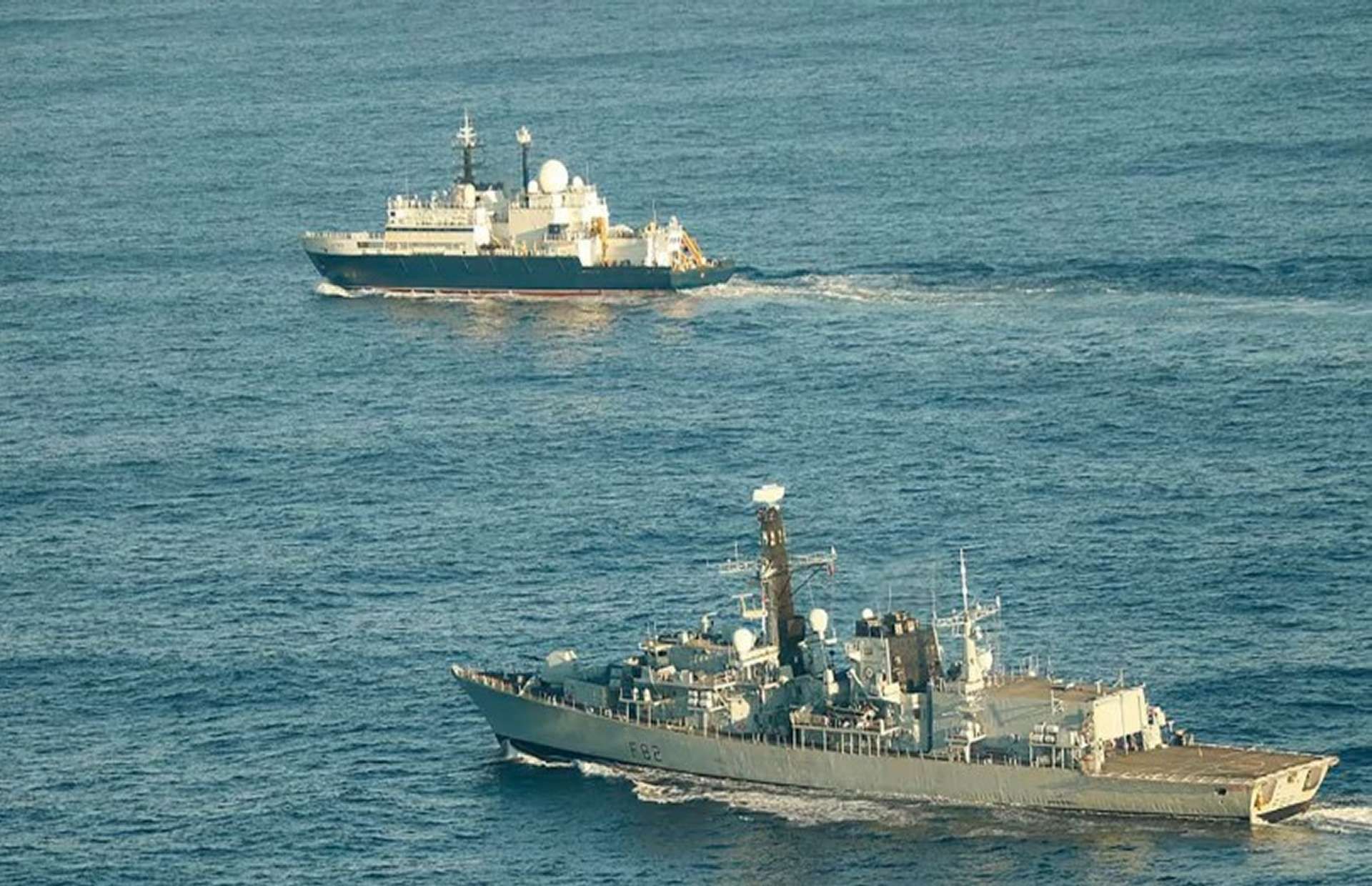
Royal Navy frigate HMS Somerset and RAF Poseidon aircraft shadow the Russian intelligence vessel Yantar as it approaches UK waters north of Scotland, amid rising concerns that the seabed warfare ship is mapping and probing critical British undersea cables (Picture source: UK Navy).
Yantar is officially registered as an oceanographic research vessel of Project 22010, but Western navies treat it as a dedicated seabed warfare platform operated by Russia’s secretive GUGI directorate. At around 108 metres in length with a full-load displacement of roughly 5,736 tons, the ship uses quiet diesel-electric propulsion, making it ideal for slow survey patterns over subsea cable routes. It serves as a mothership for deep-diving autonomous submersibles of the Rus and Konsul classes, which US and NATO assessments say can operate at depths of up to 6,000 metres, sufficient to reach almost any cable on the Atlantic seabed. Towed hydroacoustic arrays and specialised winches allow Yantar to drag sensors behind it, map cable runs with high precision, and inspect seabed nodes used for military communications and anti-submarine surveillance.
The same technical tools that underpin “research” are also the enablers of covert interference. By systematically charting power and data cables off Scotland and in the North Atlantic approaches, Yantar helps Moscow build a target list that could be exploited in a crisis to cut, tap, or pre-rig infrastructure for sabotage. Recent investigations have already tracked the vessel loitering over key cable junctions in the Irish Sea and near other NATO-linked infrastructure, reinforcing concerns that GUGI is preparing options to disrupt civilian connectivity and naval command-and-control without resorting to open warfare.
The alleged use of lasers against RAF Poseidon crews fits that pattern. Military and commercial aircraft have previously been illuminated by low-power green lasers from state vessels, a method designed to dazzle pilots and temporarily degrade electro-optical sensors. While such incidents usually stop short of causing permanent injury, they breach basic aviation safety norms and create escalation risks over the North Atlantic, where heavily armed aircraft are conducting real-time surveillance of a ship tied to Russian military intelligence.
Shadowing Yantar at sea is HMS Somerset, a Type 23 Duke-class towed-array frigate optimised for anti-submarine warfare. The ship combines a quiet hull and CODLAG propulsion with the powerful Type 2087 low-frequency active towed sonar, capable of detecting and classifying contacts at significant stand-off ranges, including submersibles operating near cables. Somerset’s Artisan radar, electronic support measures, and combat management system generate a continuous picture of the Russian vessel’s movements and emissions, while an embarked Merlin or Wildcat helicopter can extend that surveillance bubble with its own radar, electro-optical turret, and dipping sonar. The frigate has also become the Royal Navy’s pathfinder for the Naval Strike Missile, successfully test-firing the sea-skimming weapon in September 2025 and adding a modern 200-kilometre-class anti-ship capability on top of Sea Ceptor, the 4.5-inch gun, and close-in guns.
Overhead, the RAF Poseidon MRA1 fleet based at Lossiemouth provides the long-range sensing that makes persistent tracking possible in the harsh North Atlantic environment. Derived from the Boeing 737, Poseidon carries the APY-10 maritime radar, electro-optical and infrared cameras, a sophisticated electronic support suite, and an acoustic system able to deploy large fields of sonobuoys to listen for submarines or seabed activity. Unlike earlier patrol aircraft, the P-8 lacks a traditional magnetic anomaly detector but compensates with advanced processing and networking with the Royal Navy and allied units across the GIUK gap. The UK is also integrating the Sting Ray Mod 1 lightweight torpedo on Poseidon, providing a sovereign anti-submarine weapon if Russian boats accompany Yantar’s cable work.
What is at stake goes far beyond a single Russian hull cruising off Scotland. Between 95 and 99% of global international data travels through subsea fibre-optic cables, and the UK is both a major hub for transatlantic traffic and heavily dependent on these links for financial markets, government communications, and defense planning. Parliamentary committees and independent studies have repeatedly warned that Britain remains “woefully” underprotected against cable sabotage from Russian and Chinese actors, with GUGI specifically identified as a central player in this emerging threat to national sovereignty. In a crisis, the ability to selectively cut or manipulate cables serving London, Faslane, and key operational headquarters could slow UK mobilisation, hinder SSBN operations, and complicate coordination with NATO allies without a single shot being fired on land.
This is why the Yantar deployment has become an important test case for UK resolve. London is beginning to respond with a more coherent seabed defence posture built around assets such as RFA Proteus, future Multi-Role Ocean Surveillance Ships, and the “Atlantic Bastion” concept, which envisages networks of unmanned systems and seabed sensors to harden critical underwater infrastructure. Yet the immediate signal is carried by HMS Somerset and the Poseidon crews circling above Yantar, demonstrating that Russian seabed operations in the UK’s approaches will not go unobserved.