



Navy - Naval Technology
-
UK Calls Industry to Shape Royal Navy’s Future Type 93 Extra-Large Uncrewed Submarine Force
{loadposition bannertop}{loadposition sidebarpub}
Britain is taking a significant step toward an autonomous underwater force with the Type 93 programme, a new generation of extra-large uncrewed submarines designed to extend the Royal Navy’s reach into contested waters while reducing risks to crewed vessels. In a market-engagement notice published on 12 October 2026, the Ministry of Defence called on industry to help shape the platforms, payloads, artificial intelligence and mission systems behind the future capability, potentially giving Britain a persistent undersea tool for surveillance, seabed operations and other high-risk missions while accelerating its shift toward a Hybrid Navy and deeper AUKUS-enabled underwater warfare.
Britain is seeking defense industry input to shape the Royal Navy’s future Type 93 extra-large uncrewed underwater vehicle capability, including its payloads, autonomy, mission systems and support architecture (Picture Source: BAE Systems)
Britain is opening the door to industry to help shape a new generation of extra-large uncrewed submarines that could become an important element of the Royal Navy’s future underwater force. In a preliminary market-engagement notice published on 12 October 2026, the Ministry of Defence linked the emerging Type 93 XLUUV programme directly with Britain’s transition towards a Hybrid Navy and its commitments under AUKUS Pillar II. According to Find a Tender Service Notice 096028-2026, the Royal Navy is seeking industry input on platforms, payloads and the technologies needed to support them, marking an important step in turning years of underwater experimentation into a potential future operational capability.
Britain is effectively calling on a broad defence-industrial ecosystem to help define what a future Type 93 capability could look like. The Royal Navy is seeking interest not only from manufacturers of Extra-Large Uncrewed Underwater Vehicles, but also from payload developers, autonomy and artificial-intelligence specialists, mission-management software providers, systems integrators and through-life support companies. Companies registering may subsequently be invited to collaborative workshops, one-to-one discussions, industry days and written Requests for Information, with their responses informing requirements development and wider programme planning. The breadth of the engagement is significant: rather than treating Type 93 simply as a vehicle acquisition, the Royal Navy appears to be examining the complete capability architecture surrounding it, from autonomy and mission software to payload integration, sustainment and support, before future requirements are fixed.
Related Topic: North Korea Tests Two Types of Submarine-Launched Strategic Cruise Missiles in the Sea of Japan
Crucially, this remains an information-gathering phase. Participation does not constitute pre-qualification and the notice explicitly states that it should not be interpreted as a commitment to proceed with a future procurement. That distinction is important because the Royal Navy is still shaping the requirement rather than selecting a final platform, fleet size or in-service configuration. The preliminary engagement gives industry an opportunity to influence the future technical framework while allowing the Navy to compare what is realistically available across platforms, payloads, enabling technologies and support arrangements.
Type 93 Takes Shape Around a New Generation of XLUUVs
One of the most revealing details is the Royal Navy’s initial interest in vehicles approximately 12 metres long and 2 metres in diameter, while deliberately leaving the door open to proposals of different dimensions. That scale closely resembles XV Excalibur, the 12-metre experimental XLUUV developed by Plymouth-based MSubs for the Royal Navy under Project Cetus. It is also broadly comparable to BAE Systems’ Herne extra-large autonomous underwater vehicle, another roughly 12-metre platform developed around a modular approach to autonomous undersea missions. Excalibur is an experimental test vessel rather than a confirmed Type 93 design, while Herne is a separate BAE Systems programme, but both provide useful indications of the kind of large autonomous underwater platforms British industry is already developing. Their broadly similar scale and emphasis on adaptable mission payloads make them relevant reference points for a future Type 93-class capability, without implying that either design has been selected.
That experience became still more relevant in September 2026 when XV Excalibur successfully launched and controlled an inert US Navy Mk48 Mod 4 heavyweight torpedo during an AUKUS trial at the British Underwater Test and Evaluation Centre in Scotland. Neither the vehicle nor weapon had originally been designed for that arrangement, making the integration effort a notable demonstration of modular adaptability. The experiment is significant because it illustrates the value of an open and adaptable payload architecture for large uncrewed submarines, an approach also reflected in platforms such as Herne, although there is no indication that the Mk48, Herne, Excalibur or any other specific weapon or platform has been selected for Type 93. The lesson for the Royal Navy is less about a particular weapon or vehicle than about proving that future XLUUVs can be configured to accept new mission systems and payloads as requirements evolve.
Type 93’s Role in the Royal Navy’s Hybrid Fleet
The wider Royal Navy plan is considerably more significant than acquiring another experimental underwater drone. Under Britain’s Defence Investment Plan, the service is moving towards a Hybrid Navy combining conventional warships, submarines and aircraft with autonomous and uncrewed systems. Type 93 has been identified as the extra-large uncrewed underwater component of that future force, with the government stating that such vessels are intended to operate alongside crewed hunter-killer submarines in the anti-submarine warfare mission. This points towards Type 93 acting as a force multiplier for Britain’s highly capable crewed submarine fleet rather than replacing it. At the conceptual level, XLUUVs could allow the Royal Navy to distribute sensors, payloads and persistent underwater presence across a wider operating area while reserving crewed submarines for missions where their capabilities are indispensable.
The precise operational concept remains under development, however, and the present market notice specifies neither a final configuration nor fleet quantity. The government has separately said numbers of its Type 91-94 uncrewed maritime systems are expected to expand during the 2030s, reinforcing the direction of travel without fixing the eventual scale of the Type 93 programme. This makes the current market engagement especially important: the Royal Navy is effectively testing the maturity of the industrial base before locking itself into a particular technological path. For Britain, that approach offers the possibility of building a more adaptable underwater force in which hardware, software and payloads can evolve progressively rather than being tied from the outset to a single fixed solution.
Type 93 is also being developed against a much larger allied backdrop. The market engagement expressly supports Britain’s commitments to the AUKUS Pillar II Signature Project for uncrewed undersea vehicles, through which Australia, the United Kingdom and the United States plan to develop payloads and enabling systems capable of operating across their respective UUV fleets. The project encompasses sensors, navigation and potential offensive capabilities alongside common standards, control systems and other technologies intended to increase interoperability. AUKUS is pursuing a phased approach, initially developing national payloads designed to be interchangeable and integrated by each partner before progressing towards jointly developed trilateral payloads and next-generation enabling technologies. Delivery under the Signature Project is scheduled to begin in 2027, meaning Britain’s Type 93 market engagement is taking place as the trilateral UUV initiative begins moving towards its first capabilities.
There is also a distinctly British industrial dimension. Experience accumulated through Project Cetus and XV Excalibur has already given the Royal Navy and the UK maritime sector practical exposure to large autonomous underwater systems, while the new engagement considerably widens the field to companies working in vehicles, payloads, AI, autonomy, software, integration and support. For UK industry, the potential opportunity could extend well beyond construction of the underwater vehicle itself: considerable future value may reside in the digital architecture, mission systems, payload integration and through-life support surrounding Type 93. Instead of prematurely freezing the requirement around one existing solution, the Royal Navy is using market engagement to establish what industry can realistically provide and allow those findings to inform future requirements. Organisations have been asked to aim to register by 29 October 2026 at 17:00 GMT, although registration will remain open throughout the preliminary engagement programme.
Britain’s Type 93 initiative represents an important but carefully measured step towards putting greater autonomous mass beneath the waves. The significance of the latest move is not that the Royal Navy has already selected its next uncrewed submarine or ordered a defined fleet, but that it is beginning to translate experimentation into a structured future capability requirement. With XV Excalibur providing increasingly sophisticated practical lessons, Type 93 now occupying a defined place within the Hybrid Navy vision, British industry offering expertise across the autonomous-undersea ecosystem, and AUKUS creating a pathway towards interoperable payloads and enabling systems, the United Kingdom is establishing many of the foundations from which a deployable XLUUV capability could emerge. For the Royal Navy, the ambition is becoming clearer: combine the reach and combat power of Britain’s crewed submarine force with scalable autonomous systems, while preserving the flexibility to adopt the strongest technologies that British and allied industry can deliver.
Explore More Defense News
• Land Defense News
• Naval Defense News
• Defense Aerospace NewsWritten by Teoman S. Nicanci – Defense Analyst, Army Recognition Group
Teoman S. Nicanci holds degrees in Political Science, Comparative and International Politics, and International Relations and Diplomacy from leading Belgian universities, with research focused on Russian strategic behavior, defense technology, and modern warfare. He is a defense analyst at Army Recognition, specializing in the global defense industry, military armament, and emerging defense technologies.
-
U.S. Navy Nears F/A-XX Sixth-Generation Fighter Decision as Boeing and Northrop Battle for Contract
{loadposition bannertop}{loadposition sidebarpub}
The U.S. Navy is nearing a decision on its F/A-XX sixth-generation carrier fighter, with Boeing and Northrop Grumman remaining in competition ahead of an expected August 2026 downselect, according to Defense IQ’s 2026 International Fighter Aircraft Global Market Report. Long-range threats are increasingly forcing U.S. carriers to operate farther from contested areas, heightening the urgency of fielding an F/A-18 replacement that can preserve carrier air superiority and long-range strike capability across the Indo-Pacific.
F/A-XX is expected to provide greater range, survivability, and combat persistence than the F/A-18E/F Super Hornet, giving the U.S. Navy greater freedom to project air power from safer distances. China is the principal source of this operational pressure, as its expanding missile forces, increasingly capable sensor networks, integrated air defenses, and advanced combat aircraft increase risks to carrier strike groups and reinforce the need for greater combat radius, survivability, and networked air-superiority capabilities.
Related Topic: U.S. Navy Accelerates F/A-XX Sixth-Gen Fighter to Counter China’s Long-Range Missile ThreatBoeing rendering of a future U.S. Navy carrier-based sixth-generation fighter concept associated with the F/A-XX program, which is intended to replace the F/A-18E/F Super Hornet and preserve carrier air superiority, long-range strike reach, and survivability in contested Indo-Pacific operations. (Image source: Boeing)
The F/A-XX is being developed as the U.S. Navy’s future carrier-based air-superiority fighter for operations from Nimitz- and Gerald R. Ford-class aircraft carriers. Expected to enter service during the 2030s while complementing the F-35C, F/A-XX is intended to give carrier air wings the range, survivability, networking, and integration with uncrewed aircraft needed to sustain offensive operations across an increasingly contested Indo-Pacific.
The operational problem is straightforward. As anti-ship missiles, integrated air defenses, electronic warfare, and long-range sensing expand, U.S. carrier strike groups may need to remain farther from hostile coastlines while still generating offensive air power. A longer-range fighter would let the U.S. Navy preserve air superiority and strike options without requiring the carrier itself to operate as deep within the most heavily contested threat envelope.
The report traces the F/A-XX requirement to U.S. Navy planning work that began in 2008, with an Analysis of Alternatives completed in 2019. The program entered a much more uncertain phase in 2025, when Pentagon officials reduced its priority relative to the U.S. Air Force’s F-47 and raised concerns about whether the U.S. aerospace sector had sufficient engineering and production capacity to mature two sixth-generation fighters concurrently.
That concern matters because Boeing is already the prime contractor for the F-47. The U.S. Air Force awarded Boeing the F-47 engineering and manufacturing development contract in March 2025, placing the company at the center of U.S. efforts to replace the F-22 Raptorwith a new air-dominance fighter designed to operate with Collaborative Combat Aircraft, advanced sensors, secure communications, and next-generation propulsion.
A Boeing victory in the F/A-XX competition would therefore concentrate both principal U.S. sixth-generation crewed fighter programs within the same manufacturer. Such an outcome could create opportunities for engineering commonality and a larger long-term production base, but it would also place considerable pressure on Boeing’s combat-air workforce, development infrastructure, and supplier network as the company attempts to mature two highly demanding aircraft programs.
A Northrop Grumman victory would produce a different industrial structure by dividing the U.S. Air Force and U.S. Navy programs between two prime contractors. Northrop Grumman withdrew from the U.S. Air Force NGAD prime competition in 2023 but has remained involved in the U.S. Navy contest, making the F/A-XX decision more significant for maintaining multiple U.S. industrial centers capable of designing and integrating advanced combat aircraft.
Lockheed Martin is no longer part of the competition. According to the Defence iQ report, the company was removed from the F/A-XX contest in 2025 after its proposal reportedly failed to meet U.S. Navy requirements, leaving Boeing and Northrop Grumman as the remaining contenders.
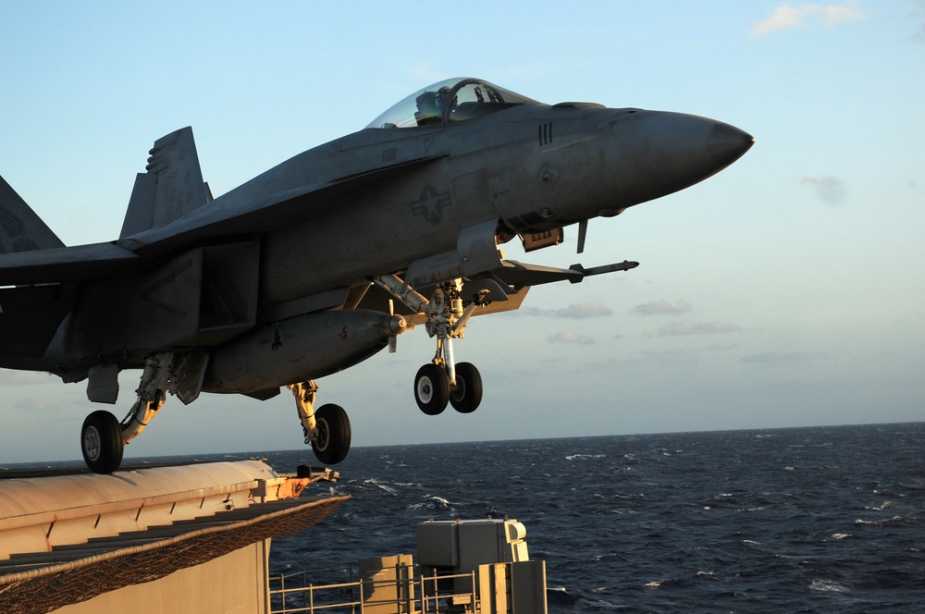
A U.S. Navy F/A-18E Super Hornet launches from USS Nimitz in the Pacific. The F/A-XX requirement reflects the need for future carrier air wings to generate combat power over greater distances while keeping aircraft carriers farther from contested threat zones. (Picture source: U.S. Department of War/Defense)
Funding illustrates how close F/A-XX came to a much deeper slowdown. The Pentagon’s FY2026 request reduced development funding to only $74 million, effectively delaying the program and postponing a contract decision. Congress moved in the opposite direction, providing substantially greater support for the program. According to the report, congressional action included funding figures of $454 million and a subsequent $897 million allocation, with total FY2026 funding calculated at approximately $972 million. The precise relationship between these figures depends on how the report accounts for requested, authorized, and appropriated funds.
The congressional intervention matters because delaying F/A-XX would create a capability problem that extends beyond fighter replacement. The U.S. Navy expects its Super Hornet fleet to reach the end of its service life during the 2030s, while the F-35C alone is not intended to provide every element of future carrier air superiority. Without a new long-range crewed fighter, the U.S. Navy carrier air wing could face increasing difficulty generating offensive reach from outside the most dangerous anti-access zones.
The U.S. Navy is consequently seeking more than another fighter with improved aerodynamic performance. F/A-XX is expected to operate as part of a broader network of sensors, weapons, and uncrewed aircraft, allowing carrier aviation to distribute sensing and combat effects across a larger battlespace. This mirrors the U.S. Air Force’s approach with the F-47 and Collaborative Combat Aircraft, although the U.S. Navy requirement adds the constraints of carrier launch, recovery, deck handling, and maritime operations.
The Defence iQ report identifies crewed-uncrewed teaming as one of the defining trends in future fighter development. It argues that next-generation combat aviation increasingly depends on combining survivable crewed fighters with autonomous adjuncts that support intelligence, surveillance, and reconnaissance, electronic warfare, decoy operations, and additional weapons carriage.
For F/A-XX, this could allow the U.S. Navy to expand the effective reach and combat mass of a carrier air wing without relying exclusively on additional high-cost crewed fighters. Uncrewed aircraft operating forward of the carrier-based fighter could extend sensor coverage, complicate enemy targeting, support electronic attack, and potentially carry weapons, while the crewed aircraft remains responsible for mission command and the most complex tactical decisions.
The industrial challenge is therefore inseparable from the operational requirement. Sixth-generation combat aircraft demand specialized expertise in low-observable design, advanced propulsion, thermal management, sensor fusion, electronic warfare, software engineering, and secure networking. Developing the F-47 and F/A-XX concurrently requires sufficient capacity not only at the prime-contractor level but also across many of the same engine, electronics, materials, and weapons suppliers.
This is why the F/A-XX selection has consequences well beyond which company receives the U.S. Navy contract. The decision will help determine whether the United States maintains competing centers of combat-aircraft design expertise or increasingly consolidates future fighter development around fewer companies and supplier networks.
The challenge is amplified by the scale of U.S. combat-air modernization. Washington is simultaneously financing the F-35, expanding F-15EX procurement, developing the F-47, moving Collaborative Combat Aircraft toward acquisition, and maintaining major investments in advanced weapons, propulsion, and electronic warfare.
For the U.S. Navy, the strategic value of F/A-XX ultimately rests on whether it can preserve carrier combat power at the distances imposed by an increasingly contested Indo-Pacific operating environment. A fighter capable of operating farther from the carrier, sharing targeting data across dispersed forces, and working with uncrewed aircraft could give commanders greater freedom to keep high-value ships and support aircraft outside the most dangerous threat zones while still generating offensive missions.
That makes F/A-XX more than a replacement for the F/A-18E/F Super Hornet. It is part of the U.S. Navy’s effort to ensure that the aircraft carrier remains an effective offensive instrument as the threat environment becomes increasingly shaped by long-range precision weapons, persistent sensing, and advanced air-combat systems.
The August 2026 downselect identified by the Defence iQ report could therefore become one of the most consequential U.S. Navy aviation decisions of the decade. Selecting Boeing or Northrop Grumman will determine the industrial leadership of the U.S. Navy’s future fighter, but the larger question is whether Washington can finance, engineer, and produce F/A-XX alongside the F-47 without overstretching the industrial base needed to deliver both.
If the United States succeeds, the two programs could provide complementary sixth-generation air-dominance capabilities tailored respectively to land-based U.S. Air Force and carrier-based U.S. Navy operations. If industrial-capacity constraints, funding pressures, or schedule delays force further postponements, the U.S. Navy could enter the 2030s with a widening gap between the Super Hornet's retirement profile and the reach required to keep carrier air power effective across the Indo-Pacific.
Explore More Defense News
• Land Defense News
• Naval Defense News
• Defense Aerospace News
Written by Alain Servaes – Chief Editor, Army Recognition Group
Alain Servaes is a former infantry non-commissioned officer and the founder of Army Recognition. With over 20 years in defense journalism, he provides expert analysis on military equipment, NATO operations, and the global defense industry.
-
U.S. Navy Explores Underwater Drones to Resupply Nuclear Submarines While Fully Submerged
{loadposition bannertop}{loadposition sidebarpub}
The U.S. Navy is examining how unmanned underwater vehicles could deliver critical parts between nuclear-powered submarines and aircraft carriers while submarines remain fully submerged. The concept, outlined by the Commander, Submarine Force, U.S. Pacific Fleet in August 2026, could preserve submarine stealth while extending combat endurance across contested Pacific waters.
A submerged resupply capability would allow attack submarines to receive mission-critical equipment without surfacing or returning to port. This could make carrier strike groups more resilient by reducing logistics constraints and keeping submarines forward for longer during high-intensity operations.
Related Topic: U.S. Navy Selects Kongsberg and Oceaneering to Develop 1000-Mile CAMP XLUUV Undersea DroneU.S. Navy Nimitz-class aircraft carrier USS Theodore Roosevelt (CVN 71) leads a multinational formation during RIMPAC 2026 in the Pacific. U.S. Navy commanders are examining how unmanned underwater vehicles could eventually transfer critical components between aircraft carriers and submerged submarines. (Picture source: PACOM)
Rear Adm. Chris Cavanaugh, commander of Submarine Force, U.S. Pacific Fleet, discussed the concept with Rear Adm. Marcos Jasso, commander of Carrier Strike Group 9, during a July 30, 2026, visit aboard the Nimitz-class aircraft carrier USS Theodore Roosevelt (CVN 71) following the at-sea phase of RIMPAC 2026. The U.S. Department of Defense published details of the discussion on August 13, 2026, highlighting deeper integration between submarines, carrier strike groups, and unmanned undersea systems.
The operational significance lies in sustaining submarines without forcing them to compromise concealment. A U.S. Navy nuclear-powered attack submarine that must surface, approach a support ship, or leave its patrol area for a relatively small replacement part can lose time on station and risk detection. Under the concept discussed by U.S. Pacific Fleet commanders, an unmanned underwater vehicle could transport selected components from an aircraft carrier to a submerged submarine, which could then deploy or recover the unmanned system while remaining entirely underwater.
This would significantly expand the role of unmanned underwater vehicles. U.S. Navy UUV development has largely focused on reconnaissance, intelligence collection, mine warfare, seabed operations, and extending the sensor reach of crewed submarines, but logistics would turn these systems into direct sustainment assets for deployed combat forces. For U.S. Navy nuclear-powered attack submarines, that could be especially valuable because they are expected to conduct anti-submarine warfare, anti-surface warfare, intelligence collection, precision land strike, and special operations support while operating well ahead of surface forces.
If a failed electronic module, sensor component, communications assembly, or mechanical part threatens a mission, underwater delivery could allow the submarine to remain in position instead of withdrawing to a support location. The concept is therefore less about replacing conventional U.S. Navy logistics than about delivering small, high-value components with disproportionate operational importance. A relatively compact item could determine whether a submarine remains combat-effective or has to leave a contested patrol area.
That makes the concept particularly relevant to Pacific warfare. The Indo-Pacific imposes enormous distances between bases, repair facilities, carrier strike groups, and submarine patrol areas, and those distances would become even more difficult to manage during a high-intensity conflict. In that context, any requirement for a submarine to surface, alter its patrol pattern, or move toward a predictable logistics point could create additional operational risk.
The U.S. Navy has not identified China as the intended target or scenario for this resupply concept. However, from an operational analysis perspective, the idea is highly relevant to a potential Western Pacific conflict because U.S. Navy submarines could be required to operate in areas covered by maritime patrol aircraft, satellites, surface combatants, submarines, and other surveillance systems. In such an environment, preserving concealment while sustaining forward operations would be especially important.
That distinction is important. The confirmed U.S. Navy development is the exploration of unmanned underwater vehicle transfers between submarines and aircraft carriers; the China scenario is an analytical assessment of where such a capability could have the greatest strategic value. In a confrontation with a peer maritime power, keeping attack submarines forward without exposing them to surface logistics could preserve one of the most survivable and offensive elements of U.S. maritime combat power.
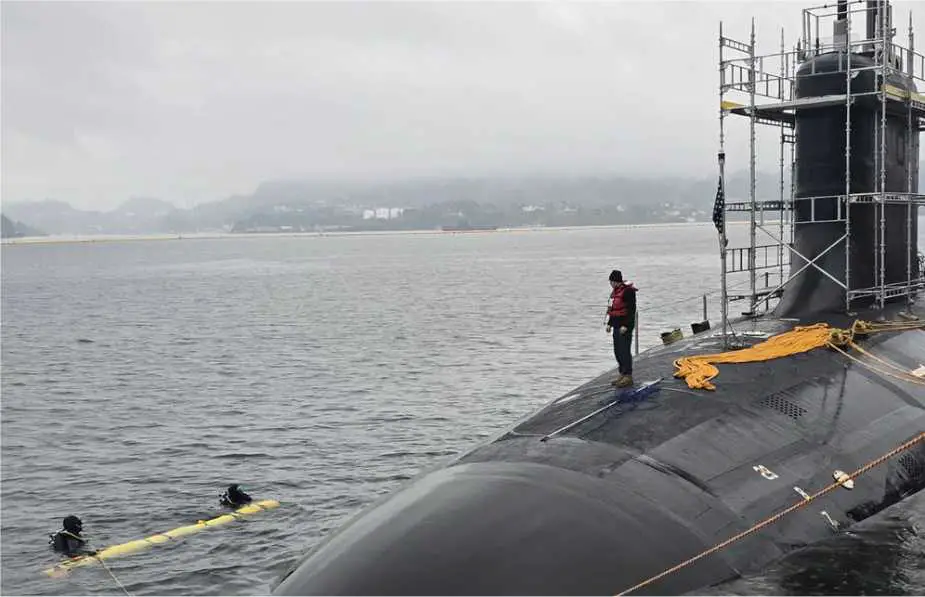
U.S. Navy divers operate a Yellow Moray REMUS 600 unmanned underwater vehicle alongside Virginia-class fast-attack submarine USS Delaware (SSN 791) during testing in Norway in 2025. The exercise demonstrated torpedo-tube launch and recovery of an unmanned underwater vehicle, providing a technological foundation for future submerged logistics missions. (Picture source: U.S. Depart
The U.S. Navy's recent work with submarine-launched unmanned underwater vehicles provides a technological foundation for this concept. In 2025, the Virginia-class fast-attack submarine USS Delaware (SSN 791) completed the first forward-deployed submarine torpedo-tube launch and recovery of the Yellow Moray UUV during operations near Norway, completing three tactical sorties without diver assistance. That demonstration showed that a UUV could be integrated directly into submarine operations using existing launch and recovery infrastructure, a key requirement if future systems are expected to carry small cargo loads to submerged submarines.
For undersea logistics, torpedo-tube compatibility could offer a practical way to receive compact components while minimizing exposure. A standard heavyweight torpedo tube would impose clear limits on cargo size and volume, but that constraint may be acceptable if the mission focuses on high-value parts rather than bulk supplies. Army Recognition previously examined U.S. Navy submarine-launched unmanned underwater vehicle operations, highlighting how autonomous systems can extend the sensing reach of Virginia-class submarines while reducing the need for the crewed submarine itself to enter every high-risk area.
At the larger end of U.S. Navy UUV development, the Boeing-built Orca extra-large unmanned underwater vehicle demonstrates progress in long-range autonomous operations. In July 2026, an Orca completed a transit of more than 1,000 nautical miles in the Pacific for the first time, a milestone that is particularly relevant to Indo-Pacific operations where undersea systems may need to travel across very large distances. Army Recognition has also covered the U.S. Navy Orca extra-large unmanned underwater vehicle program and autonomous undersea warfare, although the U.S. Navy has not identified Orca as the system intended for submarine resupply.
The eventual resupply architecture could therefore involve different types of unmanned underwater vehicles depending on the cargo and mission. Smaller torpedo-tube-compatible systems would be better suited to compact parts and direct submarine recovery, while larger UUVs could carry heavier loads but would require different transfer methods. The U.S. Navy has not disclosed the payload capacity, range, navigation architecture, or recovery method envisioned for the logistics mission, so the concept remains developmental rather than an established operational capability.
Technical challenges remain significant. An unmanned underwater vehicle would need to navigate accurately to a submarine whose position may be deliberately concealed, establish a secure rendezvous, and complete the transfer without creating communications or acoustic signatures that could compromise either system. Cargo protection would also be critical, because sensitive electronics or mechanical assemblies would need to survive pressure, seawater, shock, and potentially long submerged transit.
Command-and-control is another key issue. A U.S. Navy submarine operating under strict emissions control may have limited opportunities to transmit its precise location, meaning the UUV would need a high degree of autonomy and carefully controlled rendezvous procedures. In a highly contested environment, including a potential conflict with China, those requirements could become more demanding if satellite navigation is degraded, communications are disrupted, or undersea movements are closely monitored.
The aircraft carrier's role is equally important. A carrier strike group already carries substantial maintenance capability, technical personnel, and spare-parts inventories, giving it the potential to act as a mobile source of selected submarine components. Using unmanned underwater vehicles to move those components to submerged submarines could make the carrier strike group more internally resilient while linking submarines, aircraft carriers, surface combatants, and autonomous systems through a physical logistics network.
This fits the broader logic of U.S. Navy distributed maritime operations. As U.S. Navy forces disperse across wider areas to reduce vulnerability and complicate enemy targeting, commanders must still sustain ships and submarines without concentrating them around predictable logistics nodes. For submarines, the central advantage remains concealment, and any support method that forces an attack submarine to surface, slow in a predictable location, or return to port reduces that advantage.
An unmanned underwater vehicle capable of carrying a critical component to a submerged rendezvous point could therefore have an operational effect far greater than its cargo capacity suggests. Its value would come from helping preserve the submarine's position, availability, and combat role rather than replacing conventional resupply. In a potential Indo-Pacific conflict, that could allow U.S. Navy nuclear-powered attack submarines to remain in contested waters longer while continuing anti-submarine, anti-surface, intelligence, and strike missions.
The concept remains developmental, but it points toward a broader transformation in undersea warfare. If the U.S. Navy can combine reliable autonomous navigation, secure submerged rendezvous, practical cargo handling, and submarine-compatible recovery methods, underwater drones could become not only sensors and reconnaissance assets, but also a new layer of submarine sustainment. The strategic value is straightforward: a U.S. Navy submarine that can receive a critical part without surfacing is harder to detect, harder to disrupt, and more likely to remain combat-effective in a future Pacific conflict.
Explore More Defense News
• Land Defense News
• Naval Defense News
• Defense Aerospace News
Written by Alain Servaes – Chief Editor, Army Recognition Group
Alain Servaes is a former infantry non-commissioned officer and the founder of Army Recognition. With over 20 years in defense journalism, he provides expert analysis on military equipment, NATO operations, and the global defense industry.
-
How MQ-25A Unmanned Refueling Aircraft Could Transform U.S. Navy Carrier in Future Pacific War
 {loadposition bannertop}{loadposition sidebarpub}
China’s expanding deployment of DF-21D and DF-26 anti-ship ballistic missiles is forcing the U.S. Navy to rethink how it fights in the Western Pacific, where aircraft carriers could face long-range precision strikes during a conflict near Taiwan or the South China Sea. The Boeing MQ-25A Stingray unmanned refueling aircraft, increasingly highlighted by the Pentagon as a critical force multiplier, is designed to solve that challenge by extending the combat reach of carrier-based aircraft while allowing U.S. carriers to operate farther from Chinese missile threat zones.
By providing unmanned aerial refueling deep into contested airspace, the MQ-25A enables carrier air wings to conduct longer-range strike, surveillance, and air superiority missions without relying on vulnerable forward positioning. The aircraft represents a major shift toward distributed and survivable naval air operations, reinforcing the U.S. Navy’s ability to sustain power projection against increasingly sophisticated Chinese anti-access and area-denial networks.
Related Topic: U.S. Navy Clears Boeing MQ-25A Stingray Carrier Tanker Drone for Low-Rate ProductionBoeing’s MQ-25 Stingray test aircraft conducts carrier deck operations aboard USS George H.W. Bush (CVN-77) in December 2021, marking a major milestone toward integrating autonomous aerial refueling drones into future U.S. Navy carrier air wings. (Picture source: U.S. Department of War/Defense)
The problem has become increasingly urgent as China expands its anti-access/area denial (A2/AD) network across the Indo-Pacific. The People’s Liberation Army Rocket Force fields long-range anti-ship ballistic missiles such as the DF-21D and DF-26, systems specifically designed to threaten U.S. naval forces operating near the Chinese mainland. Supported by maritime surveillance satellites, over-the-horizon radars, airborne early warning aircraft, and long-range reconnaissance assets, these missile systems are intended to force U.S. Navy carrier strike groups to remain farther from Taiwan and the South China Sea during a conflict.
That operational displacement creates a major problem for carrier aviation. If U.S. Navy aircraft carriers must operate hundreds of nautical miles farther from combat zones, the combat radius of carrier-based F/A-18E/F Super Hornet fighters and F-35C stealth multirole combat aircraft becomes significantly constrained. Aircraft would either carry less weapon payload to preserve fuel or spend less time over target areas, reducing combat persistence and operational tempo at the exact moment the U.S. Navy would require sustained high-intensity operations.
The MQ-25A Stingray is set to become the U.S. Navy's first carrier-based unmanned refueling aircraft, bringing a major new capability to carrier strike groups. In this video, we examine how the MQ-25A could dramatically extend the combat range of F-35C Lightning II and F/A-18E/F Super Hornet fighters, allowing U.S. Navy carriers to operate farther from enemy missile threats while maintaining their striking power.
The MQ-25A Stingray changes this equation by serving as an autonomous carrier-based aerial refueling aircraft, extending the operational range of naval aviation. According to the Congressional Research Service (CRS), the U.S. Navy’s objective is for the aircraft to deliver between 14,000 and 16,000 pounds of fuel (6,350 to 7,260 kg) at a distance of 500 nautical miles (926 km) from the aircraft carrier.
In practical operational terms, that means carrier-based fighters can fly farther into contested airspace while the aircraft carrier itself remains at safer stand-off distances outside the most dangerous Chinese missile engagement zones. The aircraft therefore directly supports the U.S. Navy’s evolving distributed maritime operations concept, which seeks to maintain combat effectiveness despite long-range missile threats and contested operational environments.

AI-generated infographic highlighting the technical features, autonomous aerial refueling capability, and operational role of the MQ-25A Stingray unmanned aircraft developed for future U.S. Navy carrier air wings. (Copyright Army Recognition Group)
The strategic importance of the MQ-25A goes beyond simple aerial refueling. According to CRS, the Stingray is expected to become the U.S. Department of Defense’s first operational unmanned tanker and the U.S. Navy’s first carrier-based unmanned aerial vehicle fully integrated into fleet operations. Congress has shown growing interest in the program because it directly affects the future survivability, structure, and combat effectiveness of U.S. Navy carrier air wings.
The aircraft also represents one of the most important transitions in naval aviation since the introduction of the nuclear-powered aircraft carrier. The MQ-25A is among the first autonomous aircraft designed for routine catapult launches, arrested recoveries, and integrated carrier deck operations alongside crewed aircraft. U.S. Navy officials have repeatedly described the Stingray as a “pathfinder” for the future carrier air wing, one increasingly shaped by unmanned systems, AI-enabled operations, and human-machine teaming.
Its development reflects a broader Pentagon transition toward distributed warfare concepts where survivability depends on range, flexibility, networking, and the integration of autonomous systems. Future Indo-Pacific conflicts are expected to involve electronic warfare, cyber attacks, communications degradation, and long-range missile engagements across vast maritime areas. Unmanned aircraft capable of operating semi-autonomously provide operational resilience while reducing risk to pilots and increasing mission endurance.
One of the MQ-25A’s most immediate operational benefits involves the U.S. Navy’s current use of F/A-18E/F Super Hornets as “buddy tankers.” Today, a significant portion of Super Hornet aircraft assigned to carrier air wings routinely carry external refueling pods instead of weapons in order to refuel other aircraft in flight. While effective as an interim solution, this practice reduces the number of fighters available for combat missions such as strike operations, fleet defense, suppression of enemy air defenses, and air superiority.
The Congressional Research Service specifically notes that the MQ-25A is intended to relieve modified F/A-18E/F aircraft from conducting aerial refueling missions, allowing those fighters to return to combat roles while simultaneously extending the operational range of the U.S. Navy carrier air wing.
That shift fundamentally improves the efficiency, survivability, and strike flexibility of U.S. Navy carrier aviation. Every Super Hornet released from tanker duty becomes another aircraft available for combat missions. The carrier air wing gains more offensive capacity without requiring additional carriers or larger air wings. At the same time, pilots are freed from repetitive refueling sorties that contribute to fatigue and consume airframe service life.
The operational advantages extend well beyond aircraft availability. Carrier fighters supported by MQ-25A tankers can remain airborne longer, patrol larger maritime sectors, escort strike packages deeper into hostile airspace, and conduct longer surveillance missions over contested regions. This is especially important in Pacific operations, where distances between the carrier strike group, combat zones, and patrol sectors are enormous.

MQ-25A Stingray unmanned aerial refueling aircraft is designed to extend the operational range, endurance, and strike reach of U.S. Navy carrier air wings. (Picture source U.S. Department of War/Defense)
In a Taiwan contingency, aerial refueling could become one of the decisive enablers of sustained U.S. Navy aviation operations. Carrier aircraft may need to conduct repeated long-duration sorties across wide operational areas while maintaining persistent surveillance, maritime strike coverage, and defensive combat air patrols. Without reliable refueling support, aircraft would spend less time near operational targets and more time transiting back to the aircraft carrier, weakening overall operational tempo.
The MQ-25A also directly improves aircraft carrier survivability. By extending the reach of carrier-based aircraft, the unmanned tanker allows U.S. Navy aircraft carriers to remain farther from hostile coastlines while still projecting combat power into contested areas. This capability directly supports the U.S. Navy’s operational response to Chinese anti-ship ballistic missile threats and helps preserve the relevance of aircraft carriers in an era increasingly dominated by long-range precision strike weapons.
China’s military modernization has accelerated the urgency of this transition. The People’s Liberation Army Navy is expanding carrier aviation, long-range missile systems, integrated air defense networks, and maritime surveillance capabilities designed to challenge U.S. naval operations throughout the Western Pacific. Beijing’s strategic objective is to complicate U.S. military access to the region and reduce the effectiveness of American power projection near Taiwan and the South China Sea.
The MQ-25A therefore represents part of a broader Pentagon effort to preserve U.S. Navy aviation effectiveness under contested conditions. It does not eliminate the Chinese missile threat by itself, but it helps restore operational flexibility to U.S. commanders by increasing aircraft range, improving fuel distribution, and allowing carrier strike groups to operate from more survivable positions.
The program’s origins date back more than two decades. According to CRS, the U.S. Navy and the Defense Advanced Research Projects Agency began exploring carrier-based unmanned combat aviation concepts in 1999 through efforts that eventually evolved into the Unmanned Carrier-Launched Surveillance and Strike (UCLASS) program.
In 2016, however, the U.S. Navy shifted the focus from a stealth strike unmanned aircraft toward aerial refueling, creating the Carrier Based Aerial Refueling System (CBARS) that later became the MQ-25 Stingray. The decision reflected the U.S. Navy’s immediate operational need to increase carrier air wing range and reduce pressure on Super Hornet fleets already heavily tasked with tanker operations.
Boeing was selected in 2018 to develop the aircraft and received the engineering and manufacturing development contract for the program. The Boeing-owned T1 demonstrator first flew in 2019 and successfully conducted its first aerial refueling mission with another aircraft in 2021, proving core elements of the concept.
Industrial production of the aircraft is centered at Boeing’s facility at MidAmerica St. Louis Airport in Mascoutah, Illinois, where the company opened a $200 million (€176 million) production facility in 2024. The aircraft uses the Rolls-Royce AE 3007N turbofan engine produced in Indianapolis, Indiana, while BAE Systems supplies the vehicle management system and other components. The MQ-25A is also expected to use the Cobham aerial refueling store already employed on tanker-configured F/A-18E/F aircraft.
The U.S. Navy is simultaneously building the command architecture required for carrier-based unmanned aviation. CRS reports that the Unmanned Carrier Aviation Mission Control System includes consoles, communications systems, networking architecture, and Lockheed Martin-developed Multi Domain Control Capability software designed to plan and manage unmanned flight operations.
The U.S. Navy is fielding ship-installed, shore-based, and mobile variants of the control system. According to CRS, the first carrier-based mission control system was installed aboard USS George H.W. Bush (CVN-77) in 2024, marking an important step toward operational integration of unmanned aviation within carrier strike groups.
Congress continues closely monitoring the program’s schedule and costs because of its strategic importance. For FY2026, the U.S. Navy requested approximately $1.04 billion (€915 million) in procurement and research, development, test, and evaluation funding linked to MQ-25 activities, including procurement of the first three low-rate initial production aircraft.
The current program of record covers 76 aircraft, including 67 operational aircraft and nine test and developmental aircraft.
The program, however, has experienced delays and oversight concerns. According to CRS, the Department of Defense Inspector General warned in 2023 that the U.S. Navy planned to begin low-rate initial production before completing sufficient developmental and operational testing of production-representative aircraft.
The U.S. Navy subsequently revised the program schedule, delaying several milestones by approximately two years. Flight testing of engineering and manufacturing development aircraft shifted from 2022 to 2025, while initial operational capability moved from 2025 to 2026 and later to the end of FY2027.
The Government Accountability Office estimated the MQ-25A program’s total acquisition cost at approximately $15.9 billion (€14 billion), with an acquisition unit cost of roughly $209 million (€184 million) per aircraft, representing a 4 percent increase over previous estimates.
Congress is also examining the aircraft’s future potential beyond aerial refueling. CRS notes lawmakers are considering whether future variants could support attack missions, intelligence gathering, electronic warfare, communications relay operations, or even land-based tanker roles for other U.S. military services.
That future warfare dimension may ultimately become one of the program’s most important aspects. The MQ-25A establishes operational experience, carrier integration procedures, and command architectures that could eventually support a new generation of unmanned carrier aircraft performing combat, reconnaissance, electronic attack, or autonomous strike missions.
In future Indo-Pacific conflicts, those capabilities could prove decisive. Unmanned aircraft could maintain persistent ISR coverage across vast maritime areas, support long-range targeting networks, relay communications in degraded environments, and accompany crewed aircraft deep into contested airspace.
For the F-35C specifically, the MQ-25A could significantly improve operational persistence and strike flexibility. Stealth fighters supported by unmanned tankers can remain airborne longer, maintain greater stand-off options, escort strike formations over longer distances, and exploit their low-observable characteristics deeper inside defended operational areas.
For U.S. Navy carrier strike groups overall, the aircraft restores something increasingly challenged in modern naval warfare: operational depth. By extending the range of carrier aviation without exposing aircraft carriers themselves to greater risk, the MQ-25A helps preserve the strategic value of the aircraft carrier in an era of long-range missile competition.
Despite delays, budget pressures, and technical risks, the strategic rationale behind the MQ-25A remains increasingly clear. The United States Navy needs a way to sustain long-range carrier aviation operations against a near-peer adversary equipped with advanced missile systems, and the MQ-25A directly addresses that operational challenge.
More than a support drone, the MQ-25A Stingray could become one of the systems that determines whether U.S. Navy aircraft carriers remain operationally effective against China in the next generation of naval warfare. Its value lies not only in the fuel it carries, but in the distance it creates, the combat aircraft it frees for battle, and the operational flexibility it restores to American naval commanders across the Pacific.
Written by Alain Servaes – Chief Editor, Army Recognition Group
Alain Servaes is a former infantry non-commissioned officer and the founder of Army Recognition. With over 20 years in defense journalism, he provides expert analysis on military equipment, NATO operations, and the global defense industry.
-
Ukraine Ready to Deploy New Marichka Underwater Drone for Combat Naval Strikes
 {loadposition bannertop}{loadposition sidebarpub}
Ukraine has brought its Marichka autonomous underwater drone to combat readiness after more than a year of wartime testing and refinement. The development signals Ukraine’s intent to expand long-range strike options against Russian naval forces and coastal infrastructure well beyond the front line.
Ukraine has quietly brought a new class of naval weapon closer to operational use, with defense sources now assessing the Marichka autonomous underwater vehicle as ready for combat deployment. Developed under wartime conditions and refined through months of testing, the system reflects a broader Ukrainian effort to push maritime strike operations below the surface, complicating Russian naval defense planning across the Black Sea and adjacent coastal regions.
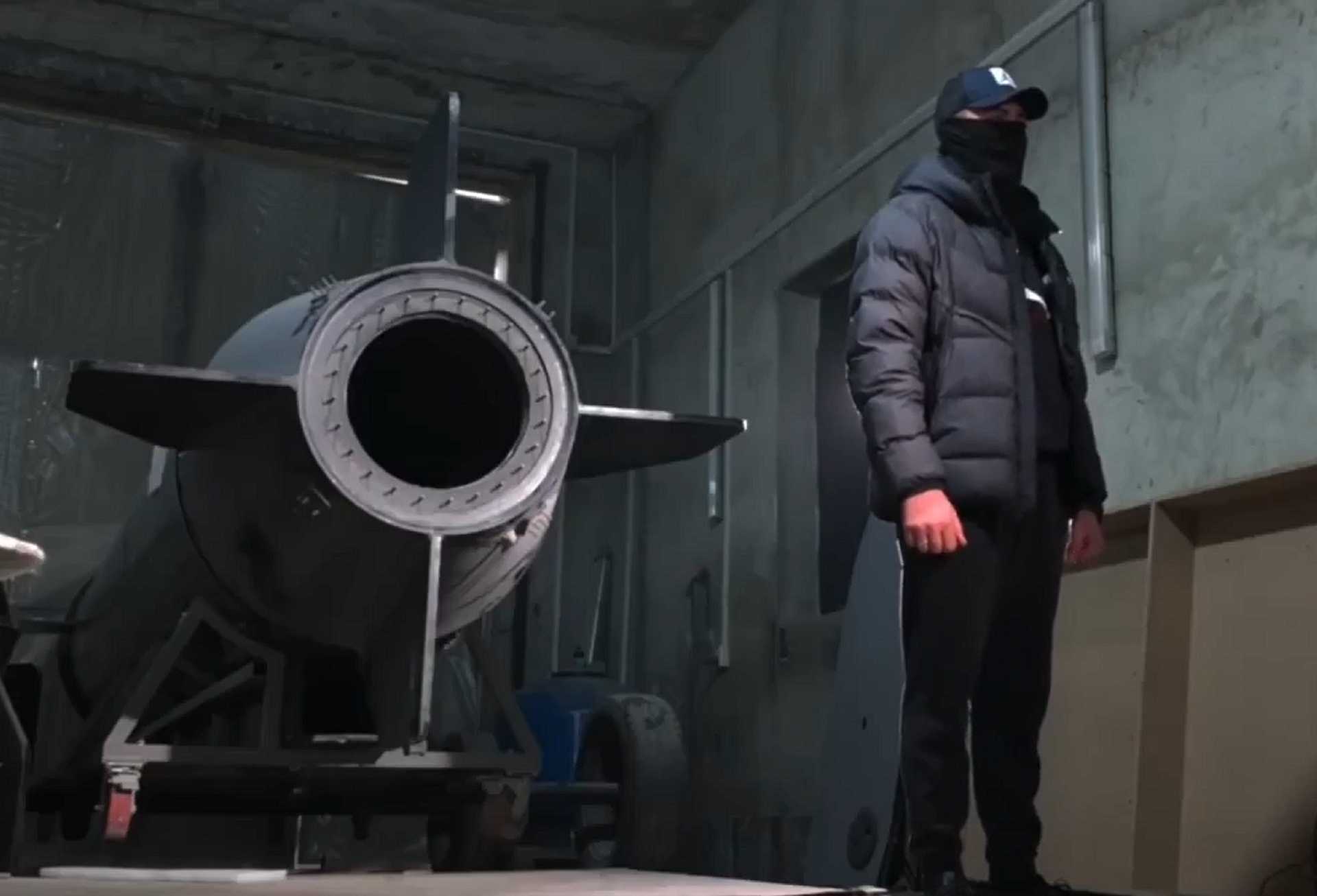
Follow Army Recognition on Google News at this linkDuring an exclusive interview, a Ukrainian defense industry representative presents the Marichka autonomous underwater drone, revealing details of the long-range system designed for strike, reconnaissance, and covert maritime operations against high-value naval targets. (Picture source: Social Network)
Measuring approximately six meters in length, Marichka is designed as a multi-purpose autonomous underwater vehicle capable of both offensive and non-kinetic missions. Its most striking feature is its reported payload capacity of up to one ton of explosives, a figure that places it well beyond the scale of conventional naval mines or earlier improvised underwater systems. With an operational range of up to 1,000 kilometers and a cruising speed of roughly 10 kilometers per hour, the platform is optimized for long-duration missions that prioritize stealth and endurance over speed.
Ukrainian engineers involved in the program describe Marichka as a modular system rather than a single-use weapon. While its primary role is underwater strike, the vehicle can be configured for cargo delivery or reconnaissance, enabling it to support a broad spectrum of naval and joint operations. In a strike configuration, Marichka is intended to engage high-value maritime targets, including landing ships, patrol boats, missile corvettes, submarines at anchor, and fixed coastal objectives such as bridge pylons or port infrastructure. The emphasis on the underwater approach significantly complicates detection and interception by traditional naval defenses.
The first successful test of the system was publicly acknowledged in late August 2023, coinciding with Ukraine’s Independence Day, a timing widely interpreted by analysts as a strategic signal. Days later, released test footage showed the vehicle operating autonomously, validating navigation, control, and propulsion systems under real conditions. Since then, further refinement has reportedly focused on guidance accuracy, mission reliability, and survivability in contested waters.
From an operational standpoint, Marichka fits into Ukraine’s broader asymmetric naval strategy in the Black Sea. Lacking a traditional blue-water fleet, Kyiv has increasingly relied on unmanned surface and subsurface systems to challenge Russian naval dominance. Underwater drones such as Marichka add a new layer to this approach, threatening adversary vessels and infrastructure in areas previously considered relatively secure due to distance or depth.
Military analysts note that a one-ton underwater explosive, if accurately delivered, could inflict catastrophic damage on large surface combatants or logistics vessels, particularly in ports or choke points. Even the credible threat of such systems may force changes in enemy naval posture, requiring increased anti-submarine patrols, port defenses, and resource-intensive countermeasures.
Beyond combat applications, the cargo and reconnaissance variants suggest potential dual-use value. In military terms, Marichka could covertly deliver supplies to isolated positions or conduct seabed surveillance of enemy ports and sea lines of communication. In a civilian or post-conflict context, similar platforms could be adapted for underwater inspection or recovery tasks, highlighting the technological depth Ukrainian developers have achieved despite wartime constraints.
While official details on production numbers and deployment timelines remain closely guarded, Marichka's readiness signals a significant evolution in Ukraine’s unmanned warfare capabilities. As underwater drones transition from experimental projects to operational weapons, Marichka stands out as a system designed not just to harass but to decisively strike, reshaping the risk balance in contested maritime environments.
From the perspective of an Army Recognition defense analyst, the real operational value of Marichka lies in the tactical and psychological pressure it places on Russian naval forces. In the context of the Russia-Ukraine conflict, where Moscow maintains superiority in conventional surface combatants and submarines, a long-range autonomous underwater drone armed with a massive explosive payload forces a costly and complex defensive recalibration. Russian ships, ports, and coastal facilities must now contend with slow, low-acoustic-signature threats operating below the surface, a domain where detection is inherently complex, and countermeasures remain limited. Tactically, Marichka enables Ukraine to conduct precision strikes, delayed attacks, and deep-reach operations without exposing personnel or scarce naval assets. Strategically, it exemplifies how unmanned underwater systems can erode traditional naval dominance, constrain freedom of maneuver, and impose persistent uncertainty on an adversary operating in contested littoral and near-coastal waters.
Written by Alain Servaes – Chief Editor, Army Recognition Group
Alain Servaes is a former infantry non-commissioned officer and the founder of Army Recognition. With over 20 years in defense journalism, he provides expert analysis on military equipment, NATO operations, and the global defense industry.
-
How U.S. Navy Nimitz-Class Carrier USS Abraham Lincoln Is Armed to Counter Drones and Swarm Boats
 {loadposition bannertop}{loadposition sidebarpub}
The U.S. Navy aircraft carrier USS Abraham Lincoln CVN 72 conducted a live fire Close In Weapon System exercise on 8 January 2026, according to information published by the U.S. Department of War. The drill confirmed the carrier’s ability to defeat close-range aerial and surface threats while operating in a strategically sensitive region.
The U.S. Navy Nimitz-class aircraft carrier USS Abraham Lincoln (CVN-72) carried out a live fire exercise with its Close-In Weapon System on the flight deck on 8 January 2026, validating the ship’s ability to respond to immediate threats under real-world operating conditions. The event, disclosed by the U.S. Department of War, came while the carrier was deployed in the South China Sea, where USNI News reported on 5 January 2026 that the strike group was conducting routine operations amid heightened regional military activity.
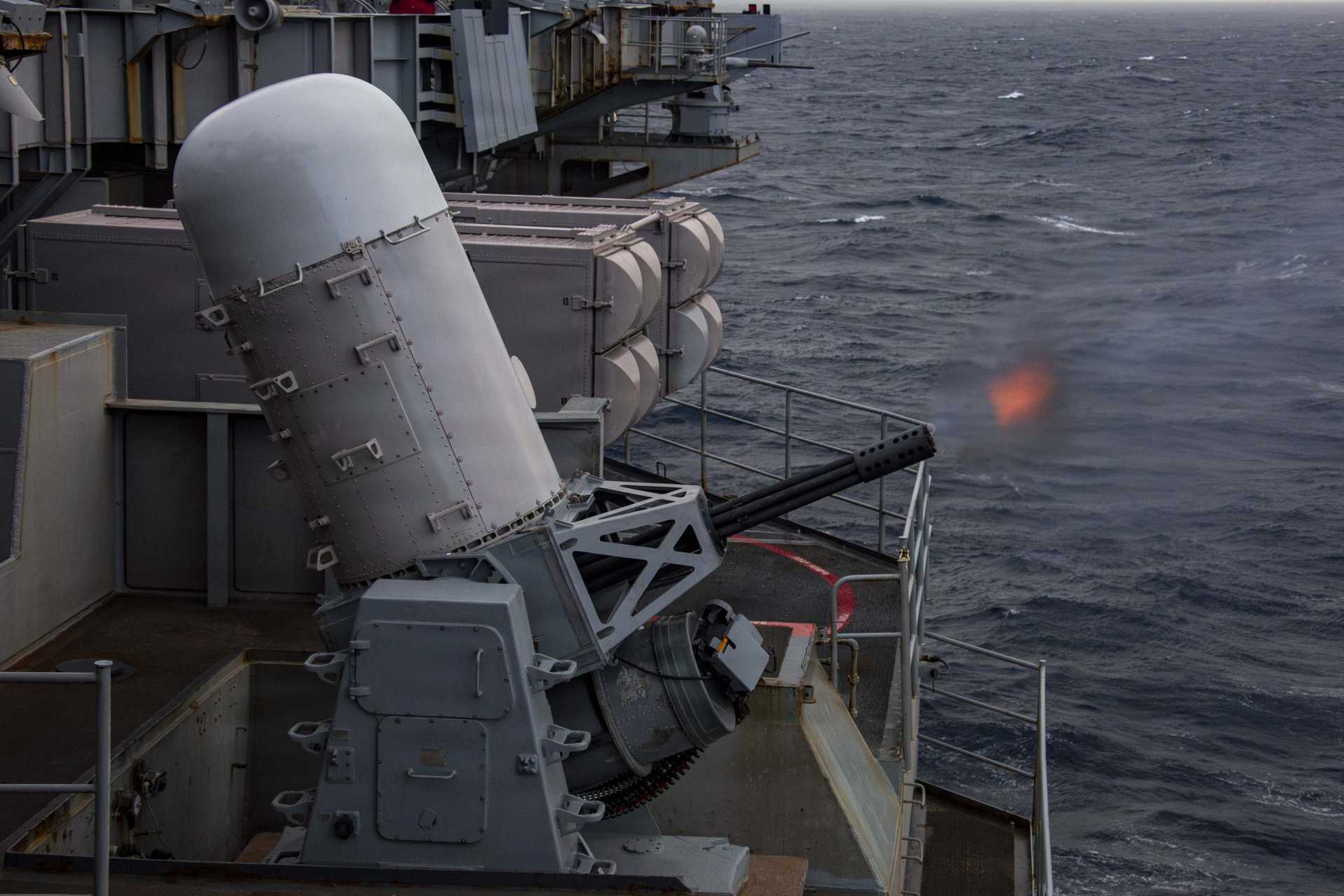
Follow Army Recognition on Google News at this linkA Phalanx CIWS fires aboard USS Abraham Lincoln during a live-fire exercise, demonstrating the carrier’s layered defense against aerial and surface threats. (Picture source: U.S. Department of War)
The live-fire event focused on the Phalanx Close-In Weapon System, a core element of the Nimitz-class carrier’s self-defense architecture. U.S. Navy aircraft carriers are high-value strategic assets whose protection depends on a layered defensive approach designed to counter a wide spectrum of threats, ranging from anti-ship missiles to unmanned aerial systems and explosive-laden fast attack craft.
CIWS: Final Shield Against Aerial and Surface Threats
A Nimitz-class aircraft carrier is typically equipped with four Phalanx CIWS mounts, installed on elevated sponsons around the hull and near the island superstructure. These positions provide overlapping 360° coverage, protecting the flight deck, command spaces, and critical systems from threats approaching at very short range.
Each CIWS integrates search radar, tracking radar, electro-optical sensors, and a six-barrel 20 mm M61A1 Gatling gun capable of firing more than 4,500 rpm. With an effective engagement range of approximately 1.5–2 km, the system is designed to defeat very low-altitude and high-speed threats in the final seconds before impact.
Against aerial threats, CIWS functions as a last-ditch anti-aircraft and anti-missile system. It is optimized to destroy sea-skimming anti-ship missiles flying only a few meters above sea level, as well as low-flying aircraft and small UAVs that evade longer-range defenses. Its autonomous operation allows rapid engagement without reliance on external fire-control data.
Against kamikaze boats and unmanned surface vessels (USVs), CIWS remains one of the most effective defensive tools available. Fast, low-profile explosive boats can approach at high speed with minimal warning, particularly in congested littoral waters. CIWS can disable propulsion systems or detonate explosive payloads before impact, providing a decisive close-range counter.
Sea Sparrow: Short-Range Air and Missile Defense Layer
Beyond gun-based defense, USS Abraham Lincoln is equipped with two Mk 57 Mod 3 NATO Sea Sparrow launchers mounted amidships on port and starboard sponsons. These launchers fire the RIM-7 Sea Sparrow missile, a radar-guided interceptor with an effective engagement range of approximately 15–20 km.
Sea Sparrow serves as the carrier’s primary short-range anti-aircraft and anti-missile defense system, designed to intercept hostile aircraft, helicopters, and incoming anti-ship missiles at low to medium altitudes. By engaging threats well before they reach CIWS range, Sea Sparrow increases reaction time and reduces the risk of saturation attacks.
Against aerial drones, Sea Sparrow is effective against larger UAVs, armed reconnaissance platforms, and loitering munitions with sufficient radar cross-section. While it is not optimized for very small drones, it provides a critical defensive layer against more capable unmanned aerial threats.
Sea Sparrow retains a limited surface engagement capability against large, radar-visible surface targets, but it is not intended as a primary anti-boat weapon and remains focused on air and missile defense missions.
Rolling Airframe Missile: High-Agility Counter to Modern Threats
Complementing Sea Sparrow is the RIM-116 Rolling Airframe Missile (RAM) system, which typically has two launchers installed on Nimitz-class aircraft carriers. These launchers are positioned near the island superstructure and aft sections of the ship to protect key approach sectors and flight operations areas.
RAM has an engagement range of approximately 9–10 km and employs a dual-mode passive RF/IR guidance system. This allows the missile to home in on radar emissions or thermal signatures without emitting radar energy, improving survivability in electronically contested environments.
RAM is specifically designed to defeat highly maneuverable aerial threats, including modern anti-ship missiles and low-altitude UAVs. Its fire-and-forget capability enables rapid sequential engagements, making it particularly effective against multi-axis or swarm-style attacks.
Against USVs and kamikaze boats, RAM provides an emerging capability. Larger unmanned boats equipped with engines, sensors, or data links generate IR and RF signatures that RAM can exploit, allowing engagement before the threat enters CIWS range.
Layered Defense Against New Maritime Warfare Threats
Together, the carrier’s four CIWS mounts, two Sea Sparrow launchers, and two RAM launchers form a layered inner-defense architecture capable of countering aircraft, UAVs, anti-ship missiles, and fast attack craft. Threats are engaged progressively, from missile range to last-ditch gun defense, ensuring redundancy and resilience against saturation attacks.
These onboard systems operate in coordination with the carrier strike group. Aegis-equipped cruisers and destroyers provide long-range air and missile defense extending hundreds of km from the carrier, while carrier-based aircraft and helicopters contribute to early detection and surface threat interdiction. The carrier’s organic weapons ensure survivability if outer defensive layers are penetrated.
Live-fire exercises such as the one conducted aboard USS Abraham Lincoln are essential to maintaining combat readiness. They validate weapon performance, sensor fusion, and crew proficiency under realistic operational conditions in which reaction time is limited and flight operations must continue.
Strategic Significance
The exercise reflects a broader shift in maritime warfare. The proliferation of low-cost UAVs, loitering munitions, and explosive USVs has increased the importance of automated, layered close-in defenses alongside traditional missile defense systems.
As USS Abraham Lincoln continues operations in the South China Sea and across the Indo-Pacific, its demonstrated defensive capabilities reinforce U.S. deterrence, freedom of navigation, and the protection of allied interests. The survivability of U.S. aircraft carriers increasingly depends on their ability to counter unmanned and asymmetric threats in addition to conventional ones.
The continued modernization, correct positioning, and intensive training associated with Nimitz-class defensive armament ensure that U.S. aircraft carriers remain credible, protected, and operational in an evolving maritime threat environment.
Written by Alain Servaes – Chief Editor, Army Recognition Group
Alain Servaes is a former infantry non-commissioned officer and the founder of Army Recognition. With over 20 years in defense journalism, he provides expert analysis on military equipment, NATO operations, and the global defense industry.
-
INTEL: Japan Joins U.S. and UK Navies in Deploying Laser Weapons on Warships
 {loadposition bannertop}{loadposition sidebarpub}
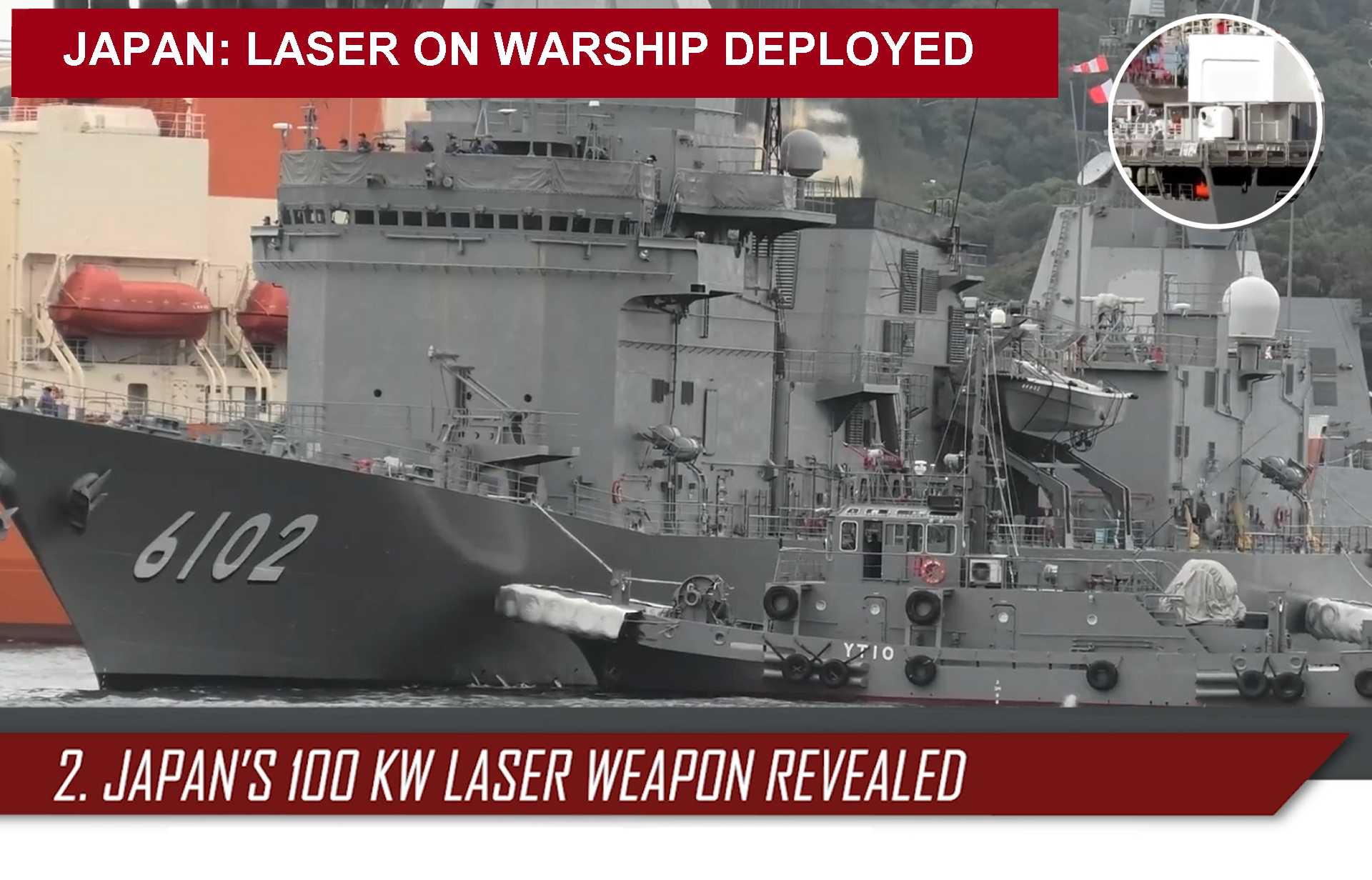
Japan has installed its first high-powered shipborne laser weapon, mounting a 100-kilowatt-class system aboard the testbed destroyer JS Asuka. The deployment places Japan alongside the United States and the United Kingdom as allied navies accelerate the deployment of directed-energy defenses against emerging maritime threats.
Japan has crossed a major threshold in maritime defense with the first-ever installation of a high-energy laser weapon aboard a naval warship. Defense officials confirmed that a 100-kilowatt-class laser system has been mounted on the Japan Maritime Self-Defense Force testbed destroyer JS Asuka, marking the country’s most advanced step yet into shipborne directed-energy technology. The move aligns Japan with the United States and the United Kingdom, both of which are already deploying and testing similar naval laser systems in response to rapidly evolving threats across the maritime domain.
Follow Army Recognition on Google News at this linkJapan’s JS Asuka experimental destroyer outfitted with a 100kW-class laser weapon system during integration trials, marking the nation’s first operational step into directed energy naval defense. (Picture source: Japan MoD)
JS Asuka, long used as an experimental platform within the Japan Maritime Self-Defense Force (JMSDF), has now been tasked with conducting live sea trials of the laser system, which was developed domestically by a team led by Mitsubishi Heavy Industries and Toshiba Energy Systems. Defense officials familiar with the project say these trials will test not only the laser’s ability to track and neutralize drones and incoming threats, but also its endurance, targeting stability, and power management in real oceanic conditions. This is an essential step toward fleet-wide adoption.
This deployment reflects a growing sense of urgency in Japan’s defense establishment. In the face of mounting regional threats from China’s expanding naval presence, North Korea’s missile testing campaigns, and the widespread use of unmanned and hypersonic systems, Japan is investing in next-generation defenses that offer both strategic deterrence and tactical resilience. Laser weapons, capable of engaging targets at the speed of light with virtually unlimited magazine depth and negligible cost-per-shot, are increasingly seen as a necessary countermeasure against massed drone attacks and saturation missile strikes.
Japan’s decision mirrors and responds to parallel developments by two of its key strategic partners: the United States and the United Kingdom. Both nations are accelerating operational integration of naval lasers after years of research and live-fire validation.
United States:Operational deployment with HELIOS and future scalability
The United States Navy remains the clear leader in directed energy deployment. After early experimentation with the 30-kilowatt LaWS (Laser Weapon System) aboard USS Ponce in the Persian Gulf, the Navy has since moved to deploy the more powerful and combat-ready HELIOS (High Energy Laser with Integrated Optical-dazzler and Surveillance) system developed by Lockheed Martin. Installed aboard the Flight IIA Arleigh Burke-class destroyer USS Preble (DDG-88), HELIOS is the first U.S. Navy laser weapon fully integrated into the Aegis Combat System, enabling automatic sensor-to-shooter engagement loops.
Rated between 60 and 150 kilowatts, HELIOS has already undergone live tests to neutralize UAVs and simulate engagements against fast-attack boats. Its integration provides a true multi-role capability. Beyond kinetic strikes, it can dazzle incoming surveillance sensors and feed intelligence directly into the ship’s battle network. The U.S. Navy sees this as part of a broader shift toward distributed maritime operations, where lasers, combined with unmanned assets and next-generation electronic warfare systems, will defend surface groups against complex swarm attacks and low-cost aerial incursions.
Additional programs, such as ODIN (Optical Dazzling Interdictor, Navy) and Layered Laser Defense (LLD), are further enhancing the Navy’s arsenal of scalable directed energy systems. Future versions are targeting 300 kW-class interceptors for anti-ship missile defense.
United Kingdom: DragonFire enters at-sea trials phase
The United Kingdom has also moved quickly into the directed energy domain, led by the DragonFire program, a high-energy laser demonstrator created by a partnership including MBDA, Leonardo UK, and QinetiQ. The DragonFire system has entered shipboard testing aboard a Type 23 frigate, with live drone and boat-target trials anticipated in late 2025. The system’s power range, estimated at 50-100 kilowatts, is designed to be scalable for deployment on the upcoming Type 26 and Type 31 frigates by the early 2030s.
What sets DragonFire apart is its advanced beam control and thermal management systems, specifically engineered for maritime conditions in the North Atlantic and beyond. Its integration with the Royal Navy’s command systems will allow seamless transition from detection to engagement. This is particularly important for protecting task groups in areas such as the Red Sea, Indo-Pacific, and high-risk chokepoints.
Japan’s use of JS Asuka as a dedicated laser weapon trial ship is a calculated choice. By testing first on a purpose-built experimental platform, Japan minimizes risk and accelerates deployment timelines for frontline warships such as the Maya-class Aegis destroyers and Mogami-class multi-mission frigates. Sources inside the Acquisition, Technology, and Logistics Agency (ATLA) indicate that future versions of the laser system may integrate artificial intelligence for autonomous target prioritization and energy management. This capability is critical for responding to swarm attacks in real time.
Tactically, the laser weapon gives the JMSDF a persistent, cost-effective defensive tool that complements Japan’s missile defense capabilities. With increasing drone incursions around Japanese territory and frequent missile launches from North Korea, the need for deep-magazine defenses has never been more urgent. Lasers also allow for flexible escalation, disabling sensors or UAVs non-lethally without crossing conventional red lines or firing kinetic weapons that could trigger conflict.
Around the world, naval forces are pivoting toward laser-based systems not only for their technological promise but because traditional air defense models are no longer sustainable in future conflict environments. Missile interceptors like the SM-2, ESSM, or Sea Ceptor are expensive, finite, and increasingly vulnerable to overwhelming tactics. Laser weapons offer a disruptive alternative. They provide speed-of-light interception, virtually unlimited firing capacity, and integration with modern combat management systems.
Germany has begun laser trials aboard the Sachsen-class frigate Sachsen, with Rheinmetall’s demonstrator leading the charge. France’s Naval Group is advancing research under the ARES program. Israel’s Iron Beam system, while initially designed for land-based missile defense, is now being evaluated for naval deployment aboard Sa’ar-class vessels. South Korea and Australia are investing in similar technologies to defend ships operating in high-threat environments such as the South China Sea and the Sea of Japan.
This new generation of directed energy systems is not designed to replace missiles, but to complement them. Lasers are intended to absorb the drone and loitering munition threat while preserving interceptor inventories for larger, high-value targets such as cruise or ballistic missiles. In high-tempo, multi-domain battles, lasers offer constant readiness, low cost, and minimal collateral damage. This makes them an ideal solution for the demands of 21st-century naval combat.
The installation of a 100kW-class laser weapon aboard the Japanese warship JS Asuka is more than a technological milestone. It represents Japan’s strategic entry into a new era of maritime warfare. As sea trials begin, Japan joins a small but powerful group of naval powers actively weaponizing light to defend against the fastest, smallest, and most numerous threats on the modern battlefield.
With the U.S. Navy fielding integrated systems, the Royal Navy pushing toward deployment readiness, and Japan demonstrating indigenous capability, the directed energy race is no longer about who can build the most powerful laser. It is about who can integrate, scale, and operate these systems across fleets before the next conflict demands it.
Written by Alain Servaes – Chief Editor, Army Recognition Group
Alain Servaes is a former infantry non-commissioned officer and the founder of Army Recognition. With over 20 years in defense journalism, he provides expert analysis on military equipment, NATO operations, and the global defense industry.
-
China’s Type 076 Amphibious Assault Carrier Outsizes France’s Aircraft Carrier to Conduct Attacks From Sea
 {loadposition bannertop}{loadposition sidebarpub}
China’s Type 076 amphibious assault carrier measures 263 meters and is estimated at roughly 50,000 tons, placing it well above France’s Charles de Gaulle in both length and displacement. The platform signals China’s intent to build a larger, drone-enabled amphibious force aimed at rapid operations around Taiwan.
China’s unveiling of the Type 076 amphibious assault carrier has drawn attention across the naval defense community because its 263-meter hull and estimated 50,000-ton displacement now exceed the dimensions of France’s nuclear-powered Charles de Gaulle. According to early assessments from regional security analysts, the ship is structured less as a blue-water strike carrier and more as a high-capacity platform for drones, helicopters, and amphibious forces, designed for short-range power projection along China’s eastern coastline and in the Taiwan Strait.
Follow Army Recognition on Google News at this linkVisual comparison between China’s Type 076 amphibious assault carrier and France’s Charles de Gaulle nuclear aircraft carrier. The Type 076 measures 263 meters in length and displaces approximately 50,000 tons, while the Charles de Gaulle is slightly shorter at 261.5 meters and displaces around 43,000 tons. (Picture source: Zhao DaShuai X account)
On paper, France’s Charles de Gaulle retains clear supremacy in fixed-wing aviation, operating a CATOBAR (catapult-assisted takeoff but arrested recovery) system that launches Rafale M fighters for long-range strike, air superiority, and deep ISR missions. Its 40-aircraft complement includes advanced multirole jets and early-warning aircraft such as the E-2C Hawkeye, giving it full-spectrum combat air capabilities and unmatched blue-water reach. Nuclear propulsion allows for high-speed, sustained operations across distant theaters. This design remains ideal for France’s role in NATO operations and global expeditionary power projection.
The Type 076 is designed for a distinct operational vision: maximizing short-range, high-impact amphibious strike capabilities near the Chinese coast. Rather than pursuing air dominance, it orchestrates amphibious landings, deploys large numbers of drones, and supports ground operations from the sea. This reflects a PLAN doctrine tailored to the “first island chain,” prioritizing rapid, seizure-focused conflict measured in hours.
Regarding air assets, the Type 076 is expected to carry between 20 and 30 helicopters and UCAVs. These may include Z-8 and Z-20 transport and assault helicopters for airborne infantry insertions, and potentially Z-10 attack helicopters for close air support. More significantly, the ship is designed to operate a fleet of vertical takeoff and landing (VTOL) unmanned combat aerial vehicles (UCAVs), including stealthy platforms such as the GJ-11 Sharp Sword. These drones will provide precision strike, electronic warfare, and ISR (intelligence, surveillance, and reconnaissance) coverage. This air component forms the backbone of the ship’s offensive capability from the sea.
This divergence in aviation strategy reveals a deeper doctrinal split. The Charles de Gaulle exists to dominate the airspace and sustain high-end fighter operations far from home waters. The Type 076, on the other hand, is designed to saturate localized battle spaces, such as the Taiwan Strait, with drones and rotorcraft in support of rapid joint landings. It sacrifices fixed-wing range and air superiority in favor of logistical tempo, drone endurance, and sensor saturation. These attributes are more applicable to high-density littoral conflict than to traditional carrier warfare.
Defense analysts from the Army Recognition team assess that the Type 076 introduces a new hybrid capability within the PLAN. It combines the roles of assault carrier, drone command hub, and amphibious flagship. This warship is not a conventional LHD in the traditional sense. The expanded flight deck, internal hangar space, and likely electromagnetic launch technology point to a platform designed to support persistent drone operations at high tempo. This could enable swarming attacks, ISR coverage, and coordinated sea-based battlefield strikes. If successfully integrated, this capability would provide China with a significant tactical advantage in shaping the battlefield before ground forces ever reach the shore.
Operationally, the vessel’s large well deck and internal storage capacity are configured to deploy air-cushioned landing craft (LCACs) and amphibious combat vehicles. This enables massed landings of mechanized infantry under the protective umbrella of drone-based air support. In a cross-strait scenario, this would allow Chinese forces to bypass traditional choke points and establish beachheads quickly and in volume. At the same time, UAVs could neutralize defensive infrastructure in real time, clearing paths for amphibious units.
While Charles de Gaulle symbolizes France’s nuclear-powered, blue-water naval reach, the Type 076 represents something fundamentally different. It is a regionally focused platform designed for rapid escalation in the Taiwan theater. Its length advantage and greater displacement are not symbolic. They directly support operational needs such as extended aviation fuel reserves, expanded drone bays, and enhanced command-and-control infrastructure.
The timing of the Type 076’s sea trials coincides with a marked uptick in PLA amphibious training near the Fujian coastline. Chinese naval activity in the East and South China Seas continues to escalate, and this vessel appears positioned to serve as a flagship for future large-scale amphibious task forces. Its introduction marks a significant evolution in the PLAN's force structure. It alters the balance of power in the Indo-Pacific and challenges long-standing U.S. and allied assumptions about China’s amphibious limitations.
The analysis concludes that the Type 076 marks a fundamental shift for the PLAN: it is not just a new ship, but a doctrinal pivot toward readiness for high-intensity, regional conflict. If built in numbers, the class could redefine amphibious operations with integrated drone, helicopter, and mechanized assault capabilities—directly impacting the Taiwan scenario and regional stability.
Written by Alain Servaes – Chief Editor, Army Recognition Group
Alain Servaes is a former infantry non-commissioned officer and the founder of Army Recognition. With over 20 years in defense journalism, he provides expert analysis on military equipment, NATO operations, and the global defense industry.
-
Exclusive Report: Top 10 Most Modern Attack Submarines in 2025 Ranked by Capability and Deployment
 {loadposition bannertop}{loadposition sidebarpub}
The global defense landscape in 2025 is witnessing a rapid acceleration in undersea warfare capabilities as major powers invest heavily in the next generation of attack submarines. From nuclear-powered leviathans with hypersonic strike capacity to ultra-quiet diesel-electric boats armed with ballistic missiles, these platforms now serve as critical assets for strategic deterrence, sea control, intelligence gathering, and special operations. Driven by regional tensions, evolving naval doctrines, and industrial self-reliance, countries across Europe, Asia, and the Americas have launched highly advanced submarine programs that are redefining the balance of power beneath the waves. This exclusive Army Recognition report ranks the ten most advanced attack submarines in the world based on their operational status, technological features, and combat capability as of mid-2025.
Follow Army Recognition on Google News at this linkThe world’s top 10 most advanced attack submarines in 2025, including the U.S. Virginia-class Block V, Russia’s Yasen-M, France’s Barracuda-class, China’s Type 095, and South Korea’s KSS-III Batch II, representing the cutting edge of underwater warfare and strategic deterrence across nuclear and conventional platforms.
1. Virginia-Class Block V – United States
The Virginia-class program began in the late 1990s as the U.S. Navy’s next-generation SSN to replace the aging Los Angeles-class. Block V construction began in 2019, with the final two submarines ordered in April 2025. The first Block V unit is expected to enter operational service in 2026, featuring the most significant redesign since the class’s inception.
Displacing over 10,200 tons submerged, Block V submarines introduce the Virginia Payload Module, an 84-foot hull section equipped with four large-diameter payload tubes, allowing up to 40 Tomahawk Block V missiles—more than triple the payload of previous blocks. The S9G nuclear reactor provides over 30 years of fuel life. The class features fiber-optic sonar arrays, photonic masts, acoustic dampening, and pump-jet propulsion for ultra-quiet movement at high speed. It is also fitted for unmanned undersea vehicle (UUV) deployment, seabed warfare, and special operations.
Unique edge: The highest strike missile capacity of any attack submarine, combined with multi-domain modularity, unmatched ISR systems, and long-term operational endurance, making it the most capable SSN in the world.

2. Yasen-M Class (Project 885M) – Russia
Development of the Yasen-M class resumed in the early 2000s after Cold War-era designs were shelved. The first modernized unit, Kazan, entered service in 2021, with Arkhangelsk added in January 2025. By mid-2025, five Yasen-M boats are in active service, with additional hulls under construction at Sevmash Shipyard.
The Yasen-M displaces 13,800 tons submerged and is powered by the OK-650V.02 nuclear reactor with a 30-year core life. The hull incorporates composite acoustic insulation and high-strength steel. Armed with 32 VLS cells, it can launch Kalibr land-attack missiles, Oniks supersonic anti-ship missiles, and Tsirkon hypersonic missiles—the latter in operational service since late 2023. The submarine also features 10 torpedo tubes and the MGK-600 sonar suite for long-range detection in blue-water or Arctic environments.
Unique edge: First submarine class with operational hypersonic strike capability and strategic deep-sea patrol range, giving Russia a versatile and heavily armed SSN optimized for high-end naval warfare.

3. Barracuda-Class (Suffren-Class) – France
The Barracuda program was initiated in the early 2000s to replace France’s Rubis-class SSNs. The first submarine, Suffren, was commissioned in 2022, followed by Duguay-Trouin in 2023. Four additional units are under construction, with full fleet delivery planned before 2030.
The class displaces around 5,300 tons submerged and is powered by the K15 pressurized-water reactor adapted from France’s strategic submarine fleet. It incorporates pump-jet propulsion, advanced automation, and a crew-reducing digital architecture. Armament includes MdCN cruise missiles (1,000+ km range), Exocet SM39 anti-ship missiles, and F21 torpedoes. The Thales S-CUBE sonar suite and SYCOBS combat system provide high-fidelity threat detection and weapon control.
Unique edge: The only European SSN equipped with strategic-range cruise missiles, pump-jet propulsion, and full-spectrum special operations capability, tailored for NATO and Indo-Pacific expeditionary roles.

4. Type 095 (Tang-Class) – China
The Type 095 program began in the early 2010s to replace the Type 093A. At least two hulls were launched between late 2023 and 2025 at Huludao Shipyard. Full operational capability is expected by late 2025 or early 2026.
The class is believed to displace over 7,000 tons submerged and is China’s first SSN to feature pump-jet propulsion, reflecting a major acoustic and propulsion leap. It includes a new bow-mounted spherical sonar array, flank arrays, and modern towed sonar, marking significant Chinese progress in passive detection.
The submarine integrates vertical launch systems capable of firing YJ-18 supersonic cruise missiles, with speculation about future land-attack variants. It is designed to escort China's Jin-class SSBNs and carrier strike groups and support long-range ISR and hunter-killer missions.
Unique edge: China’s first true multipurpose SSN with low-frequency sonar, VLS capability, and powerplant improvements, giving PLAN a credible deep-sea strike platform for blue-water deployment.

5. KSS-III Batch II – South Korea
The KSS-III program began in 2007, with the first Batch I submarine entering service in 2021. Batch II construction commenced in 2023, with delivery expected in 2026. These submarines are built entirely by South Korean industry, marking a significant leap in indigenous naval capability.
Displacing around 3,800 tons submerged, Batch II submarines integrate lithium-ion batteries, AIP fuel-cell systems, and a new Korean-designed combat suite. The boats are equipped with flank sonar, synthetic aperture sonar, and advanced ESM systems. Submerged endurance exceeds 20 days without snorkeling. Its Korean Vertical Launching System (K-VLS) can carry up to 10 Hyunmoo-4-4 SLBMs, giving it a strategic regional deterrence function.
Unique edge: The only conventionally powered submarine in the world fielding operational indigenous ballistic missiles, combining stealth AIP propulsion with strategic missile capability.

6. Taigei-Class – Japan
Japan initiated the Taigei-class program in 2017 to replace the Sōryū-class. The lead submarine, Taigei, was commissioned in March 2022, with additional boats delivered through 2025. The class is optimized for regional stealth operations in contested environments.
Taigei-class submarines displace around 3,000 tons submerged and are powered by lithium-ion batteries—offering higher output, faster charging, and longer submerged duration compared to traditional AIP. The class features high-resolution sonar systems by Oki Electric and NEC, and advanced fire-control for Type 18 heavyweight torpedoes and Harpoon missiles.
Unique edge: First operational submarine class powered entirely by lithium-ion batteries, enabling ultra-quiet sprints and enhanced tactical agility without the limitations of AIP systems.

7. Type 212CD – Germany/Norway
Germany and Norway launched the Type 212CD program in 2017 as a successor to the Type 212A. Construction began in 2022, with the first boats scheduled for delivery in 2026. It is being built by TKMS for the German and Royal Norwegian navies.
The submarine displaces approximately 2,500 tons and is equipped with a hydrogen fuel-cell AIP system, which allows for submerged endurance of up to 21 days. Its hull is built from non-magnetic steel and shaped to reduce sonar and magnetic detection. It includes Atlas Elektronik’s ISUS 100 combat suite and Seehecht torpedoes, optimized for shallow, acoustically complex environments like the Baltic and Arctic.
Unique edge: Most advanced AIP submarine in NATO, combining zero-emission fuel-cell propulsion with low-observable hull geometry and modular upgrades for extended Northern Hemisphere patrols.

8. Astute-Class – United Kingdom
The Astute-class was developed in the late 1990s to replace the Trafalgar-class. HMS Astute was commissioned in 2010, and by 2025, five boats are in service with two more in advanced fitting. Astute-class submarines will remain the UK’s front-line SSNs until SSN-AUKUS hulls arrive in the 2030s.
Displacing over 7,400 tons submerged, the class is powered by a PWR2 nuclear reactor and pump-jet propulsion, offering 25 years of fuel life. Sonar 2076 provides unrivaled acoustic range with more than 13,000 hydrophones. The boats are armed with Spearfish torpedoes and Tomahawk Block IV (and soon Block V) cruise missiles.
Unique edge: One of the most acoustically sophisticated SSNs in NATO, combining extended global endurance, exceptional sonar coverage, and modular upgrade potential aligned with the future AUKUS platform.

9. Kalvari-Class (Project 75 Scorpène Variant) – India
India’s Kalvari-class is based on the French Scorpène design and was developed under Project 75 in partnership with Naval Group and Mazagon Dock Shipbuilders Limited. The program began in the early 2000s, with the first submarine, INS Kalvari, commissioned in 2017. The sixth and final boat of the class, INS Vagsheer, was commissioned in January 2025, completing the first indigenous modern submarine production cycle in Indian naval history.
The Kalvari-class displaces around 1,775 tons submerged and is powered by diesel-electric engines with battery propulsion, supported by French SUBTICS combat systems. These submarines are equipped with sonar systems developed by Thales and BEL, and they deploy Black Shark torpedoes and SM39 Exocet missiles. AIP capability was not integrated in Batch I but is scheduled for retrofitting in the coming years through an indigenous fuel-cell-based AIP module developed by DRDO. The submarines also support special forces deployment via integrated swimmer lockout trunks.
Unique edge: India’s first modern submarine production line, combining French design with Indian systems integration, and providing a scalable platform for indigenous AIP, cruise missile, and stealth upgrades in future Project 75(I) developments.

10. A26 Blekinge-Class – Sweden
The A26 Blekinge-class represents the most advanced Swedish submarine program since the Gotland-class and is designed for operations in both littoral and blue-water environments. Developed by Saab Kockums, construction began in 2021 for the Swedish Navy, with delivery of the first unit, HMS Blekinge, expected by 2026.
The A26 displaces around 2,122 tons submerged and features a modular design with a hull optimized for stealth, pressure resistance, and near-zero radiated acoustic emissions. It includes Stirling engine-based air-independent propulsion, offering three weeks of submerged endurance without surfacing. The integrated combat system is designed around Saab’s 9LV suite and Atlas Elektronik sonar. Armament includes torpedoes, mines, and long-range land-attack missiles (under development in cooperation with Saab Dynamics). The class features a unique multi-mission portal—a 1.5-meter lockout hangar for deploying special forces, UUVs, and divers.
Unique edge: The world’s most advanced modular AIP submarine, optimized for both confined and open-water operations, with unmatched mission adaptability for UUVs, seabed warfare, and special forces deployment.

-
Exclusive: Türkiye enters elite group of countries able to build aircraft carrier with MUGEM-class
 {loadposition bannertop}{loadposition sidebarpub}
Türkiye has officially entered the elite league of nations capable of designing and constructing a fully indigenous aircraft carrier with the start of the MUGEM-class program at Istanbul Naval Shipyard in early 2025. The MUGEM-class represents a major leap in Türkiye’s naval defense ambitions, showcasing the maturity of its domestic shipbuilding and aerospace industries. Developed entirely through local engineering, manufacturing, and systems integration, the project places Türkiye on par with traditional naval powers such as the United States, China, and France, who each rely on large, complex industrial ecosystems to support their carrier construction programs.
Follow Army Recognition on Google News at this linkScale model of Türkiye's MUGEM-class aircraft carrier displayed at defense exhibition showcases the future flagship of the Turkish Navy with fully indigenous design and aviation capabilities. (Picture source: Army Recognition Group)
The Turkish MUGEM-class aircraft carrier will be the largest warship ever built in Türkiye, with a projected displacement of 60,000 tons and a length of 285 meters. Built under the framework of the MILGEM national warship program, MUGEM adopts a STOBAR (Short Take-Off But Arrested Recovery) configuration. Its flight deck will incorporate 12-degree modular ski-jump ramps and an indigenous arrestor system, supporting a diverse air wing of manned and unmanned platforms. The air component will include the Bayraktar TB3 UCAV, Kızılelma jet-powered stealth drone, the HÜRJET light fighter, and potentially a navalized version of the TF-Kaan fifth-generation stealth aircraft. With capacity for thirty aircraft in its internal hangar and an additional twenty on deck, MUGEM is engineered as a hybrid carrier capable of sustained air operations in contested maritime zones.
The propulsion system will rely on a domestically developed COGAG (Combined Gas and Gas) configuration, enabling speeds above 25 knots and an operational range exceeding 10,000 nautical miles. Türkiye’s leading defense contractors including HAVELSAN, ASELSAN, and STM are responsible for the development and integration of MUGEM’s combat management system, electronic warfare suite, radar architecture, navigation, and command-and-control infrastructure. Unlike the traditional multi-national approaches to carrier construction, MUGEM is being built in a single national shipyard, demonstrating the industrial efficiency and capability of Türkiye’s vertically integrated defense ecosystem.
In comparison, the United States Navy remains the benchmark for carrier warfare with its Gerald R. Ford-class nuclear-powered supercarriers. The latest vessel in the class, USS Enterprise (CVN-80), is under construction at Newport News Shipbuilding and expected to join the fleet by 2028. These carriers feature advanced EMALS (Electromagnetic Aircraft Launch Systems), AAG (Advanced Arresting Gear), and the latest AN/SPY-6 radar suites. Displacing over 100,000 tons, each Ford-class carrier supports more than 75 aircraft including F-35C stealth fighters, E-2D Hawkeyes, and a full complement of electronic warfare and strike aircraft. The U.S. carrier model reflects over a century of sustained development supported by the world’s most mature naval industrial base.
China, quickly rising as a formidable maritime power, has accelerated its naval aviation programs through the Type 003 Fujian-class carrier, launched in 2022 at the Jiangnan Shipyard in Shanghai. With a displacement exceeding 80,000 tons and equipped with electromagnetic catapults similar to those used on U.S. carriers, Fujian marks China’s transition into high-tempo fixed-wing carrier operations. The ship is undergoing sea trials and is expected to be operational by the end of 2025. In parallel, China is advancing plans for a fourth carrier possibly nuclear-powered while expanding its shipyard infrastructure and aircraft development to support future carrier strike groups capable of global deployment.
France, a long-standing European naval power, is pursuing its next-generation carrier project, PANG (Porte-Avions de Nouvelle Génération), to replace the nuclear-powered Charles de Gaulle by the late 2030s. Built by Naval Group, the PANG will displace approximately 75,000 tons, be equipped with EMALS catapults, and launch future aircraft developed under the trinational FCAS (Future Combat Air System) program. Powered by two K22 nuclear reactors developed by TechnicAtome, the PANG reflects France’s emphasis on autonomous expeditionary capabilities and its commitment to maintaining a nuclear-powered blue-water navy with full strategic independence.
In contrast to these superpowers, Türkiye is achieving comparable technical sophistication within a streamlined national model. MUGEM’s full design, construction, and integration process is occurring entirely within Turkish borders, an unprecedented achievement in such a short development cycle. The project draws upon the experience gained from earlier indigenous platforms such as the TCG Anadolu amphibious assault ship, the Ada-class corvettes, and the I-class frigates. The inclusion of TF-2000 destroyers and the MILDEN-class submarines under the same national strategy reflects Türkiye’s broader goal to assemble a complete, indigenously built carrier strike group.
Strategically, the MUGEM-class serves Türkiye’s long-term maritime doctrine based on the "Blue Homeland" (Mavi Vatan) concept, extending the country’s naval reach across the Eastern Mediterranean, Aegean Sea, Black Sea, and deep into the Red Sea and Indian Ocean. This aircraft carrier is not only a projection of airpower at sea but a command-and-control hub that integrates unmanned technologies, electronic warfare, and next-generation naval aviation into a unified system. It will also provide a mobile base for rapid response operations, humanitarian missions, and multinational deployments completely free from foreign dependency.
More than a ship, MUGEM symbolizes the culmination of Türkiye’s transformation into a fully independent defense producer. With regional and global dynamics increasingly shaped by maritime superiority, the introduction of the MUGEM-class aircraft carrier positions Türkiye as a decisive actor capable of influencing the future of naval power projection well beyond its borders. This development will not only redefine Türkiye’s naval strategy but also send a clear message to allies and competitors alike. Türkiye has arrived as a carrier-capable maritime power with global ambitions, full industrial autonomy, and a shipbuilding model that is both innovative and strategically sustainable.
-
U.S. Navy mine counter-measure efforts advance with Raytheon Barracuda underwater neutralization vehicle
 {loadposition bannertop}{loadposition sidebarpub}
According to information published by Raytheon on July 8, 2025, the American defense company successfully completed the first untethered, semi-autonomous demonstration of its Barracuda naval mine neutralization vehicle during open water testing in Narragansett Bay. The event marks a critical milestone in the U.S. Navy’s effort to modernize its mine countermeasure capabilities through the integration of autonomous unmanned systems. Raytheon, a business of RTX, confirmed that Barracuda performed all mission-critical functions independently, including underwater navigation, communication, target detection, classification, and tracking, culminating in a man-in-the-loop final engagement decision.
Follow Army Recognition on Google News at this linkRaytheon's Barracuda unmanned underwater mine detection vehicle during open water testing for mine neutralization missions. (Picture source: Raytheon)
The Raytheon Barracuda is a next-generation naval mine neutralization system and an advanced Unmanned Underwater Vehicle (UUV) specifically engineered to identify and destroy bottom, volume, and near-surface sea mines. Unlike legacy systems that rely on tethered Remotely Operated Vehicles (ROVs), Barracuda functions untethered and semi-autonomously, significantly enhancing operational reach, mission efficiency, and platform survivability in high-risk maritime environments. The recent demonstration validated Barracuda’s ability to operate independently throughout a complete search-to-neutralization mission profile, marking a significant advancement in U.S. Navy undersea warfare technology.
For the U.S. Navy, Barracuda offers a transformative leap in mine warfare operations by enabling faster and safer mine clearance in littoral zones, chokepoints, and critical sea lanes. Its autonomous functionality reduces the need for divers and crewed platforms to enter mine-infested waters, significantly decreasing risk to personnel. The system’s modularity allows for easy deployment from various naval assets, including unmanned surface vessels, helicopters, and small boats, giving commanders operational flexibility and rapid response capability. Furthermore, its integration with networked battle management systems enables coordinated, multi-domain mine countermeasure operations as part of a larger naval task force.
Barracuda features a compact, hydrodynamic design with a modular and open systems architecture that supports advanced payload integration. It utilizes a suite of high-resolution sonar, electro-optical sensors, and onboard processing powered by artificial intelligence to detect and classify underwater mines with high accuracy. After positively identifying a threat, the system transmits data to a human operator who authorizes the final neutralization action, typically through the deployment of a controlled explosive charge. This man-in-the-loop safety mechanism maintains critical human oversight while reducing direct exposure of personnel to underwater threats.
As the first untethered mine neutralization UUV to become a formal program of record for the U.S. Navy, Barracuda represents a paradigm shift in autonomous naval mine warfare. The vehicle was developed under Raytheon’s Advanced Technology division, known for pioneering innovations used in other major programs such as LTAMDS and SPY-6. Designed for launch and recovery from various platforms, including unmanned surface vessels (USVs), helicopters, and small boats, Barracuda enables distributed and expeditionary MCM operations in both shallow coastal zones and deep-sea environments.
Raytheon has confirmed that the Barracuda program is on track to reach Initial Operational Capability (IOC) and Low-Rate Initial Production (LRIP) by 2030, in line with the U.S. Navy’s mine warfare modernization strategy. Additionally, Raytheon is investing in a larger, more capable variant of the Barracuda platform to support future mission profiles beyond mine neutralization, including subsea and seabed warfare, infrastructure security, and persistent undersea surveillance.
Barbara Borgonovi, president of Naval Power at Raytheon, highlighted the significance of the recent milestone, stating: “This recent testing demonstrates the significant strides we've made in advancing mine countermeasure technology. Barracuda's capabilities will dramatically improve safety and efficiency for the U.S. Navy, keeping sailors out of harm’s way while effectively addressing underwater threats.”
With the introduction of the Barracuda UUV, Raytheon is redefining the U.S. Navy’s ability to ensure maritime domain superiority through autonomous systems. Its flexibility, precision, and survivability make it a critical enabler of future undersea operations, supporting the U.S. Navy’s transition to a more agile and unmanned-capable fleet in response to evolving threats across the globe.
-
Exclusive Report: U.S. Navy Naval Surface Warfare Center Panama City leads military diving innovations
 {loadposition bannertop}{loadposition sidebarpub}
The U.S. Navy Naval Surface Warfare Center Panama City Division (NSWC PCD) continues to cement its role as the epicenter of U.S. military diving innovation. Under the leadership of Dr. John Kelly, head of the Special Mission Systems Division, the center integrates cutting-edge research, engineering, testing, and sustainment programs to support the U.S. Navy, Marine Corps, and joint force underwater operations. Situated at the Naval Support Activity Panama City (NSA PC), NSWC PCD works in tight coordination with the Navy Experimental Diving Unit (NEDU) and the Naval Diving and Salvage Training Center (NDSTC), forming a trio of capabilities unmatched in the defense sector.
Follow Army Recognition on Google News at this linkTwo military divers operate a dual-frame Seacraft diver propulsion vehicle during maritime operations. The system supports both linear tow and independent maneuver modes, allowing rapid adaptation to mission-specific requirements. (Picture source: U.S. DoD)
At the heart of U.S. Navy NSWC PCD's (Naval Surface Warfare Center Panama City Division) mission is the development of advanced underwater mobility systems, next-generation diving apparatus, life support technologies, and tools for maritime special operations. These efforts are supported by a multidisciplinary team of engineers, scientists, and analysts who routinely simulate deep-sea conditions using hyperbaric chambers to test new gear and tactics. As underwater threats grow more sophisticated and operational demands increase, the center’s work remains critical in equipping divers with systems that offer both enhanced safety and superior mission performance.
Dr. Kelly highlights the synergy between the three tenant commands at NSA PC as a defining strength: NSWC PCD pioneers the technology, NEDU rigorously tests and certifies life support systems through manned evaluations, and NDSTC serves as the training ground for military divers across all U.S. service branches. This integrated approach enables rapid feedback loops from design to deployment, ensuring the U.S. underwater warfighter remains ahead of evolving threats.
Command Master Chief Jay Cox of NDSTC, a former master diver at NSWC PCD, underscores the technical foundation that underpins operational readiness. He emphasizes how NSWC PCD’s work in areas such as rebreather development, protective suits, mine countermeasures, underwater surveillance, and human performance modeling directly addresses modern challenges in military diving. These include extended-duration missions, complex environmental navigation, and cognitive load management under extreme pressure.
Diving is no longer limited to support roles, it is a frontline capability critical to a broad range of high-risk military and special operations missions. In recent years, military divers have supported operations such as the neutralization of naval mines in the Red Sea, sabotage prevention and reconnaissance around critical port infrastructure in the Eastern Mediterranean, and underwater recovery and exploitation missions in the Indo-Pacific region. These tasks demand the highest level of physical resilience and technical readiness, requiring gear that enables long-duration stealth movement, accurate underwater navigation, and survival in high-pressure or chemically contaminated environments.
NSWC PCD's innovations directly support these missions through modular rebreather systems that allow mission-adaptable gas mixes and low acoustic signatures, integrated diver propulsion systems with onboard sonar and threat detection, and digital heads-up displays for navigation in low visibility. Moreover, their collaborations on data-fusion tools link diver sensors with command-and-control networks, enabling live updates and mission flexibility in real time.
The operational utility of divers in Special Forces is expanding with new platforms that integrate manned and unmanned systems. Special operations divers are increasingly deploying alongside autonomous underwater vehicles (AUVs) for coordinated mine clearance, sabotage, or hydrographic intelligence collection. These capabilities are enhanced by NSWC PCD’s continued focus on cognitive performance research under hyperbaric stress, ensuring not only physical endurance but also mental clarity in critical mission phases.
By focusing on decompression modeling, diving physiology, and precision-engineered systems, NSWC PCD not only advances mission capability but also ensures diver survivability. The center’s holistic approach, linking research, real-world testing, and training, makes it a cornerstone of maritime security and undersea warfare innovation. As defense priorities shift toward littoral and undersea dominance, Panama City stands as the indispensable forge where underwater military advantage is shaped and sustained. In a world where sea control and denial are increasingly contested beneath the surface, the diver remains not just a tool of warfare, but a strategic asset enabled by relentless innovation.
-
EXCLUSIVE: U.S. Navy USS Delaware achieves first submarine torpedo tube launch and recovery of unmanned underwater vehicle
 {loadposition bannertop}{loadposition sidebarpub}
According to information published on the Facebook account of the U.S. Commander of Submarine Forces on May 30, 2025, the Virginia-class fast-attack submarine USS Delaware (SSN 791) successfully conducted a landmark unmanned mission in the U.S. European Command (EUCOM) area of responsibility. The operation featured the Yellow Moray Unmanned Underwater Vehicle (UUV), a customized version of the REMUS 600 designed to perform a wide range of underwater tasks, including mine countermeasures, surveillance, reconnaissance, and hydrographic surveys. This mission marked the first-ever forward deployed launch and recovery of a UUV via a submarine’s torpedo tube to complete a tactical objective, establishing a major breakthrough in submarine-launched autonomous capabilities.
Follow Army Recognition on Google News at this linkUS Navy divers prepare the Yellow Moray Unmanned Underwater Vehicle alongside the Virginia-class submarine USS Delaware during a historic forward-deployed launch and recovery operation. (Picture source: Facebook U.S. Commander of Submarine Forces)
The mission involved three autonomous sorties of 6 to 10 hours each, conducted using the same Yellow Moray UUV (Unmanned Underwater Vehicle). All launches and recoveries were performed via U.S. Navy submarine Delaware’s torpedo tubes while submerged, without the use of divers. This operation validated the system’s reliability and effectiveness in real-world conditions, underscoring the strategic potential of integrating robotic platforms into traditional submarine operations. The ability to perform these missions autonomously enables new approaches to subsea and seabed warfare (SSW) while significantly reducing the risk to personnel.
The U.S. Navy USS Delaware (SSN 791), commissioned in April 2020, is the 18th submarine in the Virginia-class and part of the Block III series. It measures 115 m (377 ft) in length, has a beam of 10.3 m (34 ft), and a submerged displacement of approximately 7,800 tonnes. Propelled by an S9G nuclear reactor coupled to a pump-jet propulsor, it achieves submerged speeds exceeding 46 km/h (25+ knots) and can operate at depths beyond 240 m (800+ ft). The submarine is armed with 12 vertical launch system (VLS) tubes for Tomahawk cruise missiles and four 533 mm torpedo tubes for Mk 48 ADCAP torpedoes. Its sensor suite includes the AN/BQQ-10 sonar and Large Aperture Bow (LAB) array, providing superior undersea detection capabilities. It is also optimized for special operations, with reconfigurable payload spaces and dry deck shelter compatibility.
The Yellow Moray is a mission-configured variant of the REMUS 600 UUV, developed by HII’s Hydroid division. It is engineered for long-range, high-endurance operations at depths of up to 600 m (1,968 ft). The vehicle measures 3.25 m (10.7 ft) in length, has a diameter of 0.32 m (12.6 in), and weighs approximately 240 kg (530 lbs). Its modular design supports a variety of mission payloads including synthetic aperture sonar, side-scan sonar, CTD sensors, Doppler velocity logs (DVL), and inertial navigation systems. The system can operate autonomously in GPS-denied environments and execute complex routes in both shallow and deep waters.
The primary missions of the Yellow Moray UUV include seabed mapping, mine countermeasures, hydrographic reconnaissance, and undersea infrastructure monitoring. It is also capable of supporting intelligence, surveillance, and reconnaissance (ISR) operations in denied areas where traditional platforms may face high risk. The vehicle provides operational commanders with valuable environmental and tactical data, enabling informed decision-making and more effective battlespace preparation.
For the U.S. Submarine Force, the operational deployment of UUVs like the Yellow Moray represents a strategic enhancement to mission capabilities. These systems allow submarines to extend their reach beyond manned limits, conducting detailed surveys and reconnaissance in contested or hazardous environments without exposing the platform or its crew to danger. They also increase the tempo and persistence of undersea operations, as UUVs can be rapidly redeployed for repeated missions without requiring maintenance between sorties. Additionally, launching and recovering a UUV via torpedo tube eliminates the need for surfacing or diver support, preserving stealth and operational security.
Vice Admiral Rob Gaucher, Commander of Submarine Forces, emphasized that integrating autonomous systems aboard submarines reduces risk to personnel and enables distributed sensing in complex environments. He highlighted the Navy’s intent to expand the use of such capabilities fleet-wide, ensuring that future attack submarines are equipped not only with powerful weapons and sensors, but also with unmanned systems that multiply their effectiveness across the battlespace.
The mission also showcased the agility and innovation of Submarine Force and UUV Group 1 personnel. After an initial failure to recover the UUV during trials in a Norwegian fjord in February, due to damage discovered post-launch, the system was returned to the U.S. for urgent repair. SUBFOR then redeployed the UUV back to theater, and USS Delaware performed a successful expeditionary reload, executing multiple autonomous missions, including the first-ever pierside diver-assisted torpedo tube UUV load in Norway.
The success of this operation confirms the operational readiness of submarine-launched UUVs for a wide array of missions critical to undersea warfare. As the U.S. Navy advances toward greater autonomy in its undersea forces, the Yellow Moray’s deployment from USS Delaware establishes a crucial milestone in the evolution of 21st-century naval combat, enabling a future where manned and unmanned assets operate seamlessly to ensure undersea dominance.
-
Exclusive Report: How British Navy Astute-class became one of the stealthiest attack submarines in the world
 {loadposition bannertop}{loadposition sidebarpub}
The British Royal Navy Astute-class submarine is widely recognized as one of the most acoustically discreet and stealth-optimized submarines in the world. Designed and built by BAE Systems for the British Royal Navy, this class of nuclear-powered fleet submarines is the result of decades of technological refinement aimed at creating a platform capable of operating silently and invisibly beneath the oceans. In a modern maritime battlespace where the ability to remain undetected defines operational success, the Astute-class represents a near-perfect convergence of stealth, endurance, firepower, and resilience.
Follow Army Recognition on Google News at this linkHMS Astute submarine surfacing during UK Carrier Strike Group 2025 operations, shown here to illustrate the advanced stealth technologies discussed in this report, including its anechoic tile coating and ultra-quiet propulsion system. (Picture source: British MoD)
The British Royal Navy Astute-class is powered by a Rolls-Royce PWR2 nuclear reactor, which gives it virtually unlimited range and the ability to remain submerged for up to 90 days—its endurance limited only by crew and food supplies. The reactor provides energy to a turbo-electric propulsion system, where the nuclear energy generates electricity used to power an electric motor that drives the submarine’s pump-jet propulsion. This design eliminates the need for direct mechanical linkage between the reactor and propulsion shaft, drastically reducing the noise generated by moving components. The pump-jet system further lowers noise by avoiding cavitation, the bubble formation typically caused by propeller movement in water. This configuration enables the Astute to navigate with exceptional discretion even at higher speeds.
The stealth profile of the Astute-class is further enhanced by the application of more than 39,000 anechoic tiles covering the submarine’s hull. These tiles are made from a classified elastic material filled with microscopic air pockets specifically engineered to absorb incoming sonar waves. The function of the tiles is twofold: they reduce the effectiveness of active sonar signals targeting the submarine and also absorb vibrations and sounds emitted from inside the vessel, preventing these from being transmitted into the surrounding water. Unlike earlier submarine designs where tiles often detached during operations, the Astute-class benefits from improved materials and adhesives that ensure the tiles remain in place, even under the extreme pressure of deep-sea missions.
Internally, the submarine’s systems and layout are meticulously engineered to maintain silence. All heavy machinery is mounted on vibration-damping platforms to prevent mechanical resonance. Pipelines, ducts, and fittings are isolated acoustically, minimizing the transmission of structural noise. Crew activities are managed to conform with strict noise discipline, especially during sensitive operations. These combined efforts contribute to an acoustic signature so minimal that the Astute is considered quieter than natural marine background noise in some conditions.
The Astute-class also includes robust backup systems to ensure continued stealth even under mechanical failure or during specific low-speed maneuvers. Diesel generators are installed and can be activated when the submarine is surfaced or at periscope depth using a snorkel mast. These generators supply power to Emergency Propulsion Motors (EPMs), enabling the submarine to perform silent ‘cold moves’ at low speed when the reactor is offline. This is typically used during port transitions, such as movement between Faslane Naval Base and the Coulport weapons facility. In more extreme cases, if the main propulsion system is compromised, the submarine is fitted with a Secondary Propulsion Motor (SPM), nicknamed the "egg whisk." This electrically operated thruster can be deployed from the aft and used for low-speed navigation. It is also rotatable, allowing for directional steering and support in confined areas like harbors.
When it comes to firepower, the Astute-class marks a significant upgrade over previous British submarines. It is equipped with six 533mm torpedo tubes and has internal storage capacity for up to 38 weapons. This is a notable improvement from the Trafalgar-class, which had five tubes and carried 30 weapons. The Astute can be armed with the latest Spearfish Mod 1 heavyweight torpedoes as well as Tomahawk Land Attack Missiles (TLAMs). The Spearfish Mod 1 introduces a fiber-optic guidance system, an advanced warhead, improved counter-countermeasures, and enhanced propulsion—all of which increase both its range and its ability to strike quietly and accurately. These weapons give the Astute-class formidable anti-submarine and anti-surface warfare capabilities, as well as the ability to strike strategic land targets without exposing its position.
The submarine is fitted with the Thales 2076 sonar suite, considered one of the most advanced in the world. This sonar system provides full 360-degree coverage and long-range detection, capable of identifying threats far beyond the range at which the Astute itself could be detected. Integrated with a sophisticated combat management system co-developed by BAE Systems and Thales UK, the Astute-class can rapidly assess threats and deploy weapons in complex environments without compromising its position.
Technically, the Astute-class measures approximately 97 meters in length and displaces around 7,400 tonnes when submerged. It has a submerged speed exceeding 30 knots and a crew complement of roughly 98, with accommodations and support systems designed for extended deployments. Its construction incorporates high-strength steel and modern composite materials, and it is designed to endure extreme pressure at great depths while maintaining stealth and survivability.
The British Royal Navy Astute-class is not merely a submarine—it is a strategic tool of silent influence, designed for long-duration patrols in hostile or contested waters. Its fusion of anechoic technology, ultra-quiet propulsion, highly capable sonar and weapon systems, and extensive redundancy makes it one of the most effective and undetectable attack submarines ever produced. As underwater warfare becomes increasingly pivotal in global defense strategies, the Astute-class ensures the Royal Navy maintains a silent, lethal presence in the depths—ready to strike without warning and vanish without a trace.
-
Exclusive: U.S. Navy tests solid fuel rocket ramjet from drone to enhance strike flexibility in contested airspace
 {loadposition bannertop}{loadposition sidebarpub}
The United States Navy has reached a significant milestone in missile technology by successfully conducting the first air-launch of a Solid Fuel Integral Rocket Ramjet (SFIRR) from an unmanned aerial platform. This test, carried out by the Naval Air Warfare Center Weapons Division (NAWCWD), represents a major advancement in the modernization of long-range missile systems. By integrating cutting-edge propulsion and fire control systems into a missile demonstrator in just 12 months, the Navy has demonstrated its capacity for rapid innovation and fielding of next-generation weapons.
Follow Army Recognition on Google News at this linkA remotely piloted BQM-34 unmanned aerial target launches a test missile over the Point Mugu Sea Range, supporting the development of an advanced missile design to enhance range and precision for future Navy operations. (Picture source: U.S. Navy)
The SFIRR (Solid Fuel Integral Rocket Ramjet) technology offers a new paradigm in missile propulsion. Unlike traditional ramjet systems, which typically rely on liquid fuel and complex combustion mechanisms, the SFIRR uses a solid fuel source that acts both as a propellant and as part of the structural component of the missile. This eliminates many of the design and logistical challenges associated with handling and storing liquid fuels, particularly in combat environments. Additionally, solid fuel systems are inherently more stable and easier to integrate into various launch platforms. By combining the acceleration phase of a rocket with the sustained propulsion of a ramjet in a compact solid fuel package, the SFIRR achieves high speeds over long distances while retaining superior maneuverability. This makes it ideal for striking fast-moving or distant targets with high precision.
The recent test involved launching the SFIRR from a BQM-34 unmanned target vehicle, which was equipped with a sophisticated fire control system to coordinate the launch. This represents not just a propulsion breakthrough but a strategic evolution in how the U.S. Navy intends to deploy future weapons. By launching missiles from unmanned platforms, the U.S. Navy can engage threats at standoff ranges, keeping both manned assets and personnel out of harm's way. This approach also introduces greater operational flexibility, as unmanned systems can be deployed in contested or denied areas where manned aircraft might face greater risks.
The Naval Air Warfare Center Weapons Division (NAWCWD), headquartered at China Lake, California, is the U.S. Navy's principal research and development center for weapons systems. As the Lead Prototype Integrator in this project, NAWCWD successfully combined propulsion, avionics, and fire control technologies into a single, flight-ready demonstrator in under a year. This accomplishment highlights the center’s ability to rapidly translate emerging research into practical, deployable solutions. NAWCWD works in collaboration with government agencies, defense industry partners, and academic institutions to accelerate innovation and ensure the Navy maintains a technological edge in an increasingly contested global security environment.
From a tactical and strategic standpoint, the SFIRR’s success carries far-reaching implications. Its compact design and simplified fuel system reduce logistical burdens and make it suitable for a wide variety of platforms, from manned fighter jets to unmanned aerial systems. The increased range and speed provide greater engagement envelopes, allowing commanders to neutralize threats before they come within effective striking distance. The solid fuel ramjet's high-speed, sustained propulsion is particularly advantageous for penetrating advanced air defense systems or pursuing time-sensitive targets. In a future combat scenario, these capabilities enhance the Navy’s ability to project power, conduct deep strikes, and operate with agility across multiple domains.
This successful demonstration is more than a technical achievement—it is a clear indication that the U.S. Navy is moving swiftly to modernize its arsenal and maintain superiority in missile warfare. The lessons learned from the SFIRR test are already being applied to the development of an even more advanced missile prototype, focused on increasing speed, range, and operational flexibility. As potential adversaries invest in their own advanced weaponry, initiatives like this ensure that the U.S. Navy remains at the forefront of global maritime combat capability.
-
Technology: UK SubSea Craft unveils MARS next generation unmanned surface vessel for modern naval warfare
 {loadposition bannertop}{loadposition sidebarpub}
On May 1, 2025, British maritime technology company SubSea Craft officially unveiled its latest cutting-edge innovation: the MARS (Maritime Autonomous Reconnaissance System), a multi-mission uncrewed surface vessel (USV) tailored for the operational demands of modern and future maritime warfare. Developed in just 100 days, MARS stands as a hallmark of rapid, platform-level innovation, engineered to address the urgent tactical needs identified through lessons learned from recent global conflicts, notably the war in Ukraine and operations in the Black Sea.
Follow Army Recognition on Google News at this linkMARS uncrewed surface vessel developed by UK’s SubSea Craft during sea trials following rapid 100 day production cycle. (Picture source: Subsea Craft)
The conflict in Ukraine has accelerated global interest in autonomous and unmanned systems, particularly in the maritime domain. Ukrainian forces’ creative use of uncrewed surface vessels—many of them commercially modified or rapidly improvised—highlighted their effectiveness in asymmetric naval warfare, including in contested areas such as the Black Sea. These vessels have been used to disrupt larger Russian warships and coastal infrastructure, proving the strategic value of low-cost, expendable platforms capable of high-risk missions where deploying manned assets would be too dangerous or politically sensitive. This operational context has prompted defense innovators like SubSea Craft to respond with scalable, purpose-built USVs that are both versatile and rapidly deployable.
MARS is designed for projection from medium to large surface platforms, and combines a low signature with high-speed capability. Its role spans from blue-water operations to littoral zones and inland waterways, reflecting a growing need for vessels that can operate seamlessly across varied maritime environments. Whether deployed autonomously or as part of a manned-unmanned teaming (MUM-T) framework, MARS provides scalable, multi-mission capabilities ideally suited for modern naval scenarios where flexibility and risk mitigation are paramount.
The MARS platform supports a broad range of mission profiles, including maritime domain awareness, persistent intelligence, surveillance, and reconnaissance (ISR), counter-uncrewed systems (UxS), and full-spectrum ISTAR operations. With an open architecture digital control system—evolved from the company’s earlier VICTA platform—MARS is compatible with scalable C5ISR networks and a variety of kinetic and non-kinetic modular payloads. This adaptability allows the vessel to integrate seamlessly into both asymmetrical and conventional force structures.
Significantly, MARS has been designed, built, and put into the water in just over three months, a testament to SubSea Craft’s agile engineering process and operator-led development philosophy. Manufactured in the UK, the platform has already undergone field trials in Australia, in collaboration with the Australian Maritime College, and has been tested with U.S.-developed payloads, reinforcing its international interoperability and appeal, particularly within the AUKUS defense framework.
SubSea Craft plans to exhibit the MARS platform at major defense expos throughout 2025, including SOF Week in Tampa, DEFEA in Athens, and DSEI in London. These events will allow defense stakeholders to explore the capabilities of MARS firsthand and assess its value in modernizing naval forces and preparing for increasingly complex and high-risk maritime operations.
As the nature of conflict evolves, with greater emphasis on autonomy, survivability, and operational reach, platforms like MARS signify a clear shift in how maritime power can be projected and sustained. SubSea Craft’s approach underscores a broader transformation in naval doctrine—one in which modular, unmanned, and quickly deployable systems will play a pivotal role in maintaining maritime superiority.