The Boeing F-47 is the United States Air Force’s future sixth-generation crewed fighter aircraft. Developed under the Next Generation Air Dominance program, it is intended to replace the Lockheed Martin F-22A Raptor in air-superiority and contested-airspace penetration missions. It will serve as the central crewed component of a broader family of systems combining combat aircraft, uncrewed collaborative platforms, sensors, and communication networks.






Technical Data
-
Development and Experimental Aircraft
The F-47 program draws on work conducted with two experimental X-planes developed by Boeing and Lockheed Martin in cooperation with the Defense Advanced Research Projects Agency. Their first flights occurred in 2019 and 2022, and each aircraft subsequently accumulated several hundred flight hours.
These demonstrators were used to reduce risks associated with stealth, range, autonomous systems, and new operational concepts. They do not necessarily represent direct prototypes of the final F-47 configuration, but they allowed several technologies and design methods associated with the NGAD program to be tested under actual flight conditions.
Digital engineering and digital twins are expected to support the virtual testing of the airframe, propulsion system, and mission equipment before their integration into development aircraft. This approach should accelerate design changes and reduce costly modifications during the flight-test campaign.
-
Configuration and Upgrade Potential
The initial F-47 configuration will reflect the baseline developed during the EMD phase. Its open architecture is nevertheless intended to support successive capability upgrades without requiring a complete redesign of the airframe or mission systems.
The aircraft should therefore evolve through successive software and hardware standards incorporating new sensors, communication systems, electronic warfare capabilities, and weapons. This approach is also intended to reduce dependence on a single supplier for individual mission-system functions.
-
Design and Stealth
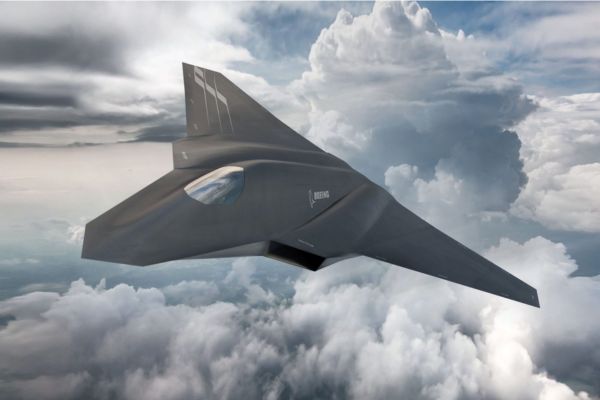
Official representations of the F-47 should be regarded as artist’s impressions rather than engineering drawings. They nevertheless suggest a highly blended airframe, a swept wing, canard foreplanes, and a configuration with no clearly visible vertical tail surfaces.
If the canards are representative of the actual aircraft, they could provide strong pitch authority, reduce trim drag under certain flight conditions, and improve control at high angles of attack. These benefits would be particularly valuable for a long-range aircraft required to combine substantial internal volume, high supersonic performance, and combat maneuverability.
Moving foreplanes also present a challenge for radar-signature management. Their possible adoption would suggest that Boeing believes their radar returns can be controlled through planform alignment, positioning, materials, and precise coordination with the aircraft’s other flight-control surfaces.
The combination of a combat radius exceeding 1,000 nautical miles and low observability requires substantial internal capacity. A large part of the airframe volume is therefore likely to be allocated to fuel, weapon bays, sensors, and thermal-management systems. The wing and fuselage should be closely blended to generate the required lift while limiting drag at transonic and supersonic speeds.
The engine inlets are also likely to be designed to shield highly reflective engine components, particularly the compressor faces. Internal weapon bays should preserve both the aircraft’s radar signature and its aerodynamic performance during penetration missions.
The F-47’s next-generation stealth should form part of a broader survivability system. Airframe signature reduction will likely be combined with passive detection, sensor fusion, electronic warfare, and information received from other platforms. Together, these capabilities should allow the aircraft to limit its own emissions, select favorable engagement conditions, and reduce the time during which hostile systems can detect and track it.
-
Armament
The F-47’s weapon suite has not been disclosed. As the successor to the F-22, with responsibility for both air superiority and long-range strike, it should carry beyond-visual-range and short-range air-to-air missiles as well as precision-guided air-to-surface weapons. Most of these weapons are expected to be carried internally to preserve the aircraft’s low-observable characteristics.
The F-22 provides a useful operational benchmark. In its air-to-air configuration, it can internally carry six AIM-120 AMRAAM missiles and two AIM-9 Sidewinders, while also retaining an internal M61A2 20 mm cannon. Its strike configuration can combine two GBU-32 Joint Direct Attack Munitions with two AIM-120s and two AIM-9s. These figures do not define the F-47’s future loadout, but they illustrate the minimum range of missions its replacement will be expected to perform and expand upon.
The AIM-260 Joint Advanced Tactical Missile is the most logical candidate for the F-47’s future long-range air-to-air weapon. Developed as a successor to the AIM-120, it is intended to engage hostile aircraft at greater distances. Its use on the F-47 remains consistent with the aircraft’s mission rather than an officially confirmed integration decision.
-
Propulsion
The F-47’s final propulsion system has not been disclosed. Its range, speed, electrical-power, and thermal-management requirements nevertheless make a twin-engine configuration highly likely. Two engines would also provide the thrust required for an aircraft expected to be larger and heavier than the F-22.
General Electric is developing the XA102 and Pratt & Whitney the XA103 under the Next Generation Adaptive Propulsion program. These adaptive-cycle engines are intended to favor high thrust during combat or greater fuel efficiency during cruise. Their architecture should also improve electrical-power generation and heat dissipation for the aircraft’s sensors, computing systems, and electronic warfare equipment.
The XA102 and XA103 programs completed their assembly readiness reviews in May 2026. NGAP nevertheless remains platform-agnostic, and neither engine has officially been selected for the F-47. Potential integration is being considered around 2030, while the aircraft’s first flight is planned for 2028. This schedule makes it likely that the initial development aircraft will use a different or interim propulsion standard before any later integration of an adaptive-cycle engine.
Supercruise, which allows an aircraft to sustain supersonic flight without continuous use of afterburners, has not been officially confirmed. It would nevertheless be consistent with the F-47’s mission, its maximum speed above Mach 2, its extended combat radius, and its role as the successor to the F-22.