







Breaking News







U.S. Navy Aircraft Carrier USS Theodore Roosevelt in Japan for Keen Sword 2027 May Deploy to Middle East.
The U.S. Navy aircraft carrier USS Theodore Roosevelt (CVN 71) has arrived at Yokosuka Naval Base in Japan ahead of exercise Keen Sword 2027, marking the carrier’s first visit to the base and the operational debut of Leidos’ Seahawk unmanned surface vessel alongside Carrier Strike Group 9. The deployment adds an unmanned maritime capability to the strike group as it prepares for joint operations in the Indo-Pacific.
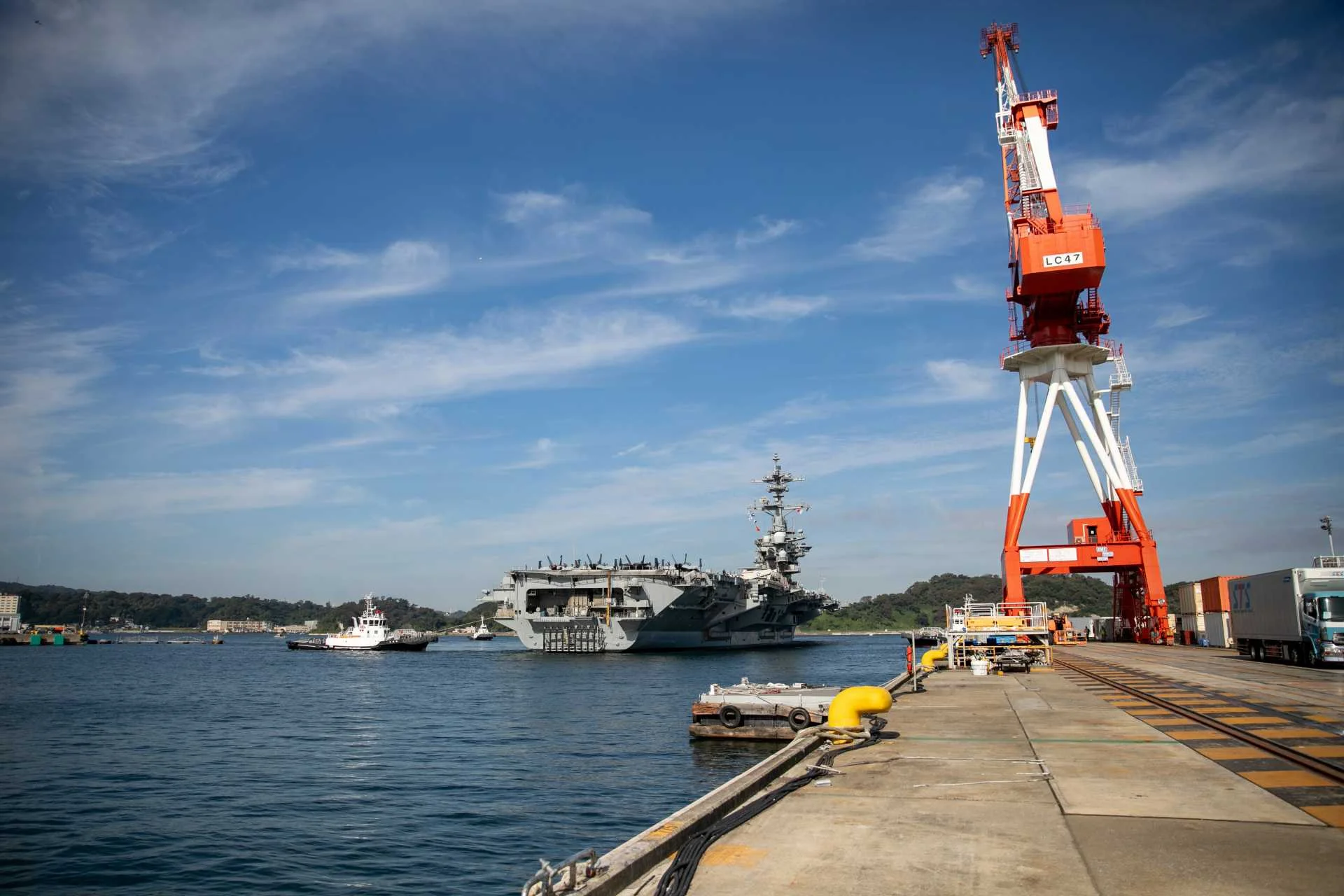
If deployed to the Middle East after Keen Sword 2027, the USS Theodore Roosevelt would become the fifth U.S. aircraft carrier to operate against Iran since the war began on February 28, 2026, following the USS Abraham Lincoln, USS Gerald R. Ford, USS George H.W. Bush, and USS George Washington. (Picture source: US DoD)
The U.S. Navy aircraft carrier USS Theodore Roosevelt (CVN 71) has arrived at Yokosuka Naval Base, Japan, ahead of the Keen Sword 2027 exercise, with the cruiser USS Chosin (CG 65) and destroyer USS Decatur (DDG 73) ahead of it. The visit marks Theodore Roosevelt’s first port call at Yokosuka and the first by a U.S. aircraft carrier not permanently based in Japan since USS Abraham Lincoln visited in May 2022. Carrier Strike Group 9, commanded by Rear Adm. Marcos Jasso and comprising approximately 5,000 sailors and Marines, is also deployed with Leidos’ Seahawk unmanned surface vessel, marking the first deployment of a large unmanned vessel alongside an operational U.S. carrier strike group. Theodore Roosevelt arrived at Yokosuka on October 16, 2026, ahead of Keen Sword, scheduled from October 19 to October 29, 2026.
Keen Sword 2027 will involve approximately 45,000 Japanese personnel, 6,100 vehicles, 40 vessels, and 260 aircraft, with additional participation from U.S. forces and six partner countries. After the exercise, USS Theodore Roosevelt could receive further tasking, including a possible deployment to the Middle East to relieve USS George Washington, although the U.S. Navy has not confirmed a transfer date or follow-on deployment. Theodore Roosevelt departed San Diego on September 27 and reached Japan 19 days later after Pacific operations that included an October 10 replenishment with USS Chosin. Commissioned in 1986, the Nimitz-class carrier measures 332.8 meters, displaces more than 100,000 tonnes, and is powered by two A4W nuclear reactors driving four shafts at speeds exceeding 30 knots.
Related topic: US Navy confirms first deployment of unmanned warship alongside aircraft carrier strike group
Its air wing includes F/A-18E/F Super Hornets, EA-18G Growlers, E-2D Hawkeyes, and MH-60 helicopters; the USS Chosin, a Ticonderoga-class cruiser commissioned in 1991, carries 122 Mk 41 vertical-launch cells for Standard Missiles, Tomahawks, and anti-submarine weapons, while the USS Decatur, an Arleigh Burke-class Flight I destroyer commissioned in 1998, adds 90. The actual missile loads and embarked aircraft numbers remain undisclosed. Commanded by Capt. Will Mathis, the carrier will use its three-day Yokosuka stop for resupply, maintenance, and coordination with Japanese naval units before joining Keen Sword. Keen Sword 2027 will involve U.S. Indo-Pacific Command, U.S. Forces Japan, U.S. Army Pacific, Pacific Fleet, Pacific Air Forces, and Marine Corps Forces Pacific, alongside Japan and six partner countries: Canada, France, Germany, the Netherlands, New Zealand, and the Philippines.
Japan will contribute 45,000 personnel, 6,100 vehicles, 40 vessels, and 260 aircraft to activities spanning across the Ryukyu Islands, Kyushu, Okinawa, and surrounding waters. Training includes coastal missile deployments, integrated live firing, autonomous surveillance, and aircraft dispersal. Twelve F-15 fighters will disperse from Naha, while runway repair exercises at Hyakuri between October 22 and 26 will examine the restoration of airfield operations after damage. The combination tests whether aircraft can relocate with fuel, weapons, maintenance crews, and communications equipment while damaged runways are repaired, two requirements for sustaining sorties during potential attacks on Japanese air bases. Carrier Strike Group 9 also comprises the Seahawk USV, built by Leidos, a composite trimaran displacing 147.3 tonnes, with two outriggers and a 53,000-liter fuel capacity.
Its development followed DARPA's 2010 Anti-Submarine Warfare Continuous Trail program, which awarded Leidos $59 million for the earlier Sea Hunter in 2012 and $35.5 million for the Seahawk in 2017. Delivered on April 7, 2021, the Seahawk incorporated more than 300 lessons from Sea Hunter, whose performance included 27 knots maximum speed, 12 knots cruising speed, and a projected 10,000-nautical-mile range. The Seahawk uses Leidos Autonomous Vessel Architecture for collision avoidance, restricted-area navigation, remote supervision, communications failover, and waypoint navigation during GPS interruptions. Leidos' autonomous vessels have collectively accumulated more than 200,000 nautical miles and 14,000 operating hours, figures not attributable solely to Seahawk. Refueling trials with USNS Guadalupe in April 2026 and USS Chafee on September 11 established astern fuel-transfer procedures, but both required personnel aboard Seahawk.
Keen Sword will concentrate U.S. Marine Corps anti-ship and air defense deployments across Japan's southwestern islands, and includes the first deployment of the NMESIS and MADIS systems to Yonaguni, situated 113 km from Taiwan, to cover the East China Sea and approaches to Taiwan. Approximately 60 Army and Marine Corps personnel will support the deployment, while both systems will also return to Ishigaki after training there in September 2025. The NMESIS carries two Naval Strike Missiles on an unmanned JLTV launcher, with an engagement range exceeding 185 km; the MADIS combines Stinger missiles, a 30 mm cannon, a 7.62 mm machine gun, and surveillance equipment across two JLTV-based vehicles. Tanegashima will host NMESIS, MADIS, and HIMARS, with additional MADIS training at Kirishima on Kyushu.
Japan will deploy its Type 25 surface-to-ship missile outside Camp Kengun for the first time since March 31, 2026, to conduct anti-ship training at Onobaru and Kengun. The Type 25's nominal 1,000-km range extends potential coverage across much of the East China Sea, but no live firing of these missile systems is scheduled. On October 19-20, Japanese forces will conduct a separate integrated live firing at Oki Daito with two AH-64D Apache helicopters, four F-2 fighters, a Hyuga-class helicopter carrier, a destroyer, and a Mogami-class frigate. The helicopters will operate from the naval formation, while a MQ-35 V-BAT drone will provide observation support, following earlier Japanese shipboard training aboard the JS Kumano.
A separate one-day demonstration between October 19 and 23 will involve STR8's Ghostwake unmanned surface vessel (USV) off White Beach, Okinawa, operated by the 12th Marine Littoral Regiment and Unmanned Surface Vessel Squadron 7 with Japanese personnel observing. The Ghostwake will demonstrate autonomous maritime surveillance rather than live weapons employment. An autonomous resupply exercise from Shibushi Port to three locations on Tanegashima was cancelled on October 7. Neither Ghostwake's integration with Seahawk nor the transmission of weapons-quality targeting information from V-BAT has been confirmed. The USS Theodore Roosevelt's deployment follows the transfer of the USS George Washington from Japan to the Middle East on August 19, 2026, to relieve the USS Abraham Lincoln.
The U.S. Navy USS Abraham Lincoln departed San Diego on November 21, 2025, entered the Middle East in January 2026, and participated in Operation Epic Fury and the blockade of Iranian ports. Its extended deployment included 265 consecutive days at sea before arriving in Thailand on September 2, exceeding the USS Dwight D. Eisenhower's 206-day 2020 benchmark by 59 days. The USS George Washington's departure temporarily removed the permanently forward-deployed U.S. carrier from Japan, as the USS George H.W. Bush was also operating in the Arabian Sea in early October. For its part, the three-ship Makin Island Amphibious Ready Group departed San Diego on September 28 with the 13th Marine Expeditionary Unit. The USS Theodore Roosevelt could subsequently relieve the USS George Washington, but its next assignment remains unconfirmed, and such a rotation would not necessarily increase the sustained carrier presence in the Middle East.
Explore More Defense News
• Land Defense News
• Naval Defense News
• Defense Aerospace News
Written by Jérôme Brahy
Jérôme Brahy is a defense analyst and documentalist at Army Recognition. He specializes in naval modernization, aviation, drones, armored vehicles, and artillery, with a focus on strategic developments in the United States, China, Ukraine, Russia, South Korea, Türkiye, and Belgium. His analyses go beyond the facts, providing context, identifying key actors, and explaining why defense news matters on a global scale.