







Breaking News







U.S. Corsair One-Way Attack Sea Drones Redefine Naval Strike Warfare in First Combat Use Against Iran.
Three U.S. Navy-backed Saronic Corsair one-way attack sea drones struck Iran’s Bandar Abbas Naval Base during a July 12 operation, marking the first confirmed American combat use of autonomous surface strike vessels, as revealed by U.S. CENTCOM on July 13, 2026. The attack signals a new capability that allows U.S. forces to penetrate defended naval facilities with precise, expendable platforms while keeping sailors outside the most dangerous threat zones.
The three Corsairs targeted a submarine maintenance facility, demonstrating that unmanned surface vessels can disrupt not only frontline naval assets but also the infrastructure that sustains fleet operations. Their combat debut highlights a growing shift toward autonomous maritime strike systems that expand operational reach, reduce risk to personnel, and strengthen U.S. options for maintaining deterrence and freedom of navigation in contested waters.
Related Topic: Blackbeard Hypersonic Missile Launch from Marauder USV Could Expand U.S. Distributed Maritime Strike Architecture
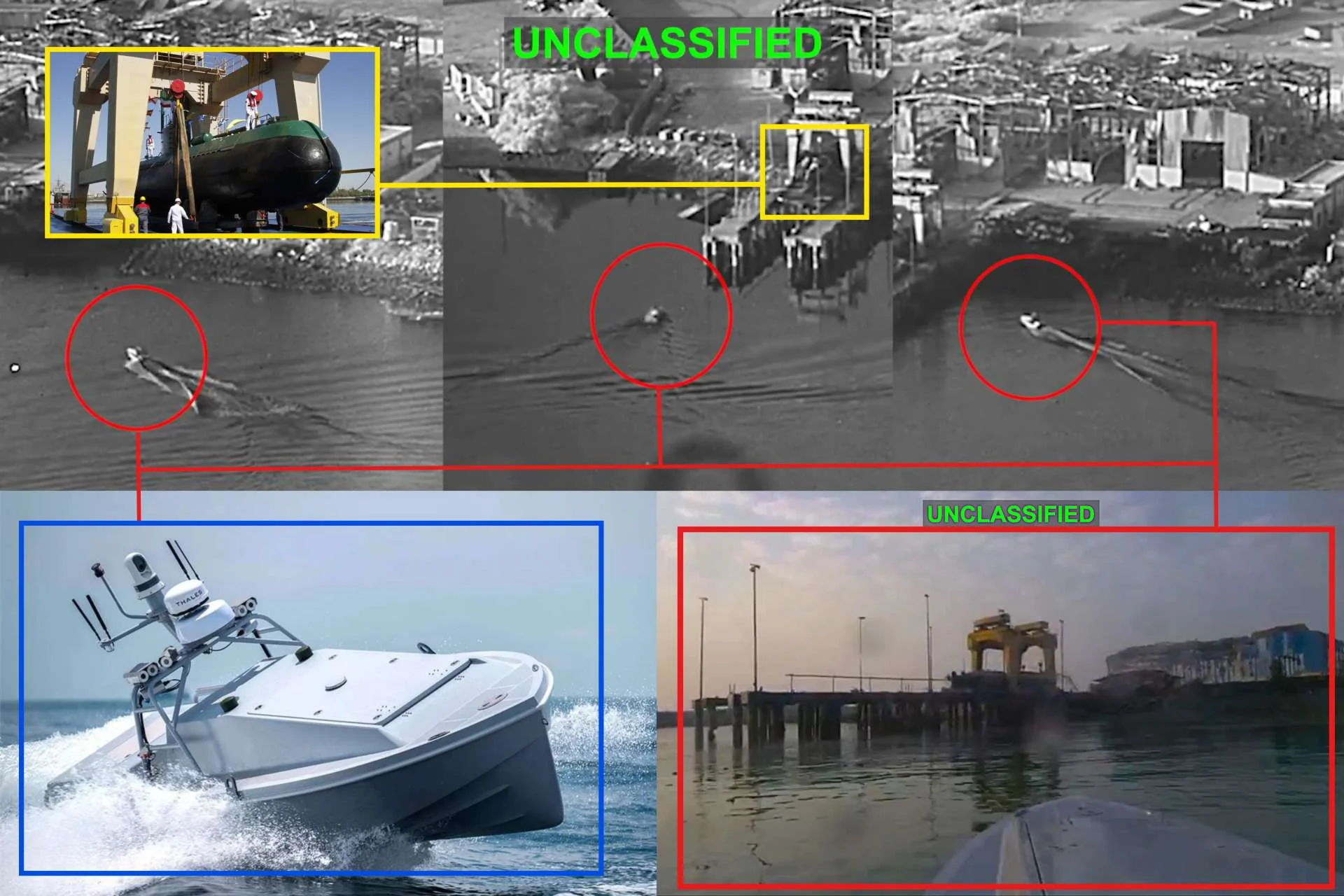
Three U.S. Corsair unmanned surface vessels struck a submarine maintenance facility at Bandar Abbas, marking America’s first acknowledged combat use of one-way attack drone boats (Picture Source: U.S. CENTCOM / Saronic Technologies / Iranian Media / Edited By Army Recognition Group) © Army Recognition Group. All rights reserved. Unauthorized use, reproduction, or distribution prohibited.
On July 13, 2026, U.S. CENTCOM confirmed that American forces had employed one-way attack sea drones in combat for the first time during strikes conducted the previous day. The operation formed part of a wider campaign against Iranian air-defense systems, coastal radars, missile and drone capabilities, and small boats threatening commercial navigation around the Strait of Hormuz. Three Saronic Corsair autonomous surface vessels struck a submarine and ship-maintenance facility at Bandar Abbas Naval Base, moving an emerging American naval capability from testing into combat employment. The mission demonstrated that U.S. maritime forces can now deliver precise and expendable effects inside a defended naval facility without placing sailors aboard the attacking vessels.
Corsairs Penetrate the Bandar Abbas Naval Complex
The most revealing image from the July 12 attack shows the forward view from a Saronic Corsair as it closes on a Ghadir-class midget submarine positioned beneath a yellow maintenance gantry. The U.S. CENTCOM image places the viewer directly inside the vessel’s terminal approach and confirms that the unmanned craft penetrated deep into the Bandar Abbas naval complex before impact. The target was not simply a submarine located in open water. It was a submarine undergoing maintenance beside infrastructure needed to lift, service, repair, and return Iranian naval platforms to operational status. U.S. CENTCOM confirmed that three Saronic Corsair unmanned surface craft hit the port, introducing redundancy and increasing the probability that the assigned aim points would be reached. The released imagery does not reveal the complete attack geometry or final battle-damage assessment, but it confirms a successful penetration of the facility and the first acknowledged American combat employment of one-way attack surface vessels.
A Strike Against Iran’s Naval Regeneration System
Viewed as a complete target system, the objective extended beyond the photographed Ghadir-class submarine. Maintenance gantries, workshops, electrical connections, specialist tooling, spare-parts inventories, access routes, and trained personnel form an interconnected naval regeneration network. Damage to selected elements of this network could delay repairs to several vessels, disrupt maintenance schedules, and reduce the number of Iranian platforms available for future operations. The attack may consequently represent more than the destruction or disabling of a single submarine. It points to a broader concept of fleet suppression through maintenance denial, in which the United States targets the infrastructure responsible for generating combat-ready naval forces rather than waiting for individual vessels to deploy at sea. A submarine undergoing maintenance is deprived of its main defensive advantages: underwater concealment, mobility, acoustic discretion, and the ability to exploit the complex littoral environment of the Persian Gulf.
Corsair Combines Endurance, Speed and Modular Payload Capacity
Corsair is a 24-foot autonomous surface vessel and the largest platform in Saronic’s original family of small autonomous craft. It has a published range exceeding 1,000 nautical miles, a top speed above 35 knots, and a payload capacity of up to 1,000 pounds. This configuration provides a balance of endurance, speed, and modular load carriage in a hull compact enough to be transported, dispersed, and deployed in numbers. Its architecture includes mission-level autonomy, adaptive navigation, multichannel communications, and modular payload integration. The same vessel can support intelligence, surveillance and reconnaissance, maritime domain awareness, logistics, personnel recovery, electronic effects, or kinetic missions. Public information does not disclose the explosive configuration employed at Bandar Abbas, and the vessel’s published payload capacity should not be interpreted as confirmed warhead weight.
Corsair’s published range also introduces operational uncertainty for an opponent. A vessel capable of travelling more than 1,000 nautical miles does not need to be launched immediately outside a defended harbor. It could potentially approach from a dispersed maritime position, follow an indirect route, remain outside defended waters until required, or operate as part of a wider unmanned mission package. The launch platform, route, control method, communications architecture, and degree of human supervision during the terminal phase have not been publicly disclosed. The operation confirms combat use of an autonomous-capable vessel, but it does not establish that lethal action was conducted without human authorization.
Risk Displacement and Coordinated Multi-Vessel Attack
Corsair’s primary operational advantage is the transfer of risk away from American personnel. A crewed fast boat attempting to enter Bandar Abbas would expose sailors to coastal surveillance, harbor patrols, automatic weapons, mines, anti-ship systems, and the danger of capture. Corsair transfers that exposure to an attritable unmanned platform while preserving crewed combatants for missions requiring larger sensors, heavier weapons, and direct human judgment. Its low profile and shallow draft may also provide access through maritime approaches unavailable to destroyers, frigates, or submarines. Onboard electro-optical systems can support terminal observation immediately before impact, while adaptive navigation allows the vessel to alter its route, exploit coastal clutter, and approach from less predictable directions.
The decision to employ three Corsairs also deserves tactical attention. The vessels may have been assigned separate aim points, used to provide redundancy against interception or mechanical failure, or directed into the target area within a compressed engagement window to overload harbor defenses. One craft could have served as a diversion while the others approached the primary objective. The available evidence does not confirm coordinated swarm autonomy, making “coordinated multi-vessel strike” or “multi-axis unmanned surface attack” more accurate descriptions. Whatever the precise formation, three vessels provided CENTCOM with more tactical options than a single one-way platform and reduced the possibility that one defensive interception would defeat the entire mission.
A New Option Between Cruise Missiles and Crewed Raids
Corsair does not replace fighter aircraft, cruise missiles, torpedoes, or special operations forces. It adds another layer to the American joint strike architecture. Fighter aircraft can reach targets rapidly and deliver heavier or specialized weapons, but operations inside defended airspace may require aerial refueling, suppression of enemy air defenses, airborne command-and-control support, and acceptance of aircrew risk. Ship-launched cruise missiles provide long-range precision and high speed, yet consume limited vertical-launch-system capacity and may be disproportionate for an exposed pier-side target accessible from the sea. A torpedo is optimized to attack a vessel afloat beneath the waterline, not a submarine positioned ashore beside maintenance infrastructure. A special operations raid could produce detailed sabotage, but with far greater personnel, intelligence, and escalation risks.
Against a harbor installation, the one-way surface drone occupies a valuable operational middle ground. It is persistent, precise, scalable, and expendable. The price of a combat-configured Corsair has not been publicly released, preventing a reliable unit-cost comparison with cruise missiles or combat-air sorties. Its principal value lies in the cost-risk exchange. Using an unmanned surface craft against an exposed coastal target can preserve aircraft flight hours, trained aircrews, submarine availability, special operations personnel, and scarce long-range missile inventories. Even where the vessel itself is not inexpensive, accepting the loss of an unmanned platform may remain preferable to exposing a crewed asset or expending a high-end weapon needed for a more heavily defended objective.
This calculation becomes increasingly important during prolonged operations. Modern surface combatants carry a finite number of missiles, while reloading vertical-launch cells at sea remains difficult. Employing Corsair-type vessels against suitable coastal infrastructure could allow commanders to reserve advanced missiles for mobile launchers, integrated air-defense systems, hardened command facilities, and major combatants. The sea drone becomes not only an alternative strike system, but also a tool for increasing magazine depth and preserving high-end combat power across a sustained campaign.
Corsair Builds on Lessons from Ukrainian USVs
The closest modern precedent is Ukraine’s campaign in the Black Sea, where explosive unmanned surface vessels helped impose sea denial against a larger Russian fleet. Ukrainian USVs forced Russian warships to operate more cautiously, strengthened the requirement for harbor barriers and patrols, and contributed to the relocation of important naval assets away from exposed facilities in Crimea. Ukraine demonstrated that comparatively small and expendable surface drones could threaten major warships, attack naval infrastructure, disrupt maritime logistics, and compel a conventionally stronger fleet to divert resources toward force protection.
Ukraine’s MAGURA V5 offers the clearest technical and operational comparison. The craft has been reported with a range exceeding 800 kilometers, a speed of approximately 80 kilometers per hour, and a 250-kilogram warhead. Ukrainian operators have emphasized repeated attacks by multiple vessels rather than relying on one oversized explosive charge. Such tactics allow one drone to attract defensive fire or disrupt the target while additional craft pursue further impact opportunities. MAGURA V5, Sea Baby, and related Ukrainian systems evolved rapidly under combat pressure as specialized attack platforms optimized for remote operation, high-speed approach, low visual profile, and repeated tactical adaptation.
Corsair differs in purpose, scale, and institutional support. Ukraine developed its USVs as asymmetric instruments capable of compensating for the absence of a large conventional surface fleet. Corsair enters combat as part of an established American joint-force structure. It can potentially operate alongside satellites, maritime patrol aircraft, fighters, surface combatants, submarines, aerial drones, electronic-warfare systems, and global intelligence networks. Ukraine proved that unmanned vessels could deny maneuver to a larger fleet. The United States is applying the same underlying principle while integrating the platform into a far broader sensor, command-and-control, and precision-strike architecture. Corsair is not a substitute for American naval power; it is a force multiplier designed to extend that power into areas where the use of crewed platforms would be unnecessarily dangerous or operationally inefficient.
Multi-Domain Pressure on Iranian Defenses
The Bandar Abbas mission occurred within a wider multi-domain strike campaign. U.S. CENTCOM reported attacks against Iranian air-defense systems, coastal radar sites, missile and drone capabilities, and small boats using fighter aircraft, naval vessels, aerial one-way attack drones, and one-way attack sea drones. The precise sequencing of these actions has not been released, but the force package would have confronted Iranian defenders with threats arriving through several domains and on different timelines. Attacks against radar and air-defense systems could reduce situational awareness, aerial drones could divide defensive attention, and naval or air-delivered weapons could place pressure on command posts while the Corsairs approached at sea level.
The primary American advantage is not simply possession of a new drone boat. It is the ability to integrate that vessel into a wider sensor-to-shooter network connecting intelligence, surveillance, communications, electronic effects, deception, suppression, and terminal strike. An isolated unmanned vessel can be detected and destroyed. A surface drone approaching while radar sites, air defenses, missile batteries, drone infrastructure, and command systems are simultaneously under attack presents a far more complex defensive problem. Corsair’s combat value is closely tied to the wider joint force supporting it.
Strategic Impact on the Strait of Hormuz
Bandar Abbas was a carefully selected objective. The base supports Iranian naval activity near the Strait of Hormuz, while Ghadir-class midget submarines are designed for operations in the shallow waters of the Persian Gulf. Their compact size and littoral operating profile make them relevant to ambush missions, covert surveillance, mine warfare, special-forces insertion, and attacks against vessels moving through restricted maritime approaches. Striking the submarine while it was out of the water removed its ability to exploit concealment and mobility while placing the surrounding repair infrastructure at risk.
At the geostrategic level, the mission expands the U.S. ability to defend freedom of navigation while preserving crewed platforms and high-end missile inventories. A deployable force of long-range autonomous craft gives American commanders another method of holding coastal radars, fast-attack boats, missile positions, logistics nodes, submarine facilities, and naval infrastructure at risk across the Persian Gulf and Gulf of Oman. It also imposes a broader defensive burden on Iran. Every harbor entrance, maintenance quay, sheltered anchorage, and coastal installation must now be protected against low-profile surface contacts as well as aircraft, missiles, submarines, and aerial drones.
Physical barriers, patrol craft, electro-optical surveillance, short-range radar, electronic warfare, remote weapon stations, and rapid-response interceptors consume personnel and resources even when no unmanned attack is underway. Ports such as Bandar Abbas cannot be completely sealed because they must remain accessible to friendly ships, tugboats, maintenance vessels, and logistics traffic. This creates a continuing force-protection burden capable of slowing Iranian naval activity and diverting resources away from offensive operations.
Corsair-type vessels could also support persistent surveillance of coastal approaches, detect fast-attack craft, monitor temporary missile or drone launch areas, inspect maritime corridors, and deliver precision effects without continuously positioning large crewed warships inside the Gulf’s most exposed waters. They could be distributed across the Gulf of Oman and Arabian Sea, making it harder for Iran to determine where an attack originated or which coastal sector is threatened. By expanding maritime presence without a proportional increase in sailors or crewed hulls, autonomous surface vessels can help the United States sustain pressure across a wide operating area while preserving destroyers, submarines, and aircraft for missions only those platforms can perform.
The Bandar Abbas operation was more than an attack against a submarine-related target; it marked the combat unveiling of a new American naval strike method combining autonomy, precision, endurance, and expendability within an integrated joint-force command structure. Three Corsairs carried U.S. firepower into an Iranian naval base while American sailors remained outside the terminal threat envelope, demonstrating that hostile coastal forces can no longer assume that distance, harbor defenses, maintenance facilities, or the absence of a nearby crewed warship will provide protection. Corsair gives the United States a scalable instrument for imposing operational risk, preserving personnel, disrupting enemy fleet regeneration, defending critical maritime routes, and conserving high-end combat power. Ukraine proved that maritime drones could deny maneuver to a larger fleet; at Bandar Abbas, the United States demonstrated the next stage of that evolution by integrating autonomous surface strike into the full strength of American joint warfare.
Written by Teoman S. Nicanci – Defense Analyst, Army Recognition Group
Teoman S. Nicanci holds degrees in Political Science, Comparative and International Politics, and International Relations and Diplomacy from leading Belgian universities, with research focused on Russian strategic behavior, defense technology, and modern warfare. He is a defense analyst at Army Recognition, specializing in the global defense industry, military armament, and emerging defense technologies.
Explore More Defense News
• Land Defense News
• Naval Defense News
• Defense Aerospace News