







Breaking News







China’s Fourth Aircraft Carrier Advances Toward Nuclear Propulsion to Rival U.S. Ford-Class.
China’s fourth aircraft carrier program is advancing toward nuclear propulsion and electromagnetic catapults to match the endurance and airpower of U.S. Navy Ford-class carriers. While hull and launch architecture are converging, achieving parity in sustained sortie generation, integrated air warfare, and global blue-water deployment remains a long-term operational test for China.

China’s fourth aircraft carrier is under construction, with an inset showing a U.S. Ford-class aircraft carrier for comparison. The Chinese vessel’s final propulsion configuration and aircraft capacity remain unconfirmed. (Picture source: Weibo)
Satellite imagery captured on November 12, 2026, and reported by The Aviationist on November 16 shows continued hull and flight-deck construction at Dalian Shipyard. The vessel, commonly called Type 004, represents a potentially substantial advance beyond China’s existing carriers. However, Beijing has not publicly confirmed its propulsion arrangement, final dimensions, aircraft complement, or detailed combat systems. Any comparison must therefore distinguish the Chinese ship’s projected capabilities from the Ford class’s documented equipment and operational experience.
The strongest evidence for a nuclear-powered Chinese carrier comes from internal construction features. The Center for Strategic and International Studies, in its October 27 assessment, identified two approximately 15-by-15-meter compartments resembling shielded reactor spaces and rated nuclear propulsion as likely. Those observations support an assessment, rather than confirmation, of installed reactors. Their output, fuel characteristics, maintenance requirements, and associated electrical-generation capacity remain unknown.
Related Topic: Could China’s future Type 004 replace the USS Gerald R. Ford as the world’s most powerful aircraft carrier?
U.S. Ford’s propulsion provides a much firmer benchmark: two nuclear reactors driving four shafts, with an officially stated speed exceeding 30 knots. Nuclear power’s military value extends beyond avoiding frequent propulsion-fuel replenishment. Sustained high speed helps a carrier reposition, maintain favorable wind over the flight deck, and respond to changing operational demands. A nuclear-powered Type 004 could gain similar flexibility, but its maximum speed and ability to sustain that performance cannot yet be compared credibly with Ford.
Electrical capacity is a separate question from propulsion endurance. Congressional testimony described the Ford design as providing approximately three times the electrical-generating capacity of the Nimitz class, supporting demanding shipboard systems and future growth. No equivalent verified figure exists for Type 004. Even if China adopts two reactors, reactor count alone would reveal little about usable electricity, redundancy, cooling capacity, or the ability to operate sensors and aviation equipment simultaneously. Claims that the Chinese carrier already equals Ford’s power architecture are therefore premature.
Nor would nuclear propulsion make either carrier logistically independent. Aircraft still consume aviation fuel, while sustained combat expends weapons and replacement parts. Escorts also require support. Nuclear power removes a major replenishment burden for the carrier itself; it does not remove the supply chain needed to keep its air wing fighting. CSIS explicitly places China’s carrier expansion within a wider requirement for escorts, submarines, and replenishment vessels.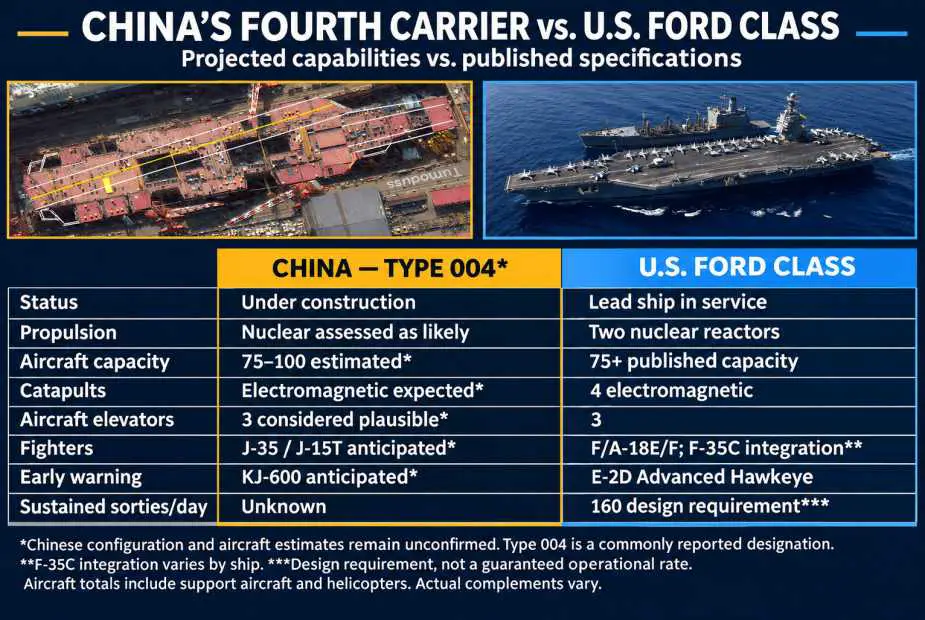
China’s fourth aircraft carrier under construction compared with the U.S. Ford-class, highlighting propulsion, aircraft capacity, launch systems, and projected air-wing capabilities. Chinese specifications remain unconfirmed, while Ford’s sortie-generation figure represents a design requirement rather than a guaranteed operational rate. (Graph Info Army Recognition Group)
In numerical terms, the U.S. Navy publishes a Ford-class aircraft capacity of 75 or more, while a Naval Sea Systems Command comparison lists an air wing of 75 aircraft. This total includes different aircraft categories, rather than 75 fighters, and the actual embarked complement varies with deployment requirements. It is a published capacity benchmark, not a verified count aboard USS Gerald R. Ford on any particular day.
For Type 004, no official aircraft capacity or squadron allocation has been disclosed. Published secondary estimates include approximately 75–90 aircraft and, in other reporting, 75–100 aircraft. Those figures should be treated as speculative planning ranges, not confirmed specifications. They suggest a possible total complement comparable to or larger than Ford’s published benchmark, but do not establish how many J-35 fighters, J-15 variants, KJ-600 surveillance aircraft, helicopters, or unmanned aircraft could operate together effectively. An exact fighter-by-fighter comparison is not yet supportable.
For air power, electromagnetic catapults could be as consequential as the propulsion change. China’s earlier ski-jump carriers impose different aircraft-launch constraints from catapult-equipped ships. Fujian has already demonstrated launches and recoveries involving J-35 stealth fighters, J-15T fighters, and KJ-600 airborne early-warning aircraft, according to China’s Ministry of National Defense in September 2025. That establishes an important technical foundation for the fourth carrier, although it does not establish the future ship’s embarked force or sustained combat readiness.
The J-35 would give a future Chinese air wing a low-observable fighter component, while the J-15T could provide a complementary multirole aircraft. However, publicly available evidence does not support precise comparisons with American fighters in radar detection range, electronic protection, combat radius under equivalent loads, or mission availability. Similar roles and external characteristics do not demonstrate equivalent performance. The more useful question is whether China can integrate fighters, weapons, airborne surveillance, and electronic support into a dependable combat formation.
The American side also requires careful treatment. The Ford class should not be treated as having an identical air wing aboard every hull. Naval News reported that F-35C launch-and-recovery testing began aboard the second ship, John F. Kennedy, in October 2026. That milestone demonstrates progress toward integrating the stealth fighter with the class; it does not establish an operational F-35C squadron aboard USS Gerald R. Ford. A fair comparison separates aircraft available to the wider navy from those integrated and deployed aboard a particular carrier.
Airborne early warning may prove one of China’s most important advances. The KJ-600 offers the prospect of a dedicated fixed-wing surveillance and command aircraft supporting fighters beyond the carrier’s immediate sensor coverage. Its American counterpart in mission is the E-2D Advanced Hawkeye, whose documented equipment includes the AN/APY-9 radar, Cooperative Engagement Capability, and tactical data links supporting integrated air and missile defense. The comparison therefore concerns the quality of the entire detection-to-engagement chain, rather than simply whether both carriers carry radar aircraft. Comparable public evidence about KJ-600 networking and performance remains limited.
Electronic warfare adds another layer. The American EA-18G Growler combines threat sensing, jamming, and suppression of enemy air defenses, helping other aircraft operate against defended targets. Such support can materially affect the effectiveness of a strike package even when fighter numbers remain unchanged. Assessing a future Chinese carrier air wing requires equivalent evidence about its electronic-attack aircraft, mission systems, training, and coordination. A projected inventory alone cannot establish parity with the American capability.
Sortie generation is where these systems must work together. CSIS considers four catapults and a third aircraft elevator plausible for Type 004, but neither feature is confirmed. Additional launch positions and aircraft-handling capacity could help, yet sustained output also depends on recovery operations, maintenance, deck crews, refueling, and weapons movement. Ford’s published design requirements—160 daily sorties sustained over 30 days and 270 daily during a four-day surge—apply under defined conditions, not as rates guaranteed on every deployment.
Ford’s own development illustrates the difficulty of converting design ambition into reliable performance. American operational testing documented launch-and-recovery reliability and maintenance concerns, while also reporting that sortie generation during its fiscal 2024 deployment met operational tasking. More recently, USNI News reported in August 2026 that the chief of naval operations said Ford exceeded Nimitz-class performance during a sortie-generation test. Both findings matter: the American ship has demonstrated substantial capability, but its development should not be presented as free of technical limitations. China has yet to produce comparable operational evidence for its fourth carrier.
Combat survivability likewise extends beyond the hull. U.S. Ford-class carriers carry Evolved Sea Sparrow Missiles, Rolling Airframe Missiles, and close-in weapons for self-defense, while a carrier strike group adds aircraft, escort sensors, defensive missiles, and anti-submarine capabilities. Type 004’s final defensive fit remains unconfirmed. Its combat value will depend on how effectively China connects those protective layers while maintaining flight operations, especially when operating beyond readily available shore support.
The evidence supports a significant potential narrowing of the design gap: a larger Chinese carrier with likely nuclear propulsion and advanced launch equipment. It does not yet support equality in sustained air power. The decisive milestones will be confirmation of the propulsion and deck configuration, followed by sea trials and repeated operations with a complete air wing. Until then, the U.S. Navy's Ford-class provides an operational benchmark, while Type 004 remains a developing capability whose most consequential performance measures are still unknown.
Explore More Defense News
• Land Defense News
• Naval Defense News
• Defense Aerospace News
Written by Alain Servaes – Chief Editor, Army Recognition Group
Alain Servaes is a former infantry non-commissioned officer and the founder of Army Recognition. With over 20 years in defense journalism, he provides expert analysis on military equipment, NATO operations, and the global defense industry.