







Breaking News







Rheinmetall’s HAMMR Revives U.S. Army’s Quest to Put Precision Airburst Firepower Inside the Infantry Squad.
American Rheinmetall has unveiled the Highly-Advanced Multi-Mission Rifle (HAMMR) as its 40mm contender for the U.S. Army’s Precision Grenadier System (PGS), according to a video released on July 13, 2026, positioning it to give infantry squads an organic precision-fire capability against enemies behind cover, light vehicles, and small drones without relying on heavier supporting fires. By combining programmable airburst ammunition, digital fire control, and a semi-automatic magazine-fed design, HAMMR aims to close a long-standing gap in squad-level lethality by delivering faster and more accurate engagements at extended ranges.
Built around Rheinmetall’s SSW40 launcher and integrated with the Aimpoint FCS15 fire-control system, HAMMR is designed to improve first-round hit probability while enabling rapid follow-up shots with a wide range of 40mm programmable munitions. As the U.S. Army evaluates competing next-generation precision grenade systems, the weapon reflects a broader shift toward equipping infantry squads with autonomous precision effects, enhanced counter-drone capabilities, and greater battlefield flexibility in complex combat environments.
Related Topic: Barrett’s 30mm Squad Support Rifle Offers Fast Precision Strikes Against Drones And Fortified Targets
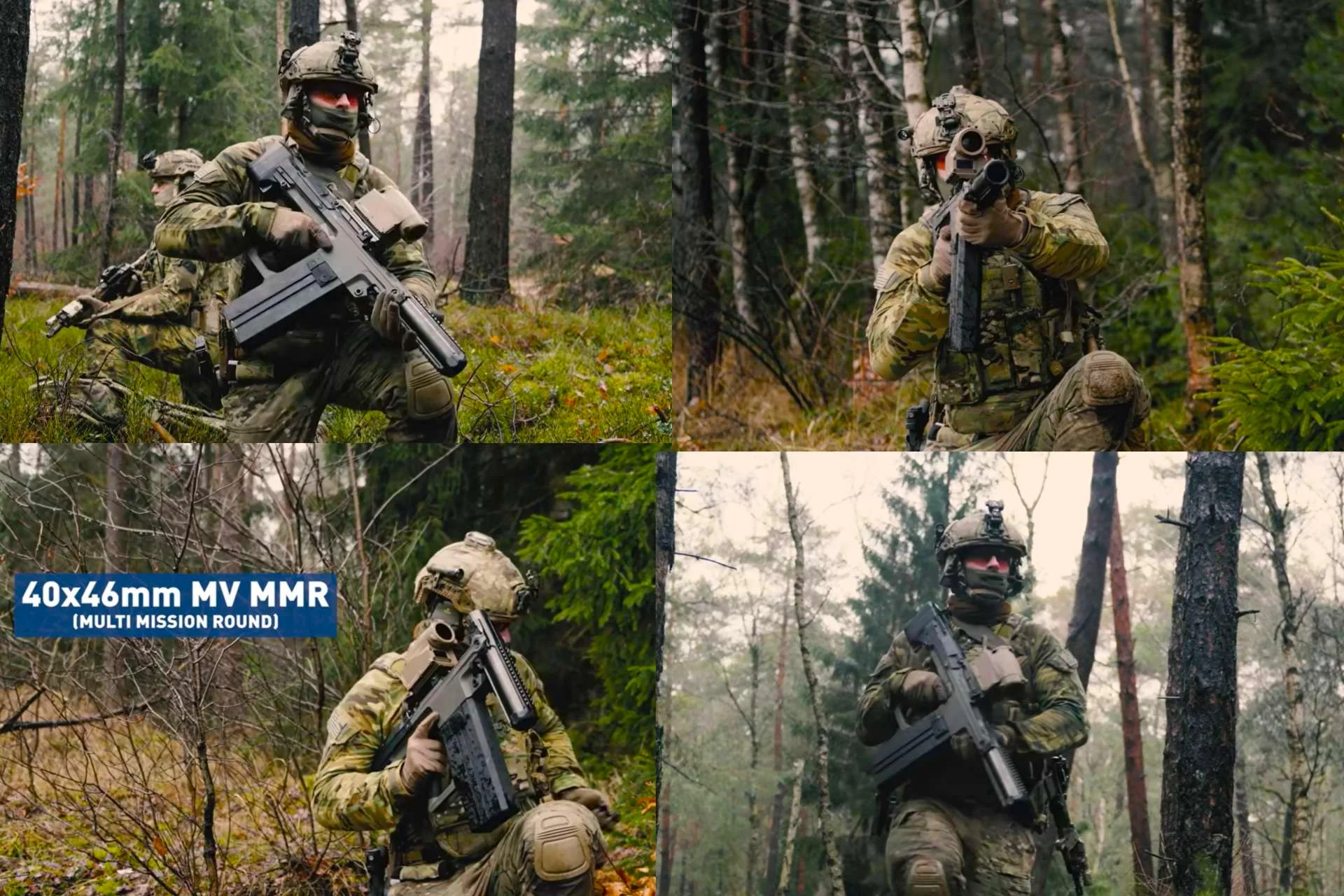
Rheinmetall’s new HAMMR is a magazine-fed 40mm precision grenadier system built to deliver programmable airburst effects against troops behind cover, light vehicles and small drones (Picture Source: Rheinmetall)
On July 13, 2026, American Rheinmetall released a new video presenting the Highly-Advanced Multi-Mission Rifle, or HAMMR, as its 40mm answer to the U.S. Army’s Precision Grenadier System requirement. The showcase arrives as the Army seeks a soldier-portable weapon able to defeat troops behind cover, engage at extended range and add a counter-drone option without relying on heavier supporting fires. By combining programmable ammunition, digital fire control and rapid follow-on shots, HAMMR targets one of the most persistent gaps in squad-level combat power.
HAMMR is a shoulder-fired, semi-automatic, magazine-fed precision grenadier system designed around programmable and airburst 40mm ammunition. Its intended role is not simply to launch a larger projectile, but to give one soldier an organic precision-effects capability: measure the target distance, calculate the ballistic solution, program the grenade and detonate it above or beyond cover. American Rheinmetall describes extended-range precision, rapid repeat engagements, improved first-round hit probability and scalable effects for complex urban terrain.
The weapon’s technical backbone is Rheinmetall’s SSW40, an approximately 80-centimetre, four-kilogram baseline launcher equipped with a self-regulating hydropneumatic recoil system. Rheinmetall claims its 40×46mm medium-velocity ammunition can engage targets at up to 900 metres, while HAMMR combines the launcher with the Aimpoint FCS15 fire-control system and retains compatibility with qualified U.S. Army low-velocity 40mm rounds. The wider ammunition portfolio includes high-explosive airburst, multi-mission, dual-purpose anti-armour and training cartridges; the manufacturer says its HEDP round can penetrate four inches of rolled homogeneous armour. Exact HAMMR magazine capacity, final configuration weight and Army-qualified effective range remain undisclosed.
HAMMR’s development path blends a European launcher lineage with a U.S.-specific adaptation effort. Rheinmetall first presented the SSW40 publicly at Eurosatory in 2022, conducted a prototype live-fire demonstration in 2025 and subsequently described HAMMR as a version tailored around American targeting systems, ergonomics, safety rules and performance standards. The Army launched its current PGS search in 2023, requesting effectiveness from 35 to at least 500 metres, a desired complete-system weight below 14.5 pounds, a length under 34 inches and a flight time of no more than three seconds to 500 metres.
The program also carries the institutional memory of the 25mm XM25, which underwent operational assessment in Afghanistan before the Army terminated it in 2018 following weight and reliability problems. HAMMR has not been publicly identified as the winner of the Army’s xTechSoldier Lethality competition: MARS and Barrett’s 30mm Support Rifle System won that process, while FN America later received a $2 million development contract for its competing 30mm MTL-30. This suggests HAMMR is entering a contested capability market rather than moving toward fielding without further Army evaluation.
Compared with the single-shot M320, HAMMR’s core advantage is engagement tempo. A magazine-fed action can deliver a correction shot, engage several positions or place different effects on one target without reloading after every trigger pull. Medium-velocity ammunition also offers a flatter trajectory and shorter time of flight than conventional low-velocity grenades. Against the 30mm MTL-30 and MARS designs, Rheinmetall trades ammunition compactness for a larger payload, an established 40mm ammunition base and compatibility with existing Army stocks.
FN publicly lists the MTL-30 at around 11 pounds, 34 inches in length, with three- or five-round magazines and a 500-metre effective range. Rheinmetall advertises longer reach for the SSW40 baseline, although no independent, like-for-like Army evaluation has been released. The 30mm contenders may allow a grenadier to carry more ammunition for the same combat load; HAMMR may offer greater effect per shot, more diverse warhead options and lower integration risk through compatibility with legacy 40mm rounds. The Army’s eventual choice will involve more than range: ammunition weight, recoil, fuze cost, reliability, battery endurance and the burden placed on a primary-weapon operator will shape the outcome.
HAMMR could allow a squad to suppress a trench line, attack a rooftop firing position, clear an opening, engage a light vehicle and rapidly shift to a second threat without waiting for mortars, artillery or aviation. That closely matches the Army’s objective of reducing soldier exposure while attacking personnel in defilade. Its counter-UAS potential is credible at the system level: programmable airburst ammunition and fire control incorporating tracking software could form a localized hard-kill layer against small drones. Yet the promotional video is not test evidence. Public information does not provide Army-validated hit probability, probability of kill, electronic-warfare resilience or performance against fast, manoeuvring drones in cluttered terrain.
The strategic impact would extend beyond a new grenade launcher. Broad PGS fielding would distribute precision fires deeper into the infantry squad, shorten the sensor-to-shooter chain and give dispersed formations more autonomy in urban, subterranean and broken terrain. A 40mm solution compatible with NATO ammunition families could also strengthen coalition interoperability and simplify allied resupply, while driving new demand for programmable fuzes, medium-velocity cartridges and digital fire-control production. For Washington, American Rheinmetall’s U.S.-tailored approach offers a route to combine allied weapon technology with domestic standards and manufacturing capacity. This is an inference based on the Army’s stated operational requirements and Rheinmetall’s system architecture.
HAMMR’s principal strength lies in its integrated system architecture, combining the weapon, ammunition and fire-control elements into a single operational concept. Its long-term relevance, however, will depend on factors that cannot be demonstrated through promotional material alone, including soldier load, safety, reliability, maintainability, training requirements and the ability to deliver consistent effects at an acceptable cost. Should the system perform well across those areas, it could give infantry squads a more responsive organic precision-fire capability. The XM25 program nevertheless provides a reminder that advanced squad-level weapons must balance technical ambition with weight, durability, logistics and sustainment demands.
Written by Teoman S. Nicanci – Defense Analyst, Army Recognition Group
Teoman S. Nicanci holds degrees in Political Science, Comparative and International Politics, and International Relations and Diplomacy from leading Belgian universities, with research focused on Russian strategic behavior, defense technology, and modern warfare. He is a defense analyst at Army Recognition, specializing in the global defense industry, military armament, and emerging defense technologies.
Explore More Defense News
• Land Defense News
• Naval Defense News
• Defense Aerospace News