






Breaking News




US and Taiwan Partner to Convert Firejet Target Into Mighty Hornet IV High Speed Combat UAV.
US Kratos Defense and Taiwan’s National Chung-Shan Institute of Science and Technology (NCSIST) announced the Mighty Hornet IV, a conversion of the MQM-178 Firejet target drone into a high-speed attack UAV, at TADTE in Taipei.
At the Taipei Aerospace & Defense Technology Exhibition held from 18 to 20 September at the Nangang Exhibition Center, Kratos Defense & Security Solutions and Taiwan’s National Chung Shan Institute of Science and Technology announced the Mighty Hornet IV, a conversion of the MQM-178 Firejet that began life as a subsonic aerial target. The press material from Kratos frames the effort as a reworking of a proven airframe for high-speed attack roles while retaining the basic robustness of the original design.
Follow Army Recognition on Google News at this link
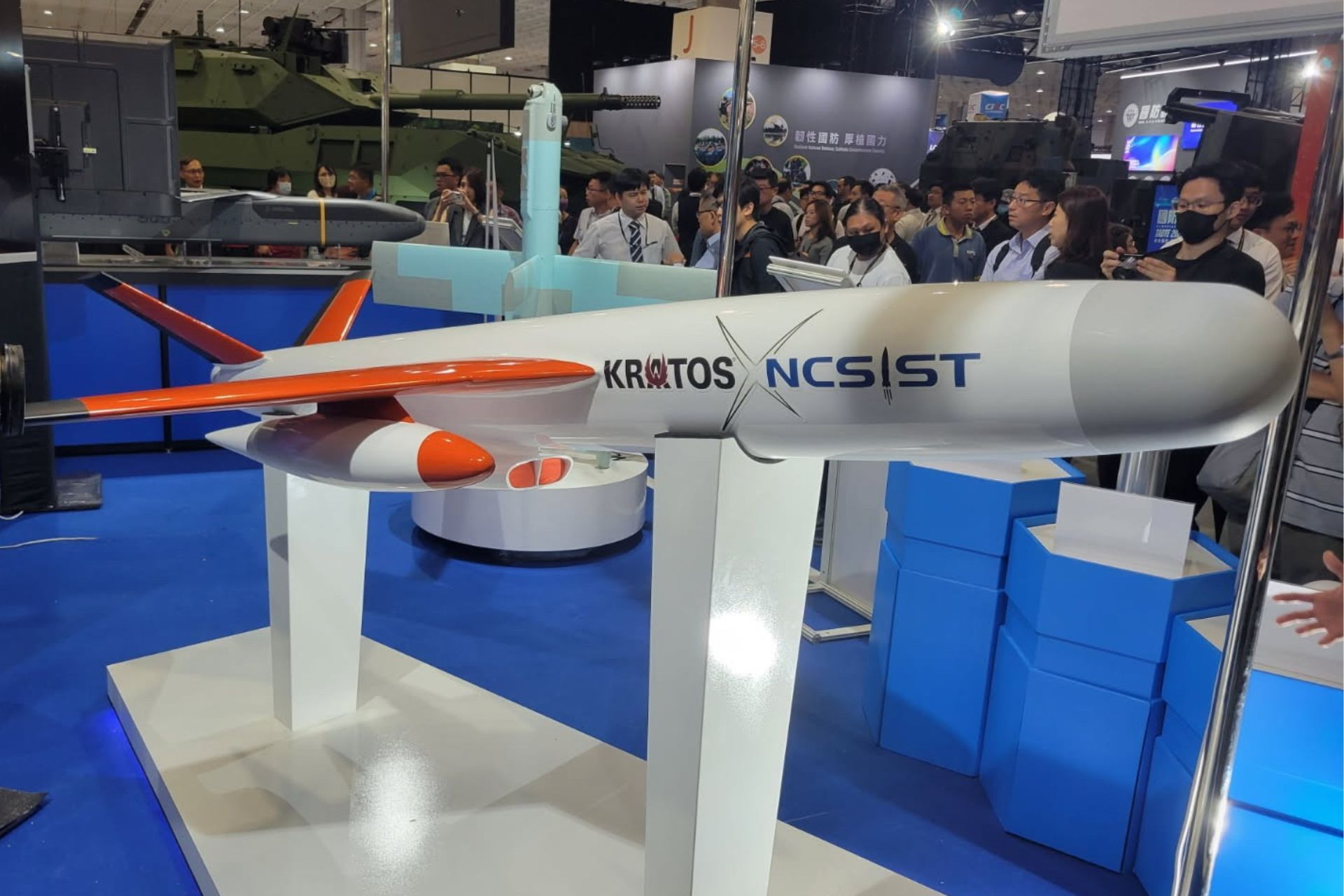
The Mighty Hornet IV repurposes a known airframe into a Mach 0.8 attack platform with a ceiling above 35,000 feet and a role in advanced MUM-T employment. (Picture source: Kratos)
The industrial arrangement is straightforward. Kratos brings unmanned systems expertise and will handle international marketing. NCSIST is responsible for local modifications and systems integration. Together, they aim to turn the MQM-178 into a high-speed attack platform capable of reaching about Mach 0.8, flying above 35,000 feet, and operating in advanced Manned Unmanned Teaming scenarios. Those parameters point to missions such as high-speed penetration, targeted strikes, and close support for crewed aircraft rather than long endurance surveillance.
On the technical side, the work covers propulsion, structure, and mission systems. The MQM-178 airframe is a useful starting point because it is low-cost, well-known to maintainability and aerodynamically predictable. Engineers have reworked the internal architecture to accept attack payloads and more capable sensors while trying not to undermine speed or manoeuvrability under high G loads. Recent trials cited by the developers show the platform can reach Mach 0.8 and sustain operational heights above roughly 10,600 meters. Those traits make the converted design suitable for profiles that mix fast transit with slower phases for target search and acquisition, which is also how loitering munitions are often used.
A core part of the concept is MUM-T integration. The Mighty Hornet IV is presented as able to work alongside crewed aircraft, relaying sensors, acting as decoys or performing coordinated offensive tasks. Achieving that in practice requires resilient communications, clear interoperability protocols, and a sensor suite suited to real-time data sharing. Both partners highlight the need for extensive operational testing to validate these capabilities under realistic conditions.
There is a commercial angle. Kratos says it will promote the Mighty Hornet IV internationally. Converting an existing platform shortens development time and lowers some risks, which can be attractive to buyers looking for a rapid and cost-conscious capability. At the same time, the conversion raises export control and regulatory questions and feeds into ongoing debates over the governance of dual-use systems.
Politically, the Taipei demonstration is more than a product launch. For Taiwan, expanding operational and industrial options increases resilience in a tense regional environment. For U.S. industry and policymakers, the cooperation with a local institute illustrates a pragmatic model of support that blends foreign know-how and local capacity. The exhibition serves both as a technology showcase and as a diplomatic signal that will draw attention from visiting delegations and potential customers.
Written By Erwan Halna du Fretay - Defense Analyst, Army Recognition Group
Erwan Halna du Fretay is a graduate of a Master’s degree in International Relations and has experience in the study of conflicts and global arms transfers. His research interests lie in security and strategic studies, particularly the dynamics of the defense industry, the evolution of military technologies, and the strategic transformation of armed forces, with a strong focus on multilateral cooperation and geopolitics.