






Breaking News






Polish HSW unveils new heavy infantry fighting vehicle concept at MSPO 2025.
According to information collected by Army Recognition at MSPO 2025 in Kielce, Poland, on September 2, 2025, Polish defense group PGZ and its subsidiary Huta Stalowa Wola (HSW) unveiled their proposal for a new generation tracked heavy infantry fighting vehicle (HIFV). Designed to transport and protect infantry units in high-threat environments, the new platform represents a significant evolution of Poland’s armored vehicle industry, combining advanced mobility, protection, and firepower to compete with Western European and South Korean designs already in service or development.
Follow Army Recognition on Google News at this link
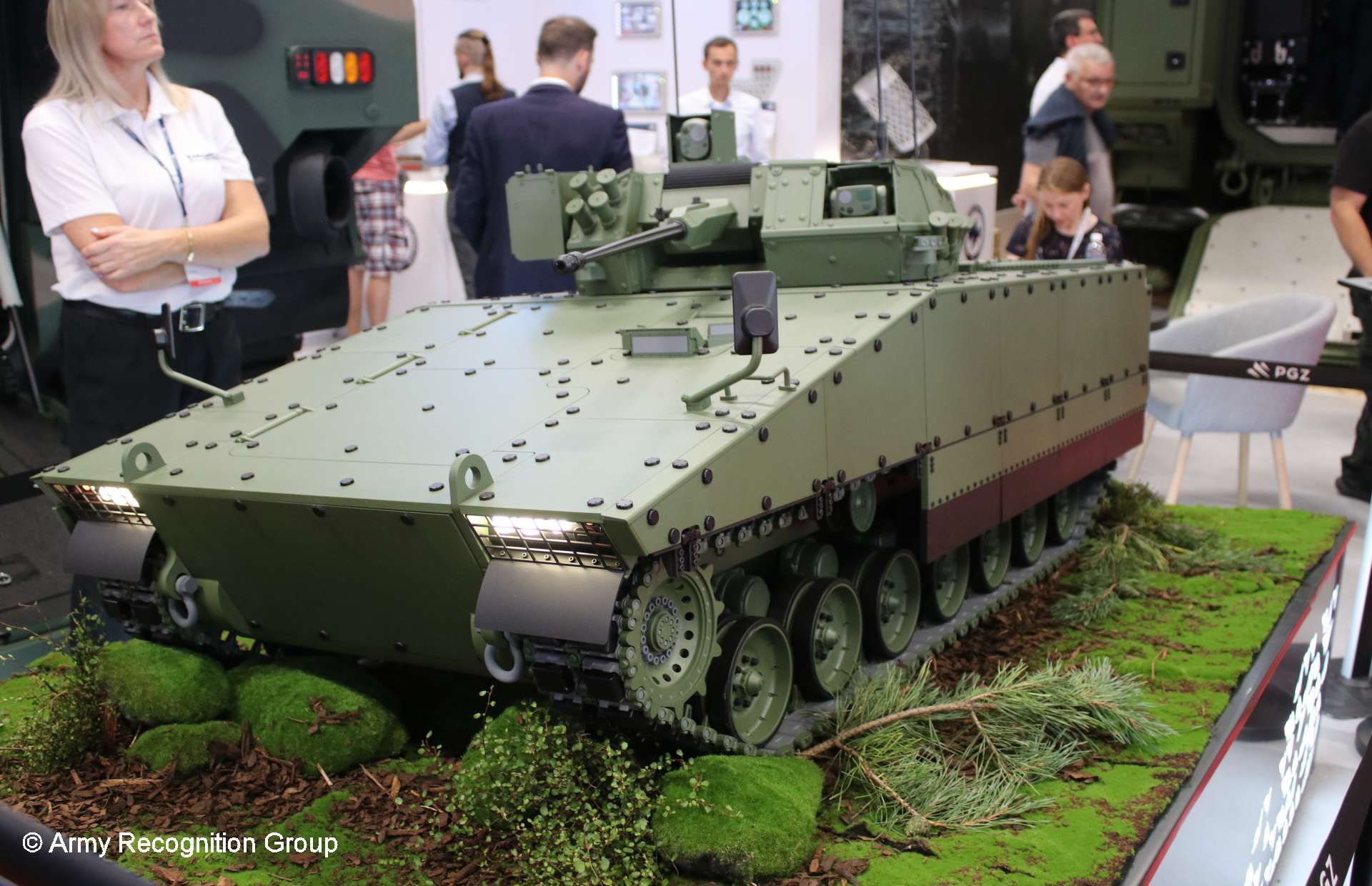
The new Polish heavy infantry fighting vehicle unveiled at MSPO 2025 is armed with the ZSSW-30 remote turret featuring a 30–40 mm automatic cannon, Spike anti-tank missile launcher, and advanced targeting systems, providing firepower against infantry, armored vehicles, and fortified positions (Picture source: Army Recognition Group).
The new heavy infantry fighting vehicle is built on a robust tracked chassis optimized for mobility across difficult terrain, with a focus on high tactical flexibility. The vehicle incorporates advanced ballistic and mine protection compliant with NATO STANAG standards, allowing operations in regions saturated with artillery, improvised explosive devices, and modern anti-armor threats. Its crew configuration includes a commander, driver, and up to six to eight dismounts, providing the capability to deliver a fully equipped infantry squad into contested environments.
Armament is centered around the ZSSW-30 remote-controlled turret armed with a 30 to 40 mm automatic cannon, coaxial machine gun, and an integrated launcher for Spike anti-tank guided missiles. This configuration provides the vehicle with the capacity to counter a wide spectrum of battlefield threats ranging from enemy infantry and fortified positions to main battle tanks. In addition, the platform is designed to accommodate advanced Active Protection Systems (APS), counter-drone technologies, and laser warning receivers, dramatically increasing survivability against precision-guided munitions and loitering drones.
The vehicle is fully integrated into Poland’s command and battlefield management systems, enabling interoperability with NATO forces. It also features NBC filtration systems and the option to mount additional countermeasure suites such as soft-kill and hard-kill defenses. Its design emphasizes modularity and growth potential, ensuring future upgrades in armament, sensors, and protection can be incorporated as battlefield requirements evolve.
The heavy infantry fighting vehicle is envisioned to provide both offensive and defensive fire support, secure maneuver capability, and sustained mobility for mechanized infantry units. In scenarios ranging from high-intensity conventional warfare to hybrid conflicts, the platform would serve as a force multiplier, giving the Polish Armed Forces and potential export customers a modern and resilient armored fighting vehicle.
The unveiling of this heavy IFV comes at a moment when Poland is rapidly modernizing its land forces in response to the war in Ukraine and the growing threat on NATO’s eastern flank. Poland has already acquired South Korean K2 Black Panther tanks and K9 howitzers, as well as American Abrams MBTs, but with this domestic IFV project, Warsaw aims to strengthen its defense industry autonomy. PGZ and HSW’s concept signals Poland’s ambition not only to equip its own military with state-of-the-art systems but also to position itself as a competitive exporter in the European and global armored vehicle market.
If adopted, the heavy infantry fighting vehicle could complement Poland’s existing Borsuk IFV program by offering a heavier, more protected variant suitable for frontline mechanized brigades. Its presentation at MSPO 2025 underscores the country’s determination to provide its soldiers with cutting-edge capabilities while reinforcing its role as a regional defense hub within NATO.