











Danish Leopard 2A7 DK Live-Fire in Latvia Signals NATO’s Strengthened Eastern Deterrence.
Danish Army crews carried out live-fire drills in Latvia on October 21 with their Leopard 2A7 DK tanks, according to NATO Multinational Brigade Latvia. The exercise underscores NATO’s reinforced forward presence and its growing integration of modern armor in the Baltic region.
On October 21, 2025, Danish tank crews conducted live-fire ranges in Latvia with Leopard 2A7 DK main battle tanks, an activity that strengthens the combat readiness of the NATO-led Multinational Brigade, Latvia, and its forward defense posture, as reported by NATO Multinational Brigade Latvia. The training fits into the eFP build-up that has transformed Latvia’s posture since the brigade’s stand-up in 2024 and its ongoing series of high-readiness exercises. For allies and observers, it signals both assured reinforcement and continued integration of advanced armor on NATO’s northeastern flank.
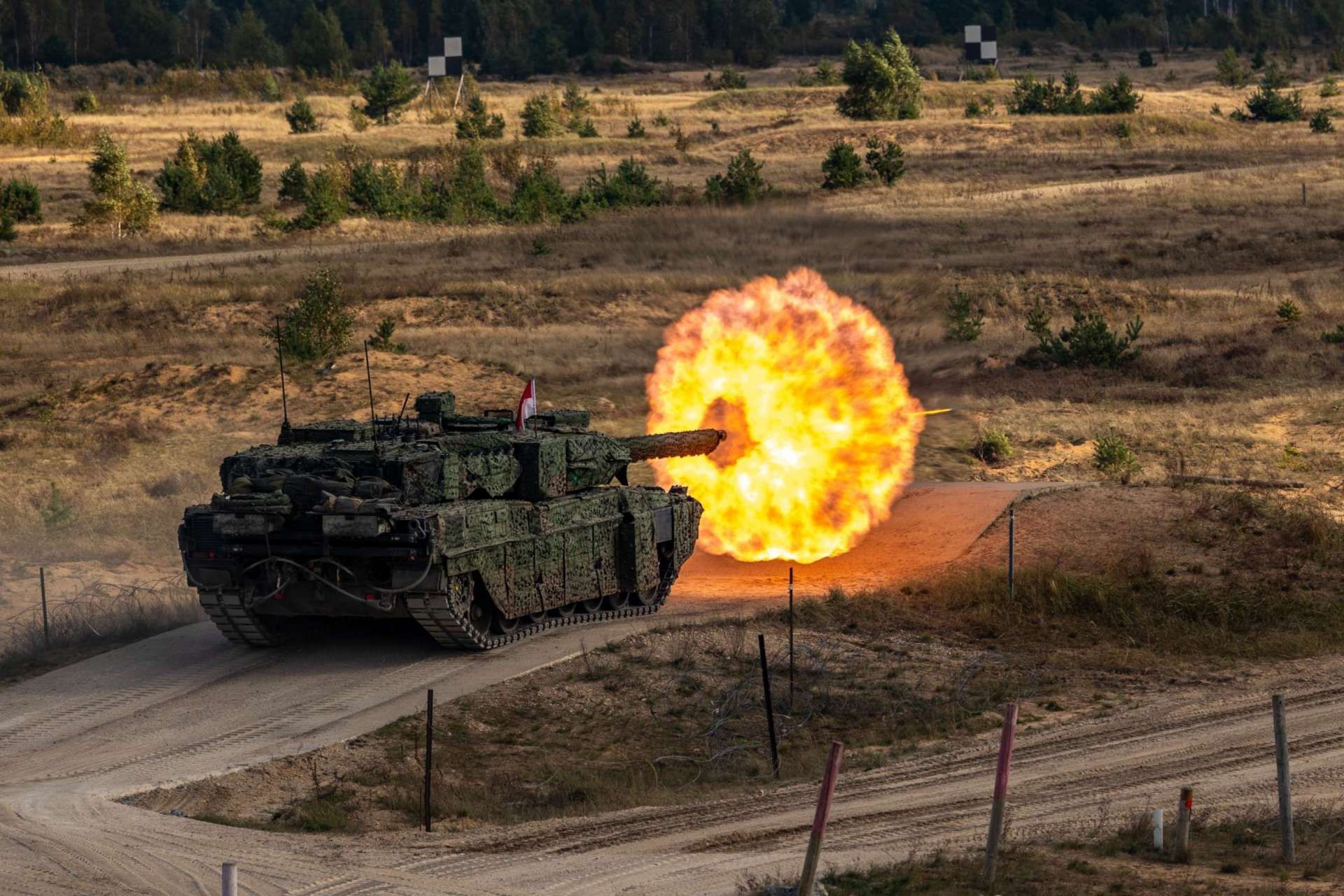
Denmark’s live-fire activity in Latvia therefore, goes beyond a simple training event. It demonstrates the operational maturity of the Leopard 2A7 DK program, the result of a sustained modernization effort that has brought the Danish armored force to NATO’s highest standards (Picture Source: NATO)
The Leopard 2A7 DK represents Denmark’s most advanced evolution of the Leopard 2 series, integrating a Rheinmetall 120 mm L55/L55A1 smoothbore gun capable of firing next-generation kinetic and programmable munitions. The platform features modular composite armor with scalable protection levels, a fully digitized battlefield management system, and enhanced crew survivability measures including improved mine resistance and thermal signature reduction. Powered by a 1,500 hp MTU MB 873 Ka-501 diesel engine, it maintains a combat weight below 69 tonnes, achieves road speeds up to 70 km/h, and offers an operational range of approximately 450 km. The integration of remote weapon stations, advanced fire-control systems, and multi-spectral sensors ensures lethality and situational awareness in high-intensity, multi-domain operations across extreme environments.
Operationally, Denmark migrated from refurbished Leopard 2A4s to 2A5DKs and then ran a structured upgrade program with KMW to the 2A7DK standard. Deliveries concluded in 2023, concentrating the fleet with the Jutland Dragoon Regiment before forward deployments and multinational drills in Latvia such as Resolute Warrior and this season’s Baltic training serials. Danish forces have also trained in Latvia during Exercise Namejs, embedding armor within larger joint maneuver packages under the brigade’s command framework.
In capability terms, the 2A7DK’s protection suite, modern FCS, and lethality with the L55-series gun give it an edge in long-range gunnery and survivability versus legacy 2A4/2A5 configurations and place it broadly on par with peers like the M1A2 SEPv3 and Challenger 3 for NATO missions in Europe. Compared with newer European baselines, Leopard 2A7V/2A8, the Danish variant shares the core fire-control and armor concepts while retaining national adaptations, offering a balanced mix of firepower and logistical commonality across a large European user base. That commonality matters in Latvia, where multiple contributing nations field Leopard platforms, simplifying ammunition, spares, and recovery across the brigade.
Strategically, deploying 2A7DKs to Latvia contributes to NATO’s deterrence calculus by demonstrating ready heavy armor integrated at brigade level, not just battlegroup scale. Geopolitically, it supports the Alliance’s Madrid- and Vilnius-cycle commitments to scale forces in the Baltics, while geostrategically positioning a credible armored reserve along key avenues of approach toward Riga and the wider Baltic corridor. Militarily, recurring live-fire certifies crews, validates combined arms with allied artillery and infantry, and shortens the timeline from alert to combat-credible response under MND-North.
Denmark’s live-fire drills in Latvia highlight the Leopard 2A7 DK’s operational maturity and NATO-standard modernization. Integrated within a multinational brigade, the exercise reflects Denmark’s commitment to collective defense and strategic cohesion on the Baltic flank. It also showcases effective industrial cooperation with Krauss-Maffei Wegmann, ensuring interoperability with allied Leopard operators. The deployment signals readiness, unity, and NATO’s capacity for rapid response to eastern threats.
Written by Teoman S. Nicanci – Defense Analyst, Army Recognition Group
Teoman S. Nicanci holds degrees in Political Science, Comparative and International Politics, and International Relations and Diplomacy from leading Belgian universities, with research focused on Russian strategic behavior, defense technology, and modern warfare. He is a defense analyst at Army Recognition, specializing in the global defense industry, military armament, and emerging defense technologies.