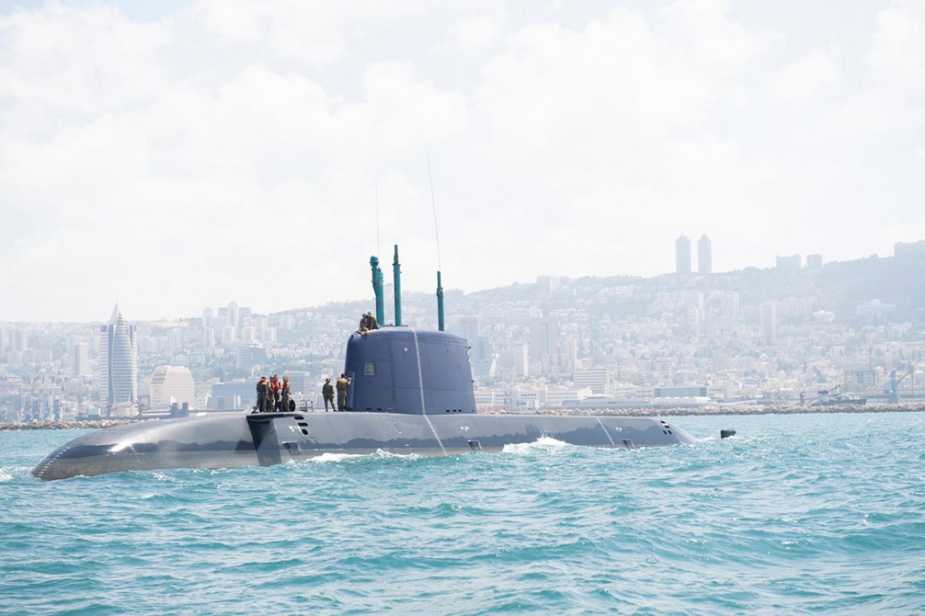
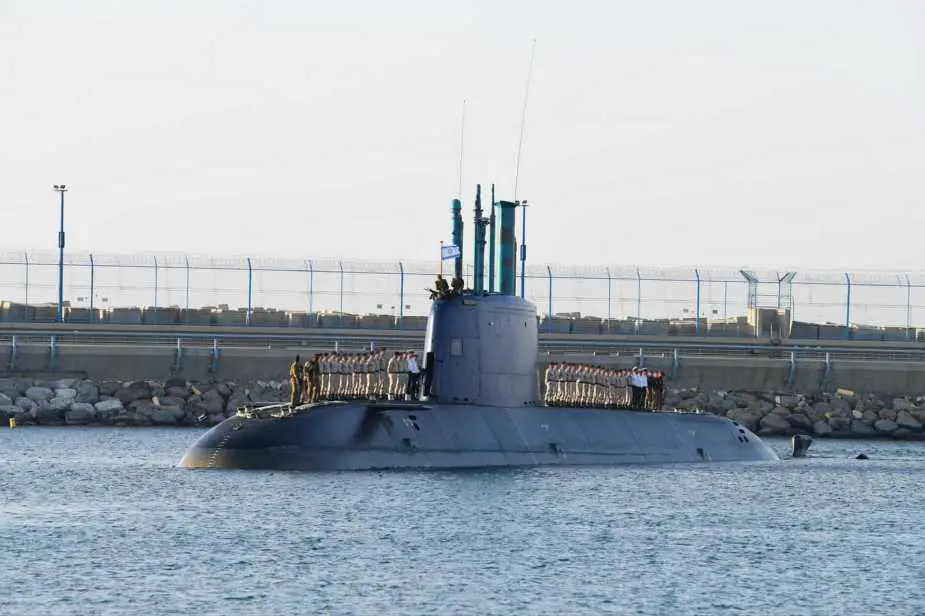
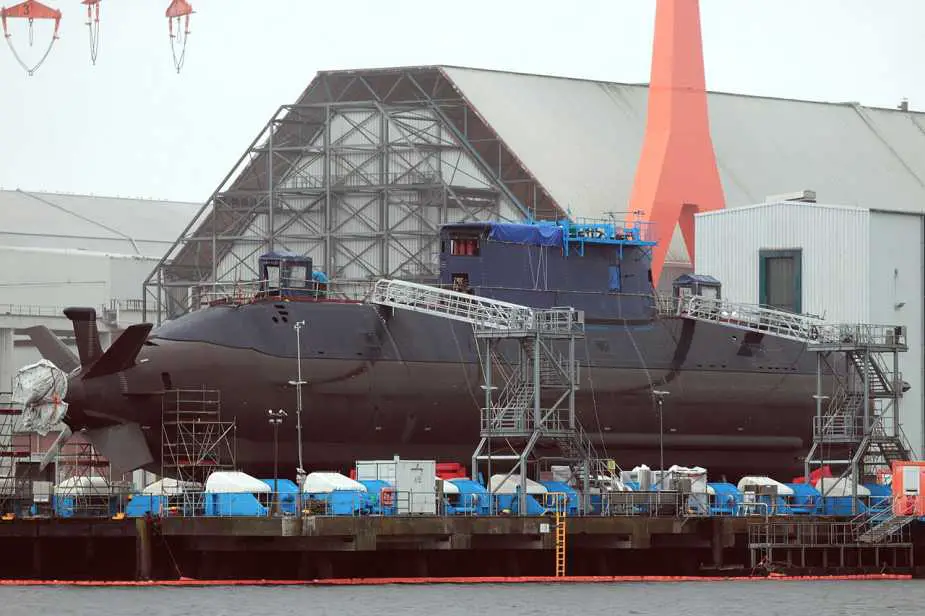
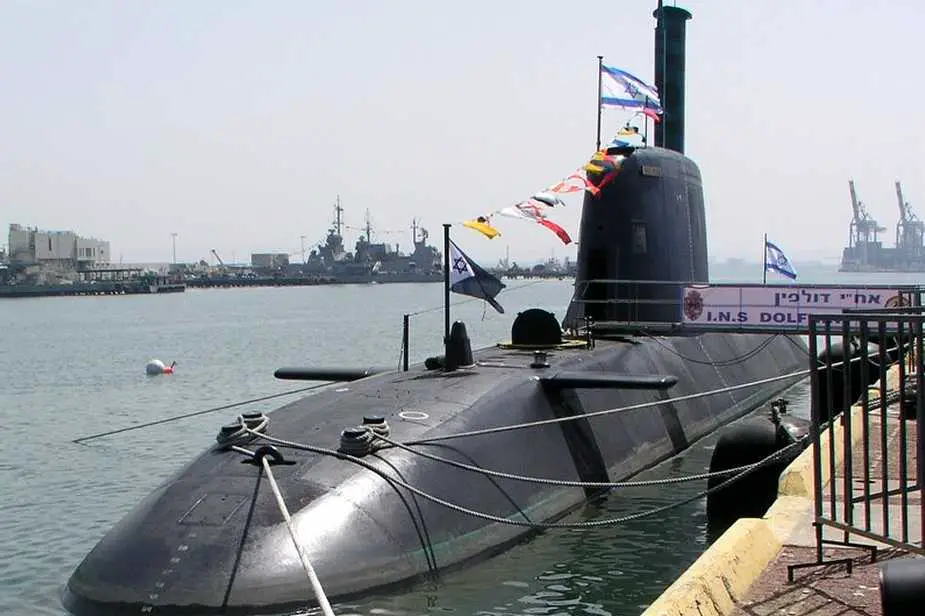
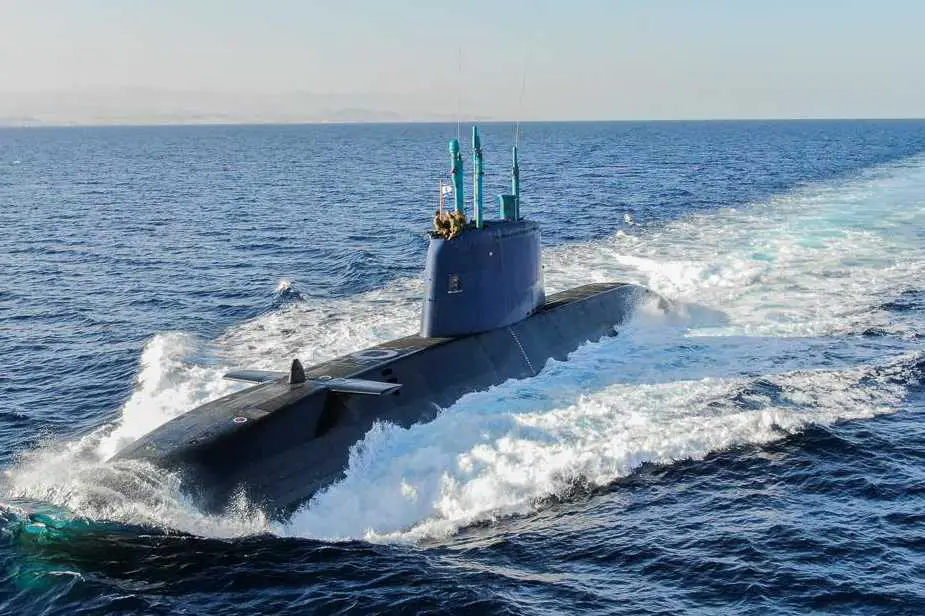
Replacing the three smaller Gal-class submarines that had entered Israeli service from 1977, the Dolphin-class is a family of six diesel-electric attack submarines developed for the Israeli Navy’s Shayetet 7 submarine flotilla and built in Germany by Howaldtswerke-Deutsche Werft (HDW) in Kiel, now part of TKMS. The class consists of two main variants: the original Dolphin-I boats (INS Dolphin, INS Leviathan, and INS Tekumah) commissioned between 1999 and 2000 and the enlarged Dolphin-II boats equipped with air-independent propulsion (INS Tanin, INS Rahav, and INS Drakon), which entered service between 2014 and 2026. Designed primarily for long-endurance intelligence gathering, anti-surface warfare, anti-submarine warfare, special operations, and strategic deterrence missions, the class has served as the backbone of Israel's submarine force since 1999.






Technical Data
-
Armament
The Dolphin-class carries up to 16 torpedoes and missiles in a forward weapon section built around six 533 mm and four 650 mm tubes. This ten-tube arrangement is unusually heavy for a Western conventional submarine and allows several weapons to remain loaded while up to six additional rounds are held in reserve. The 533 mm tubes support heavyweight torpedoes and encapsulated anti-ship missiles, while the 650 mm tubes provide 48.7% more cross-sectional area and can carry oversized missiles, naval mines, swimmer-delivery equipment, or standard 533 mm weapons through removable liners. Actual loading varies by mission, with anti-submarine patrols favoring torpedoes, anti-surface missions combining torpedoes and Harpoons, and special operations or strategic patrols allocating more space to larger payloads.
Initial boats used the Atlas Elektronik DM2A3 heavyweight torpedo, a wire-guided weapon carrying a 260 kg warhead. It reaches 40 knots with an engagement range exceeding 13 km in active-homing mode, or 28 km at 22 knots while using passive homing. Israel subsequently adopted the electrically propelled DM2A4 Seehake, which adds fiber-optic guidance, improved active and passive acoustic seekers, greater data-transfer capacity and stronger resistance to decoys and jamming. The submarine can update either weapon after launch using sonar-derived target data, allowing course corrections against maneuvering ships or submarines before the torpedo activates its terminal seeker.
The 533 mm tubes are also associated with the UGM-84C Harpoon anti-ship missile, launched underwater inside a watertight capsule before transitioning to high-subsonic flight. The cited configuration carries a 227 kg warhead and has a range of 130 km, giving the submarine a longer-range anti-surface option than a torpedo at the cost of a more detectable launch event. Dolphin-II boats have additionally been linked to the Triton or IDAS anti-helicopter missile, intended for limited self-defense against helicopters using dipping sonar, sonobuoys or lightweight torpedoes. Operational integration of IDAS across the class has not been confirmed, and the weapon should therefore be treated as an associated Dolphin-II capability rather than a standard fit on all six submarines.
The four 650 mm tubes are widely associated with the Israeli Popeye Turbo submarine-launched cruise missile, credited with a range of at least 1,500 km and linked to a possible sea-based second-strike role. Israel has not confirmed the missile's operational status, guidance system, warhead, or nuclear mission, so the class can only be identified as potentially strategic-capable. INS Drakon retains the established ten bow tubes but may add separate payload or vertical-launch capacity within its enlarged sail and extended hull. Estimates of two large silos or four to eight smaller cells remain unverified, and the additional volume could instead support unmanned underwater vehicles, reconnaissance systems, or special operations equipment.
-
Design
The three Dolphin-I submarines measure 57.3 m in length, 6.8 m in beam and 6.2 m in draught, displacing 1,640 tonnes surfaced and 1,900 tonnes submerged. The standard Dolphin-II subclass, represented by INS Tanin and INS Rahav, retains the same beam and draught but increases length to 68.6 m, surfaced displacement to 2,050 tonnes and submerged displacement to 2,400 tonnes. This represents an 11.3 m, or 19.7%, increase in length and a 500-tonne, or 26.3%, increase in submerged displacement, primarily to accommodate the fuel-cell AIP section, reactant storage, electrical conversion equipment and associated machinery.
The hull uses a prismatic external form with faired transitions between the pressure hull and sail to limit hydrodynamic turbulence and self-generated flow noise. Extensive use of non-magnetic materials reduces vulnerability to magnetic anomaly detectors and magnetic-influence mines, while the pressure hull is rated to a test depth of at least 350 m. The Dolphin-I uses a six-bladed propeller, whereas the Dolphin AIP boats use a seven-bladed propeller intended to distribute blade loading and reduce cavitation-related noise. All variants retain single-shaft propulsion, concentrating the stern arrangement around one electric motor and propeller while reducing the number of rotating components and pressure-hull penetrations.
Internal volume is divided among ten bow weapon tubes, reserve weapon stowage, sonar equipment, batteries, diesel generators, command spaces, crew accommodation and mission equipment within a hull only 6.8 m wide. The normal complement is 35 personnel, with berthing for ten additional specialists or special operations personnel, bringing maximum embarked strength to 45. A wet-and-dry compartment permits combat swimmers to leave and re-enter while the submarine remains submerged, while an external shelter behind the sail can carry swimmer-delivery equipment or other mission payloads. These installations support special operations without requiring the submarine to surface near hostile coastlines, but embarked personnel and equipment directly reduce the space available for provisions, weapons and maintenance stores during patrols lasting up to 30 days.
The INS Drakon introduces a third physical configuration within the class. Estimated at 73-74 m in length, it is 4.4-5.4 m longer than the Tanin and Rahav and 15.7-16.7 m longer than the Dolphin-I, while retaining the listed 6.8 m beam. Its enlarged sail is longer, wider and taller than those of the standard Dolphin-II boats and required structural changes to the pressure hull, machinery spaces, accommodation, cable routes and piping. The added volume has been associated with vertical missile tubes, unmanned vehicles, intelligence systems or special operations equipment, but no launch-cell count, payload type or Drakon-specific displacement has been confirmed. The scale of the redesign, including more than ten years between the Rahav's commissioning in January 2016 and the Drakon's entry into service in August 2026, makes the submarine an engineering transition between Dolphin-II and the future Dakar-class.
-
Propulsion
The Dolphin-class uses a single-shaft diesel-electric propulsion system built around three MTU 16V 396 SE 84 diesel engines producing a combined sustained output of 3.12 MW, three Siemens alternators rated at 750 kW each, and one Siemens electric propulsion motor rated at 2.85 MW. The diesel engines generate electrical power and recharge the batteries while the submarine is surfaced or snorkeling, rather than driving the propeller directly. The Dolphin-I relies entirely on battery power when fully submerged, requiring periodic snorkeling that exposes the intake mast, diesel exhaust, machinery noise, thermal signature, and surface wake to radar, infrared sensors, aircraft, and surface ships.
The Dolphin-II subclass retains the same diesel-electric architecture but adds a hydrogen fuel-cell air-independent propulsion (AIP) system. The fuel cells generate electricity underwater through an electrochemical reaction between hydrogen and oxygen, producing water and heat without requiring atmospheric air or creating diesel exhaust. AIP supports low-speed patrols and onboard electrical loads while reducing snorkeling frequency, whereas batteries remain necessary for rapid acceleration and maximum submerged speed. Installation of the AIP section increased hull length from 57.3 m to 68.6 m and submerged displacement from 1,900 tonnes to 2,400 tonnes, adding space for fuel cell modules, reactant storage, electrical conversion equipment and safety systems.
The Dolphin-I reaches 20 knots, or 37 km/h, submerged, while the Dolphin-II exceeds 25 knots, or 46 km/h, despite displacing 500 tonnes more underwater. The original boats use a six-bladed propeller, whereas the AIP boats use a seven-bladed propeller intended to distribute thrust over more blades and reduce cavitation-related noise. Maximum speed is intended for short-duration evasion, repositioning or weapon employment because high-speed movement rapidly depletes battery capacity, increases machinery and flow noise and degrades passive-sonar performance. Snorkeling speed is limited to 11 knots, or 20 km/h, because of mast loading, sea-state restrictions, intake stability and the increased detectability of the mast and wake.
The class has an unrefuelled surface range of 8,000 nautical miles, or 15,000 km, at 8 knots, while battery-powered submerged range exceeds 400 nautical miles, or 740 km, at the same speed. Covering 400 nautical miles at 8 knots would require more than 50 hours, although propulsion, sonar, pumps and environmental systems draw from the same electrical reserves. Unsupported patrol endurance is limited to 30 days by fuel, provisions, oxygen management, water, waste capacity and crew requirements rather than propulsion alone. Test depth is at least 350 m, while the INS Drakon retains the Dolphin-II diesel-electric and fuel-cell architecture, a submerged speed exceeding 25 knots and the same stated test depth.
-
Sensors and detection systems
The Dolphin-class uses an integrated German-Israeli sensor architecture centered on the Atlas Elektronik ISUS-series combat system, identified as ISUS 90-1 and elsewhere as ISUS 90-55. It combines sonar, radar, electronic surveillance, navigation and weapon data into a common tactical picture, supporting automatic sensor management, target motion analysis, fire control calculations and post-launch torpedo guidance. The available information does not clearly establish whether the two ISUS designations represent subclass differences or modernization stages, but both refer to the system coordinating detection, classification, tracking and weapon assignment across the submarine.
Primary underwater detection is provided by the Atlas Elektronik CSU 90 hull-mounted active and passive sonar, supported by the PRS-3 passive ranging sonar and FAS-3 flank-array sonar. The CSU 90 performs submarine and surface-ship search, localization, attack support, navigation and obstacle detection, while the PRS-3 improves range estimation without active transmission. The flank array provides a longer acoustic aperture for detecting distant low-frequency machinery and propeller signatures, although effectiveness decreases as submarine speed and hull-flow noise increase. Before 2016, all Dolphin boats also received a Rafael sonar upgrade designed to improve detection of low-signature vessels by filtering environmental noise, merchant traffic, biological sounds and own-ship interference.
Electronic surveillance is provided by the Elbit 4CH(V)2 Timnex ESM system, which detects, classifies and records radar emissions while the submarine remains passive. The available figures conflict, listing frequency coverage of either 2-18 GHz or 5-20 GHz, while one entry gives processing capacity of up to one million pulses per second and direction-finding accuracy of 5-10 degrees. Surface navigation and target detection are supported by an Elta I-band radar, which provides precise range and bearing when surfaced or at mast depth but exposes the submarine to hostile ESM receivers. Two Kollmorgen periscopes provide visual surveillance, navigation, recognition and attack support, although the source does not identify their optical, thermal imaging or optronic configuration.
The sensor suite is designed to build tracks progressively while limiting active emissions. A surface ship may first be detected through radar emissions, then through the flank array, localized by the bow and passive-ranging sonar and visually identified through a periscope before the ISUS system generates a weapon solution. The INS Drakon retains the ISUS 90-1 architecture and was observed with six retractable masts raised simultaneously, indicating a dense fit of surveillance, navigation, communications and electronic support equipment within its enlarged sail. Individual mast functions, confirmed sonar detection ranges, a towed array, dedicated torpedo-warning equipment and unmanned system control installations are not identified to date.

The Dolphin-class uses a diesel-electric propulsion architecture built around three diesel engines, electrical generators, batteries, one electric propulsion motor, and a single propeller shaft.


Photo Gallery