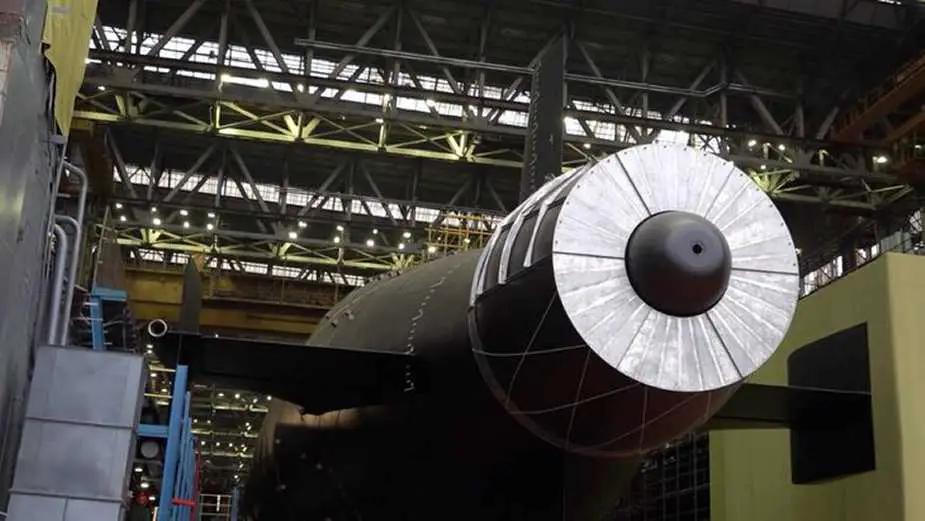
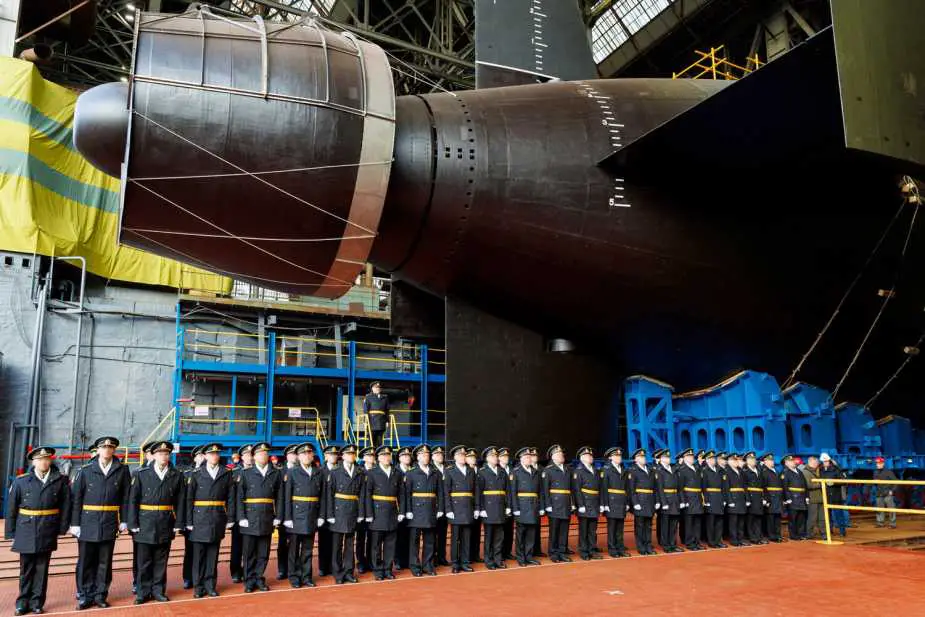
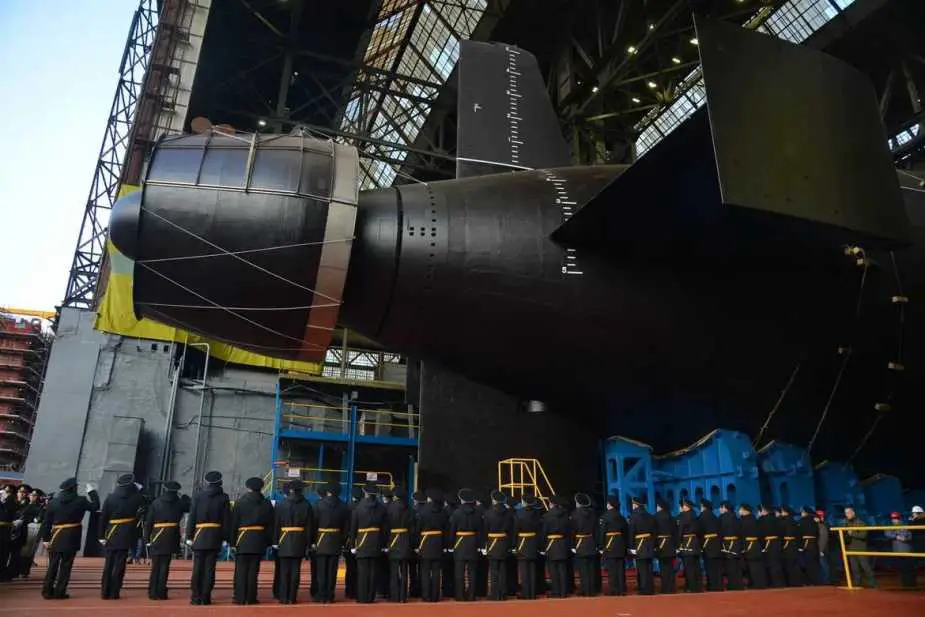
The Khabarovsk-class, officially designated Project 09851, is a nuclear-powered special-purpose strategic submarine designed by the Rubin Central Design Bureau and constructed by Sevmash in Severodvinsk, Russia. Its primary mission is to carry and deploy the Poseidon nuclear-powered unmanned underwater vehicle, forming a core part of Russia’s future undersea nuclear deterrence capabilities.
Country users: Russia






Technical Data
-
Design
The Khabarovsk-class (Project 09851) is designed as a strategic special-purpose nuclear-powered submarine, based on a shortened and modified Borei-class hull. The vessel is estimated to be around 113 meters in length, with a beam of 10 meters, and a submerged displacement of approximately 10,000 tons. It is built for deep-ocean and Arctic operations, with a working diving depth of about 500 meters. The submarine features advanced acoustic stealth technologies, including structural vibration isolation and sound-absorbing hull treatments. Its internal layout supports the integration of large robotic systems and unmanned underwater vehicles. Mission endurance is estimated between 90 and 120 days, and crew capacity is around 100 personnel, optimized for long-term strategic deployments.
. -
Armament
The Khabarovsk class (Project 09851) is configured to carry up to six 2M39 Poseidon nuclear-powered strategic underwater torpedoes, housed in six 2P39 launch tubes. These long-range autonomous weapons are designed to travel intercontinental distances underwater and deliver multi-megaton nuclear warheads against coastal targets, including naval bases and carrier groups. In addition to the Poseidon system, the submarine is likely armed with 533 mm or 650 mm torpedo tubes for standard heavyweight torpedoes and potentially land-attack or anti-ship cruise missiles. This combination of strategic and tactical payloads supports its multi-role capacity within Russia’s naval doctrine.
-
Propulsion
The Khabarovsk-class (Project 09851) is powered by a pressurized water-cooled nuclear reactor, believed to be of the VM-5 or OK-650V series, driving steam turbines connected to a single shaft. The reactor’s output is estimated at around 43,000 horsepower, allowing the submarine to reach speeds of 30 to 32 knots submerged. Its nuclear propulsion system provides virtually unlimited operational range, with autonomy determined by food, crew stamina, and mission requirements rather than fuel. The submarine is capable of extended deployments in contested and remote waters, including the Arctic Ocean and deep-sea zones.
-
Sensors and Detection Systems
The Khabarovsk-class (Project 09851) is believed to be equipped with an advanced sonar and detection suite. This includes a spherical bow-mounted sonar, flank arrays, and a towed passive sonar system, enabling both long-range detection and quiet operation. The submarine also carries electronic support measures (ESM), radar warning receivers, and navigation sonar optimized for under-ice and deep-sea operation. Due to its role in deploying autonomous underwater weapons, the vessel is expected to feature dedicated control interfaces for UUVs, underwater communication systems, and seabed surveillance technologies. These capabilities allow it to coordinate and launch complex unmanned systems while maintaining stealth and tactical awareness.


Photo Gallery