




The BTR-22 is a Russian-made 8×8 wheeled armored personnel carrier (APC) developed by the Military Industrial Company (VPK) based in Moscow, Russia. Introduced as a modern successor to the BTR-80 and BTR-82 family, it represents a significant shift in Russian armored vehicle design—embracing Western-inspired configuration principles and emphasizing modularity, protection, and crew survivability. The vehicle made its debut at the Army-2023 International Military-Technical Forum, signaling its entry into Russia's new generation of battlefield mobility platforms.
Country users: Russia






Technical Data
-
Armament
The main armament in the standard BTR-22 variant is the 2A72 30 mm automatic cannon, offering a rate of fire of approximately 330 rounds per minute. This weapon is effective against infantry, lightly armored vehicles, and low-flying aerial threats. It is stabilized in two planes and linked to the TKN-4GA-01 fire control sight, which includes day/night optics, thermal imaging, and a laser rangefinder. Engagement range extends up to 2,500 meters under optimal conditions.
The Balista variant significantly enhances combat capabilities by introducing the 2A42 30 mm automatic cannon, known for its higher cyclic rate. It also mounts two 9M113 Konkurs ATGM launchers on either side of the turret, capable of penetrating up to 800 mm of rolled homogeneous armor (RHA) behind explosive reactive armor (ERA), enabling effective engagement of enemy main battle tanks and fortifications.
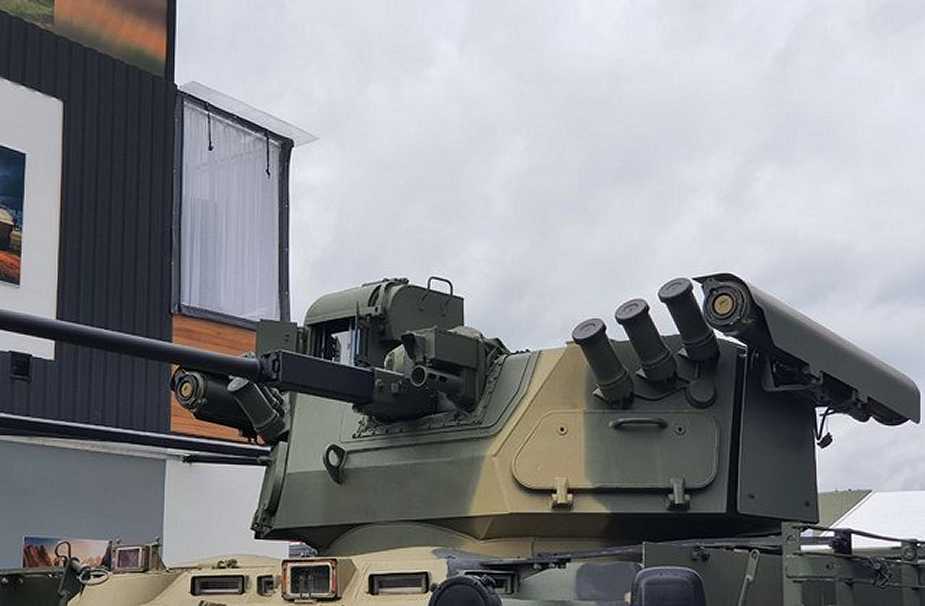
Close view of the BTR-22 turret armed with one 30mm cannon, one 7.62mm coaxial machine gun, and one anti-tank launcher mounted on each side of the turret. -
Design and protection
The BTR 22 represents a major departure from earlier Soviet armored personnel carrier designs through the relocation of its engine to the front right section of the vehicle. This layout provides for a rear troop compartment with a full-sized rear access door, allowing infantry to dismount more safely and efficiently in combat conditions. The driver and commander are positioned at the front of the vehicle, while the turret is mounted centrally on the roof, and the infantry section is located at the rear.
The hull takes inspiration from the Boomerang platform, featuring a raised roofline and a V shaped underbody that enhances blast resistance against mines and improvised explosive devices. Standard armor protection ensures resistance against 12.7 millimeter and 14.5 millimeter armor piercing rounds along the frontal and lateral arcs. The vehicle is also designed to support modular add on armor kits that can increase survivability based on mission requirements.
For additional protection against modern battlefield threats, the BTR 22 can be equipped with wire cage armor fitted to the front and rear sections of the hull. This type of armor is specifically designed to improve resistance to self propelled grenades such as RPGs. On top of the turret, a cope cage structure can be installed to defend against aerial threats, including loitering munitions and first-person view drones, both of which have become increasingly common in recent conflicts.
Inside, the vehicle carries a crew of two consisting of the driver and commander, and has seating for eight infantry troops. All occupants are provided with blast attenuating seats, and the interior is designed to allow greater headroom and internal space, improving troop comfort and protection during movement and dismounting.
-
Mobility
The BTR-22 is powered by a YaMZ-536 diesel engine, delivering approximately 330 horsepower, mated to a manual 5-speed transmission. The BTR-22 uses an 8×8 all-wheel drive layout with independent suspension, enabling it to traverse uneven and soft terrain effectively.
The vehicle can reach a maximum road speed of 80 km/h and has an estimated operational range of approximately 750 kilometers on internal fuel. Amphibious capability is retained, with the vehicle able to traverse rivers and shallow water obstacles using built-in waterjets for propulsion. Ground clearance and terrain approach angles are optimized for mixed-terrain maneuvering, allowing effective use in both rural and urban combat zones.
-
Combat Equipment
The BTR-22 incorporates a modern fire control system, including the TKN-4GA-01 sight, which integrates day optics, thermal imaging, and laser rangefinding in a single unit. The main gun is fully stabilized for firing while on the move. Additional equipment includes smoke grenade launchers for concealment and obscuration.
The vehicle is prepared for integration with GPS/GLONASS navigation systems, secure battlefield communication networks, and includes a CBRN (Chemical, Biological, Radiological, Nuclear) protection suite. Future versions are expected to include the LGSh-689 electronic warfare module, which will enable jamming and disruption of UAVs and enemy electronics. These capabilities allow the BTR-22 to operate within networked battle groups and contribute effectively to electronic and information warfare domains.


Photo Gallery


