Air Defense Vehicles.
FP-7.x Air Defense Interceptor Missile.

The FP-7.x, also designated FP-7x, is a Ukrainian interceptor missile project developed within Project Freya, a proposed integrated air and missile defense architecture intended primarily to counter ballistic and other high-speed aerial threats. The concept combines a Ukrainian interceptor and launcher with European radar, seeker, command-and-control, and communications technologies, with the objective of creating a modular, networked, and comparatively affordable defensive system compatible with NATO-standard operational environments.
Country users: Ukraine

Description
The FP-7X / FP-7.x is the interceptor missile associated with the Ukrainian Project Freya air and missile defense system. The project is of Ukrainian origin, although the available material does not identify a single confirmed Ukrainian prime contractor responsible for the complete interceptor. Project Freya is instead presented as a multinationally integrated architecture in which Ukrainian industry provides the missile and launcher elements, while selected European systems are proposed for surveillance, target tracking, seeker technology, command-and-control, and tactical networking.
The available project material associates Diehl Defence of Germany with the missile’s imaging-infrared seeker concept. At system level, Kongsberg Defence & Aerospace of Norway is referenced in connection with the Fire Distribution Center and command-post architecture. Several European radar manufacturers are also shown as possible contributors to the wider Freya network, including Saab, Thales, Hensoldt, Weibel Scientific, and Leonardo. These companies are best regarded as referenced or candidate subsystem providers rather than confirmed suppliers of the final production configuration unless separately documented.
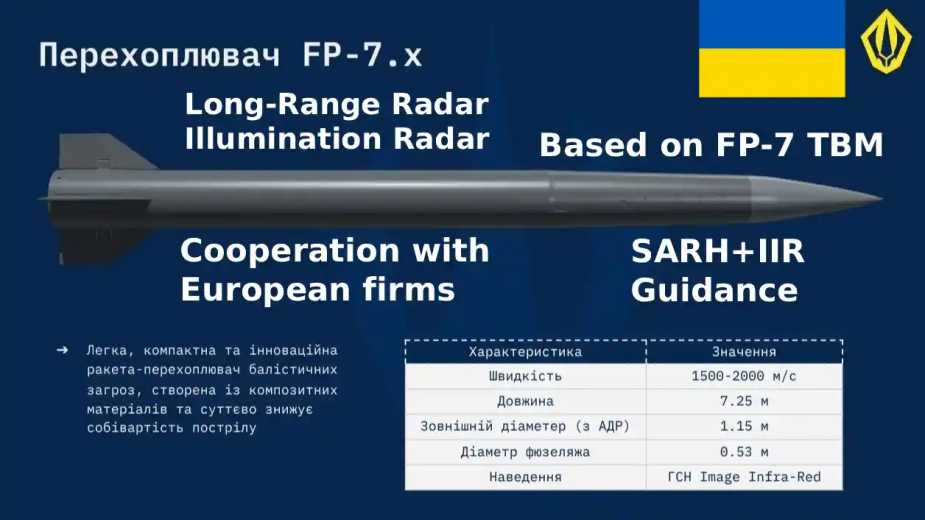
The FP-7X is described as being based on the FP-7 tactical ballistic missile, indicating that the interceptor concept derives from an existing Ukrainian missile architecture. The exact degree of structural, propulsion, manufacturing, or component commonality between the FP-7 and FP-7X has not been publicly disclosed. The available information therefore supports describing FP-7X as an interceptor derived from the FP-7 family, but not assigning specific inherited components without further confirmation.
The development of Project Freya appears to reflect Ukraine’s requirement for a more sustainable air and missile defense capability able to supplement expensive imported interceptors. The project material emphasizes the objective of reducing the cost of interception while maintaining the ability to engage demanding ballistic targets. Rather than relying on a completely closed national architecture, the concept combines a Ukrainian effector with already-developed European sensors and command-and-control components.
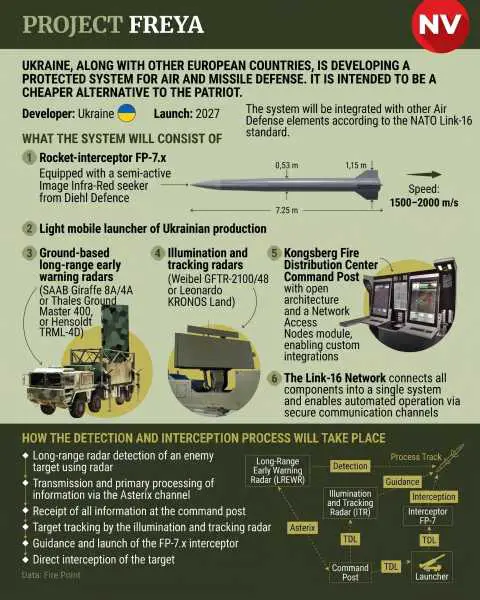
Project Freya is presented as a complete engagement architecture rather than simply as a missile and launcher. The system concept links long-range surveillance radar, precision target-tracking or illumination radar, a command post, mobile launchers, and FP-7X interceptors through secure tactical communications. This arrangement is intended to allow target detection, tracking, command processing, and missile launch to be distributed across several system elements instead of being concentrated within a single proprietary battery configuration.
For long-range surveillance, the project material illustrates several candidate radar families, including the Saab Giraffe 8A and Giraffe 4A, the Thales Ground Master 400, and the Hensoldt TRML-4D. These systems are shown as potential sensors for early detection and track generation. Candidate precision tracking or illumination systems illustrated within the same concept include the Weibel GFTR-2100/48 and Leonardo KRONOS Land.
The command-and-control element is presented around a Kongsberg Fire Distribution Center, which forms part of the proposed engagement-management architecture. The project material also references Link 16, indicating intended compatibility with NATO tactical data-link standards, while ASTERIX is shown in connection with radar or surveillance-data exchange. These elements reinforce the concept of Freya as a networked air-defense system designed to integrate multiple external sensors and command nodes.
The FP-7X should currently be regarded as a developmental interceptor rather than a confirmed operational missile. The supplied project material indicates 2027 as a future program milestone, but the precise significance of this date has not been publicly established. It should therefore not automatically be interpreted as confirmed entry into service, serial production, first operational deployment, or initial operational capability.
The principal role of the FP-7X is ballistic missile interception. Its projected performance and proposed guidance architecture may also provide potential against other high-speed aerial threats, but such missions should be treated as possible capabilities rather than confirmed operational roles unless supported by additional documentation.
Within Project Freya, the FP-7X would serve as the kinetic effector at the end of an engagement chain beginning with target detection and track generation, followed by command processing, precision tracking, launch authorization, and missile guidance toward the interception point. The exact sequence of radar support, seeker activation, and terminal homing has not been publicly disclosed.
A broader strategic purpose of Project Freya is to increase the degree of Ukrainian participation in the production and sustainment of advanced missile-defense effectors while retaining access to established European sensor and command technologies. If the program reaches operational maturity, the system could provide Ukraine with an additional layer of ballistic missile defense integrated into a wider NATO-compatible air-defense environment.
FP-7.x variants:
No variants at this time.
Technical Data
-
Design
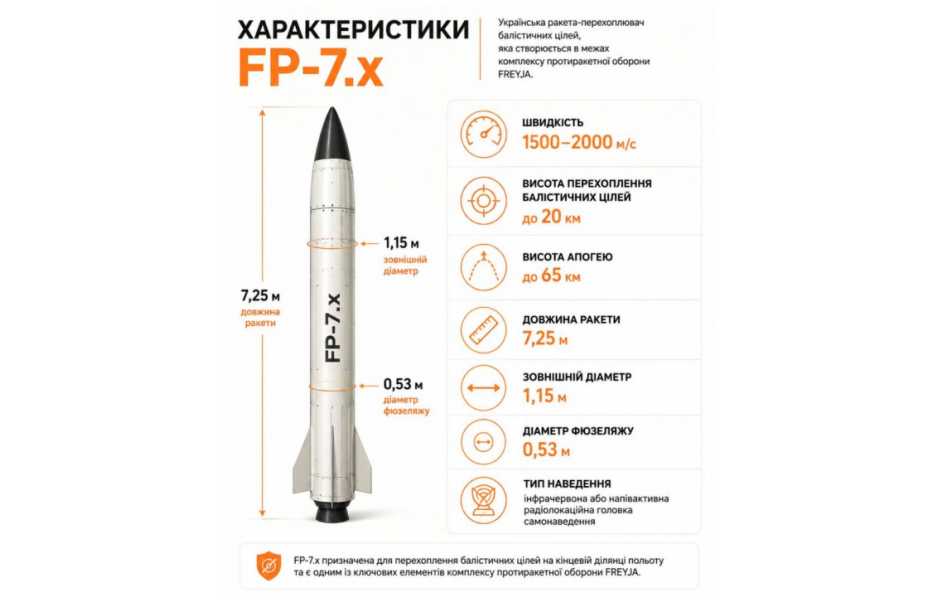
The FP-7.x is depicted in the supplied Project Freya material as an elongated interceptor missile with a pointed forward section, cylindrical main body, and rear-mounted aerodynamic control surfaces. The missile is shown with an overall length of approximately 7.25 m, a main body diameter of approximately 0.53 m, and a maximum rear span of about 1.15 m. The project material also describes the interceptor as a light and compact design using composite materials. FP-7X is presented as being based on the FP-7 tactical ballistic missile, although the precise level of structural, propulsion, or component commonality between the two designs has not been disclosed. The missile is intended for use with a Ukrainian-produced mobile launcher, while the exact launcher chassis, missile load, canister arrangement, and reload configuration remain unspecified in the available material.
-
Propulsion
The FP-7.x is credited in the supplied project information with a stated speed of approximately 1,500 to 2,000 m/s. The available material does not identify the exact propulsion type, motor configuration, propellant, number of stages, launch mass, engagement range, interception altitude, powered-flight duration, acceleration profile, or maximum operational ceiling. These characteristics should therefore be regarded as undisclosed rather than estimated. The quoted velocity is best treated as a projected or stated design performance figure, as no flight-test data confirming this speed are provided in the available project material.
-
Guidance Systems
The FP-7.x is presented with a proposed SARH + IIR guidance architecture combining Semi-Active Radar Homing with Imaging Infrared guidance. The supplied project material associates Diehl Defence with the imaging-infrared seeker concept. Project Freya is also shown with several candidate long-range surveillance radars, including the Saab Giraffe 8A, Saab Giraffe 4A, Thales Ground Master 400, and Hensoldt TRML-4D. Candidate target-tracking or illumination systems illustrated in the project graphics include the Weibel GFTR-2100/48 and Leonardo KRONOS Land. The available material does not disclose the exact guidance sequence, seeker handover logic, radar illumination procedure, onboard navigation arrangement, or electronic counter-countermeasure capability.
-
Command and Control
The FP-7.x is intended to operate within the wider Project Freya air and missile defense architecture, which is shown as linking surveillance radars, tracking or illumination radars, a command post, mobile launchers, and interceptor missiles. The supplied project material references a Kongsberg Fire Distribution Center as part of the command-and-control structure. Link 16 is identified as a tactical data-link element, while ASTERIX is referenced for radar or surveillance-data exchange. The architecture is presented as modular, with several European radar systems shown as possible components. The final production configuration, exact sensor pairing, degree of network integration, and detailed operational data-flow sequence have not been publicly confirmed in the available material.
-
Combat Use
The FP-7X is intended to serve as the kinetic interceptor within Project Freya’s ballistic-missile defense engagement chain. Its combat use centers on intercepting incoming ballistic targets during the terminal phase, with the missile launched after target detection, tracking, and engagement assignment by the wider air-defense network. The interceptor is designed to close rapidly on the predicted intercept point and use its onboard guidance package, supported by external radar data, to achieve terminal engagement of the hostile missile. In operational terms, FP-7X would be employed to defend priority military facilities, critical infrastructure, command centers, air bases, logistics hubs, and populated areas against short-range and tactical ballistic missile attacks. The missile is therefore intended as a point- and area-defense effector against high-speed ballistic threats rather than as a general-purpose strike weapon.
Specifications
-
Type
Surface-to-air / ballistic missile interceptor
-
Country users
Ukraine
-
Designer Country
Ukraine
-
System
Project Freya integrated air and missile defense architecture
-
Speed
Approximately 1,500–2,000 m/s, stated/projected
-
Guudance
Proposed Semi-Active Radar Homing plus Imaging Infrared
-
Weight
?
-
Status
Developmental; 2027 indicated as a projected program milestone
-
Range
?
-
Dimensions
Approximately Length: 7.25 m; Diameter: 0.53 m; Rear Span: 1.15 m