



Air- Aviation defence industry technology
-
F-47 Sixth-Generation Fighter: How 1,000-Nautical-Mile Range Could Reshape U.S. Air Force Superiority
{loadposition bannertop}{loadposition sidebarpub}
The U.S. Air Force is developing the F-47 sixth-generation fighter with a planned combat radius exceeding 1,000 nautical miles (1,852 kilometers), about 70% greater than the F-22 Raptor and nearly 50% greater than the F-35A Lightning II. Designed to offer significantly improved survivability, advanced lethality, and rapidly upgradeable combat systems, the new aircraft aims to extend American air superiority operations deep into heavily defended airspace while reducing dependence on vulnerable forward air bases and aerial refueling aircraft.
Artist’s rendering of the U.S. Air Force’s future Boeing F-47 sixth-generation stealth fighter, developed under the Next Generation Air Dominance (NGAD) program to provide extended combat range, enhanced survivability, and advanced air superiority capabilities in heavily contested airspace. (Picture source: U.S. Department of War/Defense)
During an interview hosted by the Mitchell Institute for Aerospace Studies, U.S. Air Force Brig. Gen. Timothy Helfrich, Portfolio Acquisition Executive for Fighters and Advanced Aircraft at the Air Force Life Cycle Management Center, emphasized that the F-47 will combine extended operational reach, greater survivability, and rapid adaptability to emerging threats. These capabilities matter especially for operations in the Indo-Pacific, where vast distances and increasingly sophisticated Chinese air defense networks pose major challenges for American fighter aircraft currently in service.
Helfrich described the F-47 as what the U.S. Air Force considers the world's first sixth-generation fighter and stressed that its development is progressing toward an initial flight during the current U.S. presidential administration. The U.S. Air Force is targeting 2028 for the aircraft's first flight, with operational fielding expected to follow later, subject to development and testing. Although the fighter remains under development, its planned range, survivability, and adaptability represent a major evolution beyond the capabilities of the F-22 Raptor and F-35A Lightning II currently in U.S. Air Force service.
During the interview, Helfrich highlighted the F-47's planned combat radius of more than 1,000 nautical miles as one of its most significant operational advantages. Unlike maximum ferry range, combat radius is the distance an aircraft can travel from its operating base, complete its assigned mission, and return, depending on mission conditions and fuel requirements. This capability would allow the F-47 to conduct long-range air superiority missions over the Pacific while reducing its dependence on forward airfields and aerial refueling support.
The improvement becomes particularly significant when compared with existing U.S. Air Force stealth fighters. The F-22 Raptor, currently the service's principal dedicated air superiority fighter, has a publicly reported combat radius of approximately 590 nautical miles (1,093 kilometers), while the multirole F-35A Lightning II reaches approximately 670 nautical miles (1,241 kilometers). Based on these published figures, the F-47's planned radius would exceed the F-22's by more than 410 nautical miles and the F-35A's by more than 330 nautical miles, substantially expanding the geographical area in which American fighters could operate without refueling.
The F-22 Raptor, developed by Lockheed Martin and Boeing, entered operational service in 2005 and remains one of the U.S. Air Force's most capable air superiority fighters. Powered by two Pratt & Whitney F119 engines, it can exceed Mach 2 and sustain supersonic flight above Mach 1.5 without afterburners, a capability known as supercruise. Its low-observable technology, advanced radar, maneuverability, and internally carried air-to-air missiles let it engage hostile aircraft while limiting exposure to enemy detection systems.
In its conventional air superiority configuration, the F-22 can carry six AIM-120 AMRAAM radar-guided missiles and two AIM-9 Sidewinder short-range missiles in internal weapons bays, preserving its low-observable characteristics. However, its comparatively limited combat radius creates operational constraints during missions requiring substantial distances between air bases and contested airspace. The F-47 is intended to retain the advantages of a penetrating stealth fighter while considerably increasing the distance at which it can conduct air superiority operations.
The F-35A Lightning II presents a different comparison because it was designed primarily as a multirole stealth fighter combining air-to-air combat, precision strike, intelligence gathering, and electronic warfare capabilities. Powered by a single Pratt & Whitney F135 engine, the aircraft reaches a maximum speed of approximately Mach 1.6 and carries more than 18,000 pounds of internal fuel. Its advanced sensor fusion system integrates data from the AN/APG-81 radar, electro-optical sensors, and electronic warfare equipment to give pilots a comprehensive battlespace picture.
Although the F-35A has a greater published combat radius than the F-22, its operational role differs from that of the future F-47. The F-35A emphasizes multirole combat effectiveness and information sharing, while the F-47 is being optimized for long-range air superiority and operations against the most advanced aerial threats. The planned sixth-generation fighter is expected to build on existing stealth and sensor technologies while introducing greater operational reach and enhanced survivability in heavily contested environments.
U.S. Air Force Brig. Gen. Timothy Helfrich discusses the F-47’s planned 1,000-nautical-mile-plus combat radius and its importance for future air superiority missions.
The F-47 also differs from the F-15EX Eagle II, one of the U.S. Air Force's newest fighters. The F-15EX is designed around exceptional weapons capacity, long-range operations, powerful radar systems, and modern electronic warfare equipment. It can carry approximately 29,500 pounds (13,381 kilograms) of external weapons and stores, substantially more than the internally carried combat loads publicly documented for existing American stealth fighters. However, unlike the F-47, the F-15EX lacks a comprehensive low-observable design intended to penetrate advanced integrated air defense networks.
This distinction illustrates the two aircraft's complementary roles. The F-15EX can carry substantial missiles and deliver long-range firepower, especially when other aircraft provide targeting information. The F-47, by contrast, is intended to operate inside heavily defended airspace where enemy-sensor visibility becomes a critical factor. In a future conflict, these capabilities could let stealth fighters identify and engage high-priority threats while other combat aircraft provide additional firepower from less contested areas.
Compared with the F-16 Fighting Falcon, which continues to equip numerous U.S. Air Force active-duty, Air National Guard, and Air Force Reserve units, the F-47 represents an even greater technological transition. The F-16 remains an effective fourth-generation multirole fighter capable of air defense, precision strike, and suppression of enemy air defenses. However, its conventional aerodynamic design and reliance on external weapons and fuel tanks limit its survivability against sophisticated radar-guided missile systems compared with stealth fighters. The F-47's planned combination of advanced low observability and extended endurance is intended to address threats that increasingly restrict the operational employment of non-stealth aircraft.
The extended combat radius is especially relevant to a potential confrontation in the Western Pacific, where Chinese long-range missiles could threaten American air bases, logistics facilities, and supporting aircraft. A fighter capable of operating farther from its deployment location would provide U.S. Air Force commanders with greater flexibility in positioning combat forces and reduce the number of aerial refueling operations required for some missions. Nevertheless, a combat radius exceeding 1,000 nautical miles would not eliminate the need for tankers, particularly for missions involving longer distances, extended combat patrols, or operations deep inside defended territory.
Helfrich also emphasized that survivability will be a defining requirement of the F-47. He said the aircraft will be substantially more survivable than existing fifth-generation fighters, reflecting the growing difficulty of operating against integrated air defense networks equipped with advanced radar systems, long-range surface-to-air missiles, and modern interceptors. This represents a particularly demanding objective because both the F-22 and F-35A already incorporate sophisticated low-observable designs intended to reduce enemy detection and targeting opportunities.
The F-47's planned survivability improvements are expected to combine advanced stealth characteristics, integrated sensors, electronic warfare capabilities, and mission systems. However, the U.S. Air Force has not publicly disclosed the aircraft's radar cross-section, detailed electronic warfare performance, or classified survivability characteristics. Consequently, the extent of its expected advantage over the F-22 and F-35A cannot yet be independently measured and remains a development objective rather than a demonstrated operational capability.
Beyond range and survivability, Helfrich identified adaptability as one of the F-47's most important technological advances. He explained that the fighter will enter service with a fully open architecture, allowing the U.S. Air Force to introduce new capabilities and upgrades more rapidly as enemy threats evolve. This approach is intended to reduce the time required to integrate new combat software, sensors, electronic warfare functions, and other technologies throughout the aircraft's service life.
This capability becomes clearer when compared with the modernization requirements of existing fighters. The F-22 has received successive improvements to its radar, communications, electronic warfare, and weapons integration, while the F-35A is undergoing extensive modernization through its Technology Refresh 3 and Block 4 efforts. These programs show the complexity of upgrading advanced combat aircraft whose mission systems tightly integrate hardware and software. The F-47's open-architecture design aims to make future improvements more flexible and reduce dependence on lengthy modernization cycles.
The F-15EX already incorporates an open mission systems architecture to facilitate technology integration, showing that modular software and electronics aren't exclusive to sixth-generation fighter development. The F-47's intended advancement lies in combining this adaptability with a new low-observable aircraft optimized for operations in highly contested airspace. If implemented successfully, the design could let the U.S. Air Force introduce new capabilities more quickly without extensive redesign of existing onboard systems.
For the U.S. Air Force, the ability to upgrade a fighter faster than an adversary can develop countermeasures is becoming increasingly important. Advances in radar technology, artificial intelligence, passive detection systems, and integrated air defenses are shortening the period during which a particular combat capability can maintain a decisive advantage. Helfrich's emphasis on rapid upgrades suggests the F-47 is being developed not only for initial combat performance but also to remain effective over decades of operational service.
The remarks came during a Mitchell Institute Aerospace Nation interview published on September 28, 2026, as the U.S. Air Force continues developing next-generation fighter capabilities. The F-47 is the U.S. Air Force's central crewed fighter element in the Next Generation Air Dominance initiative. Boeing received the engineering and manufacturing development contract in March 2025, establishing the industrial and technological foundation for a new generation of American air superiority aircraft intended to succeed the F-22 Raptor.
The aircraft is also expected to operate alongside collaborative combat aircraft, including uncrewed fighters being developed to support crewed aircraft through coordinated missions. These aircraft could extend sensor coverage, carry additional weapons, and complicate enemy targeting calculations. A long-range crewed fighter combined with supporting uncrewed aircraft could significantly expand the area over which U.S. Air Force units can conduct offensive and defensive counterair operations.
This approach would represent an important change from the traditional employment of existing fighters. While F-22 and F-35A aircraft already operate within networked formations and exchange tactical information with other military assets, the F-47 is being developed with future human-machine teaming requirements in mind. Collaborative combat aircraft could conduct reconnaissance, support electronic warfare, or carry weapons, allowing the crewed fighter to coordinate a wider combat formation without exposing every mission element to the same level of risk.
Previously disclosed U.S. Air Force objectives include a maximum speed exceeding Mach 2 and a planned inventory of at least 185 F-47 fighters. That speed places the F-47 in the same broad performance category as the F-22, while exceeding the F-35A's maximum speed of about Mach 1.6. However, maximum speed alone does not determine combat effectiveness; operational performance also depends on acceleration, endurance, maneuverability, sensor capability, weapons integration, and the ability to survive enemy detection and missile threats.
The planned F-47 inventory also reflects the U.S. Air Force's intention to maintain a dedicated high-end air superiority force as the F-22 fleet approaches eventual replacement. Unlike the F-35A, which is being acquired in much larger numbers for a broad range of missions, the F-47 is expected to concentrate on the most demanding air superiority requirements. The final procurement quantity, acquisition cost, and deployment schedule will depend on development progress, flight testing, industrial production capacity, and future defense budgets.
The F-47's operational significance therefore extends beyond introducing another advanced fighter into the U.S. Air Force inventory. Compared with the F-22, its principal planned improvements include substantially greater combat radius, enhanced survivability, and greater modernization flexibility. Compared with the F-35A, it emphasizes longer-range air superiority operations rather than primarily multirole employment, while its intended low-observable characteristics distinguish it from the heavily armed but non-stealth F-15EX and the widely operated F-16.
If these capabilities are validated during development and delivered at sufficient scale, the F-47 could provide U.S. Air Force commanders with greater freedom to conduct long-range combat operations against increasingly sophisticated enemy air defenses. Its combination of extended reach, survivability, and rapidly upgradeable mission systems is intended to reduce operational limitations affecting existing fighters, particularly in the Indo-Pacific, where geography and missile threats complicate air operations.
The strategic challenge will be translating these ambitious technical requirements into an affordable and deployable combat aircraft. As China expands its advanced fighter fleet, long-range missile inventory, and integrated air defense capabilities, the F-47 is intended to preserve the United States' ability to contest air superiority in environments where existing U.S. Air Force fighters may face increasing operational restrictions. Helfrich's comments underline that the program's long-term value will depend not only on how effectively the aircraft can survive and fight when it first enters service, but also on how quickly it can adapt to threats that have yet to emerge.
Explore More Defense News
• Land Defense News
• Naval Defense News
• Defense Aerospace News
Written by Alain Servaes – Chief Editor, Army Recognition Group
Alain Servaes is a former infantry non-commissioned officer and the founder of Army Recognition. With over 20 years in defense journalism, he provides expert analysis on military equipment, NATO operations, and the global defense industry.
-
Turkey’s KAAN Takes Shape as Twin-Engine Fifth-Generation Fighter Counterpart to U.S. F-35
{loadposition bannertop}{loadposition sidebarpub}
Turkey’s KAAN is taking shape as a twin-engine, fifth-generation fighter jet counterpart to the U.S. F-35, with a projected maximum speed of Mach 1.8, internal weapons bays, and a low-observable design intended to support air-superiority and deep-strike missions. The comparison remains one of concept rather than operational maturity: the F-35 is a combat-proven fighter deployed at scale, while KAAN is still progressing through development and flight testing.
That development is entering a new phase in 2026. Turkish Aerospace said in early October that it had completed system checks on the P1 prototype and expected the aircraft to fly within weeks, while assembly and testing of the P2 prototype continued. Earlier ground trials had already moved the newer KAAN prototypes into taxi testing, with P1 and P2 incorporating a more advanced systems architecture than the original demonstrator that first flew in 2024.
Related Topic: Türkiye’s KAAN P1 Taxi Test Reveals Advanced Sensors and Major Fifth Generation Design Refinements
KAAN and F-35A highlight two different stages of fifth-generation fighter development. Turkey’s twin-engine KAAN is advancing through flight testing with a projected Mach 1.8 speed, internal weapons bays, integrated sensors, and nationally controlled weapons and electronic warfare systems, while the U.S. F-35A remains the operational benchmark with mature stealth, sensor fusion, networking, and combat-proven service. (Picture source: Editing Army Recognition Group)
For the Turkish Air Force, the significance extends beyond replacing aging F-16s. KAAN is intended to give Turkey national control over fighter design, mission software, sensors, electronic warfare equipment, weapons integration, and future upgrades, reducing dependence on foreign suppliers for capabilities that increasingly define modern air combat.
Developed by Turkish Aerospace, KAAN is substantially larger than the single-engine F-35A. The Turkish fighter measures about 20.3 meters in length with a 13.4-meter wingspan and has a maximum takeoff weight of roughly 34.75 tonnes, while the current development configuration uses two engines in the approximately 29,000-pound-thrust class. Its larger airframe provides additional internal volume for fuel, sensors and weapons, while the twin-engine arrangement offers greater installed thrust and propulsion redundancy.
These characteristics point toward a fighter designed not simply as a direct replacement for the F-16, but as a higher-end combat aircraft for air superiority, interception and long-range strike missions. Turkish Aerospace lists a projected maximum speed of Mach 1.8, a 55,000-foot service ceiling, internal weapon carriage, low observability, and supercruise among KAAN’s intended characteristics.
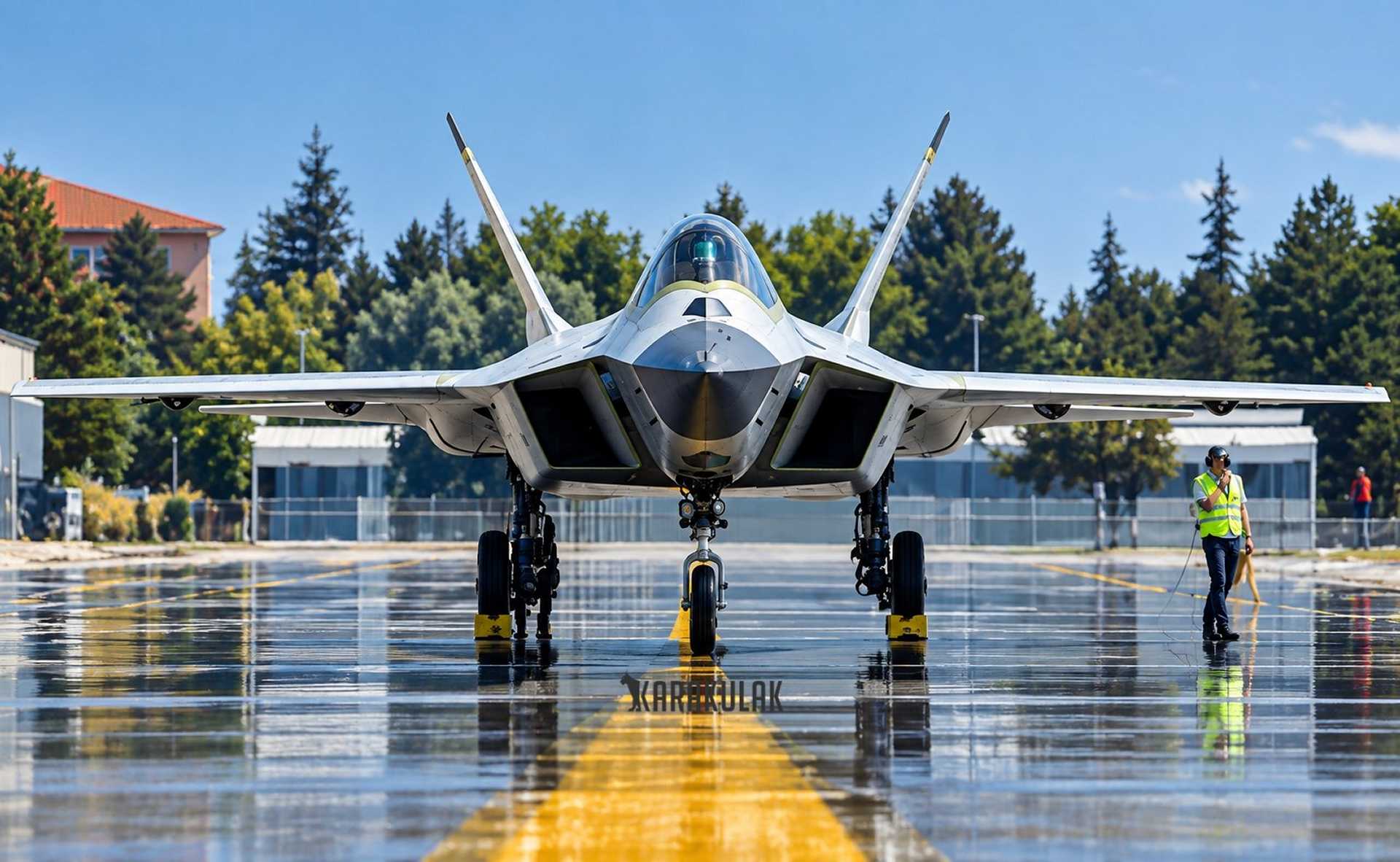
Turkey’s KAAN fifth-generation fighter is being developed as a twin-engine, low-observable combat aircraft with internal weapons bays, advanced sensors, and nationally controlled mission systems. The aircraft remains in development, with new prototypes moving through ground and flight-test phases. (Picture source X account)
The F-35A provides the clearest operational benchmark. The U.S.-built fighter uses a single Pratt & Whitney F135 engine producing about 40,000 pounds of maximum thrust and has a published top speed of Mach 1.6, with a combat radius greater than 590 nautical miles, or approximately 1,093 kilometers, on internal fuel.
On paper, KAAN’s projected Mach 1.8 top speed therefore exceeds the F-35A’s Mach 1.6 figure. That difference should not be interpreted as evidence of overall superiority, because maximum speed represents only one part of modern fighter effectiveness. Low observability, sensor performance, electronic warfare, information fusion, secure communications and the ability to detect and engage an opponent before being detected are generally more decisive in fifth-generation air combat.
This is where the F-35 currently holds its most important advantage. Its radar, distributed electro-optical sensors, electronic warfare suite and communications systems already feed a fused tactical picture to the pilot, allowing the aircraft to function simultaneously as a shooter, sensor and information node. The F-35 can also distribute targeting and surveillance information across other aircraft, ships and ground forces, multiplying its value beyond its own weapons load.
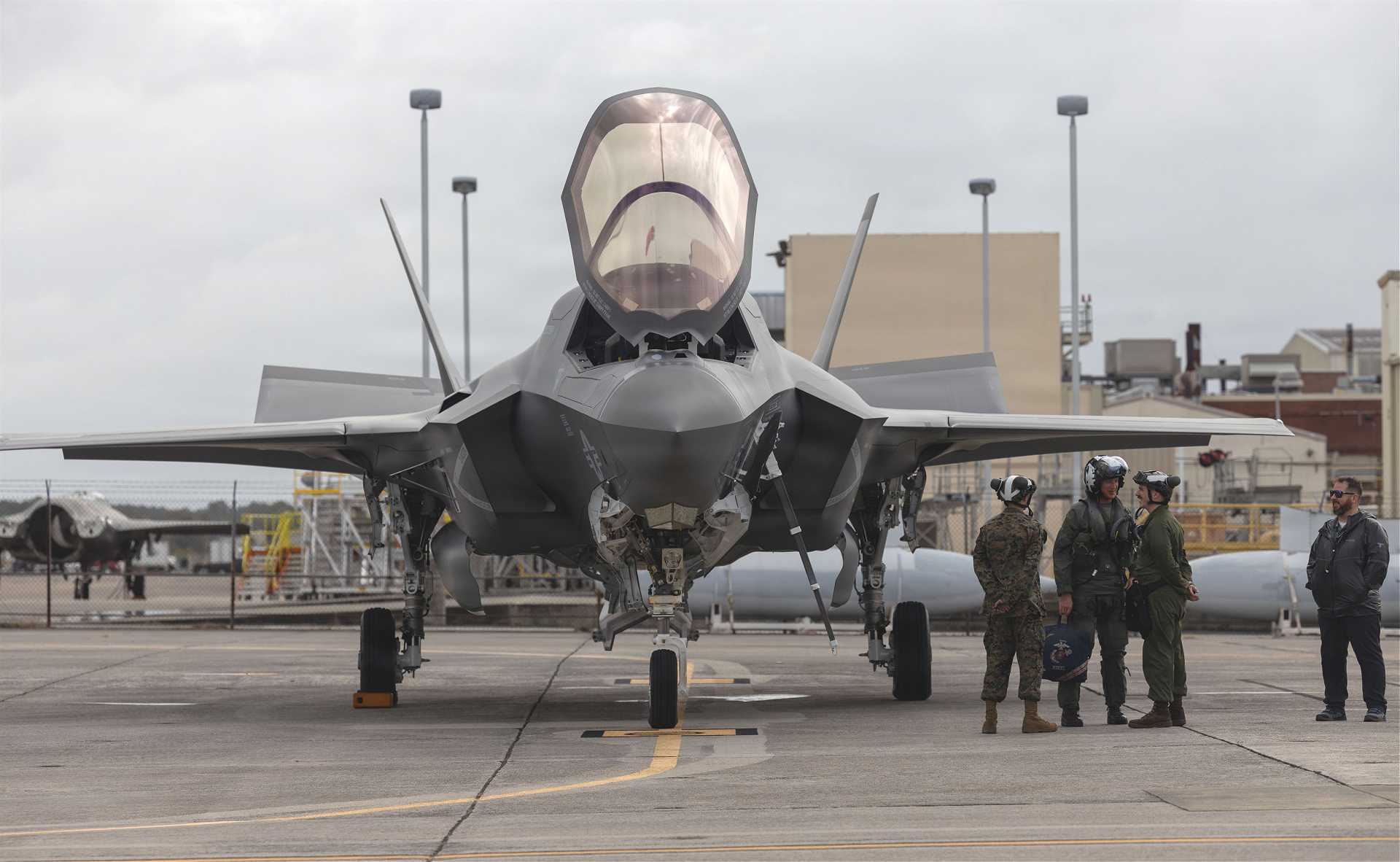
The U.S. F-35A Lightning II is an operational fifth-generation stealth fighter combining low observability, sensor fusion, advanced electronic warfare, and networked combat capabilities. It remains the most widely fielded stealth fighter in service today. (Picture source: U.S. Department of War/Defense)
Turkish KAAN fighter jet is being developed around broadly similar principles, including integrated radio-frequency sensors, electro-optical systems, electronic warfare, secure communications, and sensor fusion. Turkish Aerospace also emphasizes situational awareness and interoperability, but these characteristics remain under development and must be validated through flight testing and operational evaluation before direct comparison with the mature F-35 fighter jet.
Internal weapons carriage is particularly important to KAAN’s intended role. Carrying missiles and bombs inside the fuselage helps preserve a reduced radar signature, whereas external pylons and weapons increase radar reflections and make a fighter easier to detect.
The Turkish SOM-J stand-off missile is relevant to this requirement, although it should not yet be described as an established operational KAAN weapon. Roketsan designed SOM-J as a reduced-observable air-to-surface missile suitable for internal or external carriage, weighing about 540 kilograms, with a 140-kilogram warhead, imaging-infrared terminal guidance, and a published range of up to 275 kilometers.
SOM-J also creates an important technological link between KAAN and the F-35. Lockheed Martin originally developed the missile for internal carriage on the F-35, so its dimensions and reduced-observable characteristics are relevant to Turkey’s effort to establish an indigenous stealth-strike ecosystem. Any future internal integration on KAAN would allow the fighter to approach contested areas while maintaining a lower radar signature before releasing a stand-off weapon, but such integration should be treated as a planned or relevant capability rather than one already demonstrated in service.
The propulsion contrast also reflects different design approaches. KAAN’s twin-engine layout provides greater total installed thrust and redundancy and may offer additional growth capacity for future power, cooling, and electronic requirements. The F-35A instead achieves its performance with one high-thrust F135 engine and benefits from a mature propulsion, maintenance, and logistics infrastructure developed through years of multinational operations.
KAAN’s current flight-test history illustrates this maturity gap. The original prototype made its maiden flight on February 21, 2024, remaining airborne for 13 minutes while reaching about 8,000 feet and 230 knots. A second flight followed on May 6, reaching 10,000 feet during a 14-minute sortie. These were early envelope-expansion flights rather than demonstrations of the fighter’s projected Mach 1.8 performance or complete combat configuration.
The P1 and P2 aircraft are therefore particularly important because they move the program beyond the initial technology demonstrator toward prototypes with more representative systems. Turkish Aerospace’s 2026 ground-test campaign and preparations to fly P1, followed by continued assembly and testing of P2, indicate that the program is entering a phase where avionics, systems integration and flight performance can be evaluated more extensively.
For Turkey, this technical progression is closely tied to strategic autonomy. National control over radar, electro-optical sensors, electronic warfare equipment, mission computers, software and weapons interfaces would allow Ankara to determine future upgrades and integrate Turkish-developed weapons without relying entirely on a foreign prime contractor or external authorization.
That flexibility could eventually become one of KAAN’s most important operational advantages for the Turkish Air Force. Rather than measuring the program solely against the F-35 in speed or individual specifications, its value will depend on Turkey’s ability to continuously integrate new air-to-air missiles, stand-off weapons, sensors and electronic warfare functions throughout the aircraft’s service life.
The F-35 nevertheless remains the more mature and operationally proven reference point. Its stealth characteristics, sensor fusion, networking, electronic warfare and multinational sustainment system are already functioning at fleet scale, whereas KAAN still has to demonstrate comparable integration, reliability and survivability through testing and eventual operational service.
The Turkish KAAN’s importance therefore lies less in whether Mach 1.8 is faster than the F-35’s Mach 1.6 and more in whether Turkey can combine low observability, advanced sensing, electronic warfare, data fusion and indigenous weapons into a coherent combat system. If the P1 and P2 flight campaigns validate those objectives, KAAN could give the Turkish Air Force something substantially more consequential than another F-16 replacement: a nationally controlled fifth-generation fighter built around Turkey’s own sensors, weapons and future combat-air requirements.
Explore More Defense News
• Land Defense News
• Naval Defense News
• Defense Aerospace News
Written by Alain Servaes – Chief Editor, Army Recognition Group
Alain Servaes is a former infantry non-commissioned officer and the founder of Army Recognition. With over 20 years in defense journalism, he provides expert analysis on military equipment, NATO operations, and the global defense industry.
-
U.S. Air Force Expands F-15EX Eagle II Fleet to 149 Fighter Jets With Production Through 2031
{loadposition bannertop}{loadposition sidebarpub}
The U.S. Air Force is moving to expand its F-15EX Eagle II fleet well beyond earlier plans, with the 2026 defense budget outlining 149 aircraft through 2031 and keeping production active into FY2031. The larger buy would give the service more long-range firepower and weapons capacity while preserving stealth aircraft for missions where survivability is critical.
The F-15EX combines heavy payload, extended range, modern sensors, and advanced electronic warfare systems to support air defense, long-range strike, and high-volume missile employment. Its expanding role highlights a broader push to build combat mass alongside F-35A and future F-47 fleets without relying on the most advanced aircraft for every mission.
Related Topic: U.S. F-15EX and MQ-28 Ghost Bat Teaming Marks New Era in Indo-Pacific Manned-Unmanned Air CombatU.S. Air Force F-15EX Eagle II fighter: the service now plans to procure 149 aircraft through 2031, expanding the non-stealth fighter’s role as a high-payload, long-range missile carrier alongside the F-35 and future F-47. (Picture source: U.S. Department of War/Defense)
According to the International Fighter Aircraft Global Market Report 2026-2031 published by Defence iQ, the FY2027 U.S. Air Force budget request includes 24F-15EX aircraft valued at $2.66 billion, while procurement is now programmed through FY2031 and the 2026 defense budget points to 149 aircraft between 2026 and 2031. The scale suggests that the Eagle II is moving from a relatively limited F-15C/D replacement effort toward a more substantial element of the future U.S. tactical aviation force.
The F-15EX acquisition originated as a rapid solution to the structural aging and declining readiness of the F-15C/D fleet. In July 2020, the U.S. Department of Defense awarded Boeing a $22.89 billion indefinite-delivery/indefinite-quantity contract covering F-15EX design, integration, manufacturing, testing, aircraft delivery, sustainment, modifications, spares, training and technical support, with an initial delivery order capped at approximately $1.19 billion.
That contract gave Boeing’s St. Louis fighter production operation a long-term framework under which successive F-15EX lots could be ordered rather than requiring a completely new contracting structure for each batch. The original Air Force plan centered on replacing F-15C/D fighters, but the program has repeatedly changed in size as Washington reassessed fighter capacity, F-35 delivery schedules and the number of combat aircraft required for future high-intensity operations.
The F-15EX program began in 2019, when the U..S. Air Force approved a rapid-fielding requirement to address the deteriorating F-15C/D fleet. The first aircraft was accepted in March 2021, demonstrating one of the programme’s principal industrial advantages: because the Eagle II builds on an already mature F-15 production and support base, the Air Force could introduce a new fighter substantially faster than would be possible with an entirely new aircraft design.
The latest budget profile shows that the acquisition is no longer being treated as a short bridge program. Procurement is now scheduled through FY2031, while the FY2027 request for 24 aircraft represents one of the programme’s most substantial annual buys, and the report also identifies $16.9 million for post-production support as the operational fleet and its sustainment requirements expand.
The F-15EX Eagle II is the newest U.S. version of Boeing’s long-running F-15 fighter family, but it is substantially modernized compared with the F-15C/D aircraft it is intended to replace. It is a two-seat, twin-engine 4.5-generation fighter built around high payload, long range and rapid fielding, retaining the Eagle’s aerodynamic performance while incorporating digital flight controls, modern avionics, electronic warfare equipment and an open mission-systems architecture.
Two General Electric F110-GE-129 turbofan engines power the aircraft, and it integrates the Eagle Passive Active Warning and Survivability System, or EPAWSS, along with updated F-15 Operational Flight Program software. These improvements are designed to keep the fighter relevant in a battlespace dominated by increasingly capable radars, electronic attack, long-range missiles and rapidly changing software-defined threats.
Its most important distinction from the F-35 is weapons capacity. Boeing states that the F-15EX has a maximum payload capacity of about 29,500 pounds, or 13,300 kilograms, and can carry up to 12 AIM-120 AMRAAM air-to-air missiles, giving a single Eagle II a considerably deeper missile magazine than a stealth fighter operating with weapons confined to internal bays.
That figure helps explain why the Air Force can rationally buy more non-stealth F-15EX fighters while simultaneously investing heavily in the F-35 and F-47. The three aircraft solve different parts of the same combat problem: the F-35 prioritizes low observability, sensor fusion and penetration; the F-47 is being developed for future air dominance with even greater survivability, reach and crewed-uncrewed integration; the F-15EX prioritizes missile volume, external payload, speed, range and rapid generation of combat sorties.
In practical terms, an F-35 penetrating closer to hostile air defenses can use its sensors and low observability to develop targeting-quality information while an F-15EX operating farther from the highest-threat area provides additional weapons. That creates a division of labor in which one fighter maximizes survivability and sensing while the other supplies the magazine depth needed to turn targeting information into more engagements.
The F-47 will push this logic further rather than make the F-15EX automatically irrelevant. Boeing received the F-47 engineering and manufacturing development contract in March 2025, and the report identifies approximately $3.5 billion for the program in FY2026, with research and development funding expected to exceed $5 billion in FY2027. The sixth-generation fighter centers on survivability, range, sensing, networking, and crewed-uncrewed teaming, positioning it for the most demanding air-dominance missions.
The Eagle II therefore occupies a different place in the force structure. It does not need to penetrate every advanced Chinese or Russian surface-to-air missile engagement zone to be useful; it can contribute from outside those zones by carrying large numbers of air-to-air weapons, long-range strike weapons or future oversized munitions that are difficult to accommodate internally on smaller stealth fighters.
This distinction matters because stealth is operationally decisive in the most heavily defended parts of a battlespace, but it is not required for every sortie. F-35s and, eventually, F-47s can focus on missions where penetration, advanced sensing, and survivability against modern integrated air defenses are essential, while F-15EX aircraft can carry larger external weapon loads from less exposed positions or operate where the threat environment does not justify committing scarce stealth aircraft.
The Indo-Pacific gives that force structure particular relevance. Former U.S. Air Force Chief of Staff Gen. David Goldfein has previously pointed to the Pacific’s long distances and the combination of F-15 range and payload as reasons the Eagle II became more attractive when the service examined different fighter mixes for a major regional conflict.
China presents exactly the type of operational problem that makes missile capacity and range increasingly important. U.S. combat aircraft could have to operate across enormous distances while confronting Chinese fighters, long-range air-to-air missiles, integrated air defenses and attacks against forward air bases, creating pressure to maximize the number of weapons carried by every fighter reaching the combat area.
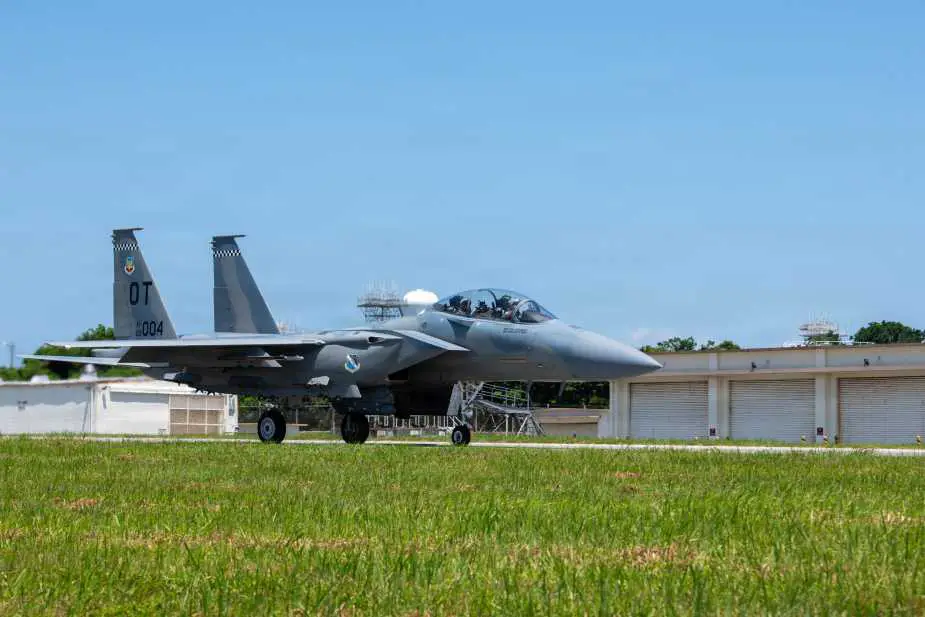
A U.S. Air Force F-15EX Eagle II assigned to the 85th Test and Evaluation Squadron taxis at Kadena Air Base, Japan, on July 8, 2026. The deployment highlights the fighter’s growing Indo-Pacific role as the U.S. Air Force expands the F-15EX fleet, combining long range, advanced electronic warfare systems and increased missile capacity to complement F-35 and future F-47 operations. (Picture source: U.S. Department of War/Defense)
The F-15EX is already being connected directly to that Indo-Pacific posture. In June 2026, F-15EX aircraft deployed again to Kadena Air Base in Japan for testing and familiarisation, with the U.S. Air Force saying the work would support the Eagle II’s eventual integration into Kadena’s long-term mission and strengthen combat readiness across the Indo-Pacific.
That makes the fighter’s large missile magazine strategically relevant, not just a specification-sheet advantage. In a Pacific air battle, F-35s could operate forward as survivable sensors and shooters, while F-15EX fighters farther back contribute additional AMRAAMs or long-range effects, increasing the number of engagements a formation can sustain before aircraft must return to base to rearm.
This creates the basis for a weapons-carrier role in which a stealth fighter detects, identifies, or helps generate targeting data while an F-15EX contributes additional missiles or stand-off weapons from farther outside the highest-risk area. Boeing is also positioning the aircraft for long-range kill chains and networked operations with other crewed and uncrewed aircraft, reinforcing the Eagle II’s potential value as both a shooter and a communications node.
The same logic applies to homeland air defense, one of the missions explicitly identified for the Eagle II. Replacing aging F-15C/D fighters with F-15EX aircraft gives the U.S. Air Force a modern fighter that can maintain alert missions, intercept aircraft, and defend U.S. airspace without consuming flight hours from F-35 units whose low-observable characteristics are more valuable in contested expeditionary operations.
Operationally, this division of labor reduces the need to treat every fighter sortie as a stealth mission. Routine air defense, homeland alert, permissive-environment strike, cruise-missile defense and other missions can be assigned to an aircraft with high speed and a deep weapons magazine, reserving finite F-35 availability for missions where penetrating survivability provides a decisive advantage.
This division of labor could become increasingly important as the U.S. Air Force introduces Collaborative Combat Aircraft. The report says CCA procurement enters a dedicated aircraft acquisition line in FY2027, with $996.5 million requested for procurement, $150.5 million in advance procurement and another $1.37 billion in research and development. More than 150 uncrewed combat aircraft could be acquired before FY2031, creating a force in which F-35s, F-47s, F-15EX fighters and autonomous aircraft contribute different combinations of survivability, sensor reach, weapons capacity and acceptable operational risk.
The report describes this as part of a broader North American market shift in which fifth-generation recapitalization, sixth-generation development, uncrewed combat aircraft and renewed investment in selected fourth- and 4.5-generation fighters are proceeding simultaneously. The F-35 remains the largest acquisition effort, but the F-15EX has expanded beyond earlier planning and is now funded through FY2031 as the F-47 and CCA programs also accelerate.
That mix suggests the U.S. Air Force is increasingly building around complementary mission roles rather than expecting one fighter type to do everything. An F-35 brings penetration and advanced sensing, an F-47 is intended to deliver next-generation air dominance, CCA aircraft add lower-cost uncrewed combat mass, and the F-15EX adds a large weapons magazine and mature fighter capacity that can be fielded without waiting for a new generation of technology.
For the F-15EX, its central advantage is therefore capacity. The aircraft retains the F-15 family’s emphasis on high payload and long range while adding modern mission systems, EPAWSS, and updated operational software, creating a fighter that can carry substantial external weapon loads while operating as part of a wider networked force.
This also explains why a simple F-15EX-versus-F-35 comparison can be misleading. The F-35 is substantially better suited to penetrating dense integrated air defenses because of its low-observable design and sensor fusion, while the F-15EX offers greater external weapons capacity and can carry munitions too large for an F-35 internal weapons bay. The Air Force can gain more combat effect by combining those strengths than by forcing either fighter to replace the other.
The comparison with the F-47 is even more asymmetric. The F-47 is intended to survive and dominate inside future high-threat environments while controlling or cooperating with uncrewed combat aircraft; the F-15EX offers a mature, high-capacity fighter available years earlier and without requiring the U.S. Air Force to use an extremely advanced sixth-generation aircraft for every air-defense patrol or missile-carriage mission.
That helps explain why the F-15EX expansion does not represent a retreat from stealth or sixth-generation technology. Instead, it reflects a force-design problem: highly sophisticated aircraft are expensive, complex and potentially too scarce to provide all the combat mass required during a prolonged high-intensity campaign. A larger Eagle II fleet gives commanders another way to distribute missions according to threat level while preserving more specialised aircraft for operations where their unique characteristics are indispensable.
F-35 delays have also strengthened the argument for additional F-15EX capacity. Air & Space Forces Magazine reported in May 2026 that delays to critical F-35 upgrades contributed to the Air Force reassessing the balance between Eagle II and F-35A procurement, with service officials emphasizing the need for a fighter portfolio offering different weapons capacities and capabilities for a Pacific conflict.
The approach also responds to the industrial and readiness pressures highlighted throughout the Defence iQ report. Recent conflicts have demonstrated the importance of sustaining operations, replacing losses, maintaining munitions inventories and generating combat power over extended periods. A mixed fleet gives the U.S. Air Force more flexibility than a force dependent exclusively on a limited number of highly complex stealth aircraft.
The procurement profile is equally significant for Boeing and the U.S. combat-air industrial base. The original $22.89 billion F-15EX contract framework provides substantial production and sustainment opportunities for Boeing’s St. Louis operation, while the company is simultaneously responsible for developing the F-47, linking current-generation fighter production with the Air Force’s next major air-dominance program.
That industrial continuity has its own strategic value. Keeping F-15 manufacturing, engineering, suppliers and skilled labor active gives the United States additional fighter-production capacity at a time when Washington is increasingly concerned about its ability to replace combat losses and sustain aircraft output during a prolonged conflict.
The wider spending picture reinforces the point. The report forecasts approximately $19.4 billion in North American fourth- and 4.5-generation fighter spending between 2026 and 2031, even as fifth-generation expenditure reaches about $77.3 billion, sixth-generation programs approach $27.9 billion and loyal-wingman procurement totals roughly $15.7 billion. The categories are growing alongside one another rather than following a simple generational replacement cycle.
For the U.S. Air Force, the emerging structure is increasingly clear: stealth aircraft provide penetration and advanced sensing, CCAs add affordable combat mass and risk-tolerant capacity, and the F-15EX supplies payload, range and sortie-generating potential for missions that do not demand the same degree of low observability.
If the report’s projection of 149 F-15EX aircraft procured between 2026 and 2031 is sustained, the Eagle II will no longer look like a small bridging purchase intended only to replace worn-out F-15Cs. It will instead become a substantial part of a deliberately tiered U.S. combat-air force, giving commanders a fighter capable of carrying as many as 12 AMRAAMs while F-35s penetrate, CCAs add mass and the future F-47 tackles the most demanding air-dominance missions.
That combination could prove particularly valuable against China, where distance, missile expenditure, dispersed basing and the need to preserve scarce stealth aircraft could make magazine depth almost as important as individual aircraft sophistication. The surprise expansion of the F-15EX therefore says less about the U.S. Air Force turning back toward an older generation of fighter technology than about how it expects to fight: with stealth, autonomous aircraft and sixth-generation systems opening the battlespace, and heavily armed Eagle IIs adding the volume of fire needed to exploit it.
Explore More Defense News
• Land Defense News
• Naval Defense News
• Defense Aerospace News
Written by Alain Servaes – Chief Editor, Army Recognition Group
Alain Servaes is a former infantry non-commissioned officer and the founder of Army Recognition. With over 20 years in defense journalism, he provides expert analysis on military equipment, NATO operations, and the global defense industry.
-
UAE Mirage 2000-9 Fighter Jet Used in Iran Oil Strikes Gets New EDGE Thunder Guided Bomb Kit
{loadposition bannertop}{loadposition sidebarpub}
The United Arab Emirates' EDGE Group has revealed that the UAE Air Force's French-made Mirage 2000-9 multirole fighter aircraft are now equipped with the Thunder precision-guided bomb conversion kit, according to images published on the company's official X account on July 29, 2026. The new smart weapon provides the aircraft with a cost-effective precision-strike capability by converting conventional Mk 81 and Mk 82 general-purpose bombs into guided munitions using satellite navigation, inertial navigation, and optional laser guidance, significantly expanding the number of affordable precision-guided bombs available for sustained air operations.
The development is particularly significant because the Mirage 2000-9 was reportedly involved in UAE air strikes against Iranian oil facilities on Lavan Island in May 2026, conducted in retaliation for Iranian attacks on Emirati territory, underscoring the operational value of equipping the fighter with an indigenous JDAM-equivalent smart weapon.
Related Topic: UAE Expands Defense Industry with Resource Industries Developing Military Vehicles and DronesA UAE Air Force Mirage 2000-9 multirole fighter aircraft armed with HALCON's Thunder precision-guided bomb conversion kit. The EDGE Group-developed smart weapon transforms standard Mk 81 and Mk 82 bombs into low-cost precision-guided munitions, significantly enhancing the aircraft's strike capability for sustained combat operations. (Picture source: EDGE Group/X)
The images released by EDGE Group provide the first public evidence that the HALCON Thunder guidance kit has been integrated onto the Mirage 2000-9. Although neither the UAE Ministry of Defence nor EDGE issued detailed information on the integration, the appearance of operationally configured aircraft carrying the weapon strongly indicates that qualification and certification activities have advanced sufficiently for operational service. The integration strengthens the UAE Air Force's ability to conduct precision air-to-ground missions using domestically produced smart weapons while reducing reliance on more expensive imported precision-guided munitions.
Developed by HALCON, an EDGE Group company specializing in precision-guided weapons, the Thunder family is a modular guidance kit designed to convert conventional free-fall bombs into precision-guided bombs. The system is compatible with the Mk 82 (500-pound) and Mk 81 (250-pound) general-purpose bombs, designated respectively as the P-32 and P-31, allowing existing bomb inventories to be transformed into accurate guided munitions without requiring entirely new weapon production.
Thunder employs a Guidance Augmented Inertial Navigation System (GAINS) that combines an inertial navigation system with Global Navigation Satellite System (GNSS) updates, providing accurate, all-weather navigation toward fixed targets. For missions demanding greater terminal accuracy, the kit can also be fitted with a semi-active laser (SAL) seeker, enabling engagement of laser-designated objectives, including moving targets. This dual-guidance architecture offers commanders greater flexibility across a wide range of operational scenarios, from pre-planned strikes against strategic infrastructure to dynamic battlefield engagements supporting ground forces.
Conceptually, Thunder occupies the same operational niche as the U.S. Joint Direct Attack Munition (JDAM), which transformed conventional bombs into GPS-guided precision weapons and revolutionized modern air warfare by dramatically lowering the cost of precision strike. China's FT (Fei Teng) and LS (Lei Shi) precision guidance kits, as well as Russia's emerging satellite-guided bomb conversion efforts, reflect the same global trend toward affordable smart weapons that maximize existing bomb inventories. Although Thunder is optimized for shorter-range employment, it follows the same philosophy by delivering precision effects at a fraction of the cost of dedicated stand-off missiles, making it an attractive solution for sustained combat operations and export customers seeking a cost-effective precision-strike capability.
The Mirage 2000-9 remains one of the most advanced versions of Dassault Aviation's Mirage 2000 family. Developed exclusively for the United Arab Emirates, the fighter incorporates the Thales RDY-2 multimode radar, advanced mission computers, upgraded electronic warfare systems, modern cockpit displays, and compatibility with a broad range of precision-guided weapons. It continues to serve as one of the principal combat aircraft of the UAE Air Force despite the ongoing introduction of the Rafale F4, providing a highly capable multirole fighter force for regional contingency operations.
The aircraft has traditionally employed advanced French weapons, including the SCALP-EG/Black Shaheen long-range cruise missile, AASM Hammer precision-guided bombs, and MICA air-to-air missiles. The integration of Thunder adds a complementary capability optimized for missions where lower-cost precision effects are sufficient. This enables commanders to reserve more expensive long-range stand-off weapons for heavily defended strategic targets while using Thunder-guided bombs for routine precision strikes against tactical objectives, thereby improving both operational endurance and munitions management.
The public appearance of Thunder-equipped Mirage 2000-9 fighters also demonstrates the growing maturity of the UAE's domestic defense industry. Successfully integrating an Emirati-developed smart weapon onto a sophisticated Western fighter requires extensive work in avionics integration, software validation, flight testing, weapons separation analysis, and operational certification. The achievement illustrates EDGE Group's increasing capability not only to develop advanced precision-guided bombs but also to integrate them with frontline combat aircraft, reinforcing the UAE's ambition to become a global supplier of advanced defense technologies.
Operationally, Thunder expands the Mirage 2000-9's effectiveness against a broad range of military objectives, including command centers, logistics facilities, radar sites, fuel depots, armored formations, air defense positions, and critical infrastructure. The optional semi-active laser guidance further enhances performance during close air support and time-sensitive targeting missions by allowing precise engagement of laser-designated objectives with minimal collateral damage. For a regional air force that may need to sustain high sortie rates during extended operations, the ability to field large numbers of affordable precision-guided bombs represents a significant combat multiplier.
The timing of the public disclosure is also noteworthy. Following reports that UAE Mirage 2000-9 fighters participated in retaliatory strikes against Iranian energy infrastructure in May 2026, the appearance of Thunder-equipped aircraft suggests the UAE continues to expand its precision-strike toolkit in response to an increasingly volatile regional security environment. Rather than relying exclusively on expensive imported stand-off weapons, the UAE Air Force is building a layered arsenal that combines cruise missiles, advanced precision bombs, and domestically developed smart weapons, improving both operational resilience and strategic autonomy.
Beyond its significance for the UAE, Thunder reflects a broader transformation in the global precision-guided munitions market. Recent conflicts have demonstrated that air forces require not only highly sophisticated long-range weapons but also large inventories of affordable precision-guided bombs capable of sustaining high-intensity operations over extended periods. By developing a JDAM-equivalent system integrated onto one of its frontline fighter aircraft, the UAE is positioning EDGE Group and HALCON to compete in a growing international market that is increasingly focused on cost-effective smart weapons that deliver precision without the expense of dedicated cruise missiles.
Explore More Defense News
• Land Defense News
• Naval Defense News
• Defense Aerospace News
Written by Alain Servaes – Chief Editor, Army Recognition Group
Alain Servaes is a former infantry non-commissioned officer and the founder of Army Recognition. With over 20 years in defense journalism, he provides expert analysis on military equipment, NATO operations, and the global defense industry.
-
Collaborative Combat Aircraft (CCA): The Future of Human-Machine Teaming in Air Combat
{loadposition bannertop}{loadposition sidebarpub}
The Farnborough International Airshow (FIA) 2026 confirmed that Collaborative Combat Aircraft (CCA) have become one of the most important developments shaping the future of military aviation. Across the exhibition, defense manufacturers, armed forces and technology companies presented autonomous aircraft, artificial intelligence (AI)-enabled mission systems and advanced human-machine teaming concepts that are rapidly transitioning from technology demonstrators to operational capabilities. While sixth-generation fighter aircraft continue to attract considerable attention, Farnborough demonstrated that future air superiority will increasingly depend on how effectively crewed aircraft operate alongside autonomous combat systems.
This evolution reflects a fundamental shift in air warfare. For decades, air forces sought to maintain superiority by developing increasingly capable fighter aircraft equipped with advanced sensors, stealth technology and precision-guided weapons. Today, operational advantage is moving beyond the performance of individual aircraft towards the effectiveness of interconnected combat formations in which crewed fighters, autonomous aircraft, airborne sensors and digital command-and-control networks function as an integrated force. Collaborative Combat Aircraft are emerging as one of the principal enablers of this transformation.
Related Topic: Aviation Defense Industry TechnologyBAE Systems unveils its Collaborative Combat Aircraft concept during the Farnborough International Airshow 2026, highlighting the growing role of autonomous human-machine teaming in future air combat operations. (Picture source: X account Defence 360°)
Although many of the concepts displayed at Farnborough remain under development, they demonstrate a clear global trend. The United States, Australia, Europe, Japan, China, Russia, Türkiye, India and other nations are investing heavily in autonomous combat aircraft that will accompany both current fifth-generation fighters and future sixth-generation combat aircraft. Rather than replacing human pilots, these systems are intended to expand combat capability, increase survivability and provide the affordable combat mass required for high-intensity operations.
This article explains what Collaborative Combat Aircraft are, how they differ from other categories of uncrewed military aircraft, the technologies that enable them, the missions they are expected to perform, the major international programs currently under development and why they are widely regarded as one of the defining capabilities of next-generation air combat.
What is a Collaborative Combat Aircraft?
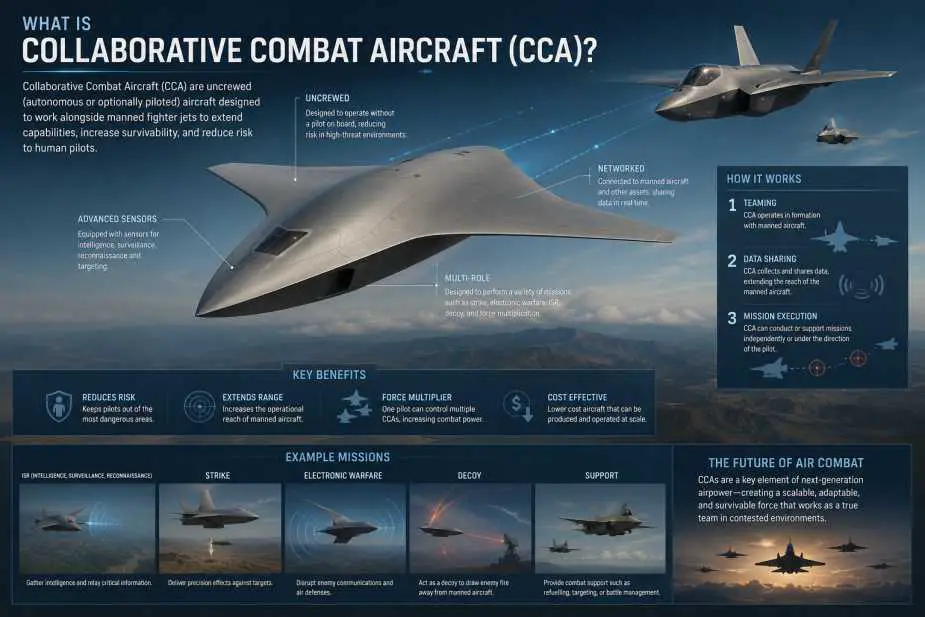
A Collaborative Combat Aircraft (CCA) is an unmanned combat aircraft designed to operate as an integral member of a crewed-uncrewed combat formation. Unlike traditional remotely piloted aircraft, a CCA is intended to execute assigned missions with varying degrees of onboard autonomy while remaining under human command for mission objectives and the employment of lethal force. Once tasked, the aircraft can independently navigate, manage sensors, react to changing battlefield conditions, and cooperate with other aircraft across a secure combat network.
The defining characteristic of a Collaborative Combat Aircraft is not simply that it flies without a pilot on board, but that it functions as an intelligent teammate rather than a remotely controlled asset. By continuously exchanging information with crewed fighters, airborne early warning aircraft, satellites and command-and-control systems, a CCA extends the combat effectiveness of the entire force. It can increase situational awareness, expand weapons capacity, support electronic warfare operations and perform high-risk missions that would otherwise expose valuable crewed aircraft to enemy air defenses.
Instead of representing a single aircraft type, Collaborative Combat Aircraft constitute a new operational concept. Future fleets may include multiple CCA designs optimized for air superiority, intelligence, surveillance and reconnaissance (ISR), electronic warfare, strike operations or communications support, all working together with crewed aircraft as part of a distributed combat architecture.
Key Characteristics of Collaborative Combat Aircraft:
- Operate alongside crewed fighter aircraft and other combat assets.
- Execute missions with varying degrees of onboard autonomy.
- Remain under human command for mission objectives and the employment of lethal force.
- Exchange real-time information across secure, networked combat architectures.
- Carry modular payloads for air-to-air combat, strike, ISR or electronic warfare missions.
- Increase combat mass while reducing risk to pilots and high-value crewed aircraft.
FQ-42A CCA is an uncrewed fighter jet developed for semi-autonomous air-to-air operation.
How Collaborative Combat Aircraft Differ from Other Uncrewed Military Aircraft
Although the terms UAV, UCAV, Loyal Wingman, and Collaborative Combat Aircraft are often used interchangeably, they describe different categories of uncrewed military aircraft with distinct operational concepts and levels of autonomy.
Aircraft Category Human Control Typical Mission Level Autonomy Unmanned Aerial Vehicle (UAV) Remote pilot Intelligence, surveillance, reconnaissance, communications support Low Unmanned Combat Aerial Vehicle (UCAV) Remote pilot with limited autonomous functions Precision strike and combat missions Low to Medium Loyal Wingman Human-supervised autonomous operation Escort and direct support of crewed fighter aircraft Medium Collaborative Combat Aircraft (CCA) Human command with autonomous mission execution Multi-role combat teammate integrated into a networked air combat force High The Loyal Wingman concept represented an important milestone in the evolution of autonomous military aviation by demonstrating that uncrewed aircraft could safely accompany crewed fighters during operational missions. Collaborative Combat Aircraft build upon this foundation by introducing higher levels of autonomy, greater mission flexibility and deeper integration within networked combat formations. Rather than simply following a lead aircraft, CCAs are expected to make tactical decisions within predefined parameters, coordinate with multiple assets simultaneously and contribute actively to mission execution.
Why Air Forces Need Collaborative Combat Aircraft
The rapid development of Collaborative Combat Aircraft is driven by strategic, operational, and economic realities. Modern fighter aircraft have become exceptionally capable but also increasingly expensive to acquire, operate and sustain. Fifth-generation aircraft such as the Lockheed Martin F-35 Lightning II and F-22 Raptor, together with future sixth-generation programs including the U.S. Next Generation Air Dominance (NGAD), Europe's Future Combat Air System (FCAS) and the Global Combat Air Program (GCAP), represent critical national capabilities whose cost inevitably limits fleet size.
At the same time, future conflicts are expected to unfold in highly contested environments characterized by sophisticated integrated air defense systems, long-range precision weapons, advanced electronic warfare capabilities and persistent multi-domain surveillance. Relying exclusively on relatively small fleets of high-value crewed fighters risks reducing operational flexibility while increasing the consequences of combat losses.
Collaborative Combat Aircraft address this challenge by restoring what defense planners increasingly describe as affordable combat mass. Autonomous aircraft can accompany crewed fighters into contested airspace, perform high-risk missions, carry additional sensors or weapons, and absorb attrition without exposing pilots to unnecessary danger. Rather than replacing crewed aircraft, CCAs multiply their effectiveness by distributing combat functions across a larger and more resilient force.
This distributed approach also reflects a broader evolution in military doctrine. Future air operations will rely less on the capabilities of individual aircraft and more on the collective performance of interconnected formations in which sensors, weapons, electronic warfare systems and command-and-control functions are shared across multiple crewed and autonomous assets. The result is a combat force that is more adaptable, more survivable and better suited to the demands of high-intensity warfare.
From Loyal Wingman to Collaborative Combat Aircraft
The concept of Collaborative Combat Aircraft evolved from the "Loyal Wingman" programs launched during the late 2010s, which demonstrated that autonomous aircraft could safely accompany crewed fighters while carrying sensors or additional weapons under close human supervision. These early efforts proved the viability of crewed-uncrewed teaming but remained focused on relatively limited support roles.
Rapid advances in artificial intelligence, autonomous flight control, sensor fusion and resilient communications have since transformed the concept. Today's CCAs are expected not only to escort fighters but also to understand mission objectives, coordinate with multiple aircraft, adapt to changing tactical conditions and continue operating even when communications are disrupted by enemy electronic warfare.
The fighter pilot consequently assumes a new role—not simply as an aircraft operator but as the commander of a distributed formation comprising several autonomous teammates. One CCA may conduct electronic attack while another provides intelligence, surveillance and reconnaissance, and a third carries additional long-range missiles. Together they create a flexible combat package whose effectiveness exceeds that of any individual aircraft operating alone.
This evolution marks a fundamental change in air combat doctrine. The decisive factor in future air superiority will no longer be the performance of a single fighter aircraft but the ability of integrated human-machine teams to sense, decide and act across a highly connected battlespace.
Take an exclusive look at the development of Collaborative Combat Aircraft (CCA) like the XQ-58 Valkyrie, which marked a revolutionary shift in air power. Explore how artificial intelligence and autonomous systems are being integrated into uncrewed, high-performance jets that can fly alongside human-piloted fighters.
Typical Missions of Collaborative Combat Aircraft
The operational flexibility of Collaborative Combat Aircraft is one of the principal reasons they are attracting significant investment from air forces worldwide. Rather than being designed for a single mission, CCAs are intended to perform multiple roles according to the operational environment and payload configuration. Their modular architecture allows commanders to tailor autonomous aircraft for specific tasks while reducing the exposure of crewed fighters to the most contested areas of the battlespace.
In air superiority operations, CCAs can accompany crewed fighters to extend radar and sensor coverage, detect hostile aircraft at greater distances, and carry additional beyond-visual-range air-to-air missiles. This "missile truck" role significantly increases the available firepower of a fighter formation without requiring larger or more expensive crewed aircraft. During intelligence, surveillance and reconnaissance (ISR) missions, autonomous aircraft can penetrate contested airspace ahead of the main force, collecting and transmitting real-time intelligence while reducing the risk to human pilots.
Electronic warfare is expected to become another core mission. Equipped with jamming systems or electronic support measures, CCAs can disrupt enemy radar networks, interfere with communications, and contribute to the suppression or destruction of enemy air defenses. Other configurations may function as decoys, deliberately attracting hostile sensors and missiles to reveal enemy positions or exhaust defensive interceptors before crewed aircraft enter the engagement area.
Future Collaborative Combat Aircraft are also expected to serve as communications relays, extending secure data links between widely dispersed aircraft and command centres while contributing to resilient, network-centric operations. As military forces increasingly adopt multi-domain operational concepts, the ability of CCAs to combine sensing, communications, electronic warfare and strike capabilities within a distributed combat network will make them a key component of future air operations.
Major Collaborative Combat Aircraft Programs
Collaborative Combat Aircraft are being developed through several major national and multinational programs that illustrate the global transition toward autonomous human-machine teaming. The U.S. Air Force's Collaborative Combat Aircraft program is currently the most advanced, with the General Atomics YFQ-42A and Anduril YFQ-44A selected as the first Increment 1 aircraft to operate alongside the F-35 Lightning II, F-22 Raptor, and the future Next Generation Air Dominance (NGAD) family of systems. In Australia, Boeing's MQ-28 Ghost Bat, developed under the Loyal Wingman program, continues to validate autonomous teaming technologies that have influenced CCA developments worldwide. In Europe, the Future Combat Air System (FCAS) incorporates Remote Carriers that will operate alongside the New Generation Fighter within a networked Combat Cloud, while the Global Combat Air Program (GCAP) led by the United Kingdom, Italy and Japan is integrating collaborative autonomous systems as a core element of its future sixth-generation air combat architecture.
Although these programs differ in maturity, design philosophy and operational concepts, they all pursue the same objective: combining crewed fighters with increasingly autonomous aircraft to create more resilient, more lethal and more adaptable combat formations. As additional programs emerge and existing systems transition from development to operational service, Collaborative Combat Aircraft are expected to become a defining capability of next-generation air forces. This guide serves as Army Recognition's evergreen reference on the CCA concept and will be updated as new technologies, programs, and operational milestones continue to shape the future of human-machine teaming in air combat.
Explore More Defense News
• Land Defense News
• Naval Defense News
• Defense Aerospace News
Written by Alain Servaes – Chief Editor, Army Recognition Group
Alain Servaes is a former infantry non-commissioned officer and the founder of Army Recognition. With over 20 years in defense journalism, he provides expert analysis on military equipment, NATO operations, and the global defense industry.
-
Boeing MQ-28 Ghost Bat Stealth Combat Drone Passes Key Radar Tests for Fighter Teaming
 {loadposition bannertop}{loadposition sidebarpub}
Boeing’s MQ-28 collaborative combat aircraft has successfully validated its stealth performance through radar cross-section testing, reinforcing its potential value as a force multiplier for fifth-generation platforms such as the F-35 and future U.S. Air Force air combat operations. Announced by Boeing Defense on June 1, 2026, the results confirm a reduced radar signature that enhances survivability in contested airspace and supports the growing role of autonomous aircraft in penetrating advanced enemy air defense networks.
The testing demonstrates that the MQ-28 can combine low observability with autonomous mission capabilities, enabling it to conduct sensing, escort, and strike-support missions alongside crewed fighters while reducing pilot risk. As the U.S. Air Force advances its Collaborative Combat Aircraft (CCA) strategy, stealth-enabled systems like the MQ-28 highlight the shift toward human-machine teaming designed to extend combat reach, increase operational mass, and strengthen air superiority in future conflicts.
Related Topic: U.S. MQ-28A Ghost Bat Stealth Drone Tests Syracuse Electronic Warfare System in Live FireThe Boeing MQ-28 Ghost Bat is an AI-powered stealth drone designed to fly alongside F-35 fighters and future combat aircraft, providing reconnaissance, electronic warfare, and force-multiplying capabilities in contested airspace. (Picture source: Boeing Defense)
Radar cross-section testing measures how much radar energy an aircraft reflects and helps determine the range at which hostile radar systems can detect, identify, and engage it. For a collaborative combat aircraft expected to operate deep inside contested battlespaces, low observability is a decisive capability. Reduced radar detection enables autonomous aircraft to approach defended areas more closely, remain on station longer, and support crewed aircraft without exposing pilots to unnecessary risk.
The successful validation represents another significant milestone for the MQ-28 program, one of the most mature loyal-wingman and collaborative-combat aircraft initiatives currently in development. Developed by Boeing Defense Australia under the Airpower Teaming System program in partnership with the Royal Australian Air Force (RAAF), the MQ-28 was designed to operate alongside crewed fighters while extending their sensing, electronic warfare, and combat capabilities. The program marked the first military combat aircraft designed and manufactured in Australia in more than five decades and has attracted growing international attention as air forces seek autonomous force multipliers for future conflicts.
Since its first flight in 2021, the MQ-28 has progressed through an extensive testing campaign that has demonstrated autonomous flight operations, mission-system integration, teaming functions, and sensor capabilities. Boeing has steadily expanded the aircraft's operational envelope, transforming it from a technology demonstrator into an increasingly mature combat capability aligned with emerging concepts of manned-unmanned teaming.
Explore Boeing's MQ-28 Ghost Bat, the AI-powered stealth drone designed to fly alongside F-35 fighters as a loyal wingman. Learn how this Collaborative Combat Aircraft (CCA) combines autonomy, stealth technology, and advanced sensors to support future air superiority missions against modern threats from China and Russia.
The MQ-28 is a jet-powered autonomous combat aircraft measuring approximately 11.7 meters in length and featuring a combat radius suitable for long-range operations alongside modern fighter aircraft. Powered by a single turbofan engine and designed with a modular architecture, the aircraft can rapidly adapt to different missions through interchangeable payload sections. Its modular nose allows integration of intelligence, surveillance, and reconnaissance sensors, electronic warfare equipment, communications relay systems, and future mission-specific payloads. Advanced onboard autonomy enables the aircraft to perform assigned tasks with limited operator intervention while remaining integrated within a broader combat network.
One of the aircraft's most important characteristics is the combination of artificial intelligence-enabled autonomy and low-observable design. While traditional unmanned aerial vehicles often depend on continuous operator control, the MQ-28 is designed to execute missions independently, respond to dynamic battlefield conditions, and coordinate with crewed aircraft. This allows the aircraft to act as a true combat teammate rather than a remotely controlled asset, significantly reducing pilot workload while expanding operational flexibility.
The significance of the MQ-28 extends far beyond Australia. The aircraft represents one of the clearest examples of how future air warfare is evolving toward collaborative combat ecosystems in which autonomous aircraft operate alongside advanced fighters. For the U.S. Air Force, concepts demonstrated by the MQ-28 closely mirror objectives pursued through the Collaborative Combat Aircraft initiative, which seeks to field large numbers of autonomous aircraft capable of supporting F-35 Lightning II fighters and future NGAD aircraft during high-intensity operations.
Under the CCA concept, autonomous combat aircraft could perform missions that would otherwise place crewed fighters at greater risk. These include forward reconnaissance, electronic attack, suppression of enemy air defenses, communications relay operations, decoy missions, and weapons carriage. By distributing sensors and combat functions across multiple autonomous aircraft, commanders can increase combat mass and operational resilience while preserving high-value crewed assets.
Stealth plays a particularly important role in this concept. Modern integrated air defense systems increasingly combine active electronically scanned array radars, passive detection systems, long-range surface-to-air missiles, and advanced networking technologies, creating highly contested operational environments. Aircraft lacking low-observable characteristics face increasing challenges in penetrating such defenses. The MQ-28's validated stealth performance, therefore, addresses one of the most critical requirements for future collaborative combat aircraft expected to operate near or inside defended airspace.
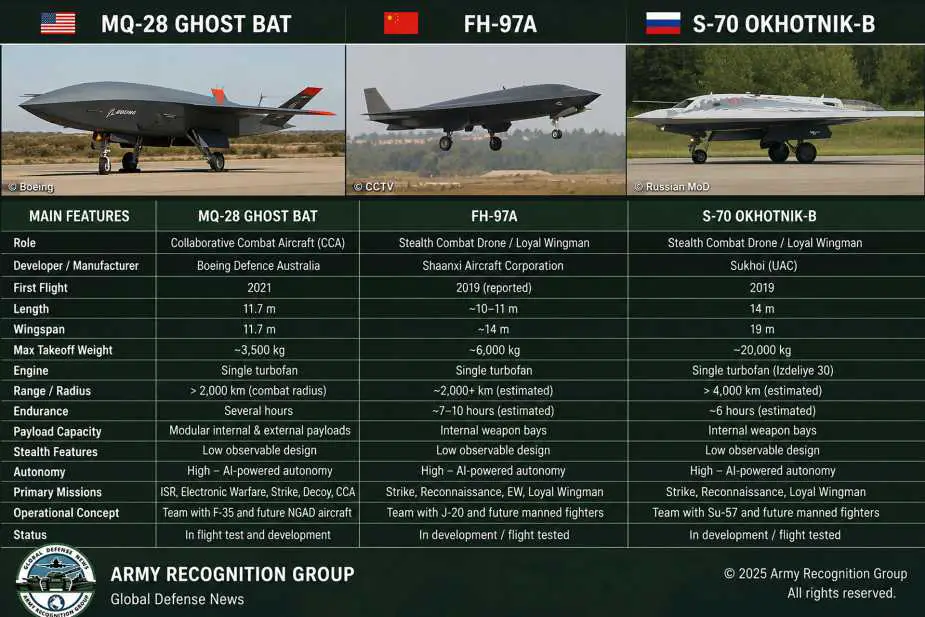
A comparison of the Boeing MQ-28 Ghost Bat, China’s FH-97A, and Russia’s S-70 Okhotnik-B highlights how the United States and allied nations, China, and Russia are accelerating the development of AI-powered stealth combat drones designed to operate alongside crewed fighter aircraft in future air warfare. (Picture source Army Recognition Group)
The strategic relevance of such capabilities is becoming increasingly apparent in the Indo-Pacific region, where China continues to modernize both its air combat forces and integrated air defense networks. Beijing is actively developing autonomous combat aircraft concepts intended to complement advanced fighters such as the J-20 Mighty Dragon. Programs, including the FH-97A Loyal Wingman concept and other unmanned combat aircraft initiatives, demonstrate China's recognition that future air superiority will depend not only on advanced fighters but also on autonomous systems that extend combat reach, sensor coverage, and electronic warfare capabilities.
Russia has pursued a similar approach through the S-70 Okhotnik-B stealth combat drone program. Designed to operate alongside the Su-57 fighter, the Okhotnik combines low-observable shaping with strike and reconnaissance capabilities intended to enhance Russia's future air combat potential. While differing in design philosophy and operational concepts, both Chinese and Russian efforts underscore the growing global competition to field survivable autonomous combat aircraft capable of operating effectively in contested environments.
In this context, the MQ-28's latest testing milestone provides more than a technical validation of radar signature management. It demonstrates that one of the Western world's leading collaborative combat aircraft programs is making tangible progress toward delivering a survivable autonomous capability for future air operations. The aircraft's combination of stealth, autonomy, modular payload architecture, and networked operations aligns closely with the requirements increasingly identified by allied air forces preparing for potential conflicts against technologically advanced adversaries.
From an industrial perspective, the program also highlights Boeing's growing investment in autonomous combat aviation and its efforts to position the MQ-28 within the expanding global market for collaborative combat aircraft. As nations evaluate future force structures that combine crewed and uncrewed systems, proven survivability characteristics are likely to become a major differentiator in acquisition decisions.
The successful radar cross-section validation strengthens the MQ-28's position as one of the most advanced stealth drone programs currently available to allied nations. As military planners prepare for future conflicts characterized by dense sensor networks, long-range missile threats, electronic warfare, and increasingly capable adversary air forces, low-observable, AI-powered combat aircraft are expected to become essential elements of future air-superiority strategies.
For the United States and its allies, the MQ-28's latest achievement offers a glimpse into the future of air warfare. Whether operating as an F-35 wingman, supporting NGAD formations, conducting electronic warfare missions, or extending sensor coverage deep into contested territory, collaborative combat aircraft equipped with stealth and advanced autonomy could fundamentally transform how air power is generated and employed in the decades ahead. The validation of the MQ-28's low-observable performance, therefore, represents not only a milestone for Boeing's program but also a significant indicator of the direction in which future air combat is evolving.
Explore More Defense News
• Land Defense News
• Naval Defense News
• Defense Aerospace News
Written by Alain Servaes – Chief Editor, Army Recognition Group
Alain Servaes is a former infantry non-commissioned officer and the founder of Army Recognition. With over 20 years in defense journalism, he provides expert analysis on military equipment, NATO operations, and the global defense industry.
-
Most Modern 5th Generation Fighter Jets as U.S. China Russia and Allies Compete for Air Dominance
 {loadposition bannertop}{loadposition sidebarpub}
The race for air dominance has become a global competition, driven by fifth-generation fighters designed to operate in heavily contested airspace through stealth, sensor fusion, and networked combat. From the United States and China to Europe and emerging aerospace powers, nations are investing in advanced aircraft and future combat systems to secure control of the skies in high-intensity conflict scenarios. This analysis examines the leading operational fighters and next-generation developments shaping the balance of air power worldwide.
Fighter jets such as the F-35, F-22, J-20, and Su-57 demonstrate how advanced sensors and real-time data sharing enable faster detection and engagement, while emerging programs like NGAD, Tempest, and other international efforts signal a shift toward distributed, multi-domain air warfare. Together, they reflect a transformation in which global air superiority depends not only on aircraft performance but also on the ability to integrate stealth, connectivity, and decision speed across entire combat networks.
Related Topic: U.S. Fifth Gen F-35 Jets Join F-16s for Rapid NORAD Surge in Greenland’s Arctic Defense DrillImages showing the latest fifth-generation fighter aircraft worldwide, illustrating the global race for air dominance driven by stealth, sensors, and networked warfare. (Picture source: Army Recognition, protected illustration, reproduction prohibited without permission.)
The F-35 Lightning II represents the most complete realization of network-centric warfare. Designed as a multirole fighter, it is now the backbone of allied airpower across NATO and partner nations. Since its first flight in 2006 and entry into service in 2015, it has evolved into a system focused less on individual performance and more on controlling the battlespace through data.
Its stealth design enables it to operate in advanced air-defense environments, while its sensor-fusion architecture remains unmatched. The AN/APG-81 radar, Distributed Aperture System, and onboard processing merge inputs into a real-time 360-degree battlefield picture. This allows the F-35 to detect threats, assign targets, and share data across aircraft, ships, and ground units.

U.S. F-35 Lightning II multirole stealth fighter, designed for network-centric warfare with advanced sensor fusion and real-time data sharing across air, land, and naval forces. (Picture source: U.S. Department of War)
In terms of performance, the F-35 reaches speeds around Mach 1.6 with a combat radius of roughly 1,000 kilometers, depending on the variant. It carries AIM-120 AMRAAM and AIM-9X missiles internally, along with precision-guided bombs such as JDAM and SDB. External pylons increase payload but reduce stealth.
In combat, the F-35 acts as a forward sensor and command node. It can guide other fighters or missile systems without exposing them. Its limitation is not capability but complexity, as heavy reliance on software and logistics creates sustainment challenges. Strategically, it gives the United States and its allies a decisive edge in networked warfare.

The US. F-22 Raptor air superiority fighter, combining extreme stealth, supercruise speed, and unmatched maneuverability to dominate high-end aerial combat. (Picture source: U.S. Department of War)
The U.S. F-22 Raptor remains the purest air-dominance fighter ever built. Developed during the Cold War and operational since 2005, it was designed to defeat advanced enemy fighters before they could pose a threat. Even today, it remains unmatched in combining stealth, speed, and maneuverability.
Its ability to supercruise above Mach 1.5 without afterburner allows it to engage quickly while maintaining low detectability. Combined with thrust vectoring, it dominates both long-range and close-range combat. Its AN/APG-77 radar and low-observable design ensure it sees the enemy well before it is detected.
The F-22 carries AIM-120 AMRAAM missiles and AIM-9X Sidewinder missiles internally, supported by a 20 mm M61 cannon for close combat. Its top speed exceeds Mach 2, and it maintains high-altitude performance that enhances missile range and survivability.
In operational terms, the F-22 is a first-strike air-superiority fighter. It clears the skies of enemy aircraft, creating space for other assets to operate. Its main limitation is its small fleet size and the end of production. Strategically, it remains critical for maintaining US air superiority against peer adversaries.

China’s J-20 and J-35 fifth-generation fighter jets combine stealth design, long-range missile capability, and advanced sensors to support air dominance across land and maritime domains. (Picture source: Army Recognition, protected illustration, reproduction prohibited without permission.)
China’s J-20 Mighty Dragon reflects a different approach focused on long-range engagement and strategic denial. Since entering service in the late 2010s, it has become central to China’s effort to challenge US air power in the Indo-Pacific. Its design emphasizes frontal stealth and extended range rather than extreme maneuverability.
The aircraft is built to carry long-range PL-15 air-to-air missiles in internal bays, enabling engagements at very long ranges. Its AESA radar and sensor suite are optimized to detect high-value assets, such as tankers and airborne early warning aircraft. This supports China’s anti-access strategy.
In terms of performance, the J-20 is believed to reach speeds around Mach 2 and has a large combat radius, exceeding that of many Western fighters. Ongoing integration of WS-15 engines aims to improve thrust and supercruise capability.
In combat, the J-20 operates as a long-range interceptor, pushing adversaries away before they can project power. Its strengths lie in range and missile reach, while engine maturity and full stealth refinement remain evolving factors. Strategically, it signals China’s ambition to contest regional air dominance.
China’s J-35 represents the next phase of Beijing’s stealth aviation strategy, extending fifth-generation capability beyond land-based operations into the naval domain, while the parallel J-35A variant is being developed for land-based use with the People’s Liberation Army Air Force. Unlike the J-20, which is optimized for long-range air dominance, the J-35 family is designed as a more flexible multirole fighter that supports both carrier-based operations and broader force expansion.
The aircraft originates from the FC-31 program, which first flew in 2012 as a technology demonstrator. It has since evolved into more mature variants aligned with both naval and air force requirements. Recent prototypes with catapult-launch capability indicate integration with China’s newest aircraft carriers, while the J-35A reflects a land-based adaptation aimed at increasing fleet size and operational flexibility. Both remain in advanced testing and development.
The J-35 and J-35A incorporate key fifth-generation features, including low-observable airframes, internal weapon bays, and reduced radar and infrared signatures. They are expected to field AESA radars, electro-optical sensors, and data links for networked operations. Their weapons load will likely include PL-15 long-range air-to-air missiles, PL-10 short-range missiles, and precision-strike munitions. Performance is estimated around Mach 1.8, with twin engines supporting range, survivability, and sustained operations.
Operationally, the J-35 will serve as the backbone of future Chinese carrier air wings, while the J-35A will expand stealth capability across land-based units. Together with the J-20, they form a layered approach to air dominance, combining long-range interception with multirole flexibility. Strategically, this dual-track development underscores China’s ambition to build a complete and scalable fifth-generation ecosystem across air and maritime domains, reinforcing the broader global competition where stealth ensures survival, sensors enable dominance, and networking connects modern airpower.

The Russian Su-57 Felon multirole stealth fighter combines reduced observability, high maneuverability, and advanced sensors to perform both air superiority and precision strike missions. (Picture source Wikimedia)
Russia’s Su-57 Felon follows a hybrid philosophy that blends stealth, maneuverability, and sensor diversity. After a long development period, it has entered limited service, though production remains relatively low compared to Western programs.
Its N036 radar system uses multiple arrays to provide wide coverage, supported by infrared search-and-track for passive detection. This allows it to operate even when stealth advantages are reduced. The aircraft also emphasizes agility, maintaining Russia’s traditional focus on close-combat performance.
The Su-57 carries a mix of advanced air-to-air missiles such as R-77 and R-74, along with precision-strike weapons. It can exceed Mach 2 and is expected to gain improved engines for better supercruise and range in future variants.
Operationally, the Su-57 is designed as a multirole fighter capable of both air superiority and strike missions. Its limitations include slower production and less refined stealth. Strategically, it provides Russia with a fifth-generation capability but does not yet match the scale or integration of US systems.

Türkiye’s KAAN and South Korea’s KF-21 Boramae next-generation fighter aircraft, illustrating emerging airpower capabilities focused on stealth design, advanced sensors, and multirole combat performance. (Picture source: Army Recognition, protected illustration, reproduction prohibited without permission.)
Türkiye’s KAAN fighter jet represents an emerging effort to enter the fifth-generation domain with a domestically developed fighter. Following its first flight in 2024, the aircraft remains in early testing, but its ambition is to deliver stealth, multirole capability, and strategic independence.
The design includes internal weapon bays and a low-observable airframe, with plans for advanced sensors and network integration. Much of its future capability will depend on engine development and the maturity of avionics over the coming decade.
Projected performance places KAAN in the Mach 1.8 to Mach 2 fighter class, with a modern weapons suite including air-to-air missiles and precision-strike munitions carried internally. Exact specifications will evolve as testing progresses.
In operational terms, KAAN is intended to replace legacy fighters and provide autonomous airpower capability. Its limitation is its early stage of development. Strategically, it reflects the growing number of nations seeking technological independence in advanced combat aviation.
South Korea’s KF-21 Boramae fighter jet offers a pragmatic approach positioned between fourth- and fifth-generation fighters. Since its first flight in 2022, it has progressed rapidly, focusing on delivering modern capability at lower cost while maintaining upgrade potential.
While not fully stealthy, it incorporates reduced radar signature and advanced avionics, including an AESA radar and modern data links. Its design allows future evolution toward internal weapons carriage and enhanced stealth.
The KF-21 can reach speeds around Mach 1.8 and carries a wide range of weapons, including Meteor beyond-visual-range missiles, IRIS-T, and precision-strike munitions. Its external carriage increases flexibility but reduces stealth compared to true fifth-generation aircraft.
Operationally, it strengthens national defense and offers export potential. Its strength lies in affordability and scalability, though survivability in high-threat environments is lower than that of fully stealth aircraft. Strategically, it demonstrates how emerging powers compete through cost-effective innovation.

Next-generation air combat systems, including the U.S. NGAD, Europe’s Tempest, and FCAS, illustrate the future of air dominance through stealth, artificial intelligence, and networked multi-domain warfare. (Picture source: Army Recognition, protected illustration, reproduction prohibited without permission.)
Beyond current fifth-generation fighters, the competition is already shifting toward a new generation of air combat systems that move beyond the traditional concept of a single aircraft. The United States Next Generation Air Dominance (NGAD) program is built around a family of systems that combines a crewed sixth-generation fighter with autonomous, collaborative combat aircraft, advanced sensors, and secure, high-speed data links.
In this architecture, the manned aircraft acts as a central command node, directing multiple unmanned assets that extend sensor coverage, conduct electronic warfare, and carry additional weapons. Artificial intelligence is playing an increasingly important role in data processing and enabling rapid decision-making. This transforms air combat into a distributed system in which survivability and lethality depend on network resilience rather than on individual aircraft performance.
The NGAD fighter itself is expected to feature next-generation stealth, adaptive cycle engines for extended range, and advanced electronic warfare suites capable of operating in heavily contested environments. Its ability to coordinate multiple drones will significantly expand engagement range and complicate enemy targeting, reinforcing the principle that networking defines future warfare.
Europe is pursuing a parallel vision through the Future Combat Air System (FCAS) and the Tempest program, now evolving under the Global Combat Air Program. These initiatives aim to integrate next-generation fighters with remote carriers, space-based sensors, and a digital combat cloud that connects all assets in real time. The emphasis is on multi-domain operations, where airpower is fully integrated with land, naval, cyber, and space capabilities.
Both FCAS and Tempest are expected to incorporate advanced stealth, optionally crewed configurations, and artificial intelligence-assisted mission systems. They will operate alongside swarms of unmanned systems, creating a layered force structure capable of overwhelming defenses through coordination and data superiority rather than sheer numbers.
This emerging layer confirms that the global race for air dominance is accelerating. Fifth-generation fighters are no longer the final objective but a transition toward fully connected combat ecosystems. The competition between the United States, China, Russia, and allied or regional powers is expanding into a race to control data, connectivity, and decision speed, where the side that best integrates stealth, sensors, and networks will define the future battlespace.
The pattern across all fifth-generation fighters remains clear. Stealth ensures survival. Sensors determine dominance. Networking defines future warfare. Whether through the F-35 data-centric approach, the F-22 air-dominance focus, the J-20 long-range interception strategy, or future NGAD and European systems, the same logic applies across all competitors.
In this evolving battlespace, the decisive advantage will belong not to the fastest aircraft, but to the force that can integrate stealth, sensors, and networks into a single, resilient combat system capable of operating across all domains.
Written by Alain Servaes – Chief Editor, Army Recognition Group
Alain Servaes is a former infantry non-commissioned officer and the founder of Army Recognition. With over 20 years in defense journalism, he provides expert analysis on military equipment, NATO operations, and the global defense industry.
-
China accelerates development of sixth-generation fighters J-36 & J-50 ahead of US Next-Gen Air Dominance
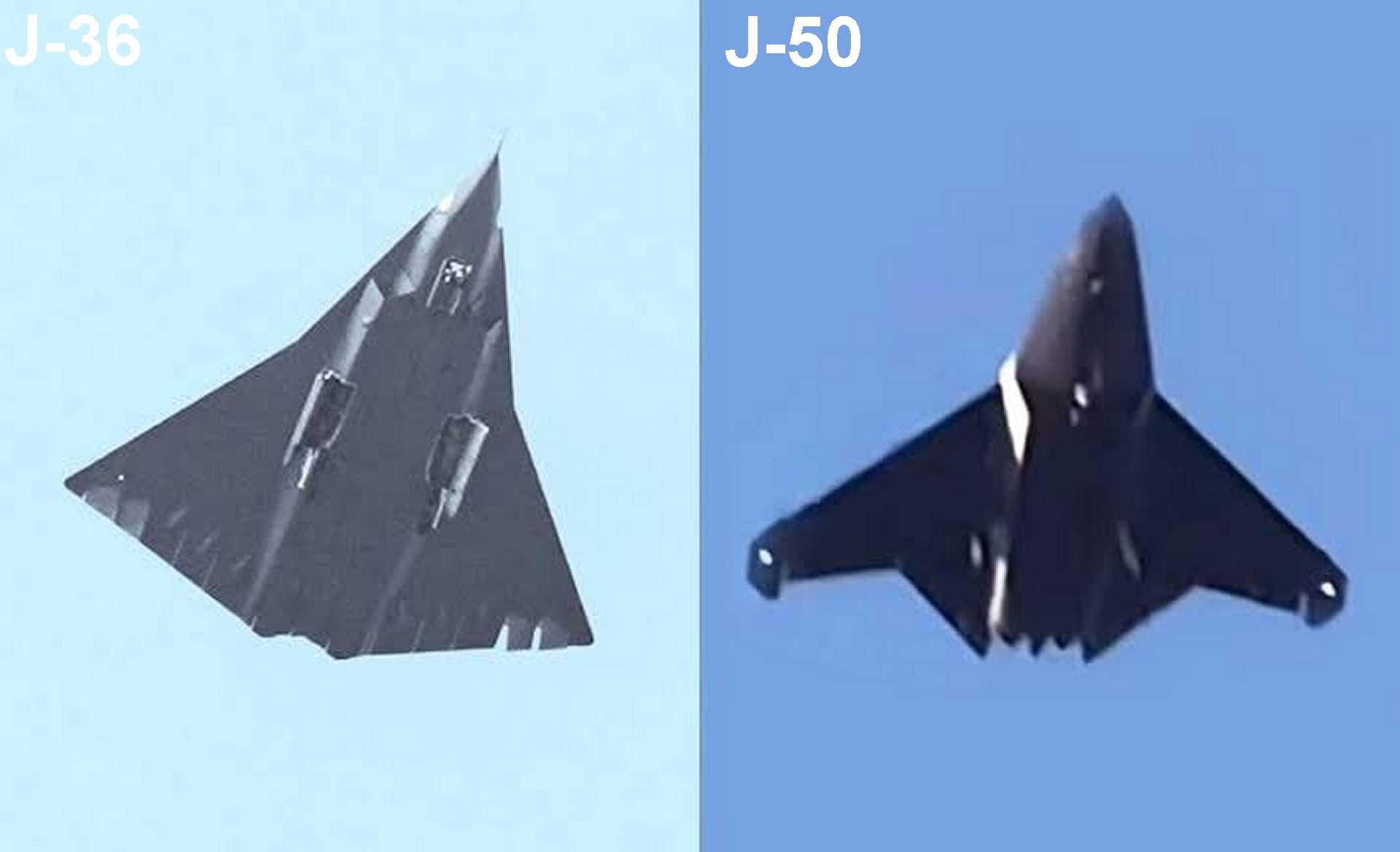 {loadposition bannertop}{loadposition sidebarpub}
A U.S. Department of War report released in December 2025 states that China conducted initial flight testing of two distinct sixth-generation fighter prototypes in December 2024. The disclosure suggests Beijing is pursuing parallel development paths to accelerate advanced air combat capabilities, including manned and uncrewed teaming.
China has quietly advanced its next-generation combat aviation efforts, according to a U.S. Department of War report published in December 2025, which confirms that two separate sixth-generation fighter aircraft prototypes completed their first flight tests late last year. The aircraft, referred to in Western defense analysis as the J-36 and J-50, are described as parallel development programs intended to cover a wide spectrum of missions, from air superiority and precision strike to coordinating uncrewed aerial systems in contested airspace.
Follow Army Recognition on Google News at this linkSide-by-side comparison: China’s sixth-generation fighter prototypes – the Chengdu J-36 (left) optimized for long-range air superiority, and the Shenyang J-50 (right) designed for future carrier-based operations. (Picture source: Social Networks)
The U.S. report emphasizes that China is no longer operating in the conceptual or design phase; these aircraft are part of active flight-test programs backed by the country’s top-tier aerospace industry. Operational capability for both platforms is projected to emerge by the mid-2030s, placing them on a timeline comparable to the U.S. Air Force’s NGAD and the Navy’s F/A-XX initiatives.
Based on Army Recognition’s independent analysis of open‑source intelligence, including released flight test videos, satellite imagery, industrial site activity, and defense aviation tracking data, the two aircraft referenced in the U.S. report are assessed to be the Chengdu J‑36 and the Shenyang J‑50. These two platforms represent parallel sixth‑generation development paths pursued by China’s leading combat aircraft manufacturers, reflecting a deliberate strategy to field both land‑based and carrier‑capable next‑generation fighters.
Throughout 2025, multiple video recordings circulated on Chinese social media platforms and aviation forums have shown two different stealth aircraft conducting taxi tests, takeoffs, and early maneuvering flights at geographically separate test facilities. Army Recognition analysts geolocated these videos to known experimental airfields associated with Chengdu Aircraft Corporation in western China and Shenyang Aircraft Corporation in northeastern coastal regions. Subsequent satellite imagery confirmed increased ground support activity, specialized instrumentation aircraft, and new hardened hangars consistent with early sixth‑generation flight test programs.
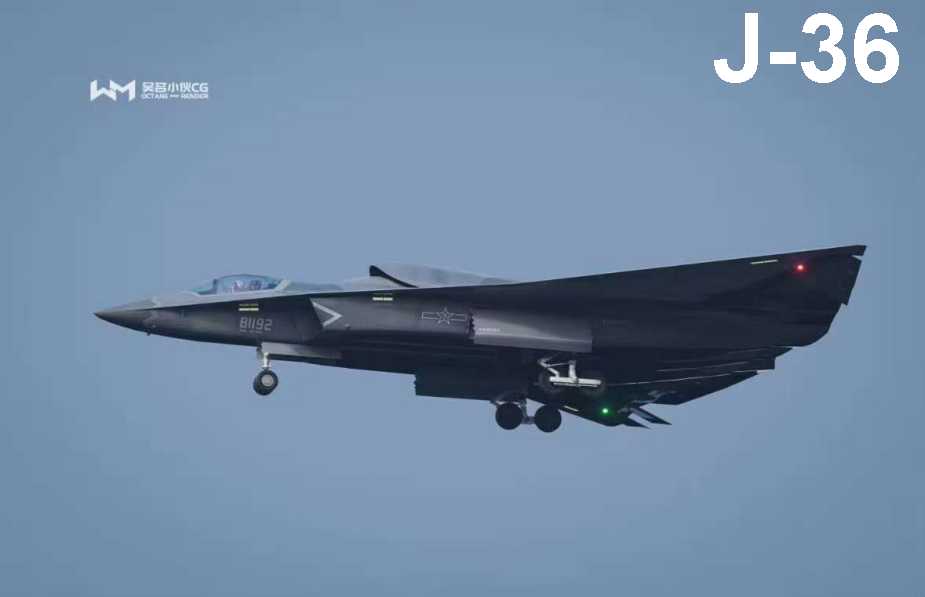
The Chengdu J-36 is China’s land-based sixth-generation fighter prototype, featuring a tailless flying wing design, deep stealth shaping, and long-range multi-role capabilities. (Picture source: China Social Network)
The J‑36, attributed to Chengdu Aircraft Corporation, is widely assessed as China’s primary sixth‑generation air superiority platform and a long‑term successor to the J‑20. Observed airframe characteristics include a tailless configuration, a broad delta- or diamond-shaped wing, a deeply blended fuselage, and fully internalized weapons bays, all optimized for extremely low radar observability. The absence of vertical stabilizers suggests heavy reliance on advanced flight control software and thrust vectoring, pointing toward a highly software‑driven aircraft architecture. Analysts assess that the J‑36 is designed for long‑range operations, enabling deep penetration into contested airspace while acting as a central node for sensor fusion, electronic warfare coordination, and command of loyal wingman uncrewed combat aerial vehicles.
Flight footage analyzed by Army Recognition shows the J‑36 executing wide‑radius turns and stable high‑speed passes, consistent with early envelope expansion testing rather than mere technology demonstration. The aircraft’s size relative to known chase planes suggests significant internal fuel capacity, reinforcing assessments that endurance and range are central to its mission profile. The J‑36 is expected to integrate artificial–intelligence–assisted decision–making tools, advanced multispectral sensors, and secure data links that can network with satellites, ground‑based systems, naval assets, and uncrewed platforms.
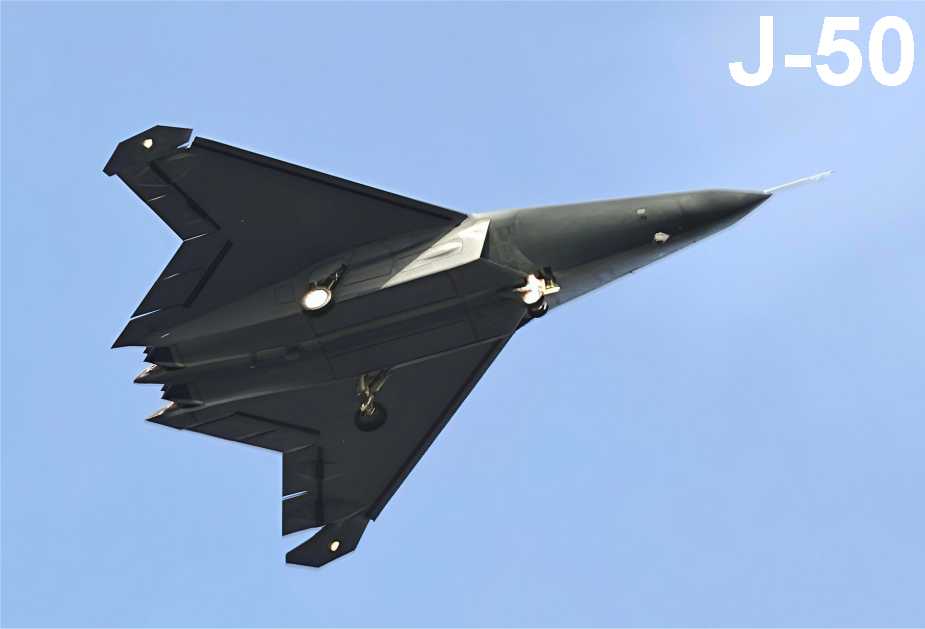
J-50: China’s next-generation stealth fighter for carrier deployment, featuring AI-enabled systems and manned-unmanned teaming architecture for high-threat maritime environments. (Picture source: China Social Network)
Running in parallel, the J‑50, developed by Shenyang Aircraft Corporation, reflects a different operational emphasis. Video footage and satellite imagery place the aircraft at coastal test ranges, with design features suggesting a focus on naval aviation. Analysts observe a more compact airframe, a twin‑engine layout, and possible structural adaptations for carrier operations, including reinforced landing gear and wing-folding mechanisms. The J‑50 is widely assessed as China’s future carrier‑based sixth‑generation fighter, intended to operate from the PLA Navy’s new generation of catapult‑equipped aircraft carriers, including the Type 003 Fujian and follow‑on vessels.
The decision to pursue two separate sixth‑generation fighters simultaneously highlights a major shift in Chinese military aviation strategy. Rather than a single universal platform, Beijing appears intent on fielding mission‑optimized aircraft tailored for land‑based air dominance and maritime power projection. This approach mirrors, and in some respects anticipates, the U.S. division between Air Force and Navy sixth‑generation programs, but with the notable distinction that China has already moved both designs into visible flight testing.
These developments contrast sharply with the current status of U.S. sixth‑generation programs. According to the Congressional Research Service report IF12805, published on December 20, 2025, the U.S. Air Force’s Next Generation Air Dominance (NGAD) program remains in the engineering and manufacturing development phase. NGAD is not a single aircraft but a family of systems centered on a crewed sixth‑generation fighter supported by multiple Collaborative Combat Aircraft (CCA). These unmanned platforms are designed to conduct missions such as electronic warfare, missile carriage, ISR, and decoy operations under the control of the manned NGAD aircraft.
The U.S. Department of War confirms that the U.S. Air Force awarded a full‑scale development contract for NGAD in 2023 and that at least one prototype may have flown in classified conditions. However, no publicly acknowledged flight tests have been disclosed, and NGAD remains largely shielded from public scrutiny. The Air Force plans for NGAD to replace the F‑22 Raptor in the early 2030s, with initial operational capability targeted around 2030 or shortly thereafter. Key technologies cited by CRS include adaptive‑cycle engines, modular open‑systems architecture, AI‑enabled battle management, and advanced multi‑domain networking.
In parallel, the U.S. Navy’s F/A‑XX program represents the maritime component of U.S. sixth‑generation airpower, intended to replace the F/A‑18E/F Super Hornet and EA‑18G Growler in carrier air wings during the 2030s. Unlike NGAD, F/A‑XX has faced repeated funding uncertainty and shifting Pentagon priorities. Recent reporting indicates that after proposed budget reductions, Congress restored approximately $1.4 billion in funding for F/A‑XX, underscoring legislative concern over maintaining carrier‑based air superiority in the Indo‑Pacific.
Open‑source reporting indicates that industry competition for F/A‑XX has narrowed primarily to Boeing and Northrop Grumman, with Lockheed Martin reportedly exiting the program earlier in 2025. Navy leadership has emphasized that F/A‑XX must deliver significantly greater range than current carrier fighters, enhanced survivability against advanced integrated air defense systems, and deep integration with uncrewed aircraft and naval combat networks. Expected features include advanced stealth shaping, AI‑assisted mission management, large internal payload capacity, and seamless coordination with assets such as the MQ‑25 Stingray and future carrier‑based UCAVs.
Despite these ambitions, F/A‑XX remains in the concept refinement and early design phase, with no confirmed flight demonstrators and a projected operational timeline extending into the mid‑2030s. Senior Navy officials have acknowledged that sustaining two parallel sixth‑generation fighter programs alongside NGAD places strain on the U.S. defense industrial base, but argue that abandoning F/A‑XX would leave carrier strike groups increasingly vulnerable to China’s expanding anti‑access and naval aviation capabilities.
When viewed collectively, the contrast is striking. China has moved two sixth‑generation fighter designs into visible flight testing, supported by a centralized industrial model that emphasizes rapid prototyping and iterative testing. The United States, by contrast, is pursuing a more complex and modular approach centered on software adaptability, autonomous teaming, and long‑term technological flexibility, but at the cost of slower public progress and extended development timelines.
The December 2025 Department of War report and the CRS analysis converge on a critical conclusion: the traditional U.S. assumption of uncontested leadership in combat aircraft development can no longer be taken for granted. While U.S. sixth‑generation systems may ultimately surpass Chinese designs in integration and adaptability, China’s head start in flight testing and its dual‑track development strategy represent a tangible strategic advantage.
As both nations race toward operational deployment in the 2030s, the outcome will shape not only future air combat but the broader balance of power in the Indo‑Pacific. The sixth‑generation fighter race is no longer theoretical. It is unfolding in real time, across test ranges in China and classified development facilities in the United States, with profound implications for deterrence, escalation control, and the future character of air warfare.
Written by Alain Servaes – Chief Editor, Army Recognition Group
Alain Servaes is a former infantry non-commissioned officer and the founder of Army Recognition. With over 20 years in defense journalism, he provides expert analysis on military equipment, NATO operations, and the global defense industry.
-
Analysis: China’s H-20 Competes with U.S. B-21 Raider to Become the World’s Leading Stealth Bomber
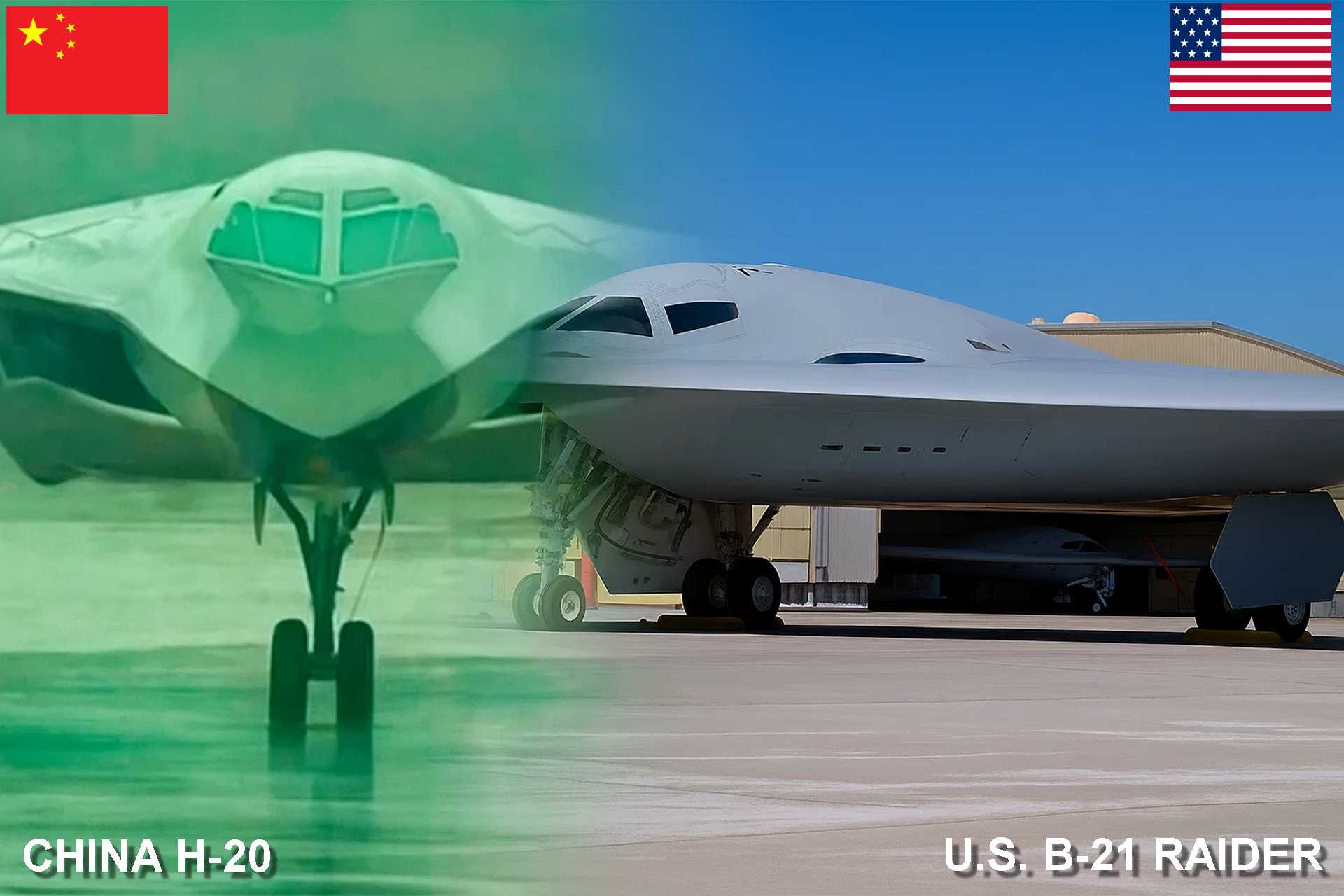 {loadposition bannertop}{loadposition sidebarpub}
China’s long-anticipated H-20 stealth bomber is emerging as China’s answer to the U.S. Air Force’s B-21 Raider, placing the two aircraft at the center of future long-range strike competition. While both reflect flying-wing stealth concepts, their differences in maturity, integration, and operational readiness reveal a widening gap in real-world capability.
After decades of development shaped by Cold War legacies and modern anti-access warfare, the United States and China are now fielding their most advanced strategic bombers to date. U.S. Northrop Grumman’s B-21 Raider has already entered flight testing under a tightly managed Air Force program. At the same time, China’s Xi’an H-20 remains officially unrevealed but heavily signaled by People’s Liberation Army officials as a cornerstone of future power projection. Defense analysts argue that the contrast between the two programs highlights not only a technological competition but also fundamentally different approaches to stealth warfare, command integration, and global-strike credibility.
Follow Army Recognition on Google News at this linkThe United States B-21 Raider (right) and China’s H-20 (left) represent the next generation of long-range stealth bombers, signaling a global shift in strategic airpower. (Picture source: Editing Army Recognition Group)
At the heart of both programs is the flying-wing architecture, a design chosen primarily for its extremely low radar cross-section and aerodynamic efficiency. The B‑21 Raider builds upon the United States’ unrivaled experience in stealth aircraft, from the F-117 to the B-2 Spirit and F-35, incorporating advances in radar-absorbent materials, infrared signature reduction, and thermal management to defeat multiple spectrums of detection. Engine inlets are deeply buried, surface seams are minimized, and electronic emissions are tightly managed.
The B‑21’s design benefits from decades of operational data and survivability modeling, enabling it to perform sustained operations in the heart of contested airspace. China’s H‑20, while echoing many of the same shaping principles, including a tailless flying wing layout and internal weapons bays, remains largely a mystery. Based on concept art and limited intelligence assessments, the H‑20 may incorporate serrated engine inlets, blended contours, and a cranked-kite wing similar to American stealth bombers. However, it remains unclear whether China’s defense industry has yet achieved the signature management sophistication necessary to match the B‑21’s all-aspect stealth performance under operational conditions.
The B‑21 Raider is a sixth-generation platform designed to deliver both conventional and nuclear payloads over intercontinental distances. It is smaller and more efficient than the B-2, with a reduced logistics footprint and lower operating cost per flight hour. The bomber’s internal bays can carry advanced munitions, including the upcoming AGM‑181 Long Range Stand Off (LRSO) nuclear cruise missile, B61 family nuclear gravity bombs, and long-range conventional weapons such as the AGM‑158 Joint Air-to-Surface Standoff Missile Extended Range (JASSM-ER). Northrop Grumman has engineered the Raider with an open-systems digital backbone, enabling rapid upgrades to weapons, sensors, and communications throughout the aircraft’s life cycle. Future integration of hypersonic strike systems, electronic attack pods, and even directed-energy payloads is feasible within the platform’s modular architecture.
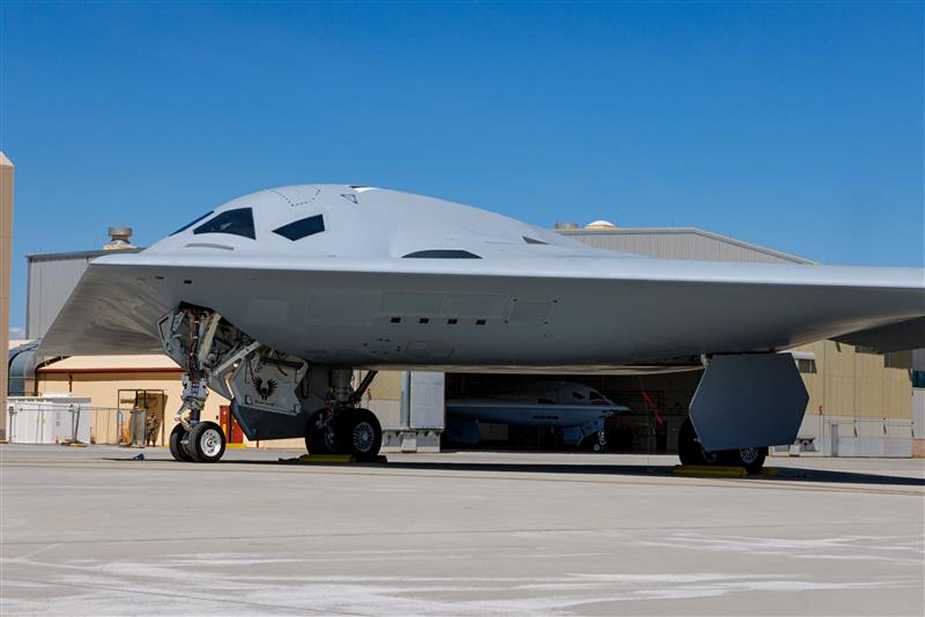
The B-21 Raider is the U.S. Air Force’s next-generation stealth bomber, designed for long-range precision strikes and nuclear deterrence in contested airspace. (Image source: U.S. Department of War)
In comparison, the Xi’an H‑20 is projected to carry a payload of at least 10,000 kilograms internally, capable of delivering conventional precision-guided munitions, nuclear gravity bombs, and standoff cruise missiles such as the CJ-10 or CJ-20. Several unofficial estimates suggest the H‑20’s operational radius could exceed 8,500 kilometers, positioning it as a true long-range strategic bomber, China’s first. While its payload capacity may be comparable to that of legacy U.S. platforms, China has yet to demonstrate the same level of integration between air-launched systems and stealth platforms. Without confirmed flight testing or weapons validation, analysts remain cautious about the H‑20’s ability to deliver precision effects under battlefield conditions. Nonetheless, its development signals a major shift in the PLAAF’s strategic posture, from a regionally-focused air force to one capable of intercontinental deterrence.
A key differentiator lies in the integration of avionics and combat systems. The B‑21 Raider has been designed from inception to operate within the Joint All-Domain Command and Control (JADC2) framework. This allows the bomber to serve not only as a precision-strike platform but also as a forward sensor node, capable of passing targeting data, conducting battle-damage assessments, and synchronizing with manned and unmanned systems across multiple domains. The aircraft’s mission systems leverage AI-assisted planning, dynamic threat avoidance, and onboard data fusion to survive and adapt inside highly contested environments dominated by advanced air defense systems. This positions the B‑21 as both a strategic weapon and an informational asset, capable of shaping the battlespace through intelligence and decision advantage.
The H‑20’s onboard systems remain speculative, though observers anticipate the use of domestically developed AESA radar, satellite navigation linked to BeiDou, and a range of indigenous electronic warfare capabilities. While China has made strides in sensor miniaturization and data-link technology, the level of redundancy, encryption, and battlefield resilience required for high-end peer conflict remains under development. The integration of H‑20 into a broader networked kill web spanning space, cyber, and electromagnetic domains will ultimately determine whether it can challenge platforms like the B‑21 not just in stealth but in mission effectiveness. Without a mature battle management and data-sharing ecosystem, even a stealth platform may face limitations in real-time adaptability and survivability.
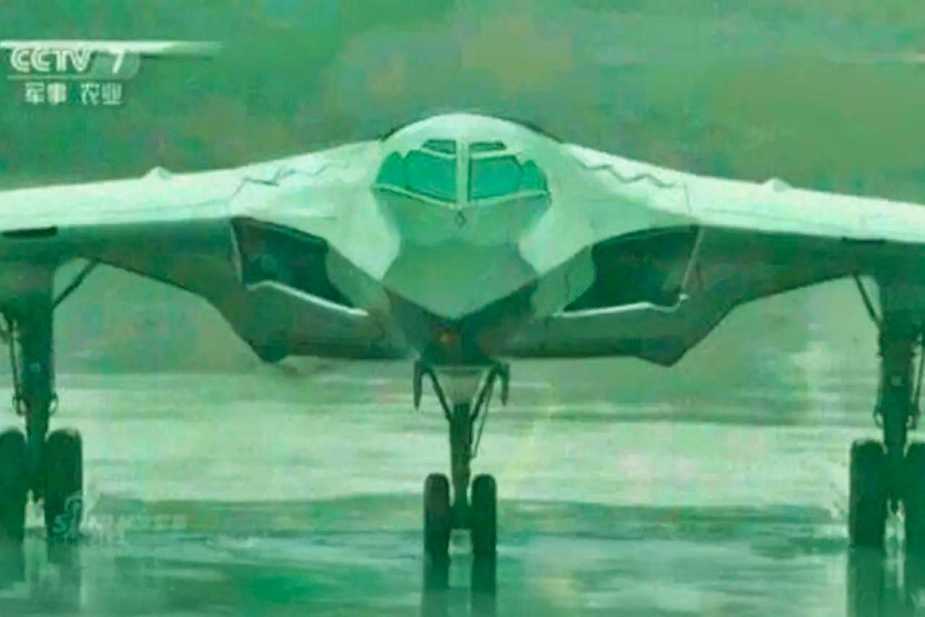
The H-20 is China’s first long-range strategic stealth bomber, designed to extend the PLA Air Force’s strike capability deep into the Indo-Pacific and beyond. (Picture source: CCTV video footage)
In terms of range and endurance, the B‑21 is expected to achieve a combat radius greater than 9,000 kilometers without refueling, giving it the ability to strike from continental U.S. bases against targets in the Indo-Pacific, the Middle East, or Eastern Europe. This strategic reach is further enhanced by the United States’ global aerial refueling infrastructure, which enables persistent presence and flexible basing options. The B‑21 is designed to deploy from austere airfields, leverage allied infrastructure, and operate under dispersed basing models, critical for surviving a first strike in a high-threat environment. Its design also supports high-tempo sortie generation, enabling sustained campaign operations.
The H‑20, on the other hand, dramatically expands China’s strategic aviation reach. With an expected range capable of reaching U.S. bases on Guam and potentially Hawaii with tanker support, the bomber breaks China’s traditional regional limitations. This has immediate implications for Indo-Pacific theater planners, as it introduces the prospect of long-range air-launched precision strikes on American and allied assets well beyond the First and Second Island Chains. However, China’s current aerial refueling capabilities, primarily centered around older platforms like the H-6U and limited numbers of the Y-20U, may constrain the H‑20’s global endurance in the near term.
From a survivability standpoint, the B‑21 Raider integrates not only stealth shaping but a comprehensive defensive suite designed to degrade, spoof, or jam advanced radar and missile systems. Its combination of passive and active defenses, alongside its data-driven threat assessment tools, gives it significant advantages in electronic warfare-dense environments. The B‑21’s role in opening contested airspace is not simply to evade detection, but to help suppress or blind enemy sensors, enabling follow-on strikes by other platforms.
The H‑20’s survivability under modern integrated air defense conditions remains unproven. While China is investing heavily in EW and signature reduction, its ability to produce radar-absorbent coatings, stealth coatings, and low-RCS airframes at scale remains in question. The aircraft’s actual radar cross-section, thermal profile, and electronic signature management will determine its operational survivability, not just in theory, but in confrontation with systems like Patriot PAC-3, AEGIS, or airborne early warning networks.
Perhaps the most decisive factor in the near term is program maturity. The B‑21 has already completed its first flight and entered low-rate initial production. Multiple airframes are under construction, and the U.S. Air Force has outlined clear basing plans and operational timelines. The Raider is expected to enter initial operating capability before the end of the decade, with procurement goals exceeding 100 units to ensure strategic mass. Its digital engineering foundation enables rapid spiral development and sustainment efficiencies, making it uniquely suited for sustained peer competition.
By contrast, the H‑20 has yet to be publicly unveiled in flight, and reliable reports suggest the bomber is still undergoing ground testing and integration. Even assuming a formal rollout in the coming year, full operational capability may not be reached before the early 2030s. Manufacturing stealth platforms at scale, equipping them with validated long-range weapons, and training crews for strategic missions remain massive undertakings for the PLAAF. China is closing the capability gap, but the Raider has already crossed into production and integration, giving the United States a critical window of strategic advantage.
Ultimately, the B‑21 Raider is not just a bomber. It is a central pillar in the evolving architecture of American power projection, deterrence, and high-end warfare. Its capacity to deliver nuclear or conventional weapons, share real-time intelligence, and adapt in flight makes it a symbol of U.S. technological and doctrinal superiority in airpower. The Xi’an H‑20, while still an enigma, marks a bold challenge to U.S. dominance in this field and signals Beijing’s intent to field a truly global strategic strike capability. As both platforms evolve, they will shape the balance of airpower and strategic stability in ways that extend far beyond the radar horizon.
While the B‑21 Raider stands as a proven leap forward in long-range stealth strike, integrating decades of U.S. expertise in low-observable design, networked warfare, and nuclear-capable precision targeting, the H‑20 remains an emerging challenger still fighting through the fog of development. Army Recognition’s defense analysts assess that the Raider will enter operational service years ahead of its Chinese counterpart, setting a benchmark that the H‑20 must strive to match. The Raider’s seamless integration into joint operations, its production momentum, and technological sophistication provide the United States with a clear, if temporary, lead in global strategic aviation. But China’s determined effort to field a credible intercontinental bomber force underscores that this is not the end of the race, but the beginning of a new era of bomber competition that will define the strategic skies of the next decade.
Written by Alain Servaes – Chief Editor, Army Recognition Group
Alain Servaes is a former infantry non-commissioned officer and the founder of Army Recognition. With over 20 years in defense journalism, he provides expert analysis on military equipment, NATO operations, and the global defense industry.
-
U.S. F-35 fighter jet with AN/APG-81 radar invisible destroyer before visual contact
 {loadposition bannertop}{loadposition sidebarpub}
The U.S. F-35 Lightning II’s AN/APG-81 radar, built by Northrop Grumman, can detect and track enemy destroyers before visual contact. This advanced sensor turns the jet into a long-range intelligence and targeting platform that reshapes modern air combat.
The U.S. F-35 Lightning II fighter jet's dominance in modern air combat does not rest solely on stealth or speed. Its true power lies in what it can see before anyone else. Central to this capability is the AN/APG-81 Active Electronically Scanned Array (AESA) radar, developed by Northrop Grumman, which transforms the aircraft into a multi-domain combat platform. This radar does far more than detect targets. It empowers the F-35 to control the battlespace, identifying and tracking threats across the air and ground simultaneously, long before they become visible to adversaries.
Follow Army Recognition on Google News at this linkThe AN/APG-81 AESA radar is housed in the F-35's nose, providing simultaneous air and ground threat detection and precision tracking. (Picture source: Northrop Grumman)
The AN/APG-81 Active Electronically Scanned Array (AESA) radar offers simultaneous air-to-air and air-to-ground surveillance, a technological leap over previous-generation systems. It allows the F-35 to map terrain, detect moving ground targets, scan for low-observable airborne threats, and track cruise missiles, all in real time, and all without switching radar modes. This capability ensures continuous awareness in fast-changing combat scenarios, where threats can emerge from any vector at any moment. The radar functions in both active and passive modes, enabling it to detect electronic emissions from enemy systems without revealing the F-35’s own position. This passive surveillance is critical in contested environments where survivability depends on stealth and discretion.
Equipped with thousands of solid-state transmit/receive modules, the APG-81 uses advanced gallium arsenide (GaAs) technology to steer beams electronically. This eliminates the mechanical limitations of older systems, allowing the radar to scan multiple sectors in milliseconds. The result is a highly detailed, long-range picture of the battlespace that gives F-35 pilots unmatched situational awareness. Unlike legacy radars that feed isolated data to pilots, the APG-81 integrates with the F-35’s mission systems and Distributed Aperture System (DAS), fusing inputs from onboard sensors and external sources to present a single, prioritized tactical picture. This sensor fusion not only reduces pilot workload but also accelerates the decision-making cycle, a critical factor in modern air combat.
One of the APG-81’s most significant combat advantages is its integrated electronic attack capability. The radar can suppress or degrade enemy air defense systems by jamming or blinding tracking radars and missile guidance systems. This electronic warfare function is built directly into the radar’s hardware and software, making it an organic part of the F-35’s strike package. While some fourth-generation fighters, like the EA-18G Growler, offer electronic attack capabilities, they rely on external pods or specialized mission configurations. The F-35’s radar delivers these effects natively and covertly, allowing the aircraft to penetrate anti-access and area denial zones such as those protected by Russian S-400 or Chinese HQ-9 systems.
In exercises like Red Flag, F-35s equipped with the APG-81 have consistently demonstrated the ability to detect and engage threats before being seen themselves. U.S. Air Force reports confirm that the radar’s ability to cue weapons systems and share targeting data with allied platforms has reduced kill chain timelines from minutes to seconds. In practical terms, this gives the F-35 the coveted first-look, first-shot, first-kill advantage that defines fifth-generation warfare.
While other modern fighters have adopted AESA technology, none match the APG-81’s level of integration or multi-role functionality. The F-16 Viper now carries the AN/APG-83 SABR radar, and the F/A-18E/F Super Hornet fields the AN/APG-79, both AESA systems. Yet these platforms remain limited by their fourth-generation architecture, which lacks full sensor fusion and seamless passive-active operation. These radars provide significant range and reliability improvements over older mechanical systems, but they operate more like enhanced tools than the fully integrated combat brain that the APG-81 represents.
Russia’s Su-57 and China’s J-20 are believed to use AESA radars, N036 Byelka and KLJ-7A or KLJ-5 respectively, but their true capabilities remain unverified and may fall short of the APG-81’s demonstrated performance. Reports suggest that while these radars claim long-range detection and stealth tracking capabilities, they do not offer the same level of battlefield fusion, low-probability-of-intercept operation, or integrated electronic warfare that defines the F-35’s system. Moreover, many of these foreign AESA systems are still in early stages of operational maturity, whereas the APG-81 has flown thousands of combat hours across multiple U.S. and allied air forces.
With the upcoming Block 4 software upgrade, the APG-81 is set to gain even more advanced capabilities, including next-generation electronic attack modes, higher-resolution synthetic aperture radar imaging, adaptive target recognition using machine learning, and expanded threat libraries. These enhancements will ensure that the radar remains ahead of evolving threats well into the 2030s, further extending the F-35’s margin of superiority in any airspace it enters.
The APG-81 does not simply support the F-35’s mission. It defines it. Against legacy fighters, it offers an overwhelming sensor advantage. Against emerging peer systems, it remains a step ahead through integration, stealth compatibility, and multi-domain dominance. In the age of information-driven warfare, the radar is not just the eyes of the F-35. It is its brain.
Written by Alain Servaes – Chief Editor, Army Recognition Group
Alain Servaes is a former infantry non-commissioned officer and the founder of Army Recognition. With over 20 years in defense journalism, he provides expert analysis on military equipment, NATO operations, and the global defense industry.
???? WATCH: Inside the F-35’s “beast” radar — the AN/APG-81 AESA, built by Northrop Grumman.
— Defence Index (@Defence_Index) October 31, 2025
It scans the skies and ground simultaneously, detecting threats long before they’re visible to others. pic.twitter.com/OD5EO9F0lV
-
Exclusive: South Korea KF-21 Boramae Fighter Jet Enters Mass Production to Rival International Fifth Gen Competitors
 {loadposition bannertop}{loadposition sidebarpub}
South Korea's defense aerospace industry has entered a transformative era with the official signing of the second production batch for the KF-21 Boramae fighter jet program. With 100 jets now contracted for delivery by 2032, the Korean government has reaffirmed its long-term vision to establish the country as a global defense technology leader. The KF-21, developed by Korea Aerospace Industries (KAI), represents a significant leap forward in domestic military aviation capabilities, built upon a decade of rapid industrial expansion, R&D investment, and a strategic shift toward defense export competitiveness.
Follow Army Recognition on Google News at this linkKF-21 Boramae fighter jet displayed during ADEX 2023 in South Korea, highlighting the nation's advancements in indigenous combat aircraft development. (Picture source: Army Recognition)
Production of the South Korean KF-21 fighter jet formally began following two sequential contracts signed between KAI (Korea Aerospace Industries )and South Korea’s Defense Acquisition Program Administration (DAPA). The first contract, covering 20 Block I fighters, was concluded in June 2024. A second identical contract for 20 additional units was signed in June 2025. These agreements secure the procurement of 40 Block I aircraft. According to the delivery timeline, the first 20 jets are scheduled for handover to the Republic of Korea Air Force (ROKAF) by 2027, followed by the remaining 20 by 2028. With the latest order for 60 additional aircraft expected to be Block II multirole variants, South Korea’s total acquisition goal remains fixed at 120 aircraft by 2032, establishing the KF-21 as the backbone of future ROKAF airpower.
Over the last ten years, South Korea’s defense aerospace sector has evolved from a licensed-production model to a vertically integrated ecosystem capable of independently designing, manufacturing, and exporting sophisticated combat aircraft, helicopters, satellites, and UAVs. Beginning with the T-50 Golden Eagle trainer jet co-developed with Lockheed Martin, South Korea successfully laid the groundwork for indigenous aircraft development, establishing advanced manufacturing lines, testing centers, and an integrated supply chain that now supports the KF-21 project and future export platforms.
The KF-21 program alone has employed more than 250 domestic suppliers, including Hanwha Systems for radar development, LIG Nex1 for EW and missile systems, and Korean Air for component manufacturing. The KF-21's AESA radar—developed in-house by the Agency for Defense Development and Hanwha—represents one of the most complex indigenous defense technologies ever completed in the country. In parallel, South Korea has dramatically increased its defense R&D budget, surpassing $5.3 billion annually by 2025, with aerospace programs receiving a substantial share.
The country’s aerospace industry has also expanded its global footprint. KAI has exported FA-50 light combat aircraft to countries including Iraq, the Philippines, Thailand, and Malaysia, with recent contracts signed with Poland and negotiations underway with Colombia and Peru. These exports are supported by favorable financing packages, co-production offers, and strong after-sales support structures. The success of the T-50/FA-50 line has directly reinforced South Korea's credibility as a reliable defense supplier and has created a launchpad for the KF-21 on the international stage.
KAI is concurrently developing advanced unmanned combat systems and AI-assisted autonomous flight technologies, further broadening the nation's aerospace defense ambitions. The company’s roadmap includes potential stealth UAV integration with KF-21 formations and the development of loyal wingman drones, modeled after systems like the Boeing MQ-28 Ghost Bat. These projects are intended to position South Korea as a future-focused player in manned-unmanned teaming warfare concepts.
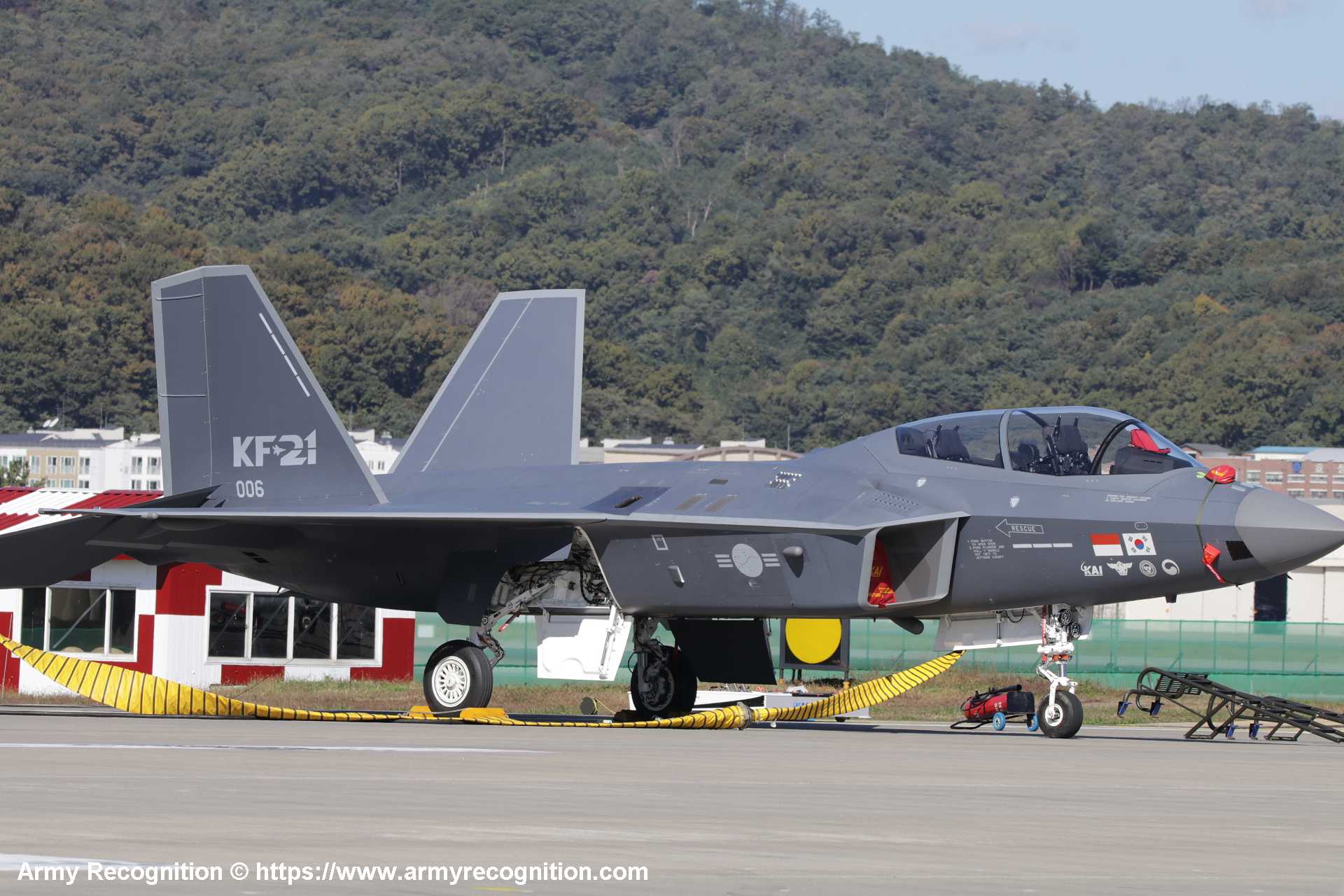
Close view of the KF-21 Boramae at ADEX 2023 showcasing its twin-engine layout, advanced AESA radar, and modular weapons integration designed to support multirole combat missions. (Picture source: Army Recognition Group)
The KF-21 itself is a tangible result of this decade-long industrial surge. Block I aircraft will enter production first with multirole capabilities to follow under Block II. The Block I configuration focuses on air superiority, featuring ten external hardpoints, the Meteor BVRAAM, and advanced digital cockpits with glass touchscreen interfaces. Block II, in design finalization, will introduce limited internal weapons bays, advanced jamming and electronic countermeasure suites, and increased stealth shaping—aimed at missions deep into contested airspace. With the second production batch now secured, the total order for 120 KF-21 fighters ensures economies of scale and paves the way for further export opportunities. Indonesia, the program’s only international partner, has reiterated interest in acquiring 48 aircraft, and discussions continue around joint production and technology transfer.
In terms of technical characteristics, the KF-21 presents several unique features that differentiate it from its global competitors in the current generation of fighter aircraft. When compared to the Turkish KAAN fighter, the KF-21 benefits from a more mature industrial ecosystem and production-readiness advantage. While KAAN aspires to full fifth-generation status with internal bays and a stealth-optimized design, it remains in the prototype stage, with initial flight testing ongoing and series production unlikely before 2029. In contrast, the KF-21 Block I is already in the production phase and features limited stealth shaping, digital flight systems, and an advanced South Korean-developed AESA radar, offering earlier operational deployment and cost stability for export customers.
Against the Eurofighter Typhoon, the KF-21 provides a newer-generation digital cockpit, open mission architecture, and lower lifecycle costs. While the Eurofighter offers high-end performance and multirole versatility, its architecture is based on 1990s-era systems. The KF-21, built around a modular avionics structure, is more easily adaptable to emerging combat technologies, sensor upgrades, and weapons packages from multiple vendors.
When compared to the Dassault Rafale, the KF-21 stands out with its twin-engine configuration and long-term upgrade roadmap. Although the Rafale has a proven combat record and internal system integration advantages, the KF-21 offers a cost-effective platform with broader weapons compatibility and a strategic emphasis on industrial collaboration. Its indigenous software and radar systems reduce reliance on foreign suppliers, making it more attractive to non-aligned countries seeking autonomy in their defense acquisitions.
Compared to the American F-35A, the KF-21 does not match the full spectrum of stealth and sensor fusion capabilities. However, it offers a significantly lower acquisition and operational cost. It also avoids export limitations imposed by ITAR and political considerations often attached to U.S. defense technology. This makes the KF-21 a viable alternative for countries that either cannot obtain the F-35 or prefer a more open and cooperative technology partnership model. Furthermore, the KF-21’s open architecture is designed for easier integration of regional or indigenous munitions, unlike the F-35’s tightly controlled weapons suite.
Finally, in comparison to the Swedish JAS-39E Gripen, the KF-21 surpasses it in terms of payload capacity, range, and multi-role versatility. While Gripen remains a leading platform in terms of cost efficiency and electronic warfare, the KF-21’s twin-engine configuration provides superior thrust and survivability. Both platforms share a philosophy of rapid technology integration, but South Korea’s industrial scalability and government-backed financing support give the KF-21 a competitive edge in long-term export potential.
As production accelerates under the new contracts, the KF-21 will not only become a central pillar of South Korean air power but will also redefine its standing in the global fighter aircraft market. Offering a rare combination of technological sophistication, production readiness, and strategic export flexibility, the KF-21 Boramae is poised to secure its place among the most significant next-generation fighter programs of this decade.
-
Technology: U.S. Raytheon Successfully Flight Tests PhantomStrike Radar Offering Real-Time Multi-Target Detection and Tracking
 {loadposition bannertop}{loadposition sidebarpub}
American company Raytheon, a business unit of RTX, announced on May 6, 2025, a significant achievement and pivotal milestone in radar technology with the successful first flight test of its PhantomStrike next-generation airborne radar system. The test was conducted on the company’s Multi-Program Testbed aircraft in Ontario, California. This event marks a new chapter in the development of lightweight, high-performance radar systems capable of integration across a broad range of military platforms. During the flight, the PhantomStrike system demonstrated its operational readiness by effectively tracking multiple airborne targets and producing high-resolution terrain maps—underscoring its superior situational awareness capabilities.
Follow Army Recognition on Google News at this linkRaytheon’s PhantomStrike radar in action: visualizing real-time detection, tracking, and prioritization of multiple airborne targets during a simulated combat mission—highlighting its compact design and integration on lightweight aircraft platforms. (Picture source: Raytheon)
Raytheon PhantomStrike represents a leap forward in radar technology—bringing the sophisticated capabilities typically reserved for high-end fighter jets into a radically smaller, lighter, and more affordable package. For those unfamiliar with radar systems, PhantomStrike functions as the “eyes” of a combat aircraft, but with a level of intelligence and agility that far surpasses traditional radar. Most legacy radars rely on rotating antennas to scan the airspace, limiting speed and flexibility. PhantomStrike, on the other hand, employs active electronically scanned array (AESA) technology, which uses electronically controlled beams to detect, track, and prioritize multiple targets in real-time, even in challenging and contested environments.
What makes PhantomStrike unique is its engineering. It is the world’s first fully air-cooled AESA radar powered by gallium nitride (GaN) semiconductors. GaN allows for higher power output and improved efficiency while keeping heat generation low—an essential trait in the harsh operational environments of military aviation. Unlike conventional radar systems that require liquid cooling and substantial space, PhantomStrike’s air-cooled system is compact and easy to maintain, opening the door to installation on platforms previously unable to accommodate advanced radar technologies.
Despite its small size—roughly half the weight of a standard AESA radar—PhantomStrike offers full-spectrum fire-control capabilities. It can conduct long-range detection of airborne threats, map terrain with exceptional detail, and support simultaneous tracking of multiple targets. Its integration of Raytheon’s CHIRP (Compact High-reliability Integrated Receiver/Exciter Processor) provides the radar with lightning-fast digital beam agility and multi-mode operation, enabling aircraft to transition instantly between air-to-air, air-to-ground, and navigation missions without compromising performance.
PhantomStrike’s compact dimensions and lower power requirements make it suitable for a wide range of platforms beyond just high-end fighter jets. These include light-attack aircraft, uncrewed aerial vehicles (UAVs), helicopters, and even ground-based towers. This versatility ensures that modern radar capabilities can be deployed across a broader array of assets, improving fleet-wide effectiveness without the cost of purchasing or developing entirely new aircraft.
Raytheon has also prioritized ease of integration and long-term flexibility by designing PhantomStrike with an open mission systems architecture. This means the radar can be upgraded or modified with new software and hardware as missions evolve, without requiring a complete system overhaul. For international partners and U.S. allies, this capability offers not just tactical advantage but long-term investment value. Approved for direct commercial sales (DCS), PhantomStrike can be delivered and fielded rapidly, without delays typically associated with government-to-government defense exports.
The radar is already in production at multiple sites, including facilities in Forest, Mississippi; Tucson, Arizona; and Scotland, with support from Raytheon UK. This multinational production base underscores Raytheon’s intent to meet growing international demand and strengthen global defense capabilities through scalable, future-ready technologies.
PhantomStrike is more than just a new radar—it is a strategic shift in how combat aircraft are equipped for modern warfare. By enabling advanced situational awareness, threat tracking, and targeting precision on a wide variety of platforms, Raytheon is redefining the boundaries of airborne combat systems. Whether mounted on next-generation UAVs, legacy aircraft, or mobile battlefield towers, PhantomStrike delivers the radar vision of a fifth-generation fighter to a much wider and more versatile range of platforms, reshaping the future of aerial combat with speed, power, and affordability.
-
Can US air defense systems really intercept China's new Jiutian high-altitude drone over the Taiwan Strait?
 {loadposition bannertop}{loadposition sidebarpub}
On April 28, 2025, Zhao DaShuai claimed that China's new Jiutian super-high altitude, long-endurance drone could operate beyond the reach of nearly all air defense systems thanks to its 15,000-meter flight ceiling. Unveiled at the 15th Zhuhai Airshow, the Jiutian could potentially bypass many traditional air defense systems and conduct sustained operations over contested areas. However, can these advantages truly ensure that the Jiutian remains beyond the reach of modern high-altitude interception systems deployed by other countries in the region?
Follow Army Recognition on Google News at this linkThe Jiutian UAV incorporates a modular payload bay allowing rapid mission switching between electronic warfare, cargo transport, reconnaissance, and strike roles. (Picture source: Weibo/高山CG)
China has introduced the Jiutian (SS-UAV) super-high altitude, long-endurance drone at the 15th Zhuhai Airshow in November 2024. Developed by the Aviation Industry Corporation of China (AVIC), in collaboration with the First Aircraft Institute, Shaanxi Unmanned Equipment Technology Co., and Guangzhou Digital Technology's Haige Communications subsidiary, the Jiutian drone is designed as a large, flexible-configured UAV. It has a maximum takeoff weight of 16 tons, a wingspan of 25 meters, a flight ceiling of 15,000 meters, a maximum speed of 700 km/h, and an operational range of 7000 kilometers, with some modules extending endurance to 36 hours. It is powered by a high-thrust turbofan engine, equipped with eight underwing hardpoints, and features a modular "Isomerism Hive Module" capable of deploying smaller drones for reconnaissance, electronic warfare, or strike missions.
The Jiutian UAV incorporates a modular payload bay allowing rapid mission switching between electronic warfare, cargo transport, reconnaissance, and strike roles. It integrates quantum-encrypted communications, hydrogen-fueled propulsion systems, and supermaterial-based radar cross-section reduction technology. The UAV is also equipped with AI-based swarm control algorithms to maintain functionality under electromagnetic interference. The drone's capability to launch swarms of smaller UAVs enables saturation attacks or distributed surveillance missions, depending on operational requirements.
Claims regarding the Jiutian's operational ceiling indicate that with its ability to reach 15,000 meters, it could operate beyond the engagement capabilities of many medium-range air defense systems currently deployed worldwide. Systems with engagement ceilings below 15 kilometers, such as older Soviet-era SAM systems and some medium-range interceptors, would be unable to effectively counter the Jiutian at its cruising altitude. In these scenarios, the Jiutian could conduct missions with reduced risk of interception, maintaining persistent surveillance and targeting operations in airspaces lacking modern high-altitude defenses.
However, advanced air defense systems are capable of engaging aerial threats operating at or beyond 15 kilometers. The U.S. THAAD system can intercept targets at altitudes up to 150 kilometers, while the Patriot PAC-3 system and South Korea's KM-SAM Block II both have operational ceilings around 20 kilometers. Japan's Aegis BMD destroyers and Taiwan's Sky Bow III system also possess the capability to intercept targets at high altitudes. Therefore, in regions protected by such modern systems, the Jiutian would still face significant threats despite its operational altitude, requiring the People's Liberation Army to secure localized air superiority or implement countermeasures to reduce interception risks.
Strategically, the Jiutian is positioned to support operations following the establishment of air superiority, conducting persistent surveillance, precision strikes, and acting as a command center for drone swarms. It is intended for missions across the Taiwan Strait, South China Sea, and potentially extended missions toward strategic targets such as Guam. Its modular configuration enables adaptability for different mission profiles, including border patrol, disaster relief, and logistic support, under both military and civilian contexts.
The Jiutian is part of China's broader effort to develop advanced UAV capabilities, following platforms like the Wing Loong and Caihong series, which have seen operational use internationally. It combines endurance attributes similar to the RQ-4 Global Hawk with strike capabilities comparable to the MQ-9 Reaper, while adding the capability to deploy drone swarms, which is not present in the American systems. While official data outlines these features, the Jiutian's operational performance has not yet been independently verified in combat situations.
The project reflects significant investment, with more than three billion yuan allocated, full domestic production, and a manufacturing chain covering all stages from component fabrication to system integration. Haige Communications and associated entities developed digital twin environments for testing, integrated hydrogen fuel technologies, and employed quantum communication protocols to enhance mission reliability. The Jiutian project is aimed at achieving rapid development cycles, with the fourth prototype assembled by April 2025, following a project launch in late 2023.
In terms of civil applications, the Jiutian's modularity supports missions such as emergency logistics, aerial surveillance, and search and rescue operations. Future operational concepts include deployment from amphibious assault ships like the 076-class, expanding China's offshore UAV operational capabilities. Deployment strategies envision the drone acting as a force multiplier in coordinated operations involving aircraft carriers and unmanned swarm assets. While some analysts highlight the operational advantages of reduced personnel risk and increased operational reach offered by AI-controlled swarm operations, others warn of destabilization risks associated with lower conflict thresholds.
-
Focus: Saab integrates human-machine collaboration and AI into Gripen fighter jet to enhance air combat operations
 {loadposition bannertop}{loadposition sidebarpub}
In today’s evolving battlefield, victory often hinges not on who has the fastest aircraft or the most firepower, but on who can make critical decisions a few seconds faster than the opponent. Recognizing this decisive factor, Saab’s Gripen fighter jet introduces a revolutionary shift from traditional Human-Machine Interaction (HMI) to what is now known as Human-Machine Collaboration (HMC). This evolution, underpinned by cutting-edge Artificial Intelligence (AI) and machine learning technologies, transforms the relationship between pilot and machine into a dynamic partnership, changing the very nature of air combat operations.
Follow Army Recognition on Google News at this linkSaab integrates human-machine collaboration and AI technologies into the Gripen fighter jet, enhancing pilot situational awareness and decision speed. (Picture source: Editing Army Recognition Group)
Unlike earlier generations of fighter jets, where Human-Machine Interaction focused mainly on simplifying controls and enhancing cockpit ergonomics, the Gripen’s philosophy of Human-Machine Collaboration means the aircraft actively supports the pilot’s cognitive and tactical processes. The machine is no longer a passive tool but an intelligent participant, capable of processing vast streams of sensor data, interpreting threats, proposing tactical responses, and even predicting enemy maneuvers in real time. Saab’s integration of AI (Artificial Intelligence)ensures that the Gripen acts not merely as an extension of the pilot’s will but as an intelligent advisor, helping to manage information overload and reducing the time needed to make life-or-death decisions.
When we talk about the Gripen being "AI-powered," it means that the aircraft’s onboard systems can think and learn in a way that mimics human decision-making, but much faster and more precisely. Artificial Intelligence allows the jet to recognize patterns, prioritize threats, suggest maneuvers, and even adapt to new combat situations without needing direct human programming each time. In simple terms, the Gripen’s AI transforms data into meaningful actions, helping pilots stay ahead of the enemy by seeing, analyzing, and reacting quicker than ever before.
At the core of this capability is a suite of AI-powered systems embedded in the Gripen’s avionics and mission computer. These systems perform sensor fusion, combining data from radar, infrared search and track (IRST) sensors, electronic warfare suites, and communication networks into a single, coherent operational picture. Through sophisticated algorithms, the Gripen can prioritize and display only the most mission-critical information, allowing the pilot to maintain situational awareness without being overwhelmed by extraneous data. The AI acts as a filter and a guide, ensuring that the pilot’s attention is focused where it matters most.
Machine learning technologies further enhance this collaboration by enabling the aircraft to learn from operational data. The Gripen can analyze patterns of previous engagements and adjust its threat assessment models accordingly, offering predictive insights rather than merely reactive support. This ability to adapt in real time to the evolving dynamics of the battlefield means that every sortie strengthens the bond between human and machine, making the collaboration more efficient and effective with each mission.
Saab’s latest variants, the Gripen E and Gripen F, epitomize this advanced integration. Designed with future threats in mind, the Gripen E/F includes an enhanced electronic warfare suite, the powerful AESA (Active Electronically Scanned Array) radar, and a cutting-edge IRST system. These platforms integrate open-architecture mission systems, allowing for continuous upgrades and seamless incorporation of future AI technologies. The Gripen E in particular brings a significant increase in processing power and sensor fusion capabilities, ensuring that pilots can maintain situational dominance even in highly contested electromagnetic environments.
The benefits of Human-Machine Collaboration in the Gripen E/F are profound. It shortens the critical Observe-Orient-Decide-Act (OODA) loop, allowing pilots to be the first to detect, assess, and engage threats. It empowers them with decision superiority, providing those precious extra seconds that can mean the difference between mission success and failure. Moreover, by automating routine tasks such as countermeasure deployment and threat prioritization, the aircraft frees the pilot to concentrate on high-level tactical decision-making, transforming them from a traditional operator into a true battle manager.
The implications for future air warfare are significant. Human-Machine Collaboration will enable fighter pilots to manage increasingly complex battlespaces characterized by multi-domain threats, electronic attacks, and information saturation. AI-driven collaboration will not only enhance survivability but also allow pilots to orchestrate mixed forces involving unmanned aerial vehicles (UAVs), ground assets, and naval elements in real time. Gripen’s HMC technologies lay the foundation for next-generation capabilities such as Manned-Unmanned Teaming (MUM-T), where intelligent systems and autonomous drones can work seamlessly alongside human pilots, enhancing mission flexibility and lethality.
In an era where speed of thought and action outweigh pure kinetic capability, Saab’s Gripen fighter jet stands at the forefront of a paradigm shift. It transforms the aircraft from a sophisticated flying machine into a cognitive extension of the pilot’s will—a true collaborative partner in battle. By fostering genuine collaboration between human and machine, Saab ensures that Gripen pilots are not only better informed but fundamentally better equipped to dominate the complex and contested skies of tomorrow’s battlespaces. In a world where milliseconds can decide the outcome, Human-Machine Collaboration provides the decisive edge—and Gripen pilots are trained to exploit it to the fullest.
-
Technology: Türkiye Advances Indigenous Air-to-Air Arsenal with GÖKHAN Ramjet Missile Design Completion
 {loadposition bannertop}{loadposition sidebarpub}
Türkiye has successfully completed the preliminary design phase of its indigenous GÖKHAN ramjet-powered air-to-air missile, a major step forward in the country's ambition to develop a domestically produced long-range missile system capable of engaging aerial threats beyond visual range. This advancement comes as part of the "National Ramjet Powered Air-to-Air Missile (GÖKHAN) Development Project," initiated under a contract signed between the Ministry of National Defense and TÜBİTAK SAGE on May 21, 2021.
Follow Army Recognition on Google News at this linkConceptual illustration of Türkiye’s GÖKHAN ramjet-powered air-to-air missile, designed for beyond-visual-range engagements and integration on F-16 and KAAN fighter aircraft. (Picture source: Army Recognition Group)
The GÖKHAN project aims to equip the Turkish Air Force with a new generation of air-to-air missiles designed to establish air superiority in contested environments. The program focuses on the creation of a missile system with ramjet propulsion, which enables sustained high-speed flight over extended ranges. While official specifications have not been disclosed, early estimates suggest that GÖKHAN will be capable of striking targets at distances exceeding 100 km.
With the completion of both the Conceptual Design Phase and the Preliminary Design Phase, the project has now entered the Ground Tests Phase. This stage will involve detailed subsystem evaluations, system-level verifications, and the start of flight and firing tests. These tests are expected to validate the missile’s propulsion behavior, guidance system performance, structural integrity, and aerodynamic characteristics under real-world conditions.
GÖKHAN’s propulsion is based on a ramjet engine, which uses atmospheric oxygen for combustion during flight. This gives the missile a significant advantage over conventional solid-fueled systems, allowing it to maintain speed throughout its engagement envelope. Ramjet technology increases the missile’s no-escape zone and terminal maneuvering capability, making it especially effective against fast-moving and maneuvering airborne targets at long distances.
The missile will initially be integrated on Türkiye’s upgraded F-16 fighter jets, serving as a key enabler of long-range interception and self-defense capabilities. It will later be adapted for the KAAN National Combat Aircraft, Türkiye’s indigenous fifth-generation stealth fighter currently under development by Turkish Aerospace Industries. The pairing of GÖKHAN with KAAN will result in a fully Turkish-made air combat system, reducing reliance on foreign suppliers and enhancing national defense autonomy.
The GÖKHAN project reflects the rapid maturation of Türkiye’s defense industry over the past decade. Turkish defense institutions — including TÜBİTAK SAGE, ASELSAN, ROKETSAN, and HAVELSAN — have expanded their technological base through sustained investment in critical defense systems. TÜBİTAK SAGE, the lead developer of GÖKHAN, has previously delivered successful guided munitions such as the GÖKDOĞAN and BOZDOĞAN air-to-air missiles, as well as the SOM cruise missile and a series of guidance kits for precision strike.
The development of GÖKHAN places Türkiye among the few NATO member states pursuing ramjet-powered missile systems. Comparable efforts in Europe have produced the MBDA Meteor, while similar technologies are in development or operation in countries such as India, China, and Russia. By completing the preliminary design phase and advancing toward live testing, Türkiye demonstrates not only the technical viability of its program but also its strategic intent to develop advanced deterrent capabilities in the air domain.
Once fielded, GÖKHAN will enhance the Turkish Air Force’s ability to protect high-value assets, defend against enemy fighters and missile carriers, and provide long-range engagement options in complex air defense environments. Its integration on both current and next-generation aircraft platforms ensures that Türkiye will possess a scalable and sustainable capability to maintain air dominance.
As the program moves into the next testing phases, additional technical data and performance results are expected to be released. The continued progress of GÖKHAN signals Türkiye’s intent to assert a more independent and technologically advanced posture in aerial warfare, consolidating the role of its national defense industry in supporting long-term strategic goals.
-
China’s Secret Fighter Project Unveiled What We Know About the New J-50 Stealth Jet
 {loadposition bannertop}{loadposition sidebarpub}
In early April 2025, newly published images circulating on Chinese social media platforms ignited a wave of speculation and analysis within the global defense community. These pictures, which appear to show a futuristic, tailless stealth aircraft conducting taxiing and possibly low-altitude flight tests near the Shenyang Aircraft Corporation’s facilities in Liaoning Province, are believed to depict China's long-rumored sixth-generation fighter jet, unofficially designated as the J-50.
Follow Army Recognition on Google News at this linkChinese J-50 sixth-generation fighter jet is seen in a rare image published on China's Weibo platform, which is believed to show early flight trials. (Picture source: Weibo Chinese Social Network)
Though the aircraft’s existence has not been formally confirmed by Chinese authorities, the emergence of these visuals—showing a sharply swept wing design, ventral intakes, and a smooth radar-absorbent fuselage—provides the strongest public indication yet that China is accelerating its next-generation air combat ambitions. This article draws on the newly released images, as well as insights from open-source intelligence and expert commentary, to assess the development, features, and international ramifications of the J-50 program.
The J-50 stealth fighter jet presents a configuration strongly reminiscent of conceptual designs associated with sixth-generation fighters. Notably, it lacks vertical stabilizers—a key feature aimed at reducing radar visibility—and features a lambda-shaped, blended wing-body structure that is optimized for stealth and aerodynamic efficiency. The fuselage shows no apparent external weapons bays, suggesting an internal carriage system consistent with low-observable doctrine. According to several open-source defense analysts, this configuration aligns with trends observed in U.S. and European sixth-gen programs such as the Next Generation Air Dominance (NGAD) and Future Combat Air System (FCAS).
While official specifications are unavailable, open-source assessments suggest the J-50 may incorporate a number of features that define sixth-generation platforms. These include artificial intelligence-supported mission management, network-centric warfare integration, optionally manned capability, and the ability to control loyal wingman drones in complex combat scenarios. The use of advanced composite materials and active stealth technologies, possibly including adaptive skin or electronic cloaking, is also speculated. Furthermore, propulsion may rely on a next-generation turbofan engine—possibly a variant of the WS-15—designed to support supercruise and enhanced thermal signature management. These assumptions remain speculative, but they are consistent with China’s documented research in these areas over the past decade.
The emergence of the J-50 must be understood within the broader evolution of China’s defense aerospace industry. Over the last twenty years, China has transformed from an importer and copier of foreign technologies into an increasingly self-reliant innovator. This evolution was marked by the introduction of the J-20 Mighty Dragon, China’s first operational fifth-generation stealth fighter, and the ongoing development of the FC-31 Gyrfalcon, a lighter stealth aircraft reportedly intended for carrier operations or export. The J-50 now appears to represent the next major leap forward, aligning with China's strategic ambition to achieve technological parity—or superiority—in key military domains.
Reports from Chinese defense forums and satellite tracking of activity around SAC’s facilities suggest that development of the J-50 began in earnest sometime after 2018, likely under a classified high-priority program. The aircraft’s sudden appearance in early 2025, therefore, reflects both sustained investment and rapid prototyping cycles, possibly facilitated by digital engineering methods and modular avionics architecture. If the program follows the timeline of the J-20, initial low-rate production could begin before 2030, positioning China as a frontrunner in the sixth-generation race.
Strategically, the J-50 may have a significant impact on regional and global airpower balances. If designed for carrier operations—a possibility given China's investment in catapult-equipped aircraft carriers such as the Fujian (Type 003)—the J-50 could dramatically enhance China’s ability to conduct blue-water operations. Such a platform would give the People’s Liberation Army Navy (PLAN) a true fifth- or sixth-generation capability at sea, closing a gap with the U.S. Navy’s F-35C and future NGAD systems.
At the geopolitical level, the introduction of a sixth-generation fighter by China adds a new layer of complexity to global defense planning. For neighboring countries such as Japan, India, and Taiwan, the potential deployment of the J-50 increases the urgency of domestic fighter modernization programs. Japan is already partnered with the UK and Italy in the GCAP project, while India continues to develop its Advanced Medium Combat Aircraft (AMCA). For NATO countries and the United States, the development of the J-50 may serve as a catalyst to accelerate the testing and fielding of their own sixth-generation platforms, reinforcing a new arms competition centered on air dominance, AI integration, and autonomous capabilities.
In parallel, the appearance of the J-50 raises concerns regarding China’s future export strategy. While sixth-generation technologies are unlikely to be exported in the near term, China has shown a pattern of developing high-end domestic variants while producing simplified versions for foreign customers. If a downgraded J-50 derivative were to be offered to key partners such as Pakistan or Middle Eastern states, it could reshape global fighter markets and undermine Western defense export dominance.
The J-50’s appearance also highlights the growing maturity of China’s defense-industrial base. Chinese engineers are now capable of designing, testing, and fielding complex stealth aircraft without foreign support. More importantly, the country's ability to maintain program secrecy while progressing rapidly suggests a high level of internal coordination and state-backed prioritization. These capabilities may extend beyond manned aircraft to include autonomous systems, hypersonic weapons, and next-generation sensors—all of which are components of an integrated future battlespace.
While much remains unknown about the J-50—its precise role, avionics suite, engine performance, and weapons systems—the emergence of its first images provides a compelling indication of China’s strategic trajectory. The sixth-generation fighter era is no longer a distant objective but a competitive reality, and China is determined to be a leader rather than a follower.
The appearance of the J-50 in newly surfaced imagery marks a turning point in global military aviation. Whether this aircraft is a prototype, a testbed, or an early production model, it confirms that China is actively working to shape the next generation of air warfare. The pace of development, coupled with the sophistication of its design, suggests that the strategic and technological race for sixth-generation dominance is now fully underway—and it may not unfold on Western terms.