






Breaking News






Discover Türkiye’s Future Eurofighter Multirole Fighter Fleet Reshaping Its Standing Among Global Peers.
Türkiye’s planned acquisition of 20 Eurofighter Typhoons from the United Kingdom, along with possible purchases from Oman and Qatar, will strengthen its air power and complement both its F-16V upgrades and the KAAN fighter program. This move ensures short-term combat readiness while preparing for fifth-generation integration, positioning Türkiye as a leading regional air power.
Türkiye’s future Eurofighter Typhoon fleet is poised to reshape its position among major air powers. Through a new agreement with the United Kingdom for 20 Typhoons, alongside separate talks for used aircraft from Oman and Qatar, Ankara is assembling a 4.5-generation force that complements its F-16V upgrades and the emerging KAAN program. This balanced approach ensures near-term combat readiness while paving the way for fifth-generation integration. Strategically, it positions Türkiye between Western and regional peers, matching the F-35A in reach, surpassing the Su-57 in reliability, and standing alongside the Rafale in versatility, making the Typhoon a key bridge toward Türkiye’s next era of air dominance.
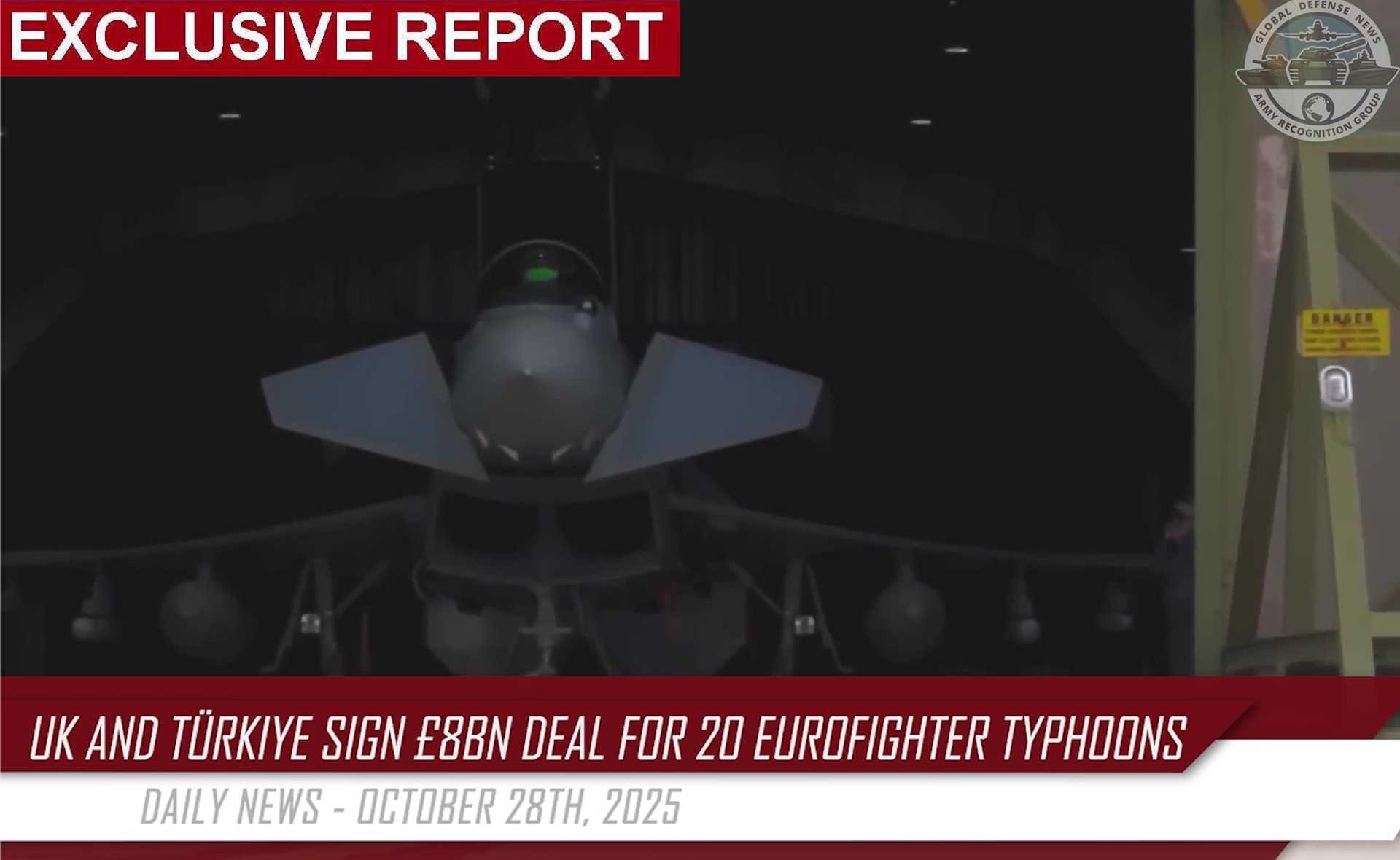
Türkiye and the United Kingdom have sealed an £8 billion deal for 20 Eurofighter Typhoons, including Meteor-equipped weapons and full support packages, with deliveries of new-build jets expected from 2030 (Picture Source: Army Recognition Group)
Türkiye and the United Kingdom have concluded an agreement for 20 Eurofighter Typhoons under UK export authority. The discussions involving 24 used jets, 12 each from Oman and Qatar, are being handled on separate tracks rather than as part of the UK–Türkiye contract. London’s £8 billion figure is a package ceiling that includes MBDA weapons (notably Meteor BVRAAM missile), pilot training, spares and integration services. Within that envelope, £5.4 billion is cited as the initial contract value, while BAE Systems’ £4.6 billion reflects only its workshare. According to Türkiye, Omani airframes would be overhauled before any potential first deliveries from early 2026; a schedule for Qatari aircraft has not been disclosed. New builds are slated from 2030, aligning with the coming radar standard.
The Eurofighter Typhoon is a twin-engine, canard-delta multirole fighter designed by a European consortium and powered by two Eurojet EJ200 afterburning turbofans, each rated at roughly 60 kN dry and over 90 kN with reheat, providing a high thrust-to-weight ratio and sustained agility, including limited supercruise. The aircraft measures 15.96 m in length, 10.95 m in wingspan, and 5.28 m in height, with a wing area of 51.2 m². It carries up to about 9,000 kg of external stores on 13 hardpoints, in addition to a 27 mm BK-27 internal cannon. The Tranche 4 variant has an increased maximum take-off weight above 23,500 kg and external load capacity over 7,500 kg. Its performance envelope includes speeds up to Mach 2, a service ceiling exceeding 55,000 ft, and take-off in under 8 seconds from a <700 m runway. The baseline sensor suite now includes the E-Scan AESA radar providing improved electronic scanning and air-to-surface mapping, the PIRATE IRST, and the Praetorian Defensive Aids Sub-System integrating radar warning, electronic jamming, and countermeasures. With 13 weapon stations, the Typhoon supports a comprehensive ordnance set including Brimstone 2, Spear 3, AGM-88E AARGM, JDAM, and laser-GPS-guided bombs, alongside its established air-to-air armament of IRIS-T, ASRAAM, AMRAAM, and Meteor missiles.
The radar and variant mix remains the crux of combat capability. Earlier Tranche 3A aircraft, such as those delivered to Oman, employ the mechanically scanned CAPTOR-M, offering credible but now dated performance compared to e-scan systems. Qatar’s Tranche 3A jets feature Leonardo’s ECRS Mk0 AESA, providing full electronic scanning yet limited by thermal and future-growth margins. The Tranche 4 configuration, however, integrates the E-Scan radar with digital electronic-warfare pods, software-defined mission systems, and modular avionics architecture capable of supporting the Future Combat Air System (FCAS). Its improved electronic-warfare suite enables spectrum management, radar-signal suppression, and enhanced survivability. Designed for service until at least 2060, the Tranche 4 will act as a bridge to Europe’s Next-Generation Fighter within FCAS. If the forthcoming Tranche 5 standard and ECRS Mk2 multifunction AESA are not available in time for Türkiye’s production schedule, deliveries would default to the Tranche 4 baseline, balancing mature technology with long-term upgrade potential.
Operationally, the UK-brokered framework enables Türkiye to field capability in two waves: the separately negotiated 12+12 second-hand Typhoons could flow into the order of battle quickly once concluded, while a higher-end “technology squadron” forms around the 20 new builds when they arrive. Turkish officials indicate a pragmatic, NATO-aligned squadron design, roughly 18 frontline jets plus reserves and maintenance float, so the 24 used airframes can seed one full unit with training depth, and the 20 new jets another with cutting-edge sensors and weapons. The hybrid approach also reduces near-term dependence on a single radar standard while Meteor integration and UK-led training compress conversion timelines.
This Typhoon tranche dovetails with Türkiye’s broader fighter roadmap. Ankara has a parallel U.S. Foreign Military Sales track for 40 new F-16 Block 70s and upgrade kits to bring 79 in-service F-16s to Viper standard, sustaining fleet availability, AESA penetration and common weapons through the 2030s. In parallel, the indigenous fifth-generation KAAN program has moved from roll-out to flight test since February 2024, with additional prototypes in assembly; the Typhoon buy is thus best read as a capability bridge that preserves high-end air-policing and BVR mass while KAAN matures toward operational service.
Against peers, Türkiye’s future Typhoon stack presents a distinctive balance. Versus the F-35A, even with ECRS Mk2 and Meteor, Typhoon remains a non-stealth, externally armed 4.5-generation platform; the F-35’s low-observable shaping, internal carriage and deep sensor fusion keep the edge for penetrating IADS and for shared situational awareness as Block 4 rolls out. Typhoon’s countervailing strengths are kinematics and sortie flexibility: high specific excess power, sustained supersonic dash with a heavy BVR load, a large missile cockpit for mixed A2A profiles, and, if Mk2 is fielded, organic electronic-attack options that can open windows for fourth-generation packages. Compared with the Russian Su-57, Typhoon offers proven availability, NATO datalinks, established weapons integration and a large user community; by contrast, Su-57 production tempo, export status and mission-system maturity remain opaque, creating uncertainty around fleet scale and sustainment.
Against Rafale F4 moving to F5 this decade, the comparison is closest. Both jets field Meteor, advanced multispectral sensors and strong EW, but they emphasize different trade-offs: Rafale leans into compact signatures, SPECTRA upgrades and tightly integrated sensor fusion that favor discrete strike and dense-EW environments, while Typhoon with ECRS Mk2 trades on raw BVR reach, jammer-receiver growth paths and a broad coalition sustainment base that simplifies munitions stockpiles and training across NATO partners. KAAN, finally, is Türkiye’s end-state answer for stealth and sovereign integration; it remains in prototype testing, so the Typhoon fleet fills the near- to mid-term air-dominance and QRA roles, preserving BVR mass and interoperability while KAAN’s envelope expands toward operational service.
Türkiye’s Typhoon plan is less a detour than a deliberate bridge. By pairing quick-to-field Gulf airframes under separate agreements with a new-build radar and weapons roadmap under the UK contract, Ankara hedges schedule and technology risk, sustains pilot currency and maintenance pipelines, and keeps a credible BVR posture while KAAN matures. In parallel, F-16V deliveries and upgrades stabilise sortie generation and common munitions across the fleet, reinforcing NATO interoperability and easing logistics. The net effect is a force mix that deters now, integrates better tomorrow, and, if ECRS Mk2 and Meteor arrive on the indicated timeline, establishes a durable BVR and electronic-attack spine for the decade ahead while preserving industrial and political ties with the UK consortium.
Written by Teoman S. Nicanci – Defense Analyst, Army Recognition Group
Teoman S. Nicanci holds degrees in Political Science, Comparative and International Politics, and International Relations and Diplomacy from leading Belgian universities, with research focused on Russian strategic behavior, defense technology, and modern warfare. He is a defense analyst at Army Recognition, specializing in the global defense industry, military armament, and emerging defense technologies.