






Breaking News






Baykar’s Kızılelma UAV Unlocks Air-to-Air Combat Power With MURAD AESA Radar Flight Test.
Baykar’s Kızılelma unmanned fighter has successfully flight-tested Aselsan’s MURAD AESA radar, marking a milestone in Türkiye’s push for indigenous air-combat systems. The integration moves the stealth UCAV closer to full air-to-air engagement capability and strengthens the country’s defense technology autonomy.
On 20 October 2025, Türkiye’s Bayraktar Kızılelma flight-tested Aselsan’s MURAD active electronically scanned array radar, a step designed to unlock full air-to-air combat functionality. The test, highlighted by Baykar’s official announcement, signals the program’s move from weapons-carriage trials to networked sensor-led air combat roles, as reported by Baykar Technologies. For Türkiye’s maturing unmanned fighter ecosystem, the event matters because it couples a stealthy UCAV with a domestic fire-control radar and an indigenous electro-optical targeting suite. It also aligns with Aselsan’s broader sixth-generation air-combat vision across KAAN and key drones, including Kızılelma.
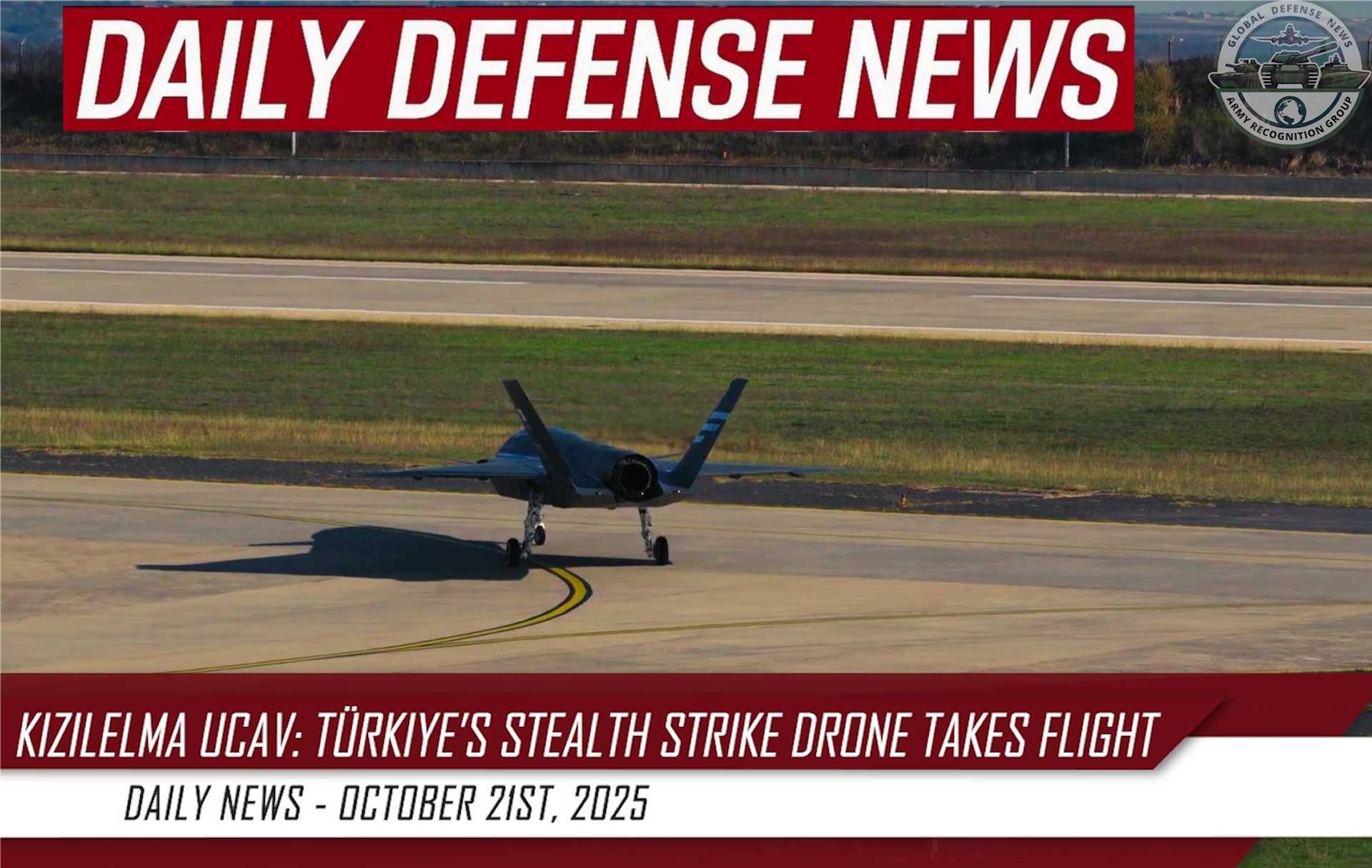
Baykar’s Kızılelma is seen in flight, equipped with the MURAD AESA radar and the TOYGUN electro-optical targeting system (Picture source: Baykar and Aselsan)
Bayraktar Kızılelma, shown in this campaign with tail number TC-OZB5, is a low-observable, carrier-capable UCAV evolving toward near- and ultimately supersonic variants. The aircraft’s latest configuration integrates Aselsan’s MURAD fire-control radar and the TOYGUN electro-optical targeting system, giving it multi-spectral sensing and weapon-cueing pathways independent of foreign supply chains.
Technically, ASELSAN’s MURAD 100-A AESA fire-control radar provides agile electronic beam steering with simultaneous air-to-air and air-to-ground operation, digital beamforming, GaN-based amplification, and a graceful-degradation architecture using solid-state T/R modules, capabilities consistent with a modern multi-mission fighter radar and crucial for BVR search, multi-target tracking and missile guidance. TOYGUN adds an HD MWIR channel with 2-axis mechanical plus 2-axis optical stabilization, single/multi-target tracking, automatic target recognition, and a laser rangefinder/designator coded to STANAG 3733 with a listed range up to 35 km, supporting passive detection, identification, terminal cueing and GPS-denied employment.
Kızılelma’s recent development cadence underscores how today’s radar flight is the logical next step. The production prototype TC-ÖZB3 flew in late 2024 with major airframe and avionics updates; 2025 then brought aerodynamic and maneuver-system identification flights, followed by carriage and live-fire trials with domestically produced guided munitions such as TOLUN and TEBER-82. In early October 2025, Baykar reported direct hits with TOLUN, days after carriage work documented by independent observers.
The third-prototype production version of Turkey’s Baykar Kızilelma (PT-3 / tail TC-ÖZB3) took to the air on 25 September 2024, marking its maiden sortie with an upgraded airframe and avionics, including an afterburner engine variant and aerodynamic refinements. In the first quarter of 2025, the platform completed aerodynamic system-identification and maneuver system tests (6–21 March) to validate the performance of its upgraded flight controls and engine. By late September and early October, it moved into weapons carriage trials, mounting ASELSAN’s TOLUN precision glide bomb on 27 Sept and the TEBER-82 guided bomb on 3 Oct as captive-carry loads. Then on 8 October 2025, Baykar announced successful hits with both TOLUN and TEBER-82 in what it described as the first live-fire test of Kızilelma. This fast-paced development cadence, from maiden flight to integrated weapons carriage and release in under 13 months, underscores how the progression to full radar-sensor and combat-mission flights appears to be a logical next step.
What the MURAD–TOYGUN sensor pairing changes for Kızılelma is the kill chain. With MURAD handling long-range detection, track fusion, and missile support, while TOYGUN provides passive, high-fidelity identification and terminal cueing, the UCAV can prosecute beyond-visual-range and within-visual-range engagements under emissions control, counter-jamming, or low-observable tactics. The architecture also aligns with Aselsan’s “sixth-generation” construct, manned–unmanned teaming, distributed sensors, and data-fused lethality across KAAN, Anka-3, and Kızılelma.
Arming implications are explicit. With a domestic fire-control radar now flight-tested on Kızılelma, the platform moves toward employing Türkiye’s GÖKTUĞ family of air-to-air missiles, Bozdoğan for short-range WVR shots and Gökdoğan for BVR engagements. Those missiles just completed live-fire tests from an F-16 on 19 October 2025, demonstrating maturity on frontline fighters and streamlining their integration pathway to Kızılelma as radar and stores management software converge.
Strategically, this milestone compresses Türkiye’s time-to-effect for a sovereign, layered air-combat construct. Geopolitically, domestic radar, EO/IR, and missile chains reduce exposure to export restrictions and enable tailored rules of engagement with allied or non-aligned partners. Geostrategically, a stealthy UCAV that can network with KAAN and other assets extends persistent BVR coverage, supports air-policing and maritime control from platforms like TCG Anadolu, and offers cost-imposed dilemmas: manned adversaries must expend high-value missiles against a lower-cost, attritable target that can still fight back. Militarily, MURAD on Kızılelma introduces fighter-like sensor-to-shooter timelines to an unmanned platform already demonstrating live-fire proficiency with indigenous precision weapons, while Aselsan’s sixth-gen roadmap points to denser sensor fusion, better EW resilience, and coordinated swarming with other drones.
Flying Kızılelma with a domestic AESA and a combat-grade EOTS moves the program from flight-test validation to force-design relevance, closing the sensor-to-shooter loop with indigenous effectors. The radar–EO/IR pairing establishes a software-defined path to air-to-air employment of Bozdoğan and Gökdoğan, enables emissions-controlled tactics, and dovetails with manned–unmanned teaming across KAAN, Anka-3, and maritime nodes such as TCG Anadolu. The immediate gates are clear: captive-carry and separation with national AAMs, validation of multi-target TWS and mid-course support, EW-resilience trials, and operational testing for sortie generation. Taken together, these steps translate a sovereign technology stack into deployable air-to-air tasking while reducing export exposure and reinforcing Türkiye’s layered air-combat posture.
Written by Teoman S. Nicanci – Defense Analyst, Army Recognition Group
Teoman S. Nicanci holds degrees in Political Science, Comparative and International Politics, and International Relations and Diplomacy from leading Belgian universities, with research focused on Russian strategic behavior, defense technology, and modern warfare. He is a defense analyst at Army Recognition, specializing in the global defense industry, military armament, and emerging defense technologies.