





Breaking News






Türkiye's Aeromac displays Sea Strike USVs in UAE to cover both naval defense and attack missions.
At UMEX 2026, the Turkish company Aeromac Electronic presented the AI-powered Sea Strike family of unmanned surface vehicles for combat, surveillance, electronic warfare, mine countermeasures, and expendable strike roles.
In January 2026 at UMEX 2026 in the United Arab Emirates, the Turkish company Aeromac Electronic presented its Sea Strike family of unmanned surface vehicles (USVs), a lineup consisting of modular USVs sharing a common AI-based marine autonomy system. The Sea Strike configurations cover naval combat, intelligence, patrol, mine warfare, electronic warfare, and expendable missions through modular payload integration.
Follow Army Recognition on Google News at this link
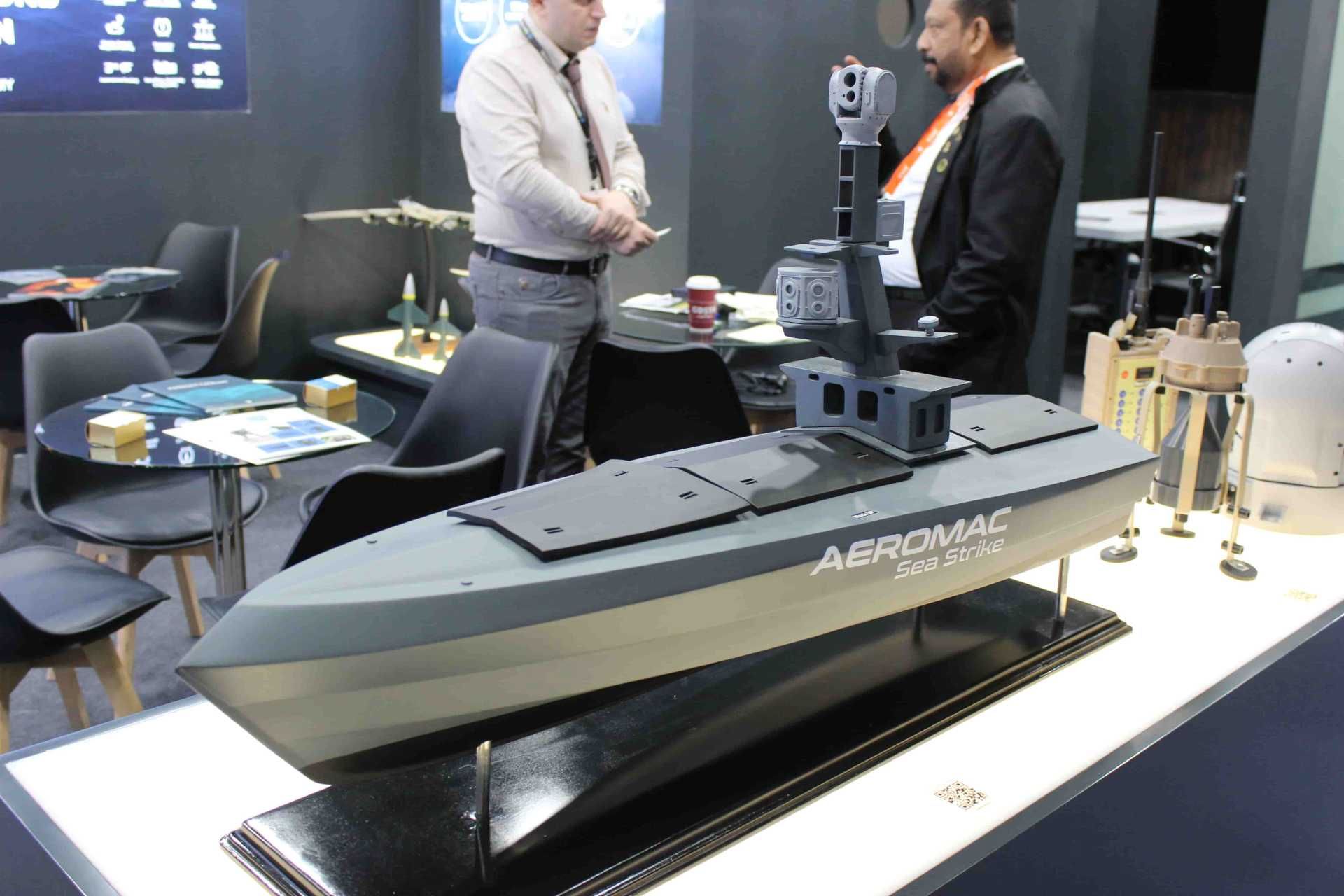
All variants of the Sea Strike USV are equipped with an AI-based marine autonomy system intended for flexible mission and route planning, safe return to base or a determined point, as well as dynamic obstacle detection and avoidance. (Picture source: Army Recognition)
The Sea Strike USVs, with multiple hull sizes, payload configurations, and mission roles unified by a common AI-based marine autonomy architecture, can be used for anti surface warfare, anti submarine warfare, air defense warfare, amphibious operations, mine countermeasure operations, electronic warfare, patrol and surveillance, signal intelligence, coast guard missions, expendable kamikaze roles, unmanned surface target functions, swarm operations, asymmetric attack profiles, and armed protection tasks for naval units and high value elements.
The central Sea Strike multipurpose USV possesses a 14.6 meter hull with a beam of 4.3 meters and a draught of 0.76 meters, constructed with an aluminum hull and cabin and powered by either jet drive or stern drive propulsion. The maximum speed for this configuration is 40+ knots, as it is positioned as a multi-role craft configurable for surface engagement, shallow water submarine search and engagement, mobile air defense, amphibious spearhead and support missions, mine detection and autonomous neutralization, and spectrum suppression activities. This same hull length is associated with multiple role codes, including SS-SURF, SS-ASW, SS-AIR, SS-AMPH, SS-MCM, and SS-EW, indicating a modular approach in which mission equipment defines the operational role rather than the basic vessel geometry.
For surface warfare tasks under the SS-SURF configuration, the Sea Strike payload options include a mini surface guided missile launcher, a 12.7 mm stabilized turret, an EO and IR pod, a low probability of intercept radar, and an AI-supported targeting system. In the SS-ASW configuration, the same hull is equipped with a light torpedo launcher, an ASW rocket, towed sonar, dipping sonar, and AI-based sonar processing to support submarine search and engagement in shallow waters. The SS-AIR variant, a mobile air defense craft, can be outfitted with payloads such as a mini Stinger-like surface to air missile, an RF jammer, and an EO and IR tracking pod, reflecting an emphasis on short range air defense and electronic countermeasures.
Amphibious and mine warfare roles are also present, with the SS-AMPH configuration for reconnaissance, supply, and spearhead missions supported by a 12.7 mm stabilized turret, fog generator, EO and IR surveillance sensors, a cargo compartment, and a robotic arm with discard and collection capability. The SS-MCM, for its part, focuses on sea mine detection and autonomous destruction, combining a mini underwater ROV, a magnetic destruction device, towed sonar, an AI-based mine classifier, and a robotic arm with discard and collection functions. For electronic warfare operations, the SS-EW's payload options include RF jammers, radar deceivers for jamming and deception, RF analyzers, and an electronic warfare database, indicating spectrum monitoring and active interference tasks.
The Sea Strike family also includes smaller hulls dedicated to patrol, surveillance, intelligence, and expendable missions. The Sea Strike Mini USV, created for patrol, surveillance, and signal intelligence, has a length of 7.2 meters, a beam of 2.00 meters, and a draught of 0.49 meters, with an HDPE hull and jet drive or stern drive propulsion enabling speeds of 40+ knots. On the other hand, the SS-PSS can be deployed for long-term intelligence and surveillance tasks, with payload options including a 7.62 mm stabilized turret, two to four FPV mini drones for ISR or light attack, EO and IR cameras, COMINT and ELINT systems, RF recording equipment, and an FPV control module, while FPV type kamikaze drone integration is noted by Aeromatic as a recurring capability across several Sea Strike variants.
Expendable and training roles are covered by the 5.45 meter Sea Strike hull, which has a beam of 1.6 meters, a draught of 0.35 meters, an HDPE hull, jet drive or stern drive propulsion, and a stated speed of 60+ knots. In its expendable configuration, labeled SS-DART K-USV or SS-OK KİDA, this craft is described as a fast, AI-powered collision vehicle equipped with a 200 kilogram marine type explosive with IP-67 protection and increased effect, combined with EO and IR sighting, INS plus AI targeting, autonomous guidance, an FPV control module, and the option to integrate one or two FPV attack or surveillance drones. The same hull form is also used as an unmanned surface target boat under the SS-TARGET designation, supporting training, testing, and radar target functions through RF reflectors, radar cross section generators, telemetry systems, RCS simulation, and task scenario software.
Beyond individual hulls, Aeromac outlined a wider Sea Strike product range including high speed multipurpose USVs in the 11.4 to 11.6 meter class, with beams between 2.4 and 2.6 meters, draughts around 0.55 meters, FRP hulls, and speeds of 60 to 65 knots. These variants possesses propulsion arrangements such as two or three 350 HP diesel engines with Jolly Drive systems and are planned for roles including coast guard operations, patrol, amphibious missions, mine countermeasures, electronic warfare, surveillance, and expendable strike tasks, with one configuration specifying a 1,000 kilogram marine type IP-67 protected explosive option for K-USV use. A larger Sea Strike variant is listed at 15.5 meters in length with a 3.5 meter beam, 0.7 meter draught, a weight of 15,000 kilograms, a payload capacity of 3,000 kilograms, a range of 350 miles, propulsion via three 900 HP diesel engines, and a stated speed of 70 knots plus, illustrating the extension of the Sea Strike family toward heavier, longer range unmanned surface craft.
The Sea Strike USVs are equipped with an AI-based marine autonomy solution supporting flexible and optimized mission and route planning, division of routes into multiple waypoints, safe return to base or a determined point, static and dynamic obstacle detection and avoidance, collision avoidance at sea, and route planning constrained by restricted or pre-determined areas. Control concepts include TeleOps remote control under LOS and NLOS conditions, autonomous docking and shove off, emergency scenario handling, and the ability to operate vessels individually or within coordinated swarm formations. Additional system attributes listed across the Sea Strike family include full COLREG compatibility, reduced radar cross section, reduced magnetic signature, increased ballistic resistance, and the ability to function as unmanned surface targets, positioning the Sea Strike family as a comprehensive set of Turkish unmanned surface vehicles built around a common autonomy and mission integration approach.
Written by Jérôme Brahy
Jérôme Brahy is a defense analyst and documentalist at Army Recognition. He specializes in naval modernization, aviation, drones, armored vehicles, and artillery, with a focus on strategic developments in the United States, China, Ukraine, Russia, Türkiye, and Belgium. His analyses go beyond the facts, providing context, identifying key actors, and explaining why defense news matters on a global scale.