






Breaking News





U.S. Virginia class submarine USS Vermont maintenance in Australia to deepen AUKUS undersea ties.
The US Navy’s Virginia-class attack submarine USS Vermont has completed a multi-week maintenance period at HMAS Stirling in Western Australia, directed by Pearl Harbor Naval Shipyard under the AUKUS framework. The evolution marks a major proof of concept for future Submarine Rotational Force West operations and for Australia’s ambition to sustain nuclear-powered attack submarines from its own soil.
Australian defence officials and the US Navy have confirmed that USS Vermont (SSN 792) has wrapped up an intensive maintenance period at HMAS Stirling, the Royal Australian Navy’s primary submarine base near Perth, after arriving on 29 October for what Canberra describes as a more complex package of work than last year’s trial activity. Directed by Pearl Harbor Naval Shipyard and Intermediate Maintenance Facility, the stopover brought together US submarine maintainers, British specialists, and a growing cohort of Australian technicians who used the visit to stress test nuclear stewardship, safety systems, and industrial processes that will underpin Submarine Rotational Force West from 2027.
Follow Army Recognition on Google News at this link
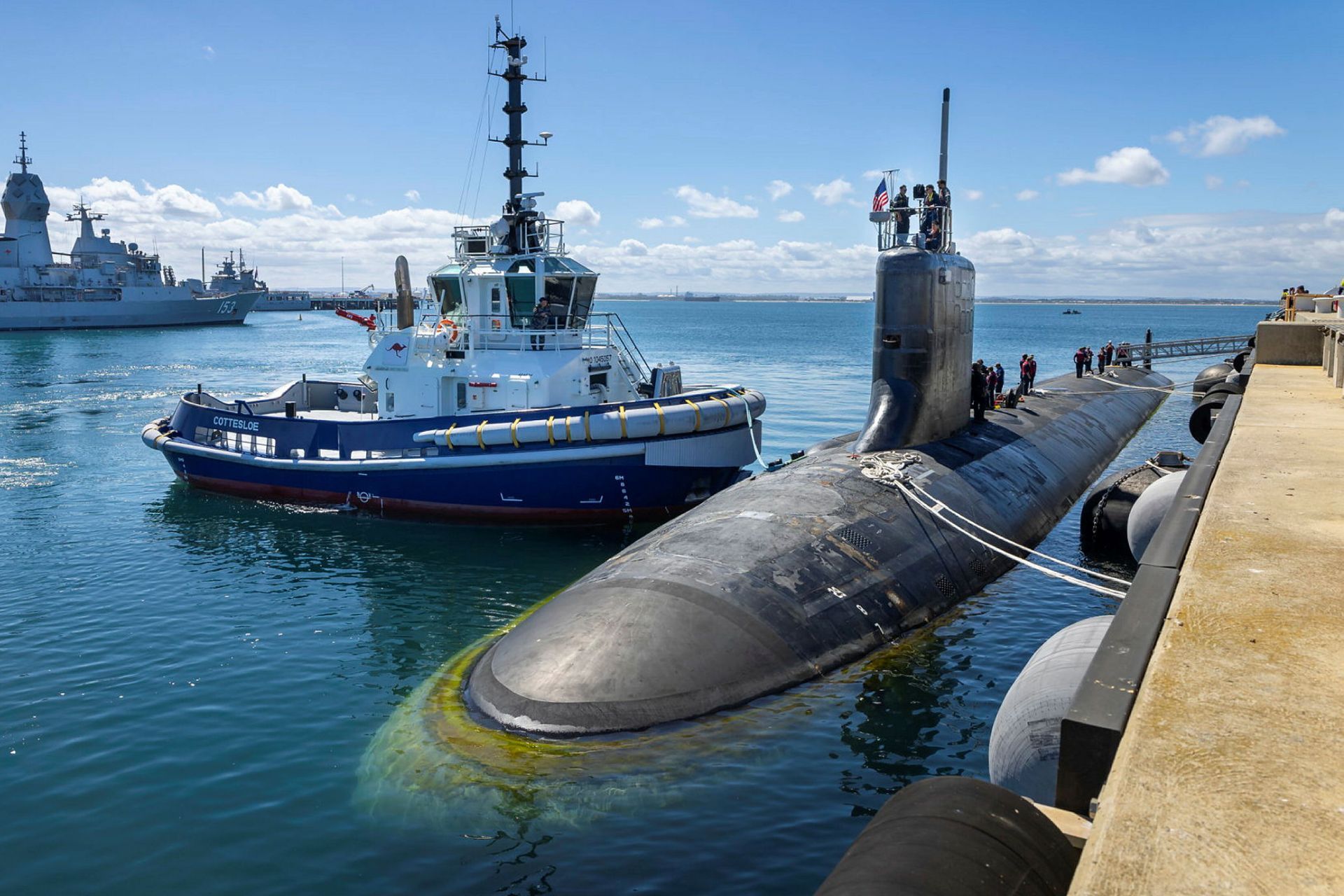
After completing a Submarine Maintenance Period in Western Australia, the United States Navy Virginia-class fast attack submarine USS Vermont (SSN 792) prepares to depart HMAS Stirling. (Picture source: Australian MoD)
USS Vermont is one of the more recent units in the Virginia program. As the first example of the Block IV batch, it provides a useful reference point for assessing the maintenance philosophy specific to this series. Delivered in April 2020 and commissioned in the same month, it changed homeport in July 2023 to join the joint base Pearl Harbor Hickam, aligning its employment with the forward posture of the US Pacific Fleet in the Indo-Pacific. Earlier in 2025, Vermont completed a seven-month deployment to the Western Pacific before returning to Hawaii in March, giving the crew and technical teams a recent operational baseline to validate the procedures implemented at HMAS Stirling.
From a technical standpoint, Vermont illustrates the key features of the Virginia family. The submarine is about 115 meters long, with a beam close to 10 meters, and displaces nearly 7,900 tonnes when submerged, a size that combines oceanic range with the ability to operate in constrained littoral approaches. Propulsion is provided by an S9G nuclear reactor driving a pump-jet propulsor, the core being designed to provide about thirty-three years of service without refuelling, which explains the importance of maintenance infrastructure calibrated to this standard at HMAS Stirling. The class routinely exceeds 25 knots submerged and prioritises acoustic discretion rather than pure speed, a parameter that matters for extended patrols in contested environments.
Weapons and sensors give Vermont a broad set of options during these patrols. As a Block IV unit, it has two large Virginia Payload Tubes in the bow, each able to accommodate six Tomahawk cruise missiles, for a total of twelve long-range strike weapons in vertical launch. Four 533 mm torpedo tubes carry Mk 48 heavyweight torpedoes as well as encapsulated anti-ship munitions if required, for a total of around forty weapons stored on board. The combat system is based on the AN BYG 1 architecture, which fuses data from a comprehensive sonar suite including bow array, flank arrays, and towed array, with electronic warfare measurements and a surface-search radar housed in a non-penetrating optronic mast.
Tomahawk cruise missiles remain one of the main tools available to the crew. Current Block IV and Block V variants can reach targets at more than 1,000 miles, around 1,600 kilometres, flying at low altitude along pre-programmed routes designed to reduce exposure to detection networks. Fired from a discreet underwater position, these weapons give a single Virginia-class submarine the ability to engage protected land targets located far inland, without exposing ships or aircraft to high-risk areas. For a partner such as Australia, hosting a platform with such reach provides a very concrete illustration of what AUKUS offers in terms of combined strike options and shared operational planning.
Block IV design changes are directly reflected in the upkeep carried out at HMAS Stirling. The US Navy designed this series to reduce the number of major overhauls from four to three over an estimated thirty-three-year service life, which allows for fifteen deployments instead of fourteen and reduces the time spent in deep maintenance. This approach only makes sense if allied bases can take on an increasing share of inspections, repairs, and corrective work between those heavy periods. Hence, the focus on integrating Australian technicians, divers and engineers into the process instead of limiting it to an exclusively US-run operation.
Alongside the quay at HMAS Stirling, the maintenance activity brings together personnel from Pearl Harbor Naval Shipyard, the submarine maintenance community of the Pacific Fleet, and Australian teams from the Fleet Support Unit, the Australian Submarine Agency, and local industry. Thirteen Australian officers and sailors are embedded in the crew, which numbers around one hundred and thirty people, and form part of the group already trained on nuclear-powered submarines in the United States. For them, this maintenance period goes beyond basic familiarisation with procedures. It acts as a practical test of how future Australian nuclear-submarine crews will handle defect management, certification routines, and safety checks alongside their US and British counterparts.
Within the framework of AUKUS Pillar 1, the United States and the United Kingdom plan to rotate nuclear-powered attack submarines through Western Australia from 2027, before transferring at least three Virginia-class units to the Royal Australian Navy in the 2030s. Each successful maintenance period for a US submarine in Australia allows Canberra to demonstrate its ability to manage nuclear safety, industrial security, and the integration of complex systems at a level deemed acceptable by its partners. For Washington and London, this anchors a lasting undersea presence in the eastern Indian Ocean and the approaches to the South China Sea, sending a clear signal to other regional actors that AUKUS is moving gradually from political statements to practical cooperation in the undersea domain.