






Breaking News






Estonia presents new Euromite USV for fast attack operations against enemy ships.
SirenTech presented a scale model of its Euromite USV at Milipol 2025, an 8-meter aluminum platform designed for ISR, patrol, strike, and electronic warfare operations.
At Milipol 2025, the Estonian start-up SirenTech, created by DefSecintel and Baltic Workboats, presented a scale model of its Euromite unmanned surface vehicle (USV), an 8-meter aluminum craft previously seen at MSPO 2025. Using several types of payload, this USV is intended for a wide range of operational needs, such as reconnaissance supported by a tethered aerial drone, logistics, strike missions, autonomous patrolling along coastlines and borders, and electronic warfare. Capable of operating even when conditions degrade due to AI-powered detection, identification, and navigation systems, the Estonian USV could reach a top speed of 55 knots.
Follow Army Recognition on Google News at this link
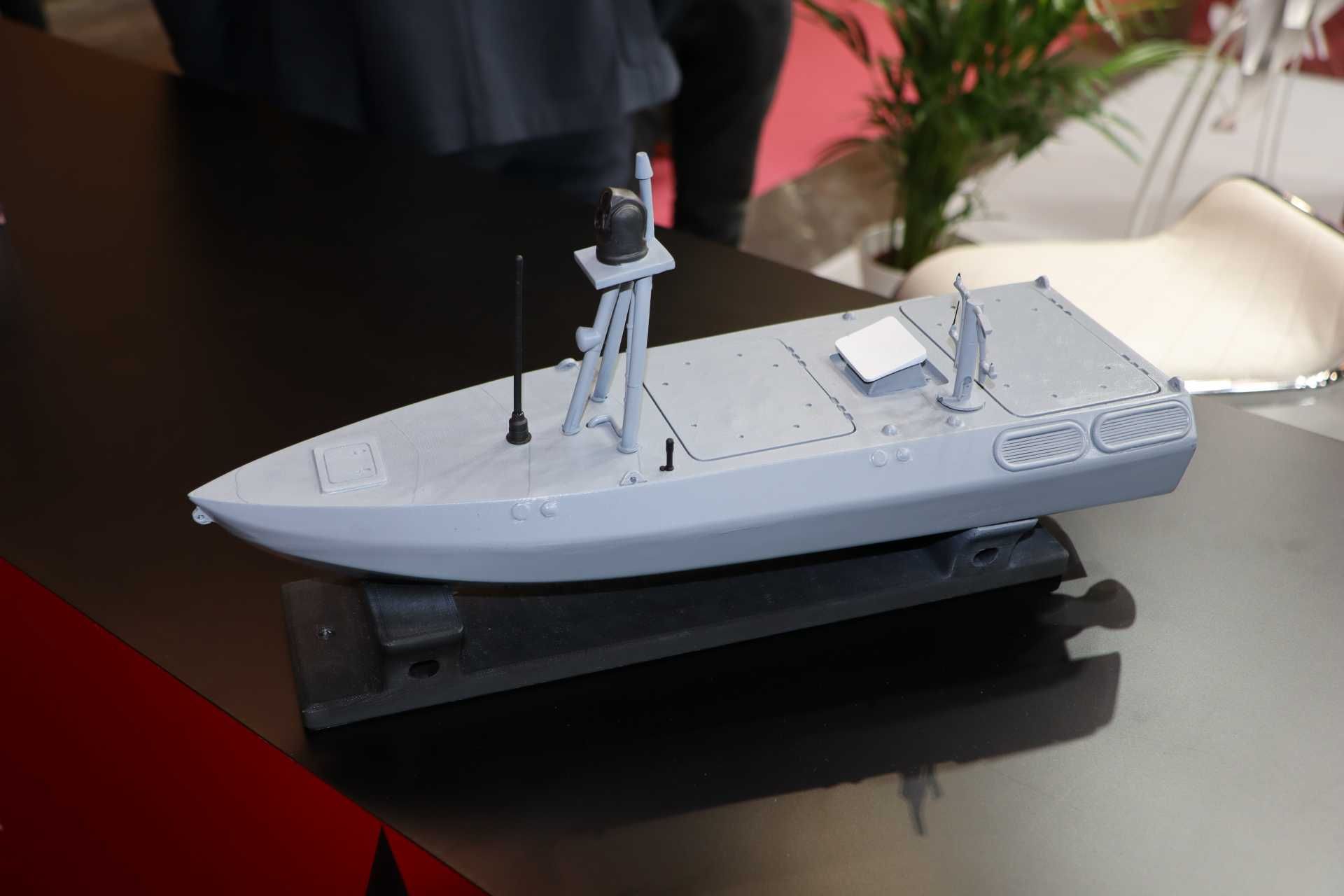
The communications of the Euromite are assured through a mix of radio, cellular, and satellite links, while built-in safety features were developed for GPS or communication loss, as well as mission cancellation. (Picture source: Army Recognition)
When configured as a patrol vessel, the Euromite can autonomously monitor coastal or border sectors while maintaining communication with command elements through its multi-channel communication architecture. Additional roles presented included harbor protection in port areas through local ISR, readiness for one-way engagement tasks, and support to electronic warfare missions, including counter-UAV defense within sensitive maritime zones. The USV was also described as capable of operating as a communication relay point at sea, extending connectivity during distributed operations between naval or security units. A vessel support role was outlined, allowing the Euromite to follow another ship to add an extra layer of security around maritime assets. Like many USVs, these missions were presented as interchangeable through several modular payloads and mission configurations, allowing a single platform to cover multiple roles depending on user requirements. The propulsion, consisting of two petrol engines driving two waterjets, allows the Estonian USV to reach a top speed of 55 knots with a 540 nautical mile range at 30 knots.
The Euromite's aluminum hull measures 8.0 meters in length, 2.2 meters in beam, and 0.5 meters in draught, while carrying up to 1,150 liters of fuel and 500 kilograms of payload. Autonomy features include several AI-supported systems for detection, identification, and navigation, along with safety systems for communication loss, GPS loss, and mission cancellation, which are intended to keep the vessel in operational status under degraded conditions. The modular payload architecture permits the integration of weapon systems, electronic warfare equipment, surveillance packages, or, surprisingly, smaller interceptor USVs. Command and control through an AI-enhanced tablet-based interface, as well as the transportability by lightweight trailer, were highlighted as two key practical features, as they could permit a quick redeployment between coastal sectors without needing major port infrastructures, while simplifying both the handover and the remote control of the Euromite from shore or afloat positions.
Unmanned surface vessels (USVs) trace their origins to early experiments in the decades following World War II, but their real development accelerated around the turn of the 21st century when improvements in sensors, propulsion, communications, and control systems made small robotic surface craft more practical. Since around 2010, rapid progress in autonomy, computing, and modular payload design has further accelerated the emergence of modern USVs developed to operate like the Estonian Euromite, such as Poland’s StormRider, Taiwan's Thunder Tiger SeaShark 800, Ukraine’s Seawolf/Sea Baby/Magura V5, and Israel’s Protector USV. The progress was remarkable: in 2001, the Spartan Scout was a simple rigid-hull inflatable boat reconfigured as an unmanned surface vehicle, and ten years later, the Piranha USV, created with advanced lightweight materials and a large payload capacity, could be deployed for anti-piracy, harbor patrol, or search and rescue. As computing, autonomy, modular payload design, navigation, and control systems continued to improve, USVs gradually evolved from simple reconnaissance or patrol craft towards multi-purpose vessels capable of mine countermeasures, surveillance, transport, and in some cases armed combat or strike missions.
The most striking example of the rise of USVs is the war in Ukraine. In August 2023, the Ukrainian command established the 385th Unmanned Surface Vehicles Brigade, regarded as the first dedicated military USV unit in the world. Among the unmanned vessels deployed by Ukrainian soldiers, the Magura V5 and the Sea Baby soon gained international recognition. The first was developed to carry out surveillance, reconnaissance, patrolling, and combat missions, and later variants were modified to carry air-to-air missiles adapted for surface-to-air use. The Sea Baby, initially conceived as a kamikaze-type explosive boat, has evolved since late 2023 into a more flexible multi-mission vessel with extended range, heavier payload capacity, and a variety of possible armament loadouts. Russian vessels and infrastructure (including patrol boats, smaller ships, and support vessels) soon paid the price following their large-scale use by Ukraine, demonstrating that relatively small, low-cost craft can significantly threaten larger conventional naval assets when used with tactical innovation.
This experience has led navies and maritime forces globally to draw several operational and strategic lessons. First, USVs demonstrate that relatively small, low-cost, uncrewed vessels can pose a significant threat to larger surface ships and infrastructure when used with surprise, swarm tactics, or asymmetric deployment, challenging traditional naval force structures built around large crewed ships. Second, the modularity and adaptability of modern USVs (enabling quick reconfiguration for reconnaissance, strike, transport, or electronic warfare) offer a flexibility that is difficult to match with crewed vessels, especially in contested littoral or coastal zones. Third, advances in autonomy, communications, and remote control reduce crew risk and logistical burden, allowing deployment from distributed or improvised launch points rather than large ports, which increases strategic options for operators under resource or infrastructure constraints. Finally, the proliferation of USV capabilities forces navies worldwide to reconsider defensive doctrine, invest in counter-USV measures, and integrate unmanned systems into mixed fleet architectures to maintain their relevance, as even a small number of USVs may alter the balance of naval power.
Written by Jérôme Brahy
Jérôme Brahy is a defense analyst and documentalist at Army Recognition. He specializes in naval modernization, aviation, drones, armored vehicles, and artillery, with a focus on strategic developments in the United States, China, Ukraine, Russia, Türkiye, and Belgium. His analyses go beyond the facts, providing context, identifying key actors, and explaining why defense news matters on a global scale.