






Breaking News





U.S. Navy bets on Palantir ShipOS to unclog submarine and destroyer production.
The U.S. Navy has selected Palantir Technologies to deploy its Foundry and Artificial Intelligence Platform across the Maritime Industrial Base under a ShipOS architecture, under a contract ceiling of 448 million dollars. The effort is designed to shorten submarine and surface combatant production cycles, stabilize fleet availability and help the United States keep pace with accelerating Chinese naval output.
Facing long-running delays in building and maintaining its nuclear submarines and surface combatants, the U.S. Navy is rolling out a new digital backbone for its shipyards and suppliers built around Palantir’s Foundry and Artificial Intelligence Platform, bundled under the name ShipOS. Navy officials describe the 448 million effort, managed through the Maritime Industrial Base program office in partnership with Naval Sea Systems Command, as a way to stitch together fragmented planning tools, legacy logistics databases, and real-time production data into a single operating picture that can expose bottlenecks in everything from hull sections to sonar arrays.
Follow Army Recognition on Google News at this link
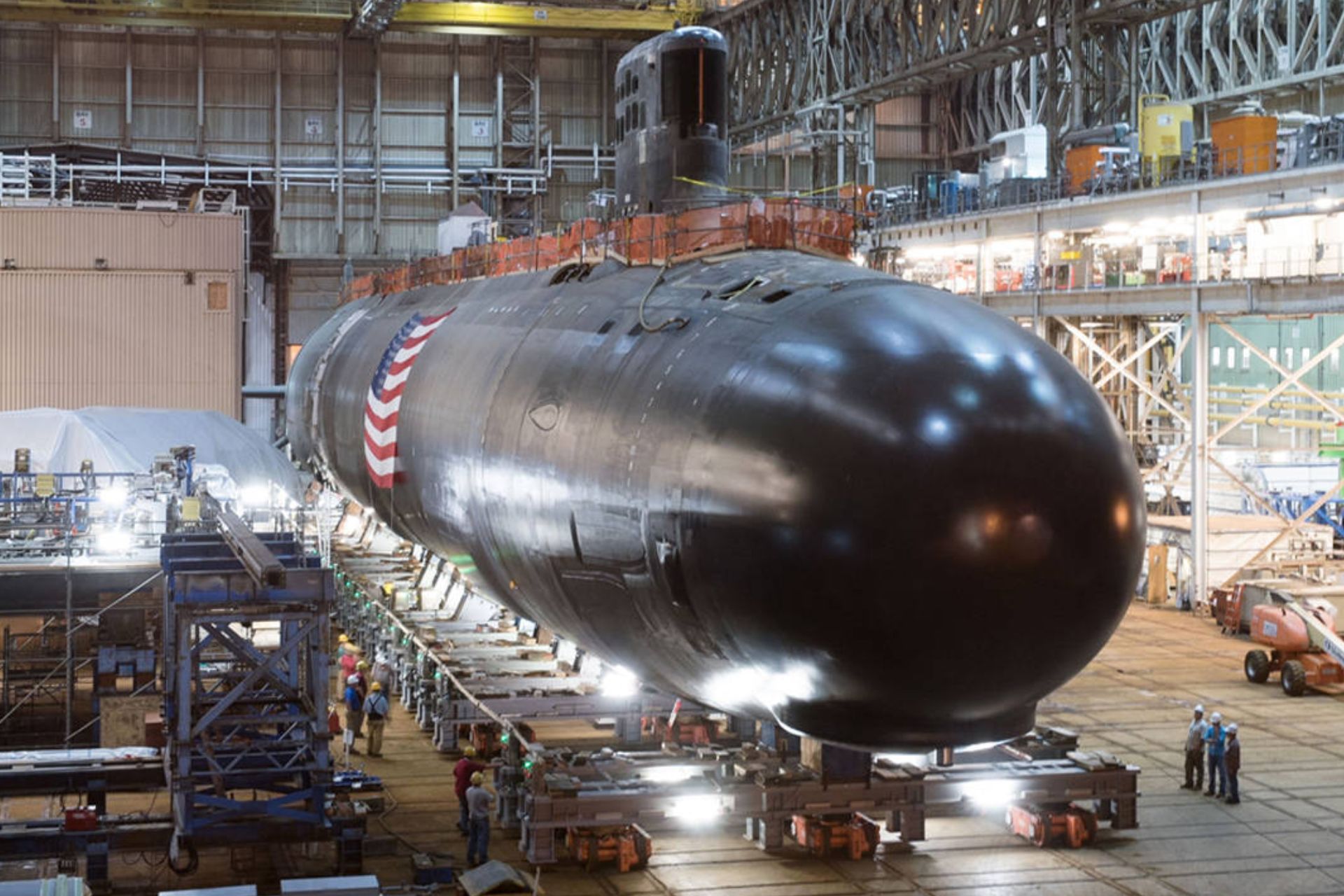
ShipOS operates by consolidating information flows from industrial planning systems, historic logistics databases, and operational data sources. (Picture source: General Dynamics)
The American naval production chain has been under mounting pressure for several years. Upgrades at public shipyards, shortages of qualified labor, the complexity of Virginia-class nuclear-powered attack submarines, and the ramp up of the Columbia program have generated congestion throughout the sector. The Navy acknowledges that production cycles are lengthening, that maintenance periods are extending, and that industry is struggling to deliver the volumes needed to keep enough units in service. In this context, Palantir presents ShipOS as an architecture able to unify existing data, reduce administrative friction, and turn a patchwork of legacy systems into a more coherent digital infrastructure. The parallel is clear: the technology is intended both to improve performance and to offset the structural weaknesses that are slowing the American production rate.
ShipOS operates by consolidating information flows from industrial planning systems, historic logistics databases, and operational data sources. The aim is to obtain an accurate view of stocks, production capacity, bottlenecks, and the actual condition of assembly lines. The initial results presented illustrate how wide the room for improvement remains. At Electric Boat, the generation of a production schedule, previously spread over 160 hours of manual work, has dropped to under ten minutes. At Portsmouth Naval Shipyard, the analysis and approval of material lots has gone from several weeks to one hour. These examples fit into an industrial reality in which each delay on critical modules, such as sections housing the AN BQQ 10 sonar or the AN BVS 1 optronic masts on attack submarines, triggers a cascade effect across the whole construction process.
The program also targets surface shipyards, which face comparable challenges. US vessels integrate high-power phased array radars such as the AN SPY 6, whose modules require a steady logistics chain and strict synchronization with installation milestones. Any disruption affecting a sensitive electronic component can halt an entire integration sequence, which often depends on a limited access window to the ship’s superstructure. Palantir emphasizes that ShipOS helps anticipate such disruptions and direct resources toward areas at risk of shortages. This discourse aligns with the Department of the Navy’s strategy to narrow the gap between planned and actual production rates, a critical issue for maintaining American maritime superiority.
The tactical and operational implications of this modernization are direct. A credible submarine fleet depends on unit availability and on a stable industrial cycle that sustains the rotation between construction, maintenance, and deployment. US attack submarines operate over long distances, rely on their sensors in dense acoustic environments, and must retain an advantage in detection and discretion. For surface combatants, the need for continuous presence in the Indo-Pacific and the Mediterranean requires available hulls fitted with fully functional radar systems and air defense capabilities. More regular production, supported by tighter control of the logistics chain, gives planners essential breathing space and limits the erosion of margins needed to absorb unexpected events.
The United States faces naval competition in which China is increasing the number of ships laid down and refining its own industrial networks. In this dynamic, control of time becomes an element of power. By strengthening the coherence of its industrial base, Washington is seeking to re-establish a construction tempo able to support its global maritime presence. The initiative launched with Palantir therefore, comes at a moment when American credibility depends on its capacity to produce, maintain, and deploy a sufficient volume of units. ShipOS thus appears as one component of a broader US strategic adjustment, a way to prevent erosion of naval advantage in an increasingly contested environment.