






Breaking News






South Korea launches major modernization program for KSS-II submarine fleet.
South Korea has initiated a 468.9 billion won program to replace the combat and sonar systems of its KSS II submarines, which were developed in the 1990s, with upgrades scheduled to continue through 2033.
As reported by the Korea JoongAng Daily on November 20, 2025, the South Korean Defence Acquisition Program Administration (DAPA) launched a 468.9 billion won project to upgrade the combat and sonar systems of the KSS-II submarines, initiating the formal start of a modernisation program that will run until 2033. The project began with a system development kick-off meeting held at HD Hyundai Heavy Industries in Ulsan, where the Navy, the Defense Agency for Technology and Quality, and industry partners reviewed development plans and cooperation arrangements. The agency confirmed that the upgrades are intended to enhance detection, identification, navigation, and attack performance, as aging systems no longer meet current operational needs.
Follow Army Recognition on Google News at this link
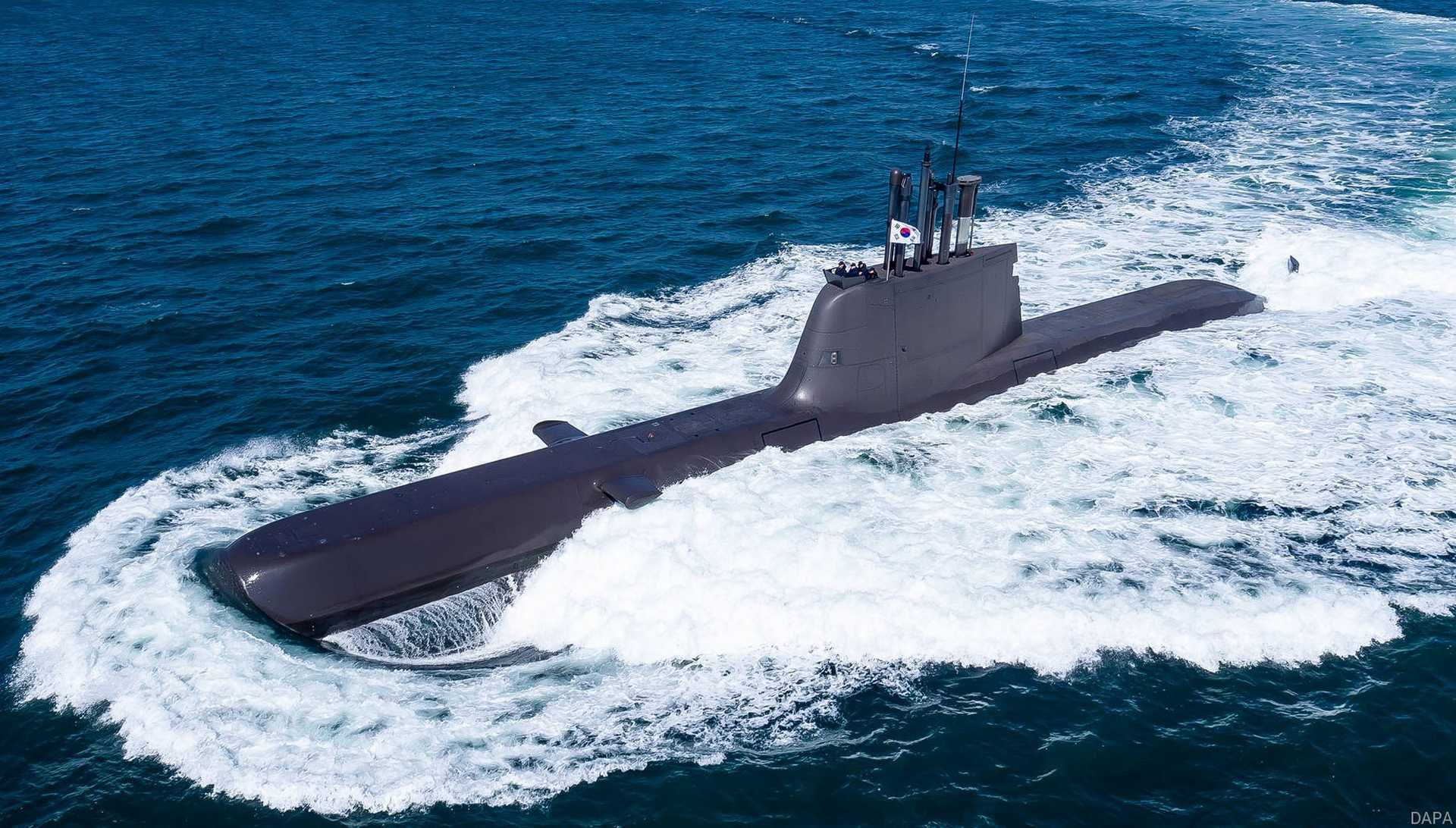
The KSS-II, also known as the Jang Bogo II or Sohn Won-il class, represents the second phase of South Korea’s broader Korean Attack Submarine plan, which was conceived to move beyond coastal midget submarines and the earlier Jang Bogo-class. (Picture source: DAPA)
The upgrade plan involves replacing the combat systems and towed array sonars on three KSS-II submarines with the latest equipment by 2033 and adding mine avoidance sonars, ship-side array sonars, and buoyant wire antennas to expand the vessels’ underwater awareness and communication capabilities. The agency noted that the current combat system and towed arrays were designed in the 1990s and had become inadequate for countering modern maritime threats, making it difficult for crews to respond effectively to adversary submarines and surface ships. The initiative is therefore intended to address these limitations by installing domestically developed systems that can support long-term logistics and provide improved resistance to emerging undersea detection technologies in contested environments.
The KSS II program, also known as the Jang Bogo II or Sohn Won-il-class, represents the second phase of South Korea’s broader Korean Attack Submarine (KSS) plan, which was conceived to acquire a more capable attack submarine that would improve endurance, reduce snorkeling, and expand mission roles beyond the earlier Jang Bogo-class, while also strengthening the domestic industrial base by constructing the vessels in Korean shipyards using foreign licensed designs. Three international proposals were initially considered, including France’s Scorpène class, Sweden’s Gotland class, and Germany’s Type 214 class, with the German design ultimately selected after the Swedish builder was absorbed into the German group in the late 1990s, which removed one of the competitors. The first contract was signed with Hyundai Heavy Industries in 2000 for three submarines, and a later requirement led to the purchase of six additional units built alternately by Hyundai Heavy Industries and Daewoo Shipbuilding and Marine Engineering.
The KSS-II fleet consists of nine submarines introduced between 2007 and 2020, built alternately by HD Hyundai Heavy Industries and Hanwha Ocean, formerly Daewoo Shipbuilding and Marine Engineering. The South Korean Navy launched the lead boat, the Sohn Won-il, in June 2006 and commissioned it in December 2007, naming the class after the first Chief of Naval Operations, and later units were delivered between 2007 and 2020, all named after historical military leaders and independence activists, including Ahn Jung-geun, Kim Jwa-jin, Yoon Bong-gil, Yu Gwan-sun, Hong Beom-do, Lee Beom-seok, and Shin Dol-seok. The construction and operation of the class have included challenges such as noise levels exceeding specifications on early hulls, vibration problems with propulsion shafts, propeller cracking on specific units, delays caused by faulty inverter modules, and performance concerns with early fuel cell systems, some of which required multi-year repairs by foreign technical teams.
Investigations revealed that early acceptance tests were sometimes abbreviated, leading to the commissioning of vessels with defects that later required major correction, and some submarines experienced extended yard periods to resolve this. Despite these issues, the class formed a critical link between the earlier Jang Bogo-class and the more recent KSS-III Dosan Ahn Changho-class and supported missions including anti-submarine warfare, anti-surface warfare, mine warfare, special operations support, and intelligence collection across multiple squadrons, providing a crucial operational experience toward the development of South Korea’s fully indigenous KSS-III submarine. By incorporating locally developed combat systems and sonar suites into the upgraded vessels, the South Korean Navy now aims to improve detection ranges, threat classification accuracy, underwater communication capability, and long-term logistics support while reducing reliance on foreign suppliers for critical systems. The modernisation is expected to preserve the KSS-II class’s ability to carry out missions through the next decade, maintaining the class as a key element of South Korea’s undersea warfare structure while new, heavier indigenous KSS-III submarines enter service under the national naval build-up strategy.
Each KSS II is a 1,690-ton surfaced and 1,860-ton submerged diesel electric submarine measuring approximately 65.3 metres in length with a beam of 6.3 metres and a draught of 6.0 metres, supported by an air-independent propulsion (AIP) system based on hydrogen fuel cells that can maintain underwater endurance for around two weeks without surfacing. Propulsion is delivered through two MTU 16V 396 diesel engines, Piller generators, and two BZM120 fuel cell modules linked to a Siemens Permasyn permanent magnet electric motor driving a single shaft for speeds of up to 20 knots underwater and around 12 knots on the surface. The submarine carries eight 533 mm torpedo tubes and can deploy SUT Mod 2 or Baeksang Eo torpedoes, Harpoon Block II missiles, and Haeseong II cruise missiles with a reported range of 1,000 kilometres, along with up to 32 mines depending on mission requirements. Multiple sonar types are used, such as the DBQS 40 bow sonar, FAS 3 medium- and low-frequency side array sonar, TAS 90 towed array sonar, MOA 3070 mine detection sonar, and PRS 3 15 sonar arrays mounted above the side arrays.
The ISUS 90 combat system integrates data from sonar, radar, environmental information, and navigation systems to track up to 240 contacts and pursue 32 targets simultaneously, using open architecture to support future upgrades and automation that enables minimal watch standing requirements. Additional onboard systems include several periscopes, such as the SERO 14 optical mast, SERO 15 attack periscope, and SERO 400 optical suite in combination with the OMS 100 non-penetrating mast. Electronic and self-protection systems include the UME 2000 electronic warfare suite, the TAU 2000 decoy and countermeasure system, while a range of communications equipment covers VLF, HF, VHF, UHF, satellite communications, without forgetting a Callisto floating communications buoy and a Link 11 network for sharing basic target information with surface ships, although the standard update rate is not real-time. The hull is constructed using HY 80 and HY 100 high-strength steel, and the internal layout includes torpedo rooms, crew quarters, control centres, AIP compartments, battery banks, and machinery rooms arranged across two decks within the pressure hull structure, allowing the class to conduct anti submarine warfare, anti surface warfare, mine warfare, and special operations support across multiple operational theatres.
Written by Jérôme Brahy
Jérôme Brahy is a defense analyst and documentalist at Army Recognition. He specializes in naval modernization, aviation, drones, armored vehicles, and artillery, with a focus on strategic developments in the United States, China, Ukraine, Russia, Türkiye, and Belgium. His analyses go beyond the facts, providing context, identifying key actors, and explaining why defense news matters on a global scale.