










Poland to launch first Delfin-class ORP Jerzy Różycki intelligence ship to increase Baltic surveillance.
As reported by Gospodarka Morska, the ORP Jerzy Różycki (261), the first of two radio-electronic reconnaissance ships of the Delfin (Project 107) program, will be launched and christened on July 1, 2025, at Remontowa Shipbuilding S.A. in Gdańsk. The Delfin program was initiated under a contract signed on November 25, 2022, between the Polish State Treasury’s Armament Agency and Saab Kockums AB.
Follow Army Recognition on Google News at this link

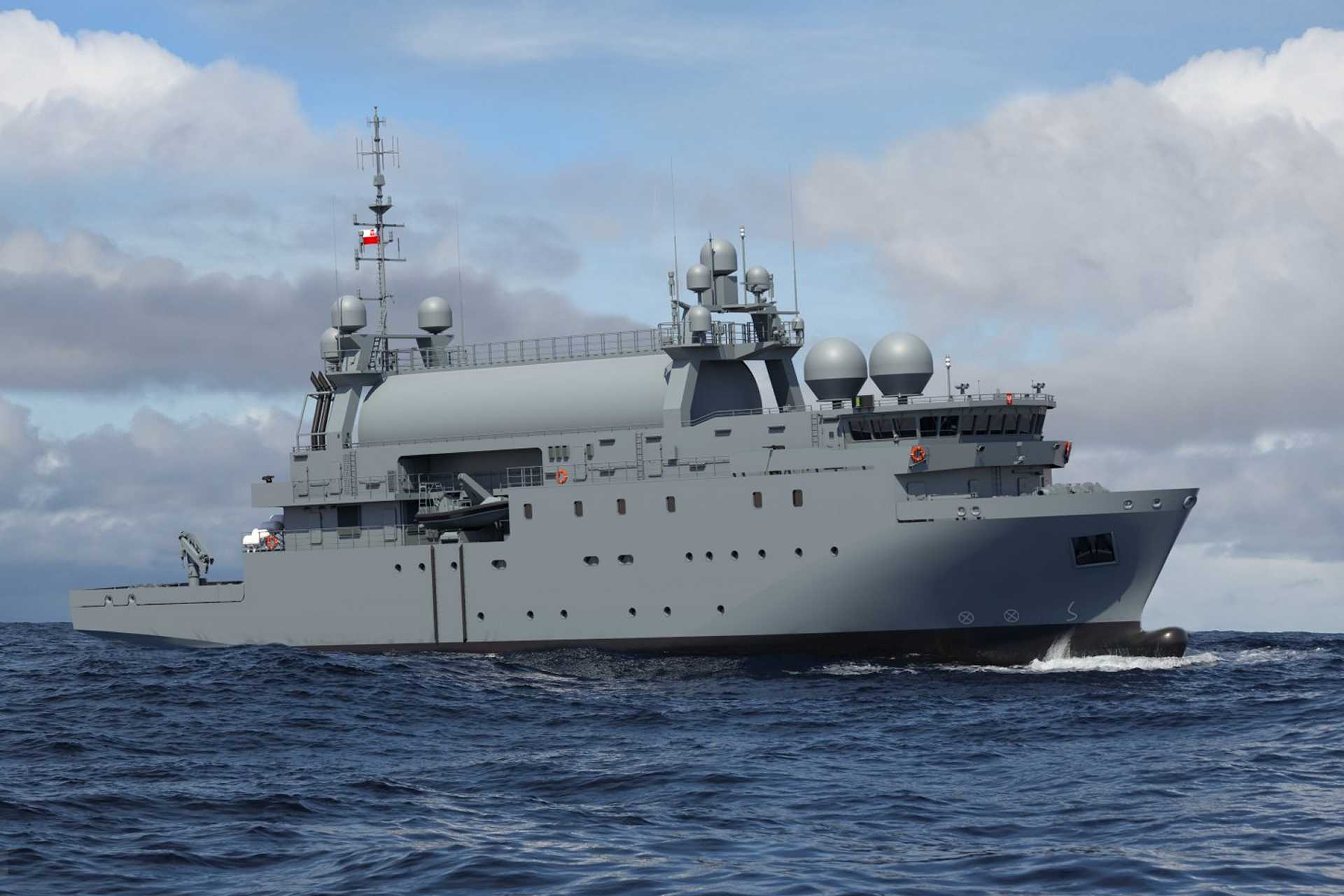
The Delfin-class design is based on the Swedish Artemis-class vessel HMS Artemis (A202), which was also constructed in part by Polish shipyards and entered service in 2024. (Picture source: Remontowa Shipbuilding)
The agreement includes the design, construction, delivery, and logistical support of two SIGINT (Signals Intelligence) vessels. The ships are intended to replace the Project 863 ORP Nawigator (262) and ORP Hydrograf (263), which were built in 1975 and 1976 at the Northern Shipyard in Gdańsk, now operating as Remontowa Shipbuilding. The new ships will be integrated into the Group of Reconnaissance Ships of the 3rd Ship Flotilla and stationed at the Naval Base in Gdynia. Both vessels are expected to be delivered by the end of 2027.
The construction of ORP Jerzy Różycki began with a steel-cutting ceremony on April 27, 2023, followed by the keel-laying on July 27 of the same year. The second ship, ORP Henryk Zygalski (264), commenced construction with steel cutting on November 15, 2023, and its keel was laid on January 23, 2024. The ships are named after Polish mathematicians and cryptologists Jerzy Różycki and Henryk Zygalski, who, along with Marian Rejewski, contributed to the breaking of the German Enigma cipher prior to World War II under the direction of Major Maksymilian Ciężki. This naming follows a Polish Navy tradition of reassigning tactical numbers of decommissioned vessels. ORP Kopernik (261) and ORP Bałtyk (264), which were retired, previously held the same hull numbers. As part of the ceremonies, commemorative medals have been welded into the keels of both Delfin-class ships.
The vessels will measure 74 meters in length and displace up to 3,000 tons. Each ship will be powered by four diesel generators rated at 990 kW each, driving azimuthal thrusters. Two bow thrusters will enhance maneuverability and positional accuracy at sea. The crew will consist of approximately 35 to 40 sailors accommodated in 35 cabins with 40 bunks. The platforms will be delivered fully constructed by Remontowa Shipbuilding, which is also responsible for completing Harbour Acceptance Trials (HAT) and Sea Acceptance Trials (SAT). Once structural work and basic outfitting are completed, Saab personnel will finalize integration of specialized electronic systems. These include electronic intelligence (ELINT), communications intelligence (COMINT), measurement and signature intelligence (MASINT), and imagery intelligence (IMINT). Although detailed specifications are classified, the ships are expected to operate across the full electromagnetic spectrum and conduct reconnaissance of radar emissions, underwater acoustic signatures, and communication links.
The Delfin-class design is based on the Swedish Artemis-class vessel HMS Artemis (A202), which was also constructed in part by Polish shipyards and entered service in 2024. Both projects share naval architecture designed by MMC Ship Design & Marine Consulting Ltd. in Gdynia. Artemis is 74.6 meters long, 14 meters wide, has a draft of 3.8 meters, and a full displacement of approximately 2,300 tons. It is equipped with four diesel-electric generators identical in output to those in the Polish vessels. Artemis has two azimuthal main thrusters and two bow thrusters, which support station-keeping functions critical to signals intelligence operations. Artemis is fitted with sensors for intercepting radio, satellite, and electromagnetic emissions and can determine their source position by triangulating data from multiple locations. Polish Delfin-class vessels are expected to be similarly capable but with configurations adapted to Polish Navy requirements.
The project includes Saab’s role as the system integrator and supplier of all reconnaissance and command systems. Saab’s cooperation with the Armament Agency and Remontowa Holding is supported by a permanent office in Gdańsk, opened in January 2024 to manage project activities and industrial coordination. Subcontractors involved include Teknotherm, a company responsible for heating, ventilation, air conditioning, and refrigeration systems. The classification and quality assurance of construction are overseen by DNV (Det Norske Veritas). The contract’s value, equivalent to approximately €620 million or 6.7 billion SEK, is subject to financial conditions which, according to Saab, were expected to be fulfilled by the end of 2022. The build sequence includes delivery of fully constructed and tested hulls by Remontowa Shipbuilding, with Saab integrating mission systems at the same shipyard before final handover.
Poland’s naval modernization program includes the Delfin-class alongside other acquisitions. Three Kormoran II-class mine countermeasure vessels are under construction at the same shipyard and will join the 12th Minesweeper Squadron of the 8th Coastal Defense Flotilla based in Świnoujście. These ships, ORP Jaskółka, ORP Rybitwa, and ORP Czajka, are scheduled to enter service by 2027. Additionally, three Miecznik-class multi-role frigates are being built to enhance Poland’s air defense and surface warfare capabilities. A naval rescue ship is planned for delivery by 2029. However, no final contract has been signed for new submarines to replace ORP Orzeł (1986). Offers have been submitted by shipbuilders from Italy and Sweden, and the procurement process remains ongoing. The Delfin-class is the first program in which an entire reconnaissance component of the Navy is being replaced under one contract, requiring preparation of new crews and maintenance of operational readiness during the transition.
The ships are designed to support reconnaissance missions focused on monitoring foreign naval units, ports, transmission infrastructure, offshore installations, and other maritime activity. The equipment will enable surveillance of radar stations, radio communication, underwater vehicles, and electromagnetic emissions across all signal bands. The vessels will also contribute to NATO intelligence-gathering operations in the Baltic Sea. Unlike armed vessels, SIGINT ships prioritize advanced data collection over combat systems. Their configuration will allow them to operate independently or in coordination with surface, underwater, air, and cyber elements of the Polish Armed Forces. The completion and delivery of ORP Jerzy Różycki and ORP Henryk Zygalski are expected to provide a significant expansion of Poland’s maritime reconnaissance capabilities in response to increased regional tensions and the need for strategic intelligence on maritime threats.