






Breaking News






Türkiye Completes NATO Qualification of Its First 7.62x51 MMT Machine Gun..
Türkiye’s state-owned defense firm MKE has completed NATO qualification of its new 7.62x51 mm MMT Modern Machine Gun after a 250,000-round endurance program. The milestone signals Ankara’s push to field a lighter, domestically controlled general-purpose machine gun aligned with NATO standards.
Türkiye’s state-owned Mechanical and Chemical Industry Corporation (MKE) announced on December 17, 2025, that it has completed the full qualification process for its 7.62x51 mm MMT Modern Machine Gun, developed in cooperation with the Presidency of Defense Industries (SSB). According to Turkish media reports citing the ANKA news agency, the weapon passed 40 NATO qualification tests and an endurance firing campaign totaling 250,000 rounds, clearing the system for serial production for the Turkish Armed Forces. SSB President Haluk Gorgun described the achievement as a clear indicator of the domestic defense industry’s growing engineering maturity and its ability to deliver alliance-compatible infantry weapons at scale.
Follow Army Recognition on Google News at this link
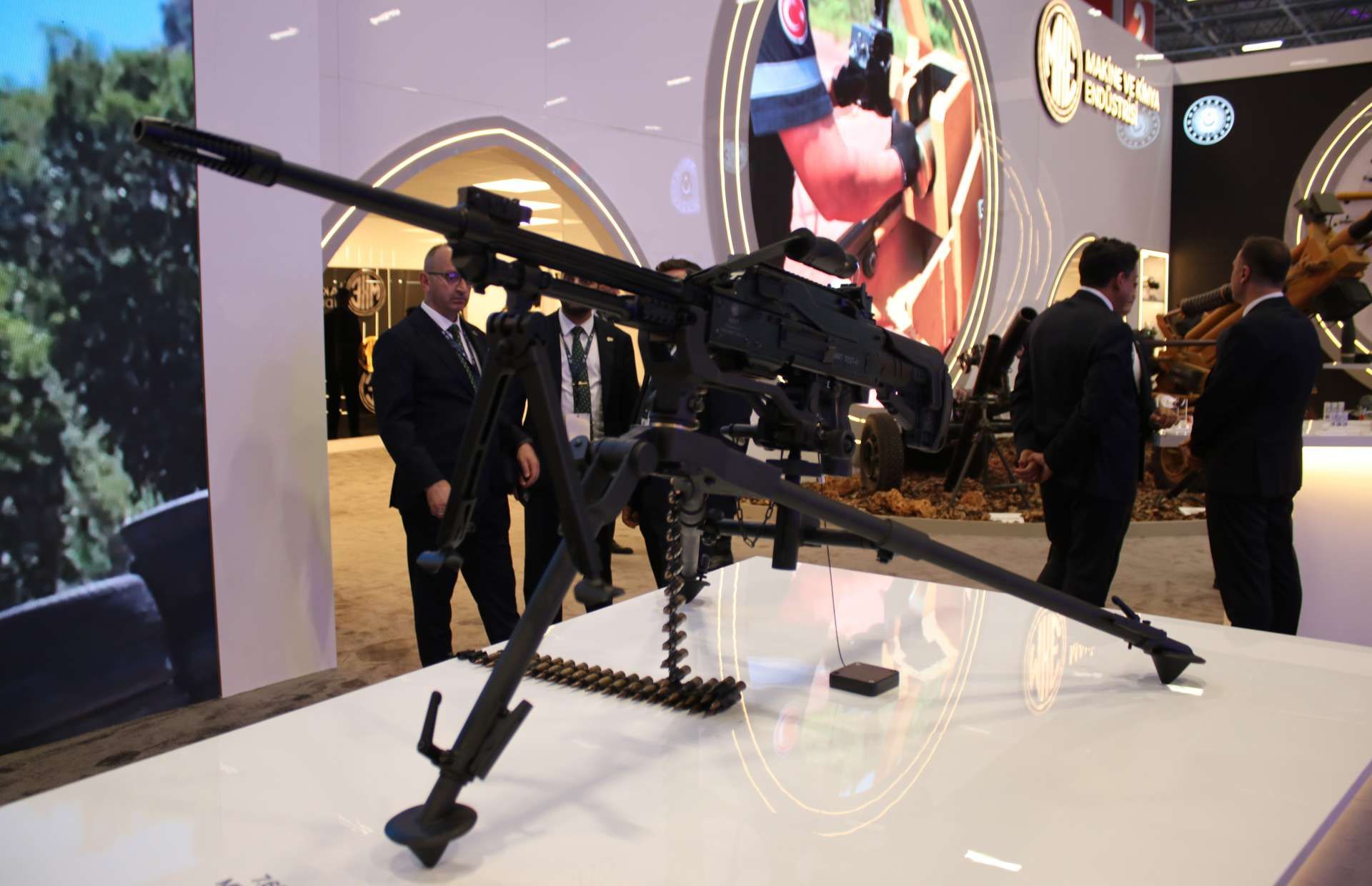
MKE's 8 kg MMT is a 7,62x51 NATO belt-fed machine with a quick-change barrel, adjustable gas, and optic rail delivering sustained suppressive fire to about 1,000 m (Picture source: Army Recognition Group).
At the hardware level, MKE’s own technical sheet frames MMT as a belt-fed 7.62x51 mm NATO infantry machine gun, optimized for mobility without compromising reach. The weapon is listed with a 604 mm barrel and an overall length adjustable from 1,120 to 1,200 mm via a telescopic stock, with a published cyclic rate of 750 rounds per minute, muzzle velocity of 840 m/s, dispersion of 8 MOA, and an effective range stated as 1,000 meters. The trigger force is specified as 15 to 30 newtons, and MKE’s export catalog for institutional customers lists linked ammunition feed, along with an effective range of 1,100 yards, which aligns closely with the 1,000 m figure.
Open source technical reporting suggests MMT’s architecture leans on the PK family’s long stroke gas piston heritage, firing from an open bolt with a rotating bolt, while adding modern infantry ergonomics such as an extended top rail for optics and aiming enablers, plus a quick change barrel and adjustable gas regulation aimed at keeping the gun running across fouling levels and extreme climates. That design choice matters tactically: it prioritizes a lighter receiver and controllable balance for dismounted troops, while still supporting sustained fire cycles through barrel swaps, tripod employment, and vehicle pintle mounts when the mission shifts from maneuver to area denial.
In practical battlefield terms, the headline number is not only 750 rpm but what an 8 kg general-purpose gun does to a small unit’s options. A gunner moving through urban alleys, mountain tracks, or trench networks can keep a 7.62 NATO belt-fed weapon closer to the fight, transition faster between firing points, and stay inside the team’s tempo rather than forcing the team to move at the machine gun’s pace. Engagement envelopes are broadly consistent with Western 7.62 GPMGs, including point target work from the bipod and expanded area suppression from tripod configurations, with maximum range figures in the 3.7 km class that match the typical ballistic ceiling of the cartridge and barrel length.
The “first” claim needs to be read precisely. Türkiye has fielded and produced various machine guns for decades, but MKE and SSB are positioning MMT as the country’s first infantry-type modern machine gun program in 7.62x51 NATO to complete a NATO-oriented qualification track as an indigenous design intended to consolidate mixed inventories. In that light, MMT is less about inventing the category and more about industrial sovereignty: controlling the design baseline, spares pipeline, and future upgrades while aligning a key infantry support weapon with alliance caliber norms.
Where MMT immediately attracts attention is its weight versus famous Western competitors. FN’s MAG and the US M240B class guns deliver proven durability but sit around 11.8 kg and 12.5 kg respectively in standard infantry configurations, while Heckler and Koch’s MG5 is also typically above 11 kg with selectable rates of fire up to 800 rpm. Even the lightweight end of the Western field, such as the M60E6 family, generally remains above 9 kg depending on barrel configuration. MMT’s published 8.0 kg figure, paired with a 750 rpm cycle and 840 m/s muzzle velocity, places it closer to the mobility of Eastern pattern guns while staying inside NATO ballistic expectations for 7.62 support fire.
Export prospects follow from that positioning. A 7.62x51 system that is qualified against NATO-style test regimes, designed for linked ammunition, and offered through established MKE export channels, is inherently attractive to customers who want NATO caliber interoperability without buying into US or EU supply constraints, and to partners modernizing from 7.62x54R legacies while keeping familiar doctrine around GPMG employment. A specialized media reported earlier international interest, including outreach from several African countries, and the weapon’s calibration to NATO ammunition and accessory ecosystems makes it a plausible candidate for security assistance-style packages, boutique special operations buys, and modernization tenders where logistics simplicity is the decisive argument.