






Breaking News






Iranian Navy claims to have intercepted US destroyer USS Fitzgerald during Gulf of Oman encounter.
On July 23, 2025, at approximately 07:30 GMT, the U.S. Navy destroyer USS Fitzgerald (DDG-62) approached waters that Iranian authorities describe as being under their surveillance in the Gulf of Oman. According to the Iranian state media Tasnim, Iran’s Third Naval District responded by dispatching a SH-3 Sea King helicopter, which flew directly over the destroyer and issued a radio warning in English, ordering the U.S. vessel to change its course.
Follow Army Recognition on Google News at this link
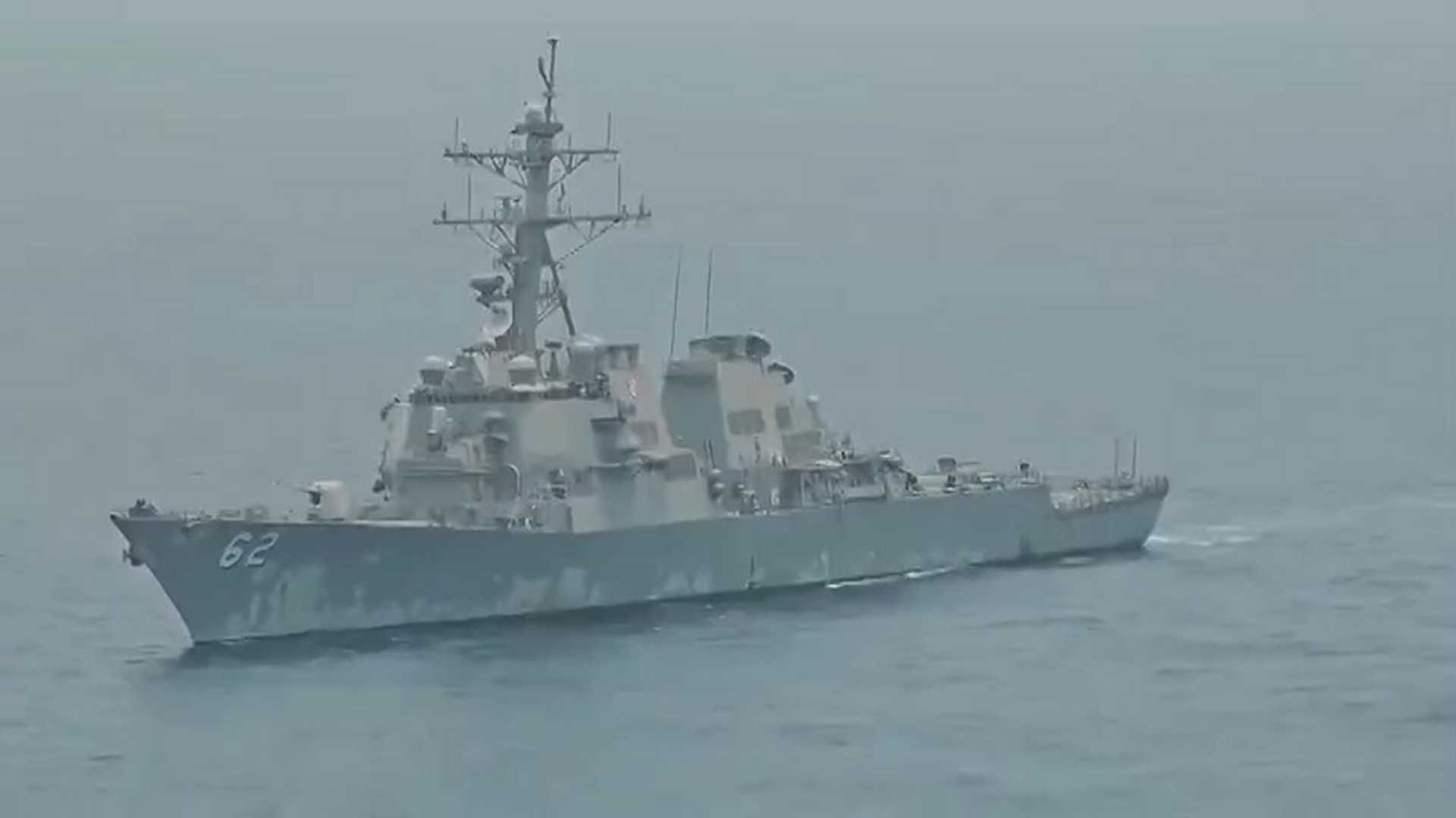
The USS Fitzgerald (DDG 62), a Flight I Arleigh Burke-class destroyer commissioned in 1995 and homeported in San Diego, is part of Destroyer Squadron 2 within Carrier Strike Group 3, led by the USS Abraham Lincoln. (Picture source: Iranian MoD)
Iranian footage reportedly taken from the helicopter shows the warship at close range, with an audible command demanding that it avoid Iranian-controlled waters. The Iranian accounts state that the USS Fitzgerald threatened to shoot down the helicopter, prompting activation of the Islamic Republic’s integrated air defense system, which declared the helicopter was fully protected and that the destroyer must leave. Iranian sources claim the Fitzgerald subsequently altered its course to the south and departed the area following this combined show of force.
U.S. Central Command firmly rejected the Iranian version of events, stating the encounter took place in international waters and describing it as a “safe and professional interaction.” A U.S. defense official, speaking to Reuters on condition of anonymity, said the Fitzgerald's mission was not affected and labeled any Iranian assertions to the contrary as misinformation disseminated by the Islamic Revolutionary Guard Corps. The U.S. military stated that there were no threats made toward the helicopter and identified it as an Iranian SH-3 Sea King. The U.S. also denied entering Iranian territorial waters or deviating from standard operating procedures. An article in USNI News cited naval expert Afshon Ostovar of the U.S. Naval Postgraduate School, who noted that the Iranian use of a single helicopter in such encounters was consistent with previous harassment tactics, aimed at testing American responses and reinforcing domestic messaging rather than projecting credible deterrence against a ship as heavily armed as the Fitzgerald.
Iranian media described the confrontation as the first direct military encounter between the United States and Iran since the 12-day conflict in June 2025 between Iran and Israel, during which the U.S. conducted a single airstrike on Iranian nuclear infrastructure on June 22. That strike, reportedly targeting three facilities, only inflicted significant damage at the Fordow site, according to post-strike assessments in U.S. media. In response, Iran launched missile attacks against the Al Udeid Air Base in Qatar, damaging a radar system and briefly disrupting American surveillance. President Donald Trump later called the U.S. operation a “spectacular” success, though Tehran’s leadership has disputed that characterization. Iranian President Masoud Pezeshkian, in a televised interview broadcast on the same day as the Fitzgerald incident, reiterated that Iran’s nuclear program was strictly civilian in nature, stated that Tehran had no intention of halting it, and warned that the country remained ready for a possible future conflict with Israel. He added that he was not optimistic about the recent ceasefire agreement brokered after the June hostilities.
Statements from Iranian military sources and various state-aligned media reiterated that the USS Fitzgerald attempted a “provocative approach” toward waters under Iranian observation. The helicopter, they reported, repeatedly instructed the ship to move away. Following the alleged threat made by the U.S. destroyer, the Iranian air defense system issued a formal warning confirming the aircraft’s protection. According to these sources, the persistence of the Iranian aircrew and air defense coverage eventually led to the U.S. warship’s retreat from the area. Video aired on Iranian television showed the helicopter’s proximity to the destroyer, with additional narration highlighting Iran’s stated objective to protect its maritime boundaries. The full timeline of events, based on Iranian sources, spans from 10:00 AM local time until the U.S. ship’s reported southward withdrawal.
The USS Fitzgerald (DDG-62) is an Arleigh Burke-class guided-missile destroyer ordered on February 22, 1990, and built by Bath Iron Works in Maine. Its keel was laid down on February 9, 1993, and the vessel was launched on January 29, 1994, before being commissioned on October 14, 1995, at Naval Station Newport, Rhode Island. Initially homeported in San Diego, the ship later operated from Yokosuka, Japan, where it became part of the U.S. Seventh Fleet. Throughout its service, it participated in a wide range of operations and exercises, including support missions in the Arabian Gulf, maritime intercepts enforcing UN sanctions, ballistic missile defense tests, and joint drills with regional allies such as Japan, South Korea, and Australia. The Fitzgerald was notably involved in humanitarian assistance following the 2011 Tōhoku earthquake and tsunami and hosted diplomatic events such as the signing of the Manila Declaration in 2011. On June 17, 2017, the destroyer was involved in a collision with the container ship ACX Crystal near Japan, resulting in the deaths of seven sailors, serious structural damage, and a multi-year repair period that included sea trials and updates. The ship returned to San Diego in 2020, later participating in RIMPAC 2022 and 2024, and as of 2025, continues to operate as part of Destroyer Squadron 2 within Carrier Strike Group 3.
The USS Fitzgerald has a full load displacement of approximately 8,900 long tons and measures 154 meters in length, with a beam of 18 meters and a draft of 9.4 meters. The destroyer is powered by two shafts and can exceed speeds of 30 knots, with an operational range of roughly 4,400 nautical miles at 20 knots. It is equipped with multiple radar and sensor systems, including the AN/SPY-1D phased-array radar, AN/SPS-67 surface search radar, and AN/SPS-73 navigation radar. For underwater detection and anti-submarine operations, it uses the AN/SQQ-89 combat system, including hull-mounted sonar and towed arrays. Defensive systems include the AN/SLQ-32 electronic warfare suite, Mk 36, Mk 53 Nulka, and Mk 59 decoy launchers, as well as AN/SLQ-25 Nixie torpedo countermeasures. The ship's armament includes one 127 mm (5-inch)/54 Mk 45 naval gun, two Phalanx 20 mm close-in weapon systems, two Mk 38 25 mm chain guns, and four 12.7 mm machine guns. Its missile systems consist of 90 vertical launch system cells capable of firing RIM-66 and RIM-156 surface-to-air missiles, RUM-139 ASROC, BGM-109 Tomahawk cruise missiles, and RIM-161 anti-ballistic missiles. The destroyer also features two triple Mark 32 torpedo tubes and supports one MH-60R Seahawk helicopter for anti-submarine and maritime surveillance missions. As of early 2025, the Fitzgerald is the first U.S. Navy ship equipped with the Enterprise Remote Monitoring Version 4 (ERM v4) artificial intelligence system, developed by Fathom5, replacing the older ICAS platform and enabling real-time monitoring of over 10,000 onboard systems for predictive maintenance.
The confrontation comes amid Iran’s efforts to institutionalize long-term military readiness following the June 2025 twelve-day war with Israel and the United States. Iranian military leadership, including Brigadier General Mohammad Reza Ashtiani, has publicly stated that the country holds sufficient military reserves to sustain a decade of warfare if necessary. On July 13, 2025, the Iranian Parliament approved the general framework of a bill mandating full funding of the 2025–2026 defense budget, immediate payment of any outstanding 2024 allocations, and the release of blocked foreign financial assets for military use. This legislative push follows a previously enacted 200 percent increase in military spending, raising the budget from $15.7 billion to approximately $46 billion. The bill also centralizes defense funding under institutions like the Supreme National Security Council and obliges the Central Bank to provide emergency resources. The Islamic Revolutionary Guard Corps (IRGC) is reported to be the main beneficiary of this increased funding.
Iran has also expanded ballistic missile testing, restricted International Atomic Energy Agency (IAEA) inspections about its uranium enrichment levels, and linked its defense posture to national sovereignty in the Gulf region. The latest encounter at sea reinforces both Tehran’s stated red lines in territorial defense and Washington’s adherence to international navigation rights. Iranian military officials used the event to assert readiness and deterrence, while U.S. military responses emphasized operational professionalism and dismissed the Iranian narrative as exaggerated and politically motivated. Though there were no reports of damage or injury, the incident highlighted the risk of escalation in the Gulf of Oman, as Iran and the U.S. continue to operate in close proximity in these contested waters, with competing interpretations of jurisdiction and engagement norms. The Fitzgerald episode joins a list of maritime standoffs between the two states, such as the 2023 claim by Tehran that a U.S. submarine surfaced while transiting the Strait of Hormuz, a claim denied by Washington. While no additional details were provided by U.S. or Iranian officials regarding follow-up communications or diplomatic measures, the event demonstrates the sustained potential for strategic friction and contested signaling in the region.