



Defense Web TV
-
SIG Sauer Reveals How XM8 Carbine Expands Combat Capabilities for U.S. Army Soldiers
{loadposition bannertop}{loadposition sidebarpub}
SIG Sauer revealed new technical details about the U.S. Army’s XM8 carbine in an exclusive interview with Army Recognition at AUSA 2026 in Washington, D.C., explaining how direct soldier feedback drove the development of a lighter, more compact weapon derived from the M7. According to the company, troops' main concern was the M7's weight, leading SIG Sauer to shorten the barrel, reduce material in key components, and cut the weapon’s weight from 3.67 kg (8.1 lb) to about 3.31 kg (7.3 lb).
In an exclusive interview with Army Recognition, SIG Sauer reveals how soldier feedback shaped the XM8, a lighter and more compact evolution of the M7 rifle. Discover its reduced weight, shorter barrel, advanced 6.8mm ammunition, and new technical features designed for U.S. Army close-combat forces. (Picture source: Army Recognition Group)
The exclusive interview offers new insight into the engineering decisions behind the XM8, which the U.S. Army has recently delivered to soldiers as part of its ongoing small-arms modernization effort. SIG Sauer described the carbine as a response to operational feedback from infantry personnel seeking a more manageable weapon while retaining the ballistic advantages of the Army’s new 6.8 mm ammunition. The manufacturer also compared the XM8's development to the historical evolution from the M16 rifle to the M4 carbine, suggesting the shorter weapon could become increasingly important for U.S. Army close-combat formations.
Speaking directly to Army Recognition, SIG Sauer representatives explained that the XM8 emerged from a collaborative development process involving the manufacturer, the U.S. Army, and soldiers providing feedback on the M7 rifle. This ongoing exchange helped engineers identify practical improvements to the weapon's weight, dimensions, and handling without abandoning the fundamental design of the Next Generation Squad Weapon (NGSW) system. One of the most consistent concerns was the physical burden of the M7, which offers greater ballistic performance than the traditional 5.56 mm M4A1 but also increases the weight infantry personnel carry, especially when equipped with optics, suppressors, loaded magazines, and other combat accessories.
EXCLUSIVE from AUSA 2026 in Washington, D.C.! SIG Sauer reveals new technical details about the U.S. Army's XM8 6.8mm carbine, recently delivered to American soldiers. (Video source: Army Recognition Group)
To address these concerns, SIG Sauer shortened the barrel from approximately 33 cm (13 inches) on the M7 configuration discussed during the interview to 25.4 cm (10 inches) on the XM8. The reduction of approximately 7.6 cm (3 inches) makes the carbine more compact and potentially easier to maneuver inside buildings, military vehicles, trenches, and other confined environments where longer infantry rifles can restrict movement. The manufacturer also modified the barrel profile by removing material from its tapered section and adding lightening cuts to the receiver. Together, these engineering changes reduced the weapon’s stated weight from about 3.67 kg (8.1 lb) to 3.31 kg (7.3 lb), a nearly 10 percent decrease.
Although this reduction may seem modest, its operational relevance becomes clearer when considering the full combat load an infantry soldier carries. Modern personnel often carry ballistic protection, ammunition, communication equipment, night-vision systems, and additional mission-specific gear, making incremental reductions in individual weapon weight relevant to mobility and endurance. The XM8 therefore seeks to preserve the benefits of the Army’s 6.8 mm weapon system while reducing the physical burden of prolonged dismounted operations and improving handling in close-quarters engagements.
Related Topic: Inside the U.S. Army’s New XM8 6.8mm Carbine: What Changes From the M7 and M4A1SIG Sauer compared the XM8's development path to the historical transition from the U.S. military’s M16 rifle to the shorter M4 carbine. In this comparison, the M7 represents the larger rifle configuration, while the XM8 provides a more compact weapon intended to better meet the requirements of close-combat formations. During the interview, a company representative said he expects the XM8 to become increasingly important in U.S. Army infantry units, though this reflects the manufacturer's expectations rather than a formally announced Army-wide decision to replace the M7.
Despite its shorter dimensions, the XM8 retains the same core mechanical architecture as SIG Sauer’s MCX-SPEAR weapon family. Like the M7, the carbine operates using a short-stroke gas-piston system, which differs from the direct-gas operating arrangement traditionally associated with the M4 family. In this mechanism, propellant gases drive a piston and operating rod that cycle the weapon’s action. Keeping this established operating system lets SIG Sauer reduce the carbine’s dimensions while preserving the M7 family's core mechanical characteristics, potentially simplifying familiarization, maintenance, and logistical support for military personnel already trained on the larger rifle.
The exclusive interview also revealed details about the XM8’s charging mechanism and weapon controls. SIG Sauer confirmed that the carbine retains both a conventional rear charging handle and a side charging handle, giving soldiers two options for manipulating the action according to their firing position and operational preferences. The company says keeping both charging systems adds little weight. The side charging handle offers practical advantages in the prone position because soldiers can manipulate the action without substantially changing their position behind the weapon, while the traditional rear charging handle preserves familiar procedures for personnel accustomed to AR-family rifles, including the M4A1.
Another important design detail concerns the stock assembly. Although earlier MCX-SPEAR configurations featured folding stocks, SIG Sauer explained that the military configuration uses a fixed mounting arrangement with an adjustable and collapsible stock rather than a folding mechanism. This configuration lets soldiers adjust the weapon’s length of pull to accommodate different soldiers and equipment arrangements. The XM8 also retains semi-automatic and fully automatic firing capabilities, preserving the firing-mode flexibility required for military combat. Combined with the shorter barrel, revised receiver, and dual charging handles, these features are intended to make the carbine more manageable across different tactical situations without fundamentally changing established weapon-handling procedures.
Beyond the carbine's physical modifications, SIG Sauer emphasized that the Next Generation Squad Weapon program's most important technological element remains its 6.8 mm ammunition. The cartridge uses a hybrid case with a brass body and reinforced steel base, allowing it to withstand much higher chamber pressures than conventional brass-cased ammunition. According to the manufacturer, the current ammunition operates in the mid-70,000 pounds per square inch pressure range, equivalent to approximately 517 MPa (75,000 psi). This high-pressure design plays a central role in the XM8’s development because it helps generate the velocity and ballistic performance required from a shorter barrel.
SIG Sauer explained that achieving comparable ballistic performance with conventional ammunition would generally require a longer barrel, making it harder to reduce weapon dimensions while retaining the performance objectives set for the Army’s new small-arms family. The hybrid cartridge therefore creates opportunities to develop a lighter and more compact infantry weapon without simply returning to the ballistic characteristics of the 5.56 mm M4A1. Nevertheless, reducing barrel length can still affect projectile velocity and external ballistics, meaning the precise performance differences between the M7 and XM8 depend on ammunition configuration, barrel characteristics, and firing conditions. The interview did not establish that both weapons deliver identical ballistic performance.
The manufacturer also highlighted the future development potential of its high-pressure ammunition technology. SIG Sauer indicated that the current cartridge architecture offers room for further performance growth, potentially allowing the U.S. Army to introduce improved ammunition as battlefield threats and individual protective equipment evolve. This capability could become strategically important because infantry weapons often remain in service for decades, during which advances in body armor and other defensive technologies may require greater projectile performance. Improving ammunition while retaining the basic weapon design could extend the operational relevance of the M7 and XM8 family without requiring an entirely new infantry rifle.
The interview also addressed possible applications of the hybrid cartridge technology beyond the Army’s 6.8 mm ammunition. SIG Sauer discussed adapting the weapon architecture to a hybrid 7.62 mm cartridge, which could interest military customers seeking higher-pressure ammunition while keeping a caliber tied to existing NATO inventories. When asked about broader NATO adoption of 6.8 mm ammunition, a company representative expressed confidence that the caliber could eventually attract wider allied interest, comparing its potential evolution to the historical introduction and standardization of 5.56 mm and 7.62 mm NATO ammunition. However, this remains the manufacturer’s expectation, not an announced NATO standardization decision.
Another significant revelation from the exclusive Army Recognition interview concerns the XM8's development strategy. According to SIG Sauer, work on a more compact carbine configuration began before the Army established a corresponding formal requirement, and the company anticipated soldiers would eventually request a lighter, shorter alternative to the M7. By undertaking this development at its own risk, the manufacturer sought to reduce the time between identifying an operational requirement and providing a suitable weapon. This approach allowed SIG Sauer to present a more mature design once soldier feedback confirmed the need for improved handling and reduced weight.
For the U.S. Army, the XM8 illustrates the continuing challenge of balancing firepower, ballistic performance, weapon weight, and soldier mobility. The transition from the 5.56 mm M4A1 to more powerful 6.8 mm weapons introduces new ballistic capabilities, but those improvements must still meet the physical demands placed on infantry personnel. The XM8 attempts to strike this balance by retaining the M7 family's core capabilities in a lighter, shorter configuration. Its reduced dimensions could prove particularly relevant for soldiers conducting urban operations, mechanized infantry missions, and close-combat engagements in restricted environments where compact weapons offer practical handling advantages.
The technical details disclosed exclusively to Army Recognition demonstrate that the XM8 represents more than a basic barrel-shortening modification. Its development combines a revised barrel profile, reduced receiver weight, dual charging systems, an adjustable stock arrangement, and high-pressure ammunition technology in a weapon shaped by direct operational feedback. The recent delivery of XM8 carbines to U.S. Army soldiers also makes SIG Sauer’s explanation of how the design evolved particularly relevant, as continued field experience and military evaluations will help determine whether the shorter, lighter configuration delivers the expected handling improvements without unacceptable compromises in ballistic performance or reliability.
Ultimately, the XM8 could represent an important next stage in the U.S. Army’s transition toward 6.8 mm infantry weapons. If the service expands its use among close-combat formations, the evolution from M7 to XM8 may follow the same general logic as the earlier transition from the M16 to the M4: preserving the firepower and operating characteristics of a larger rifle while adapting the weapon to the mobility and handling requirements of modern infantry combat. Exclusive information from SIG Sauer at AUSA 2026 highlights how direct soldier feedback, ammunition innovation, and targeted engineering changes are shaping the future configuration of U.S. Army infantry small arms.
Explore More Defense News
• Land Defense News
• Naval Defense News
• Defense Aerospace News
Written by Alain Servaes – Chief Editor, Army Recognition Group
Alain Servaes is a former infantry non-commissioned officer and the founder of Army Recognition. With over 20 years in defense journalism, he provides expert analysis on military equipment, NATO operations, and the global defense industry.
-
Special Forces Gear Review: How Direct Action Designs Equipment for Mission-Specific Needs
{loadposition bannertop}{loadposition sidebarpub}
Special forces equipment is rarely about carrying more. It is about carrying exactly what an operator needs while preserving mobility, protection, weapon handling, and immediate access to mission-critical equipment. During our review of Polish-designed tactical equipment from Direct Action, including the Spitfire Plate Carrier and HAVOC Assault Medical Backpack, the most relevant question was not how many features each product offers, but how effectively the equipment supports a soldier operating under demanding conditions.
For special operations units, individual equipment must work as an integrated combat system. Body armor, ammunition, radios, medical supplies, navigation equipment, breaching tools, and hydration all compete for limited space on the operator, and added weight directly affects endurance, speed, and freedom of movement.
Related Topic: Poland’s Direct Action Unveils New Combat Gear and Medical Systems to Boost Soldier Survivability
Direct Action tactical equipment is designed around the specific demands of special forces, where protection, mobility, medical support and rapid access to mission-essential gear must be balanced in a compact combat load.
This requirement makes the plate carrier particularly important. A carrier such as Direct Action's Spitfire is more than a way to hold ballistic plates. It forms the central structure around which an operator organizes ammunition, communications equipment, medical items, and other mission-specific equipment.
Modularity matters for special forces because no single standard combat load fits every mission. An assault team on a short-duration direct-action mission may prioritize ammunition, communications, and a compact configuration, while reconnaissance personnel operating longer may need additional sustainment equipment. Medics, breachers, and communications specialists each need a different setup, even when operating within the same team.
Discover Direct Action tactical gear from Poland designed for special forces, including the Spitfire Plate Carrier, HAVOC Assault Medical Backpack, and advanced combat equipment. (Video source: Army Recognition Group)
The Spitfire Plate Carrier reflects this requirement for configurable equipment. Its design lets operators adapt the carrier with different front, side, and rear components depending on the task. Operationally, this matters more than simply adding attachment points: repositionable equipment lets soldiers configure their load around weapon manipulation, vehicle access, communications equipment, and individual responsibilities.
A good plate carrier must also minimize interference with basic soldier functions. Shoulder movement affects rifle handling, while excessive torso bulk can make it harder to enter vehicles, move through confined spaces, or adopt unconventional firing positions. For special operations personnel, reducing unnecessary material and keeping equipment close to the body can therefore directly affect mobility.
At the same time, lightweight equipment cannot sacrifice access or durability. Special forces soldiers frequently operate at night, under stress, and while wearing gloves, so magazines, radios, medical equipment, and release mechanisms must remain accessible without requiring the operator to visually locate them. Equipment organization becomes part of combat efficiency, not just comfort.
The same principle is particularly visible with the HAVOC Assault Medical Backpack. A special operations medic faces a different equipment problem from a conventional soldier because medical supplies must remain rapidly accessible while the medic continues functioning as part of the assault element.
This creates an important design compromise. A medical backpack needs enough capacity to carry trauma-management equipment, but excessive size can restrict movement through buildings, vehicles, and narrow spaces. Internal organization is equally important because a medic treating a casualty under fire cannot afford to search an undifferentiated compartment for critical equipment.
For this reason, specialist medical packs should be assessed primarily around access, organization and integration with the rest of the combat load. The objective is not simply to carry medical equipment but to reduce the time between identifying an injury and reaching the equipment required to treat it.
Special operations equipment must also account for team-level interoperability. Operators may need to exchange ammunition, medical supplies, or other equipment during an operation. Standardized attachment systems and logically arranged pouches help personnel find essential equipment, even when accessing another team member's load.
Poland has developed a substantial tactical-equipment sector around these requirements. Direct Action focuses on military and specialist tactical equipment, while Polish manufacturer Helikon-Tex covers a broader range of tactical clothing, load-carrying equipment, and field gear. This distinction matters because special-operations equipment must be judged by mission requirements, not just by tactical appearance.
That is also why evaluating individual soldier equipment only by materials or the number of available accessories can be misleading. The real test is whether the complete configuration remains functional once ballistic protection, loaded magazines, radios, medical equipment, cables, hydration, and other equipment are installed.
Weight distribution becomes increasingly important then. Even relatively light individual components can create a heavy combat load once assembled. Poorly positioned equipment strains the shoulders and back, while too much equipment on the front of the carrier can interfere with firing positions or work close to the ground.
Special forces units therefore require equipment that allows commanders and operators to tailor the load to the mission instead of carrying the same configuration for every task. A reconnaissance mission, urban assault, hostage rescue operation, or combat medical role can impose very different requirements on the same soldier.
The Direct Action equipment we examined illustrates this broader evolution in individual military equipment. The Spitfire Plate Carrier provides the core around which ballistic protection and mission equipment can be organized, while the HAVOC Assault Medical Backpack addresses the specific requirement for rapidly accessible medical equipment carried by personnel who must remain mobile with an assault team.
Neither type of equipment should be considered independently from training and mission preparation. A highly modular carrier is only useful when operators establish a consistent configuration and repeatedly train with it. Similarly, a medical backpack's effectiveness depends as much on how its contents are organized and rehearsed as on the backpack itself.
For special forces, this is ultimately the difference between tactical equipment and genuinely mission-oriented equipment. The priority is not the largest carrying capacity or the greatest number of accessories, but achieving the required balance between protection, mobility, access, endurance and specialization.
Modern special operations increasingly demand that individual soldiers carry sophisticated communications, protection and medical equipment without losing the speed and flexibility that distinguish small specialist units. Equipment such as the Spitfire Plate Carrier and HAVOC Assault Medical Backpack is therefore best understood as part of a larger effort to manage the operator's combat load and keep essential capabilities immediately available when seconds matter.
Explore More Defense News
• Land Defense News
• Naval Defense News
• Defense Aerospace News
Written by Alain Servaes – Chief Editor, Army Recognition Group
Alain Servaes is a former infantry non-commissioned officer and the founder of Army Recognition. With over 20 years in defense journalism, he provides expert analysis on military equipment, NATO operations, and the global defense industry.
-
What Is Vectis? Lockheed Martin’s U.S.-Developed Combat Drone Designed to Fight Alongside F-35 Fighters
{loadposition bannertop}{loadposition sidebarpub}
Lockheed Martin is expanding development of its Vectis collaborative combat aircraft for U.S. Air Force, with Skunk Works now planning four additional aircraft alongside the first prototype as the company targets a first flight by the end of 2027. The U.S.-developed subsonic unmanned aircraft is designed to operate independently or alongside crewed fighters such as the F-35, adding sensors, weapons and autonomous combat mass for air-to-air combat, precision strike, intelligence, surveillance and reconnaissance, targeting and electronic warfare missions.
Lockheed Martin announced the four-aircraft expansion on September 14, 2026, bringing the planned Vectis test fleet to five aircraft and giving the program considerably more capacity to explore autonomous and collaborative operations beyond a single flight demonstrator.
Related Topic: U.S. Lockheed Martin Unveils Vectis Unmanned Combat Aircraft to Team With Poland F-35A Fighter JetsAI-generated image of Lockheed Martin’s Vectis, a subsonic collaborative combat aircraft being developed to operate independently or alongside crewed fighters such as the F-35 in future high-intensity air operations. (Picture source: Army Recognition Group)
From an aerospace perspective, Vectis is particularly significant because Lockheed Martin has placed survivability at the center of the aircraft’s concept. Its tailless configuration, internal weapon carriage and deeply recessed upper-fuselage air intake suggest that low observability is a central design objective rather than a secondary characteristic. Lockheed Martin describes Vectis as a Group 5 collaborative combat aircraft designed for high survivability and integration with fifth-generation and future combat aircraft, although the aircraft has not yet flown and its actual signature performance remains to be demonstrated.
Vectis measures approximately 34 ft (10.4 m) in length with a wingspan of around 38 ft (11.6 m), placing it much closer in scale to a compact combat aircraft than to the smaller tactical drones normally associated with unmanned operations. That size potentially provides the internal volume required for fuel, sensors, mission systems and weapons while maintaining a comparatively compact airframe. Its external configuration also provides important clues about its intended operating environment. The tailless planform, aligned edges and prominent fuselage chines are consistent with techniques used to manage radar reflections, while removing conventional vertical tails can reduce major radar-reflecting surfaces at the cost of greater dependence on flight-control software and aerodynamic control.
One of the aircraft’s most distinctive features is the deeply recessed intake positioned on the upper fuselage. Rather than exposing the engine inlet directly at the front or underside of the aircraft, the intake is set behind a descending channel that helps obstruct direct line of sight to the engine face, normally an important source of radar reflections. The arrangement may therefore contribute to signature management while also supporting practical operational requirements. An upper-mounted inlet can reduce vulnerability to foreign-object ingestion when operating from damaged, austere or debris-covered runways, an increasingly important consideration as U.S. airpower concepts place greater emphasis on dispersed operations and reduced dependence on large established bases.
Lockheed Martin’s Vectis is a new autonomous collaborative combat aircraft designed to operate independently or alongside crewed fighters such as the F-35. (Video editing Army Recognition using Lockheed Martin Video)
The prototype will be propelled by the Williams International FJ44-4 turbofan, which produces more than 3,600 lbf (16 kN) of thrust. Using an existing, mature engine reduces propulsion-development risk and lets Skunk Works focus on the airframe, autonomy, mission systems, signature reduction, and weapons integration. Lockheed Martin says the FJ44-4 provides the speed, range and endurance required for the Vectis demonstrator while supporting the program’s aggressive development schedule.
Vectis is not being presented as a supersonic unmanned fighter. Its operational value is instead expected to come from a combination of survivability, endurance, payload, autonomy and cooperative tactics. This reflects a fundamental principle behind collaborative combat aircraft: an autonomous aircraft does not need to reproduce every characteristic of a crewed fighter to increase the effectiveness of a fighter formation. It can carry additional sensors or weapons, perform electronic warfare, move closer to defended areas, or occupy tactical positions that would create greater risk for a crewed aircraft.
For an F-35-led formation, Vectis could therefore increase the number of sensors and weapons available without requiring an equivalent increase in crewed fighters. An unmanned aircraft operating forward or offset from the main formation could search for threats, contribute targeting information, support electronic attack or add air-to-air missile capacity while the crewed fighter remains farther from the most dangerous portion of the engagement. Lockheed Martin specifically identifies precision strike, ISR and targeting, electronic warfare, and offensive and defensive counter-air among the aircraft’s intended missions, giving Vectis a considerably broader role than an unmanned aircraft optimized solely for reconnaissance or weapons carriage.
Internal weapon carriage is particularly relevant to that concept. Keeping weapons inside the fuselage avoids the radar-signature penalties associated with external pylons and stores, allowing an aircraft designed around reduced observability to retain that configuration during combat missions. Lockheed Martin imagery has linked Vectis to air-to-air weapons, including the AIM-120 AMRAAM, suggesting a potential role in increasing missile capacity for fighter formations while preserving the low-observable characteristics of both crewed and uncrewed aircraft.
This opens several potential employment concepts. During an air-superiority mission, Vectis could add air-to-air weapons or occupy forward tactical positions while crewed fighters remain farther from enemy interceptors and surface-to-air missile systems. In strike operations, autonomous aircraft could potentially approach defended targets or support suppression of enemy air defenses without exposing a pilot to the same level of risk. Other aircraft could be configured for reconnaissance, targeting or electronic warfare, allowing a formation to distribute sensors, jammers and weapons across several autonomous aircraft instead of requiring every fighter to carry the complete mission package.
The deeper significance lies in this distribution of functions. Future air-combat formations could combine crewed fighters with several autonomous aircraft configured for different tasks: one concentrating on sensing, another on electronic warfare and another on weapons carriage. Information generated by one aircraft could then support an engagement performed by another, creating a distributed kill chain in which sensing, decision-making and weapons employment no longer have to originate from the same aircraft. Such an architecture could complicate an adversary’s targeting problem because disrupting a single aircraft would not necessarily eliminate the entire engagement chain.
Autonomy is therefore as important to Vectis as aerodynamic performance. Lockheed Martin says the aircraft is designed to fly independently or cooperate with crewed aircraft such as the F-35. In practical terms, this requires more than remotely piloting an unmanned aircraft from another cockpit. A fighter pilot managing a complex combat mission cannot continuously control several additional aircraft at the level of basic flight commands. The autonomous aircraft must instead be capable of executing assigned tasks, navigating, maintaining tactical relationships, reacting to changing conditions and cooperating with other aircraft while leaving the human operator focused on command decisions rather than direct flight control.
Connectivity is equally central to this concept. Lockheed Martin describes Vectis as providing multi-domain connectivity and integration with fifth-generation and future aircraft. Its military value would therefore depend not only on its onboard sensors and weapons but also on how effectively it can exchange targeting and mission data with the wider force. A forward-positioned Vectis could potentially detect or refine a target while another autonomous aircraft or a crewed fighter provides the weapon, allowing the formation to separate sensing from engagement and create a more distributed combat architecture.
Range and endurance will strongly influence how far this concept can be applied. Lockheed Martin says Vectis is being designed with endurance compatible with operations in the Indo-Pacific, Europe, and the U.S. Central Command area, although the company has not released a specific combat radius. That distinction matters because no precise operational range should be treated as established performance yet. The reference to the Indo-Pacific nevertheless clarifies the requirement: operations across the Pacific demand considerable endurance because of the long distances between bases, operating areas, and potential targets. A collaborative combat aircraft intended for that environment must operate with fighters across large distances while retaining enough fuel for tactical maneuvering and recovery.
Vectis also illustrates the difficult balance between survivability and affordability that will shape the collaborative combat aircraft market. Low-observable shaping, advanced materials, mission systems, sensors, and propulsion integration traditionally increase combat aircraft costs, yet autonomous aircraft are expected to generate much of their military value through numbers. Lockheed Martin therefore appears to be pursuing enough survivability and mission capability for Vectis to operate in contested environments without duplicating the full capability and cost structure of an F-35 or a future sixth-generation crewed fighter. The company explicitly says the aircraft is being developed around aggressive affordability goals and intends to offer it at a collaborative-combat-aircraft price point.
This helps explain why Vectis should not be viewed as a replacement for the F-35. Its intended contribution is to increase what a fighter-centered force can place in the battlespace: more sensors, additional weapons, more electronic-warfare capacity and a larger number of tactical nodes without adding the same number of pilots or high-cost crewed fighters. The concept also changes how operational risk can be distributed. Losing an advanced unmanned combat aircraft would remain militarily and financially significant, but it would not expose a pilot to death or capture, allowing commanders to consider tactical positions and mission profiles that may carry unacceptable human risk for crewed aircraft.
The current expansion from one prototype to a planned fleet of five is consequently more important than simply increasing the number of test aircraft. Collaborative combat concepts require experimentation involving several aircraft simultaneously. A larger fleet could allow Skunk Works to evaluate autonomous coordination, formation tactics, communications, sensor sharing, and eventually weapons integration in scenarios that cannot be reproduced with a single demonstrator. Lockheed Martin says the first aircraft remains on schedule to fly by the end of 2027, following a development process in which the company moved from the first drawing to a wind-tunnel fly-off in less than two months and completed its first digital build within six months.
Vectis should also be understood within the broader shift toward collaborative combat aircraft across U.S. airpower. The objective is not simply to place an unmanned aircraft beside a fighter, but to distribute combat functions across a network of crewed and autonomous aircraft. In that context, Vectis represents Lockheed Martin’s effort to combine relatively high survivability, internal weapons, useful endurance, and autonomous integration in an aircraft that can contribute directly to high-intensity air operations rather than remaining outside the most contested areas.
For defense aerospace analysts, this combination is more revealing than any individual specification. A relatively large autonomous aircraft with internal weapons, low-observable shaping, long-range ambitions, and the ability to cooperate with F-35s points toward a combat concept in which unmanned aircraft become integral elements of the fighter formation. Instead of functioning primarily as reconnaissance drones or remotely controlled auxiliaries, aircraft such as Vectis could become distributed sensors, weapon carriers and electronic-warfare nodes positioned throughout the battlespace.
Whether Vectis can achieve that role remains an open question. The aircraft has not yet flown, and Lockheed Martin’s claims concerning survivability, autonomy, affordability and combat effectiveness remain developmental objectives rather than demonstrated operational performance. Flight testing and subsequent demonstrations will need to show whether Vectis can combine useful payload, range, dependable autonomy, and low observability at a cost that allows procurement in meaningful numbers. What the design already reveals, however, is the direction Skunk Works is pursuing: not simply an autonomous aircraft flying next to a fighter, but an unmanned combat aircraft intended to become a distributed and survivable component of the fighter force itself.
Explore More Defense News
• Land Defense News
• Naval Defense News
• Defense Aerospace News
Written by Alain Servaes – Chief Editor, Army Recognition Group
Alain Servaes is a former infantry non-commissioned officer and the founder of Army Recognition. With over 20 years in defense journalism, he provides expert analysis on military equipment, NATO operations, and the global defense industry.
-
Poland’s PGZ Develops New Armored Vehicles and Advanced Military Tech for NATO Forces
{loadposition bannertop}{loadposition sidebarpub}
Poland’s PGZ defense industry group used MSPO 2026 to present a broad new generation of combat vehicles, unmanned systems, counter-drone weapons, and battlefield support equipment designed around the requirements emerging from high-intensity warfare. In an exclusive Army Recognition Group video report from Kielce, the display ranges from the new HIFV Heavy Infantry Fighting Vehicle to interceptor drones, 30 mm counter-UAS weapons, mine-laying systems, and new Rosomak and Borsuk variants.
The equipment shown at MSPO 2026 highlights Poland’s effort to combine stronger armored protection with rapidly expanding capabilities against drones and other emerging threats, while PGZ is also developing new solutions in unmanned systems, counter-UAS technologies, armored mobility, engineering support, and short-range air defense.
Related Topic: MSPO 2026 Official Online Show Daily NewsPGZ unveils its new tracked combat vehicle at MSPO 2026, highlighting Poland’s latest efforts to expand armored mobility, protection, and battlefield support capabilities. (Picture source: Army Recognition Group)
One of the most important vehicles presented is the new HIFV Heavy Infantry Fighting Vehicle. Designed for heavily protected mechanized operations, the HIFV reflects growing battlefield demand for infantry carriers able to operate alongside main battle tanks while offering greater protection against anti-armor weapons, mines, artillery fragments, and increasingly widespread drone threats. The HIFV is intended to provide Polish mechanized forces with a heavier tracked infantry fighting vehicle for high-intensity combat, complementing lighter armored vehicles by emphasizing protection, firepower, and battlefield survivability for operations in heavily contested environments.
PGZ also displayed a new version of the Borsuk infantry fighting vehicle fitted with the Slovak TURRA 30 turret. The configuration shows the Borsuk tracked chassis's ability to accept alternative weapon systems and potentially support different customer or operational requirements while retaining the mobility advantages of the Polish-designed vehicle. Another new vehicle shown during the exhibition is a universal modular tracked armored vehicle fitted with a remotely operated weapon station. The concept reflects PGZ’s effort to develop a common tracked vehicle architecture that could potentially support different combat, reconnaissance, command, or specialist missions depending on the equipment installed.
Exclusive report by Army Recognition Group from MSPO 2026 in Poland, featuring the latest combat vehicles, armored systems, weapons, and military equipment presented by PGZ Defense Industry Group.
Unmanned aerial systems were another major theme at the PGZ booth. WZL-2 presented a mini-class observation drone intended for both civilian and military applications, highlighting the growing importance of lightweight unmanned aircraft for reconnaissance, surveillance, target observation, and situational awareness. Counter-drone technology featured prominently across the PGZ display, including a dedicated counter-drone interceptor intended to engage hostile unmanned aircraft before they can reach protected troops, installations, or vehicles. The MAKO X1 counter-drone launcher represents another element of this emerging defensive layer, designed as a compact anti-drone solution that can be deployed rapidly against small unmanned aerial threats, reflecting the growing need for mobile, relatively low-cost systems capable of countering large numbers of drones.
PGZ also displayed a counter-drone vehicle fitted with a remotely operated weapon station armed with a Gatling-type machine gun. Such a configuration is intended to combine automated target tracking with a high rate of fire, giving mobile units a kinetic means of defeating small drones at short range. A heavier counter-drone vehicle was also shown on a truck chassis equipped with a Kongsberg turret armed with a 30 mm automatic cannon. The larger-caliber weapon provides greater engagement range and destructive effect, potentially allowing the vehicle to defeat larger unmanned aircraft while also retaining a capability against selected ground targets.
Beyond direct combat systems, PGZ introduced a new CBRN reconnaissance vehicle based on the Rosomak 8x8 armored vehicle. The vehicle is designed to support chemical, biological, radiological, and nuclear reconnaissance missions while protecting its crew in contaminated or otherwise hazardous environments. Engineering and area-denial systems also formed an important part of the display, with PGZ presenting a new mine-laying vehicle based on a 6x6 truck chassis that offers a mobile means of rapidly deploying minefields to block routes, channel enemy movements, and reinforce defensive positions.
A smaller single-container mine-laying system was shown mounted on an autonomous 4x4 light tactical vehicle. By combining remote operation with a compact mine-laying module, the system could let engineering units establish obstacles while reducing personnel exposure in areas threatened by artillery, drones, or direct fire. PGZ also presented the Turtle quadcopter, an unmanned aerial vehicle developed for mine-laying. Using a drone for this role could deliver mines or other obstacles into terrain that is difficult or dangerous for conventional engineering vehicles to reach.
The Rosomak family was represented by the Rosomak-L, a new version of the Polish 8x8 armored vehicle incorporating a longer hull. The enlarged configuration provides additional internal space and gives PGZ greater flexibility to develop new Rosomak variants for troop transport, command, reconnaissance, weapons integration, or specialist missions. Another major tracked system presented was a new self-propelled mortar carrier combining the Borsuk tracked chassis with the Rak 120 mm mortar system. This configuration is intended to provide Borsuk-equipped mechanized formations with indirect fire support mounted on a tracked vehicle offering similar cross-country mobility to the infantry fighting vehicles it would support.
PGZ also displayed the Piorun man-portable air-defense missile, which is already in service with several European armed forces. The weapon provides short-range protection against helicopters, low-flying aircraft, and selected unmanned aerial threats, making it an important element of layered tactical air defense. At the lighter end of the unmanned ground vehicle spectrum, PGZ is also developing a new armed robotic vehicle equipped with an assault rifle. Such systems are intended to perform reconnaissance, security, and potentially direct-fire missions while reducing the need to expose soldiers in particularly dangerous areas.
Taken together, the PGZ display at MSPO 2026 illustrates how Poland’s defense industry is adapting to a battlefield increasingly shaped by drones, persistent surveillance, armored warfare, and the requirement for rapidly deployable defensive systems. The combination of the HIFV Heavy Infantry Fighting Vehicle, Borsuk and Rosomak variants, counter-drone weapons, unmanned systems, mine-laying equipment, and short-range air defense demonstrates a broader effort to build a more survivable and integrated Polish land force.
Explore More Defense News
• Land Defense News
• Naval Defense News
• Defense Aerospace News
Written by Alain Servaes – Chief Editor, Army Recognition Group
Alain Servaes is a former infantry non-commissioned officer and the founder of Army Recognition. With over 20 years in defense journalism, he provides expert analysis on military equipment, NATO operations, and the global defense industry.
-
Poland Presents Latest Unmanned Technologies to Support Integrated Multidomain Military Operations
{loadposition bannertop}{loadposition sidebarpub}
Poland's WB Group presented a new multidomain portfolio combining strike systems, unmanned platforms, military mobility and remote weapons for operations across several environments. The systems are designed to connect reconnaissance, command and control, communications, and effectors within a common operational architecture.
The portfolio includes GLADIUS 2 and WARMATE 8X loitering munitions, the X-LiftAir launch solution for FLYEYE, the STAR 8x8 Hyperion truck, the ZMU-30 remote weapon station and the StormRider 550 unmanned surface vessel. Together, these platforms extend the company’s offering from aerial reconnaissance and precision strike to ground mobility, counter-drone engagement, and unmanned maritime missions.
WB Group's presence at MSPO 2026 therefore covered capabilities ranging from aerial reconnaissance with FLYEYE and long-range strike with GLADIUS 2 to unmanned ground systems, military logistics, remote weapon stations, and uncrewed maritime platforms. (Picture source: WB Group)
Among the systems presented was GLADIUS 2, a new long-range strike system using the WARMATE 30 effector. Developed in a flying-wing configuration, the platform can carry interchangeable warheads weighing approximately 30 kg. Its turbojet propulsion allows it to reach its operational area quickly, while the airframe is designed to reduce radar and thermal signatures. The system can be launched from a container or a ground-based launcher with the assistance of a launch booster.
GLADIUS 2 is intended to engage high-value targets at tactical and operational ranges. The system was ordered by the Polish Armed Forces in 2026 and is integrated into the existing GLADIUS reconnaissance-strike architecture as well as the TOPAZ battlefield management system. This configuration connects sensors, command posts, and effectors within a common targeting chain. WB Group also states that the main components of the system, including the composite airframe, onboard electronics, and turbojet engine, are manufactured in Poland. WB Group also presented WARMATE 8X, a new loitering munition designed for precision strikes. The system uses a cruciform arrangement of control surfaces intended to provide high manoeuvrability during the terminal phase of flight. It can carry different 8 kg warheads selected according to the mission and target type and can conduct attacks at steep angles. Real-time flight control and its data-link architecture are also intended to support integration into reconnaissance-strike networks involving multiple platforms.
In the aerial reconnaissance segment, WB Group introduced X-LiftAir, a solution designed in particular for the FLYEYE unmanned aerial system. The concept involves suspending the aircraft beneath a multirotor platform, which carries it to a predetermined altitude before releasing it to continue its mission autonomously. This procedure reduces the amount of battery power consumed by FLYEYE during the initial climb. According to WB Group, X-LiftAir can increase FLYEYE's powered-flight endurance from more than four hours to approximately six hours. The system is designed for unmanned aircraft weighing up to 30 kg and can be supplied with a platform developed by WB Group or adapted to an existing multirotor with sufficient payload capacity. In addition to extending endurance, this launch method provides another deployment option when terrain conditions or the tactical situation restrict the use of conventional launch procedures.
The Polish company also presented the STAR Hyperion, a new heavy military truck based on an 8x8 cross-country chassis. Developed in cooperation with several Polish manufacturers in response to Polish Armed Forces requirements, the vehicle can transport 15- and 20-foot containers as well as different mission modules. This configuration allows the platform to support logistics and cargo transport while also serving as a carrier for specialised systems. Several variants are planned, including configurations with armoured or unarmoured cabs.
In the land domain, WB Group displayed the Antares and Sirius vehicles associated with its Future Task Force, or FTF, concept. The concept is based on cooperation between crewed and uncrewed platforms within the same unit to extend reconnaissance and engagement capabilities while reducing direct exposure of personnel. Unmanned ground vehicles from the company's UGV family were also displayed as part of this approach to coordinated employment of robotic systems.
Another system presented at MSPO 2026 was the ZMU-30 remote weapon station. The uncrewed turret can be fitted with a 30 mm automatic cannon and, depending on the configuration, supplemented by a 7.62 mm machine gun or a 40 mm automatic grenade launcher. Its comparatively low weight is intended to allow installation on light wheeled and tracked vehicles, robotic platforms, watercraft, and autonomous containerised modules. The ZMU-30 incorporates electro-optical sensors, weapon stabilisation, and automatic target-tracking functions. It is designed to engage both ground targets and low-flying aerial threats, including unmanned aircraft. This configuration reflects the broader use of remote weapon stations not only for ground engagements but also for protecting units against unmanned aerial systems.
WB Group also expanded its maritime portfolio with the StormRider 550, a new 5.5-metre unmanned surface vessel. More compact than the previously presented StormRider 850, the StormRider 550 uses a modular architecture that allows it to be configured for different military and civilian missions. Potential applications include the surveillance and protection of ports, coastal facilities, and critical infrastructure. The StormRider family is intended to conduct reconnaissance, patrol, and protection missions in maritime and littoral environments, either autonomously or in cooperation with naval units. Depending on the configuration, these platforms can carry different navigation and surveillance sensors, electro-optical systems, and remotely operated mission equipment. The aim is to maintain a presence in potentially hazardous areas while reducing the exposure of crewed platforms.
Beyond these systems, WB Group's pavilion at MSPO 2026 also included tactical communications equipment, battlefield management solutions, and applications incorporating artificial intelligence. The overall display illustrates the company's approach to integrating unmanned aircraft and loitering munitions into a connected environment linking sensors, communication networks, command systems, and effectors. WB Group's presence at MSPO 2026 therefore covered capabilities ranging from aerial reconnaissance with FLYEYE and long-range strike with GLADIUS 2 to unmanned ground systems, military logistics, remote weapon stations, and uncrewed maritime platforms. The systems presented also reflect the Polish defence industry's continuing focus on multidomain architectures in which crewed and uncrewed platforms can exchange information and operate within a common decision-making and engagement chain.
Written By Erwan Halna du Fretay - Defense Analyst, Army Recognition Group
Erwan Halna du Fretay holds a Master’s degree in International Relations and has experience studying conflicts and global arms transfers. His research interests include security and strategic studies, particularly the dynamics of the defense industry, the evolution of military technologies, and the strategic transformation of armed forces.
-
French Army Pushes Modernization With Next-Generation Combat Equipment and Modern Armored Vehicles
{loadposition bannertop}{loadposition sidebarpub}
France is pushing its Army toward more networked, robotic and longer-range combat with a new generation of systems combining armored mobility, 120 mm mobile firepower, autonomous ground platforms and advanced battlefield communications, showcased at Eurosatory 2026 in Paris. The shift is designed to give French land forces greater speed, survivability and striking reach in high-intensity combat, where dispersed units must detect, coordinate and engage threats faster.
The emerging equipment mix links mobile direct-fire support with unmanned systems and digitally connected combat vehicles, expanding how forces can scout, maneuver and deliver effects while reducing exposure to enemy fire. It reflects a broader move toward battlefield networks in which autonomy, protected mobility and extended-range firepower increasingly determine tactical advantage.
Related Topic: France’s SAMP/T MAMBA at the Core of Layered Air Defense Against Missiles and Drones
The French Army pavilion at Eurosatory 2026 in Paris showcases the latest generation of armored vehicles, robotic systems, battlefield communications, and other technologies shaping France’s future land combat capabilities. (Picture source: Army Recognition Group)
Army Recognition's video report provides a close look at the Griffon MEPAC 120 mm mortar carrier, Griffon command-post configurations, Serval 4x4 armored vehicle, autonomous robots and new communication technologies, alongside MBDA's NCM-LCM Mk2 long-range cruise missile concept. While several of these systems are already entering service or operational use, others remain demonstrators intended to shape the French Army's next generation of battlefield capabilities.
At the center of this modernization is the Griffon MEPAC, or Mortier Embarqué Pour l'Appui au Contact, a 24.5-ton armored mortar carrier developed to provide immediately available indirect fire support to units operating close to the enemy. Built on the Griffon 6x6 armored vehicle, the MEPAC carries a semi-automatic 120 mm mortar and integrates the French ATLAS artillery command-and-control system, allowing mortar crews to receive fire missions digitally and engage targets while remaining protected inside the vehicle. This represents a significant shift from traditional towed 120 mm mortars, because the system combines crew protection, mobility and firepower in a single armored vehicle capable of accompanying mechanized formations and rapidly relocating after firing, an increasingly important capability against counter-battery radars, drones and precision artillery.
Discover the latest generation of military equipment the French Army is developing and deploying to revolutionize future combat operations. From new armored vehicles and self-propelled mortar systems to autonomous robots, unmanned surface vessels, advanced communications, and electric mobility, these technologies highlight how France is preparing its forces for the future battlefield. (Source: Army Recognition Group)
The French Ministry of Armed Forces identifies support to frontline units, armored raids, and the neutralization of observation positions and radars among the MEPAC's missions. The system has also been deployed to Estonia during Exercise Spring Storm, giving the French Army an opportunity to operate the new mortar carrier in an allied environment and demonstrate its ability to support NATO formations on the Alliance's eastern flank. The MEPAC is one element of the wider [French Army SCORPION modernization program](INTERNAL-LINK-SCORPION), which is replacing legacy armored vehicles while connecting combat units through a common digital architecture designed around collaborative combat and rapid information exchange.
The Griffon command-post vehicle shown in the Army Recognition video illustrates this emphasis on mobility and connectivity. Command variants transform the 6x6 armored vehicle from a troop carrier into a protected mobile command node, allowing commanders to control operations while moving with combat formations instead of relying exclusively on fixed headquarters that can be detected and targeted. This mobility has become increasingly important as reconnaissance drones, electronic intelligence and long-range precision weapons make static command posts more vulnerable, while distributing command functions across protected vehicles can reduce the time headquarters remain in one position and still maintain access to tactical data and communications.
Alongside the heavier Griffon family, the Serval provides a lighter, more deployable 4x4 armored vehicle for French infantry, command, reconnaissance, and specialist units. The French Army describes the Serval as a roughly 17-ton vehicle powered by a 375-hp engine, with an operational range of about 600 km and the ability to transport up to ten personnel depending on configuration, while two vehicles can be carried by an A400M transport aircraft. Its operational value goes beyond mobility because the Serval integrates SCORPION vetronics, tactical communications, threat detectors, and the SICS combat information system, enabling crews to exchange tactical information with other connected French Army vehicles and support troop transport, command, electronic warfare, reconnaissance, tactical communications, counter-drone, and ground-based air-defense missions depending on the version.
France plans a large Serval fleet across several procurement programs. The French Ministry of Armed Forces says it plans 978 Serval vehicles under SCORPION by 2035, with an additional 1,060 associated with the protected light tactical vehicle effort. In late 2025, the DGA also delivered the first 30 Serval Appui SCORPION vehicles from a 530-vehicle order placed in December 2024 and valued at more than €1 billion, illustrating the scale at which France is building out the lighter component of its digitally connected armored force.
The video also shows the communications hybridization kit being tested on SCORPION vehicles. French defense authorities have identified connectivity testing of such a kit on the Serval artillery command-post version, reflecting an effort to connect different military communications networks and increase available communication paths for deployed units. Operationally, this matters because resilient communications have become as important as armor protection: a force that can switch between communication channels, exchange targeting information, and continue coordinating when individual networks are disrupted is more difficult to paralyze through electronic warfare or attacks against command infrastructure.
The Army Recognition video also examines MBDA's NCM-LCM Mk2, one of the most strategically significant weapons displayed at Eurosatory 2026. Unveiled by MBDA on June 15, 2026, the new Naval Cruise Missile-Land Cruise Missile Mk2 is designed to provide a range exceeding 1,000 km while improving resistance to electronic jamming, survivability, flight performance and lethality. For land forces, the proposed LCM configuration introduces a mobile ground-launch capability that can operate from unprepared positions, with MBDA stating that the first Ground Launch System is planned to become available from 2029 and is designed to deploy a battery in less than 15 minutes, with four missiles already loaded and ready to fire.
Such a weapon would extend French and potentially European land-based strike capability far beyond conventional tube artillery. A range above 1,000 km would allow commanders to threaten command centers, logistics hubs, air-defense infrastructure and other high-value targets deep behind an opponent's frontline without relying exclusively on combat aircraft. The system should therefore be viewed as a future capability rather than equipment already fielded by the French Army, but its development reflects the growing importance of land-based deep strike in European high-intensity warfare.
Robotics represents another major direction of French modernization. The FURIOUS autonomous unmanned ground vehicle shown at Eurosatory is a roughly two-ton experimental robotic vehicle developed around autonomous mobility technologies for manned-unmanned operations, with autonomous functions including obstacle management, automatic localization, environmental mapping, and movement without detailed mission preparation. Potential missions include reconnaissance, patrol, and support to operations in urban or open terrain, but its broader importance lies in helping the French Army determine how autonomous ground robots can operate alongside soldiers while reducing the number of personnel who must enter exposed or dangerous areas.
The smaller EOD robot and tracked autonomous demining vehicle shown in the video address the same operational principle at different scales: placing machines between soldiers and lethal hazards. Compact robots can inspect suspicious objects, enter confined spaces, or approach explosive threats while EOD operators remain at a safer distance, while larger tracked robotic vehicles can support reconnaissance and clearance of minefields and explosive obstacles. Because mines and engineered obstacles can slow maneuver formations and channel armored units into predictable routes, increasing autonomy in combat engineering could reduce risk to personnel while helping mechanized forces restore mobility faster under battlefield conditions.
At the individual level, the SPECTRE electric motorcycle highlights a different approach to tactical mobility. Electric two-wheelers can potentially provide reconnaissance teams, liaison personnel or small combat elements with rapid movement and a reduced acoustic signature compared with combustion-powered motorcycles, particularly during short-range movement close to contested areas. Although far less heavily armed or protected than armored vehicles, such systems can contribute to dispersion, speed, and signature reduction for small units operating across a sensor-dense battlefield.
The operational logic is increasingly clear: a Serval or Griffon can move troops and command elements while exchanging digital tactical information, MEPAC can provide protected and rapidly available indirect fire, robotic vehicles can scout or operate in hazardous areas, resilient communications can keep those elements connected, and future weapons such as the LCM could extend the engagement zone hundreds of kilometers beyond the tactical frontline. For the French Army, the future battlefield is therefore being shaped as much by connectivity and information speed as by armor and firepower, with the equipment displayed at Eurosatory 2026 pointing toward units able to detect threats earlier, share information faster, maneuver more safely, and strike while exposing fewer soldiers to the most dangerous areas of combat.
Explore More Defense News
• Land Defense News
• Naval Defense News
• Defense Aerospace News
Written by Alain Servaes – Chief Editor, Army Recognition Group
Alain Servaes is a former infantry non-commissioned officer and the founder of Army Recognition. With over 20 years in defense journalism, he provides expert analysis on military equipment, NATO operations, and the global defense industry.
-
DVD 2026 in UK Showcases Latest Generation of Combat Vehicles for Armed Forces
{loadposition bannertop}{loadposition sidebarpub}
DVD 2026, the British Army’s Defense Vehicle Dynamics exhibition, brought the latest British and international combat vehicles to life for demonstration at UTAC Millbrook in Bedfordshire on September 16–17, 2026. Ajax, Challenger 3, Redback, Supacat HMT, Boxer and Defender Wolf Series II highlighted how new reconnaissance, heavy armor and tactical mobility capabilities could improve survivability and combat effectiveness on contested battlefields.
The demonstrations showed vehicles built to deliver protected maneuver, battlefield awareness, rapid mobility and mobile air defense across different combat missions. Together, these capabilities reflect the British Army’s broader modernization effort as land forces adapt to persistent drone, artillery and precision-strike threats.
Related Topic: British Army Reveals Latest Challenger 3 Tank Prototype as NATO Prepares for Armored Warfare with RussiaDVD 2026 is a live defense event showcasing the latest generation of combat vehicles, advanced weapon systems, and battlefield mobility technologies for the British Army and international armed forces. (Picture source: Army Recognition Group)
Army Recognition observed the vehicles operating during the DVD 2026 dynamic demonstrations, where their mobility and battlefield roles could be assessed beyond static exhibition stands. The event came as the UK Ministry of Defence confirmed major investment in the Boxer, Ajax and Challenger programmes, reinforcing their central role in British Army modernisation and in the development of a more connected land force able to combine sensors, protected mobility and long-range effects.
Ajax was one of the most significant British Army vehicles demonstrated at Millbrook. Developed by General Dynamics Land Systems UK, the tracked reconnaissance vehicle is intended to provide armored formations with advanced surveillance, target acquisition, protected mobility and direct-fire capability. Armed with the 40mm Cased Telescoped Cannon, Ajax is designed to detect and identify threats while operating ahead of heavier armored forces, with its sensor suite and digital communications supporting the British Army's reconnaissance-strike concept by passing battlefield information rapidly to artillery, armor and other effectors. Its appearance at DVD 2026 also came at an important stage for the program as vehicles continue their return to operational use following earlier technical problems, making the live demonstration an indicator of the system's gradual transition toward routine employment.
Discover the latest British Army and international combat vehicles on live demonstration at DVD 2026 in the United Kingdom. (Video Army Recognition Group)
The latest Challenger 3 main battle tank prototype provided the demonstration's heavy-armor component. Challenger 3 is being developed from the existing Challenger 2 fleet and introduces a new turret, digital architecture, and a Rheinmetall 120mm L55A1 smoothbore cannon. The switch from the Challenger 2's rifled gun to a NATO-standard smoothbore weapon broadens ammunition options and strengthens interoperability with allied armies, while upgraded sensors, protection and electronic architecture are intended to improve lethality against modern armored threats and provide greater growth potential for future defensive systems, communications equipment and weapon integration.
DVD 2026 also featured South Korea's Hanwha Aerospace Redback infantry fighting vehicle fitted with a Lockheed Martin UK turret armed with a 40mm cannon. The configuration demonstrated how Redback could be adapted around British-developed weapons and mission equipment while retaining the protected mobility and infantry-carrying capability of the tracked vehicle. The 40mm weapon provides greater range and destructive effect than conventional medium-caliber armament against light armor, fortified positions, and other battlefield targets, while British subsystems could support greater industrial participation and interoperability if the configuration were pursued for future UK or allied requirements.
Supacat demonstrated the latest evolution of its High Mobility Transporter family, continuing the development of a vehicle design already associated with British reconnaissance and high-mobility operations. The HMT concept prioritizes cross-country performance, payload and tactical flexibility, enabling weapons, sensors and communications equipment to be carried into terrain where heavier armored vehicles may have less freedom of movement. Its operational relevance has increased as modern reconnaissance units rely more heavily on digital sensors, unmanned aerial vehicle connectivity and precision targeting, allowing highly mobile vehicles to act as forward information and fire-support nodes rather than functioning only as transport or patrol assets.
One of the most notable air-defense configurations at DVD 2026 was Moog's Reconfigurable Integrated-weapons System, or RIwP, installed on a Boxer 8x8 armored vehicle. The configuration combines an XM914 30x113mm automatic cannon, an M240 7.62mm machine gun, Stinger surface-to-air missiles and 70mm laser-guided rockets, providing several engagement options against small unmanned aerial vehicles, helicopters and other low-altitude aerial threats. RIwP does not extend below the Boxer roofline, helping preserve internal volume, while direct-fire weapons can be reloaded under armor, a design that improves crew protection and supports sustained operation close to maneuver formations.
The Boxer air-defense configuration is especially relevant as European armies seek to rebuild mobile short-range air-defense capabilities in response to the widespread battlefield use of reconnaissance and attack drones. A Boxer equipped with this type of weapon system could maintain the mobility and protection required to accompany mechanized formations while engaging threats with cannon fire, missiles or guided rockets depending on target type and range. This gives commanders more flexibility than relying on a single interceptor and could reduce the cost of engaging lower-value aerial threats with expensive missiles.
Land mobility was another major theme at DVD 2026, where Defender revealed new Wolf Series II variants intended for military applications. The Tactical Mobility Vehicle, Mono-Tactical Mobility Vehicle and Utility Vehicle form part of a broader family positioned for future requirements, including the UK Ministry of Defense's Light Mobility Vehicle program. Wolf Series II uses Defender's D7x monocoque construction rather than the traditional ladder-frame configuration associated with earlier military Land Rovers, with the design intended to increase structural rigidity, payload capacity and adaptability for transport, command, reconnaissance, ambulance and other specialist roles.
For the British Army, a new light tactical vehicle matters far beyond routine transport. Light vehicles support command and control, liaison, reconnaissance, troop movement, logistics and specialist missions across dispersed formations, making reliability, payload, mobility and ease of maintenance directly relevant to battlefield readiness. A modern vehicle family capable of supporting several mission configurations could also reduce fleet complexity and improve logistics compared with maintaining numerous aging vehicle types for separate roles.
The variety of vehicles operating at DVD 2026 illustrates a broader change in British land warfare development. Challenger 3 provides protected direct fire, Ajax supplies reconnaissance and targeting information, Boxer offers a modular basis for infantry and specialist missions, and HMT and Wolf Series II address lighter, more dispersed tactical mobility requirements. The UK is also investing in programs intended to connect armored vehicles, drones, sensors and weapons within a wider reconnaissance-strike architecture, with the operational objective of reducing the time between detecting a threat, identifying the appropriate weapon and delivering an effect.
DVD 2026 therefore showed more than a collection of new military vehicles. The live demonstrations at Millbrook illustrated how the British Army is moving toward a force in which heavy armor, reconnaissance vehicles, mobile air defense, unmanned systems and highly mobile tactical vehicles operate as parts of an increasingly connected combat network, with battlefield information and weapons effects shared across formations to improve tempo, survivability and lethality in high-intensity operations.
Explore More Defense News
• Land Defense News
• Naval Defense News
• Defense Aerospace News
Written by Alain Servaes – Chief Editor, Army Recognition Group
Alain Servaes is a former infantry non-commissioned officer and the founder of Army Recognition. With over 20 years in defense journalism, he provides expert analysis on military equipment, NATO operations, and the global defense industry.
-
Poland’s Direct Action Unveils New Combat Gear and Medical Systems to Boost Soldier Survivability
{loadposition bannertop}{loadposition sidebarpub}
Polish tactical equipment manufacturer Direct Action is expanding its soldier equipment range with new combat clothing, body armor accessories, medical gear and casualty-evacuation systems designed to improve endurance and mobility in the field. Speaking with Army Recognition, company industrial expert Amadeusz “Iron” Szyszka said the latest developments focus on protecting troops from harsh conditions without slowing access to weapons, ammunition or life-saving equipment.
The new equipment spans the Vanguard combat clothing family, Spitfire plate carrier line and medical solutions for treating and evacuating casualties. Together, these systems reflect a broader battlefield requirement for lighter, adaptable soldier equipment that improves survivability while keeping essential combat and medical gear immediately accessible.
Related Topic: NATO Exercise in Poland Trains Gepard Air-Defense Units to Protect Tanks and IFVs from Low-Flying ThreatsPolish company Direct Action manufactures and provides a full range of individual combat gear for soldiers and special operations forces, including tactical clothing, plate carriers, medical equipment and casualty-evacuation solutions designed to improve protection, mobility and battlefield effectiveness. (Source picture: Direct Action)
A major part of this expansion concerns the Vanguard clothing system, which Direct Action is developing as a complete set of garments for field, combat and adverse-weather conditions. Szyszka presented a lightweight winter jacket designed to pack into one of its own pockets, allowing soldiers to carry it permanently without occupying significant space in a backpack. The company is also adding a Vanguard field shirt for situations where a conventional combat shirt is less suitable, together with an insulated mid-layer intended to provide protection against wind and cold while remaining compatible with plate carriers, chest rigs, holsters and magazine pouches.
The emphasis on compatibility with combat equipment is central to the design of the new clothing range. According to Szyszka, the insulated jacket can be worn in several configurations, including partially opened along the sides so that the operator retains access to a pistol, magazines or equipment mounted on a plate carrier while still receiving thermal protection. Direct Action is applying the same principle to its waterproof outer layer, which incorporates a helmet-compatible hood, ventilation openings and side access that can be opened rapidly when a soldier needs to transition from protection against rain and wind to immediate combat action. This type of configuration is particularly relevant for dismounted infantry and special operations personnel, who may need to move for extended periods in poor weather before entering a close-range engagement.
Army Recognition interviews Poland’s Direct Action to discover its latest individual combat gear for soldiers and special operations forces. Amadeusz “Iron” Szyszka presents the Vanguard clothing system, Spitfire plate carrier upgrades, compact medical equipment, assault backpacks, casualty evacuation solutions and other mission-focused gear designed to improve mobility, protection, accessibility and battlefield survivability.
Direct Action is also updating its Spitfire plate carrier system to meet requirements identified by Polish special operations users. The modified configuration incorporates quick-release buckles on the sides and shoulders, giving the wearer several ways to open or remove the carrier depending on the tactical or medical situation. Rapidly releasing body armor can matter during emergency casualty treatment, water operations, or vehicle extraction, while modular front panels, cummerbunds, and rear attachments let soldiers configure ammunition, communications equipment, and mission-specific accessories to their role.
Medical equipment forms another major element of the company’s current development work. Direct Action presented a compact medical pouch designed for medics who need additional trauma supplies without placing a bulky package on the front of their body armor, where it could interfere with rifle magazines or restrict movement in confined spaces. The pouch includes storage for gloves, casualty documentation and configurable internal organizers, allowing the user to arrange supplies according to treatment sequence and personal preference. For larger medical loads, the company developed a compact assault medical backpack that opens flat, includes stiffeners and internal compartments, and is configured to support rapid access to trauma equipment during high-intensity operations.
The medical backpack is intended to remain small enough for assault missions while still carrying the equipment required for immediate battlefield treatment. Szyszka demonstrated removable compartments that can be handed to another medic during casualty care, as well as storage for items such as oxygen or fluid containers. The pack can also be attached directly to the rear of a plate carrier, allowing it to function as a medical back panel and reducing the need for additional shoulder straps. This configuration helps keep the medic’s load close to the body and limits unnecessary movement during rapid dismounted operations.
Direct Action is extending the same compact philosophy to casualty evacuation equipment. One pouch carries up to 6.5 meters of evacuation line that can be deployed quickly with a carabiner, while another can accommodate a lightweight combat stretcher designed to move a fully equipped casualty from a dangerous area. Such equipment is particularly valuable during the first phase of casualty extraction, when wounded personnel must be removed from direct fire, collapsed structures or confined urban terrain before a conventional evacuation team can reach them. The stretcher can also be used for sensitive-site exploitation or to move equipment, increasing its utility without significantly increasing the soldier’s carried load.
The company also presented a modular knife-mounting panel designed to make better use of limited space around a soldier’s load-bearing equipment. The attachment lets the operator position a knife as preferred and access it from either side, addressing the broader challenge of arranging weapons, magazines, communications equipment, and tools on increasingly crowded body armor. While this is a comparatively small component, it reflects Direct Action’s wider approach of adapting individual equipment around accessibility and user configuration rather than imposing a single fixed layout.
The significance of Direct Action’s current expansion lies in integrating these elements into a more coherent individual combat system. Modern soldiers increasingly carry ballistic protection, ammunition, radios, batteries, medical supplies, and specialist equipment, leaving little tolerance for clothing or accessories that restrict access or add unnecessary bulk. By designing garments that work with body armor, plate carriers that can be rapidly reconfigured, and medical and evacuation equipment that stays compact and immediately accessible, the Polish company is addressing the cumulative burden on infantry and special operations personnel during prolonged missions.
For armed forces operating in high-intensity environments, these improvements can directly affect combat endurance and survivability. Protection from cold, wind and rain helps preserve physical performance, while rapid access to weapons, ammunition and trauma equipment reduces reaction time at critical moments. Direct Action’s growing range therefore reflects a broader trend in soldier modernization, where effectiveness is increasingly determined not by a single piece of equipment but by how well clothing, protection, load carriage, medical support and evacuation tools work together under battlefield conditions.
Explore More Defense News
• Land Defense News
• Naval Defense News
• Defense Aerospace News
Written by Alain Servaes – Chief Editor, Army Recognition Group
Alain Servaes is a former infantry non-commissioned officer and the founder of Army Recognition. With over 20 years in defense journalism, he provides expert analysis on military equipment, NATO operations, and the global defense industry.
-
Poland Holds Largest Military Parade to Display Expanding Combat Power on NATO Eastern Flank
{loadposition bannertop}{loadposition sidebarpub}
Poland displayed the expanding scale and modernization of its armed forces during the August 15, 2026 Armed Forces Day parade in Warsaw, presenting new tanks, long-range artillery, air defense systems, drones, and armored vehicles entering service across the military. The display underscored Warsaw’s effort to build a larger and more capable force for NATO’s eastern flank in response to the security pressure created by Russia’s war against Ukraine and Poland’s proximity to Belarus and Kaliningrad.
On August 15, 2026, Poland marks Armed Forces Day with a major military parade in Warsaw commemorating the 106th anniversary of the Battle of Warsaw, the 1920 victory that halted the westward advance of the Red Army. The ceremony brings together Polish forces and several allied contingents, while a naval parade takes place simultaneously in Gdynia. Beyond the commemorative dimension, the event serves above all as a demonstration of the accelerated transformation of the Polish Armed Forces. Tanks, long-range artillery, air defense systems, drones, and new armored vehicles illustrate a modernization effort conducted across several capability areas at once, with the aim of increasing both force size and combat effectiveness.
Related News: NATO and U.S. Forces Showcase Eastern Flank Strength at Poland Armed Forces Day ParadeIn Warsaw, the vehicle column reflects the scale of the renewal underway within the land forces. (Picture source: Polish MoD)
The maritime component extends this demonstration to the Baltic coast. More than 20 Polish and allied vessels take part in the Gdynia parade, including frigates, mine countermeasure ships, hydrographic vessels, and support units, accompanied by naval aviation. Swedish, Lithuanian, and Estonian personnel also participate in the celebrations, giving the event a clear connection to the reinforcement of NATO’s northeastern flank.
In Warsaw, the vehicle column reflects the scale of the renewal underway within the land forces. Kleszcz, Żmija, and Legwan reconnaissance vehicles appear alongside M-ATVs, Rosomak 8x8 armored vehicles, air defense systems, and engineering equipment. Among the variants displayed is the Rosomak fitted with the ZSSW-30 remotely operated turret, armed with a 30 mm Bushmaster Mk44/S cannon, a 7.62 mm machine gun, and Spike-LR anti-tank guided missiles. Its hunter-killer architecture allows the commander and gunner to observe and engage targets in succession, improving the vehicle’s responsiveness against armored vehicles and fortified positions.
Main battle tanks form another central part of the display, with the M1A2 SEPv3 Abrams, Leopard 2PL, and South Korean K2 Black Panther all represented. The K2 is armed with a 120 mm L55 smoothbore gun fed by an autoloader and powered by a 1,500 hp diesel engine. With a combat weight of around 55 tonnes and a top speed close to 70 km/h, it combines protection, direct-fire capability, and mobility. The first 180 K2 tanks ordered in 2022 were delivered before the end of 2025. A second contract signed in August 2025 covers another 180 tanks, including 116 K2GF vehicles expected in 2026 and 2027 and 64 K2PL tanks between 2028 and 2030. Of the latter, 61 are planned for production in Poland by Bumar-Łabędy.
Artillery reflects the same emphasis on range and force volume. Krab 155 mm self-propelled howitzers and WR-40 Langusta rocket launchers appear alongside M142 HIMARS and Homar-K systems. Homar-K adapts the South Korean K239 Chunmoo launcher to a Jelcz chassis and Polish support systems. Its two pods can carry 239 mm guided rockets with a range of around 80 km or tactical missiles intended for strikes at distances of up to roughly 290 km. These systems give Polish brigades a growing ability to engage troop concentrations, command posts, and logistics infrastructure well beyond the immediate line of contact.
Uncrewed systems add another layer to this development. The WARMATE 5 loitering munition is designed for strikes at around 100 km, while GLADIUS combines FT-5 reconnaissance UAVs, effectors, and the TOPAZ battlefield management system. The FT-5 can carry synthetic aperture radar, electro-optical sensors, or electronic intelligence payloads. This architecture shortens the interval between detection and engagement and expands surveillance options when weather conditions or visibility restrict optical systems.
Poland’s military transformation therefore rests on force expansion as much as on qualitative improvement. The United States supplies, among other systems, 116 M1A1 Abrams already delivered, 250 M1A2 SEPv3tanks, and 96 AH-64EApache helicopters ordered in 2024. South Korea has also become a major supplier through the K2 tank, K9 self-propelled howitzer, Chunmoo rocket launcher integrated into the Homar-K program, and FA-50 aircraft. At the same time, Warsaw is seeking to transfer more production, maintenance, and technical expertise to domestic industry. In the K2 program alone, the second batch includes partial production in Poland and the development of local support capabilities.
This military expansion is directly linked to the strategic environment created by Russia’s war against Ukraine and Poland’s geographic position. The country borders Belarus and lies immediately south of the Russian exclave of Kaliningrad, while its territory forms the main land route connecting Western Europe with the Baltic states through the Suwałki region. In the event of a confrontation on NATO’s eastern flank, Polish forces would therefore be central to the Alliance’s first land operations. Warsaw is consequently developing an army designed to absorb losses, sustain a large number of heavy formations, and generate fires at operational depth rather than relying on a limited number of highly equipped units.
The process remains incomplete. The first AH-64E helicopters are expected from 2028, with 96 aircraft planned in total, which would make Poland the second-largest Apache operator after the United States. K2PL tanks, partly produced in Poland, are due to follow between 2028 and 2030, while the Wisła and Narew air defense programs continue their integration around the Integrated Battle Command System. Warsaw is also advancing the Borsuk infantry fighting vehicle program, uncrewed systems, and domestic ammunition production. The 2026 parade therefore presents less the image of a modernization program nearing completion than that of an armed force still expanding, with further growth expected in heavy land forces, long-range fires, air defense, and aviation during the second half of the decade.
-
Belgium’s Griffon Transformation Gains Momentum Through CaMo Partnership with France
{loadposition bannertop}{loadposition sidebarpub}
Belgium is accelerating the integration of the Griffon armored vehicle as part of a broader shift toward closer combat interoperability with France, Major Grégory, Commandant of the Belgian Infantry School, explained in an exclusive DefenseWebTV interview. The CaMo partnership is reshaping how Belgian ground forces train and fight by aligning tactics, doctrine, and operational procedures with their French counterparts.
The Griffon gives Belgian troops a modern wheeled armored platform, but the more significant change lies in how units will employ it within a shared Franco-Belgian combat framework. Building on experience with the AIV and Dingo, Belgium is using CaMo to improve interoperability and prepare its land forces for increasingly integrated operations with France.
Related Topic: Belgium Signs €80M Contract with KNDS for LEGUAN Bridge Laying Systems
Belgium is accelerating its Griffon armored vehicle rollout under the CaMo partnership, aligning doctrine, training, and tactics with France to deepen battlefield interoperability (Picture Source: Army Recognition Group)
In an exclusive DefenseWebTV interview, Major Grégory, Commandant of the Belgian Infantry School in Arlon, provides new insight into the Belgian Land Force’s transition to the Griffon armored vehicle and the wider implementation of the Franco-Belgian CaMo partnership. Speaking as Belgium progressively introduces the Griffon into its land forces, the officer explains that the transformation extends well beyond the acquisition of a new vehicle. At its core is the development of common operational standards, tactical procedures, and a binational doctrine designed to strengthen interoperability between Belgian and French forces.
The Belgian Infantry School occupies a particularly important position in this transformation. According to Major Grégory, it was the first Belgian unit to adopt CaMo standards and patterns and maintains close cooperation with the French Infantry School in Draguignan, notably in doctrinal and capability development. This cooperation illustrates one of the defining features of CaMo: Belgium is not simply introducing French-origin equipment but adapting shared operational concepts to its own requirements. Major Grégory emphasizes that Belgian forces have studied French doctrine while integrating essential elements of Belgian doctrine, progressively establishing a common framework that can support increasingly close cooperation between the two armies.
From an equipment perspective, the Griffon represents the most visible component of this modernization. However, Major Grégory characterizes its introduction as an “evolution, not a revolution” for Belgian troops. The Belgian Land Force already gained experience with technologically advanced wheeled platforms such as the AIV and Dingo, meaning that the most significant adjustment is not necessarily the technological transition to Griffon itself. Instead, the deeper transformation concerns how Belgian units employ the vehicle within new tactical procedures and a doctrine increasingly aligned with their French counterparts. This distinction highlights how CaMo combines equipment modernization with changes in training, tactics, command structures, and operational methods.
Belgium is also developing a diversified Griffon fleet tailored to different battlefield requirements. Infantry units are receiving long-wheelbase Griffons equipped with 7.62 mm or .50-calibre weapon stations, while specialized configurations expand the platform’s role beyond troop transport. These include EPC command-post vehicles and Griffon ATK variants equipped for the MMP anti-tank mission. Other specialized vehicles include MEPAC mortar carriers and engineering Griffons, creating a broader family of platforms able to support command, maneuver, fire support, anti-armor, and engineering missions. While Belgium operates a smaller range of Griffon variants than France, this approach provides the Belgian Land Force with a common vehicle architecture across several operational functions.
The transformation will nevertheless be progressive. Major Grégory confirms that a broader plan is already being implemented across the Belgian Land Force, with additional units scheduled to receive Griffonsand subsequently adapt their operational doctrine. The process is expected to take several years, reflecting the scale of a transition that combines new vehicles with doctrinal adaptation and deeper Franco-Belgian interoperability. The significance of CaMo extends beyond fleet renewal: it is creating conditions for Belgian and French land units to operate according to increasingly compatible concepts while maintaining the specific characteristics and requirements of Belgium’s armed forces.
For Belgium, the Griffon program represents a major step in the long-term modernization of its land component and a concrete expression of its defense cooperation with France. The exclusive DefenseWebTV interview with Major Grégory offers a rare first-hand perspective from the Belgian Infantry School on how this transformation is being implemented at unit level, from the introduction of Griffon variants to the development of common doctrine. Watch the full DefenseWebTV video on YouTube to hear directly from Major Grégory and discover how Belgium is integrating the Griffon and preparing its Land Force for the next phase of the CaMo partnership with France.
Explore More Defense News
• Land Defense News
• Naval Defense News
• Defense Aerospace News
-
France’s SAMP/T MAMBA at the Core of Layered Air Defence Against Missiles and Drones
{loadposition bannertop}{loadposition sidebarpub}
France’s SAMP/T MAMBA is the longest-range operational ground-based air defense system fielded by the French Air and Space Force, providing 360-degree protection against aircraft, drones, cruise missiles and certain ballistic threats. Its Aster 30 interceptors can engage targets beyond 100 kilometers, giving France a mobile shield for strategic sites, deployed forces and national airspace.
Developed through the Franco-Italian SAMP/T program, MAMBA combines multifunction radar coverage, a fire-control element and truck-mounted launchers carrying eight ready-to-fire Aster 30 Block 1 missiles each. The system can engage several targets from different directions and is integrated into wider NATO air and missile defense networks, allowing French crews to operate as part of a broader allied defensive architecture.
Related News: SAMP/T NG vs Patriot: Europe Challenges U.S. Air Defense System in Missile Interception RaceFrance’s SAMP/T MAMBA uses Aster 30 missiles to engage aircraft, drones and missile threats beyond 100 km. (Picture source: Army Recognition)
Rather than operating as a stand-alone missile battery, MAMBA is integrated into a broader layered ground-based air defence architecture. A complete SAMP/T section includes the fire-control radar and its power-generation equipment, an engagement module responsible for selecting and engaging tracks, several ground launcher modules, as well as associated missile-reloading and maintenance assets. According to French documentation, between one and six launcher modules can be operated simultaneously, meaning that a section configured with six launchers could have up to 48 missiles ready to fire.
Each launcher carries eight vertically launched Aster 30 missiles. Vertical launch allows the interceptor to engage a threat approaching from any direction without the launcher first having to be mechanically oriented. According to Eurosam, the Aster 30 weighs approximately 450 kg, is 4.9 metres long and can reach Mach 4.5. After launch, the missile initially follows inertial guidance updated with target data before switching to its active electromagnetic seeker during the terminal phase. The combination of aerodynamic control surfaces and the PIF-PAF lateral control system provides the manoeuvrability required to intercept fast and highly manoeuvrable targets. Eurosam currently gives the Aster 30 a maximum engagement range of more than 150 km, although the actual interception envelope varies considerably depending on the target type, altitude, trajectory and speed. French military documentation generally describes the operational MAMBA engagement range as exceeding 100 km.
Army Recognition spoke directly with French Air and Space Force ground-based air defence personnel during rehearsals held ahead of France’s Bastille Day military celebrations. Lieutenant Soline, head of a ground-based air defence squadron and an operator within the engagement module, explained that this module is responsible in particular for coordinating missile launches and selecting the tracks to be engaged. Personnel interviewed by Army Recognition also estimated that around twenty operators can be sufficient to operate a MAMBA section, although a broader deployment naturally requires additional personnel for command, support, protection, logistics and maintenance.
The operators also stressed that MAMBA is not intended to engage every aerial threat simply because it is technically capable of doing so. The system operates under higher-level air defence command structures that assign targets to the most appropriate available assets. MAMBA therefore complements shorter-range systems, including VL MICA, as well as very-short-range air defence and counter-drone capabilities. This arrangement creates successive defensive layers around an area, infrastructure site or force requiring protection.
This distinction is becoming increasingly relevant as modern air attacks combine weapons with very different technical characteristics and costs. SAMP/T can technically engage targets ranging from aircraft and helicopters to cruise missiles, drones and ballistic threats. French personnel interviewed by Army Recognition specifically identified Shahed-type one-way attack drones among the threats that MAMBA can address.
Using an Aster 30 against a relatively inexpensive drone of this type would not, however, necessarily be the preferred engagement option if shorter-range and lower-cost interceptors were available. This is one of the main purposes of a layered architecture: to reserve the highest-performance missiles for the most demanding threats while assigning drones and less complex targets to systems better suited to their interception.
The wars in Ukraine and the Middle East have reinforced the relevance of this approach. Air defence networks increasingly have to confront combinations of one-way attack drones, cruise missiles, ballistic missiles, aircraft and decoys. Such attacks may be intended not only to penetrate the defended area, but also to saturate sensors, complicate engagement management and deplete interceptor stocks. France and Italy have jointly supplied one SAMP/T system to Ukraine, while Aster-family missiles have now gained operational experience in Ukraine as well as in naval operations linked to the Red Sea crisis.
For France, MAMBA serves both in the protection of national territory and in the defence of deployed forces. It can be used to secure air bases, critical infrastructure and major events, including deployments around Paris during the Olympic Games. Since May 2022, one system has also been deployed at Capu Midia in Romania, where it is integrated into NATO air defence structures. In May 2026, France also announced the deployment of several SAMP/T systems to the Middle East, in a security environment characterised by the combined use of drones, cruise missiles, aircraft and ballistic missiles.
From an industrial perspective, SAMP/T is the result of Franco-Italian cooperation initiated in the late 1980s. The FSAF programme led to the creation of Eurosam, which is currently owned by MBDA France, MBDA Italy and Thales. The system has been in service with the French Air and Space Force since 2010. French parliamentary documents published in 2025 referred to eight SAMP/T MAMBA systems in service, making it a limited-capacity asset intended primarily to protect priority areas and high-value targets rather than provide permanent coverage of the entire national territory.
The next development is the SAMP/T New Generation, or SAMP/T NG, which will notably replace the ARABEL radar with Thales’ Ground Fire 300. The radar provides 360-degree coverage and an announced surveillance range of more than 350 km against aerodynamic targets. The system will also integrate the Aster 30 B1NT, intended to improve interception performance against more complex ballistic threats and highly manoeuvrable targets. Initial deliveries to France are planned from late 2027.
In parallel, France is developing a more integrated layered architecture combining Aster and VL MICA. The objective is to assign each threat to the most appropriate interceptor while reserving the highest-performance missiles for the most demanding targets. This approach reflects lessons from recent conflicts, where air defence systems must now deal with saturation attacks combining drones, cruise missiles and ballistic missiles.
Written By Erwan Halna du Fretay - Defense Analyst, Army Recognition Group
Erwan Halna du Fretay holds a Master’s degree in International Relations and has experience studying conflicts and global arms transfers. His research interests lie in Security and strategic studies, particularly the dynamics of the defense industry, the evolution of military technologies, and the strategic transformation of armed forces.
-
USAvionix Unveils Delta Jet-Powered VTOL Surveillance Drone With 500 km/h Speed
{loadposition bannertop}{loadposition sidebarpub}
USAvionix has unveiled a new U.S.-developed, jet-powered VTOL intelligence, surveillance, and reconnaissance drone designed to reach speeds of up to 500 km/h and operate over an estimated range of 300–500 km. Designed for rapid deployment, onboard AI processing, and operation in electronically contested environments, the Delta unmanned aerial vehicle could give U.S. and allied forces a faster means of locating mobile missile launchers, air-defense systems, and other time-sensitive targets before they can relocate.
The Delta was publicly described in 2025 as a collaborative development by USAvionix and remains under development. Its advertised combination of jet propulsion and vertical takeoff and landing is intended to reduce the time needed to place ISR sensors over distant targets. The concept is particularly relevant to the Pentagon’s ISR requirements in contested airspace, where speed, distributed basing, and resilience under electronic warfare can determine whether reconnaissance data arrives before a mobile threat disappears.
Related Topic: Ukraine’s Chaklun Jet Interceptor Could Change How NATO Stops Russian Drone AttacksA USAvionix artist’s rendering shows its next-generation jet-powered ISR drone operating as part of a coordinated swarm, highlighting the concept’s potential for distributed surveillance, autonomous mission sharing, and rapid coverage of contested airspace. (Picture source: USAvionix)
Unlike conventional electrically powered tactical drones, which are optimized primarily for endurance at comparatively low speeds, Delta is being developed around a jet-powered architecture intended to shorten the time between launch and arrival over a distant intelligence objective. At a claimed maximum cruise speed of around 500 km/h, the unmanned aerial vehicle could reposition substantially faster than many propeller-driven tactical ISR systems, allowing commanders to redirect sensors quickly toward emerging threats or newly identified areas of interest.
This speed has direct operational implications. Modern reconnaissance increasingly depends not only on how long an unmanned aerial vehicle can remain airborne but also on how rapidly it can move sensors to a developing contact, monitor maneuvering formations, or investigate an alert generated by another intelligence source.
That becomes especially important for missile hunting. Mobile ballistic-missile launchers, surface-to-air missile batteries, command vehicles, and radar systems may expose themselves only briefly before moving again, creating short targeting windows that slower ISR drones may struggle to exploit.
A drone able to move at up to 500 km/h could significantly reduce transit time between a forward launch point and a suspected target area. In a kill chain built around rapid detection, classification, and targeting, those saved minutes may determine whether U.S. forces maintain custody of a mobile missile unit or lose it before another sensor can take over.
Delta is also designed for vertical takeoff and landing, according to information released about the project. That configuration would remove the requirement for a prepared runway and could allow deployment from forward operating bases, temporary launch locations, or distributed military positions where conventional fixed-wing unmanned aircraft would otherwise require additional infrastructure.
American Company USAvionix has unveiled a new jet-powered VTOL ISR drone designed to reach 500 km/h, operate across 300–500 km, and use onboard AI to track mobile missile launchers and air-defense systems in contested airspace.
For U.S. Army and joint-force operations, this is more than a logistical advantage. Dispersed VTOL launch sites would make it harder for an adversary to predict where ISR aircraft are based while reducing dependence on established airfields that could be targeted by ballistic missiles, cruise missiles, loitering munitions, or long-range fires.
The concept therefore aligns closely with the Pentagon’s emphasis on distributed operations in the Indo-Pacific and other theaters where long-range precision weapons threaten fixed bases. A jet-powered autonomous drone capable of launching from austere locations could extend reconnaissance coverage while allowing supporting crews and communications equipment to remain more mobile.
The unmanned aerial vehicle has been presented with a modular sensor architecture supporting electro-optical/infrared, thermal, multispectral, and radio-frequency payloads. These sensor options would allow Delta to perform missions ranging from conventional day-and-night imagery collection to electromagnetic surveillance, depending on the final payload configuration selected for operational versions.
A modular payload approach is important because modern Pentagon ISR requirements extend well beyond visual reconnaissance. Electro-optical and infrared sensors can identify and track vehicles, personnel, or heat signatures, while RF payloads can contribute to the detection and localization of communications, radar emissions, or other electromagnetic activity.
Multispectral sensors can add another layer of intelligence by identifying features that may not be readily visible through standard optical imagery. Combined with RF detection, this capability could allow Delta to contribute to the search for concealed air-defense systems or mobile command nodes whose electronic emissions may reveal their positions before they are visually identified.
USAvionix is coupling the aircraft with its Phalanx AI architecture and onboard graphics-processing capability. Material released in connection with Delta describes an autonomous system capable of launching itself, adjusting missions during flight, and distributing intelligence through mesh and satellite communications links.
The company’s current material also depicts Phalanx supporting automated detection, classification, mission coordination, and the assignment of multiple drones to areas requiring further investigation. USAvionix specifically references thermal, LiDAR, RGB, and infrared sensor inputs together with dual-GPU processing, illustrating its effort to move a significant portion of intelligence processing directly aboard the aircraft rather than relying exclusively on remote operators.
This onboard AI element could be one of Delta’s most important operational features. U.S. military drones operating in heavily jammed environments may not always be able to transmit large amounts of raw sensor data continuously to distant ground stations.
Conventional unmanned operations can generate enormous volumes of imagery and sensor information that must be transmitted for analysis. This increases bandwidth requirements and creates vulnerabilities when communications links are degraded, jammed, intercepted, or interrupted.
By processing data aboard the aircraft, Delta could theoretically identify vehicles, classify potential targets, and prioritize anomalies before sending only the most relevant intelligence to operators. This would reduce dependence on constant high-bandwidth connectivity while supporting faster decision-making at the tactical edge.
USAvionix says Delta is intended to share information through hardened mesh and SATCOM links and to remain coordinated during operations in contested or disconnected conditions. That capability is directly relevant to electronic warfare environments in which adversaries may attempt to jam control links, disrupt satellite communications, or interfere with navigation signals.
The war in Ukraine has demonstrated how quickly unmanned aircraft can lose effectiveness when their navigation and command links are disrupted. It has also highlighted the growing value of autonomous drones able to continue executing at least part of their mission when communications become unreliable.
For the Pentagon, the challenge is increasingly to develop ISR systems that do not require perfect communications conditions to remain useful. An autonomous drone capable of processing imagery onboard, modifying its search pattern, and continuing to collect intelligence under jamming would therefore offer substantially greater battlefield resilience than an aircraft dependent on continuous operator control.
The concept also reflects a broader U.S. effort to push more intelligence collection toward smaller and more deployable unmanned aircraft. The U.S. Army has expanded tactical ISR capacity through systems including the Ghost-X and Skydio X10D, while simultaneously pursuing larger airborne intelligence capabilities intended to collect information at greater range and altitude.
Related Army Recognition reports on U.S. Army Ghost-X ISR drones and Skydio X10D reconnaissance drones illustrate the widening requirement for unmanned sensors operating at multiple tactical levels.
Ghost-X and Skydio X10D occupy a different operational category from Delta. These smaller drones emphasize portability, short-range reconnaissance, and support to tactical formations, including platoons and battalions that need immediate visibility beyond terrain or obstacles.
USAvionix Jet-Powered ISR Drone – Key Features: 500 km/h Speed, 300–500 km Reach, VTOL Capability, Onboard AI Processing, Modular ISR Sensors, Swarm Operations, and Resilient Communications for Contested Airspace.
Delta’s jet propulsion and substantially higher speed would position it instead as a rapid-response ISR asset able to move across much larger areas. Rather than replacing smaller U.S. military drones, it could complement them by responding to targets detected beyond their practical range or by investigating threats that require faster sensor repositioning.
The distinction becomes even clearer when Delta is compared with larger ISR aircraft. High-end intelligence systems can provide greater endurance, heavier payload capacity, and sophisticated sensor suites, but they typically require more substantial support infrastructure and may represent much more valuable assets.
Delta appears aimed at creating an intermediate capability between low-cost tactical drones and larger intelligence aircraft. Its central proposition is rapid ISR response across extended distances: launching without a runway, accelerating to jet-powered cruise speed, moving a sensor package hundreds of kilometers, and exploiting collected information with onboard computing.
That combination could be particularly useful against mobile missile launchers. Adversary ballistic- and cruise-missile units often depend on mobility for survival, using camouflage, decoys, and rapid displacement to complicate U.S. targeting.
A high-speed ISR drone could be dispatched after an initial detection by a satellite, radar system, electronic-intelligence asset, or another unmanned aircraft. Delta could then attempt to reacquire the missile launcher, classify it with onboard sensors, and transmit updated coordinates before the target moves again.
The same logic applies to mobile surface-to-air missile systems. Advanced air-defense units frequently reposition after activating their radars to reduce their vulnerability to anti-radiation missiles and other strike weapons.
If Delta carries an RF sensor capable of detecting or geolocating emissions, it could potentially investigate suspected air-defense activity rapidly and cue additional intelligence or strike assets. Its speed would not eliminate the threat from modern surface-to-air missiles, but faster transit could reduce the amount of time the drone spends moving along predictable routes toward a target area.
The stated operating range of 300–500 km would also allow commanders to position launch sites farther from some frontline threats while still reaching substantial areas of interest. That potential standoff is operationally important because drone operators, antennas, launch equipment, and supporting vehicles have increasingly become targets once their electromagnetic or physical signatures are detected.
Distributed deployment could therefore improve both survivability and operational flexibility. Multiple Delta detachments positioned across a theater could potentially respond to emerging ISR demands without concentrating aircraft, crews, and communications equipment at a single vulnerable location.
Jet propulsion nevertheless introduces significant engineering and operational tradeoffs. Higher speed can improve reaction time and responsiveness, but fuel consumption, acoustic signature, infrared signature, maintenance demands, and procurement costs may differ substantially from those of electric or piston-powered tactical unmanned aircraft.
USAvionix has not publicly provided sufficient detailed data to assess Delta’s endurance, service ceiling, payload weight, fuel capacity, or signature characteristics. Those undisclosed parameters will ultimately determine whether the aircraft can deliver useful persistence after reaching a distant target area.
Range alone does not establish endurance. A reconnaissance drone tasked with finding a mobile missile launcher may need to orbit for an extended period, follow the target after detection, and maintain sensor coverage while another aircraft, missile battery, or strike asset prepares to engage.
Payload capacity will similarly determine Delta’s operational utility. Larger electro-optical turrets, electronic-intelligence receivers, and multispectral sensors can increase collection capability but also add weight, drag, and power requirements that may reduce range or time on station.
The aircraft’s effectiveness in contested airspace will also depend heavily on survivability. Jet speed alone would not make Delta immune to radar-guided surface-to-air missiles, electronic attack, or counter-drone systems, particularly if the drone lacks reduced-signature features.
Its strongest potential advantage may instead come from combining speed with autonomy, distributed launch points, and relatively flexible mission planning. These attributes could force adversaries to defend larger areas and react to reconnaissance aircraft arriving from less predictable locations.
The design also appears intended to support coordinated multi-aircraft operations rather than functioning only as an individually controlled drone. USAvionix describes fleet coordination through Phalanx AI, while its mission concepts portray several unmanned aircraft being allocated dynamically to detected events.
If successfully matured, that approach could allow a relatively small command element to supervise several Delta aircraft covering separate sectors. One drone could maintain surveillance over a suspected missile operating area while another moves rapidly to investigate an RF detection or new satellite cue.
This is where AI-enabled warfare could have the greatest practical effect. Artificial intelligence would not replace commanders or intelligence analysts, but it could help automate the repetitive task of searching large volumes of sensor data for anomalies, vehicles, thermal signatures, or electromagnetic activity.
Automated detection and classification could also accelerate the first stages of the military kill chain. Instead of waiting for every frame of video to be reviewed manually, onboard software could flag suspected targets for human confirmation and transmit their locations with supporting sensor data.
The concept is consistent with the U.S. military’s broader movement toward distributed sensing and machine-assisted command and control. Rather than relying exclusively on a limited number of large, high-value ISR aircraft, future forces are expected to combine crewed aircraft, tactical drones, satellites, electronic-intelligence sensors, and autonomous systems into a wider reconnaissance network.
Such a network would be especially important in the Indo-Pacific, where operational distances are much greater than those encountered in many European combat scenarios. A 300–500 km reach combined with VTOL operation could allow Delta units to reposition across islands, expeditionary bases, or temporary operating locations while providing local commanders with faster intelligence coverage.
For U.S. Army formations, Delta could also support long-range-fires missions by helping locate mobile launchers, air-defense batteries, and command posts beyond the immediate reach of small tactical reconnaissance drones. Data generated by the aircraft could potentially contribute to targeting networks supporting artillery, missiles, or other precision-strike systems.
The unmanned aerial vehicle could therefore sit between tactical reconnaissance and higher-echelon Pentagon ISR. Smaller systems such as Ghost-X and Skydio X10D can provide immediate local reconnaissance, while larger airborne intelligence assets can conduct broad-area collection at greater altitude and with greater endurance.
Delta’s potential advantage would be responsiveness. A commander receiving a cue about a time-sensitive target hundreds of kilometers away could dispatch a high-speed unmanned aircraft without requiring runway access or waiting for a larger ISR aircraft to be retasked.
For USAvionix, domestic control of key hardware and mission technology could also become an important selling point as the Pentagon and allied governments place increasing emphasis on secure supply chains and trusted autonomous drones. The project description identifies U.S.-controlled hardware, while USAvionix says its engineering organization draws on experience from aerospace, technology, and military backgrounds.
This emphasis reflects growing concern in Washington over dependence on foreign components in unmanned aircraft. Future U.S. military drone procurement is increasingly likely to favor systems that can demonstrate secure communications, trusted electronics, resilient navigation, and supply chains compatible with Pentagon requirements.
The Delta remains a developmental aircraft rather than a fielded U.S. military drone, and important questions concerning production configuration, customer commitments, flight-test milestones, and procurement timelines have not yet been publicly resolved. Related Army Recognition coverage of DARPA’s XRQ-73 ISR drone provides another example of how U.S. developers are pursuing different combinations of propulsion, autonomy, and signature reduction to improve reconnaissance in contested airspace.
Its operational significance nevertheless lies in the combination USAvionix is attempting to deliver. A jet-powered VTOL ISR drone able to reach 500 km/h, operate over an estimated range of 300–500 km, carry several categories of reconnaissance payloads, and process sensor information onboard would occupy a potentially valuable gap in the U.S. military drone inventory.
If testing validates the advertised performance and the aircraft can retain useful endurance while carrying operational sensor loads, Delta could offer the Pentagon and allied forces a rapidly deployable reconnaissance capability optimized around speed, dispersion, and autonomous exploitation rather than persistence alone.
In a battlespace shaped by electronic warfare, mobile missile systems, and increasingly compressed targeting timelines, the ability to launch without a runway, move sensors hundreds of kilometers at jet speed, and analyze intelligence onboard could become Delta’s defining military advantage. Its real value would be measured not simply by how fast it flies, but by whether that speed and autonomy allow U.S. forces to find, classify, and maintain custody of high-value mobile targets before they can disappear.
Explore More Defense News
• Land Defense News
• Naval Defense News
• Defense Aerospace News
Written by Alain Servaes – Chief Editor, Army Recognition Group
Alain Servaes is a former infantry non-commissioned officer and the founder of Army Recognition. With over 20 years in defense journalism, he provides expert analysis on military equipment, NATO operations, and the global defense industry.
-
Belgium Showcases Defense Aerospace Industry at Farnborough 2026 as Europe Accelerates Rearmament
{loadposition bannertop}{loadposition sidebarpub}
Belgium showcased the growing strength of its defense and aerospace industry at the Farnborough International Airshow, where the Wallonia Export & Investment Agency (AWEX) brought together leading companies specializing in military aviation, unmanned systems, artificial intelligence, precision manufacturing, and simulation technologies. The event underscored Belgium's growing role in strengthening Europe's defense industrial base as allied nations accelerate rearmament and seek resilient, high-tech military supply chains.
The Belgian delegation highlighted capabilities spanning next-generation aerospace technologies, autonomous systems, and advanced manufacturing that support modern military operations and future force modernization. As European defense spending continues to rise, Belgium is positioning itself as an increasingly important contributor to the continent's industrial capacity, innovation, and long-term operational readiness.
Related Topic: Belgium’s Wallonia Targets Defense Market as AWEX Pushes Regional Firms Into Military IndustryA Sol.One unmanned aerial vehicle displayed at the Farnborough International Airshow 2026 illustrates the growing role of Belgian industry in developing next-generation ISR and tactical drone capabilities for defense and security missions. (Picture source: Army Recognition Group)
The AWEX pavilion served as a showcase for the technological strengths of Wallonia's defense ecosystem, presenting companies that support both military aircraft production and next-generation defense technologies. Rather than focusing on complete weapon systems, the Belgian delegation emphasized high-value engineering, advanced manufacturing, digital technologies, and specialized equipment that enable major international defense programs.
One of the leading exhibitors was SONACA, one of Belgium's flagship aerospace companies and a globally recognized manufacturer of advanced aircraft structures. The company supplies critical structural components for numerous civil and military aircraft, including fighter aircraft and military transport airplanes. Its expertise in lightweight metallic and composite aerostructures positions Belgium as an essential industrial partner in multinational aerospace programs. As NATO countries continue expanding their combat aircraft fleets and modernizing air mobility capabilities, suppliers such as SONACA become increasingly important in ensuring resilient European production capacity.
Belgium's growing ambitions in the unmanned systems sector were represented by Sol.One, a company dedicated to the design and production of aerial drones. The rapid evolution of modern warfare has demonstrated the operational importance of unmanned aerial vehicles for intelligence, surveillance, reconnaissance, target acquisition, logistics, and force protection. Sol.One's presence reflected Belgium's commitment to participating in one of the fastest-growing segments of the defense market, where European nations seek greater technological autonomy and reduced dependence on external suppliers.
Discover AWEX at the Farnborough International Airshow, highlighting Belgium's defense and aerospace industry.
CPP (Consolidated Precision Products) showcased advanced manufacturing capabilities, a company specializing in precision-engineered metal components for aerospace and defense applications. Precision casting and complex structural parts remain indispensable for aircraft engines, propulsion systems, and high-performance military equipment. Such manufacturing expertise supports the reliability and durability required by modern combat aircraft operating in demanding environments.
The event also highlighted the role of Skywin, the Walloon aerospace cluster that brings together companies, research institutions, universities, and public organizations to strengthen innovation across aerospace and defense sectors. By facilitating collaboration between industry and academia, Skywin accelerates research, technology development, and industrial partnerships that reinforce Belgium's competitiveness in international defense markets. This collaborative model has become increasingly valuable as European governments encourage greater industrial cooperation under NATO and EU defense initiatives.
Training and operational readiness formed another important theme through the participation of Euramec, a Belgian company specializing in advanced simulation and training systems. Military pilot training is becoming increasingly dependent on high-fidelity simulators capable of reproducing realistic operational environments while reducing operating costs and aircraft availability requirements. As fifth-generation combat aircraft introduce more sophisticated mission systems, simulation technologies have become essential for preparing aircrews before live flight operations. Euramec's solutions illustrate Belgium's contribution to this critical capability area.
Belgian industrial expertise in precision aerospace manufacturing was further represented by BMT Aerospace, whose products include high-precision transmission systems and aerospace components used in aircraft engines and landing gear assemblies. Such components may not attract public attention like complete aircraft, yet they are fundamental to ensuring safety, performance, and operational reliability throughout the service life of military aviation fleets.
Among the most innovative technologies presented at the AWEX pavilion was the work of IDDEA, which showcased artificial intelligence solutions capable of detecting, identifying, and classifying military equipment on the modern battlefield. AI-assisted recognition technologies are becoming increasingly important for intelligence analysis, surveillance missions, autonomous systems, and command-and-control networks. By accelerating target identification and reducing operator workload, these technologies have the potential to improve battlefield awareness and decision-making while supporting multidomain military operations.
The Belgian defense industry was also represented by AGORIA, the federation promoting Belgium's technology sector, including defense and security companies on the international stage. AGORIA plays an important role in connecting Belgian manufacturers with global partners, supporting exports, and strengthening industrial cooperation across NATO and allied nations. As European defense budgets continue to rise, organizations such as AGORIA help position Belgian companies to participate in major multinational procurement and modernization programs.
The diversity of companies presented by AWEX demonstrated that Belgium's defense industry occupies a distinctive position within the global defense supply chain. Rather than producing complete combat systems on a large scale, Belgian companies have developed internationally recognized expertise in high-value subsystems, aerostructures, precision engineering, advanced manufacturing, simulation, digital technologies, and artificial intelligence. These specialized capabilities enable Belgian industry to contribute to numerous international defense programs while supporting European strategic autonomy.
The Farnborough International Airshow therefore illustrated more than a national industrial exhibition. It underscored Belgium's role as a technology partner capable of delivering critical capabilities across multiple defense domains, from military aviation and unmanned systems to digital battlefield technologies. As NATO members continue investing in modernization, interoperability, and resilient supply chains, the Belgian defense and aerospace industry appears well positioned to expand its participation in future multinational programs while reinforcing Europe's collective defense industrial capacity.
Explore More Defense News
• Land Defense News
• Naval Defense News
• Defense Aerospace News
Written by Alain Servaes – Chief Editor, Army Recognition Group
Alain Servaes is a former infantry non-commissioned officer and the founder of Army Recognition. With over 20 years in defense journalism, he provides expert analysis on military equipment, NATO operations, and the global defense industry.
-
Top 10 Defense Aerospace Innovations 2026 at Farnborough International Airshow
{loadposition bannertop}{loadposition sidebarpub}
Army Recognition Group presents its selection of the Top 10 Defense Aerospace Innovations unveiled at the Farnborough International Airshow 2026 in the United Kingdom, highlighting the military technologies expected to shape the future of air warfare, autonomous operations, advanced air mobility, and integrated air defense. The selection showcases breakthrough developments from leading defense manufacturers across Europe, the United States, and South America, reflecting the rapid transformation of military aviation in response to evolving operational requirements and emerging battlefield threats.
From autonomous attack rotorcraft and next-generation tiltrotor aircraft to sixth-generation combat aviation, mobile air defense systems, and advanced uncrewed helicopters, the innovations featured in this ranking demonstrate how the global defense industry is accelerating the integration of artificial intelligence, autonomy, and multidomain capabilities. More than a showcase of new equipment, Army Recognition's Top 10 highlights the technologies that are expected to have the greatest operational and strategic impact on future military aerospace capabilities.
Related Topic: Farnborough Airshow 2026 Flying Display Features F-35A KC-390 Eurofighter and Next-Generation AircraftLeonardo's Proteus unmanned helicopter is on display at the Farnborough International Airshow 2026, selected by Army Recognition among the Top 10 Defense Aerospace Innovations for its advanced autonomous rotary-wing capabilities. (Picture source: Army Recognition Group)
Among the numerous military developments presented during the FIA 2026 (Farnborough International Airshow), ten innovations stood out for their potential to influence future defense aerospace capabilities.
1. Anduril Thunder Group 5 Autonomous Attack Rotorcraft
Anduril Industries presented the Thunder, a Group 5 autonomous attack rotorcraft designed to perform armed reconnaissance, precision strike, electronic warfare, and collaborative combat missions without requiring an onboard pilot. The aircraft is intended to operate independently or alongside crewed helicopters and unmanned aerial vehicles while significantly reducing operational risk.
Thunder reflects the growing shift toward autonomous combat aviation capable of conducting missions in highly contested environments. By combining artificial intelligence, modular payload architecture, and long-endurance performance, the rotorcraft offers military commanders greater flexibility while lowering operating costs compared to conventional attack helicopters.
2. Bell Textron MV-75 Cheyenne II Tiltrotor Aircraft
Bell Textron showcased the MV-75 Cheyenne II, its next-generation military tiltrotor aircraft developed to provide high-speed vertical lift for assault, special operations, and long-range tactical transport missions. The aircraft combines helicopter-like vertical takeoff capability with airplane cruise performance, allowing forces to rapidly deploy over extended distances.
Designed for future expeditionary operations, the MV-75 expands operational reach while reducing response times in contested environments. Its combination of speed, payload capacity, and operational flexibility positions it as a significant evolution in military vertical lift capability.
Exclusive report from Army Recognition Group presenting the Top 10 Defense Aerospace Innovations of 2026 unveiled at the Farnborough International Airshow. (Video source: Army Recognition Group)
3. BETA Defense Technologies MV250 Autonomous VTOL Aircraft
BETA Defense Technologies unveiled the MV250, a multirole autonomous vertical takeoff and landing aircraft capable of performing logistics resupply, casualty evacuation, intelligence gathering, surveillance, and cargo transport missions without a pilot onboard.
Its modular configuration allows rapid adaptation for different operational requirements while minimizing dependence on prepared airfields. Such autonomous logistics aircraft are expected to become increasingly important for sustaining dispersed military operations where traditional supply routes remain vulnerable.
4. Textron Aviation Cessna SkyCourier Special Operations Transport Aircraft
Textron Aviation demonstrated the military adaptation of the Cessna SkyCourier configured for special operations missions. The twin-engine aircraft offers tactical transport capability for personnel, cargo, medical evacuation, airborne insertion, and humanitarian support while operating from short or unimproved runways.
Its relatively low operating costs combined with robust payload capacity make the aircraft particularly attractive for special operations forces and nations seeking affordable tactical airlift capabilities without relying on larger transport aircraft.
5. BAE Systems Blizzard Multi-Mission Uncrewed Air System
BAE Systems introduced Blizzard, a new multi-mission uncrewed air system designed for intelligence collection, reconnaissance, electronic warfare, and precision strike operations. The aircraft emphasizes modular payload integration, allowing operators to rapidly adapt it for evolving mission requirements.
Blizzard illustrates how uncrewed aircraft are increasingly becoming force multipliers capable of conducting persistent operations while supporting crewed aircraft through collaborative mission execution.
6. MBDA SL ASRAAM Mobile Air Defense System
MBDA presented the Surface-Launched ASRAAM (SL ASRAAM), a highly mobile short-range air defense system employing the proven Advanced Short Range Air-to-Air Missile adapted for ground launch. Mounted on a highly mobile vehicle, the system provides rapid protection against aircraft, helicopters, cruise missiles, and unmanned aerial vehicles.
As drone and missile threats continue to proliferate, mobile air defense systems such as SL ASRAAM offer highly responsive protection for maneuver forces and critical military infrastructure, strengthening battlefield survivability against low-altitude aerial threats.
7. Leonardo Proteus Unmanned Helicopter
Leonardo unveiled the Proteus unmanned helicopter, a next-generation rotary-wing aircraft developed to perform intelligence, surveillance, reconnaissance (ISR), logistics, maritime support, and other high-risk missions without an onboard crew. Designed with an open and modular architecture, the helicopter can integrate mission-specific payloads while operating autonomously or under remote control across land and maritime environments.
Proteus represents Leonardo's vision for the future of autonomous rotary-wing aviation, where uncrewed helicopters complement crewed fleets by undertaking dangerous or repetitive missions while extending operational endurance and reducing risk to personnel. Its ability to support multidomain operations, including naval deployments and distributed land operations, makes it a significant step toward the integration of autonomous helicopters into future military force structures.
8. Global Combat Air Program (GCAP)
The Global Combat Air Program (GCAP), jointly led by the United Kingdom, Italy, and Japan, remained one of the most strategically important aerospace programs showcased at Farnborough. The multinational initiative is developing a sixth-generation stealth fighter aircraft that will integrate artificial intelligence, advanced sensor fusion, collaborative combat aircraft, next-generation electronic warfare systems, and highly connected battle management capabilities.
Beyond producing a new combat aircraft, GCAP represents a long-term strategic partnership designed to preserve technological sovereignty, strengthen the defense industrial base of the three partner nations, and maintain air superiority against increasingly sophisticated peer competitors well into the second half of the century.
9. Embraer Military VTOL Aircraft Concept
Brazilian aerospace manufacturer Embraer presented its new vertical takeoff and landing aircraft concept developed for future defense applications. The aircraft is intended to support tactical transport, logistics resupply, medical evacuation, reconnaissance, and special operations while operating from confined areas with minimal infrastructure.
The concept reflects growing military interest in advanced air mobility solutions capable of supporting dispersed operations, rapidly repositioning forces, and sustaining frontline units where conventional transport aircraft cannot operate efficiently.
10. Airbus U145 Autonomous Helicopter
Airbus introduced the U145, an autonomous uncrewed version of its proven H145 helicopter, designed for logistics, intelligence, surveillance, reconnaissance, casualty evacuation, and potentially armed support missions. By leveraging the mature H145 airframe, Airbus aims to accelerate the fielding of autonomous rotary-wing capability while reducing development costs and technical risk.
The U145 demonstrates how existing helicopter designs can be transformed into autonomous military systems capable of supporting high-risk operations without exposing aircrews to hostile environments. As armed forces increasingly adopt crewed-uncrewed teaming concepts, systems such as the U145 are expected to become valuable assets for reconnaissance, sustainment, and expeditionary operations.
The innovations presented at Farnborough International Airshow 2026 collectively demonstrate that the future of military aviation extends well beyond next-generation combat aircraft. Autonomous rotorcraft, advanced air mobility, distributed logistics, mobile air defense, and collaborative combat technologies are rapidly becoming essential components of modern air power, enabling armed forces to operate faster, farther, and with greater resilience across increasingly contested operational environments.
For defense planners and military decision-makers, Farnborough 2026 confirmed that the next decade of aerospace modernization will be defined by the integration of crewed and uncrewed aircraft, artificial intelligence, advanced networking, and multidomain interoperability. The systems unveiled during the exhibition illustrate how the global defense industry is preparing armed forces for future conflicts where autonomy, survivability, operational flexibility, and rapid decision-making will be decisive factors on the battlefield.
Explore More Defense News
• Land Defense News
• Naval Defense News
• Defense Aerospace News
Written by Alain Servaes – Chief Editor, Army Recognition Group
Alain Servaes is a former infantry non-commissioned officer and the founder of Army Recognition. With over 20 years in defense journalism, he provides expert analysis on military equipment, NATO operations, and the global defense industry.
-
The Future of Collaborative Combat Aircraft: Built on Versatility and Modularity
{loadposition bannertop}{loadposition sidebarpub}
The 2026 Farnborough International Airshow confirmed that Collaborative Combat Aircraft are moving beyond conceptual studies linked to future sixth-generation fighters. General Atomics’ FQ-42A Dark Merlin, BAE Systems’ Brontonax, Airbus’ U760 Ravenstorm, Boeing’s MQ-28 Ghost Bat and Anduril’s FQ-44A Fury represent five distinct approaches to the future of uncrewed combat aviation.
Some of these aircraft are already undergoing flight and weapons trials, while others remain at the prototype or full-scale mock-up stage. All, however, are intended to address the same operational requirement: increasing the number of sensors, electronic warfare systems and weapons available to a force, extending the reach of crewed fighters and shifting part of the operational risk toward less costly and more replaceable platforms.
Related News: Collaborative Combat Aircraft (CCA): The Future of Human-Machine Teaming in Air CombatThe FQ-42A Dark Merlin is one of the two aircraft selected by the US Air Force for the initial phase of its Collaborative Combat Aircraft programme (Picture source: Army Recognition)
The central lesson from Farnborough is therefore not the emergence of a single dominant CCA design. It is the rapid segmentation of the market. These aircraft differ considerably in size, mission, autonomy, maturity and industrial philosophy.
Published performance figures should be treated with caution, as manufacturers may cite maximum range, ferry range or combat radius, which are not directly comparable. For CCAs, speed and range are only part of the equation: operational value will also depend on mission autonomy, communications resilience, turnaround time, maintenance footprint, software adaptability and the ability to manufacture aircraft at scale.
FQ-42A Dark Merlin: General Atomics Builds on Decades of Uncrewed Aviation Experience
The FQ-42A Dark Merlin is one of the two aircraft selected by the US Air Force for the initial phase of its Collaborative Combat Aircraft programme. The YFQ-42A prototype completed its first flight in August 2025, approximately 15 months after the development contract was awarded.
General Atomics describes the aircraft as a low-observable uncrewed platform primarily designed for semi-autonomous air-to-air missions. The Dark Merlin builds on the “genus/species” concept previously tested through the XQ-67A programme. The objective is to establish a common core aircraft architecture from which several mission-specific variants can be developed. General Atomics also associates this approach with its Gambit family, which includes concepts for long-endurance surveillance, air superiority and strike operations.
Rather than starting from an entirely new technological base, the company is using experience accumulated through aircraft such as the MQ-20 Avenger and the XQ-67A demonstrator. The MQ-20 has served as a test platform for mission autonomy, human-machine teaming and collaborative combat algorithms.
In February 2026, a YFQ-42A completed a flight lasting more than four hours using Collins Aerospace’s Sidekick mission autonomy software, integrated through the US government-owned A-GRA architecture. General Atomics has also reported autonomous take-offs and landings initiated through simplified operator commands.
At Farnborough, the company displayed a full-scale model of the aircraft and said that its main production site had been adapted to manufacture up to six CCAs per month. It has also completed a facility intended to apply low-observable coatings at higher production rates.
The FQ-42A appears to combine an air-to-air focus with reduced observability and an adaptable common architecture. Operationally, it could operate ahead of crewed fighters, carrying sensors or missiles and extending the forward line of detection and engagement. Until its payload, range and weapons configurations are disclosed, however, this should be considered a likely employment concept rather than a confirmed capability.
The Boeing’s MQ-28 Ghost Bat has completed the most advanced test campaign (Picture source: Army Recognition)
MQ-28 Ghost Bat: The Most Mature Operational Demonstrator
Among the aircraft showcased at Farnborough, Boeing’s MQ-28 Ghost Bat has completed the most advanced test campaign. Developed in Australia with the Royal Australian Air Force, it first flew in March 2021 and had exceeded 100 flights by March 2025. Farnborough 2026 marked its first static appearance at the British airshow.
Boeing lists a maximum take-off weight of approximately 12,000 pounds, or 5.4 tonnes, a top speed of Mach 0.9, an operating ceiling above 40,000 feet and a range of more than 2,000 nautical miles, equivalent to around 3,700 kilometres.
The Ghost Bat incorporates a modular nose section designed to accommodate different mission packages. This could allow the same basic aircraft to perform surveillance, tactical early warning, electronic warfare or other missions. Boeing has also said that the aircraft was designed to cost approximately one tenth as much as a comparable crewed platform, although no public production contract provides a verified unit price.
Its most important demonstration came in December 2025, when an MQ-28 launched an AIM-120 AMRAAM and destroyed an uncrewed target representative of a combat aircraft. The operation involved an E-7A Wedgetail, an F/A-18F Super Hornet and the Ghost Bat.
The E-7A supervised the uncrewed aircraft while the Super Hornet detected and tracked the target. Information was shared across the three platforms, after which the MQ-28 adjusted its position and received authorisation to engage.
The test demonstrated that a CCA does not have to function as the personal wingman of a single fighter pilot. Command, sensing and weapons employment can be distributed across several platforms. The tactical unit consequently becomes a network in which detection, decision-making and engagement are no longer concentrated within one aircraft.
In July 2026, the MQ-28 reached another milestone during Exercise Valiant Shield. It flew alongside a US F-15EX and participated in Agile Combat Employment operations from Rota International Airport in the Northern Mariana Islands. A US HC-130J transferred fuel directly to the Ghost Bat during a forward refuelling sequence.
This logistical demonstration was nearly as significant as the missile test. In the Indo-Pacific, CCAs will need to operate from dispersed locations, receive fuel and maintenance away from major air bases and return rapidly to the fight.
The Ghost Bat therefore stood out at Farnborough through three characteristics: its published range, modular mission architecture and practical experimentation with combat, command-and-control and support aircraft. It is not yet a fully operational squadron capability, but it currently provides the clearest indication of how a real CCA force could function.
Anduril’s YFQ-44A Begins Flight Testing for the Collaborative Combat Aircraft Program in 2025 (Picture source: Anduril)
FQ-44A Fury: Development Speed and Production Capacity as Combat Advantages
Anduril’s FQ-44A Fury reflects a different philosophy. The aircraft displayed at Farnborough measures 6.1 metres in length and has a wingspan of 5.2 metres. Anduril claims a maximum speed of Mach 0.95 and turning performance comparable to that of a fighter aircraft.
Fury uses a commercially available jet engine and modular subsystems. It can carry radio-frequency, infrared and other mission payloads, while external stores simplify the integration of weapons and sensors.
This arrangement involves a clear compromise. External payloads can increase drag and radar signature compared with internal weapon bays. The FQ-44A does not appear to prioritise maximum stealth in every configuration. Instead, it emphasises modularity, manufacturability, rapid integration and mission flexibility.
Anduril says the programme progressed from a clean-sheet design to a semi-autonomous first flight in 556 days. The aircraft executes its mission plan, manages flight controls and propulsion, and returns to land under operator supervision, without requiring a remote pilot to control it through a conventional stick and throttle.
In February 2026, the same aircraft flew with two different mission autonomy packages: Shield AI’s Hivemind and Anduril’s Lattice. The demonstration used the A-GRA government architecture, which is intended to separate the autonomy software from the air vehicle itself.
This separation is central to the US approach. The Air Force wants to avoid locking a CCA into the software originally supplied by its manufacturer. An open architecture could allow new algorithms to be installed, suppliers to be changed and aircraft behaviour to be adapted rapidly as threats evolve.
On 15 July 2026, a YFQ-44A launched an AIM-120 against a digital target over the Mojave Desert. The test validated the physical weapon-release sequence and systems integration, but it should not be equated with the Ghost Bat’s engagement of a physical airborne target. The US Air Force has also stated that CCAs will not be authorised to employ weapons independently, with the engagement decision remaining under human control.
Fury’s most distinctive feature may ultimately be industrial rather than aerodynamic. Anduril has said its Arsenal-1 production system could manufacture up to 150 aircraft annually in its current configuration.
For the FQ-44A, the most important combat performance may therefore be its ability to be produced, dispersed, and returned to service in large numbers. In a prolonged conflict, a slightly less sophisticated aircraft available by the hundreds may generate more operational effect than a highly advanced platform produced only in small quantities.
The U760 is intended to operate alongside crewed aircraft, particularly the Eurofighter, carrying out strike, air defense, data relay, and electronic warfare missions (Picture source: Army Recognition)
U760 Ravenstorm: Europe’s Heavy and Multirole CCA Concept
Airbus’ U760 Ravenstorm belongs to a heavier category. The full-scale model measures 13 metres in length and 10 metres across the wings, placing it closer to a light uncrewed combat aircraft than to a compact fighter escort drone.
Airbus is targeting availability in the early 2030s and has referred more specifically to a sovereign European solution around 2032. The planned mission set is broad. Ravenstorm is expected to conduct air-to-surface strikes with guided weapons, contribute to air defence with medium and long-range air-to-air missiles and perform electronic warfare missions.
Airbus has also identified suppression of enemy air defences and offensive counter-air operations using non-kinetic jamming effects as potential roles. This breadth distinguishes Ravenstorm from early “loyal wingman” concepts, which were often presented as relatively simple sensor or missile carriers operating close to a crewed fighter.
Ravenstorm instead appears to be conceived as a reconfigurable combat aircraft capable of changing roles through different payloads and software configurations.
At the heart of the concept is MARS, or Multiplatform Autonomous Reconfigurable and Secure. This mission system is intended to allocate tasks, plan routes, fuse sensor data, support target recognition and dynamically replan missions. Human operators would retain supervision and authority over critical decisions without continuously controlling each aircraft’s flight path.
Airbus envisages a gradual introduction of collaborative capabilities. Modernised Eurofighters could begin working with early uncrewed collaborative aircraft in the early 2030s, before the emergence of a broader system of systems connecting a future crewed fighter, Remote Carriers and the Combat Cloud.
The greatest risk to Ravenstorm may be the scale of its own ambition. Combining long range, low observability, electronic warfare capabilities and multiple weapon types could drive complexity and cost upward. A CCA loses much of its operational advantage if it becomes too expensive to acquire in numbers or too valuable to expose in contested airspace.
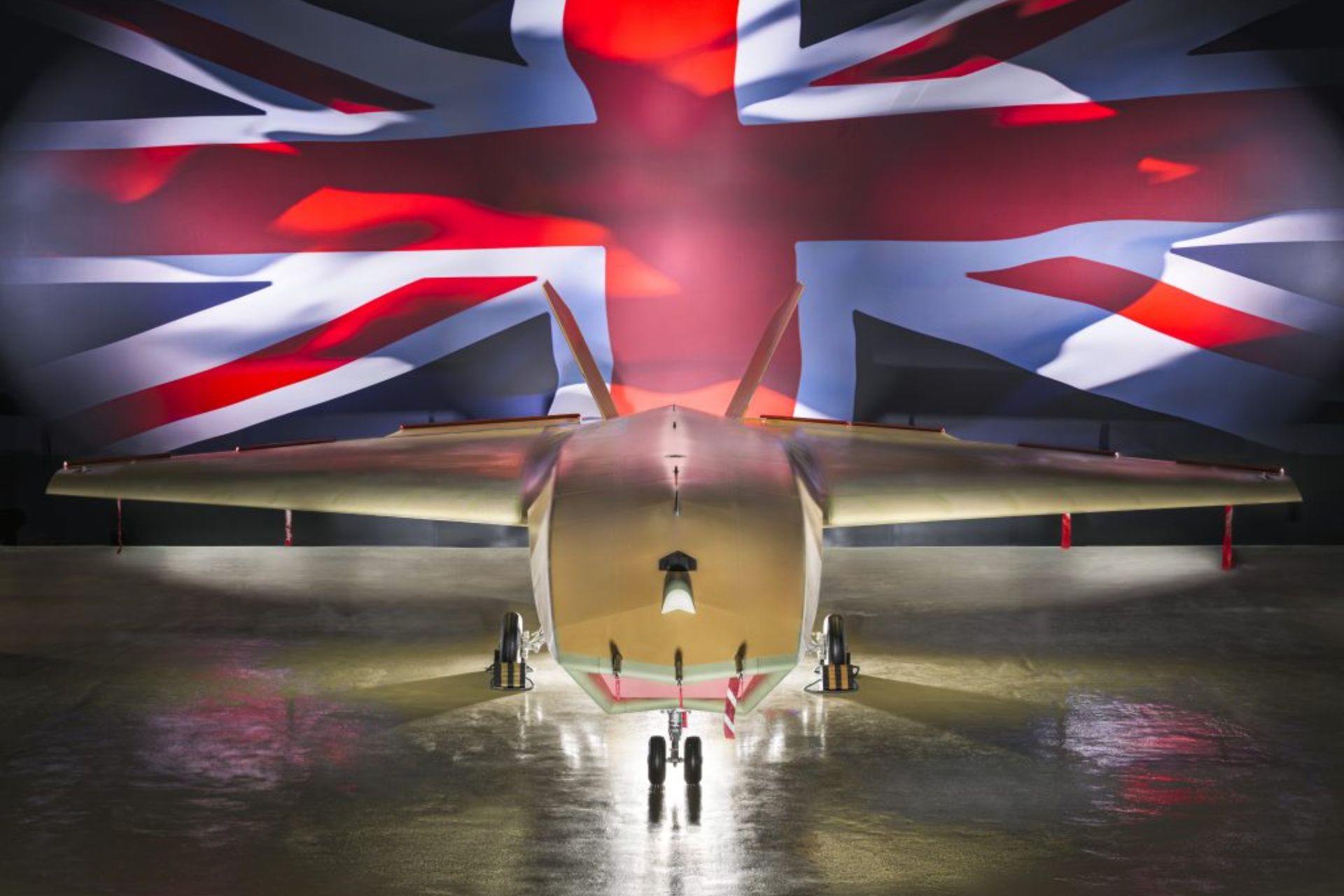
Brontanax is presented as the first British-designed autonomous uncrewed CCA(Picture source: Bae Systems)
Brontanax: A Sovereign British CCA for Typhoon and GCAP
Unveiled by BAE Systems on 22 July 2026, Brontanax is presented as the first British-designed autonomous uncrewed CCA. The prototype was designed and assembled at Warton with the involvement of more than 500 BAE Systems employees and over 75 British companies.
The aircraft is comparable in size to a Hawk trainer, although BAE Systems has not yet released information on its mass, speed, range or payload. Its planned missions include electronic warfare and precision strikes against both airborne and surface targets.
Brontanax is intended to receive mission-level direction from a Typhoon or from a remote mission commander. Its modular design and open architecture are expected to support the integration of new sensors, software and weapons without requiring extensive changes to the aircraft.
The prototype is being prepared for ground testing at Warton, with a first flight planned for 2027. The British government has committed £300 million to the Storm Fighter programme and has stated an ambition to introduce an initial capability before the end of the decade.
At this stage, the significance of Brontanax lies less in its undisclosed performance than in its industrial and operational positioning. The United Kingdom wants a sovereign platform with which it can develop collaborative combat tactics alongside Typhoon without waiting for the Global Combat Air Programme aircraft, currently expected to enter service from 2035.
The programme could allow the Royal Air Force to test command arrangements, data links, rules of engagement, mission autonomy and support procedures for mixed formations of crewed and uncrewed aircraft.
Its schedule nevertheless remains demanding. Moving from a prototype undergoing ground preparation to a militarily useful capability before 2030 will require rapid progress through flight testing, payload qualification, autonomy trials, certification and unit preparation. Brontanax should therefore be viewed as an accelerated path toward a sovereign capability, rather than as an aircraft already approaching operational service.
Five Aircraft, Three Development Strategies
The five aircraft presented or highlighted at Farnborough reveal three broad approaches.
The first is sovereign capability and gradual transition. Brontanax is intended to provide the United Kingdom with a national platform that can operate alongside Typhoonbefore GCAP. Ravenstorm follows a comparable European trajectory, but with a larger and more multirole aircraft integrated into a wider mission architecture.
The second approach is operational maturation. Ghost Bat is progressing through weapons trials, command from an E-7A, cooperation with multiple fighter types and operations from dispersed locations. Boeing and Australia are no longer demonstrating only that the aircraft can fly. They are testing whether it can enter an existing operational chain.
The third approach prioritises industrial scale and software competition. Through the FQ-42Aand FQ-44A, the US Air Force is funding two competing air vehicles alongside several potential mission autonomy providers. It plans to field more than 150 operational CCAs before the end of the decade, with a longer-term objective of approximately 1,000 aircraft.
Maintaining two competing platforms reduces dependence on a single manufacturer and allows the Air Force to compare performance, cost, availability and maintenance under increasingly realistic conditions. Competition can continue during production, including at the software level.
What CCAs Could Add to Current Air Operations?
The operational value of CCAs does not lie in replacing one fighter with one cheaper drone. Their value comes from distributing functions across several platforms.
A modern crewed combat aircraft must combine a pilot and associated life-support systems, radar, passive sensors, electronic warfare equipment, secure communications, fuel and weapons. Concentrating these functions in one airframe provides flexibility, but also increases cost and the consequences of losing the aircraft.
CCAs can separate those functions. One aircraft may carry a jammer, another may act as a forward sensor, a third may transport air-to-air missiles and a fourth may generate a false signature or provoke an air-defence radar into revealing its position.
The advantage is geometric as well as numerical. A missile launched from a CCA positioned closer to the target may retain more energy during the terminal phase. A forward sensor may detect a threat hidden from the crewed fighter, while distributed jammers can generate several axes of attack and complicate an air-defence system’s response.
CCAs Will Evolve Alongside Crewed Fighters
The programmes shown at Farnborough are developing in parallel with a wider transformation of crewed combat aviation.
In the United Kingdom, GCAP is expected to enter service from 2035 and operate alongside Typhoon, F-35 and autonomous systems. British investment in Typhoon upgrades, additional F-35s, GCAP and Storm Fighter indicates that Brontanax is not intended as an immediate replacement for the future crewed fighter. It will form an additional layer of the combat force.
France is pursuing a comparable approach around the Rafale F5. Dassault Aviation is developing a low-observable uncrewed combat aircraft intended to complement Rafale after 2030, drawing on technologies previously demonstrated through the nEUROn programme.
In the United States, CCAs are expected to increase the reach, situational awareness and survivability of fighters operating in contested airspace. Their development is being integrated into a broader air-superiority architecture, with particular attention to mass production and software-defined autonomy.
The pilot’s role will consequently evolve. Pilots are unlikely to control each CCA as though it were a remotely piloted aircraft. They will instead define intent, assign areas of operation, establish priorities and set operational limits. The aircraft will then distribute tasks while requesting human authorisation for the most sensitive decisions.
The Ghost Bat example also shows that the human commander will not always be seated in a fighter. An operator aboard an E-7A, at a ground control centre or within another command node could manage the formation. Control of the CCA force may shift between platforms according to communications availability, tactical conditions and mission requirements.
A Likely Three-Stage Evolution
Between 2026 and 2030, CCAs will primarily support experimentation, doctrine development and the establishment of initial operational capabilities. Ghost Bat, FQ-42A and FQ-44A are likely to provide the most advanced test campaigns, while Brontanax is scheduled to fly in 2027.
During the early 2030s, air forces may begin fielding more specialised families of aircraft. Some could focus on air-to-air combat, others on electronic warfare, reconnaissance, suppression of enemy air defences or precision strike. Ravenstorm is intended to enter this generation, as is the future uncrewed combat aircraft associated with Rafale F5.
Over the longer term, the ratio between crewed and uncrewed aircraft may change. Air forces are likely to retain high-value crewed fighters for command, data fusion, tactical adaptation and politically sensitive decisions. Those fighters, however, will operate with a growing number of autonomous sensors and effectors.
Farnborough 2026 does not yet identify a clear winner in the CCA race. It does show that the category has become one of the central development areas in military aviation. The fundamental shift is not the disappearance of the cockpit. It is the end of the combat aircraft as a largely self-contained platform expected to carry all its sensors, weapons and electronic warfare systems into the fight.
Future air combat will be distributed. Its effectiveness will depend on the ability of crewed and uncrewed aircraft to exchange information, allocate tasks, move weapons forward and continue operating under electronic attack. In that architecture, the best CCA may not be the fastest or the most stealthy. It will be the one that can be manufactured at scale, deployed with a limited logistical footprint, updated regularly and integrated with both existing fighters and future sixth-generation combat aircraft.
Written By Erwan Halna du Fretay - Defense Analyst, Army Recognition Group
Erwan Halna du Fretay holds a Master’s degree in International Relations and has experience studying conflicts and global arms transfers. His research interests lie in Security and strategic studies, particularly the dynamics of the defense industry, the evolution of military technologies, and the strategic transformation of armed forces.
-
Farnborough Airshow 2026 Flying Display Features F-35A KC-390 Eurofighter and Next-Generation Aircraft
{loadposition bannertop}{loadposition sidebarpub}
Farnborough International Airshow 2026 Flying Display Showcases F-35A, KC-390, Eurofighter and Next-Generation Aerospace Technologies. The flying display at the Farnborough International Airshow (FIA) 2026 featured a diverse lineup of military and civilian aircraft, ranging from fifth-generation fighters and military transport aircraft to helicopters and advanced aerospace technology demonstrators. Among the highlights were the U.S. Air Force's F-35A Lightning II, Embraer's KC-390 Millennium, the Italian Air Force's Eurofighter Typhoon, the British Army's CH-47 Chinook, Airbus' A350-1000, GE Aerospace's Saab 340B flying testbed, and the UAE's Fursan Al Emarat Display Team flying the Hongdu JL-10 (L-15). The display offered visitors a broad overview of the latest developments in military aviation, commercial aerospace, and flight technology.
The flying display opened with the U.S. Air Force's F-35A Lightning II, one of the world's most advanced fifth-generation stealth fighters. Developed by Lockheed Martin, the conventional takeoff and landing variant combines low-observable design, advanced sensor fusion, electronic warfare systems, and secure data-sharing capabilities into a single combat aircraft. Its demonstration emphasized the aircraft's agility and high-angle-of-attack handling, while also reflecting the F-35's operational role as a force multiplier capable of connecting air, land, and naval forces through a common tactical picture.
Related Topic: Lockheed Martin Unveils Armed Black Hawk with Hellfire and Air-to-Ground Missiles at Farnborough 2026A British Army CH-47 Chinook heavy-lift helicopter performs a dynamic flying demonstration during the Farnborough International Airshow (FIA) 2026, showcasing its exceptional maneuverability, lifting capability, and versatility in support of military transport and battlefield logistics missions. (Picture source: Army Recognition Group)
Brazilian manufacturer Embraer followed with the KC-390 Millennium, demonstrating the aircraft's versatility as both a tactical and strategic military transport aircraft. The twin-engine jet is designed to transport troops, armored vehicles, cargo, and humanitarian aid while also performing aerial refueling, medical evacuation, and disaster relief missions. Its higher cruise speed, digital cockpit, and ability to operate from austere airfields have made it an increasingly attractive solution for countries seeking to replace aging transport fleets without sacrificing operational flexibility.
The Airbus A350-1000 represented the commercial aviation sector with a display highlighting its aerodynamic efficiency and advanced composite airframe. While primarily designed for long-range passenger transport, the aircraft also demonstrates technologies that increasingly influence defense aviation, including lightweight structures, highly efficient engines, and next-generation digital flight management systems. Its presence reflected Farnborough's role in bringing together military and civil aerospace innovations under one event.
One of the most familiar military aircraft in the program was the British Army's CH-47 Chinook heavy-lift helicopter. The tandem-rotor helicopter remains indispensable for transporting troops, artillery, engineering equipment, and supplies in demanding operational environments. During the display, its stable low-speed handling and lifting capability illustrated why the Chinook continues to serve as a key battlefield logistics asset for the United Kingdom and numerous allied armed forces.
Experience the spectacular flying display from the Farnborough International Airshow (FIA) 2026, featuring some of the world's most advanced military and commercial aircraft. This video highlights fast jets, transport aircraft, helicopters, and aerobatic demonstrations, showcasing the latest aviation capabilities presented at one of the world's premier aerospace events. (Video source: Army Recognition Group)
GE Aerospace showcased its Saab 340B flying testbed, an aircraft dedicated not to operational missions but to accelerating aerospace innovation. The modified twin-engine turboprop serves as an airborne laboratory for evaluating new propulsion technologies, avionics, flight control systems, and digital engineering solutions under real flight conditions. Demonstrating such a test aircraft alongside frontline military systems highlighted the importance of flight testing in reducing development risks before new technologies enter operational service.
The Italian Air Force delivered one of the flying display's most dynamic demonstrations with the Eurofighter Typhoon. Designed through a European industrial partnership involving Italy, Germany, Spain, and the United Kingdom, the multirole fighter combines exceptional agility with advanced radar, precision-guided weapons, and sophisticated electronic warfare systems. Its energetic maneuvering showcased the aircraft's outstanding aerodynamic performance while reflecting the ongoing modernization efforts that will keep the Typhoon at the center of European and NATO air operations for years to come.
The program concluded with the Fursan Al Emarat Display Team of the United Arab Emirates flying the Hongdu JL-10, also known as the L-15 advanced jet trainer. Developed by China's Hongdu Aviation Industry Corporation, the twin-engine aircraft is intended to prepare pilots for transition to modern fighter aircraft while also offering light attack capability in certain configurations. The team's close-formation routines and synchronized maneuvers demonstrated both the aircraft's handling qualities and the high level of precision achieved by the UAE Air Force demonstration pilots.
Taken as a whole, the Farnborough International Airshow 2026 flying display offered more than a sequence of aerial demonstrations. It presented a cross-section of today's aerospace landscape, where stealth fighters, military transport aircraft, heavy-lift helicopters, advanced trainers, commercial airliners, and experimental flight-test aircraft each contribute to different aspects of future air capability. The diversity of participants reflected the broad scope of the airshow itself, bringing together operational aircraft, industrial innovation, and international cooperation on one of the world's most influential aerospace stages.
Explore More Defense News
• Land Defense News
• Naval Defense News
• Defense Aerospace News
Written by Alain Servaes – Chief Editor, Army Recognition Group
Alain Servaes is a former infantry non-commissioned officer and the founder of Army Recognition. With over 20 years in defense journalism, he provides expert analysis on military equipment, NATO operations, and the global defense industry.