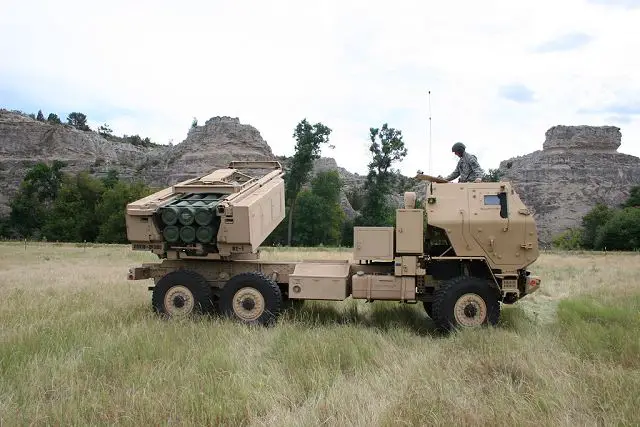
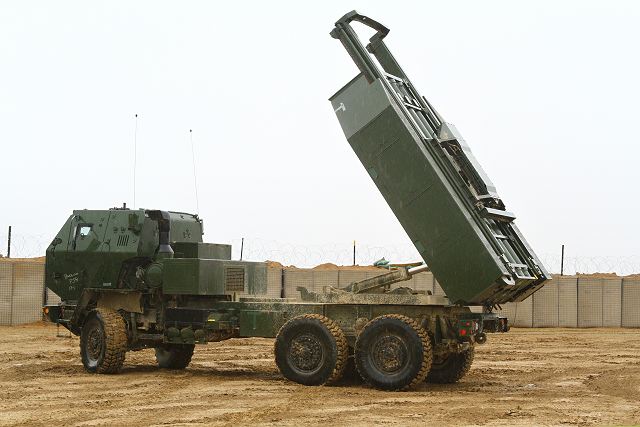
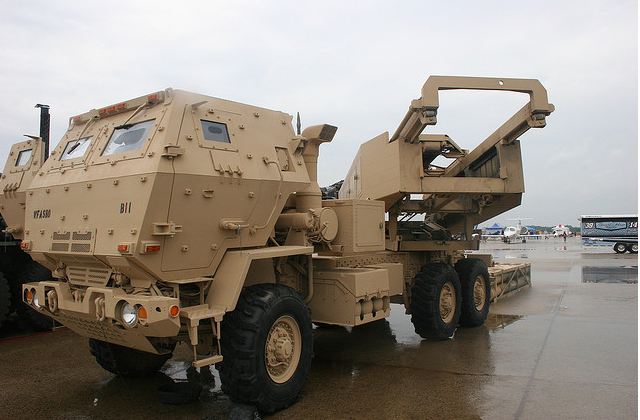
The M142 HIMARS (High Mobility Artillery Rocket System) is a multiple rocket launcher system mounted to a 6x6 FMTV truck chassis. HIMARS was developed by Lockheed Martin Missiles and Fire Control under an advanced concept technology demonstration (ACTD) program, placed in 1996.






Technical Data
-
Armament
The M142 HIMARS carries a single launcher pod mounted on the U.S. Army's Family of Medium Tactical Vehicles (FMTV) 6x6 truck chassis. The launcher consists of a carrier vehicle, an advanced Fire Control System (FCS), and a Launcher-Loader Module (LLM). The computerized fire control system calculates firing solutions, manages targeting data, and controls all launcher operations, enabling rapid, high-accuracy engagement of targets. The launcher can be reloaded independently using its integral crane system, allowing quick replenishment of ammunition in combat conditions.
The HIMARS launcher is compatible with the complete Multiple Launch Rocket System (MLRS) Family of Munitions (MFOM). It can fire six 227 mm Guided Multiple Launch Rocket System (GMLRS) rockets from a single launch pod, providing precision strike capability against targets at ranges exceeding 84 km. The system is also compatible with the Extended-Range Guided Multiple Launch Rocket System (ER GMLRS), which increases engagement distances to approximately 150 km while maintaining high accuracy.
In addition to guided rockets, HIMARS can launch one Army Tactical Missile System (ATACMS) missile from a single launcher pod. Depending on the variant, ATACMS provides precision strike capability against high-value targets at ranges of up to 300 km. The launcher is also compatible with the next-generation Precision Strike Missile (PrSM), capable of engaging targets at ranges exceeding 500 km. The PrSM significantly enhances the long-range precision fires capability of HIMARS and is intended to replace the ATACMS missile in U.S. Army service.
The M142 HIMARS is designed to fire all current and future variants of the MLRS family munitions, ensuring continued operational relevance as new rockets and missiles enter service. This flexibility allows operators to engage a wide range of battlefield targets, including artillery systems, air defense assets, command centers, logistics hubs, armored formations, and strategic infrastructure with precision-guided munitions.
-
Design and protection
The M142 HIMARS (High Mobility Artillery Rocket System) is composed of two main sections: a crew cab mounted at the front of the vehicle and a launcher-loader module mounted at the rear. The system is based on the Family of Medium Tactical Vehicles (FMTV) 6x6 truck chassis, providing a high degree of strategic and tactical mobility. The armored crew cab accommodates a crew of three, including the driver, gunner, and launcher commander. The cabin provides protection against small-arms fire, artillery shell splinters, and battlefield debris, while integrated communication and navigation systems enable efficient command and control during combat operations.
The fire control system is fully integrated within the crew compartment and includes a computerized fire control computer, GPS-assisted navigation system, inertial navigation unit, and secure communications equipment. This advanced fire control architecture enables rapid target acquisition, automated fire mission processing, network-centric operations, and highly accurate engagement of targets. The automated system significantly reduces crew workload and allows rapid execution of firing missions while minimizing the time spent in firing positions.
Mounted at the rear of the vehicle, the launcher-loader module (LLM) carries a single interchangeable launch pod container. The pod can be loaded with six 227 mm Multiple Launch Rocket System (MLRS) family rockets, including Guided MLRS (GMLRS) and Extended-Range GMLRS (ER GMLRS) munitions, or a single Army Tactical Missile System (ATACMS) missile. The launcher is also compatible with the next-generation Precision Strike Missile (PrSM), with a single pod capable of carrying two PrSM missiles. The launcher assembly is mounted on an electrically powered traversing and elevating mechanism that provides precise targeting and rapid engagement capability. An integrated crane system allows the crew to reload launch pods independently without requiring dedicated support equipment.
One of the major advantages of the HIMARS design is its ability to conduct rapid "shoot-and-scoot" operations. After launching its rockets or missiles, the vehicle can quickly relocate to avoid enemy counter-battery fire. Combined with its ability to be transported aboard a C-130 Hercules aircraft, the HIMARS offers a unique combination of long-range precision firepower, battlefield survivability, and rapid deployability, making it one of the most advanced wheeled rocket artillery systems currently in service worldwide.
-
Mobility
The M142 HIMARS is based on the 6x6 Family of Medium Tactical Vehicles (FMTV) all-wheel-drive 5-ton truck chassis, providing high mobility on roads and across difficult terrain. The vehicle is powered by a Caterpillar C7 diesel engine coupled to an Allison 3700SP 7-speed automatic transmission. This configuration enables the HIMARS to reach a maximum road speed of approximately 85 km/h and achieve a maximum cruising range of about 480 km.
The wheeled chassis gives the HIMARS excellent operational mobility compared to heavier tracked rocket launcher systems. It can rapidly move between firing positions, launch its rockets or missiles, and relocate before enemy counter-battery systems can detect and engage the launch site. This “shoot-and-scoot” capability is one of the key survivability features of the system.
The relatively light weight of the M142 HIMARS also allows it to be transported by C-130 Hercules tactical transport aircraft, enabling rapid deployment to distant theaters of operation. Its combination of road speed, off-road mobility, air transportability, and long-range precision firepower makes HIMARS especially suited for expeditionary operations, rapid reaction forces, and modern high-mobility artillery missions.
-
Combat Equipment
The M142 HIMARS is equipped with a fully integrated digital fire control system that enables rapid target acquisition, mission planning, and precision engagement of targets. The system incorporates advanced communications equipment, a fire control computer, GPS-assisted navigation, an inertial navigation system (INS), video display units, keyboard controls, and extensive onboard data storage. The automated fire control architecture allows firing missions to be executed in either automatic or manual mode, significantly reducing crew workload and reaction time while increasing operational effectiveness.
One of the key advantages of HIMARS is its high degree of interoperability with the M270A1 and M270A2 Multiple Launch Rocket System (MLRS) launchers. The fire control system, electronics, software architecture, and communications equipment are largely common across the MLRS family, simplifying logistics, maintenance, training, and battlefield integration. This commonality enables operators to transition easily between HIMARS and tracked MLRS platforms while employing the same family of rockets and missiles.
The launcher is fitted with an autonomous loading and unloading system that allows rapid replacement of launch pods without dedicated support equipment. Combined with advanced navigation and fire control systems, HIMARS can quickly occupy a firing position, receive target data from higher headquarters or external sensors, launch rockets or missiles, and relocate before enemy forces can react. This "shoot-and-scoot" capability significantly enhances survivability against counter-battery threats and contributes to the system's reputation as one of the world's most effective long-range precision fire support platforms.
The HIMARS can operate as part of a network-centric battlefield environment, exchanging targeting and mission data with artillery command centers, reconnaissance assets, unmanned aerial systems, and joint force command networks. This capability enables HIMARS to engage time-sensitive and high-value targets with exceptional speed, accuracy, and operational flexibility in modern multi-domain combat operations.


Photo Gallery