






Breaking News






US Strengthens Strategic Missile Strike Capabilities with $1 Billion LRASM and JASSM Investment.
Amid intensifying strategic competition and increasing operational pressure, the United States Department of Defense (DoD) announced on July 21, 2025, a new investment of nearly $1 billion to ensure long-term support for the AGM-158 cruise missiles, namely the Long-Range Anti-Ship Missile (LRASM) and the Joint Air-to-Surface Standoff Missile (JASSM). This funding falls under an existing framework agreement providing for indefinite quantities and deliveries of these strategic weapons.
Follow Army Recognition on Google News at this link
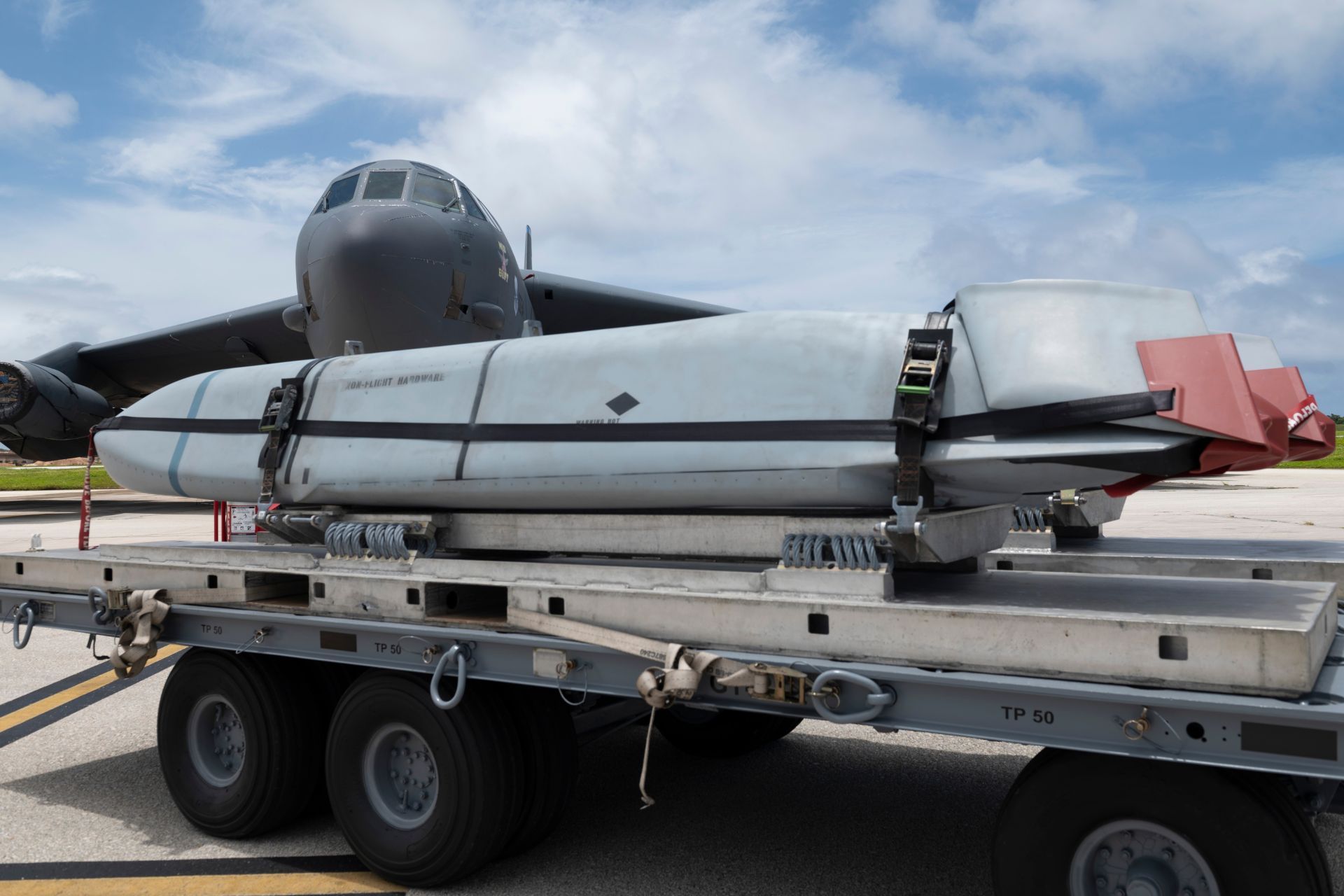
Joint Air to Surface Standoff Missiles are prepared to be loaded onto a U.S. Air Force B-52 Stratofortress on Andersen Air Force Base, Guam, April 24, 2023 (Picture source: US DoD)
The contract benefits Lockheed Martin, the prime contractor and original equipment manufacturer for both systems, which will carry out production in Orlando, Florida, with the completion deadline set for July 17, 2030. The funding aims not only to secure production line continuity but also to strengthen industrial resilience through multi-year procurement, seen as vital to increasing surge capacity in times of crisis.
The AGM-158 JASSM and AGM-158C LRASM missiles represent two evolving variants of a shared technological foundation developed by Lockheed Martin for U.S. and allied forces. Originally designed for long-range precision air-to-ground strikes, the JASSM provides deep penetration capabilities against heavily defended strategic targets. The standard version reaches 370 km, while the JASSM-ER variant, equipped with a more efficient turbofan engine and expanded fuel tank, extends the range to 1,000 km. It uses an inertial navigation system assisted by GPS, complemented by an infrared terminal seeker and an automatic target recognition (ATR) system, achieving a circular error probable (CEP) of around three meters. The missile features a 432 kg penetrating warhead and can be deployed by various aircraft, from B-1Bs to F-16s. It can also be air-dropped from transport aircraft via the Rapid Dragon palletized system.
The LRASM, derived from the JASSM-ER, was developed to meet the specific demands of modern naval warfare, particularly in electronic warfare environments where reliance on GPS and command networks is vulnerable. It features passive multi-function sensors, anti-jam navigation, and autonomous target selection capability, allowing it to identify and strike maritime targets even with degraded or imprecise cueing data. The LRASM is armed with a 1,000-pound warhead and flies a sea-skimming profile to reduce radar signature. Its range exceeds 200 nautical miles and it has already achieved operational integration on USAF B-1Bs and US Navy F/A-18E/Fs. Development is ongoing for a vertical-launch variant compatible with the Mk 41 launch systems used by the U.S. fleet.
Together, the two missiles represent a new generation of subsonic, low-observable cruise weapons resilient to modern air defenses. While the JASSM provides strategic strike capabilities over land, the LRASM extends that lethality to the maritime domain, both benefiting from a shared logistics base. Their large-scale production, exportable variants, and active modernization programs, including the extreme-range JASSM-XR and real-time data link upgrades, underscore their growing role in allied long-range strike doctrines.
Alongside this financial commitment, Lockheed Martin continues efforts to integrate both missiles onto external hardpoints of the F-35 Lightning II, particularly the F-35B variant. This integration is part of the Block 4 modernization program, described by Lockheed Martin executives Greg Ulmer and J.R. McDonald at the 2025 Paris Air Show as the most ambitious update to date.
The company is also carrying out an accelerated acquisition contract for the LRASM Deployment Office to refine technologies previously delivered under initial operational capability (IOC) programs for USAF B-1Bs and US Navy F/A-18E/Fs. In parallel, a significant effort is underway to develop a vertical-launch variant compatible with existing Mk 41 systems in the U.S. fleet.
The LRASM reached IOC on the B-1B in December 2018 following successful integration and flight testing, and was subsequently fielded on the F/A-18E/F in 2019. The JASSM, one of Lockheed Martin's first cruise missile programs, has been operational with the USAF for over two decades, providing long-range precision strike capabilities.
As part of the ramp-up of these capabilities, Lockheed Martin opened a new 225,000-square-foot production facility in June 2022, equipped with robotic paint lines, automated testing, and dynamic factory modeling systems to optimize future production planning.
With this additional investment, the United States confirms its commitment to the development and sustainment of long-range strike capabilities, which are essential in a strategic environment marked by the intensification of naval and land-based threats. This reinforcement supports an offensive deterrence architecture built around the versatility of aerial platforms and the growing precision of onboard munitions.