






Breaking News





U.S. Navy F/A-18E Super Hornet fighters test Venezuelan air defenses in contested Caribbean waters.
Two US Navy F/A-18E Super Hornets and an EA-18G Growler flew extended orbits over the Gulf of Venezuela on 9 December 2025, in airspace claimed by Caracas and already under tight surveillance. The sortie adds to a growing pattern of US naval and air activity in the Caribbean, increasing pressure on the Maduro government and raising the risk of a miscalculation close to Venezuela’s coast.
Two US Navy F/A-18E Super Hornets spent roughly forty minutes flying visible racetrack patterns over the Gulf of Venezuela on 9 December, in the middle of an area claimed by Caracas, while an EA-18G Growler orbited just to the north. According to regional defense observers, the aircraft profile closely matches the embarked air wing of the carrier USS Gerald R Ford, which has been operating in the Caribbean since November, and appears designed both to rehearse penetration of Venezuelan air defenses and to watch how the Maduro government responds. The flight comes as Washington steps up Operation Southern Spear, a campaign officially framed as counter narcotics but increasingly marked by strikes on suspected smuggling vessels and near continuous US military presence along Venezuela’s maritime approaches.
Follow Army Recognition on Google News at this link
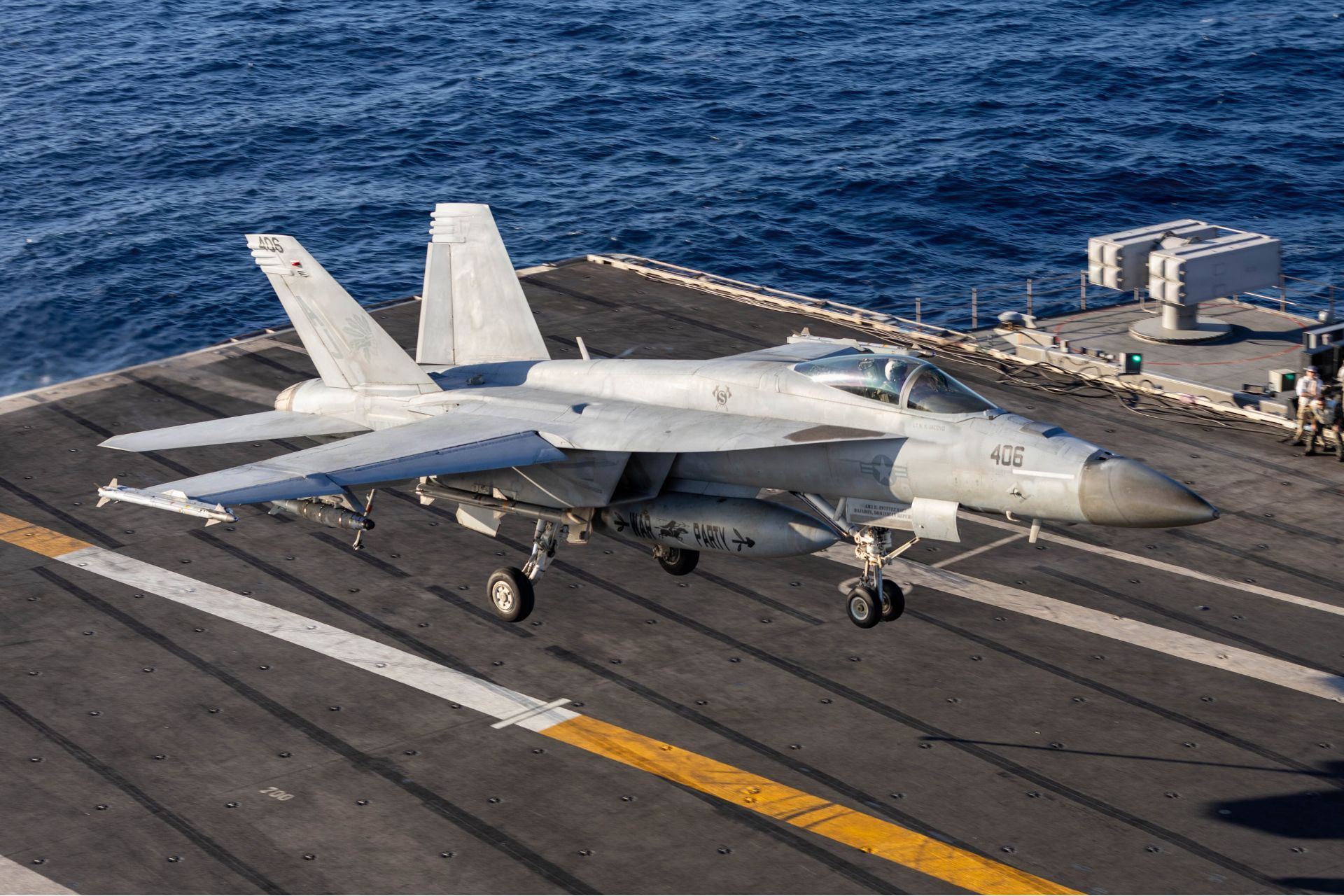
On 17 November 2025, an F/A-18E Super Hornet lands on the flight deck of the Ford-class aircraft carrier USS Gerald R Ford (Picture source: US DoD)
The presence of these aircraft closely matches the composition of the air wing embarked on the aircraft carrier USS Gerald R Ford, deployed in the region since November. The F/A-18E Super Hornet stands out through a substantially redesigned airframe compared to the original Hornet, with a fuselage about twenty percent larger, thirty-three percent more internal fuel, and endurance increased by fifty percent. Powered by two F414-GE-400 engines delivering a combined thrust of roughly 44,000 pounds, the aircraft has comfortable margins for interception profiles and medium altitude penetration. It retains a 20 mm M61 cannon and eleven hardpoints able to carry a mix of AIM-9 Sidewinder, AIM-120 AMRAAM, AGM-88 HARM, or JSOW missiles, enabling missions ranging from air superiority to close air support and maritime strike. Its AN/APG-79 AESA radar provides extended range against aerial targets and resolution suitable for advanced air-to-surface modes. The EA-18G Growlers, for their part, are equipped with the AN/ALQ-218 system paired with AN/ALQ-99 jamming pods, able to intercept and disrupt a wide array of emissions from air defence networks.
The decision to enter the Gulf of Venezuela while maintaining repeated orbits is striking, since this semi-enclosed area abuts airspace that Caracas regards as internal, where every movement is monitored by ground-based sensors. The Super Hornets activate their transponders as they enter the zone, a behaviour consistent with a declared mission intended to display a presence rather than to remain discreet. The Growlers operate further north, in an offset position that favours electromagnetic listening and monitoring of the adversary’s reactions. This distribution between combat platforms and electronic attack assets reflects a classic pattern for penetration into a defended environment, with partial degradation of hostile sensors to create a zone of uncertainty.
The mission takes place at a time when US pressure in the Caribbean has intensified. Since August, around fifteen thousand US military personnel have been involved in maritime and air activities linked to Operation Southern Spear, officially aimed at countering drug flows originating in Venezuela. Several strikes have already hit boats accused of trafficking, prompting debate over their legal basis. The growing deployment of US Navy and US Air Force units, including B-52 and B-1 bombers operating off the Venezuelan coast, has created a near-permanent presence close to Caracas’s maritime borders.
Topping our most track flights list right now: a pair of US Navy F/A-18s over the Gulf of Venezuela. https://t.co/pCIB1qQdSg pic.twitter.com/8Nt548B0mB
— Flightradar24 (@flightradar24) December 9, 2025
The tactical capabilities provided by the F/A-18E and EA-18G pairing add to this pressure. The Super Hornets are equipped with a quadruplex digital fly-by-wire system able to compensate for control surface damage and ensure a safe return, which increases the platform’s resilience in a potential confrontation. Their modern avionics suite, including ATFLIR, the Joint Helmet Mounted Cueing System, and the MIDS data link for Link 16 connectivity, supports the construction of a shared tactical picture with other US assets. The Growlers collect radar signals and critical communications to build an electromagnetic picture of the opposing air defence system, assess emission modes, and apply selective jamming where required. In a targeted strike scenario, this combination could open an operational window over sensitive Venezuelan sites, particularly in the Lake Maracaibo region, which concentrates the country’s key oil infrastructure.
The day’s observations add to a string of unusual activities monitored since September, including repeated strategic bomber flights and the partial reactivation of the former Roosevelt Roads base in Puerto Rico, now able to host F-35A aircraft. In the evening, new indications suggest that an EA-18G detachment has departed Whidbey Island with a likely destination in the Caribbean, without official confirmation. Such an expansion of land-based electronic attack assets would provide greater persistence in theatre and further increase US capacity to monitor or disrupt Venezuelan defence networks.
Taken together, these moves place relations between Washington and Caracas under growing strain. Statements by President Donald Trump, asserting that Maduro’s days are numbered, give a clear political context to the shows of force in the region. The succession of visible incursions, the increase in naval and air assets, and the role attributed to CIA covert operations all contribute to a climate of latent confrontation. For regional actors, this sustained pressure could reshape the security balance in the Caribbean and open up new risk margins, especially if interceptions multiply or if an unmanaged incident triggers an unwanted escalation.
Written By Erwan Halna du Fretay - Defense Analyst, Army Recognition Group
Erwan Halna du Fretay is a graduate of a Master’s degree in International Relations and has experience in the study of conflicts and global arms transfers. His research interests lie in security and strategic studies, particularly the dynamics of the defense industry, the evolution of military technologies, and the strategic transformation of armed forces.