






Breaking News






UK Blighter B400 radars Deliver Persistent Border Coverage for Southeast Asian Military.
A Southeast Asian military awarded Blighter Surveillance Systems a follow-on contract for B400 series mobile ground surveillance radars, paired with the BlighterNexus AI command and control layer. The kit adds persistent 360-degree sensing for people, vehicles, and low, slow drones, with quick reconfiguration on vehicles, masts, or tripods for hard-to-reach border sectors.
Blighter said on October 1, 2025, that an undisclosed Southeast Asian customer has ordered additional B400 electronically scanned ground surveillance radars with the BlighterNexus software suite. The systems are designed to run quietly in all weather with low power draw, cue operators with automated target classification, and stitch feeds from new and legacy sensors into a single picture. Local integration on specialist army vehicles, plus mast or tripod options, lets border units reposition coverage within minutes when terrain or access changes.
Follow Army Recognition on Google News at this link
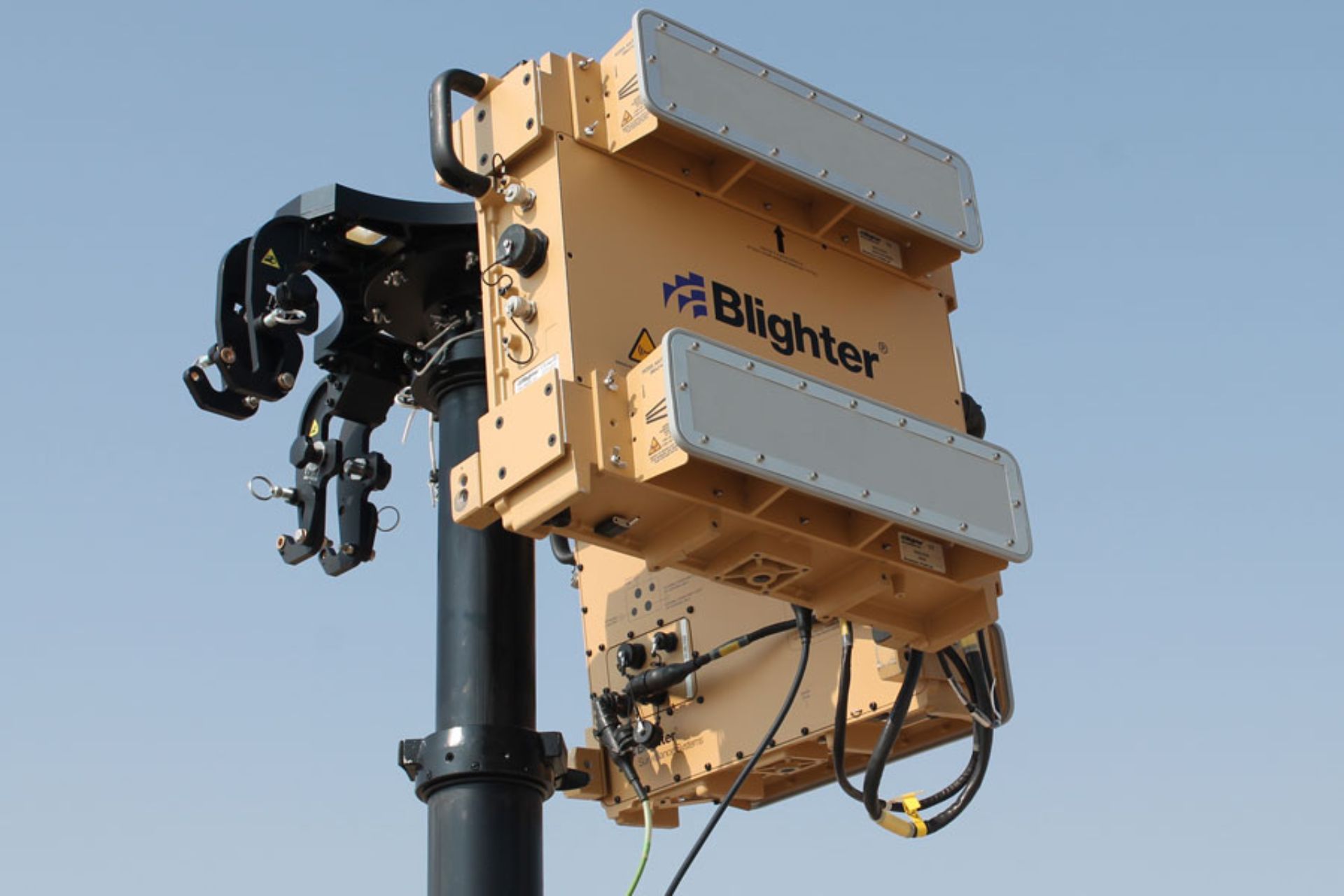
B400 solid-state radar provides 360° electronic scanning for hotspot coverage. (Picture source: Blighter)
Blighter says its low-power, solid-state B400 contains no moving parts, which keeps the units light, rugged, and easy to reposition as threat patterns shift. The radar’s compact, modular design uses electronic scanning frequency-modulated continuous-wave technology to provide uninterrupted wide-area coverage and rapid cueing. Detection ranges extend to 32 kilometers for small surface targets and near-ground aerial threats, with the system field-proven to operate 24/7 in all weather, including fog. The company states the radars can deliver up to 360 degrees of pure electronic scanning, a useful advantage when patrols must watch multiple axes across broken terrain.
The software layer is central to the offer. BlighterNexus is designed to integrate multiple radars and peripherals through a unified interface, generating a secure and scalable common operating picture across strategic border regions. According to Blighter, this architecture reduces operational blind spots and tightens coordination between surveillance operators and response teams. In practice, that means faster track hand-off from a vehicle-mounted sensor to a tripod-mounted outstation, or from a solar-powered trailer site back to a command post controlling several sectors at once.
On the technical front, three attributes stand out. First, the electronic-scanning FMCW design allows persistent look-back without mechanical rotation, cutting maintenance and improving reliability. Second, the system’s micro-Doppler processing enhances classification, helping operators tell the difference between a crawler, a pickup truck, and a low-flying multirotor. Third, the B400’s low power draw supports trailer or remote installations, including solar-powered configurations that can sit unattended for long periods while still feeding targets to the network.
The contract equips border units with a toolset built for speed and coverage rather than static surveillance alone. Vehicle-borne radars can sprint to an infiltration hotspot and be mission-ready within minutes, while trailer-mounted masts extend line of sight over river valleys or scrubland. Tripod deployments cover footpaths cut through dense forest, closing gaps that smugglers and scouts traditionally exploit. Because the B400 can detect people, vehicles, and small boats as well as near-ground aerial threats, a single patrol can manage land and littoral seams without swapping sensors. That mix of mobility, persistence, and classification is well-suited to counter smuggling, illegal crossings, and drone-enabled reconnaissance that now accompanies many cross-border networks.
Company leadership frames the award as an expansion of an established footprint. “Our radars have served this major economy for many years now,” CEO James Long noted, citing the need to extend coverage across mountains, dense forests, arid deserts, and coastlines. The broader Blighter portfolio spans land, sea, and air with the B400, C400, A400, and A800 families, drawing on a lineage that includes what the firm describes as the world’s first non-rotating, solid-state, electronic-scanning micro-Doppler ground radar introduced in 2003. Reference users include the UK Ministry of Defence for forward operating base protection, the South Korean Army along the DMZ, the US Air Force for drone detection, and several Five Eyes and NATO customers on mobile and armored platforms.
The purchase reflects a regional race to harden borders as transnational criminal networks, irregular migration flows, and inexpensive commercial drones strain legacy perimeter defenses. For a major South East Asian economy, scaling mobile radar coverage is both a sovereignty statement and a practical hedge against gray-zone tactics that blur the line between law enforcement and defense. It also signals continued demand for Western sensor technology at a time when states in the region are diversifying suppliers to balance great-power influence.