







Breaking News




U.S. Special Forces rehearse Caribbean raid to prepare possible actions against drug cartels in Venezuela.
U.S. Special Operations Forces and U.S. Coast Guard aviation conducted a joint maritime raid rehearsal over the Caribbean Sea on December 28, 2025, according to information released by U.S. Southern Command on its X account. The exercise supports preparations for possible actions against drug cartels linked to Venezuela while reinforcing U.S. regional deterrence and maritime interdiction readiness.
U.S. Special Operations Forces partnered with U.S. Coast Guard aviation for a joint maritime raid rehearsal over the Caribbean Sea on December 28, 2025, under Operation SOUTHERN SPEAR, according to information published by U.S. Southern Command on its official X account. The training event, which included a Coast Guard HH-60 Jayhawk helicopter supporting maritime insertion and interdiction drills, is intended to prepare U.S. forces for potential actions against drug cartels operating from or connected to Venezuela, while signaling elevated readiness in a strategically sensitive maritime region.
Follow Army Recognition on Google News at this link
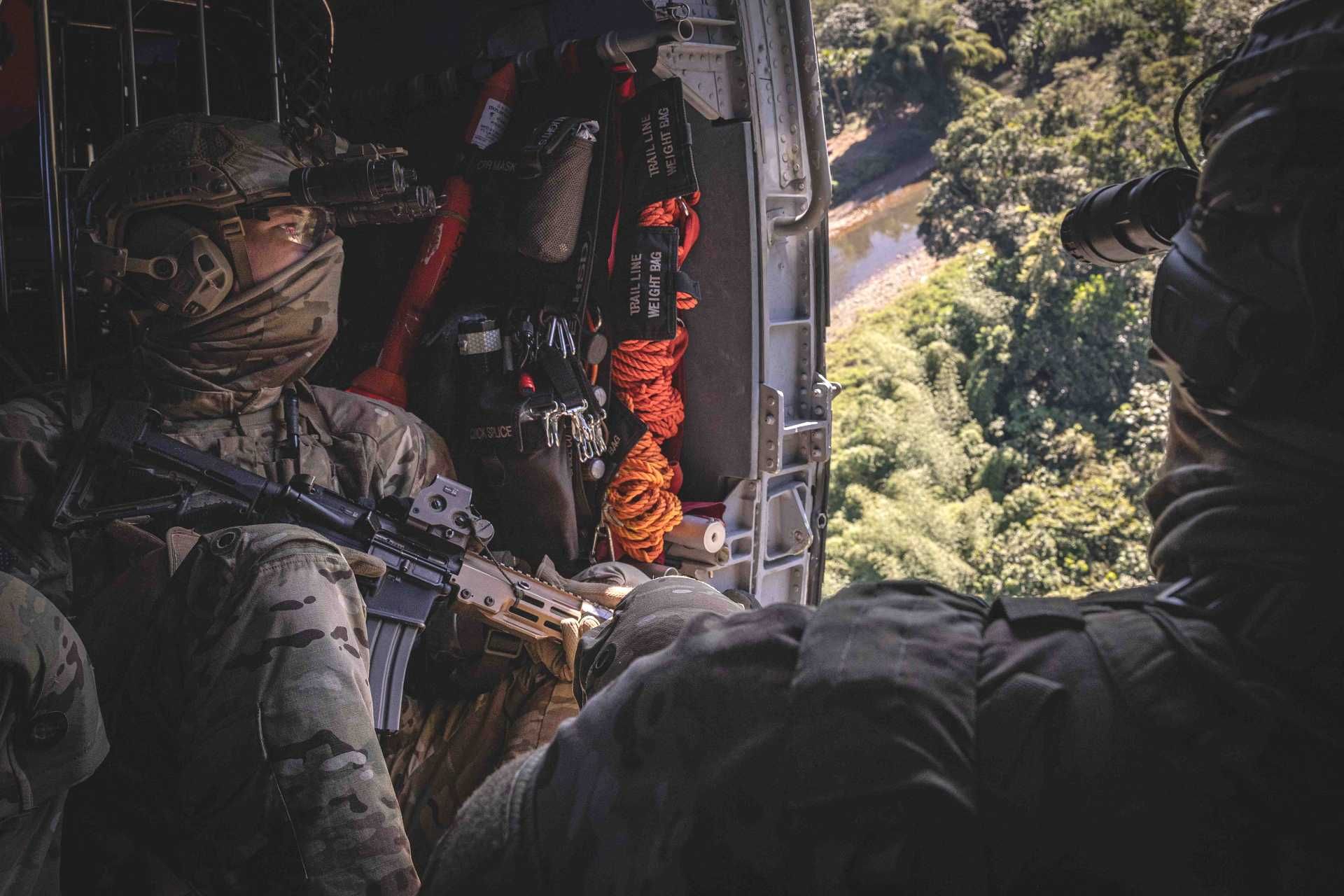
U.S. Special Operations Forces prepare for a maritime insertion from a U.S. Coast Guard HH-60 Jayhawk helicopter during a joint raid rehearsal over the Caribbean Sea in support of Operation SOUTHERN SPEAR. (Picture source: U.S. Southern Command)
While SOUTHERN SPEAR remains publicly described as a counter-narcotics and maritime security operation, the December 28 raid drills occurred within a broader operational context marked by increasing tensions with Venezuela and the expansion of U.S. maritime enforcement actions. In recent weeks, U.S. forces have intensified interdiction operations against vessels linked to illicit oil shipments from Venezuela, highlighting a shift from law enforcement support to strategic economic pressure.
On December 10, 2025, the U.S. Coast Guard intercepted and seized the Skipper, a sanctioned oil tanker operating off the coast of Venezuela. The vessel was identified as part of a shadow fleet transporting crude oil in violation of U.S. sanctions imposed on PDVSA, Venezuela’s state-owned oil company. Ten days later, on December 20, a second tanker, the M/T Centuries, was boarded by U.S. Coast Guard tactical teams in the southern Caribbean after departing Puerto La Cruz with a full cargo of Venezuelan crude. Both seizures were conducted in international waters under existing legal authorities tied to sanctions enforcement. A third vessel, Bella 1, remained under surveillance at the end of December as part of the same operation.
These maritime interdictions form part of a developing U.S. posture that includes not only counter-trafficking enforcement but targeted disruption of illicit economic flows sustaining the Maduro regime. The December 28 raid rehearsal, involving U.S. Special Operations Forces working alongside Coast Guard aviation crews, reflects the increasing interoperability between military and law enforcement elements tasked with responding to state-linked transnational threats.
The HH-60 Jayhawk, traditionally used for search-and-rescue, has been adapted for tactical operations, including SOF team insertion, shipboarding support, and coastal surveillance. The December exercise confirmed its utility in contested maritime environments, allowing rapid force projection across littoral zones and facilitating joint command-and-control for sensitive operations.
Although there is no publicly confirmed U.S. special operations presence inside Guyana, military-to-military cooperation between the United States and the Guyana Defence Force has intensified over the past year. High-level defense engagements and security assistance initiatives have been conducted to strengthen Guyana’s maritime surveillance and territorial defense capabilities. These efforts align with rising concern over Venezuela’s claims to the Essequibo region and its increased military activity along the Guyana border.
In parallel, Guyana and Brazil have conducted joint military patrols along their shared border. The move is widely interpreted as part of a coordinated regional response to growing Venezuelan assertiveness and signals a multilateral effort to reinforce the territorial status quo. While Brazil has not formally coordinated operations with U.S. forces, the alignment of security objectives among Guyana, Brazil, and the United States adds strategic depth to the regional deterrence posture.
If tensions escalate into a direct confrontation, U.S. Special Operations Forces and U.S. Coast Guard elements operating under SOUTHERN SPEAR would be positioned to transition from enforcement to combat-oriented missions while remaining within the broader legal framework of countering transnational criminal organizations. In such a scenario, likely missions could include maritime interdiction of sanctioned or hostile vessels, seizure of arms or fuel shipments supporting Venezuelan-aligned networks, and targeted raids on coastal infrastructure used by smuggling or military elements.
Special operations teams could also be tasked with conducting reconnaissance missions in the Caribbean littorals, supporting partner forces in defending key infrastructure, or executing non-combatant evacuation operations in the event of rapid deterioration of security conditions. U.S. Coast Guard assets, equipped for boarding operations and maritime domain awareness, would reinforce blockade, escort, and ship-seizure missions aimed at isolating illicit Venezuelan economic activity tied to narcotics and energy trade.
Other potential missions include direct action raids against cartel-linked logistics hubs, disruption of hybrid criminal-state smuggling routes, electronic warfare support against illicit maritime communications, and contingency-based exfiltration of high-value individuals or personnel under threat. All of these actions would fall under the operational control of U.S. Southern Command and Joint Special Operations Command, integrated through intelligence-sharing frameworks and real-time ISR platforms already active in the SOUTHCOM area of responsibility.
As Operation SOUTHERN SPEAR evolves, it has become more than a counternarcotics campaign. It is now a flexible deterrence tool that combines kinetic readiness with strategic messaging. The December 28 raid exercise highlights this transformation. With elite U.S. forces already operating in forward positions, supported by naval, air, and interagency elements, the United States is signaling both its intent and capacity to respond decisively to a range of contingencies, including those involving state-sponsored trafficking networks or regional instability driven by Venezuela’s expanding military footprint.
At a time when geopolitical fault lines are deepening across the Caribbean and northern South America, the United States is not merely observing. It is rehearsing, deploying, and preparing for the complex missions that could define the next phase of security operations in the Western Hemisphere.
Written by Alain Servaes – Chief Editor, Army Recognition Group
Alain Servaes is a former infantry non-commissioned officer and the founder of Army Recognition. With over 20 years in defense journalism, he provides expert analysis on military equipment, NATO operations, and the global defense industry.