







Breaking News




U.S. doubles Estonia’s HIMARS artillery to 12 amid growing tensions between Russia and NATO.
The United States has moved to expand Estonia’s pending HIMARS package, doubling launchers to 12 and vastly increasing ATACMS and GMLRS stocks, Kyiv Post reports. The surge in long-range precision munitions strengthens NATO’s eastern flank and raises deterrence amid rising Russian military pressure around the Baltic region.
On October 1, 2025, Kyiv Post reported that the United States has quietly moved to expand Estonia’s pending HIMARS package, increasing the number of M142 launchers and enlarging stocks of long-range ATACMS and GMLRS rockets. The development comes amid heightened Russian military pressure around the Baltic region and Tallinn’s drive to harden deterrence with precision strike options that can hold critical targets at risk well beyond Estonia’s borders. The centerpiece of the package is the M142 High Mobility Artillery Rocket System, a wheeled launcher that can fire both six-round pods of guided rockets and single-missile pods of ATACMS, giving a small force the ability to shift from saturation fires to pinpoint deep strikes within minutes. Estonia previously pursued six launchers; the new reporting points to a doubling of combat power and a far deeper magazine sized for sustained operations rather than symbolic presence.
Follow Army Recognition on Google News at this link
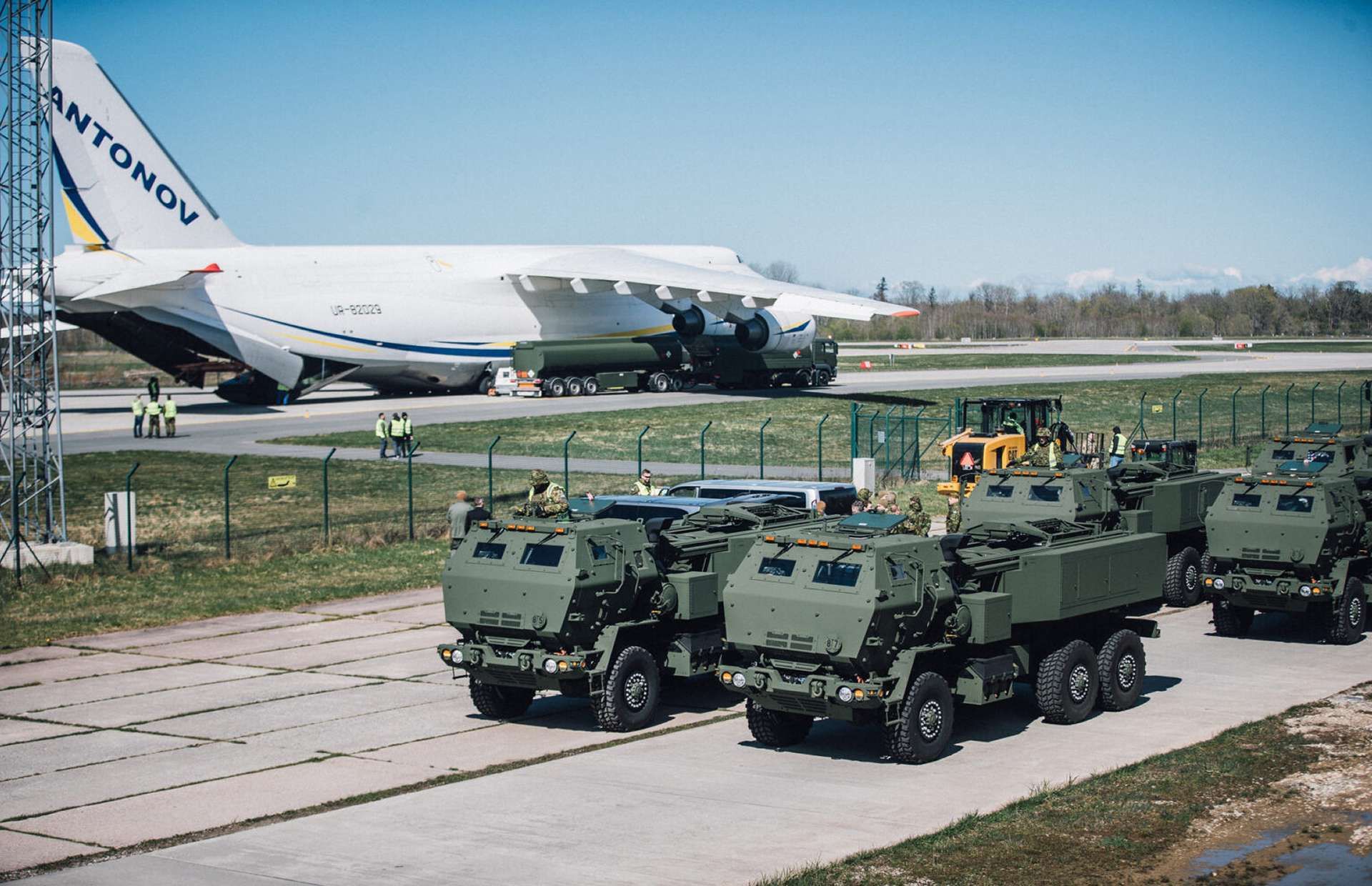
Estonia displays newly delivered U.S.-made M142 HIMARS launchers during a military ceremony in 2025, as Washington approves an expanded missile package (Picture source: Estonian Ministry of Defence).
At the equipment level, HIMARS is built on a medium tactical truck chassis carrying one modular pod and a fully digital fire control system tied to GPS and inertial navigation. The system’s hallmark is speed of action: crews can arrive in a hide, align the launcher, transmit a fire mission, ripple rockets, and displace before enemy sensors and counter-battery systems cue a response. Transportability matters for the Baltic theater. HIMARS fits inside a C-130 for rapid reinforcement, while road mobility allows dispersal across Estonia’s forested road network and pre-surveyed firing points. The launcher’s software accepts the full MLRS family of munitions, enabling Estonia to mix effects from unitary high-explosive warheads for point targets to alternative warheads for area suppression against troop concentrations and soft-skinned vehicles.
The GMLRS baseline provides precision effects at 70 to 80 kilometers with circular error probable measured in single meters, allowing counter-battery engagements, interdiction of logistics nodes, and rapid strikes on air defense radars that expose themselves. Extended-Range GMLRS pushes that envelope past 120 kilometers, giving Estonian batteries the reach to interdict bridgeheads, rail spurs, and ammunition dumps on the far side of the border area without committing scarce aircraft. These rockets arrive in sealed pods, which simplifies storage and handling and shortens reload times in the field. For a country with limited strategic depth, the ability to move a pod from transport to ready-to-fire with minimal signature is as important as raw range.
ATACMS is the decisive layer: the M57 unitary variant carries a 500-pound penetrating warhead and flies out to roughly 300 kilometers along a quasi-ballistic trajectory guided by GPS and INS. Fired from the same HIMARS launcher, ATACMS gives Estonia the capacity to strike hardened command posts, airfields, long-range air defense sites, and operational logistics hubs in the Russian rear. With sufficient inventory, Estonian planners can plan sequential fires: first ER GMLRS salvos to blind and suppress integrated air defense and artillery, followed by ATACMS to crater runways, collapse fuel farms, and cut rail junctions that feed front-line formations.
A 12-launcher fleet dispersed across concealed sites and decoyed with inflatable signatures forces an adversary to hunt for needles rather than shoot at a single depot. Each launcher can execute shoot-and-scoot cycles in minutes, aided by pre-planned fire plans, redundant communications, and pre-positioned reloads. In the opening hours of a contingency, Estonia could employ time-sensitive targeting against mobile air defense and counter-battery threats, while preplanned ATACMS missions prosecute fixed infrastructure inside the 300-kilometer ring. Integration with NATO intelligence, surveillance, and reconnaissance networks is the multiplier. Target-quality data from Allied airborne ISR, space-based sensors, and Baltic coastal radars shortens kill chains and ensures each expensive missile is matched to a target whose destruction yields operational payoff.
The enlarged magazine signals a shift from deterrence by token presence to deterrence by credible, sustained strike. Precision munitions matter only if they can be fired in volume. Estonia’s investment in reloads suggests a concept of operations built on rolling salvos that degrade an attacker’s tempo and force structure, buying time for NATO reinforcements to flow while keeping key corridors and ports open. The choice of a U.S. Army standard system also anchors training, software updates, and sustainment to a broad alliance ecosystem. That reduces life-cycle risk and ensures interoperability during a coalition fight, from shared ballistic calculations to common spares and test equipment.
Russian air and naval activity around the Baltic Sea has grown more aggressive, and periodic airspace violations have tested allied reactions. The Baltic states have pressed NATO to evolve from rotational air policing to an integrated air and missile defense posture backed by ground-based fires that can punish aggression rapidly and at depth. In parallel, European capitals are recalibrating industrial policy to produce more rockets and missiles, but near-term gaps persist. A U.S.-approved expansion of Estonia’s HIMARS case bridges that gap with a partner-funded solution, while sending a message that alliance front-line states will be equipped to impose costs from the outset of any crisis. It also complicates Russian planning across the Western Military District. Aircraft basing, ammunition parks, and forward command nodes that once sat outside Baltic artillery range now fall inside predictable strike arcs. That shifts risk calculations in Moscow and supports the broader NATO strategy of denial rather than delayed punishment.
Written by Evan Lerouvillois, Defense Analyst, Army Recognition Group.
Evan studied International Relations, and quickly specialized in defense and security. He is particularly interested in the influence of the defense sector on global geopolitics, and analyzes how technological innovations in defense, arms export contracts, and military strategies influence the international geopolitical scene.