






Breaking News






U.S. Defense Secretary Pete Hegseth calls for creation of new task force to counter drone threats.
At the end of August 2025, the U.S. Department of Defense announced that the U.S. Secretary of Defense Pete Hegseth has directed U.S. Army Secretary Daniel P. Driscoll to formally establish a new joint, interagency task force to counter the growing threat of hostile unmanned aerial systems. The initiative, designated Joint Interagency Task Force 401, will unite resources and expertise from across the Department of Defense, the U.S. Army, and multiple federal agencies to address the increasing risks posed by drones both overseas and within American borders.
Follow Army Recognition on Google News at this link
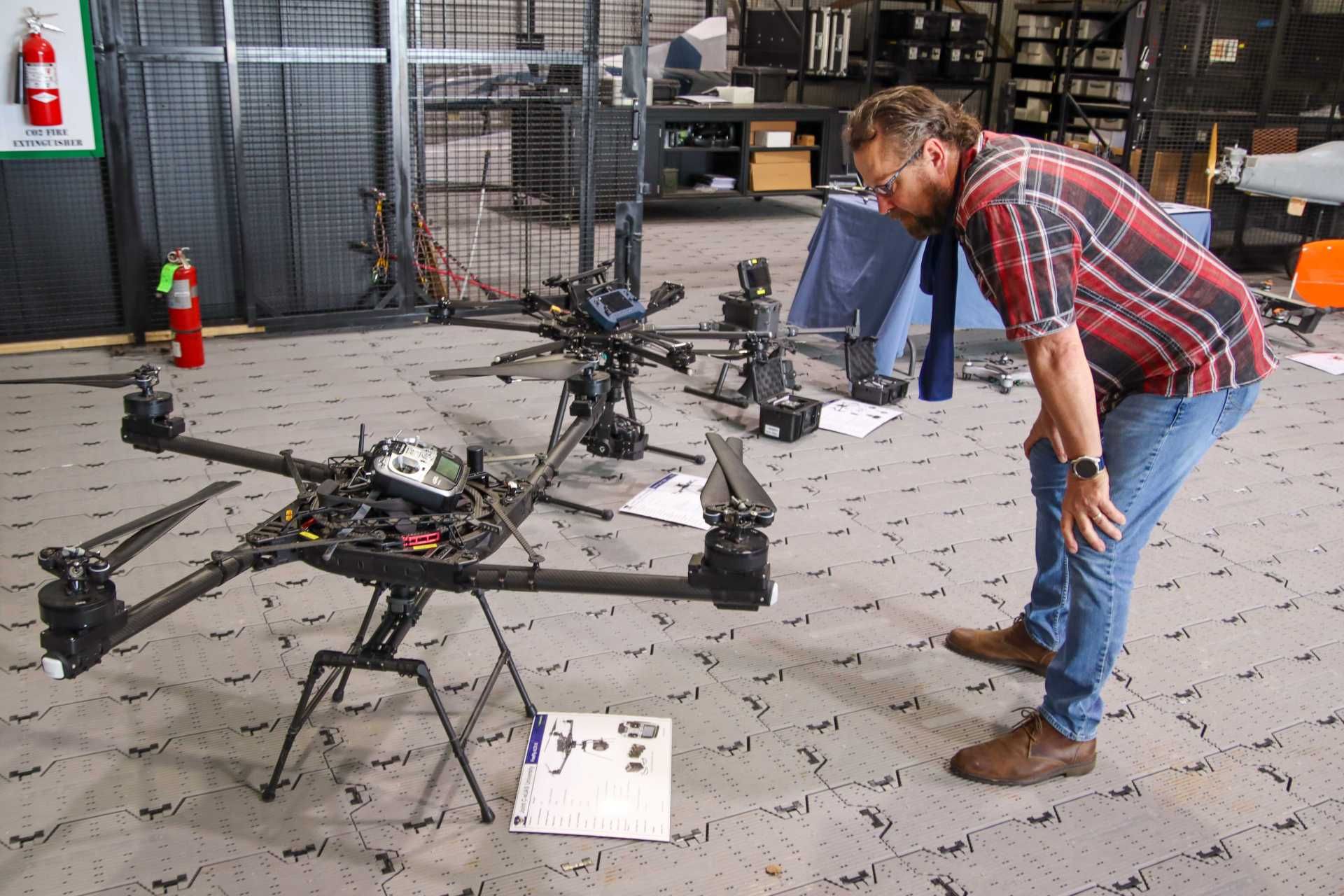
Police Captain Michael Jensen inspects a drone during the Joint C-sUAS University presentation at Fort Sill, where real-world drone threats are used to train defenders. (Picture source: U.S. DoD)
The United States’ decision reflects mounting concern over the rapid proliferation of hostile drones in modern conflicts and their potential use against critical infrastructure, forward-deployed forces, and the sovereignty of U.S. airspace. Hegseth emphasized that the objective is not only to neutralize immediate threats but to build long-term superiority in counter-UAS operations, ensuring that the United States maintains decisive control of the skies. By directing Army Secretary Driscoll to spearhead the effort, the Department of Defense signaled the Army’s central role in coordinating ground-based defenses while leveraging joint capabilities from the Air Force, Navy, Marine Corps, and Homeland Security agencies.
Joint Interagency Task Force 401, or JIATF-401, will function as a centralized hub to synchronize efforts that are currently scattered across different branches and agencies. It is designed to break down barriers between military services, intelligence agencies, and law enforcement, creating a single authority empowered to respond rapidly to evolving drone threats. According to officials familiar with the structure, the task force will integrate operators, engineers, intelligence analysts, and policymakers under one command umbrella. Its mission will extend beyond battlefield engagements to cover the defense of U.S. installations at home, the protection of borders against illicit drone use, and the safeguarding of critical civilian infrastructure from potential aerial attacks.
The composition of JIATF-401 is expected to reflect the wide scope of the threat. From within the Department of Defense, elements of the U.S. Army’s Counter-UAS Office and the Air Force’s Air Combat Command are likely to provide operational oversight and technical expertise, while the Navy and Marine Corps will contribute maritime and expeditionary counter-drone capabilities. On the interagency side, the Department of Homeland Security is expected to play a central role in coordinating drone defense for border security and the protection of domestic infrastructure, while the Federal Aviation Administration will ensure integration with civilian air traffic management. Intelligence agencies such as the Defense Intelligence Agency and the National Security Agency are anticipated to contribute data on adversary drone networks, with the Federal Bureau of Investigation providing domestic counterintelligence and law enforcement support. This blended structure aims to give JIATF-401 not only the operational reach but also the legal authority to act decisively across multiple domains.
The task force is expected to develop and deploy layered counter-drone solutions, ranging from kinetic interceptors and directed-energy weapons to advanced electronic warfare systems capable of jamming or seizing control of hostile platforms. Officials indicated that the group will also focus on intelligence-sharing frameworks to track adversary drone supply chains and operational tactics, enhancing the ability to predict and preempt drone incursions before they threaten U.S. assets. JIATF-401 is also likely to work closely with defense industry partners to fast-track promising technologies and ensure warfighters are equipped with the most effective systems available.
The urgency behind this initiative is underscored by recent global events. In Ukraine, Russian forces have demonstrated how cheap but numerous drones can overwhelm traditional air defenses, destroying artillery, tanks, and logistics hubs. Iranian-backed groups in the Middle East have increasingly turned to loitering munitions and one-way attack drones to target U.S. bases, as seen in Iraq and Syria, where American troops have repeatedly come under drone fire. Along the U.S. southern border, officials have also reported an uptick in small drones being used by transnational criminal organizations for smuggling and surveillance, raising domestic security concerns. Each of these examples illustrates the widening scope of the threat, from state adversaries to irregular actors who exploit the low cost and accessibility of drone technology.
JIATF-401 will therefore play a critical role in aligning military innovation with interagency coordination, cutting through bureaucratic delays that often slow the fielding of new technologies. Hegseth described this approach as a way to consolidate fragmented counter-drone efforts into a single authority empowered to move rapidly from concept to operational capability. Although no official timeline for full operational readiness was disclosed, defense insiders suggest that initial capabilities could be fielded within months, given the urgency of the threat and the Department of Defense directive to accelerate acquisition pathways.
This announcement marks a strategic shift for Washington, moving from reactive countermeasures to a unified doctrine aimed at dominating the counter-UAS battlespace. Hegseth concluded that America’s warfighters “deserve the best tools to defend sovereignty” and reiterated that the United States will ensure its forces are never outmatched in the drone domain.