






Breaking News






Türkiye Considers Russian S-400 Air Defense Return as Path Back to U.S. F-35 Fighter Program.
Türkiye is reportedly exploring the return of its Russian-made S-400 air defense system to Moscow, according to Bloomberg, amid renewed high-level contacts between Turkish and Russian leadership. The move could remove a key barrier to Ankara regaining access to U.S. defense programs, including the F-35, after years of sanctions and exclusion.
Türkiye is considering a scenario that would see Russia take back the S-400 Triumf long-range air defense system Ankara acquired in 2017, a purchase that triggered U.S. sanctions and led to Türkiye’s removal from the F-35 program. Bloomberg reported on December 17, 2025, that the issue was raised directly during recent leadership-level contacts with Moscow, though Russian officials have publicly downplayed the claim, and Turkish authorities say no operational changes have yet been made to the deployed system.
Follow Army Recognition on Google News at this link
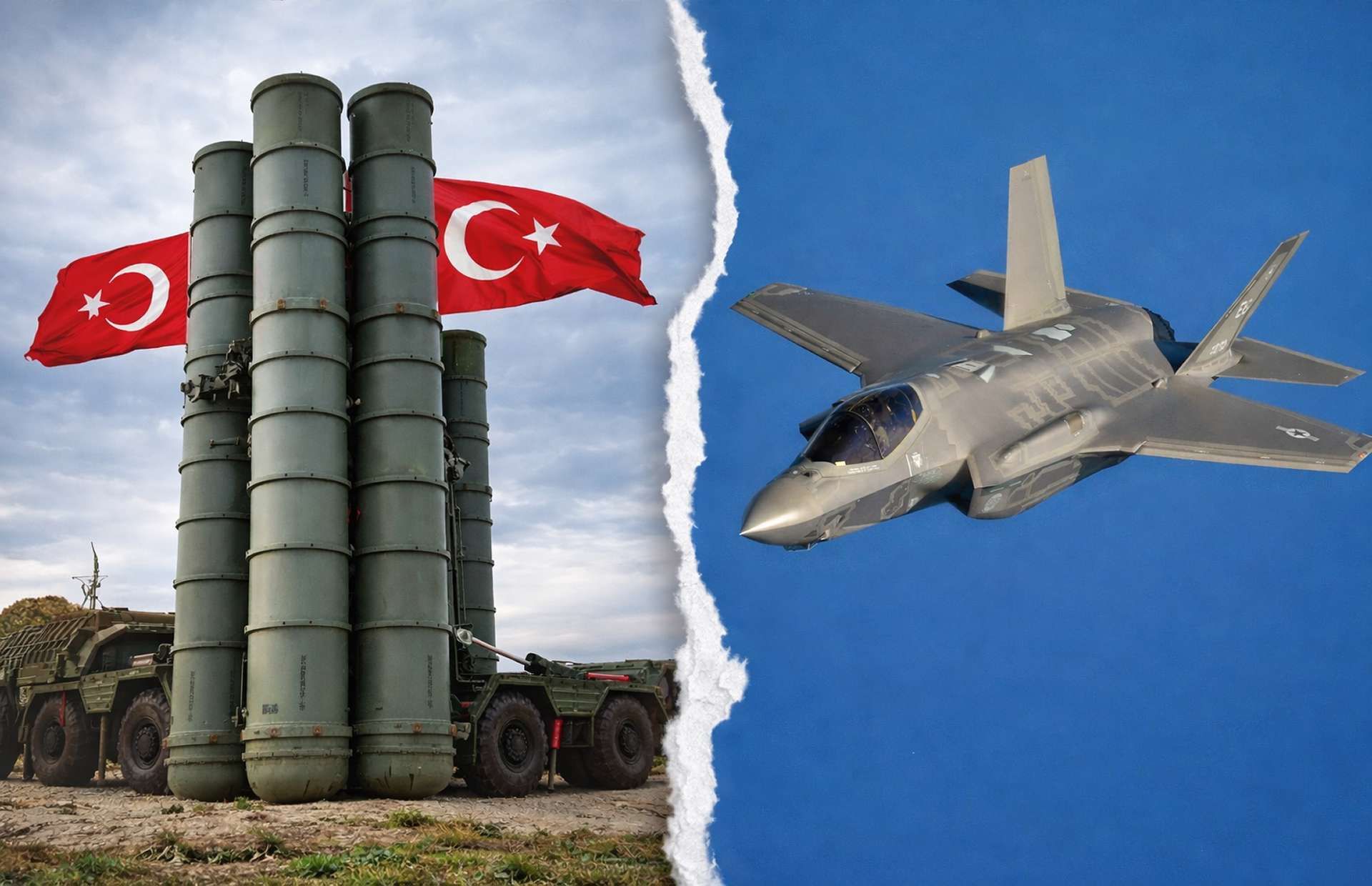
Türkiye is considering returning its Russian-made S-400 air defense system as a move that could reopen access to US defense programs, including the F-35, trading a long-range area air defense capability for renewed integration with Western combat aviation and air defense architectures (Picture source: Army Recognition Edit).
The central issue is not diplomatic signaling but the military hardware involved and the capability tradeoffs implied by such a decision. Türkiye signed a contract worth approximately $2.5 billion with Russia in 2017 after failing to reach an agreement with the United States on Patriot air defense systems under terms Ankara viewed as acceptable. Deliveries began in 2019 and included multiple fire units with associated radars, command vehicles, and missile stocks, making Türkiye the first NATO member to field the Russian-made system.
The S-400 Triumf is designed as a highly mobile, layered air defense architecture integrating long-range surveillance radars, fire control radars, command and control elements, and transporter erector launchers carrying different interceptor types. Operationally, a single battery can be deployed to defend high-value targets such as air bases, command centers, ports, or critical infrastructure, while its road mobility allows repositioning to complicate adversary targeting. The system is optimized for engaging aircraft, unmanned aerial vehicles, and cruise missiles, with a limited but relevant capability against short and medium-range ballistic missiles in their terminal phase.
From a technical standpoint, the S-400’s most significant feature is its missile mix and engagement geometry. The 48N6 interceptor family is generally associated with engagement ranges of up to 250 kilometers against aerodynamic targets, while the longer range 40N6 missile is advertised with a reach of up to 400 kilometers under favorable conditions. Against ballistic threats, the system offers terminal defense within a more constrained radius. Even without combat use, these engagement envelopes can shape air operations by forcing adversary aircraft to fly lower, reroute, or rely more heavily on stand-off munitions and electronic warfare.
A potential return of the S-400 would immediately raise operational questions for Türkiye regarding the replacement of long-range air defense coverage. Ankara has invested heavily in building a national layered air and missile defense architecture. The Siper system developed by Roketsan is presented as a long-range solution, with the first block exceeding 100 kilometers in range and later variants expected to reach approximately 150 kilometers. Siper uses inertial navigation with mid-course updates and an active radar seeker, offering modern engagement capability, but it does not yet replicate the maximum coverage radius associated with the S-400 and would require a greater number of batteries and sensors to achieve comparable area defense.
For the United States, the S-400 issue has consistently been framed as a technical and security concern linked to the protection of the F-35’s low observability, sensors, and mission systems. US defense officials have long argued that operating the F-35 alongside a Russian air defense system could expose sensitive signatures and data, undermining the aircraft’s survivability advantage. This assessment led to Türkiye’s removal from the F-35 program in 2019 and remains central to current US policy considerations.
If Türkiye were to fully divest from the S-400, the most immediate strategic benefit would be reopening the possibility of access to advanced US defense programs, with the F-35 remaining the most prominent example. For the Turkish Air Force, the F-35 would provide a substantial increase in tactical strike capability, combining stealth, sensor fusion, and networked operations to shorten kill chains and improve effectiveness in contested environments. The tradeoff would be the loss of a long-range area denial system that, at least on paper, offers significant reach against non-stealth aircraft and high altitude enablers.
For Russia, taking back the S-400 would represent an unusual reversal of an export deal. Recovered components could potentially be refurbished and redeployed to reinforce the protection of strategic sites. Financial compensation or offsets, including mechanisms tied to energy trade, have been mentioned in reporting, suggesting that any return would be embedded in a broader settlement. For Washington, the removal of the S-400 from Turkish service would reduce a major technical obstacle in bilateral defense relations, potentially allowing renewed cooperation on combat aviation and integrated air defense within a NATO framework.