






Breaking News






THeMIS UGV from Milrem Robotics Faces Challenges of Polar Cold with US Army.
The U.S. Army, through its Cold Regions Research and Engineering Laboratory (CRREL), has acquired a THeMIS Unmanned Ground Vehicle (UGV) developed by the Estonian company Milrem Robotics. This acquisition is part of a research program aimed at assessing the capabilities of autonomous systems in extreme environments, particularly in Arctic conditions, where climate presents challenges to military equipment and operations. The integration of the MIFIK Intelligent Functions Kit enhances the vehicle’s autonomous navigation, allowing it to operate in difficult terrain while minimizing human intervention.
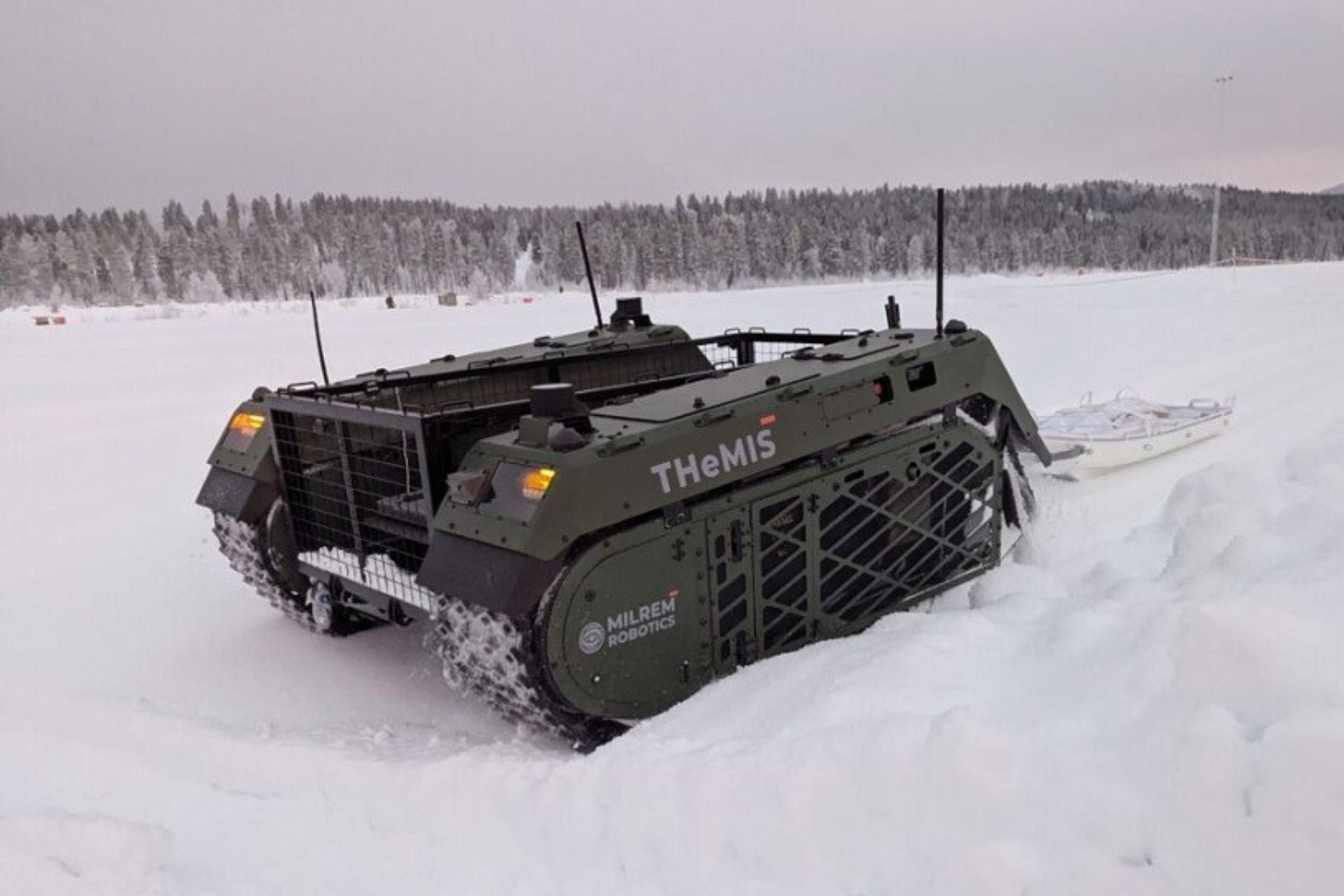
Equipped with a hybrid propulsion system combining a diesel engine and an electric generator, the THeMIS has an extended operational runtime of up to 15 hours in hybrid mode and a maximum speed of 20 km/h (Picture source: Milrem Robotics)
The THeMIS is a modular and multi-purpose robotic platform designed to support military operations in logistics, reconnaissance, and operational support. In its Cargo configuration, it assists in transporting equipment, supplies, and additional weaponry, reducing the physical and cognitive strain on personnel. This logistical capability is particularly valuable in polar regions, where extreme weather complicates troop movements and resupply operations. The vehicle’s open architecture allows for rapid adaptation to different mission requirements, including transport, combat support, medical evacuation, and explosive ordnance disposal.
Equipped with a hybrid propulsion system combining a diesel engine and an electric generator, the THeMIS has an extended operational runtime of up to 15 hours in hybrid mode and a maximum speed of 20 km/h. Its design enables it to operate in harsh environments, crossing obstacles up to 90 cm high and navigating slopes up to 60%, while maintaining functionality in freezing temperatures. Testing in these conditions will provide insights into its performance and potential applications for Arctic military operations, where equipment reliability is critical. Already in service in 19 countries, including eight NATO members, the THeMIS is currently one of the most widely used UGVs in its category.
According to Milrem Robotics, the THeMIS is currently one of the most advanced UGVs available, having been integrated into multiple armed forces worldwide. Its widespread adoption helps reduce acquisition and implementation risks for military users, benefiting from the company's extensive experience and operational knowledge. The vehicle has already been deployed in several conflict zones, including Ukraine and the Barkhane operation in the Sahel, where it has been tested under real operational conditions.
The acquisition aligns with the mission of the U.S. Army Corps of Engineers to advance technological innovation in support of national security and operational readiness. The Themis will be tested in various experimental and operational scenarios to assess its integration into future military strategies. These trials will also contribute to ongoing research on autonomous systems and their effectiveness in extreme conditions, particularly in cold environments.
CRREL, part of the U.S. Army Engineer Research and Development Center (ERDC), plays a key role in developing scientific and engineering solutions tailored to Arctic and other extreme environments. Its research supports improvements in military infrastructure, troop mobility, and operational effectiveness in challenging conditions. Integrating the THeMIS into its research program represents a step forward in adapting military capabilities to the challenges posed by the Arctic and other climate-intensive operations.
Deploying the THeMIS UGV in Arctic environments will enhance the U.S. Army’s ability to conduct operations in extreme conditions, where mobility and logistical support are critical challenges. The vehicle’s hybrid propulsion system and modular design will facilitate the transport of equipment and supplies across snow-covered and rugged terrain, reducing personnel fatigue and exposure to harsh conditions. The integration of the MIFIK Intelligent Functions Kit further strengthens its operational value by enabling greater autonomy, a crucial feature in environments where visibility and communication are often limited.
By supporting logistics, reconnaissance, and military operations in polar regions, the THeMIS will play an important role in adapting armed forces to future environmental challenges. Its extended endurance and durability will allow for long-duration missions without interruption, while its ability to operate in extreme temperatures makes it a valuable asset for Arctic military operations. Its deployment at CRREL will provide critical data on its performance in real conditions and explore new applications for autonomous systems in cold-weather missions.