






Breaking News





Thai F-16 fighter strikes hit Cambodian positions as border crisis flares.
Thai authorities say F-16 Fighting Falcons carried out strikes on 8 December 2025 against Cambodian positions near Thailand’s Sa Kaeo province after detecting troops and heavy weapons close to Thai villages, while Phnom Penh accuses Bangkok of a unilateral attack on its forces. The renewed clashes risk collapsing an already fragile ceasefire, deepening the threat from long-range rocket systems, and increasing civilian displacement along the border.
Thai military commanders report that Royal Thai Air Force F-16A/Bs struck what they describe as a camouflaged Cambodian military site in the Chan O An Ma area on 9 December 2025, saying surveillance had picked up troop movements and heavy weapons that violated an October bilateral arrangement covering the sector monitored by the First Army Region. Cambodian defense officials reject that account and insist their units were hit without provocation, echoing public statements that accuse Thailand of shredding a ceasefire brokered after July’s five-day war, when artillery and rocket fire displaced hundreds of thousands of civilians on both sides.
Follow Army Recognition on Google News at this link
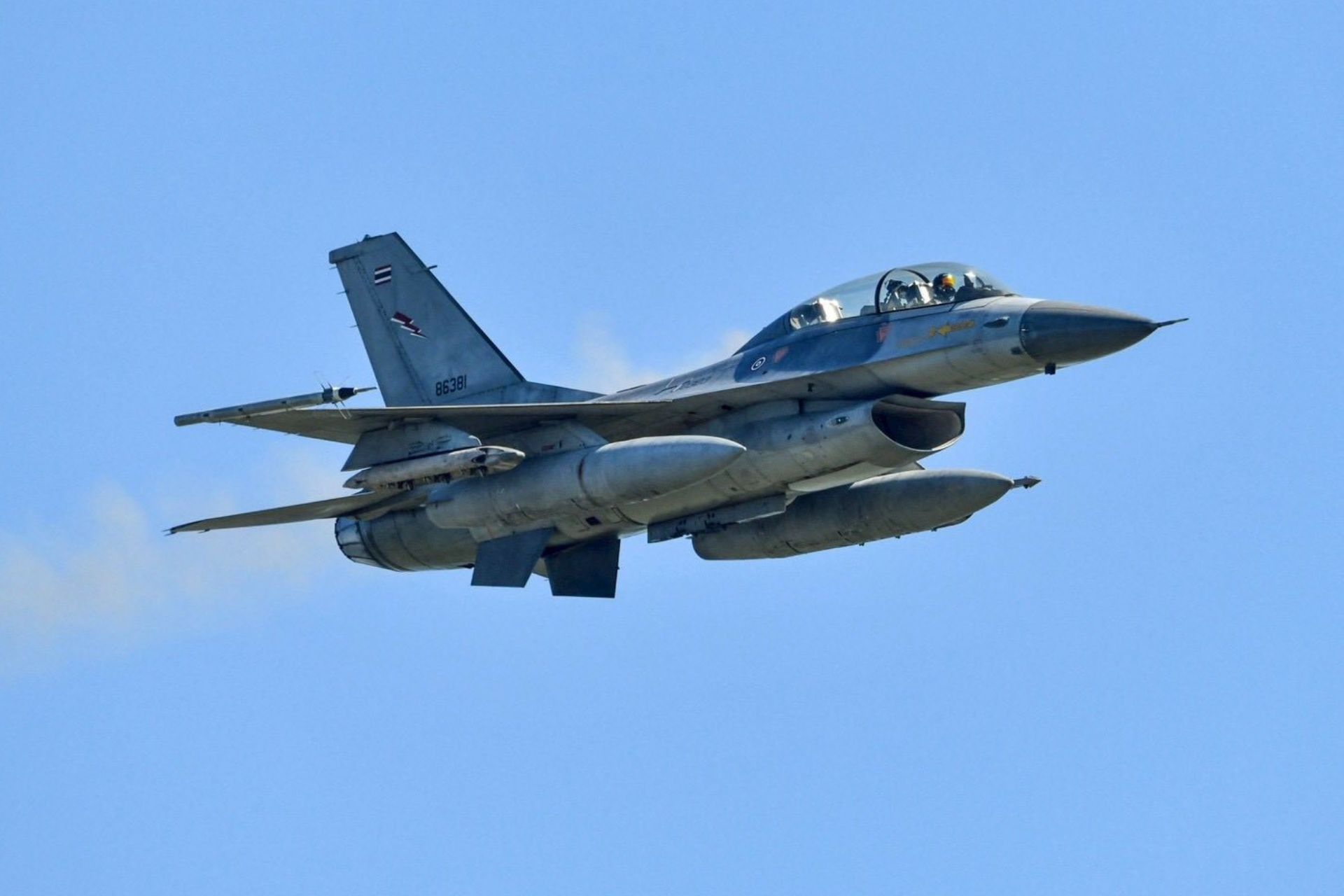
The core of the Thai response is based on the use of the F-16 Fighting Falcon, employed to neutralize a facility described as a military site disguised as a leisure complex in the Chan O An Ma area (Picture source: Royal Thai Air Force)
Thai reports specify that the Burapha Task Force, under the First Army Region, was engaged in coordination with the F-16s to regain control of border sectors where Cambodian units were reportedly observed at short distance from Thai villages. The command in Bangkok reports that these movements were accompanied, according to its own assessments, by the deployment of heavy weapons and close surveillance of the Thai positions. The Cambodian Ministry of Defence disputes these assertions, but both sides acknowledge exchanges of fire in the morning, with military casualties and civilian displacements on both sides of the line of contact.
The core of the Thai response is based on the use of the F-16 Fighting Falcon, employed to neutralize a facility described as a military site disguised as a leisure complex in the Chan O An Ma area. The aircraft, drawn from a fleet of F-16A/Bs, are built around a light airframe 15.06 m long with a wingspan of 9.45 m, designed for high-speed manoeuvrability and equipped with a low-mounted wing and a one-piece canopy providing the pilot with wide visibility. Powered by a Pratt & Whitney F100-PW-200 turbofan delivering nearly 23,830 pounds of thrust with afterburner, they reach approximately Mach 2 and benefit from a thrust-to-weight ratio suited to attack profiles at low and medium altitude.
The Westinghouse AN/APG-66 radar, with air-to-air and air-to-ground modes, provides pulse-Doppler detection adapted to interdiction and close air support, with the ability to track several targets and guide precision munitions. The aircraft carries an M61 Vulcan 20 mm cannon and can load on its underwing and under-fuselage hardpoints a wide range of weapons, from AIM-9 or AIM-120 air-to-air missiles to AGM-65 Maverick and AGM-88 HARM missiles, as well as unguided and guided bombs such as the Mk 80 series and GBU-12. Combined with a combat radius of about 550 to 800 km, depending on configuration, and a cockpit equipped with a head-up display and fly-by-wire controls, these features make it a platform suited to repeated pinpoint strikes from bases in the interior while retaining room for manoeuvre in support of ground forces along the border.
Thai sources claim that the targeted building was used as a depot for heavy weapons intended for strikes against localities deeper inside Thai territory. Phnom Penh does not acknowledge the military nature of the site and stresses the absence of retaliation in order to avoid escalation. This divergence in narrative also appears in the timeline of events, but the tactical effects observed on the ground confirm that the strikes hit sensitive infrastructure in areas that were already militarised.
The Cambodian presence in these sectors relies in part on PHL 03 multiple rocket launcher systems capable of reaching more than 70 kilometres, depending on the type of rocket, which theoretically brings several Thai infrastructures within range. Bangkok also mentions BM-21 Grad systems, which can fire 40 122 mm rockets in a few seconds and saturate an area in support of ground advances. Phnom Penh has neither confirmed the use nor the forward deployment of these systems, but acknowledges having such launchers in units stationed in the north. These platforms, combined with towed artillery and mechanised units, structure the Cambodian defence in the disputed areas.
Thai forces have simultaneously deployed M113 armoured personnel carriers and Scorpion light tanks equipped with a 76 mm gun to secure ground corridors. Their role remains secondary compared to air power, but they form an essential relay to seize or stabilise positions that have been struck from the air. The rugged terrain increases the usefulness of these light assets, whose mobility allows them to advance in areas where drones or airborne sensors detect opposing movements.
The Royal Thai Air Force operates an air defence structure based on several squadrons of F-16A/Bs and Gripen C/Ds operating from Wing 7. The system relies on long-range radars integrated into a surveillance network covering the border axes. Data collected by these radars and the operations centers are transmitted in real time to the F-16A/Bs via the tactical data links in service, improving the accuracy of strikes and speeding up decision-making. This setup gives Bangkok a reaction advantage in a zone where positions shift constantly and strategic depth remains limited.
In 2025, several clashes had already opposed the two armies, in particular in May during an exchange of fire that killed a Cambodian soldier, then in July during a five-day confrontation that caused dozens of casualties and displaced more than 300,000 people. These episodes increased the density of military forces along the border, making rapid recourse to air power more likely in any new deterioration of the situation.
Thai authorities pledge operational updates as the situation stabilises, while the Cambodian side maintains that it does not seek escalation. The regional context continues to weigh on the course of the conflict, as ASEAN observes a gradual militarisation of the Thai Cambodian front and an expansion of long-range systems in an area where historic rivalries persist. The weakening of ceasefire arrangements suggests that any new balance will have to take into account Bangkok’s growing air capabilities and Phnom Penh’s structured ground defences, in an environment where the speed of strikes and the density of sensors are gradually reshaping the balance of power.