






Breaking News





Switzerland turns to SIG Sauer P320 as next 9mm service pistol for its troops.
Switzerland has selected the SIG Sauer P320 as the new standard 9 mm service pistol for the Swiss Armed Forces, replacing the long-serving Pistol 75 and tying the choice to the 9 mm Pistole CH A NG modernization project. The deal covers approximately 140,000 pistols with Swiss-based production and a 30-year support horizon, aligning Bern with other P320 user nations while maintaining industrial control at home.
The Swiss Federal Office for Defence Procurement, armasuisse, has formally chosen the SIG Sauer P320 as the new service pistol of the Swiss Armed Forces, confirming that the modular 9 x 19 mm handgun will replace the Pistol 75 after roughly five decades in service. Announced in Bern on 4 December and followed by a joint statement from SIG Sauer’s Neuhausen am Rheinfall and Newington sites on 9 December, the decision is tied to the 9 mm Pistole CH A NG program. It includes a commitment to set up near-complete domestic production, with an initial lot of 50,000 pistols and a total requirement of about 140,000 weapons over a planned 30 year life cycle.
Follow Army Recognition on Google News at this link
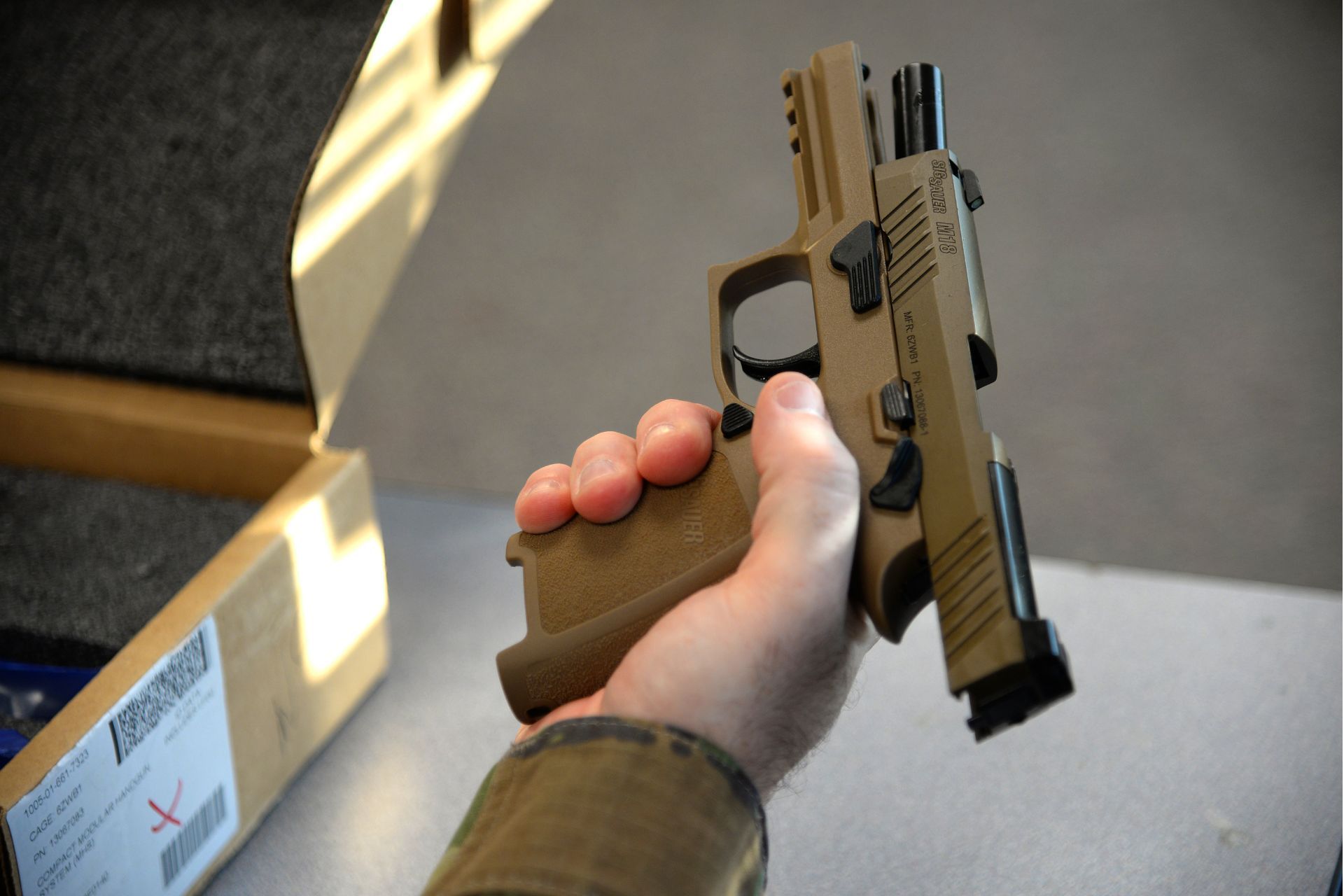
Armasuisse plans a total requirement of around 140,000 pistols, including an initial batch of 50,000 units funded under Armeebotschaft 26, to equip active troops, recruit schools, and reserve (Picture source: US DoD)
The SIG Sauer P320 is a 9 × 19 mm striker fired semi automatic pistol, built around an internal fire control unit that bears the regulatory serial number and can be inserted into different grip modules and slides. This modular architecture makes it possible to change grip size, barrel length, or slide profile without changing weapon in the administrative sense, which reduces logistical costs and facilitates adaptation to the body types of conscripts and professional personnel. On service versions, the approximately 120 mm barrel combined with a short recoil locking system ensures proven operation with 9 mm NATO ammunition, while maintaining dimensions compatible with daily carry in a holster.
The Swiss specifications require a system able to remain in service for at least thirty years, with high availability despite employment in alpine environments and across a wide temperature range. Armasuisse plans a total requirement of around 140,000 pistols, including an initial batch of 50,000 units funded under Armeebotschaft 26, to equip active troops, recruit schools, and reserves. The contract includes a commitment to production on Swiss territory, relying on a network of several hundred national suppliers for key components, in order to guarantee both the resilience of supply chains and the ability to conduct in depth maintenance over several decades.
The internal safety of the P320 nevertheless remains the subject of international debate. The pistol incorporates a firing pin block and a disconnect mechanism intended to prevent an unintended discharge in the event of a fall or impact, and SIG SAUER highlights upgrade programmes aimed at lightening certain moving parts and reinforcing mechanical disconnection. For its part, Switzerland opts for a widely fielded weapon that is nonetheless surrounded by a technical controversy, which the Armasuisse test cycle judges manageable within the framework of a military standard and a strict employment doctrine.
For the shooter, ergonomic modularity is an immediate advantage. The different grip sizes and backstraps make it possible to adjust the grip circumference, which reduces fatigue, improves recoil control and facilitates access to controls for smaller hands, common in a mixed conscription army. The standard accessory rail under the barrel allows the installation of tactical lights or laser designators, now common in night training and military police missions. Depending on the variants selected, the slide is machined to accept a red dot sight, opening the way to a gradual upgrade of sighting equipment, already underway in several allied armies that are moving towards compact optics on their service pistols.
From a purely ballistic perspective, the 9 × 19 mm cartridge remains the reference standard for Western armed forces, offering a robust compromise between penetration, recoil management and magazine capacity. The P320 uses 17-round magazines in its basic configuration, with the option of higher capacity versions for certain units or specific missions.
This volume of fire corresponds to the classic requirements of a military sidearm: close-range self-defence, convoy protection, reinforcement of guard teams and occasional use in internal security operations. The combination of pistol and ammunition fits into a widely tested ecosystem, which simplifies the supply of certified lots and access to test facilities already shared with other partner countries. The adoption of the P320 by Switzerland comes at a time when the same system is already in service with the United States Armed Forces under the designations M17 and M18, as well as with the Canadian, Australian and Danish armies.
This decision places Bern within a broader movement of convergence in equipment standards across the Euro-Atlantic area, while preserving a degree of autonomy through local production and Swiss industrial governance. In geopolitical terms, the combination of a transatlantic supplier, national manufacturing and ammunition aligned with NATO standards helps maintain Switzerland in a stance of armed but credible non-alignment. It strengthens both the resilience of its defence industrial and technological base and its ability to interact with Western partners in a crisis, at a time when the reliability of small arms, the traceability of supply chains and the regulation of exports are becoming central elements in the debate on European security.