






Breaking News





Exosens and Theon to supply Mikron night vision goggles to German and Belgian Armies.
Exosens announced in Mérignac that it will partner with Theon International to supply 100,000 Mikron night vision goggles to the German armed forces under a 500 million euro OCCAR contract, with Belgium adding a firm order for 4,000 units. The program strengthens European night combat capability and expands a shared 16 mm tube standard across multiple NATO partners.
The French optronics group Exosens confirmed on 10 December 2025 that it has signed a major contract with the Organisation for Joint Armament Cooperation (OCCAR) in partnership with Theon International to equip the Bundeswehr with 100,000 Mikron night vision goggles. According to company officials, the agreement, valued at roughly 500 million euros, covers the delivery of 200,000 compact 16 mm image intensifier tubes produced by Exosens for integration into Mikron housings designed for long-duration helmet use. Belgium converted an existing option into a firm commitment for 4,000 devices, a move that extends a rising wave of night capability upgrades across several European forces.
Follow Army Recognition on Google News at this link
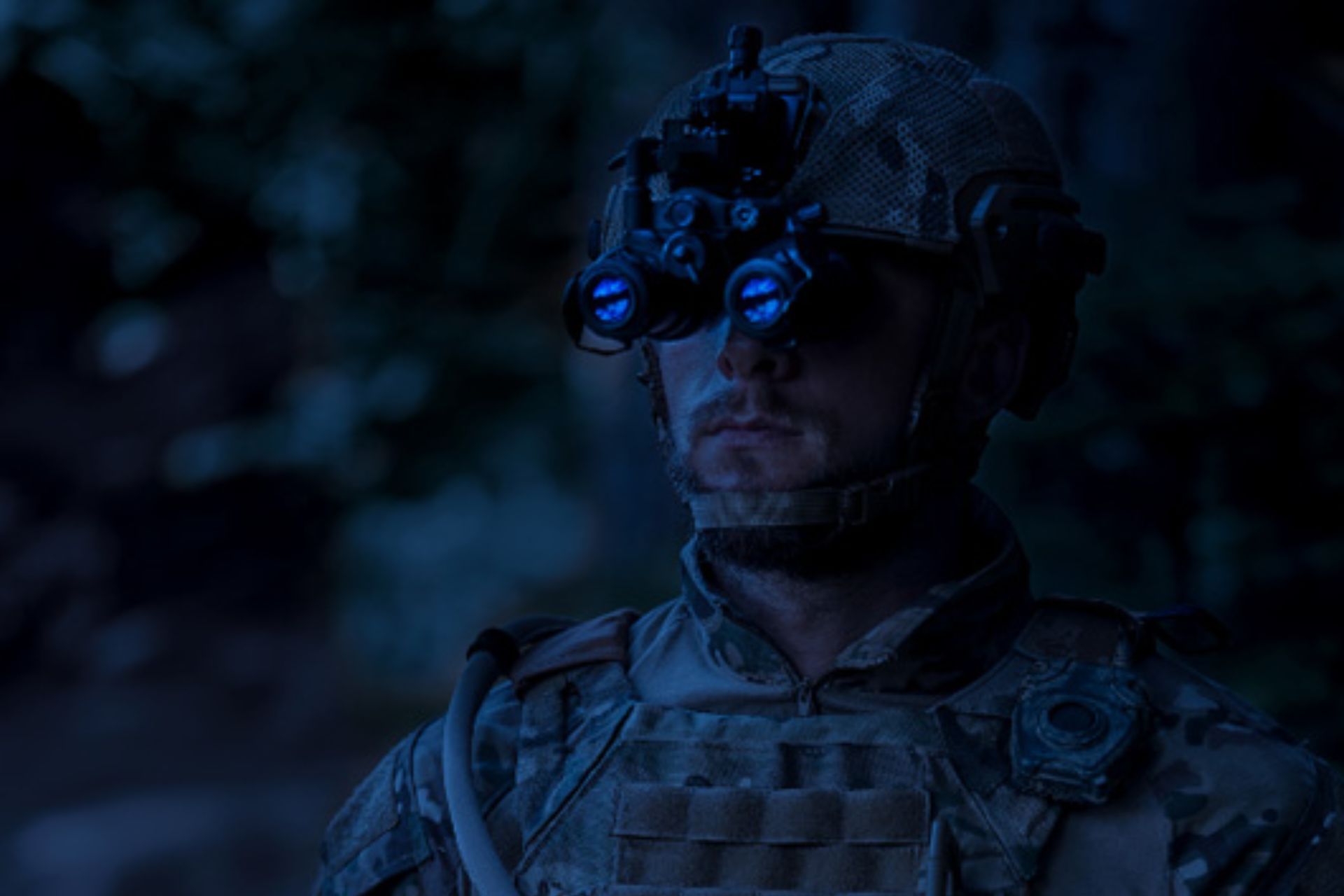
The solution is based on compact and lightweight 16mm tubes integrated into a Mikron goggle housing designed for prolonged helmet mounting (Picture source: Theon International)
This volume reflects both an industrial objective and an evolution in doctrine. Exosens, which operates twelve production and research sites in Europe and North America and employs more than 2,000 people, consolidates its position as a central supplier of intensifier tubes for European forces. Cooperation with Theon International and the THEON/Hensoldt consortium, framed by a long-term commercial agreement covering more than 400,000 image intensifier tubes, adds critical mass to the European defence industrial and technological base (BITD) in the field of land optronics.
The solution is based on compact and lightweight 16 mm tubes integrated into a Mikron goggle housing designed for prolonged helmet mounting. Compared with older 18 mm generations, the reduced format lowers overall weight and neck strain for the soldier, which improves mobility in urban areas or rough terrain. The compact design also makes it easier to mount the goggles on rails alongside other individual equipment, such as thermal cameras, communication systems, or laser designators. The 16 mm tubes still provide a sufficient level of resolution for identifying targets at short and medium range, which remains essential in high intensity night engagements.
The contract with the Organisation for Joint Armament Cooperation (OCCAR) confirms a standard that has already been tested in service. From 2015 onwards, Germany identifies the potential of 16 mm tubes and acted as a pioneer within NATO. Belgium, the United Kingdom, the Netherlands, Luxembourg, Spain and Poland subsequently adopt this architecture, creating a shared reference that simplifies training, logistics, and support in multinational operations. The agreement concluded at the end of 2025 consolidates this technical framework beyond Germany’s sole requirement.
At soldier level, the impact is immediate. The “one soldier, one goggle” concept promoted by the partners aims to equip every fighter with the latest generation night vision device, whereas many armies still reserve such equipment for high-readiness units or special forces. The generalisation of this allocation evens out night perception within platoons, reduces blind spots in surveillance patterns and limits recourse to artificial lighting, which is easily detected by an opponent. Training procedures remain close to those used for previous generations, which limits the impact on training plans while expanding the scale of night vision deployment.
On operations, Mikron goggles are integrated into an increasingly digital command and control (C2) environment. Combined with encrypted communication systems and individual radios, they become a short-range sensor feeding into the shared tactical picture. During patrols, they improve the detection of silhouettes, unlit vehicles and discreet movements. In urban areas, the accuracy of image intensification helps distinguish weapons, tripwires, or concealed openings, reducing the risk of very short range ambush. For armoured or mechanised units, equipping accompanying infantry improves the coordination of night dismounts, river crossings, or searches around convoys.
By pooling the needs of several armies around a common 16 mm tube standard and entrusting them to the Exosens and Theon industrial tandem, the Organisation for Joint Armament Cooperation (OCCAR) helps structure a European optronics sector able to support a long term land rearmament effort. In a context shaped by the war in Ukraine, renewed German investment in the Bundeswehr and a growing number of joint exercises on the eastern flank, the ability to equip forces on a large scale with night combat equipment becomes a central marker of credibility. It influences both the transatlantic dialogue and global industrial competition, in which Europe seeks to position itself as a provider of complete solutions, from the individual sensor to collaborative combat architectures.