






Breaking News






Saab extends target profiles for British Army Sky Sabre air defense system in training.
Saab’s UK subsidiary BlueBear supported Ex KOP SHIELD in the Falkland Islands, flying five target sorties with 7 Air Defence Group and the resident Sky Sabre battery alongside RAF Typhoons. The trial stressed detection to engagement timelines and joint command and control in harsh South Atlantic conditions, reinforcing the readiness of a distant UK garrison.
BlueBear, a Saab company, provided an aerial target system and on-site specialists to the British Army’s Ex KOP SHIELD in the Falklands, a two-day event that paired 7 Air Defence Group’s Counter-Uncrewed Aerial System Training Team with the islands’ Sky Sabre battery and RAF Typhoons at Mount Pleasant. According to Saab and industry releases, the team nearly doubled the target system’s usual reach and flew five sorties over open ocean to pressure sensors, datalinks, and procedures under austere conditions. The focus was disciplined timelines, clean Link 16 sharing, and a working joint picture that lets the right shooter prosecute the right target at the right moment.
Follow Army Recognition on Google News at this link
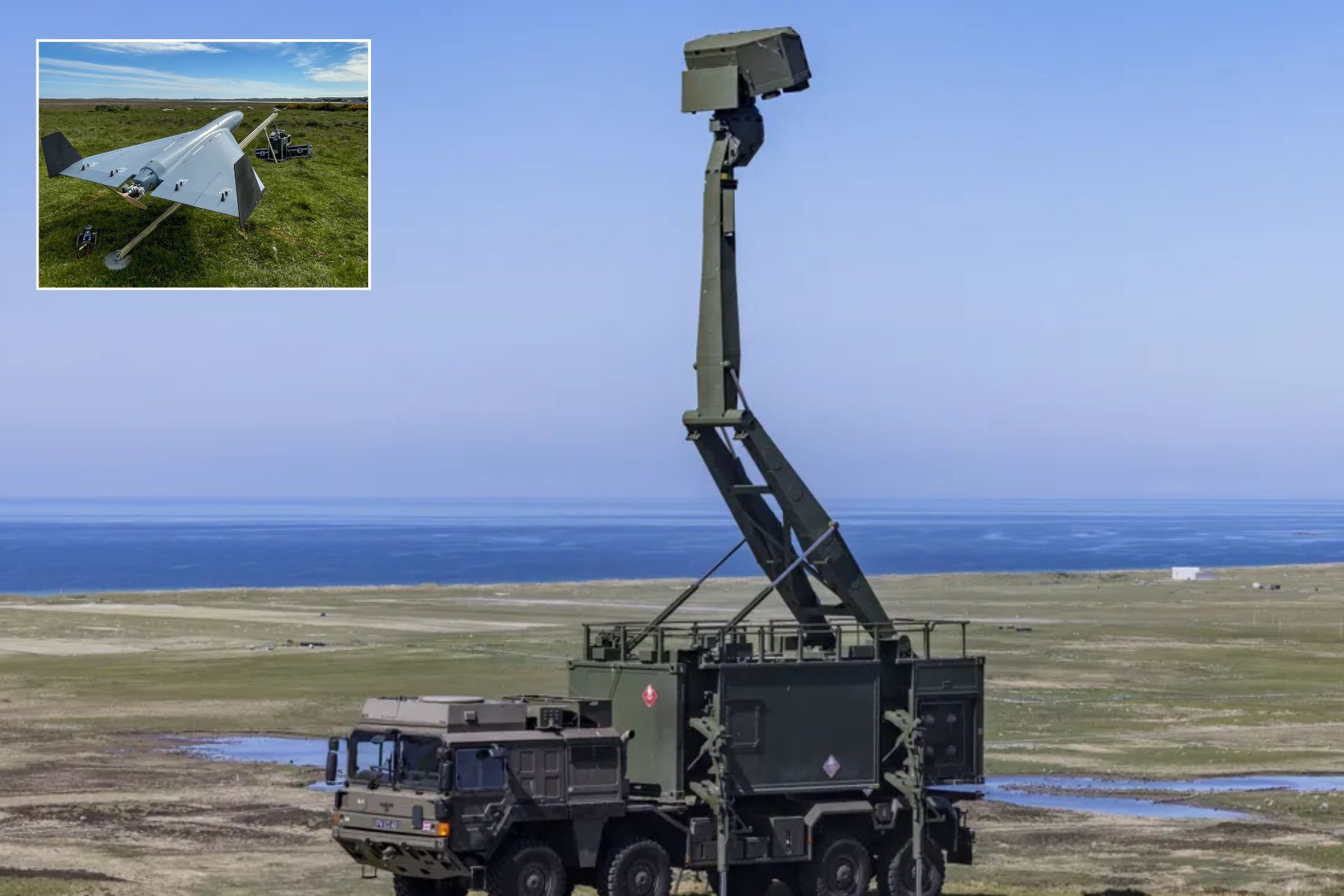
Sky Sabre, the British Army’s ground-based air defence system, is structured around three complementary elements: a surveillance radar, a command node, and an effector (Picture source: Saab)
Over two days, 7 Air Defence Group and its Counter–Uncrewed Aerial System Training Team fly BlueBear’s target system far offshore in the South Atlantic. The support package includes on-site specialists who help extend the system’s envelope, nearly doubling its usual range and covering more than 500 km during the trial. This extension is functional rather than cosmetic. It enables the unit to rehearse detection to engagement cycles at distances that stress sensors, communications, and procedures under weather and maritime constraints, while revealing the frictions specific to a theatre distant from UK sustainment.
Sky Sabre, the British Army’s ground-based air defence system, is structured around three complementary elements: a surveillance radar, a command node, and an effector. The effector is the Common Anti-Air Modular Missile (CAMM), which the Army cites with a top speed of about 2,300 mph, a mass of 99 kg, and a range clearly beyond Rapier. CAMM uses vertical cold launch and an active radar seeker, giving a wide engagement envelope against fast jets, uncrewed aircraft systems, and guided munitions. The Link 16 data link allows the battery to contribute to and benefit from a Recognised Maritime Picture/Common Operational Picture (RMP/COP) shared with Royal Air Force and Royal Navy nodes.
On the sensor layer, Sky Sabre employs Saab’s Giraffe Agile Multi-Beam (AMB) radar. Giraffe AMB is a 3D C-band, medium-range system with a one-second revisit time and strong resilience to clutter and jamming, attributes relevant in high winds and maritime ducting common in the South Atlantic. The antenna is raised on a mast to improve low-altitude coverage; according to open Army sources and industry documentation, the system is rapidly deployable and delivers engagement-quality tracks to short- and medium-range effectors. In short, it is designed for ground-based air defence (GBAD) units that have to move, re-establish the air picture, and operate under emissions control (EMCON) when required.
The presence of Typhoons in the Falklands adds a second interception layer and a means to validate joint procedures. Co-training with the fighters matters because Link 16 connectivity enables the resident battery to ingest and disseminate tracks smoothly in a mixed-service environment. Interoperability is a working method rather than a slogan: it is how the detachment maintains a continuous air picture against UAS, fast aircraft, and stand-off weapons, then assigns the appropriate shooter at the right time. In Ex KOP SHIELD, 7 Air Defence Group and its Counter–Uncrewed Aerial System Training Team feature as the core of this process; at this first reappearance of the acronym, ground-based air defence (GBAD) frames unit actions and coordination under EMCON, emissions control (EMCON).
The exercise focuses on compressing timelines and disciplined electromagnetic practice. BlueBear’s target system, pushed well beyond its usual radius, forces the battery to build the RMP/COP early and maintain it as geometry evolves. Giraffe AMB’s one-second revisit supports track quality on small, low-observable targets, while CAMM’s active seeker and cold vertical launch reduce launch signatures and broaden the engagement basket for short-notice shots. Under EMCON, the battery can still share and receive data over Link 16, sustaining the Common Operational Picture without continuous emissions. In practical terms, the detachment demonstrates that it can move, reconnect, and fire quickly in harsh weather, far from its resupply chains, which is the central requirement for an overseas garrison.
The United Kingdom’s integrated air defence posture relies on layered sensors and effectors connected to NATO Integrated Air and Missile Defence architectures. Exercises such as Ex KOP SHIELD go beyond crew warm-ups; they verify that a compact detachment fits into alliance networks and can operate jointly when necessary. In the South Atlantic, where sovereignty issues remain sensitive and regional balances evolve, keeping Sky Sabre and Typhoon crews current, with credible surrogate threats and extended training profiles, serves as discreet deterrence. The message is straightforward: London intends to retain a professional, connected, and ready garrison at the edge of its extended perimeter, while European partners, led by Saab, continue to invest in the defence industrial and technological base (BITD) that sustains this routine.