






Breaking News






MSPO 2025: Poland Focuses on Automated Minelayer ZUMP to Strengthen Battlefield Counter Mobility.
PeX Defence Polska unveiled the ZUMP during the MSPO 2025 exhibition held from September 2 to 5 in Kielce, Poland. This trailer-mounted automated minelaying system has been developed to address the growing need for mobility and counter-mobility on the battlefield. Designed to enhance the operational flexibility of armed forces, the system enables the rapid and methodical deployment of anti-tank mines across various terrains, whether on the surface or covered with soil. Its presentation comes at a time when demand for modern combat engineering and battlefield protection assets is steadily increasing.
Follow Army Recognition on Google News at this link
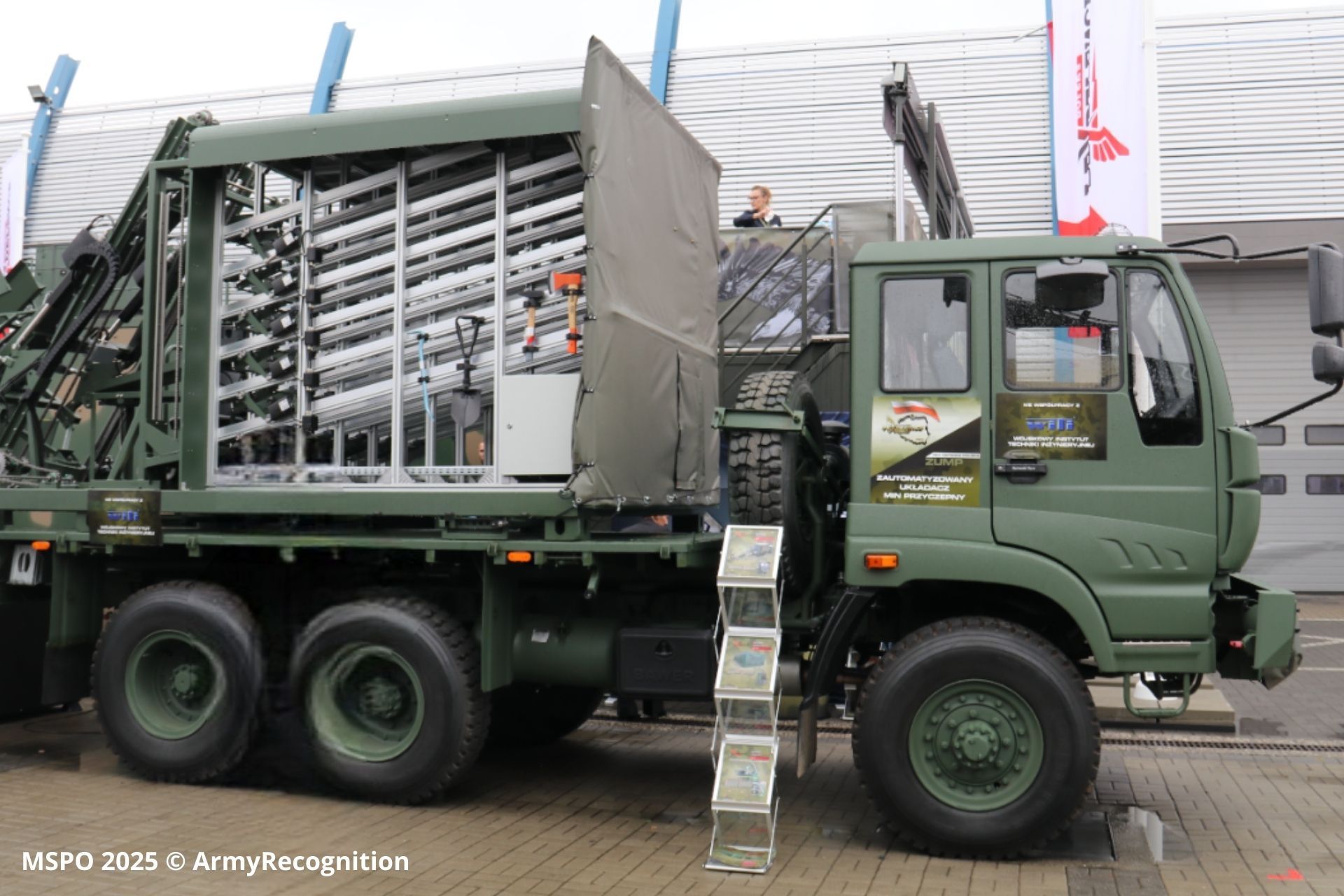
The ZUMP can be mounted on a medium-category 6x6 truck chassis with a payload capacity of at least 3.5 tons, such as the Star 266M2(Picture source: Army Recognition)
The ZUMP consists of several main components, including a storage compartment capable of holding up to two hundred mines, an automatic conveyor, an operating table, a blade with a ripper for subsurface work, and a power generator. The process is fully automated, with the operator’s role limited to removing the mine’s protective cover before deployment and monitoring the control console. The conveyor transports each mine from the storage compartment to the telescopic belt, which guides it to the working area where it is placed according to the selected settings.
The system offers two primary operating modes. In the first, the blade is lowered and the ripper deployed, creating a trench in which the mine is placed and then covered with soil. In the second, the blade is raised and the ripper retracted, allowing surface deployment. The spacing between mines is automatically regulated, ensuring consistency in minefield layout. An auxiliary power unit provides energy to the hydraulic components, improving system reliability and operational continuity.
Designed to accommodate TM-62M and MPP-B anti-tank mines, as well as other comparable models, the ZUMP can be mounted on a medium-category 6x6 truck chassis with a payload capacity of at least 3.5 tons, such as the Star 266M2. Its integrated transport and installation capabilities allow for rapid deployment and minimize crew exposure, with personnel limited to monitoring and supervisory tasks. The combination of a large storage capacity and an automated conveyor mechanism makes the system suitable for establishing large-scale defensive barriers.
Operational use of such a system is centered on its ability to reinforce counter-mobility measures in a short timeframe. On an active front, the speed of deployment makes it possible to establish minefields intended to slow, channel, or divert enemy armored forces in direct support of defensive maneuvers. In a defense-in-depth scenario, the ZUMP can be employed to create multiple successive mine lines, complicating enemy movement and helping preserve the freedom of maneuver of friendly units.
These systems are also applicable to the protection of critical areas such as strategic crossing points, logistical depots, or artillery positions. By deploying automated minefields around these locations, armed forces establish a passive barrier that hinders infiltration attempts or direct assaults. In addition, automation reduces personnel exposure, traditionally high during manual mine placement, which is an advantage in environments where indirect fire and drone strikes represent constant threats.
Finally, the ZUMP fits into the framework of modern warfare, where mobility and counter-mobility remain central factors. Its ability to lay standardized anti-tank mines quickly enables integration into maneuver plans that combine physical obstacles, direct fire, and artillery support. When used alongside other denial means, such as barriers or controlled demolitions of infrastructure, it provides a coherent tool for slowing adversary movement and creating tactical opportunities.
In conclusion, the ZUMP, presented at the MSPO 2025 exhibition in Kielce, reflects the evolution of minelaying systems toward mechanized and automated solutions that reduce human workload and increase deployment speed. Its modular design, ability to operate both on the surface and below ground, and integration onto a mobile vehicle make it a system suited to current counter-mobility requirements. With this development, PeX Defence Polska addresses operational needs in land defense by providing armed forces with a tool for protecting sensitive areas and shaping adversary maneuvers.