






Breaking News






IndoDefence 2025: German Marder 1A3 armored infantry vehicle becomes core of Indonesian Army mechanized forces.
During IndoDefense 2025 defense exhibition in Jakarta, Indonesia, the Indonesian Army showcased the German-made Marder 1A3 infantry fighting vehicle (IFV), reaffirming its status as the primary armored platform supporting the nation’s mechanized infantry doctrine. As part of a €216 million defense procurement agreement signed with Rheinmetall in 2013, the Marder 1A3s, together with 103 Leopard 2A4/2A6 main battle tanks, engineering vehicles, and support equipment, marked a transformative step in the Indonesian Army’s modernization. The first Marder 1A3 units were delivered in 2014, with the initial vehicles entering operational service and presented publicly during the TNI’s anniversary parade on October 5, 2014. A subsequent batch was confirmed to have arrived by September 2015, solidifying their deployment across key armored formations.
Follow Army Recognition on Google News at this link
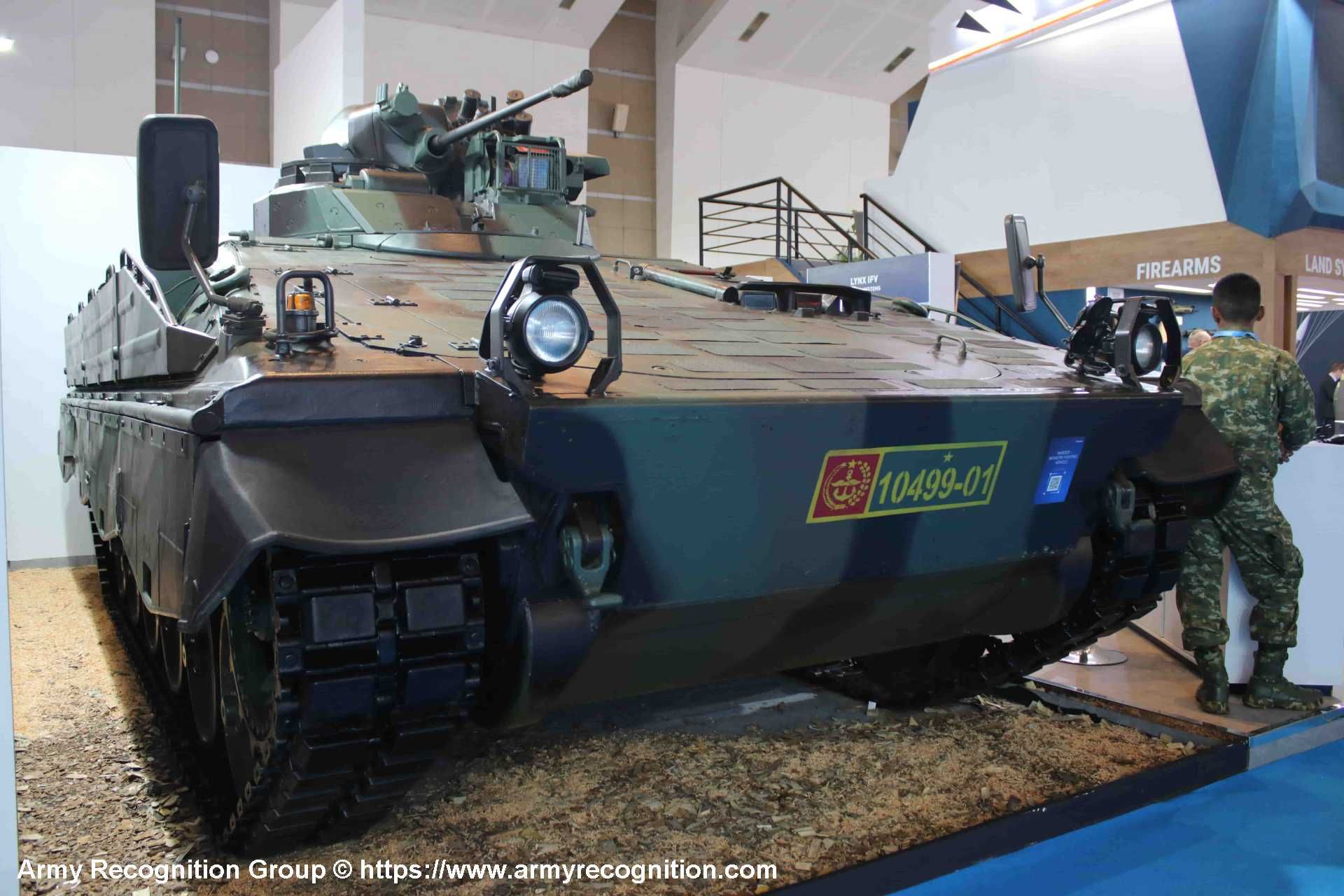
German-made Marder 1A3 infantry fighting vehicle of the Indonesian Army on display at IndoDefense 2025 defense exhibition, in Jakarta, Indonesia. (Picture source: Army Recognition Group)
Built by German Company Rheinmetall Landsysteme, the Marder 1A3 IFV (Infantry Fighting Vehicle) combines battlefield mobility, firepower, and protection in a proven combat platform. is a tracked infantry fighting vehicle developed by West Germany during the Cold War to support NATO forces against Warsaw Pact mechanized units. Introduced in the early 1970s and continuously upgraded, the Marder family is considered one of the most successful IFV platforms of its generation. The A3 version, which Indonesia operates, is the most heavily modernized variant before the introduction of the Puma IFV into German service. The A3 variant was rolled out in the 1980s in response to evolving threats, particularly the increasing prevalence of Soviet 30mm automatic cannons and tandem-warhead RPGs. It features advanced armor protection, including bolted-on steel plates and mine protection enhancements.
The vehicle is powered by an MTU MB 833 Ea-500 six-cylinder, liquid-cooled diesel engine producing 600 hp, offering a top road speed of 65 km/h and a range of up to 500 kilometers. The Marder 1A3 can cross water obstacles up to 1.5 meters deep and climb gradients of 60 percent, enabling it to maneuver effectively in difficult terrain. It accommodates a crew of three (commander, driver, and gunner) and carries six fully equipped infantrymen in its rear compartment, accessible via a hydraulic ramp.
The Marder 1A3 armament includes a 20mm Rheinmetall MK 20 Rh202 autocannon with a dual-feed system that allows rapid switching between armor-piercing and high-explosive rounds, making it effective against both soft and lightly armored targets. The coaxial 7.62mm MG3 machine gun complements its main gun for anti-personnel defense. Some variants are also equipped with launchers for MILAN anti-tank guided missiles, though Indonesian units are currently not known to be fitted with these systems.
In the specific regional context of Indonesia, a vast archipelagic state comprising over 17,000 islands, the role of the Marder 1A3 transcends traditional armored vehicle doctrine. Deployed primarily with the 1st Mechanized Infantry Division and supporting brigades within the Army Strategic Reserve Command (Kostrad), the Marder provides a unique combination of strategic mobility and tactical firepower suited for both conventional operations and rapid deployment across maritime provinces. Its tracked mobility allows it to maneuver through rugged terrain, swampy lowlands, and jungle environments found in key defense zones such as Kalimantan, Papua, and Sulawesi, areas increasingly prioritized amid regional tensions in the South China Sea and along internal security flashpoints.
The Marder 1A3 has also proven to be an effective platform during national defense exercises such as “Dharma Yudha” and “Waspada Nusa,” where its ability to integrate with infantry, armor, and air-mobile units demonstrates a multi-domain application. Its size and weight profile allow it to be airlifted by Indonesian Air Force transport aircraft, enhancing its utility for inter-island force projection in times of conflict or disaster response. In counterinsurgency or border security roles, particularly in Papua or Natuna Islands, the Marder’s speed and armor enable Indonesian forces to respond swiftly while ensuring protection in volatile engagements.
Operationally, the Marder 1A3 enhances joint maneuver capabilities when paired with the Leopard 2A4 MBTs, enabling coordinated fire and move tactics. Indonesian doctrine emphasizes asymmetric flexibility, and the Marder supports this through combined arms operations where mechanized infantry can dismount under cover of armor, establish firebases, or conduct urban clearance with superior protected mobility.
The vehicle’s continued presence in strategic showcases like IndoDefense 2025 signals not only its enduring relevance but also Indonesia’s intention to maintain a robust and modern mechanized force. With its proven adaptability, logistical reliability, and combat heritage, the Marder 1A3 IFV remains indispensable in enabling Indonesia to safeguard its territory, respond to regional contingencies, and project stability across Southeast Asia’s dynamic security environment.