






Breaking News






How US and Singapore Forging Sabre exercise forges quicker sensing and cleaner targeting.
The Republic Of Singapore Armed Forces ran the tenth Forging Sabre from 6 to 21 September at Mountain Home AFB in Idaho, using airspace far larger than Singapore to validate integrated detection and precision strike. The drill brought together the RSAF, the Singapore Army, and the Digital and Intelligence Service to compress decision timelines and refine coalition-ready tactics.
Singapore’s Ministry of Defence said Forging Sabre 2025 was built to measure how well the force could sense, decide, and deliver controlled effects under pace and friction. The biennial event, held from 6 to 21 September at Mountain Home AFB, brought the RSAF together with the Singapore Army and the Digital and Intelligence Service, operating across an airspace volume far larger than the city-state and fielding an expanded mix of manned aircraft, MALE UAVs, and micro or mini UAS. An on-site software cell from the RSAF’s Agile Innovation Digital team, known as RAiD, was embedded to push real-time fixes and features during missions.
Follow Army Recognition on Google News at this link
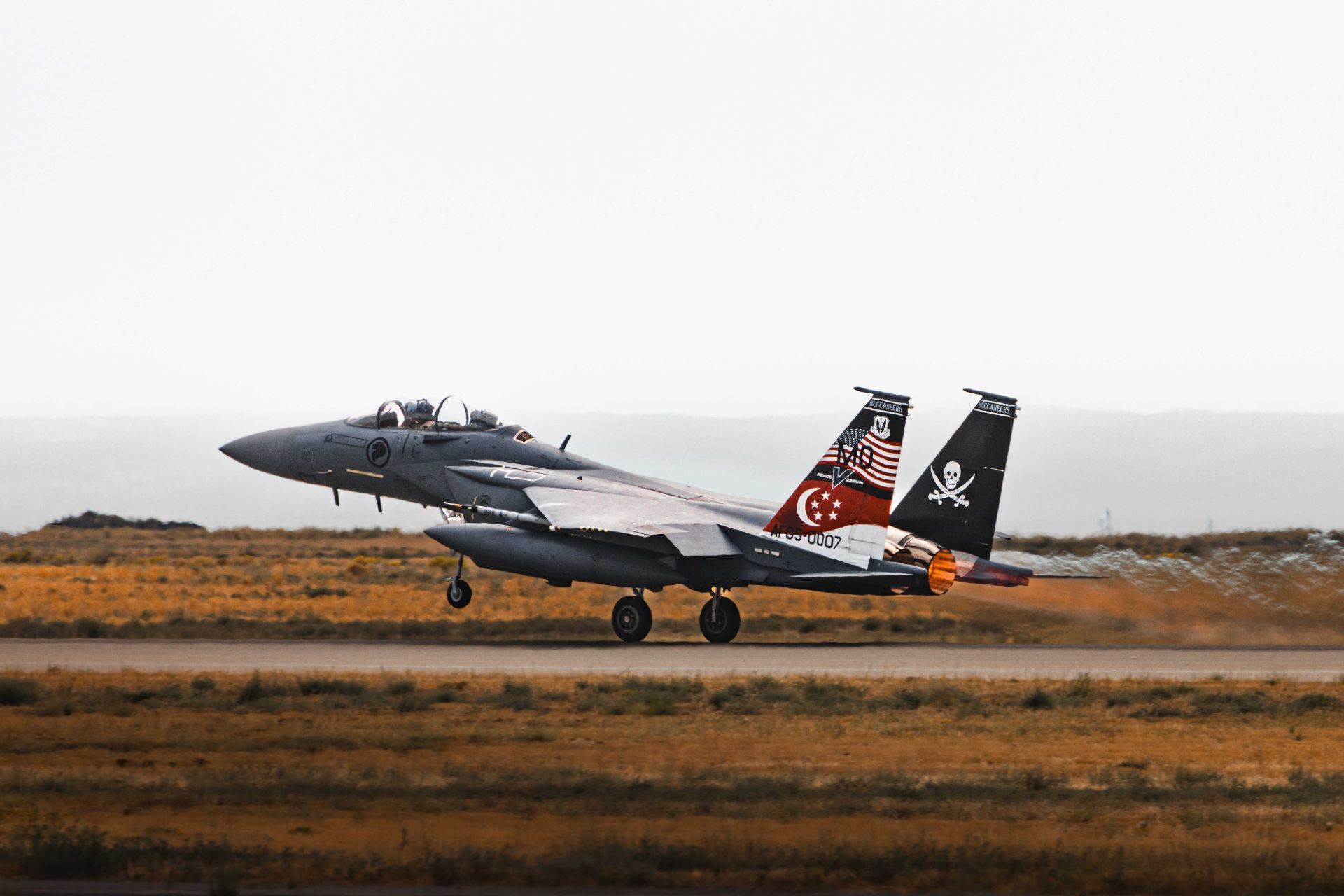
The F-15SG sat at the center of the arrangement and served as a multirole air-to-air and air-to-surface platform. (Picture source: US DoD)
The F-15SG sat at the center of the arrangement and served as a multirole air-to-air and air-to-surface platform. The aircraft used two F110 engines that provided high thrust for heavy loadouts and medium altitude penetration profiles. Its AN/APG-63(V)3 active electronically scanned array radar detected and tracked multiple targets at long range while providing high-resolution ground mapping, which allowed near-concurrent counter-air and deep strike tasking. The guided munitions it carried kept a stable employment envelope when the A330 MRTT sustained the mission flow. The A330 MRTT extended patrol time with an offload of up to about 70 tonnes during a one-hour station, 1,250 nautical miles from base, which opened a wider window for ISR and precision weapon employment.
The ISR layer was built around the Heron 1, a MALE drone designed for long persistence. The Heron 1 had endurance greater than twenty-four hours, useful for target development and pattern of life surveillance across broad sectors. Its MOSP electro-optic turret with a third-generation FLIR and low-light day sensors provided a steady line of sight designation and collection suited to medium altitudes. Around this platform, the UAS Warfare and Tactics Centre’s DROID unit fielded micro and mini UAS to thicken the low altitude sensor mesh. These small systems added a discreet presence, low opportunity cost, and the ability to point quickly at targets of limited tactical value individually, yet decisive for tempo.
The base offered access to complex airspace, varied target arrays, and range infrastructure sized for composite packages mixing fighters, ISR, and tankers. The partnership rested on Peace Carvin V and the 428th Fighter Squadron, a U.S. unit dedicated to F-15SG training. This relationship kept procedures close to U.S. Air Force standards and supported procedural interoperability that translated into flight safety, clear briefings, and effective radio work.
The Link 16 data link carried track data and command messages and supported a shared Recognized Maritime Picture and Common Operational Picture while lowering fratricide risk through status calls, no strike areas, and georeferenced coordinates. Gateways maintained continuity with other networks, which enabled dynamic retasking and the attachment of opportunistic sensors to a target whose window was closing. In parallel, the RAiD software team and DSTA treated the application as a deployed capability. In mission updates were pushed to correct a bug or add a function, shortening the decision cycle and reducing dependence on post-mission fixes.
The land fires component showed that Forging Sabre extended beyond aviation. HIMARS, introduced to live fire in 2009, remained the reference for air-to-surface integration on the artillery side. The system fired GMLRS rockets with GPS laser guidance with a typical range beyond 70 kilometers and metric accuracy, which gave depth to the sense of shooter architecture. Its employment was restrained, logistics were contained, and the system was set up quickly, all useful for achieving measured effects from standoff.
Manned aircraft flew under EMCON when discretion was required and accepted cueing from the Heron 1 and micro UAS, then refined the Recognized Maritime Picture and the Common Operational Picture at a near real-time pace. The F-15SG used the reach and agility of its AESA radar to build packages, while the A330 MRTT converted detection into sustained effects by keeping strike platforms inside their weapons employment envelope long enough to finish the task. The MALE drones filled radar coverage gaps, tracked without fatigue, and stabilized the targeting chain over areas where weather degraded noisier sensors.
With more than eight hundred personnel engaged and a training area estimated at more than twenty times the city state, the SAF rehearsed task organization of packages, reviewed force flow windows, and secured the ordinary but decisive steps that make a composite mission work. The BITD community also benefited, because trialing data fusion schemes, manned-unmanned teaming, and software refresh cycles in real conditions filtered out fragile options early and retained those that held up under constraints.
The airpower of a small state depended less on mass than on access, trusted partners, and interoperable architectures. By training in the United States within an established framework, Singapore kept crews comfortable with complex scenarios, maintained architectures compatible with coalition networks, and signaled steadiness that supported regional deterrence. In the Indo-Pacific, where the environment is dense and electronic, the combination of F-15SG Heron 1 Link 16 A330 MRTT and land-based fires added depth to operations and sustained the credibility of a collective security posture.