






Breaking News






GMARS Rocket Launcher Undergoes US Testing Offering NATO New Long Range Precision Firepower.
According to information published by Lockheed Martin Europe via X on August 4, 2025, Rheinmetall and Lockheed Martin have confirmed that the Global Mobile Artillery Rocket System (GMARS), developed in partnership by the two defense manufacturers, is currently undergoing live testing at the White Sands Missile Range in the United States. These trials, conducted under operational conditions, represent a key phase in validating the full capabilities of the system after its official unveiling at the Eurosatory 2024 defense exhibition in Paris. GMARS aims to address the growing need for long-range, precision-guided fire support across NATO-aligned armed forces.
Follow Army Recognition on Google News at this link
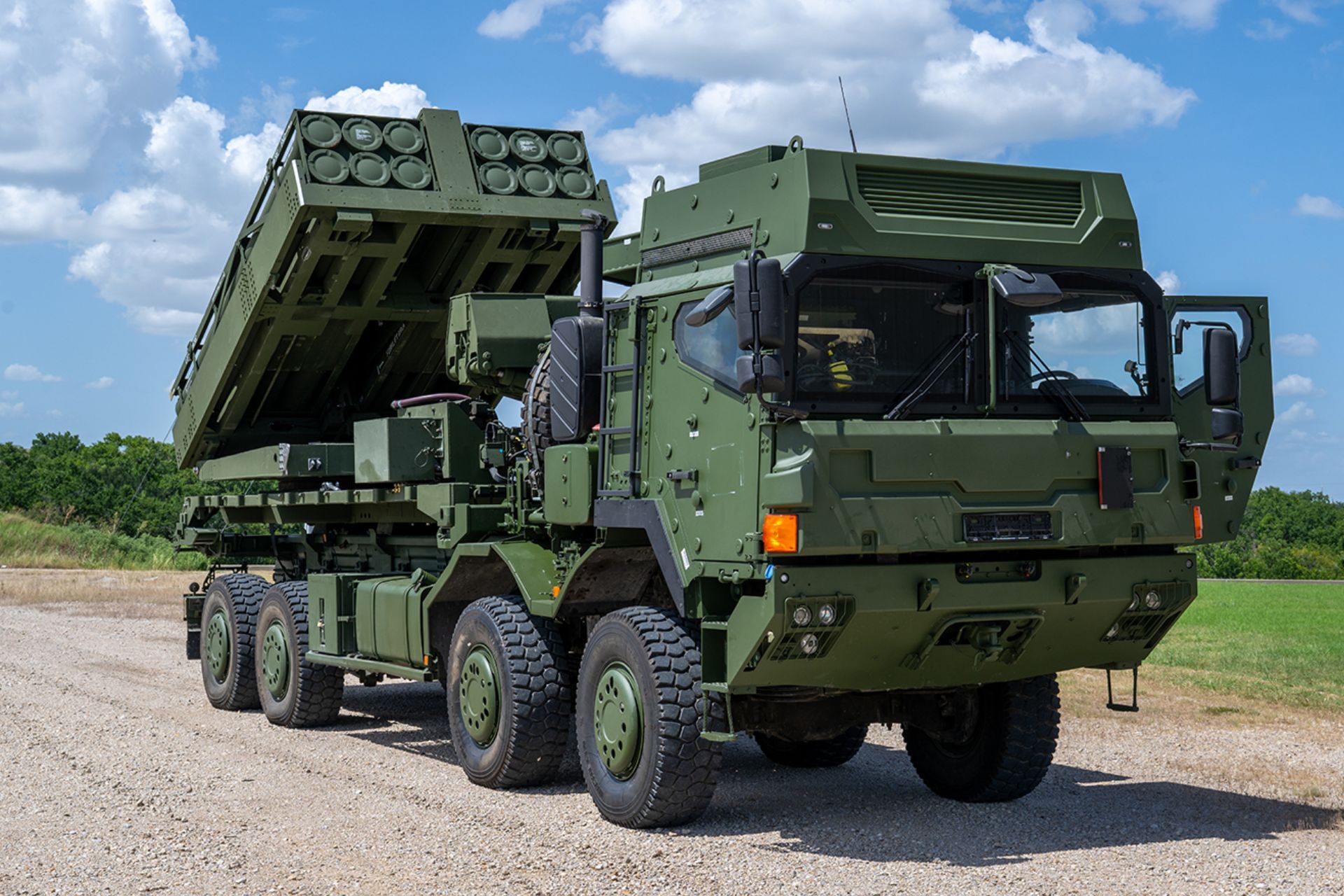
GMARS is designed to provide theater-level artillery support that bridges the gap between conventional tube artillery and air-delivered deep strike munitions (Picture source: Lockheed Martin)
GMARS is a new-generation rocket artillery platform that combines strategic reach, battlefield survivability, and interoperability with NATO-standard systems. It is based on the Rheinmetall HX 8×8 tactical truck and integrates a two-pod launcher capable of firing the full spectrum of the MLRS Family of Munitions (MFOM), including the GMLRS (70+ km), ER GMLRS (150 km), ATACMS (300 km), and PrSM (400+ km), with future compatibility for cruise missiles and other guided munitions. This arsenal provides commanders with scalable options for deep-strike missions, battlefield interdiction, counter-battery fire, and suppression of enemy air defenses.
The GMARS system is built for continuous 24/7 operations in all-weather environments and features true “shoot and scoot” functionality. This allows the launcher to fire its payload and immediately relocate, minimizing its exposure to enemy detection and counter-battery systems. Unlike traditional artillery systems, GMARS requires no outriggers or stabilizing equipment to engage targets, significantly reducing setup time and increasing responsiveness in fast-evolving combat scenarios. The integrated fire control system, paired with inertial and GPS-guided navigation, supports rapid engagement of both static and mobile targets, enabling the system to deliver precision effects at operational and strategic depths.
From a tactical mobility standpoint, GMARS weigh less than 40 tons in combat configuration and can reach speeds of up to 100 km/h with a road range of 700 kilometers. Its compact footprint, 2.5 meters wide, 3.9 meters high, and 9.8 meters long, ensures unrestricted movement on road networks and seamless integration with existing military transport infrastructure, including railways and roll-on/roll-off platforms. The vehicle is crewed by two soldiers, with a third optional seat inside a protected cabin, and features a fully integrated crane system for autonomous reloading in all operational conditions, including nighttime and adverse weather.
Operationally, GMARS is designed to provide theater-level artillery support that bridges the gap between conventional tube artillery and air-delivered deep strike munitions. In high-intensity conflict environments, it can be employed to disrupt enemy logistics, degrade command and control nodes, suppress integrated air defense systems, or neutralize time-sensitive targets. In defensive scenarios, GMARS can rapidly reinforce frontline units with precise, high-volume fire, particularly in denied or GPS-contested environments where its dual navigation system ensures uninterrupted functionality. Its rapid redeployment capacity makes it suitable for dynamic maneuver warfare, where artillery units must remain mobile to avoid destruction and sustain offensive momentum.
GMARS also fits within broader NATO interoperability frameworks by sharing a high degree of component commonality with existing systems like HIMARS and M270, which streamline training, maintenance, and supply chains. This commonality enables joint operations and fire coordination between allied forces, enhancing the efficiency of multinational task forces. Its ability to integrate future munitions and accommodate mission-specific payloads makes GMARS a modular and future-proof platform, prepared for evolving threats and the integration of next-generation sensors and targeting systems.
In early 2025, Rheinmetall and Lockheed Martin hosted an international summit in Europe attended by defense representatives from 14 countries. This event showcased the system’s capabilities and strategic value, with factory tours, technical briefings, and discussions centered around long-range precision fires and multi-domain integration. A live-fire demonstration is scheduled for summer 2025. During the event, Rheinmetall’s Vehicle Systems Division and Lockheed Martin’s Tactical Missiles leadership emphasized the system’s readiness and export potential, while retired U.S. Army Lieutenant General Ben Hodges highlighted the urgent need for advanced artillery systems like GMARS in future conflict theaters.