







Breaking News




Belgium Confirms First Procurement of 123 Serval Armored Vehicles from France.
Belgium has approved the purchase of 215 French-built armored vehicles, including Serval and Griffon platforms, under the joint CaMo Capacité Motorisée program with France. The move strengthens Belgian land forces, aligns future units with NATO requirements, and deepens multinational cooperation with Luxembourg formally joining the framework.
The Belgian government has cleared the acquisition of 215 new armored vehicles from France as part of the ongoing CaMo Capacité Motorisée program, according to information released by the Belgian Ministry of Defense on December 23, 2025. Validated during the final Council of Ministers meeting of the year, the decision covers 123 Serval VBMR-L light armored vehicles and 92 Griffon VBMR 6x6 platforms, with deliveries planned for the second half of the decade and an overall investment estimated by defense officials at several hundred million euros.
Follow Army Recognition on Google News at this link
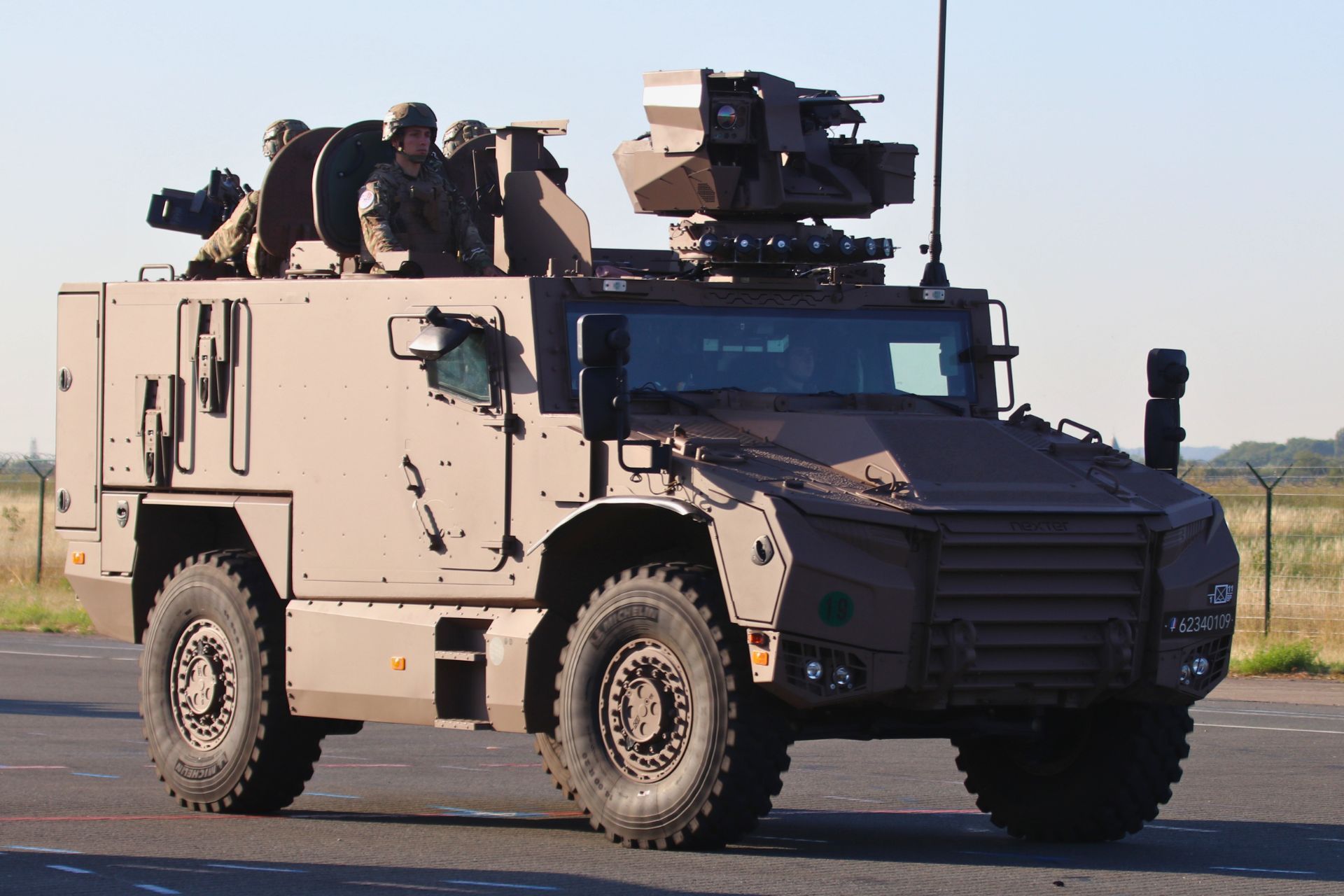
Belgian military sources indicate that the 123 Servals will be fielded across several roles, including troop transport, command and control, reconnaissance, and support functions, mirroring the modular philosophy of the French Army (Picture source: Army Recognition)
The Serval VBMR-L occupies a central role in this new tranche. Designed by Nexter Systems, now KNDS France, in cooperation with Texelis under the French Army’s SCORPION modernization program, the 4x4 Serval is intended to provide high tactical mobility, rapid deployment, and strong protection for modern expeditionary forces. Weighing between 15 and 17 tons depending on configuration, the vehicle combines modular composite armor with mine and blast protection against IEDs, while retaining a compact footprint that allows air transport by C-130 Hercules or A400M Atlas. Powered by a 375-horsepower diesel engine, the Serval reaches road speeds above 100 km/h and offers a range of up to 800 km, a capability Belgian planners consider critical for NATO rapid reaction missions.
Belgian military sources indicate that the 123 Servals will be fielded across several roles, including troop transport, command and control, reconnaissance, and support functions, mirroring the modular philosophy of the French Army. The vehicle’s remotely operated weapon station can mount a 7.62 mm or 12.7 mm machine gun or a 40 mm automatic grenade launcher, supported by smoke launchers and integrated into the SCORPION digital architecture. Its C4I connectivity, 360-degree vision systems, electronic warfare protection, and optional CBRN kits are fully compatible with French command networks, reinforcing the operational logic behind the CaMo framework.
Alongside the Serval, Belgium will acquire 92 Griffon VBMR 6x6 armored vehicles, further deepening interoperability with French land forces. The Griffon, developed by a French industrial consortium including Nexter, Arquus, and Thales, is a heavier multi-role platform with a combat weight of approximately 24.5 tons and protection up to NATO STANAG 4569 Level 4. Designed to replace older VAB-type armored personnel carriers, it carries a crew of three plus eight infantry soldiers and features a T2 remote weapon station capable of firing 7.62 mm or 12.7 mm machine guns or a 40 mm grenade launcher, with optional MMP anti-tank missiles. Its 400-horsepower diesel engine provides a top speed of around 110 km/h and a range comparable to the Serval, ensuring logistical coherence within mixed formations.
The acquisition falls under the CaMo agreement signed in June 2019 between Belgium and France, which goes beyond procurement to include shared doctrine, training, maintenance chains, and digital combat systems. For KNDS France, this represents the third major Belgian order linked to CaMo, reinforcing the SCORPION ecosystem as a reference model for European armored force modernization. French officers involved in the program have repeatedly stressed that common platforms significantly reduce deployment friction during joint NATO operations, particularly in logistics and command integration.
Luxembourg’s participation adds a multinational dimension to the program. Its order for 54 armored vehicles will equip a future Belgian-Luxembourgish battalion formally assigned to NATO, operating under Belgian command structures while remaining fully interoperable with French units. A Luxembourg defense official told Army Recognition that standardizing on the Griffon and Serval platforms was seen as the most efficient way to ensure credibility within high-readiness NATO forces without maintaining a fragmented national fleet.
Strategically, the December 2025 decision confirms Belgium’s long-term alignment with France’s vision of a more integrated European land warfare capability within NATO. By prioritizing the Serval’s mobility and digital connectivity alongside the Griffon’s protection and firepower, Brussels is shaping a force structure optimized for both high-intensity conflict and rapid crisis response on Europe’s eastern and southern flanks. For European defense industry observers, the expansion of CaMo to include Luxembourg further illustrates how shared armored platforms are becoming a concrete pillar of Europe’s defense integration rather than a purely political ambition.