







Breaking News






Türkiye’s ANKA III Flying Wing Stealth Drone Reaches Critical Milestone in Autonomous Capability.
Türkiye’s ANKA III flying wing stealth UCAV has completed a critical autopilot trial during its 46th test sortie, validating a key part of its autonomous flight envelope, according to Turkish Aerospace and local defense outlets. The milestone positions ANKA III to evolve into a long-range autonomous strike and manned-unmanned teaming asset that could shape future airpower concepts across NATO and beyond.
On December 8, 2025, Türkiye’s ANKA III stealth unmanned combat aircraft crossed a new threshold in its flight-test campaign, as reported by Turkish Aerospace (TUSAŞ). During its 46th system verification and identification sortie, the flying-wing platform successfully completed a series of critical autopilot trials designed to validate its autonomous flight envelope. This test point goes beyond a routine software check: it is a key step toward certifying ANKA III as a long-range, high-autonomy strike asset that can operate with minimal human intervention, including in complex formations. For Türkiye’s defense planners and potential export customers, the progress underlines how quickly a new generation of stealth unmanned combat aerial vehicles (UCAVs) is moving from concept to credible operational capability. It also signals that the program remains on track to transition from development to early inventory integration before the end of this decade, in line with TUSAŞ’s long-term production roadmap.
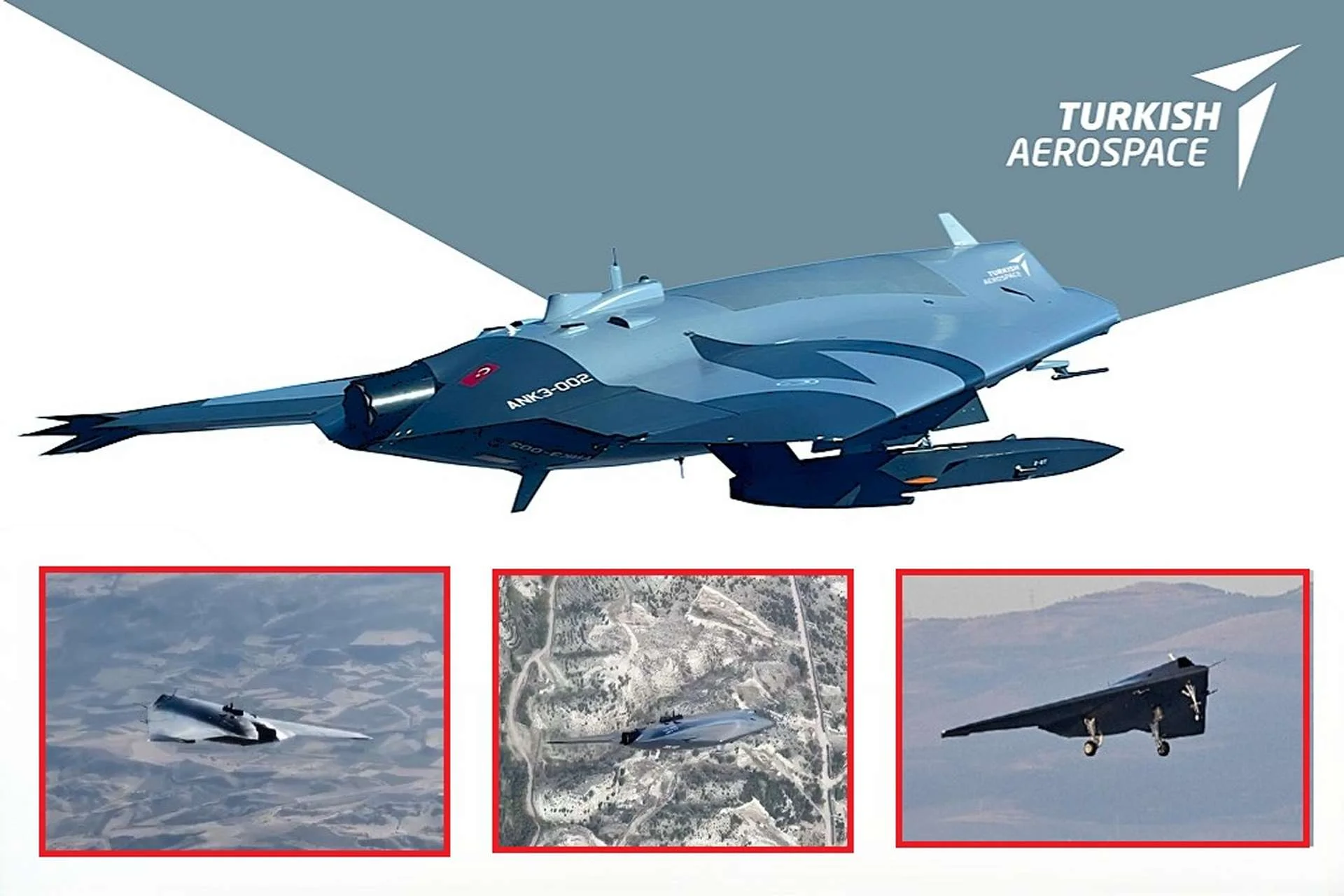
Anka III is a Turkish jet-powered, tailless flying-wing stealth unmanned combat aerial vehicle developed by Turkish Aerospace Industries, designed for long-endurance high-subsonic operations with a 1,600 kg-class payload capacity for strike, ISR, and electronic warfare missions (Picture Source: Turkish Aerospace Industries)
ANKA III is a 7-ton-class, turbofan-powered stealth UCAV built around a flying-wing configuration that inherently reduces radar signature. According to TUSAŞ, the aircraft has a maximum take-off weight of 6,500 kg, carries up to 1,600 kg of payload, and is designed to operate at altitudes up to 40,000 ft for around 10 hours, with a maximum speed of about 425 knots (Mach 0.7) at 30,000 ft. Two internal weapon bays and five external hardpoints give it a mix of low-observable internal carriage and more conventional external loads, while common avionics and ground systems with the ANKA and AKSUNGUR families simplify integration and training.
The mission suite is built for more than precision strike: ANKA III is configured for ISR with EO/IR and SAR/GMTI radar, electronic support and attack (COMINT, ELINT, ESM, EA and communications jamming), satellite communications, relay functions and the deployment of long-range air-launched unmanned systems such as the Super Şimşek target/decoy drone. TUSAŞ explicitly positions the platform for manned–unmanned teaming (MUM-T) and AI-supported swarm operations, with ANKA III expected to operate alongside the KAAN fighter and other Turkish UAVs in coordinated strike and suppression of enemy air defense (SEAD) missions.
From a development standpoint, ANKA III has moved unusually fast from concept to complex weapons and autonomy trials. Ground runs and taxi tests in 2023 culminated in a fully autonomous maiden flight on 28 December 2023, lasting over an hour and ending with an automatic landing after system checks. In 2024, the flight-test envelope expanded quickly: a formation flight with the HÜRJET advanced trainer on 5 May demonstrated cooperative operations with crewed aircraft, while a key flight in August confirmed in-flight landing-gear retraction on the flying-wing airframe. The program then pivoted to weaponization; by early September 2024, ANKA III had completed its first flight with a Teber-82 precision-guided bomb carried externally, followed later that month by a live strike in cooperation with ASELSAN and Roketsan.
Subsequent sorties added the TOLUN small diameter bomb, culminating in January 2025 with the first release of a guided glide bomb from the internal bay at 20,000 ft and 180 knots, a critical demonstration of low-observable strike capability. Tests with the LGK-82 kit and the Super Şimşek UAV, as well as formation flights between the two ANKA III prototypes, built up experience in cooperative engagements. In this context, the 46th sortie and its successful autopilot trials close a major chapter in basic flight-control validation and open the way to more demanding autonomous mission profiles.
The advantages of ANKA III, and the role it is being groomed to play, lie at the intersection of stealth, payload, autonomy and teaming rather than in any single performance figure. The flying-wing architecture with internal bays offers a level of signature management that earlier Turkish MALE platforms using only external stores could not achieve, while still matching them in payload class and endurance. High-autonomy flight control, validated by the latest autopilot campaign, is not just about reducing pilot workload in the ground control station; it is a prerequisite for complex MUM-T concepts in which KAAN or other crewed aircraft act as mission commanders for several UCAVs, and for swarm tactics supported by AI-driven decision aids.
Historically, many Western stealth UCAV efforts such as the BAE Systems Taranis or Dassault nEUROn remained at the demonstrator stage, serving primarily as technology testbeds. ANKA III, by contrast, is being engineered from the outset as an operational system tied into a wider force-structure and industrial plan, more akin to the transition from early demonstrators to fielded UAV families that Türkiye achieved with the original ANKA program. The current single-engine configuration, powered by an AI-322 series turbofan from Ivchenko-Progress, provides high subsonic performance, while plans for twin-engine, domestically powered variants based on TEI’s TF6000/TF10000 family indicate room for growth toward supersonic escort and deep-strike roles.
Strategically, ANKA III sits at the heart of Türkiye’s push to transition from a UAV-enabled air force to one that integrates fully fledged unmanned combat formations alongside fifth-generation fighters. Its low-observable profile and internal strike capability are tailored for deep attack, SEAD and electronic warfare in contested environments, where massed conventional drones would be more vulnerable. Operating from high altitude with long endurance, it offers persistent coverage over key theaters such as the Eastern Mediterranean, the Aegean, the Black Sea approaches and border regions where Ankara has routinely employed UAVs for surveillance and precision engagement.
In NATO terms, ANKA III adds a layer of autonomous strike and ISR capacity that can plug into alliance architectures and exercises, complementing crewed assets while demonstrating Türkiye’s ability to field indigenous high-end systems. At the same time, it strengthens Ankara’s position in the global UCAV market: a stealthy platform with internal bays, networked warfare features and a defined path to mass production is likely to attract interest from partners already operating Turkish drones or considering diversification away from traditional Western suppliers. For neighboring states and regional competitors, the message is clear: Türkiye intends not only to maintain its lead in UAV proliferation but to move decisively into the domain of operational stealth UCAVs and loyal-wingman concepts.
On the financial and programmatic side, ANKA III is part of a wider investment cycle led by the Presidency of Defence Industries (SSB) and implemented by TUSAŞ, which manages a large portfolio of defense projects with a strong focus on airpower and unmanned systems. Within this framework, ANKA III is expected to evolve from prototype stage to serial production once the relevant decisions are taken, with the Turkish Air Force identified as the lead operator. Export successes of earlier ANKA variants illustrate the industrial and commercial ecosystem into which ANKA III is being integrated, reinforcing its role as a key pillar of Türkiye’s unmanned aviation ambitions.
Seen from the outside, the 46th sortie of ANKA III might look like just another entry in a growing flight-test log, yet the successful completion of critical autopilot trials gives it a different weight. It confirms that the platform’s core flight-control logic and autonomy stack are maturing in line with an ambitious roadmap that ties stealth, high-endurance strike and manned–unmanned teaming into a single coherent system.
ANKA III also reassures both the Turkish Air Force and potential export partners that the flying-wing UCAV is moving out of the experimental phase and into the realm where doctrine, training and force structure can begin to adapt around it. As the test campaign shifts from basic safety and control to complex multi-ship and networked missions, ANKA III is positioning itself not simply as another drone, but as a central node in Türkiye’s future air-combat ecosystem, with the 46th flight marking the moment when that ambition started to look operationally credible.
Written by Teoman S. Nicanci – Defense Analyst, Army Recognition Group
Teoman S. Nicanci holds degrees in Political Science, Comparative and International Politics, and International Relations and Diplomacy from leading Belgian universities, with research focused on Russian strategic behavior, defense technology, and modern warfare. He is a defense analyst at Army Recognition, specializing in the global defense industry, military armament, and emerging defense technologies.